
One of the many mysteries of André Breton’s great surrealist classic, Nadja, from 1928, is whatever happened to his pen? Whatever happened to it in the text and in real life?
Nadja is a strange romance, perhaps the strangest ever written, a novel where dream and reality blur, where we’re left wondering if anything here really happened—this infatuation with a woman, this infatuation with the streets of Paris. Breton’s other infatuation was with writing itself, in his small, careful cursive, oftentimes in different colored ink—turquoise was a particular favorite. Writing for him was an art-form, an act of artistic creation, which was why many of his books and poems were illustrated by artists, usually renowned ones.
At 42 rue Fontaine, his longtime home in Paris’s 9th arrondissement, Breton’s creative den, cluttered with rare objets d’arts, books, papers, paraphernalia, and original canvases by the likes of Picasso, Miro, and Max Ernst, Breton also had a collection of a dozen or so ornately designed dipping pens with exotic holders. In his archives, now digitized and accessible online, we can see one vivid photo of eight Breton pens dear to his heart; he kept them all his life. Some come from Asia and have feather and mother-of-pearl handles; others are French with lacquered and gilded wooden holders; there’s another with an Italian neo-Renaissance winged Sphinx, and another again with an art nouveau metal holder, topped with a leaf and three brass iris flowers.
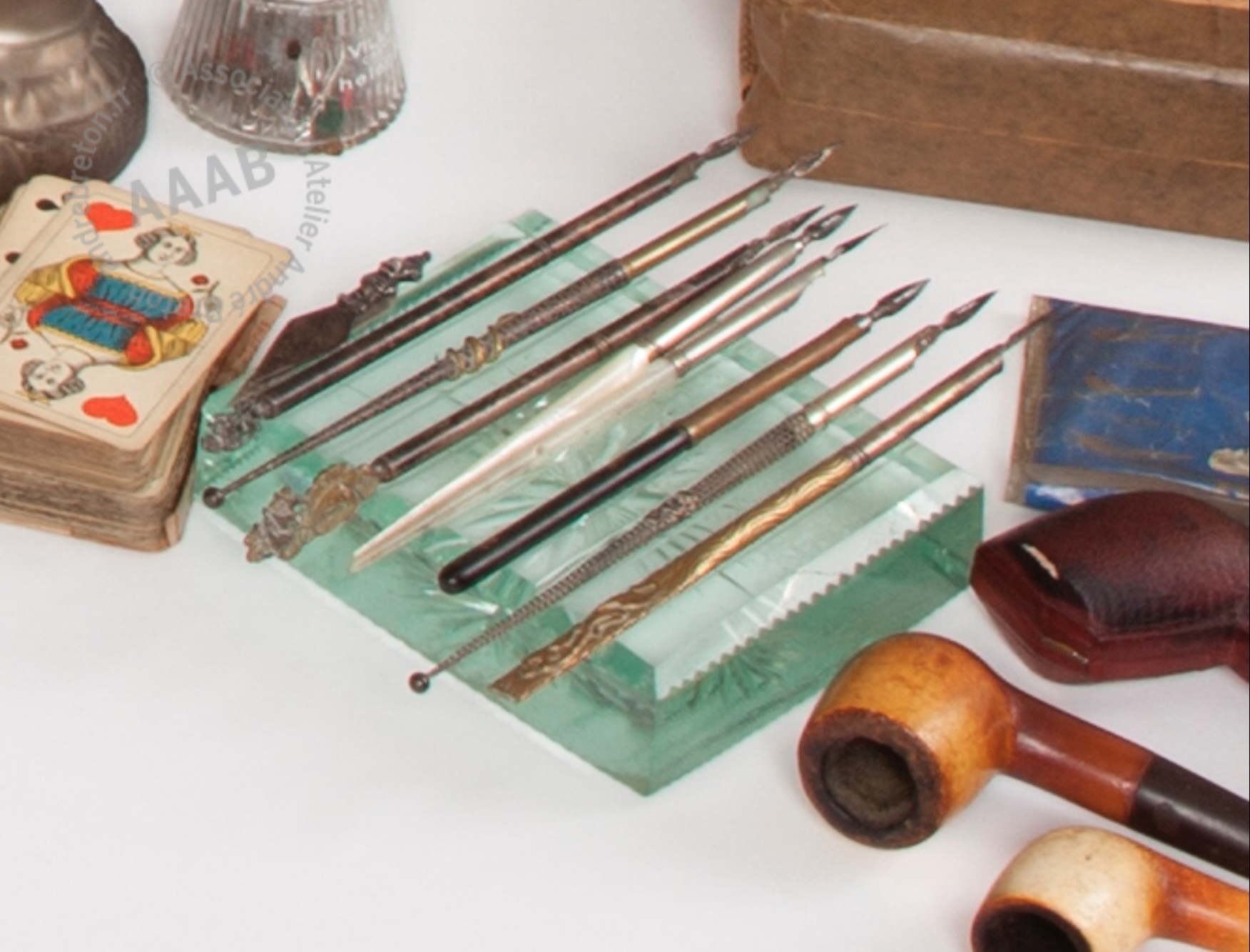
Pride of place in the collection, however, is a nib with a brass penholder, a straight, cylindrical handle and flattened from the middle to end, bearing a decorative pattern. It was Guillaume Apollinaire’s own trusty writing instrument, gifted to Breton by Apollinaire’s widow, Jacqueline, not long after her husband’s death on November 9, 1918. The two men were close friends; Jacqueline said it is what Guillaume would’ve wanted. It became one Breton’s most precious items among the many precious items he cherished in his collection.
There’s little doubt that Breton used Sergent Major dipping nibs, manufactured by Blanzy Poure & Cie, France’s most prominent nib maker based in Boulogne-sur-Mer. Breton would’ve known the northern coastal town well: it was the birthplace of artist Valentine Hugo, who’d illustrated some of his texts, and with whom Breton had had a tumultuous affair in the early 1930s. Marcel Proust was another Sergent Major nib user, writing with nothing else. He had his housekeeper Céleste Albaret, the faithful “Françoise” in his great novel, go out and purchase Sergent-Majors by the box loads. Proust attached each nib to very basic holders—porte-plumes. “It was astonishing how fast he could write,” Céleste said, “especially sat in bed in a position nobody else would find comfortable.”

Breton, too, had his own bedside encounters with Proust, when the budding surrealist was cash poor and in need of a job. In 1920, Gaston Gallimard recruited the young poet to work at La Nouvelle Revue Française, earning 400 francs per month (around $28), dealing with the journal’s subscriptions and correspondence with authors, but also, more especially, acting as a proofreader for none other than Marcel Proust. It’s the only instance of Breton having the paid work he so despised; wage-labor, he’d said in Nadja, wasn’t where life’s meaning was at. Proust only ever worked at night, exclusively at home, so Breton was obliged to start work at 44 rue Hamelin at 11 o’clock. On his debut visit, Breton had already eaten supper. Yet when he arrived, Proust insisted on a sumptuous dinner, a delivery from the Ritz hotel! Proust ate none of it himself, surviving exclusively throughout the evening off strong café au lait. Breton politely consumed the meal, knowing next time to desist from eating anything.
Proust had been enthusiastic about Breton’s and Philippe Soupault’s Magnetic Fields (1919), the duo’s opening salvo in the poesis of “automatic writing.” Maybe Proust appreciated the concept because his own rapid-fire, convoluted prose and notion of “involuntary memory” was a sort of automatism. The only difference, of course, was that afterward Proust, like his peer James Joyce, and contra the dictates of Breton’s First Manifesto of Surrealism, would infinitely rework his manuscript, erasing much and adding even more before undertaking another round of revisions and rewrites, and then another. Breton remembers Proust as incredibly courteous, a gracious host, appreciative of the young man who spent entire evenings, until dawn, reading aloud the galleys of Le côté de Guermantes; and while Breton’s aesthetic tastes never really tallied with Proust’s, he warmed to the man himself, always holding a fond memory of spending time with him and of being briefly privy to his vast literary labyrinth.
Breton didn’t last long at Gallimard, needless to say; a poor proofreader, his heart was probably never in it. The first galleys of the third volume of A la recherche du temps perdu were riddled with more than 200 erratas, spotted by Proust yet missed by Breton. With this in mind, one might wonder, eight years on, whatever happened during the proofreading of Breton’s own Nadja? Was it an editor, somebody other than Breton himself, who’d decided to remove the reference to Breton’s pen?
In 2019, Gallimard published a lavish and very beautiful facsimile boxset of the original, longhand Nadja manuscript, deemed a French National Treasure. So exquisitely reproduced, if was as if possessors could now inspect closeup Breton’s actual smudged pages, thumb through what seemed barely dried black ink. The twenty-five majestic, actual-sized leaves, numbered in red crayon at the top right of each page, were of a large format, stretching much longer than standard A4 paper, unlined and crammed with neat, straight, and tightly knitted small script, totally legible with minimal crossings out.
Breton initially had great difficulties composing his life-changing encounter with Nadja, a fling that took place over the autumn of 1926. At the book’s beginning, kicking off with its famous line, “Qui suis-je?”—“Who am I?”—Breton tells us that he spent the whole of August 1927 sojourning alone at the Manoir d’Ango in the Normandy resort of Varengeville-sur-mer, “in a hut on the edge of woods,” where, he said, he could write by day and “hunt owls” at night. Yet despite the peace and quiet, the writing was painfully slow, didn’t flow easily; nor did the recollection of what happened with Nadja, his thoughts and emotions, the style and tone he wanted to adopt. Nothing came easy. It was, he admitted to wife Simone Kahn, a tortured, stop-go affair: the text crawled along a passage a day, in a kind of anti-automatism. To compound matters, close friend Louis Aragon was staying nearby with then-partner Nancy Cunard, and Aragon was working on his own book, Treatise on Style, tossing off fifteen-pages a day, zipping along with blissful ease, which further discouraged Breton. To console himself, Breton said writing for Aragon usually came easier: his text here, Breton said, was “barely human, as always.”
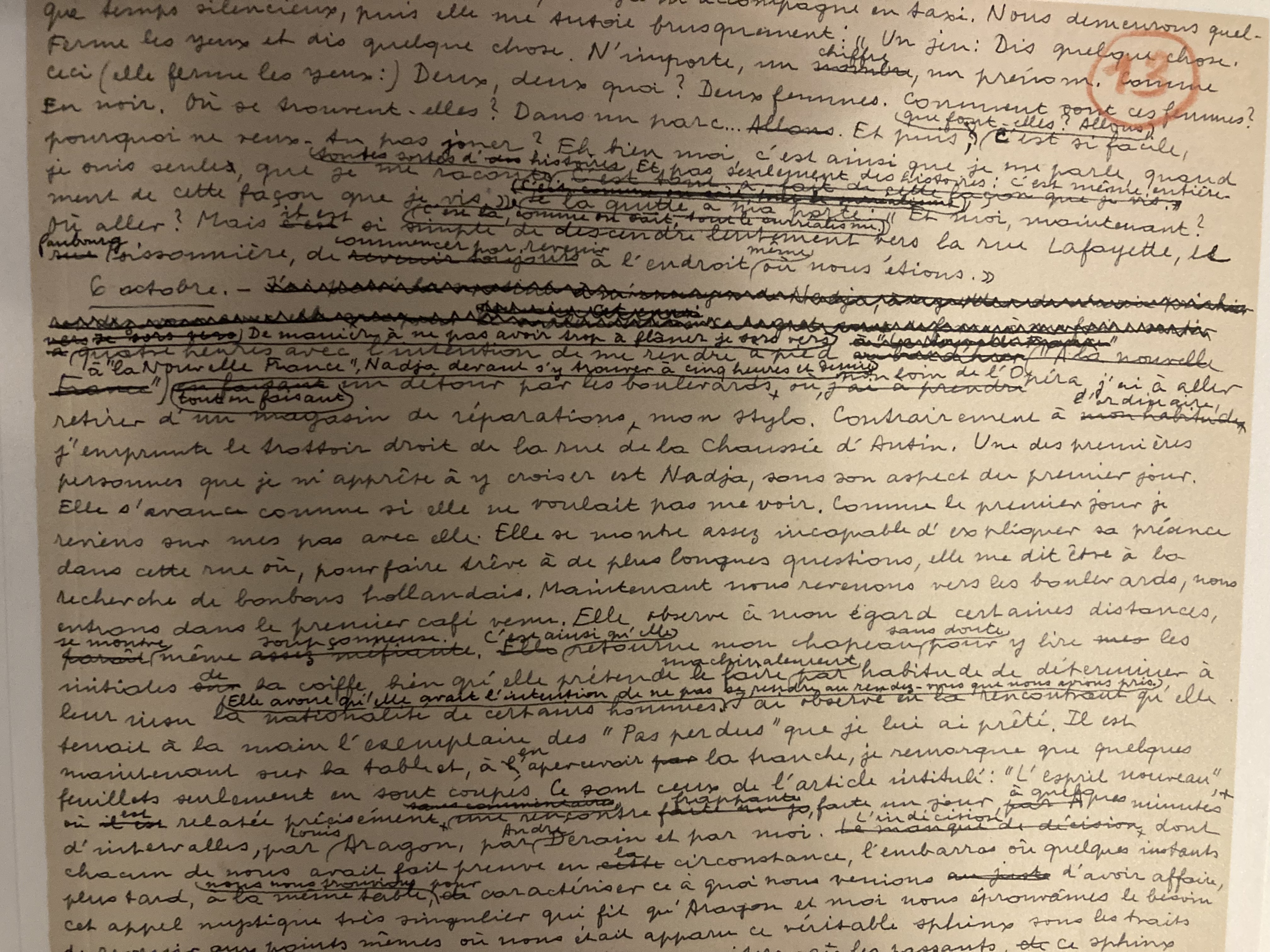
There’s one particular sentence in Breton’s handwritten draft that surrounds the mystery of the pen. In Richard Howard’s English translation, still the go-to Anglophone rendering, achieved in the late 1950s, Breton’s entry for “6 October” is translated as follows: “So as not to have too far to walk, I go out about four intending to stop in at the Nouvelle France café, where Nadja is supposed to meet me at five-thirty. This gives me time to take a stroll around the boulevards: not far from the Opéra, I have to pick up my pen at a shop where it is being repaired.” Pen enthusiasts like me might ask: which pen? And what was wrong with it? Was Breton writing his text at Manoir d’Ango with that pen, after having retrieved it? Or was it still at the pen store, assuming he never picked it up? We’ll never know the reality of which pen and why; and we’ll likely never know the mystery of why, from the longhand original—the text Richard Howard appeared to be working on—Breton’s pen episode would later get edited out?
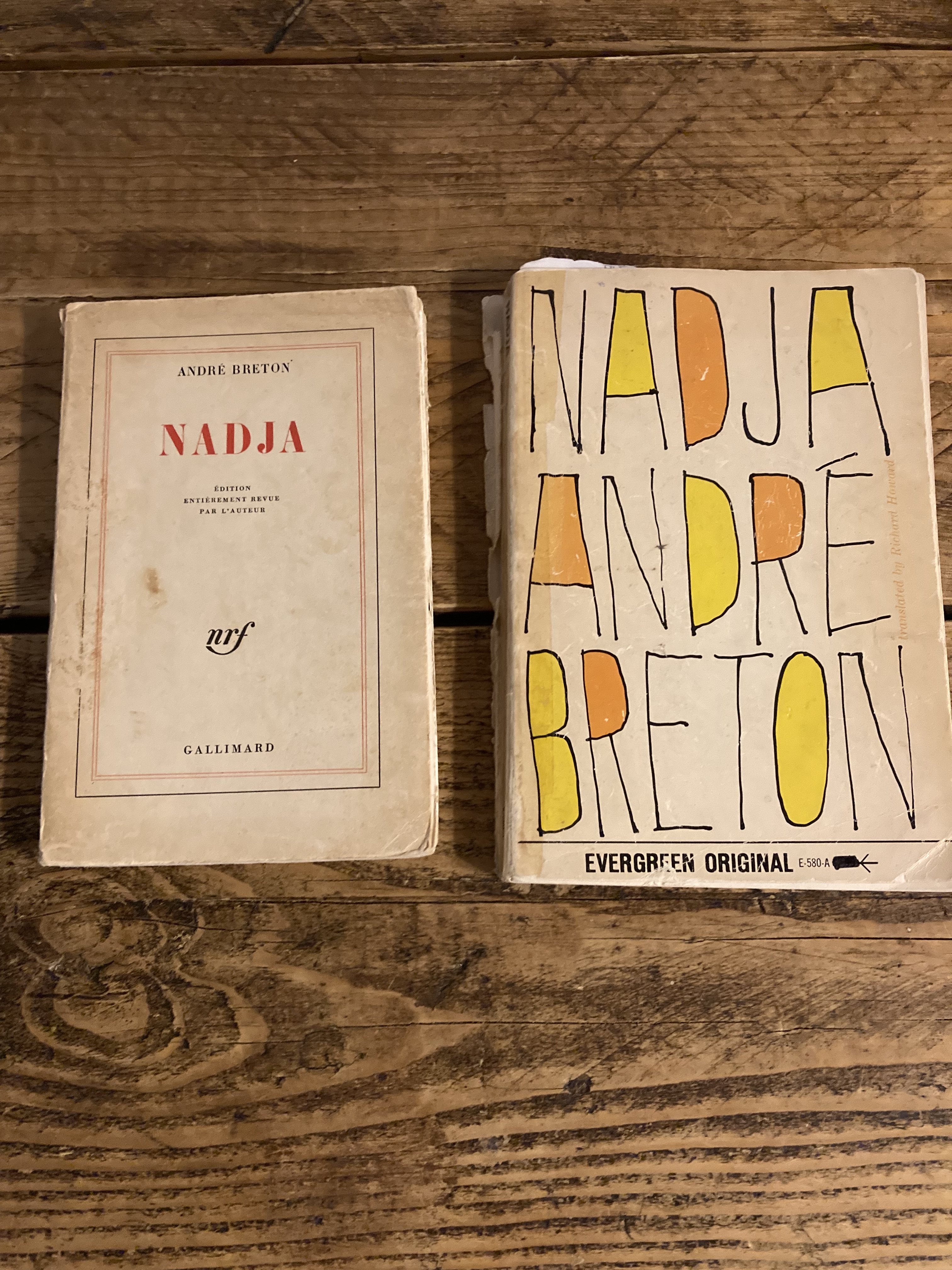
Indeed, Gallimard’s published text of 1928 says: “le temps d’un detour par les boulevards jusqu’à L’Opéra, où m’appelle une course brève.” Here, in the first printing, and in the versions that have persisted throughout Nadja’s French publishing history, Breton had “time to take a detour around the boulevards, up until the Opéra,” to make “a brief errand” [“une course brève”]. The pen is no more, mysteriously absent from the text. By way of comparison, let’s look at Breton’s actual manuscript, at the large facsimile I have in front of me, which says: “6 Octobre…tout en faisant un detour par les boulevards, non loin de L’Opéra, j’ai à aller retirer d’un magasin de reparations, mon stylo” [“all in making a detour by the boulevards not far from the Opéra, I had to go and collect my pen from the repair shop.”]
Why the discrepancy between what Breton wrote by hand and what would later appear in print? Breton’s decision or the editor’s? And did he ever go over the proofs himself? Or was he as careless with his own as he was with Proust’s? Somehow this doesn’t quite stack up. Breton was a fastidious man by nature, a pen aficionado and collector, and it seems oddly out of character he would want to see the allusion to his pen, important enough to receive a role in his original draft, get overlooked. The differing versions of Nadja haven’t been commented upon anywhere in the Breton literature; even the extensive notes accompanying Nadja in Breton’s Oeuvres Complètes (Tome 1), which discuss almost everything else in the text, every line, remain silent on the erasure of Breton’s pen.
I’ve often thought about why over the years this episode has piqued my curiosity. Maybe it’s because I’m smitten by fountain pens myself. In a sense, it was Breton who got me smitten in the first place, seeing his handwritten manuscripts years ago, his meticulously crafted letters (check out the gorgeous correspondence with his young daughter Aube in the 1940s), all realized in vividly colored inks, and all seemingly achieved with some sort of fountain or dipping pen. Unique works of art realized with a unique writing instrument, manufactured by skilled craftsman: one work of art creates another; form and content conjoin in the process of longhand writing. Maybe this also relates to what Walter Benjamin meant by the “aura” of the original, the allure of seeing a writer’s own script, witnessing something singularly unique.
Contemporaries, Benjamin and Breton may have actually met each other, fleetingly, like ships in the night, in 1940, in Marseille, when both were fleeing Nazi occupation. Benjamin’s close friend Gershom Scholem says Benjamin and Breton did correspond, although there’s no trace of these letters; and a year after Nadja’s publication, Benjamin wrote a dense essay on the Surrealist movement—“the last snapshot of the European Intelligentsia”—with extensive commentary on Nadja. Breton’s book was a marvel, Benjamin said, for it revels in a certain kind of intoxication, a “profane illumination,” he called it, a secular and materialist epiphany, yet no less inspiring for all that. Surrealist writings like Nadja, Benjamin said, give rain-blurred windows, quiet squares, shabby hotels, and ruined arcades a dreamlike texturing. They become ordinary things exploded, souls awoken, brought to life, rendered ecstatic and romantic, maybe even revolutionary.
Breton made it out of Marseille, sailing to Martinque on a rusty paquebot in March 1941; Benjamin perished in September 1940, in Portbou, a crummy border town, crossing the Pyrenees into Spain only to find the frontier closed that day, and with the wrong exit visa in his pocket. Unable to go on, in a flea bit hotel, he swallowed his morphine stash. Five years earlier, Benjamin had published a brilliant essay, one of his best-known: “The Work of Art in the Age of Mechanical Reproduction,” examining the condition of art in an age of brazen capitalist technological development; what was getting lost and what, equally, might be gained.
Typically, Benjamin expresses his considerable wisdom dialectically. Sometimes, he says, losing a work of art’s aura may not always be bad. After all, a loss of halo ushers in all sorts of democratic possibilities for popularizing art, for making it readily accessible to a lay public. On the other hand, something is forsaken: “what withers in the age of mechanical reproduction,” he says, “is the aura of the work of art…its presence in time and space, its unique existence at the place where it happens to be.” Art can be reproduced and copied on postcards and posters, re-represented cheaply and ubiquitously, in infinite ways, endlessly, seen and appreciated without the the large expense of visiting a museum or gallery. Art thus becomes less elitist, potentially less glorifying, maybe less fascist, Benjamin says. And yet, with excessive mechanical reproduction, art works become so well-known they’re rendered clichés and banalities. The presence of the original gets lost; gone, too, is “the concept of authenticity.”
Ironically, only through mechanical reproduction could I glimpse Breton’s Nadja, hold it in my own hands, inspect it at my leisure, possess it. Gallimard’s reproduction became almost the real thing for me, the nearest I’d ever get to experiencing the aura of the original for myself. At least it offered a flavor of this aura: I could examine it, check out its ink, see it crafted by hand, with a fountain pen; I could share something intimate with the author, his crossings-out, his hesitant hand, his stutters and doubts, his uncertainties, yet also where his pen seemed to flow fluidly and confidently.
Maybe what gets lost in our age of mechanical reproduction isn’t so much the aura of the original as the magical act of you doing the producing, of you doing the handwriting, you as the author of your own works. Longhand isn’t the same as typing words into a computer, tapping SMSs and e-mails with your fingers and thumbs—none can replace the handwritten script, the act of writing itself. The lack is the aura of intimacy and proximity of the writer with the blank page. The aura is your own personality getting expressed through handwriting; the joy of gripping your favorite pen, the angle at which it makes contact with the page, the tactile sensation of the nib touching paper, affected by its thickness or thinness. There’s an aura here, something lost or never discovered through digital technology, where everything is repeatable and unoriginal, carried out by everybody in the same way, facilely, mediated by the same sort of machine, which behaviors in the same manner for no matter who. Even your choice of font is conditioned by somebody else.
What’s lost in the age of mechanical reproduction is the human connection between the writer and the human mind, the author as creative producer. The writing instrument becomes the point of mediation, the link between the person and the page. The pen expresses itself across a white surface with the speed of the subjective mind, has to keep up with the writer’s thought-process. It can’t skip or hard start, requires a feed that feeds, that supplies sufficient ink through its channel, up through its slit, onward up to the nib’s point of impact. “The speed of thought is no greater than the speed of speech,” Breton wrote in The First Manifesto of Surrealism, “and that thought doesn’t necessarily defy language, nor even the fast-moving pen” [“la plume qui court”.] The fast-moving pen, it would seem, is a vital part of surrealist armory.
When Breton wrote Nadja, some of the more advanced fountain pens were known as “safety fillers” on account of their retractable nibs and novel “eyedropper” filling systems. Early fountain pens had the advantage over dipping pens because there was a consistent ink flow. But the problem was leakage. Carrying around a fountain pen was hazardous. Even when capped, pens seeped ink, staining your hands and clothes. With the retractable nib, though, a seal was formed to prevent leakage. The pioneering pen maker of Breton’s era was the “Simplo Filler Company,” a forerunner of Montblanc.
In 1906, in Berlin, a German designer and pen enthusiast August Eberstein paired up with banker Alfred Nehemias to establish the Simplicissimus-Füllhalter pen company. A year later, they abbreviated its name to the snappier Simplo Filler Company, moving base to Hamburg. Their first pen, produced in 1909, was the “Rouge et Noir,” perhaps in a nod to Stendhal’s novel. The Rouge et Noir championed the telescopic, retractable nib; the pen was explicitly marketed as a safety pen, guaranteeing zero ink leakage. Slimline, in black ebonite hard rubber, with a striking red finial and a fourteen-carat gold nib, the pen was a real beauty.
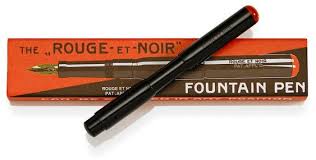
In 1910, the first “Montblanc” Montblanc appeared, with an all-white finial, after a trio of German businessmen, Wilhelm Dziambor, Christian Lausen, and Claus Johannes Voss took over the Simplo Company; during a card game one night they mused about what to call their new pen enterprise; someone said, why not call it “Montblanc” (single word), given our pens were black on the bottom and white at the top. The name stuck. By 1913, the six-pointed white snowflake had been adopted as the company’s logo, and almost every pen made since has borne this now-iconic symbol. In 1924, when Breton launched his First Manifesto of Surrealism, Montblanc introduced their Meisterstück [“Masterpiece”] series of fountain pens, with nibs bearing the engraving “M” and “4810,” signifying the height in meters of Mont Blanc, Europe’s tallest and permanently snowcapped mountain. Both pen and movement celebrate their centennial this year, 2024; a coincidence or what? Something fortuitous or foreordained?
Perhaps it goes without saying that the enthusiast who loves handwritten manuscripts might themselves enjoy putting ink on the page; that they, too, might yearn to produce something unique, desire to leave their own trace on paper, want to experience the joy of a fountain pen, feel its buttery smoothness or its feedback (oral as well as physical) as it connects with the page, as something that hitherto didn’t exist suddenly gets created, and with an ink of your choice and a font of your fashioning. And what about the paper, so crucial for fountain pen users? Whether it is glossy or coarse, whether it bleeds or ghosts ink? And what’s its quality, its grammage per square meter (psg)? Lined or unlined? Dotted? Loose-leaved or in a notebook? There’s a subtle artistry and chemistry involved in the unique act of longhand, a process that’s a wonder to behold when paper, pen, and ink find expressive unity. Forget about an iPad.
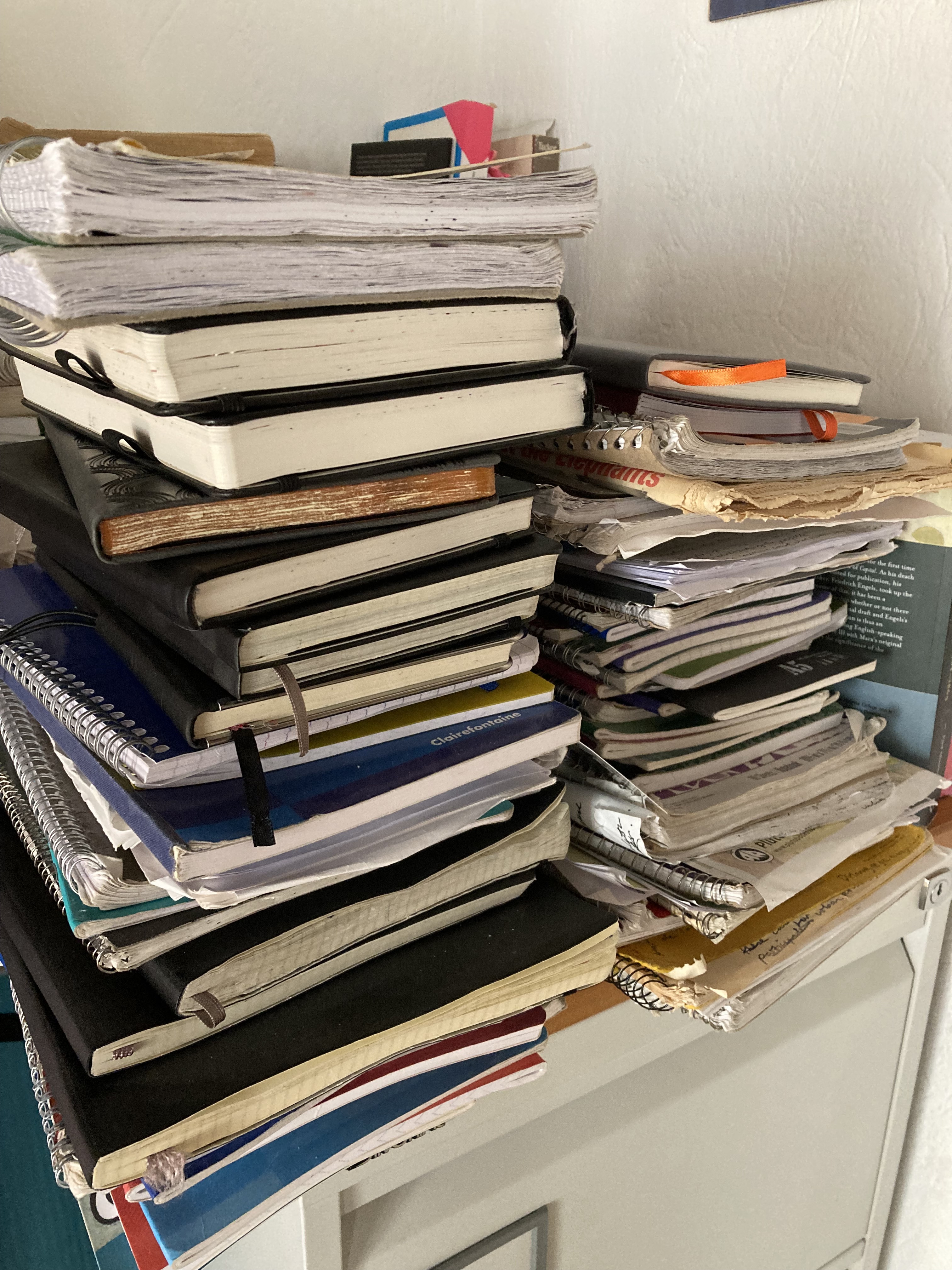
For decades, I’ve written with a fountain pen, loved using them. All my books have been drafted in longhand with some sort of fountain pen. I’ve kept these notebooks and seeing them stacked up is sometimes more pleasurable than looking at the finished books themselves. At first, I wrote with a low-budget Waterman, which adequately laid down a decent line and performed well. Later, it was a Lamy Safari; more recently, I’ve upgraded to Montblancs, invariably vintage, frequently purchased used online (eBay) or during my periodic strolls around antique stores and flea markets in cities. I write these words with an almost-fifty-year-old Montblanc 146, with a rare eighteen-carat nib. It writes as well now as it did fresh out of the box. Until you’ve written with a Montblanc it’s hard to convey just how well they perform, the difference in quality, and how I managed with anything else beforehand. Somedays my Montblanc seems to write by itself; I’m merely the holder; words flow from it; it becomes the subject, I the object.
 This pursuit for pens has assumed a private passion, replacing my former habit of worming in used bookstores. My exploration of cities becomes a pretext for a quest for a vintage fountain pen. I’ve found some real gem Montblancs over the years, and often not as expensive as you might imagine with such a luxury brand, several from Rome’s wonderful Borghetto Flaminio Flea Market, a little north of Piazza del Popolo. The used Montblanc market is populated by a markedly different consumer than the business types who purchase pens new at glitzy high-end boutiques, and for whom Montblancs are status symbols rather than passions about writing. Part of the joy of the pursuit for the used pen is the thrill of anticipating how it might write; it’s also the expectation of finding something, or of it finding you, as Breton might have said, of it happening at a bargain in a neighborhood you’d previously not known.
Breton was fascinated by flea markets and pedestrian urban exploration. In Nadja, he describes how, on Sunday mornings, he visits the vast flea market at Saint-Ouen in northern Paris. “I go there often,” he says, “searching for objects that can be found nowhere else: old-fashioned, broken, useless, almost incomprehensible.” At bazaars like Saint-Ouen, he says, he delivers himself to chance, revels in circumstances “temporarily escaping my control.” Breton was a man who once gave one of life’s great directives: “expect all good to come from an urge to wander out ready to meet anything.”
Almost a decade after Nadja, in Mad Love, Breton tells of another trip to Saint-Ouen, “on a lovely spring day in 1934. “This repetition of setting,” he qualifies, alluding to his excursion in Nadja, “is excused by the constant and deep transformation of the place.” There’s enough novelty going on, Breton hints, that you’ll never exhaust your visits, never walk through the same waters twice. The flea market isn’t like the chain store: it’s constantly changing, full of novelty and surprise, always with an “intoxicating atmosphere of chance.” “It is to the re-creation of this particular state of mind,” Breton says in Mad Love, “that surrealism has always aspired.” “I am only counting on what comes of my own openness, my eagerness to wander in search of everything, which, I am confident, keeps me in mysterious communication with other open beings, as if we were suddenly called to assemble.” “Independent of what happens, or doesn’t happen,” he adds, “it’s the expectation that is magnificent.”
These are wonderfully uplifting, inspiring passages from Breton, and they splendidly evoke my own serendipitous quest for finding the perfect pen—the idea that I might find somewhere, somewhere hidden and unsuspecting, in some old store in some old part of town, a used and bargain Montblanc fountain pen, lurking there, waiting for me. It’s a search that incorporates three experiences: a collecting experience, a writing experience, and an urban experience, a trinity that’s interrelated and an essential aspect of who I am, qui je suis. Over the years, I’ve collected a lot of Montblancs, mainly used, usually vintage, stemming from the 1950s to the 1980s; very occasionally I’ve splashed out on new pens, and have other, non-Montblancs, several Japanese, including the ginormous Namiki Emperor, with its vivid Vermillion Urushi lacquering. But old Montblancs are my fav.

What attracts me about these pens is their craftsmanship; that, in our throwaway, short-term culture, when new objects tend to be of a poor quality specifically designed not to last, intended to be constantly renewed or superseded by “better models”—forcing the consumer to buy them again and again, and again—that there’s an object of quality, beauty, and simplicity that, if cared for, endures forever: a black, “precious resin,” torpedo/cigar-shaped object with a gold nib, an object that you can fill and refill, that’s created by the hand of a specialist manufacturer, by a nib meister; an antidote to our crass disposable age. And besides, once you have these pens, with a little tailoring, a little use of micromesh pad, of differing grits, differing degrees of coarseness, you can shape and reshape your nib to your very own specification, honed to the precise angle at which you grip your pen. The pen and the writing experience become uniquely yours.
Some days, when I don’t feel like writing, I’m content merely to admire my pens, to look in awe at their nibs, to examine the meticulous detail and precision of their construction. I’ve got a few Montblanc 149s, often called the diplomats’ pen, the signature Montblanc Meisterstück, the top of its range and most famous writing instrument, with a large ink capacity, a so-called “Grail pen.” Since the early 1950s, the 149 has set the standard of what a fountain should be, becoming synonymous with style and quality, a pen where form and function achieve perfect symmetry. Girthy, you really feel you’re holding something special; it’s hard to keep your eyes off the large eighteen-carat, number 9 nib, difficult not to be mesmerized by the sheer radiance of its glint.
All of this, I know, has spawn from my encounter with André Breton, somehow flowed from his pen, from the mysteriously missing pen in Nadja‘s French publication. One might say that my interest in pens is a kind of “mad love”—something convulsive, something frequently done out of compulsion; I’ve bought a pen, wanted it, even while I’ve many others like it in my collection, often the same models, often while I could barely afford them. It says something of my convulsive personality, of not doing things in half-measures, of rarely considering the future implications of my actions and purchases. I used to have a similar weird compulsion for James Joyce’s books; every time I went into a used bookstore, and every time I spotted a copy of Ulysses or Finnegans Wake, no matter whether I already had that particular edition or version, I’d buy it anyway, acquire it. I’ve countless copies of each on my bookshelf. It always strikes anybody seeing them—anybody who doesn’t know me—as odd.
Maybe it all this harks back to those enigmatic, closing pages of Nadja, when Breton muses on beauty, on its jolts and shocks, on its emotional charge—on the need for beauty to be CONVULSIVE or it will never be. “A work of art,” he says, “should arouse a physical sensation,” and such is the case with a beautiful fountain pen, a magic wand that at its best writes through its own desire, out of its own volition, creating by itself, as if it were a mind in itself, an instrument with an unmediated immediacy and intimacy with the page, an object that’s also a subject. In fact, not an inanimate object at all, but something distinctively alive, a genie released from a bottle of ink, expressing its magical powers across a sheet of paper. In the end, you got to hand it to Breton: he, like a great pen, really feeds your imagination with ink.

 andy merrifield