
Over the years, there have been periods in my life when I’ve grown tired of reading, shocking as it may sound. I can’t find anything I want to read, and a lot on offer frankly bores me. When I lived in France, I read plenty in French, which helped freshen up the book world for me, and because I knew the language less well than my native English, everything sounded new and demanded much closer scrutiny in the act of reading. It became more interesting simply because it was a less passive experience, more interpretative. My mind was still churning over in English yet the texts before me were French. So the act of translation meant much greater focus and an active engagement with words and sentences. It was as if English were too easy, and in reading it I’d find myself drifting off or skipping words, sometimes skipping whole paragraphs since it all sounded too familiar. For a while, I found French sustaining.
I say this because it was often at these dead-end moments with English that I’d also pick up my faithful Finnegans Wake. Indeed, I should stress that there have been times in my life when Joyce’s book was the only text I could read, the only book that could keep my attention span, the only book I’d not drift off with. It was the only book I could read without being able to read it! You could perhaps say that it’s a book that somehow reads you, in the sense that you flick through it not knowing where you want to begin, when suddenly a word attracts you, catches your attention, gets you thinking, sends off buzzers somewhere in your brain. The engagement is thus more intimate, more instinctive, more an act of creation and re-creation, rather like looking at a painting or listening to music, when you’re stimulated emotionally in some unforeseen or unexpected way.
In a way, with Finnegans Wake you become child-like again, reading with pure wonderment, pouring over words that are compellingly new, sounding-out words as a young child does when they learn to read, hearing the meaning through the sound, placing the meaning in the context of what it might mean to you—not necessarily what it meant to Joyce himself. With Finnegans Wake, you, too, are able to be a literary creator and not just the recipient of a story told to you. It was at these moments when I began to understand what Samuel Beckett was getting at claiming Joyce’s writing in Finnegans Wake “isn’t about something; it is that something itself.” With Finnegans Wake, all content collapses into form, all form becomes content, and out of the dialectical synthesis the task of the reader is to write the book themselves, to ascribe meaning to the text that unfolds in their mind’s ear.
At such times, you’re no longer reading a book and following a narrative, being led along by the author’s hand, who’s insisting you follow his or her drift, their narrative flow; now, you must follow your own drift and it is words themselves that become the story; and there’s no strict way in which you can interpret them. Hence the beauty and delight with entering the infinite universe of Joyce’s Finnegans Wake, the splendor of its constantly expanding solar system, a universe that can never exhaust itself so long as it has people who open the book, who think with wonderment and abandonment, as if you were looking up observing the Milky Way.
No coincidences, perhaps, that when the quantum physicist Murray Gell-Mann was flicking through Finnegans Wake, he found the right word to name the elementary particle he’d just discovered, three-pronged matter, two up, one down, binding together protons and electrons, which he labeled “quark”—after “Three quarks for Muster Mark.” Gell-Mann said that “quark” sounded like what he’d found in the quantum world, an onomatopoeia phonetically imitating a new subatomic reality hitherto unknown.
There are many such words that I’ve recorded in my notebook devoted to Finnegans Wake, single words and groups of words that signify the something that Beckett spoke about. I’ve got my own personal favorites, yet one phrasing early on in Finnegans Wake is perhaps my absolute favorite. It’s when Joyce introduces Earwicker, sets the scene, saying his fallen man of the hod “lived in the broadest way immarginable.” I’ve used this as a sort of personal axiom, my own personal mantra that becomes a constant urging, a note to self. I also believe it becomes a kind of aide-memoire of what it means today to be on the Left, how a progressive person might live in a world increasingly hostile to their viewpoint.
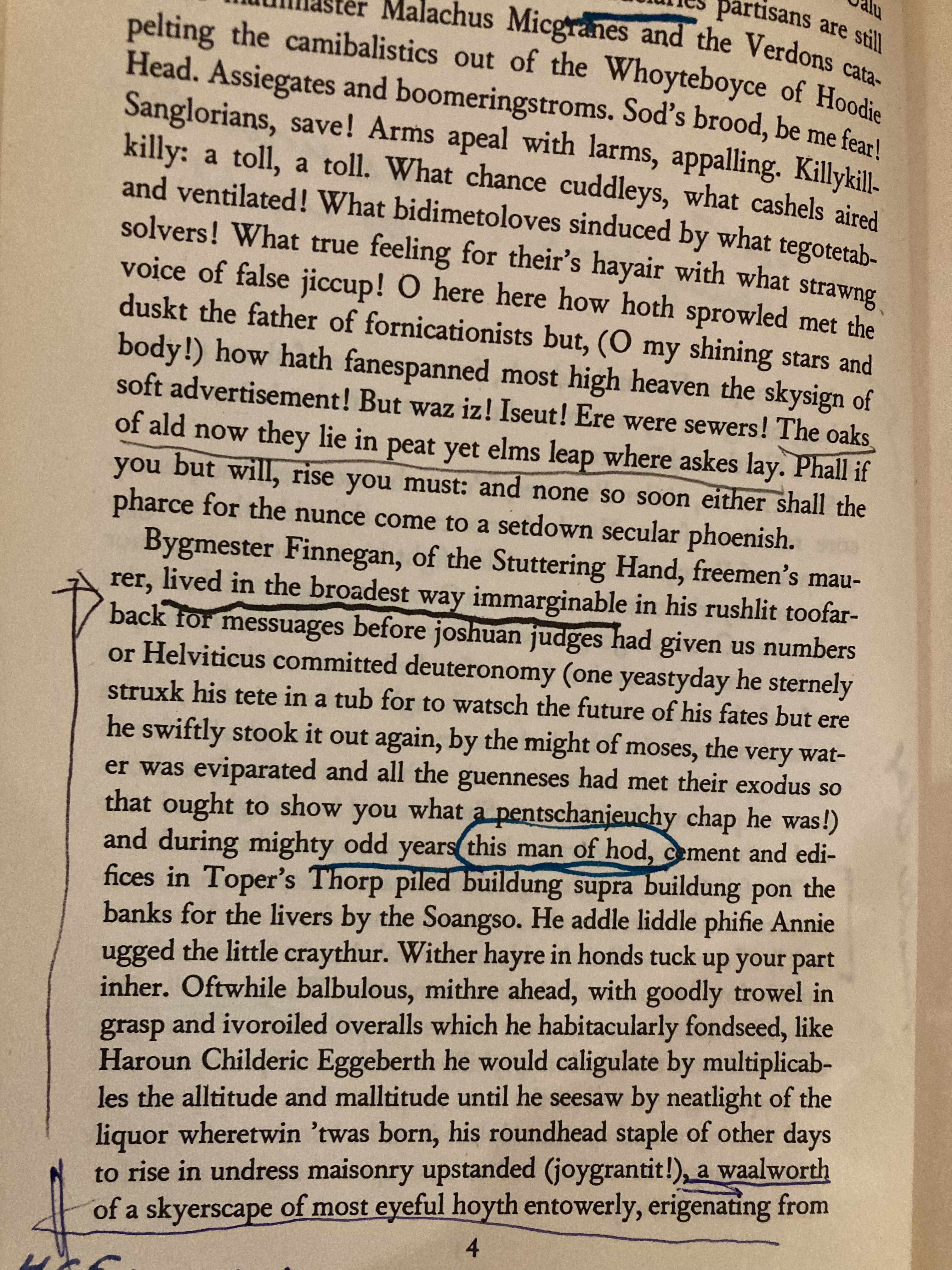
I’ve used the phrase sometimes in my writings and usually, like all of Joyce’s puns and portmanteaus, it causes editors (as well as computer autocorrects) considerable difficulty. Frequently, the word “immarginable” gets altered to “imaginable.” No, no, no! I don’t mean imaginable: I mean immarginable. It sounds pretentious even though I’m not trying to be archly clever. I just think it fits beautifully mixing “imagination” with “marginality”; that to live on the margins of society, as a minority within a dominant order, to get on, to be happy, to achieve anything worthy, you have to be imaginative, ducking and dodging, inventing another way of life for yourself and your family.
And when I say “marginal” and “minority,” I mean someone off the mainstream radar, whose value system isn’t orthodox or conventional, and who somehow identifies themselves with the downtrodden; it’s a façon de vivre as well as a savoir-faire about life in capitalist society where life is always likely to be a struggle against something. And then there’s that other aspect of Joyce’s phrase: if you’re going to live immarginably, it requires your vision to be broad and open, your mind to be curious, not closed.
For me, one of great interpreters of this mode of thinking is the late French philosopher Gilles Deleuze (1925-1995), whose outlook incorporates the spirit of Joyce. It offers an instructive example of what living in the broadest way immarginable means. Deleuze, along with his colleague and co-author, the psychoanalysis Félix Guattari, were big Joyce enthusiasts. (If anything, Guattari was even more a Joyce obsessive, drawing on the Irish writer for his work on chaosophy. When Guattari died of heart failure in August 1992, sitting at his desk at La Borde clinic, nearby, apparently still open, was his well-thumbed English copy of Ulysses.) But it isn’t Deleuze’s explicit thinking on Joyce that interests me, so much as the series of quirky filmed interviews he did in the late 1980s with the Libération journalist Claire Parnet. Eight hours of documentary footage emerged, a so-called Abécédaire, in which Deleuze extemporizes on all things from A to Z, Animal to Zigzag.
Not long ago, I checked out Abécédaire again, relistening to what Deleuze had to say about the letter “G,” for “Gauche”—“Left,” wondering myself what Left might still mean today. Deleuze was asked by Parnet, “What does it mean for you to be ‘Left’?” “I’m going to tell you that there’s no government of the Left,” says Deleuze. “A government of the Left doesn’t exist,” he says, “because to be Left isn’t an affair of government.” Let’s begin with what it means not to be Left, he says. This is to think of the world “a bit like your postcode. You begin with yourself, the street where you live, the city, the country, other countries further and further away.” And yet, “to be Left moves in the opposite direction.”
It’s to perceive the horizon, to move inward from the outside, to imagine the planet, “the continent, your country, region, city, street, you.” It means to celebrate oneself as part of a much bigger reality–as a “humble indivisibles in a grand continuum,” as Joyce says– with a vast horizon, to affirm this horizon and not be afraid of its immensity as one’s home address. “Left,” says Deleuze, is an affair of perceiving that horizon, of keeping your vision of yourself and the world expansive. It’s to live with the vastness of the planet, to want to understand it, to keep its frame of reference and plane of immanence open. Problems the other side of the planet are, willy-nilly, our problems, my problem.
Deleuze says that there’s another criterion of what it means to be Left, defined not by your nature but by your “becoming” [devenir]: “To be Left,” he says, “is to never cease becoming a minority.” It’s to know that you’re probably never ever going to make up the majority—even if, in crude numbers, you are the majority. To be Left is to affirm your Being by Becoming a minority, alongside other minorities, to be proud of it, to wear it as a badge of honor, to do so in the broadest way immarginable. Deleuze reckons that “the minority is the becoming of everybody, one’s potential becoming.” It’s very Joycean. He’s clear that “majority is never becoming. All becoming is minoritarian.”
It’s to assemble and form an ensemble with your fellow minorities, to express your becoming out in the world together. It’s becoming a revolutionary [devenir-révolutionnaire] even when (especially when?) there’s zero prospect of revolution. It concurs with Joyce’s Professor MacHugh in Ulysses, when he says that smart people are “always loyal to lost causes,” that “success for us is the death of the intellect and of the imagination.” “We were never loyal to the successful.”
Maybe this is what Joyce was driving at in Finnegans Wake, his notion of “wake”: “Phall if you but will, rise you must.” Above all else, Left means to wake up, to be savvy enough to see through ruling class smoke screens and participate in your own process of becoming, doing it with others, forging alternative minority communities within and against the official majority community.

 andy merrifield