GOGOL AT THE VILLA

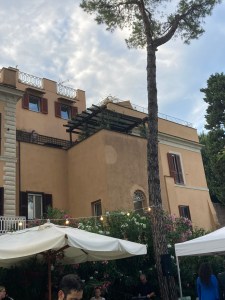
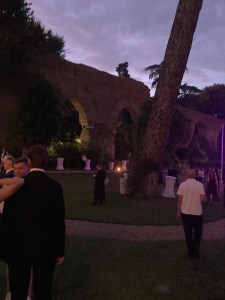
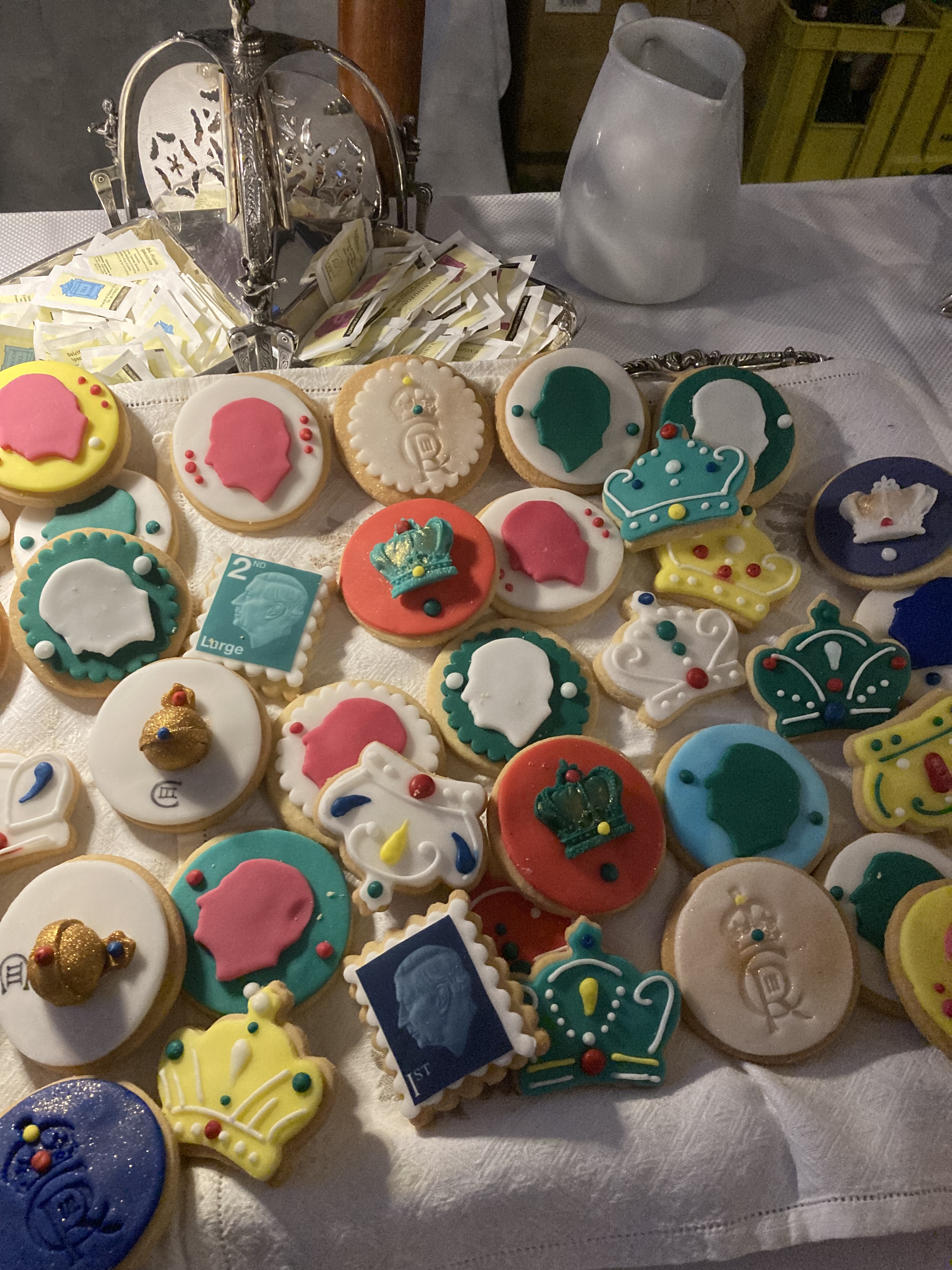
I don’t usually get invited to these things. I’m standing in the delightful grounds of Rome’s Villa Wolkonsky, the British Ambassador’s residence, a stone’s throw away from the Basilica San Giovanni in Laterano, full of imposter syndrome. It’s a gorgeous summer’s evening, mid-June, and I’m here as a so-called “plus-1,” the guest of a guest, to celebrate the King’s birthday—that King being Charles, the current British monarch. Everybody knows it’s not his real birthday—well, I think everybody knows—which is in November; but any excuse for Rome’s elite to have a good old bash, a rollicking time, is never forsaken. Apparently, for a long while, it’s been a British royal tradition to stage an al fresco commemoration of a monarch’s birthday, in mid-summer, usually around the solstice, when there’s a better than average chance that, in Britain at least, it won’t rain.

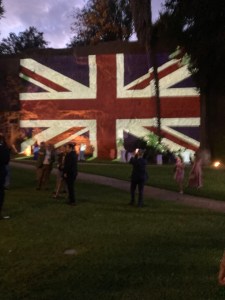
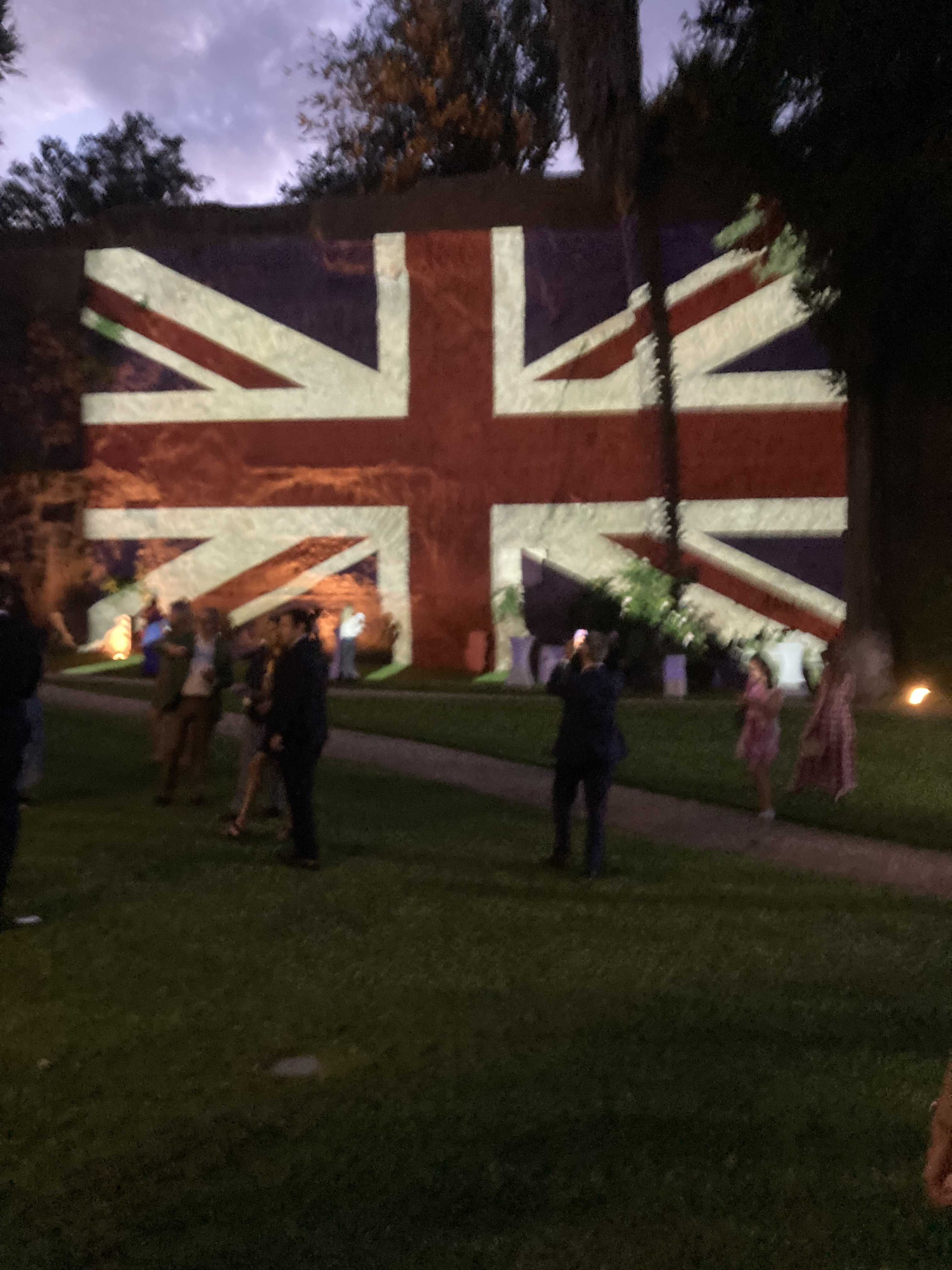
There are hundreds of people here, decked out to the nines, sipping champagne, prosecco, beer, and white wine, all on the house—diplomats and employees from Rome’s numerous international organizations and missions, as well as dignitaries from the Italian government. It’s the biggest “public” event of the year, a showcase for Britain, with giant Union Jacks hanging around and projected against walls. It’s hobnobbing with anybody who is anybody in Rome. I’m a fly on the wall and can’t help myself from taking photographs, snapping away at everything and everybody, at the goings on, at the marvelous garden that envelops us, at all the beautiful people around me. I make small talk with the people I meet, chatting as if I was one of them; little do they know I’m here by default, that it’s really my wife who’s the guest, and she had to get special permission for me to be allowed in.
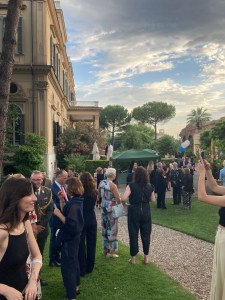
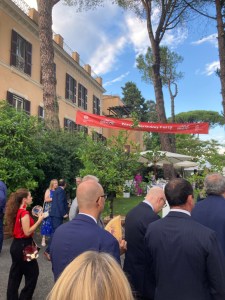
I keep it to myself that I’ve zilch interest in British royalty, whether it’s the King’s birthday or whatever; and I’m not terribly concerned about the copious amounts of free booze on offer, either—thank the British taxpayer (none present!) for that—nor the cuisine, which mercifully is Italian. I chat with the guests and ask them, in passing, if they knew anything about the history of the place. A few knew that during the early 1940s, the villa was the wartime headquarters of the Gestapo. I enquired about whether they knew about its older Russian past, and if they’d ever heard of a writer called Nikolai Gogol.

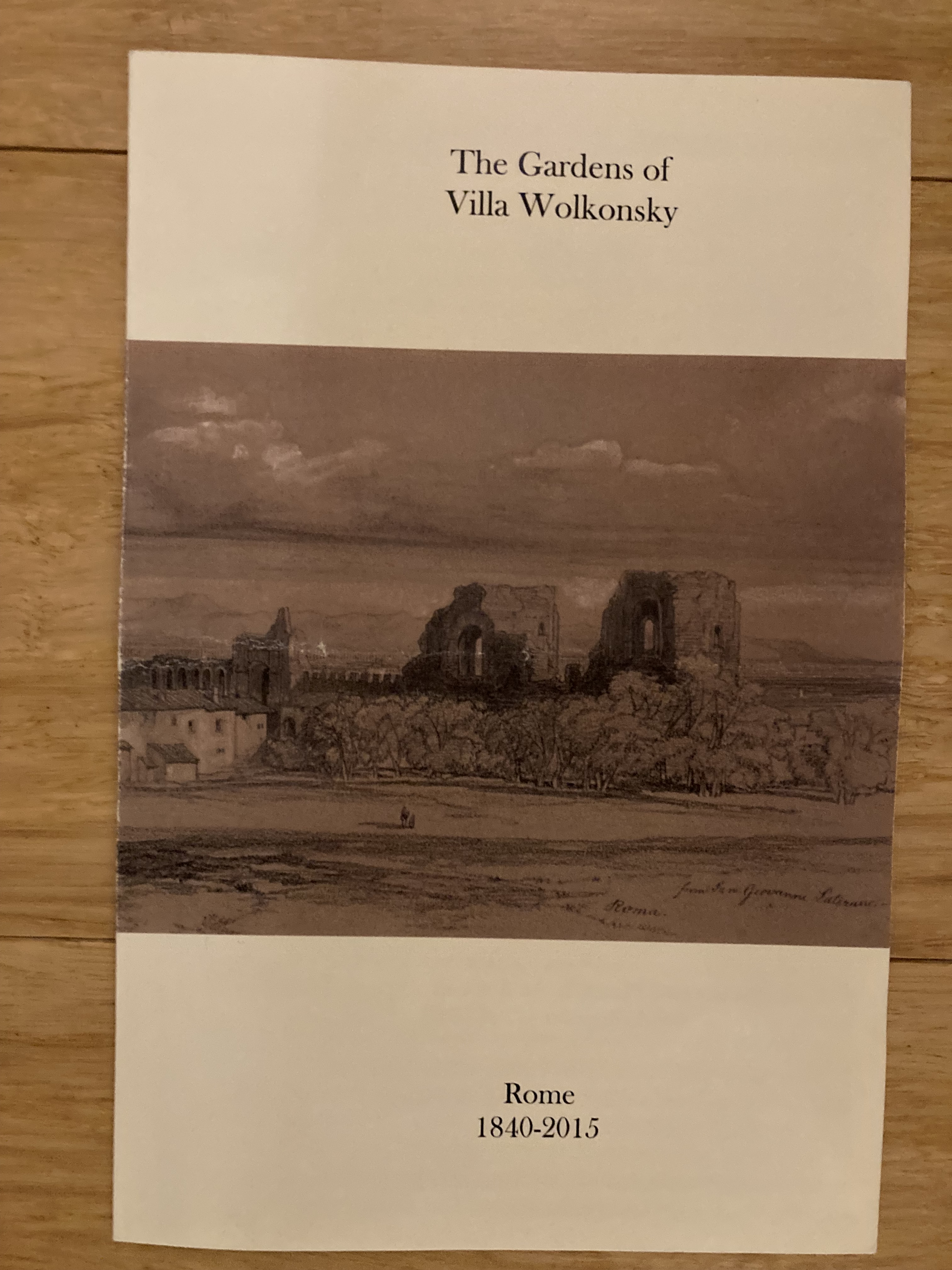
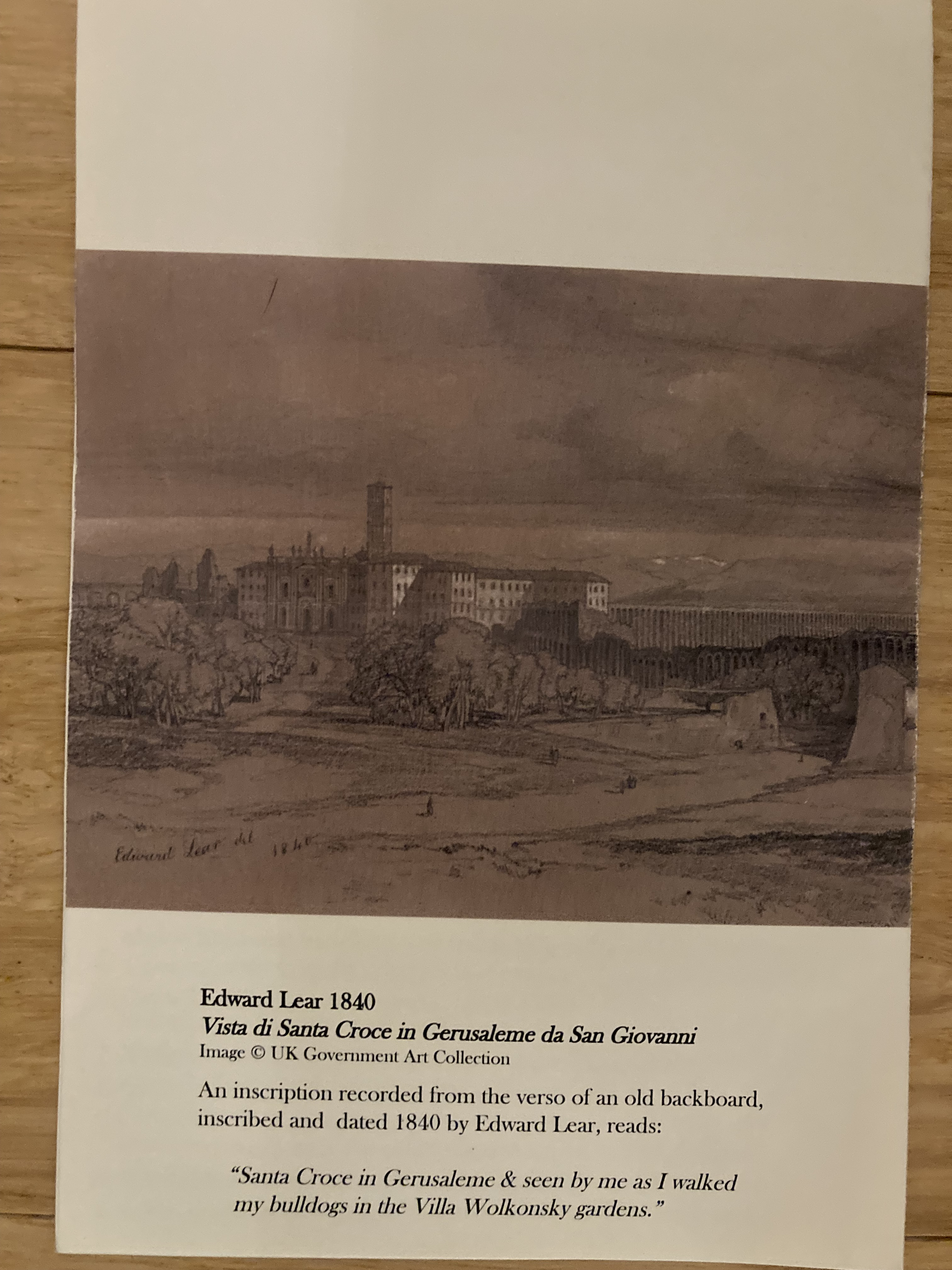
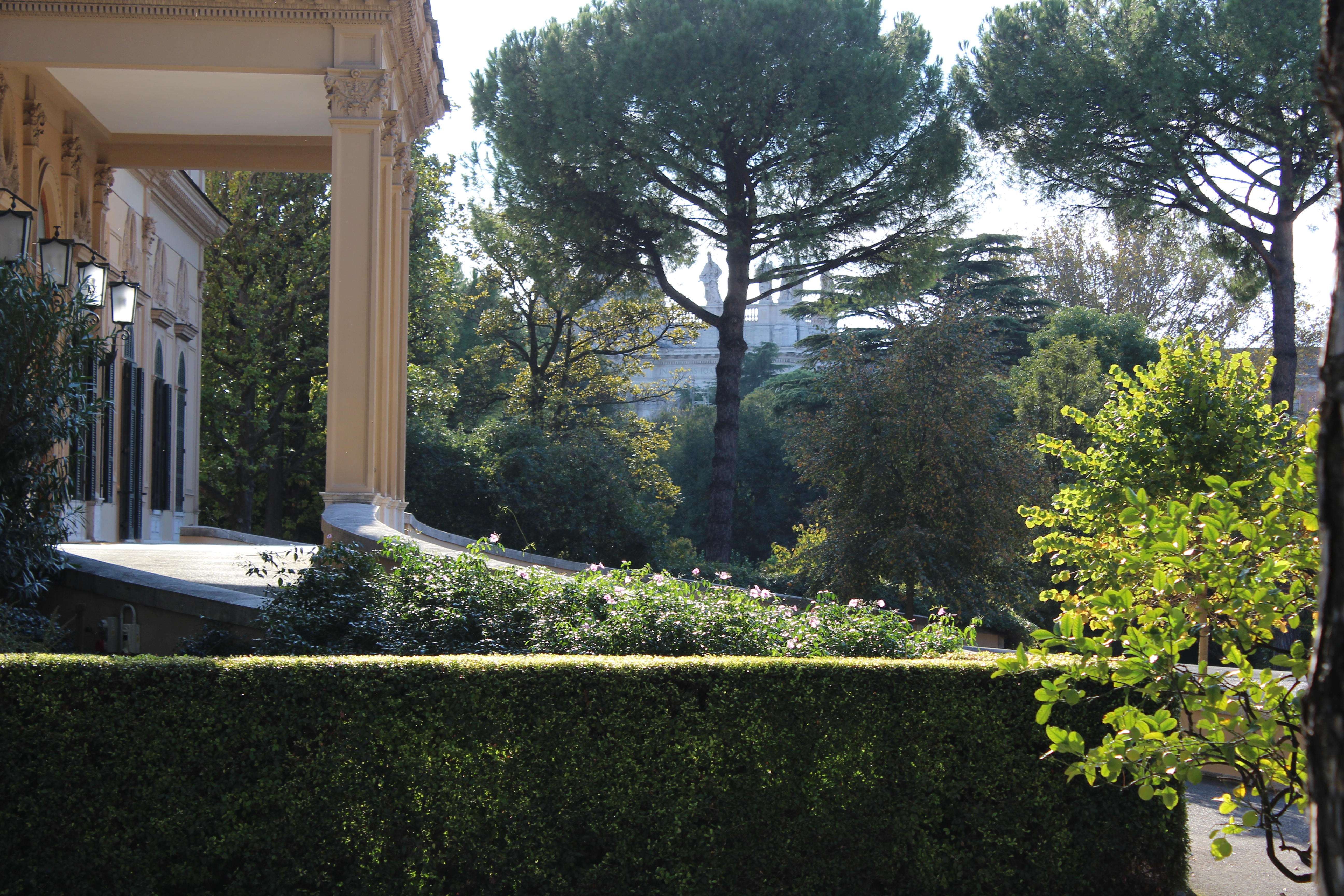
No, not really, most people said. I mentioned that the writer used to hang out here; that he was the guest of the Russian princess Zinaida Volkonsky, the eponymous founder of the villa, the woman who organized the landscaping, had the original villa built in the 1830s. This smaller property, now dwarfed by the much larger, grandiose house, the current home of the British ambassador, has a little parapet on top of one side, and on this little parapet Gogol once sat, looking over the nearby Basilica, and composed Dead Souls. There’s a pencil sketch from the early 1840s of him, sitting on the parapet’s low wall, wearing in hop hat, with the San Giovanni Basilica in the near distance. In those days, there was a clear, unbroken view of it.

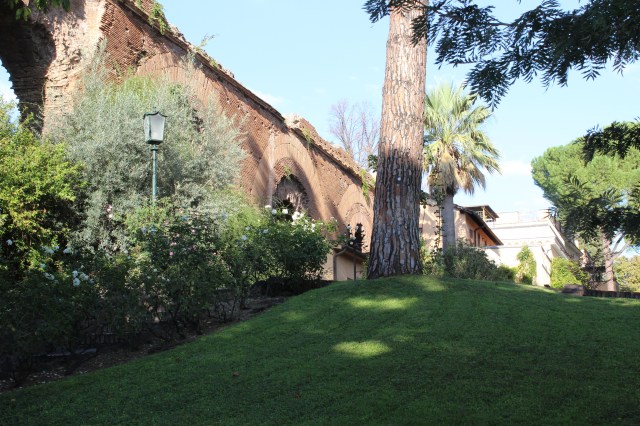
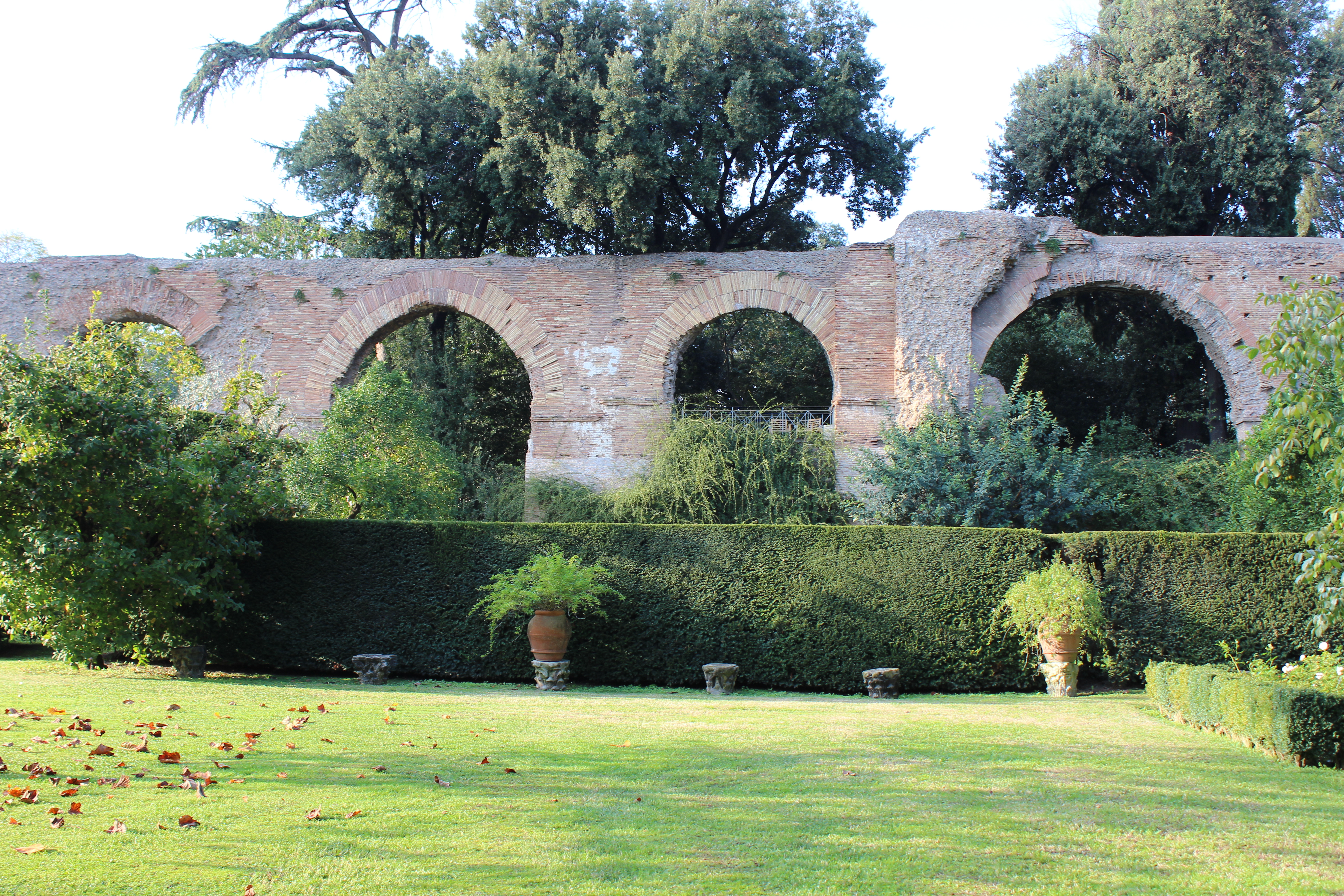
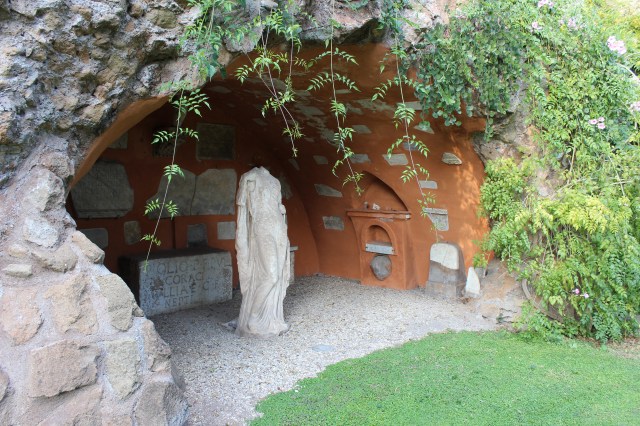
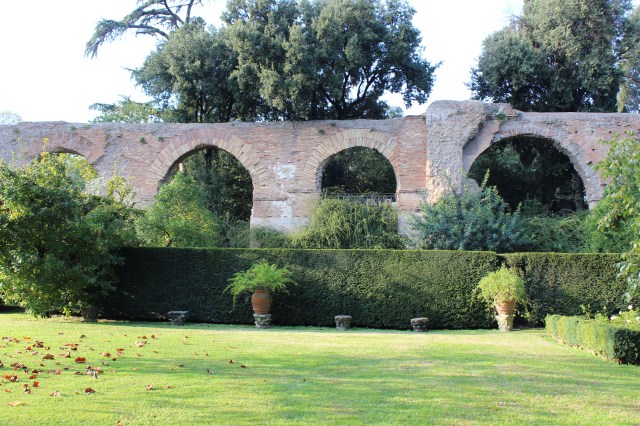
Elsewhere in the villa’s grounds, Gogol lay down on grass, marveling at the bright blue Roman sky. He’d nestle up against the wall of what is the villa’s most distinctive feature: the thirty-six spans of a majestically ruined Roman aqueduct, dating from Nero’s time, from the First-Century A.D, traversing the villa’s ground. It’s a sight to behold. Under one of its arches, the princess created a cool little grotto for her friend, the famed writer Gogol, who worked there during the summer. Ordinarily, unlike this evening, Villa Wolkonsky is an oasis of peace and quiet in the incessant humdrum of the Eternal City.

***

Zinaida Volkonsky was the wife of Tsar Alexander I’s personal assistant, his aide-de-camp, Prince Nikita Volkonsky. It’s a long story of how she ended up in Rome, but she arrived here in February 1829. A year on, Zinaida purchased five-hectares of agricultural land on Esquiline Hill and proceeded over the next few years to create her very own enchanted magic kingdom, studded in banksia roses and purple coils of wisteria, lined with hedges and scores of different species of plants and trees (reputed to be near two hundred today). Meanwhile, she commissioned the architect Giovanni Azzurri to build a simple villa within three bays of Nero’s aqueduct, becoming the nucleus of the whole property, Zinaida’s summer retreat. (In the winter, she rented an apartment in the Palazzo Poli, at the back of the Trevi fountain.)

She also rearranged ancient statues and artifacts reclaimed from the tombs that were embedded in the aqueduct. “The villa itself,” wrote one early visitor, Fanny Mendelssohn, sister of the composer, “isn’t a palace, but a dwelling house built in the delightfully irregular style of Italian architecture. Roses climb up as high as they can find support, and aloes, Italian fig trees and palms run wild among capitals of columns, ancient vases and fragments of all kinds…The beauty here is of a serious and touching type.”

After the princess’s death in 1862, Alexander, Zinaida’s son (named after Tsar Alexander I), inherited the property, enlarged it, and excavated more of the Roman tombs in the ground. In the 1880s, he sold off a lot of the land to the Campanari family (Nadia Campanari was a descendent of Alexander’s), who built for themselves the larger, more regal mansion, the centerpiece of today’s villa, and Zinaida’s house became the servant’s quarter. In the early twentieth century, the villa went through a somewhat checkered period. In the 1920s, it was owned by the German government, home to their Italian ambassador until 1943. Until the end of the Second World War, the Gestapo ran the place; its torture chambers were housed in the main Villa’s basement. In 1947, two-years after war’s end, the British embassy rented the property and its grounds from the Italian government (after a Zionist bomb had destroyed the British embassy at Porta Piazza), and in 1951 Villa Wolkonsky—its “V” now transformed into a “W”—was purchased by the Brits as the official home of the British Ambassador to Italy, remaining so ever since.

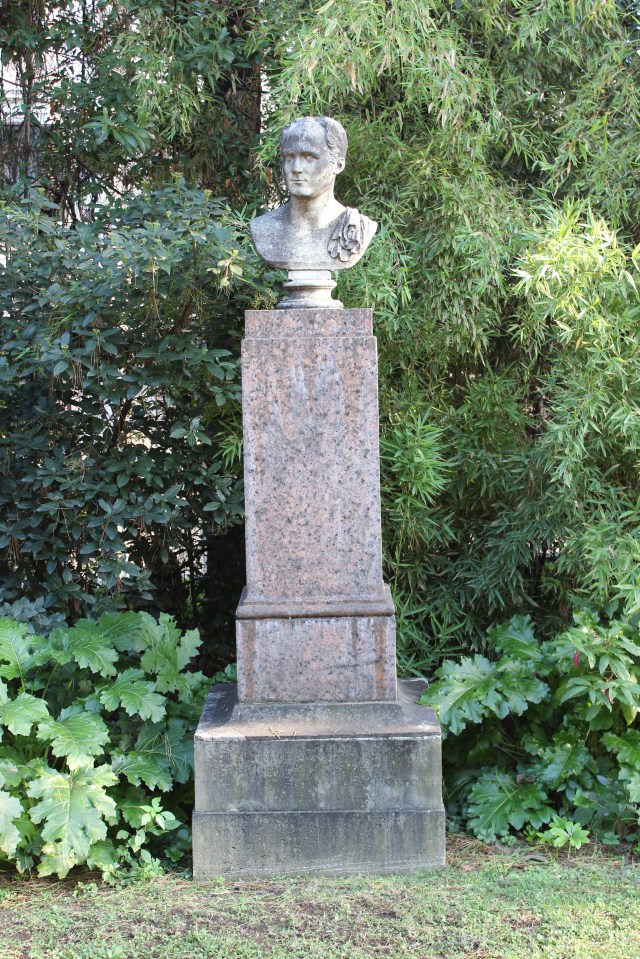
Princess Volkonsky was a fascinatingly brilliant woman. Born in Dresden into one of Russia’s oldest aristocratic families, young Zinaida became the Lady-in-Waiting to the Queen of Prussia, assuming close relations with her husband’s boss, Tsar Alexander I. Alexander and Zinaida maintained a lively correspondence with each other and it was rumored they were onetime lovers. (A bust of Alexander haunts the gardens of Villa Wolkonsky today.) When she was in her twenties, Zinaida moved to Russia, settling in Moscow in 1822. Before long, bored as simply a housewife, her mansion along Tverskaya Street began hosting literary and musical salons, fast assuming notoriety—Pushkin was a regular. Zinaida adored the celebrated poet; he called her “the queen of music and of beauty.”

According to Zinaida’s biographer, Maria Fairweather (see The Pilgrim Princess: The Life of Princess Zinaida Volkonsky), Zinaida shone in the salons of Moscow and St. Petersburg. Her many talents and lively intelligence were infectious, drew admirers and followers from the arts and political life. She was the life and soul of the party, and soirées modeled themselves on the salons of pre-revolutionary Paris, with marked liberal and progressive leanings, embracing European enlightenment thought. Evenings staged readings and political discussions, performed poetry, songs, and theater, played games of charade. The princess became a veritable magnet for Moscow’s artistic circles and brains community. She was rich, beautiful, and smart, with literary talents of her own, as well as a singing voice apparently as sweet as a nightingale’s. She played an accomplished piano and harp, too, composed music and later befriended Rossini. University types and philosophers likewise began partaking, among whom were historians and critics like Stepan Shevyrev and Mikhail Pogodin, both close to Gogol.

The sudden death of Tsar Alexander from typhoid in 1825 changed things. While the last years of his reign had disappointed many liberals—serfdom, after all, was still operative and basic freedoms were thin on the ground—the incoming emperor Nicolas I was a lot more oppressive, obsessed with order, peddling a mantra of orthodoxy, autocracy, and nationality. As a counter, Zinaida participated in the Decembrist oppositional movement, coined after the attempted revolt against this new Tsarist regime, in St. Petersburg on December 26, 1825. Some of Zinaida’s friends and former associates would be exiled or imprisoned, occasionally executed—her brother-in-law Decemberist activist, Sergei, spared death, was shipped off to Siberia.

“For me,” she wrote Prince Peter Viazemsky, a close friend known since childhood, “Russia has been defiled and bloodied. I can’t bear it here, I feel stifled. I cannot, I do not wish to live peacefully in this place.” Her salons soon became clandestine gatherings of Decembrist sympathizers, conducted in the shadow of suspicion; Tsarist spies closely monitored proceedings. Russia began to feel like a prison for her, and she explored ways out, exit routes. Italy became an obvious answer, a country she’d visited often in her childhood, Rome especially.

Antagonisms with the Tsar were compounded by Zinaida’s religious beliefs, her turning away from Russian Orthodoxy in favor of Catholicism—she was a recent convert—all which prompted accusations that she was really a Jesuit agent. Thus, on February 28, 1829, Zinaida had had enough: she quit Russia for good, returning only twice for short visits, but never living there again. She exited with her elder sister Madeleine, assorted household servants, as well as Stepan Shevyrev, whom she convinced to leave his academic position and become the personal tutor of Zinaida’s son, Alexander. Punitively, the incumbent Tsar refused permission for Zinaida’s husband to travel. He would have to remain in Moscow. “What bliss,” Zinaida would nonetheless write in her journal, “to be streaming toward Italy.”

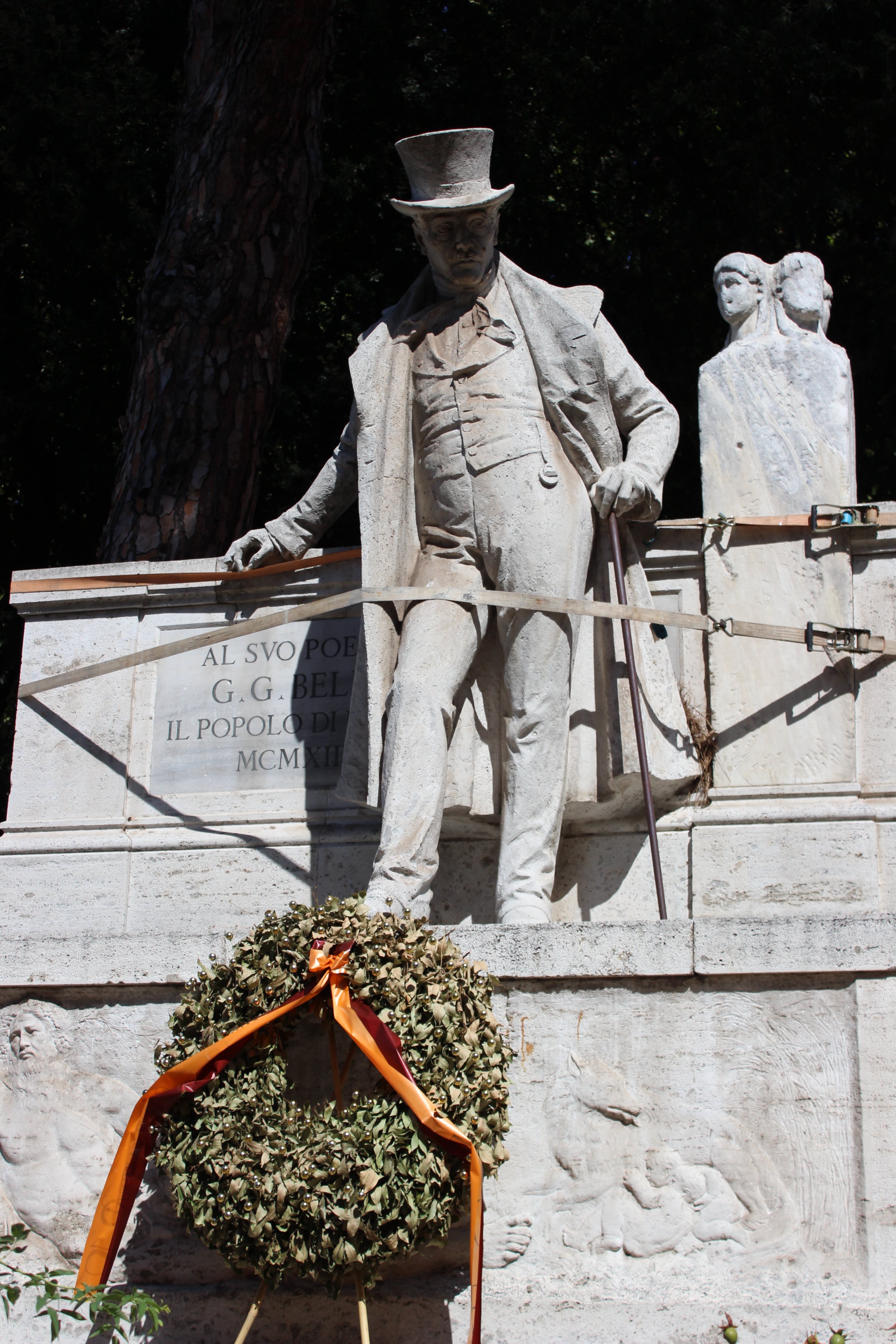
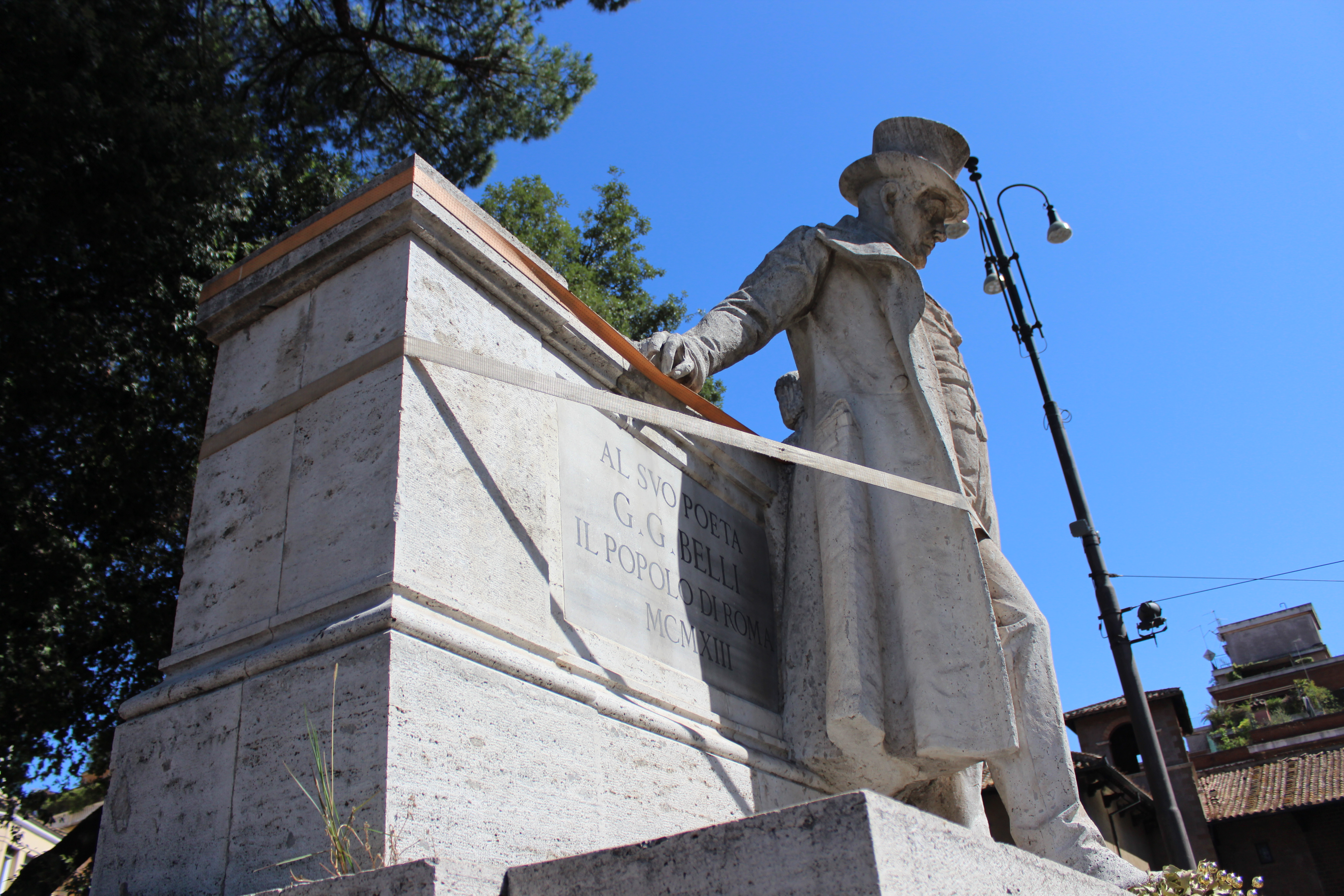
One of her first friendships in Rome at the Palazzo Poli was the popular Roman poet Giuseppe Gioachino Belli, who, for a while, lived practically next door, at via Poli, 91. (It’s more than likely that Gogol initially met Belli at one of Zinaida’s salons at the Palazzo, a tradition she continued to pursue with vigor in Rome.) Another early guest at her Palazzo apartment was Prince Viazemsky. Other notables were Victor Hugo, Stendhal, the American novelist James Fennimore Cooper, and Walter Scott, who, recovering from a stroke, fleeing another damp and dreary Scottish winter, stopped by, enchanting his host. Then, in June 1837, another vagabond man of letters arrived, Nikolai Gogol, with a letter of introduction to Zinaida penned by Prince Viazemsky, their mutual friend, a sort of uncle figure for Gogol, ensuring him fast-track entry into the princess’s inner court. Zinaida was thrilled; Gogol already had a reputation of a writer of genius.

The rapport between the two was immediate. Zinaida seemed one of the few women, besides his mother, with whom Gogol felt entirely at ease. He and Zinaida had plenty in common: both were deeply spiritual, each suffered periodic bouts of depression, oscillating between melancholy and excess, and both were idealists and impassioned lovers of Rome, living and breathing Italy. In 1837, the year of Gogol’s arrival, the pairing shared another event, the devastating breaking news of Pushkin’s death, at the age of thirty-eight, mortally wounded in a duel, passing away two-days later as Prince Viazemsky held a vigil around the poet’s bed. “All the joy of my life has disappeared with him,” Gogol told his friend Pletnev from Rome. “I never undertook anything without his advice. I never wrote a single line without imagining him before me—my present work [Dead Souls] was suggested by him. I owe it entirely to him. I can’t go on—I am broken-hearted.” (We know, of course, that for Gogol it was something of a case of Samuel Beckett’s: “I can’t go on. I’ll go on…”)

Gogol was a regular at Zinaida’s apartment near the Trevi fountain, and, especially, at the Villa Wolkonsky, whose gardens became one of his cherished spots to write in the whole of Rome. Zinaida’s villa soon had an added attraction for Gogol, on account of one of the princess’s guests, which revived Gogol’s spirits: a young prince called Iosif Vielhorsky, whose father was an old family friend of Zinaida’s and wanted his son, recently diagnosed with tuberculosis, to winter in Rome at the villa.
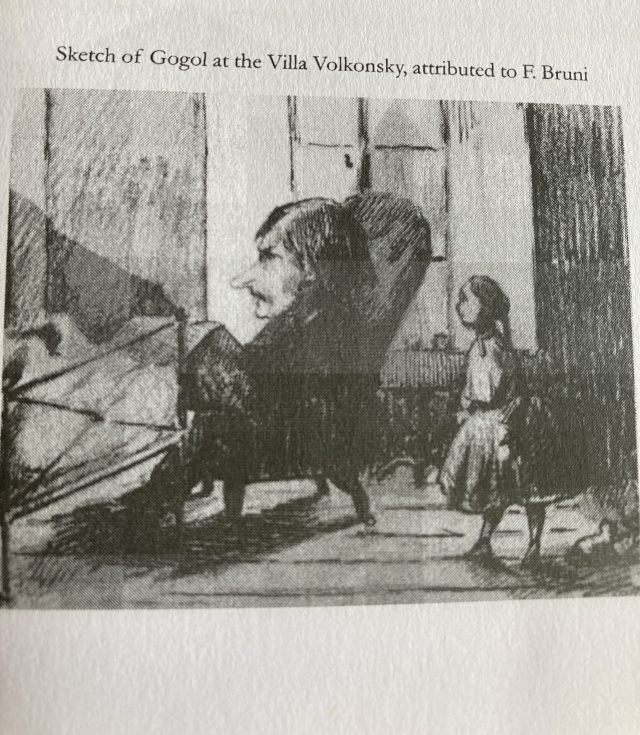
In December 1838, Gogol, hardly thirty himself, met the young prince, four-years his junior, and they rapidly fell head over heels for each other. They were inseparable all winter. Gogol was completely in love with the handsome, serious, and studious prince, who’d been at work compiling a bibliography of Russian history. The prince reciprocated Gogol’s affections, a rarity for the writer. But his health took a turn for the worst over the following spring. Gogol, grief-stricken at his partner’s rapidly failing health, came to live temporarily at the villa, at Zinaida’s behest, and he passed many hours at Iosif’s bedside, tending the sick young man. He later wrote about it, his only openly gay piece of writing, unfinished, barely three-pages long, a poetic and poignant account of his “Nights at the Villa.” (The manuscript fragment was only discovered in the archive of Pogodin after the historian’s death in 1875, and for a long while lay buried, apparently censored because of its explicit content.)

“I’m now spending sleepless nights at the bedside of my sick and dying friend Iosif Vielhorsky,” Gogol wrote Maria Balabina (May 30, 1839). “Without doubt you have heard of him…but no doubt you didn’t know his beautiful soul or his beautiful feelings or his strong character (too firm for his tender years) or his extraordinary soundness of his mind, and all this is prey of inexorable death; and neither his youthful age or right to life (doubtless a beautiful and useful one) will save him. Now I live his dying days, watch his minutes. His smile or his expression when it brightens for a moment are epochs for me, an event in my day which passes monotonously.”

“They were sweet and languid those sleepless nights,” Gogol began Nights at the Villa. “He sat sick in a chair. I was next to him. Sleep dared not touch my eyes. Silently and involuntarily he seemed to respect the sanctity of my night vigil. It was so sweet to sit beside him, to look at him. It was already two nights since we had said to each other: thou. How nearer he became to me after that! He sat still meek, quiet, submissive. God, with what joy, with what cheerfulness I would have taken on his illness, and if my death could have brought him back to health, with what readiness I would have rushed to it.”

“At ten o’clock I went down to him,” Gogol continues, ratcheting up the intimacy of his descriptions. “I had left him three hours earlier to rest a little…He was sitting alone, the languor of boredom expressed on his face. He saw me. He waved his hand slightly—‘you are my savior!’ he said to me. They still echo in my ears, those words. ‘My angel, did you miss me?’—‘Oh, how I missed you!’ he answered me. I kissed his shoulder. He offered me his cheek. We kissed. He was still shaking my hand.”

Gogol seemed to have had an epiphany that final night beside Iosif, “my life was strangely new then,” he says. “It is difficult to give an idea of it,” he says: “a charge, a fleeting fragment from my youth,” he writes, grappling to define it, “coming back to me, when a youthful soul seeks friendship and brotherhood among his young peers, and a friendship resolutely juvenile, full of sweet, almost infantile trifles, intermittent signs of tender affection, when it is sweet to look into another’s eyes, and when one is ready to make sacrifices…And all these feelings, so sweet, so young and fresh, which inhabit an irretrievable world—all these feelings returned to me. God! Why? I looked at you, my sweet young flower!” But the reality of death stared Gogol full in the face, as that young flower withered before him. “Was it necessary for this fresh breath of youth to envelop me suddenly, only to sink again into the vast cold where my feelings become numb, so that with even more distress and despair I see my life vanish. Thus the dying fire casts one final flame, illuminates the dark walls with a flickering glow, to then disappear forever and…”

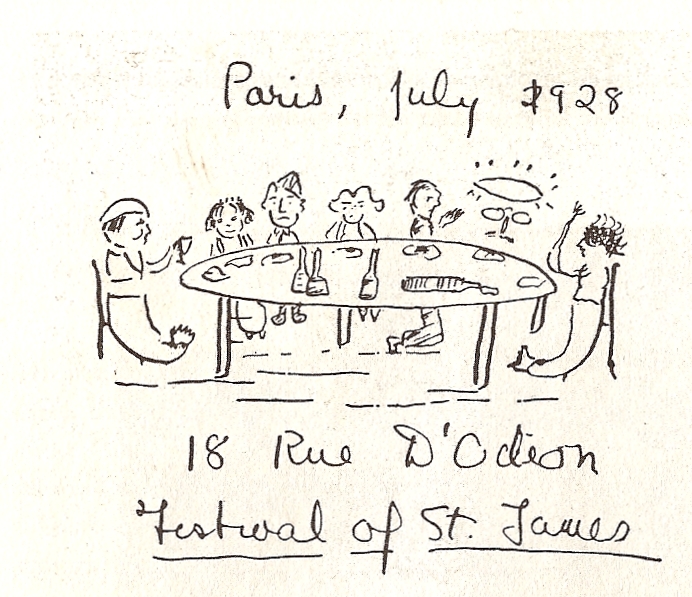
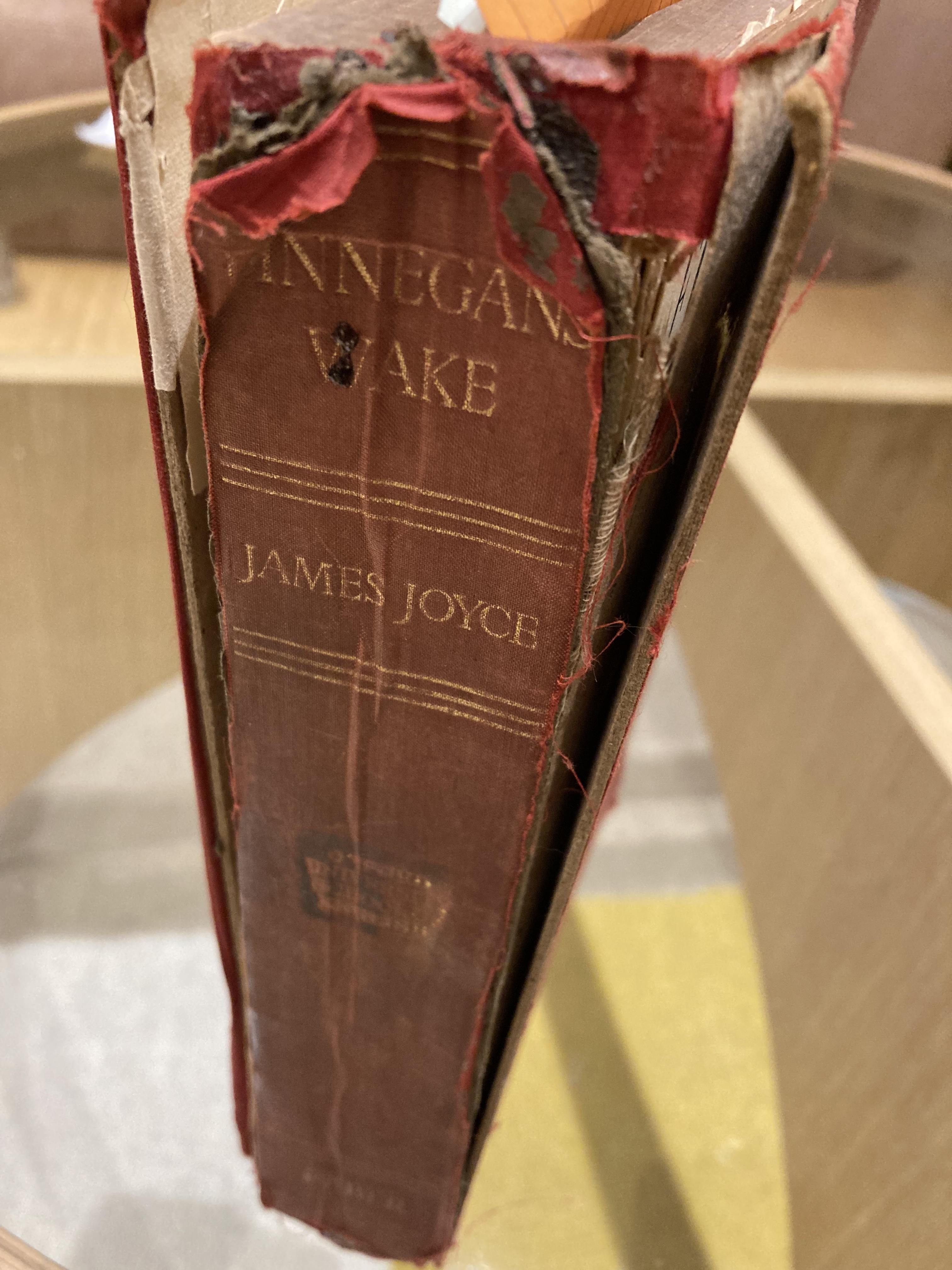
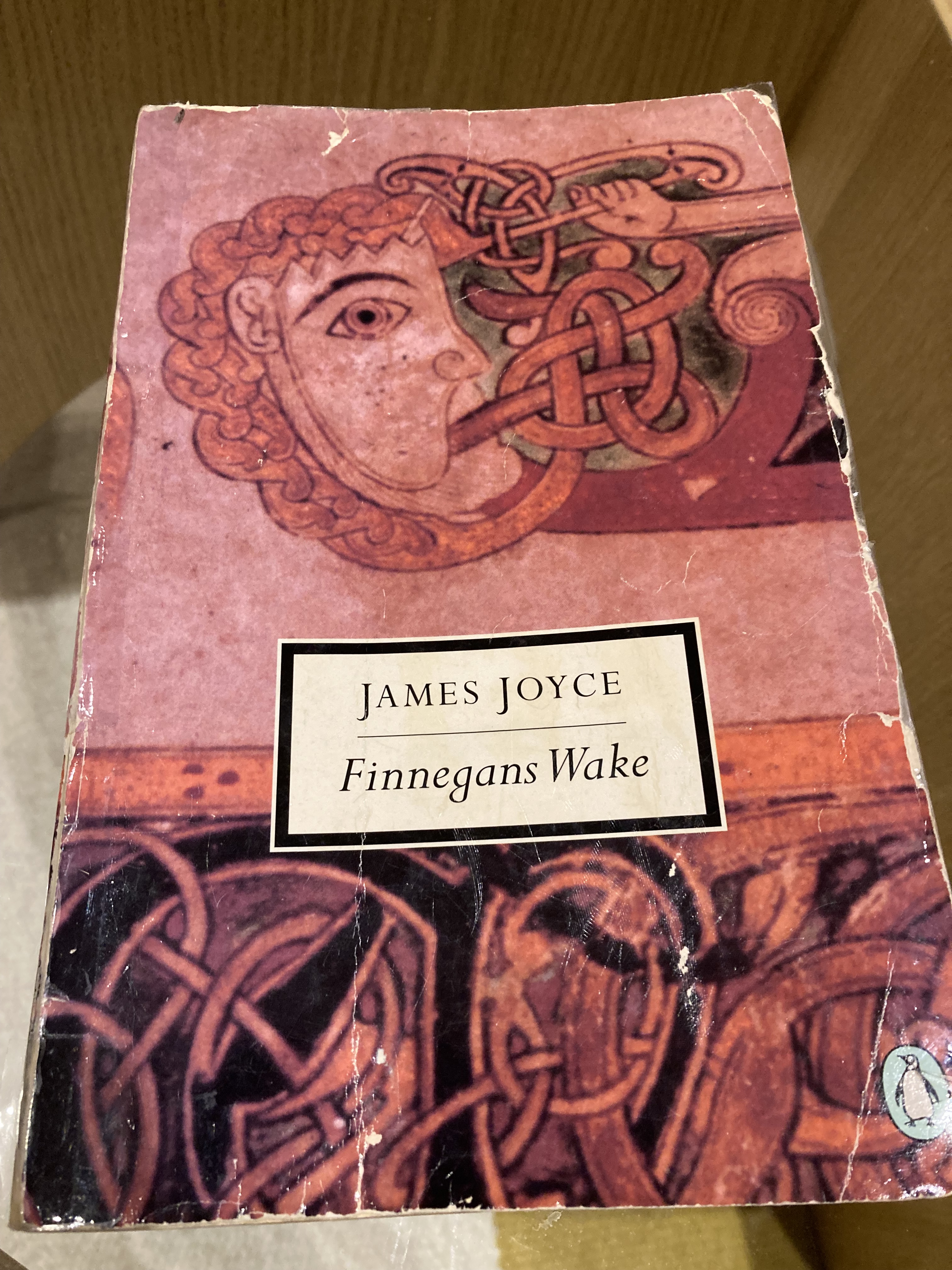
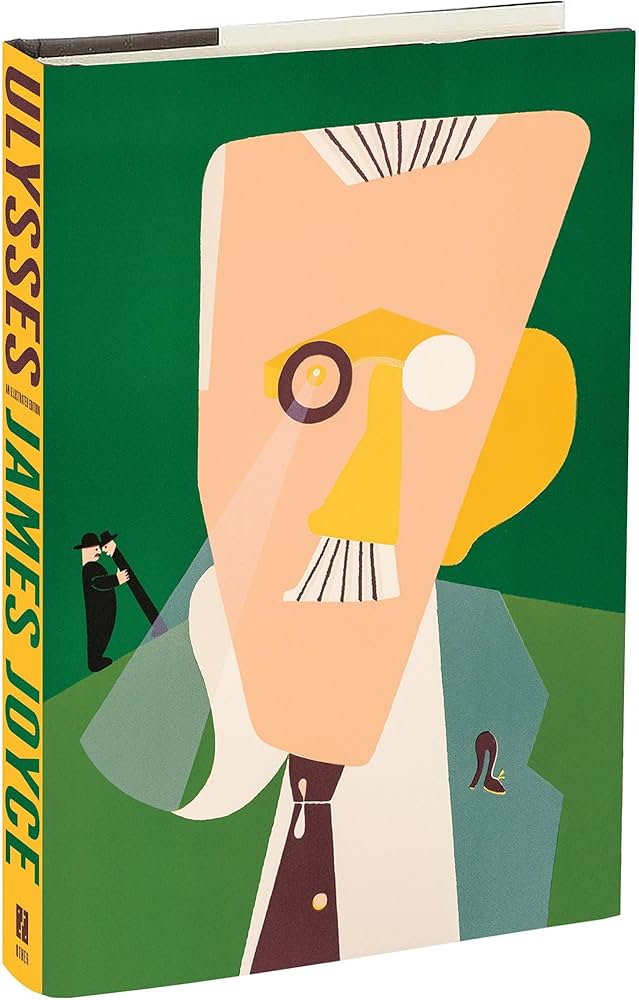
Here Gogol’s manuscript trails off, ending with an “and.” Was it intended as a longer work? An autobiographical account of his friendship and homosexuality, hitherto kept under wraps, even if he never disguised it? Yet this wasn’t a fecund “and” like the flowing “the” of James Joyce, figuring at the end of Finnegans Wake, which duly marked a beginning, a rebirth, an eternally reoccurring universe; nor was it the affirmative “yes” concluding Ulysses. Rather, Gogol’s “and” fades away into negativity, into oblivion, and marks a punctuation, the closure of a chapter of life, perhaps the conclusion of his youth, now irretrievable. Only the inexorable passage into middle-age awaited him.

He’d henceforth bury himself in the distant land of his imagination, provincial Russia, its poshlost world of philistinism, of “bogus profundities, crude, moronic dishonesty” (Nabokov’s words), epitomized by the inscrutable Chichikov. The atmosphere of Dead Souls is full of poshlost, dreary banalities created in the tasteful bliss of Villa Volkonsky. Pushkin always said Gogol was the master craftsman who brought banalities to life, making them readable and enjoyable, worthy literary subject matter. But when Gogol read aloud early draft chapters of Dead Souls to Pushkin in St. Petersburg, rather than laughing joyfully as per usual, Pushkin became gloomier and gloomier, until, completely somber, uttered in an anguished voice: “My God, how sad our Russia is!”

After Iosif’s death on June 2, 1839, the proximity between Gogol and Princess Volkonsky dissolved. Iosif’s last hours were fraught. Zinaida said she saw the young man’s soul leaving his body, “and it was a Catholic soul.” There seemed to be then some attempt on her behalf to convert Gogol to Catholicism, but, offended, he’d have none of it. Indeed, “I will begin by saying,” he later wrote Shevyrev, “that your comparison of me to Princess Volkonskya with regard to religious exaltation…I will tell you that I came to Christ by the Protestant path rather than Catholic.”

Zinaida made a last-ditch effort to inveigle Gogol over to the church of Rome, in front of his dying friend, which caused a rift between her and the writer. Afterward, Gogol fell into a deep depression. “A few days ago,” the maudlin writer told Danilevsky, “I buried my friend, one whom fate gave me at a time when friends are no longer given—I mean my Iosif Vielhorsky. We have long been attached to each other, but we became united intimately, indissolubly and absolutely fraternally, only during his illness, alas. The man would have adorned the reign of Alexander II. The rest of those who surround him haven’t a grain of talent. The great and beautiful must perish, as all that is great and beautiful must perish in Russia.”

It took a while before Gogol and Zinaida made up, repaired their relationship, though it never would assume the previous level of intimacy; she always said this was the moment when the gloomy Gogol began his “spiritual education,” spending hours on the villa’s terrace, gazing at the sky, and at the Basilica of San Giovanni in Laterano. He and Zinaida undertook their own private religious mania, eventually parting their spiritual ways, their fanaticism taking on radically different forms. He, Maria Fairweather notes, “began to see his work as part of a process of Russia’s redemption…she of her special mission in the general regeneration of the world.”

A decade after Gogol’s passing, his “Overcoat” took on a dramatic twist. One winter’s day in February 1862, Zinaida was making her way home on a particularly bitterly cold Roman day. She spotted a beggar woman shivering on the street. Pitying her, Zinaida offered her petticoat and continued on. When she returned home, thoroughly chilled to the bone, Zinaida caught a cold herself, which turned feverish; several days on, she was gone, aged seventy-three.

***

Gogol loved Villa Volkonsky, but it was hard for me to comprehend this, to appreciate it fully, during the night of the King’s birthday, this deep past, the story of Gogol and the princess at the villa. Yet the more I read about his time there, the more I felt an inexorable urge to return, to see the place under calmer circumstances, in a quieter, more reflective mood, as Gogol would have experienced it. More particularly, I wanted to stand in the Villa’s grounds, get inside the original villa, if I could, discover Gogol’s grotto, if it still exists, look out at the Basilica of San Giovanni in Laterano, as he had looked at it, look out over Rome, over Russia, up at the sky.

Over the proceeding months, I inveigled my wife to pull a few strings. She said she’d get in touch with Fiona, a colleague she knows at the British Foreign, Commonwealth Development Office, explaining my request. Fiona told my wife I should reach out to Terry, the villa’s Residence Security Manager, which I did, and, in time, all was arranged: on a gorgeously sunny, mild November afternoon, I stood at the iron-grilled entrance of the villa again, passing soldiers from the Italian military guarding the outside. At an internal sentry post, I was buzzed in through two gates, the second slowly opening as the first slowly closed. Terry greeted me on the inside. He said he was born down the road yet sounded like he’d been raised in London’s east end. Terry explained he couldn’t show me around as something had cropped up, but instead one of the Italian security guards, Giovanna, speaking excellent English, would supervise my tour.

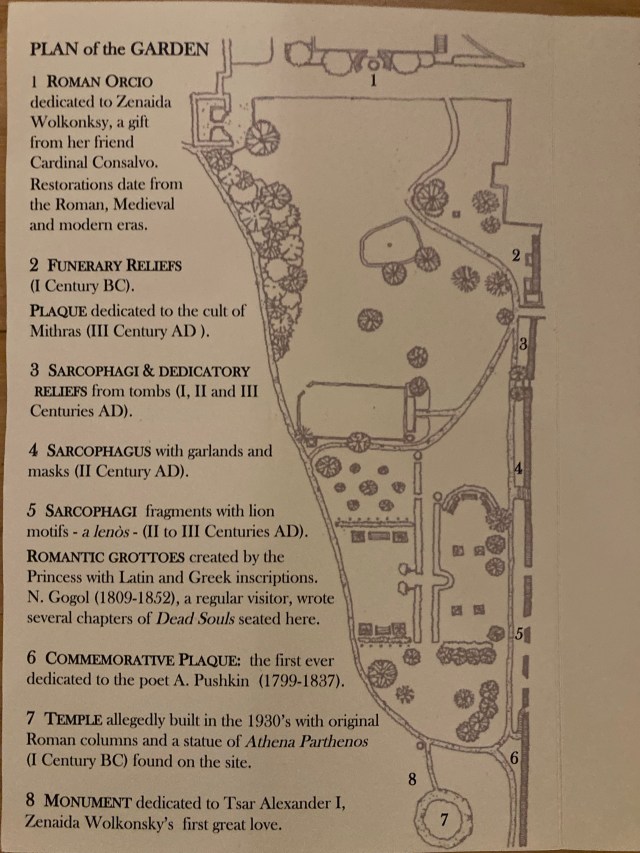
Giovanna, in her late fifties, was a delight, telling me, apologetically, that she’d been on the job at the villa for only two days, having worked for over thirty on security at Fiumicino airport; it’s the same contract company deployed at the villa (ADR Security). She didn’t know anything about the villa’s history, nor about Gogol, but said she was excited to walk around with me, happy to be out of her office confinement. Both of us followed the informative “Plan of the Gardens,” a little map and guide Terry had equipped us with, produced by the UK government. Without further ado, we were off on our afternoon’s exploration, and what an afternoon! 

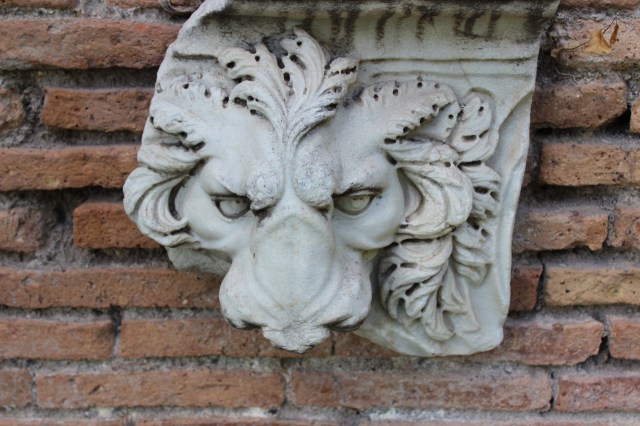
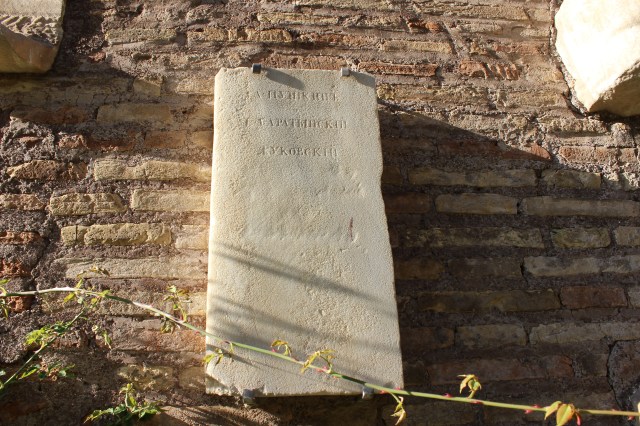
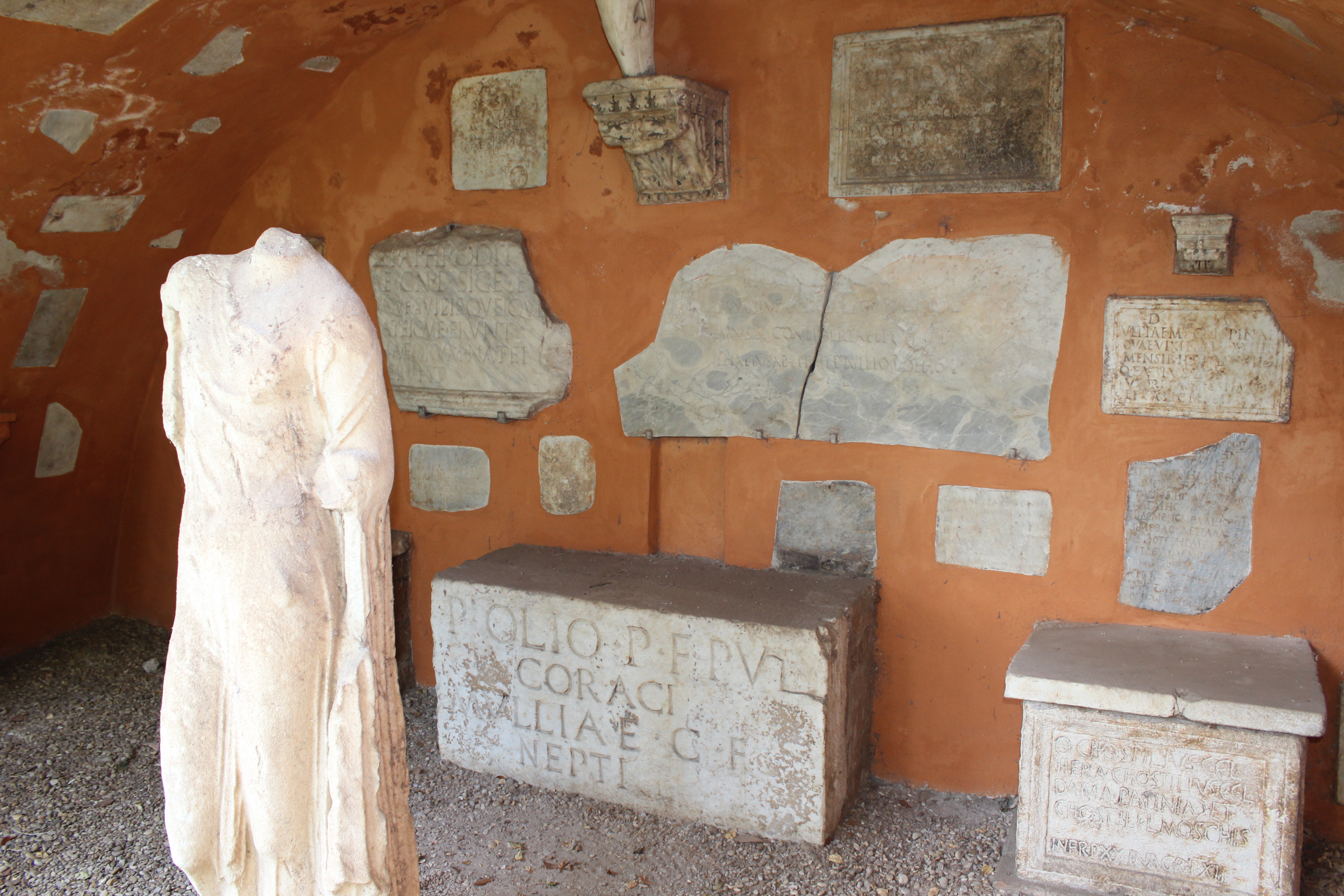
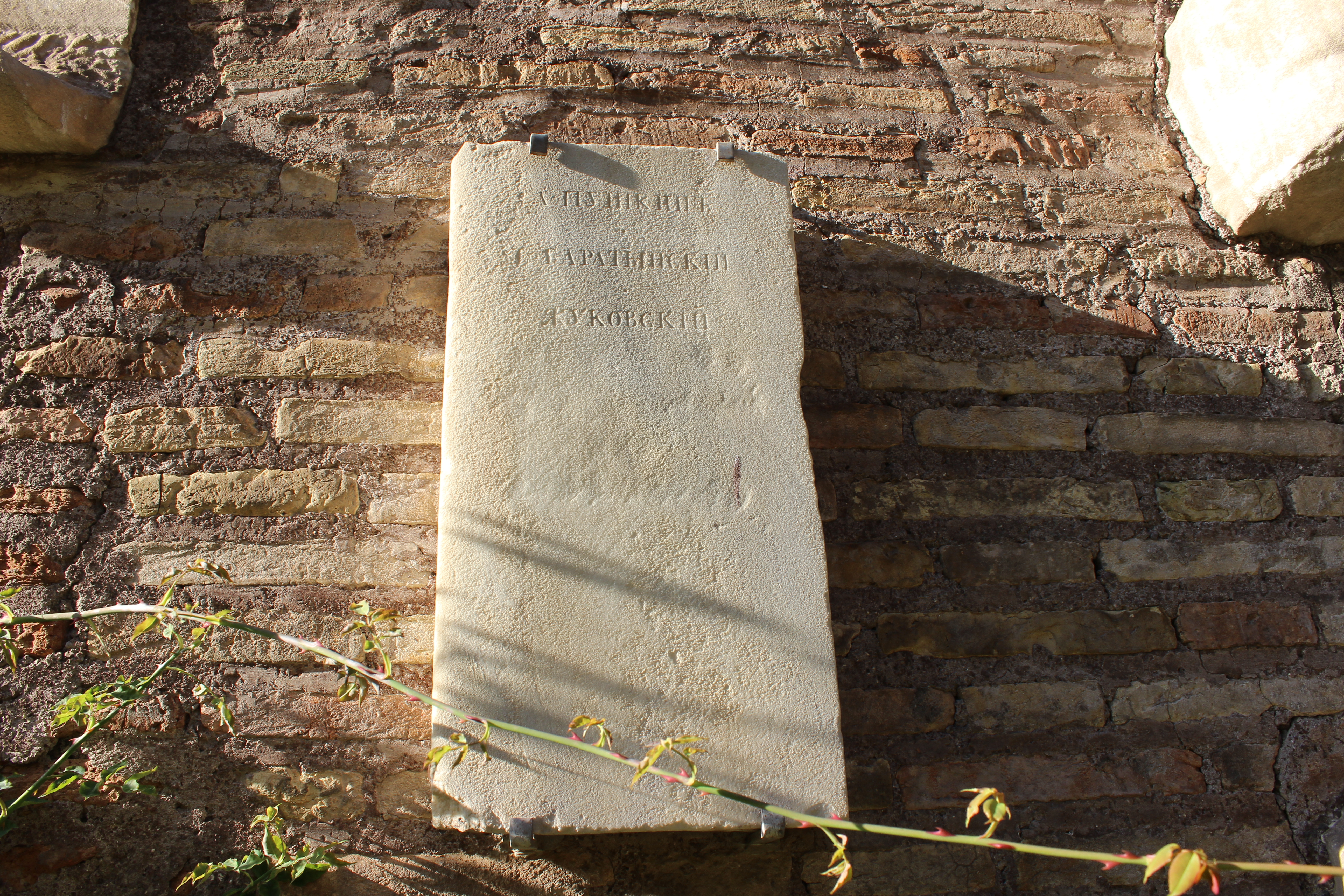
Alas, I couldn’t enter Zinaida’s original villa, Terry said, because it is occupied by British diplomats, who live inside the converted apartments, and, as private residences, the building was off-limits to me. At first, my heart sank but soon I realized the gardens themselves were a cornucopia of treasures, especially Gogol’s grotto. Created by the princess, with its Latin and Greek inscriptions, the granite bench had Gogol sit scribbling lines of Dead Souls, in peace and tranquility, in the freshness of his orange-colored niche. A headless, life-sized statue of a woman stood in the middle (point to note: most, if not all, of the thousands of the ancient statues scattered around are headless). Needless to say, thrilled, I took plenty of photos. Nearby, to the left, adorning Nero’s aqueduct, were fragments of lion motifs, little sculptures dating from the Second and Third Centuries A.D. A bit further along from Gogol’s grotto, also on the aqueduct’s wall, was a marble plaque in Russian commemorating Pushkin, something I never knew existed, beautiful in its simplicity, glistening in the magnificent light enveloping the gardens.
I felt very privileged: a private viewing of these wonderfully preserved artefacts, of the pristine green lawns in their radiant glory—with turf apparently shipped in from Britain, and, in a far corner, near the temple (built in 1931), we came across that bust of Tsar Alexander I, looking a bit ruined yet still remarkably stately; the “Plan of the Gardens” says he was Zinaida’s “first great love.”

I passed a lovely hour in the grounds, and in Giovanna’s company, who told me she was born in Sardinia though grew up from an early age in Ostia, a working-class coastal town (site of Pier Paolo Pasolini’s murder) a half-hour or so away (traffic permitting). Giovanna seemed pleased when I mentioned that my last book was on the Sardinian Antonio Gramsci. As we headed toward the gate, the villa’s resident cat, Elizabeth, joined us (no guesses after whom she’s named), and before long I had passed through the security gates again, exiting onto via Ludovico di Savoia.

Five minutes later, zipping along on a Lime scooter, I was back home at my apartment, shaking my head in wonderment, in disbelief that I live here, in Rome, and just up the road, quite literally, had been where Gogol wrote a good chunk of Dead Souls. It was kind of amazing, and for a while I reflected on this amazement. On that stone seat, surrounded by beautiful gardens, in a romantic grotto nestled in Nero’s aqueduct, not far from here, Gogol sat, and there he wrote. I thought about what the American critic (and Gogol fan) Edmund Wilson had said when visiting Rome in the mid-1940s, a century after Gogol’s time, marveling in letter to another Gogol fan, Vladimir Nabokov, about how Gogol invented Chichikov “in clear Italian light—all that world of Dead Souls seems so far away.”

In a sense, it couldn’t have been truer. In another sense, thinking about it now, having seen what I’d seen, having felt it, perhaps the provincial Russian estate of Manilov in summer is closer to the Villa Wolkonsky than you might think. “Over the master’s house,” Gogol wrote, “were strewn, English-fashion, two or three flower beds with bushes of lilac and yellow acacia. Five or six birches in small clumps raised their small-leaved tops here and there. Beneath two of them could be seen a gazebo with a flat green cupola, blue wooden columns and an inscription: THE TEMPLE OF SOLITARY REFLECTION.”

Was Gogol thinking of Zinaida and her villa when he had Chichikov address Manilov’s wife? “‘Madame, here’, said Chichikov, ‘here is the place—and with that he put his hand over his heart—‘yes, it is here that the agreeableness of time spent with you will abide! and believe me, there could be no greater bliss for me than to live with you, if not in the same house, then at least in the nearest vicinity. Oh! that would be a paradisal life!’ said Chichikov, sighing.”

Somehow, in this bliss of the villa’s paradisal life, Gogol created the scoundrel Chichikov, the very definition of mediocrity, “neither too fat nor too thin, nor could he be described as either old or young.” His arrival caused no commotion in the town, says Gogol, nor anything special, “except for a few comments exchanged between two peasants standing by the entrance to a tavern opposite the inn, which, as a matter of fact, concerned the carriage rather than the occupant.” Yet Chichikov’s real forte resided in the fact that he is a deceiver and fraud, a cagey conman who’d have functioned effortlessly in our own times, which might be Gogol’s deeper point. Chichikov’s lies and deceptions would gladly make our world go around.

“The newcomer,” says Gogol, “seemed to avoid saying too much about himself, and, if he did, it was only in general terms and with marked modesty.” In his conversations with the town’s dignitaries, “he displayed great skill at flattery.” After a while, everybody who makes his acquaintance heartily agreed that he is “an extremely pleasant fellow”—even those who seldom have a kind word for anyone. “Such was the general impression made by the newcomer,” writes Gogol. “It was quite flattering and lasted until a strange peculiarity came to light. But we are soon to learn about this matter, which all but threw the entire town into confusion.”

Chichikov identifies the vicinity’s largest landowners, and one-by-one pays them a visit. He politely butters them up, and they wine and dine him and he’s full of compliments and not without a certain charm. When he raises the matter of dead souls to Manilov, the latter is speechless: he “opened his mouth and his pipe dropped to the floor. He remained with his mouth gaping for several minutes.” It’s another “dumb scene,” resembling the finale of The Government Inspector. Manilov hadn’t heard anything stranger, “more unusual than any that had ever reached human ears before.” Why would anybody want to buy dead souls? The souls in question are serfs, and every landowner who has an estate of any significance has a posse of serfs laboring for them. The richer the landowner, the more serfs they own, the more “souls” they possess, an emblem of wealth and standing in the region.

Yet these souls must be documented and are subject to a poll-tax. The tax system operative in those days was desperately skewed, because the squires themselves were exempt from paying taxes: it was the serfs who paid up! All the landowners did was assume responsibility, collecting taxes from their serfs, and then sending them off in accordance with the number of living serfs at the time of the last census. If the serfs died before the next census, landowners themselves remained liable for their poll tax. Thus, selling a dead serf liberated them of the burden of having to pay, and the new owner became responsible for payment. As such, why would anyone be stupid enough to want to buy “dead souls” and become liable for their poll tax? It seemed utterly bizarre, preposterous, hence Manilov’s gaping mouth, his dumb scene. It isn’t clear to anybody, and it’s only much later, near the end of the first part of the finished Dead Souls, that Chichikov’s motive becomes clearer.

So it goes that Chichikov does the rounds of the local squires, driving a hard bargain, acquiring their dead souls at a peppercorn price. That is until he encounters Nozdrev, a wily, ruffian squire, an uncouth, aggressive, and crooked landowner, a lying businessman; it takes one to know one. Chichikov had met his nemesis. By then, he had purchased hundreds of dead souls and, in the eyes of the town’s elite, is a proven big shot, a rich gent who is planning to snap up a large estate, somewhere nearby, where his apparently living souls would graft. When the legal exchange is signed and sealed at the town hall, nobody mentioned that the listed souls were in fact all dead, and nobody apparently cared.

And yet, when Chichikov attempts to obtain Nozdrev’s dead serfs, the latter smells a rat. “Why d’you want ’em, then?” he enquires. Chichikov hadn’t been confronted like this before and didn’t know how to respond. He claims he wants to marry somebody and needed the souls to emphasize his social standing, to convince the bride’s father of his worth. “You’re lying!” Nozdrev says. “You’re a liar, friend!” And so he was. “I know it very well,” Gogol has Nozdrev exclaim, “you’re a monumental fraud.” Right again. Chichikov quickly realizes it’s a grave error to have set eyes on this character Nozdrev; he’s set to scupper Chichikov’s best laid plans. “He will gossip, lie, and spread rumors,” muses Chichikov. “It wasn’t good at all…his business wasn’t of a sort that could safely be entrusted to a man like Nozdrev.”

It’s all true, because bit by bit we discover Nozdrev effectiveness at spreading false news about Chichikov. Lies becomes a liar’s downfall. Nozdrev doesn’t only spill the beans about those acquired souls being in reality dead—not false, of course—but that Chichikov is really after the governor’s daughter, that he plans to abduct her, which is not true. Busybodies soon arouse the whole town and before long, “everything was astir,” Gogol says. It took a little more than an hour before the fake news to run rampant, to assume verisimilitude. So it became fact that Chichikov planned to elope with the governor’s daughter. “Amplifications, additions, and revisions were added to all this,” says Gogol, “as it trickled down to the humbler parts of town.” Who needed social media with hearsay like this!

“No one actually knows who Chichikov really is.”  Even Gogol himself starts to wonder who this person is he’s created; and then, near the book’s end, we find out, in a sort of author’s confession. “I haven’t chosen a man of virtue for my hero,” admits Gogol. Our narrator is tired of positive heroes, he says, of virtuous men, who usually figure as hypocrites anyway, “and now I feel the time has come to make use of a rogue. So let’s harness him for a change.” Is Gogol talking about us, even about himself? Maybe I’m Chichikov, he says at one point. Chichikov is a serial loser that seems to succeed by taking everybody in. He hops from one failing to another, yet seems to gain esteem each time, finding his way through it all, showing at least one talent: resilience, overcoming blows with his amazing drive to succeed, believing the lies he tells and the yarns he spins. He’s a man of our age, all right!

Entering middle-age, Chichikov concocted the hairbrained idea of buying up dead souls, knowing that estate owners would be only too happy to let him have them, releasing them of their per-capita taxes. “If I offered, let’s say, a thousand rubles for the lot,” Chichikov reasons to himself, “I could get a mortgage from the National Treasury of about two hundred rubles per soul, which would bring me around two hundred thousand rubles!” We might say that Chichikov hatches a scheme to revalorize dead labor. That’s the way I like to view Dead Souls, as something akin to what Marx used to call dead labor. For that’s what dead souls essentially are, living-labor that created value, yet now have expired, becoming dead labor, no longer value creating—or are they? Because, here, we can see how a title to dead labor is in fact something that helps accumulate capital.

“The over-worked die off with strange rapidity,” Marx said in Capital. “But the places of those who perish are instantly filled, and a frequent change of person makes no alteration to the scene.” When Marx spoke about “dead labor” he wasn’t always, despite this quotation, speaking literally. More usually, dead labor for him represented past labor accumulated in machinery and technology, those acts of labor embodied in means of production that now set in motion living labor—an actual human workforce. Marx said these instruments of labor “confront” the worker during the labor process and come to dominate, “soaking up” living labor; dead labor thus sets the rhythm and dictates of the conditions of living labor. Marx’s prose in Capital is graphic: “dead labor, vampire-like, lives only by sucking living labor.”

Chichikov is vampire-like in his thirst for dead souls, for dead labor—which, for him, came to dominate living souls, dominate in the sense that instead of owning real capital he could valorize fictitious capital, much handier as a pure financial asset than any living soul. “Best of all,” Chichikov says, “is that the commodity to be transacted is too unusual to raise anyone’s suspicions.” He knows all-too-well how the art of the deal reigns. We’ve exhausted the virtuous man, Gogol reminds us; virtue doesn’t seem to get you far in this world.

Near the end of Part 1 of Dead Souls, Gogol’s narrator intervenes again, addressing us, his readers, taunting us, challenging us, posing questions of us and about the book we’ve just read, as our narrator had recounted—as Gogol had written it. It’s a strange intervention, self-exoneration. “The reader ought not blame me,” he says, “if the people we’ve met so far aren’t exactly to their taste: blame Chichikov, for we must follow him wherever he decides to go. “What triumphs and failures he’ll experience, how he’ll cope with even more difficult obstacles, how great will be the stature of the characters who’ll appear in the narrative as it gains momentum, how its horizon will expand, and how it’ll acquire lyrical overtones—this the reader will discover later.”

But Gogol doesn’t give us a chance to find out: in the intervening years—the five years that would pass since Part 1 of his novel—he’d destroy much of its continuation. Instead, he leaves us with Chichikov hurtling out of town in his carriage, fleeing the gossipers, the rumor-spreaders, watching the houses, the walls, the fences, and the streets skipping up and down as they recede “and God alone knew whether he would see them again in his lifetime.” And then the tops of pine trees float away in the mist, the sound of church-bells fade, and, finally, the endless horizon opens up. “The whole road is flying,” Gogol signs off, famously, “everything is flying…And you, Russia—aren’t you racing headlong like the fastest troika imaginable?…And where do you fly to, Russia? Answer me!”


*Coda: In 1984, Russian TV audiences had the chance to watch Mikhail Schweitzer’s marvelously other-worldly rendering of Dead Souls, a lot filmed in soft focus. Shown in five-parts, Gogol himself starred—well, a disturbing lookalike actor played by Alexander Trofimov, narrating his own book from Rome (we know it’s Rome because of the rooftops glimpsed out of the open window, together with the sound of church bells). There’s a deliciously camp and risqué (for Soviet TV) scene, early on in the first episode, of a boot fetish lieutenant preening and admiring his polished leather high footwear; it’s a genuinely hilarious extract of the close of chapter VII in Gogol’s actual text.

When everybody at the inn is asleep, a single light remains on, as the lieutenant from Ryazan is mesmerized by his pair of new boots, inspecting them in the mirror, unable to take them off and go to bed. “The boots were so wonderfully constructed,” Gogol writes, maybe revealing his own boot mania, “that he kept lifting a foot again and again, to examine the beautifully shaped heel.” In Schweitzer’s film, this scene becomes even funnier because he has Chichikov, in an adjacent room, peer through a secret crack in the wall, eavesdropping on the lieutenant’s private fetish; Chichikov seems moderately turned on by his peep show. (Chichikov himself wears mascara.) One can imagine Russian audiences rolling about with laughter, chinking glasses of vodka, amazed at what they were watching on the box…

Posted in All | Leave a comment

GOGOL’S DEPARTMENT OF GOVERNMENT EFFICIENCY

Almost two-centuries after its opening night, Gogol’s five-act satirical play, The Government Inspector, continues to create a stir each time it airs anew, seemingly no matter where. Maybe because corruption and self-serving double-talk aren’t just familiar features of nineteenth-century Russia but have become ingrained facets of all systems of government, of officialdom pretty much everywhere, recognizable to Gogol’s audiences whatever their language and culture.

In our own times, truth, justice, and temperance (virtues Plato said political systems needed to enshrine to call themselves “good”) have been shamelessly manipulated; scamming is normalized, a built-in feature of modern “democracy,” wallpapered on the corridors of political power. Elon Musk haunted recently as a latter-day government inspector, another character who smacks of a Gogolian gag: a shameless imposter pulling rank, beyond the pale, maybe beyond any laughing matter. Gogol probably would have seen it otherwise. He always tried to laugh this stuff off. He’d laugh nowadays, too, doubtless. Searching online for his name, I’m asked: do I mean “Google”? No, I don’t mean Google.

Gogol freely acknowledged that his friend Alexander Pushkin provided the initial spark for The Government Inspector. “Do me a favor,” Gogol wrote the poet (October 7, 1835), “send me some subject, comical or not, but an authentically Russian anecdote. My hand is itching to write a comedy…give me a plot and I’ll knock off a comedy in five acts—I promise, funnier than hell. For God’s sake, do it. My mind and stomach are both famished.” Though, as per custom, Gogol might have nabbed the tale without Pushkin’s realization. “One has to be very wary with this Ukrainian,” Pushkin later cautioned, “he robs me before I have time to shout for help.”

Since the early eighteenth-century, government inspectors roamed Russia with the intent of rooting out small-town corruption and mismanagement. Petersburg officials were dispatched to the provinces, journeying in cognito vast distances to isolated backwaters that were usually pre-warned of the inspector’s coming. But nobody knew when, exactly, often not even the inspectors themselves. Over the years, rumors became rife of how lone travelers would try to pass themselves off as government officials, if only to be wined and dined by unsuspecting locals. In 1833, when visiting Orenburg province to research The History of Pugachev, about the Cossack insurrections that almost unseated Catherine the Great, Pushkin himself had been mistaken for a Petersburg official doing his rounds.

Pushkin’s experience was reappropriated by Gogol, touched up, embroidered with his own unique slapstick magic, transforming it into one of Russia’s best-known comic pieces—funnier than hell, as he said. He never gives a name to the town where the action takes place; we know, though, it’s really somewhere, outside the Russian capital, miles away from the glitz of Petersburg, a generic smalltown Gogol knew firsthand, from his upbringing. “Why, you might gallop three years away from here,” someone says in The Government Inspector, “and still end up nowhere.” In the play, the town’s mayor, an old fogey who’s a little bent, gets wind of the visiting government inspector, an official who’ll arrive anytime soon from the capital. The announcement causes great commotion—everybody knows the district isn’t the most honest.

Gogol’s cast comprises the town’s cronies—the mayor, the judge, the school inspector, the chief of police, the doctor, warden of charities, postmaster, and a few lackies, together with the mayor’s wife and daughter. The mayor frets that shopkeepers and townsfolk will spill the beans on his administration. “They’ve been complaining that I squeeze them hard,” he says, “but as God is my witness if I do sometimes accept a little trifle from them I do it without any ill feeling.” The judge warns everybody that “you better watch out, or we’ll find ourselves in hot water!” Thus the stage is set for the inspector’s imminent arrival, and town leaders cover their backs, gloss over the bribes and petty extortions, sweep the streets, and try to stay sober. “Damn it,” says the mayor, “if the inspector asks why the hospital chapel—you know, the one for which funds were allocated five years ago—hasn’t been built yet, don’t forget to say that we did start it, but it burned down.”

Gogol’s own sketch of an interior for “The Government Inspector”

After a while, somebody notices that the young man from the city, along with his manservant, have been running up a hefty tab at the inn. Pretty soon minds begin to run away with themselves. “You know that young gent,” one yokel says, “is an official from Petersburg. His name is Ivan Aleksandrovich Khlestakov. There’s something fishy about the way he’s been behaving. Been here for a fortnight and never sets foot outside the place, has everything charged to his account and won’t pay a copeck for anything.”

And so Gogol’s play advances, in vaudeville fashion, with a case of mistaken identity, that the featherbrained wastrel from Petersburg, a cash-strapped, non-entity on his way to cadge money off his father’s estate, becomes the said government inspector. (In Ronald Wilks’s Penguin translation, the script is refreshingly idiomatic and slangy, true to Gogol’s, underscoring the genius of his wordplay and ear for the language spoken by real people.)

When Khlestakov first encounters the town officials cozying up to him, buttering him up, he’s oblivious to what’s happening. It’s his foot servant, Osip, more intelligent than his master, who cottons on, and warns Khlestakov not to milk it for too long before they’re outed as imposters. Get out while the going is good. But Khlestakov has none of it. Hilarious scenes unfold. A spread is put on for him, and he’s invited to lodge at the mayor’s house, shown around the charitable institutions and schools. Bemused, he meets personally one-on-one each town official, touching them up for a few hundred rubles here and there, for which they gladly oblige. Before long, Khlestakov grows into the role, begins to believe in his own lofty status, starts laying it on thick about his importance as a departmental head, honored and respected by the Tsar, hobnobbing with his “old pal” Pushkin.

The townsfolk are enamored by such an illustrious personage; and, like Chichikov, that other imposter from Dead Souls (a tale, incidentally, also sparked by Pushkin), fawn over him, anointing their own egos in the process. Khlestakov winds up the mayor’s wife, flirts with her, then glibly proposes to their daughter Marya, playing and preying on everyone’s delusions of grandeur. The mayor tells the town’s storekeepers, who’ve hitherto been griping about the squeeze the mayor put on them: “I’m not marrying my daughter off to some little jerk, but to a man of the likes of whom the world has never seen, a man who can do anything. Anything!”

Sounding a little like someone in office we know, wreaking revenge on all and sundry who’ve crossed him, “I’ll teach those sneaky bastards complaining about me, eh.,” the mayor says, “I want the names of all those who’ve been moaning about me—especially those filthy scribblers who concocted petitions for them.” He calls a meeting of the town officials, announcing to everyone how his luck has changed, how from now on he and his wife will be installing themselves into a plush Petersburg pad, henceforth mingling in higher circles, with aristocrats, and that his new son-in-law will ensure he’s promoted to some important post. The mayor’s wife is already bragging about her husband becoming a general, grumbling that “the air here is, I must say, so very provincial” (Gogol’s emphasis). Meanwhile, Khlestakov and Osip split the scene, supposedly exit on business, vowing to return the next day, or the day after that—but we know it’s not true.

The fantasy world Gogol creates comes crashing down when the postmaster rushes in with an opened letter in his hand, written by Khlestakov, addressed to a journalist friend of his in Petersburg. It was about to be dispatched special delivery, yet the postmaster couldn’t resist peeking inside it, breaking the seal, and reading its contents. “I was driven by some supernatural force,” he says. “I was about to send it off, but curiosity the likes of which I’d never felt before got the better of me. ‘I can’t open it, I can’t’, I thought, but then something kept tugging at me, drawing me on.”

The mayor is livid: “How dare you open the private letter of such a powerful personage!” “Well, that’s just it,” the postmaster says, “he’s not powerful at all and he’s not even a personage! He’s a complete nobody, just a little squirt.” Reading the letter aloud, the postmaster says: “the whole town took me for some governor general…You’d die laughing—they’re all such dreadful freaks. Now, those little sketches you write for the magazine—why not stick them in? Take the mayor, for example. He’s as stupid as a mule.”

It all hits like a bombshell. “Well,” says the mayor, head in hands, “he’s finished me off! I’m a broken man, played out. All I can see are pigs’ snouts everywhere instead of faces.” Everyone is bewildered. Then the judge wonders, asking a question that is perhaps the whole point of Gogol’s play, maybe even the whole problem with contemporary politics: “How did it happen, gentlemen? How could we have blundered like that?

“See how your mayor’s been duped,” says the mayor to himself. “Fool! Imbecile! Blockhead! [Shaking his fist at himself.] You thick-nosed idiot—taking that little squirt, that bloody pipsqueak for a powerful personage.” “I can just picture him [Khlestakov] now, bowling along to the sound of jingling bells, letting the whole world know about it! And if that’s not bad enough being a laughingstock already, along will come some hack, some miserable pen-pusher and stick us all in a comedy…Ooh—you lot! I’d like to get my hands on all you blasted scribblers. Ooh, you lousy hacks, damned liberals, devil’s spawn! That’s what really hurts! The scribbler won’t give a rap for rank or reputation as long as the audience grins from ear to ear and claps his hands. [Stamps furiously on floor.What are you laughing at? You’re laughing at yourselves, that’s what!

These lines were Gogol’s coup de grace, words that in the performance of The Government Inspector the mayor turns to the audience, addressing their laughter. It was Gogol’s killer ploy. As audiences watched a tale of corruption and misdeeds in office, they found themselves implicated in the plot, bearing the brunt of Gogol’s jokes, of his lampooning and pillorying. In laughing at the mayor, they were laughing at themselves, and this, for Gogol, was the crux of his comic theater: the shock of recognition.

Gogol’s famous finale act is his so-called “Dumb” (or “Mute”) scene. A gendarme enters the stage, just as the mayor has taunted the audience, proclaiming the following news: “The official who has just arrived from St. Petersburg by Imperial command requires your presence at the inn immediately. [These words strike like a thunderbolt. All the ladies cry out at once in astonishment. The whole group suddenly changes position and stands as if turned to stone.]” Each actor assumes a speechless pose, arms stretched out, heads thrown back; others squat on the floor or stand toward each other, mouths gaping, eyes popping, transformed into pillars. “The petrified group maintains this position for about a minute and a half. [Curtain.]”

***

When Gogol wrote his notes on The Government Inspector, his “after-thoughts” upon fleeing Russia in 1837, he’d corrected several scenes, added and subtracted from his original text. He’d especially reworked Act V, disappointed by how poorly the dénouement had been interpreted in earlier performances, rectifying it with instructions about its proper enactment. He didn’t like the over-the-top vaudeville nature of the acting and scripting, either. He wanted a comedy that was genuinely funny, yet somehow deep, its laughter profound—it wasn’t mere amusement he wanted to create, something entertaining only for an evening out.

Gogol was clear that the play shouldn’t be over-acted. “Beware of falling into caricature,” he says. It was message for his actors. “The actor,” he says, “must make a special effort to be more modest, unpretentious, and dignified than the character he is playing. The less the actor thinks about being funny or making the audience laugh, the more the comic elements of his part will come through. The ridiculous will emerge spontaneously through the very seriousness with which each character is occupied with his own affairs…Only the audience, from its detached position, can perceive the vanity of their concerns. But they themselves [the actors] do not joke at all and have no inkling that anybody is laughing at them.”

The character of Khlestakov, the bogus inspector, bothered Gogol most of all. While an evident mediocrity, frivolous and deceitful, Khlestakov is also cunning and malicious. There is, in short, something sinister about him. To create him solely as a laughingstock is to miss the point, miss the menace of a character who isn’t only a buffoon and clown. He is that, too, of course. And yet, says Gogol, Khlestakov “doesn’t bluff. He forgets he’s lying and believes what he says. He has become expansive…people are listening to him…He’s sincere, completely frank, and in telling lies shows the stuff he’s made of…he lies with calculation, like a theatrical braggard; he lies with feeling; his eyes convey the pleasure it gives him.”

Khlestakov is a “man who tells cock-and-bull stories enthusiastically, with gusto, who’s unaware how words spring from his lips, who, at the very moment he’s lying, has absolutely no idea that he is doing so. He merely relates his perpetual fantasies, what he would like to achieve, as if these fantasies of his imagination had already become reality.” It sounds disturbingly like somebody we know, the head of a large country vowing to make it great again.

Gogol says he chose an anonymous town for the play, a town of the imagination, largely because dishonesty and double-talk is everywhere in human society. The real point here is the consummate ease with which political systems can be hijacked and debased, replaced by a pretense wherein higher up officials, as well as lower down minions, feather their own nests, line their pockets with favors and finance. Scamming becomes institutionalized at all levels, the functioning logic of the system itself, so widespread that it gets embedded in everybody’s minds. Honesty gets you nowhere. The only honorable character, says Gogol, is laughter. Indeed, laughter for Gogol is the sole positive character in the play. But then again, whose laughter? What are you laughing at? Well, you’re laughing at yourselves, that’s what—or else you should be. “Let us banish corruption from our souls!” says Gogol. “There exists a weapon, a scourge, that can drive it out. Laughter, my worthy countrymen! Laughter, which our base passions fear so! Laughter, created so that we might deride whatever dishonors the true beauty of humans.”

Could there ever be real laughter and the shock of recognition again in theater? Is there still some way art the likes of which Gogol wrote can be performed to help transform how people think about politics and our political leaders—about ourselves? Is there a point in our lives when the shock of recognition signals enough is enough and that this absurdity on stage, in our political life, has to stop, that we’ve been duped by imposters for long enough now, that it’s high time we laugh at them and laugh at ourselves for believing them, for applauding their antics in mass adulation. Maybe what Gogolian theater can bring us isn’t just the shock of recognition but misrecognition: those lies aren’t going to reach their ideological target anymore; we can fend them off by not recognizing ourselves in them.

In this respect, misrecognition becomes vital, the reluctance of spectators to identify with the spectacle being watched. There’s no complicity between the two, no pity or sentimentality, no anger or disgust—only a sort of distancing that counteracts any possible emotional empathy audiences develop with the characters. Gogol never lets this happen. His scenes move too rapidly, never let anybody reflect. There are no heroes in his plays, no moralizing, no dichotomy between good guys and bad guys, between the deviants and the virtuous; rarely is there a moment on stage when sanity prevails, when everybody seems on solid ground.

Gogol wants laughter to prompt a thinking response from his audiences, laughter that fosters not hot feeling outburst but critical interpretation. Maybe this critical interpretation comes afterward, after the audiences go home. Gogol was a fan of Aristophanes’ drama yet sought no classical ideal of theater, where repressed energy erupts into what Aristotle called catharsis—a stirring emotional release, usually at the play’s finale. That all sounds like the din of demagogic rage. Gogol wants to snub any hyperbolic triumph. In laughing at the cast, and in laughing at oneself, a public might cease to identify with what they’re watching. They might find a critical position on the outside and not get taken in on the inside. It’s precisely this critical distance that needs to be carried over into real life, where it might promote a more resilient human value.

***

Circa 2025, one can’t help but think of a rescripting of The Government Inspector. The daily news makes ugly reading and yearns to bring Gogol’s play back to life—daily news about DOGE and its shenanigans, about its falsehoods and scams. Muskesque government inspectors slash and burn federal coffers, ax workforces, eliminate social security agencies and overseas development organizations, seize control of technology across government agencies, dismantle regulatory frameworks, close down helplines and the Financial Protection Bureau, stripping away safeguards against ordinary people getting ripped off, even ruined. Obscured by crude, make-believe accounting and White House maneuvering, it’s impossible to know how much DOGE actually shaved off the federal budget—and, moreover, what ever happened to that money.

Even the name “Department of Government Efficiency” sounds like an obscure nineteenth-century Gogolian throwback! Remember how he starts his story The Overcoat, “in one of the government departments, but perhaps I better not say exactly which one. For no one’s touchier than people in government departments, or, in short, any kind of official body…And so, to avoid any further unpleasantness, we had better call the department in question a certain department” (Gogol’s emphases).

When I say “rescripting” of Gogol, I mean role reversal. What if the whole logic of Gogol’s play is reversed? What if the townsfolk, the public, were honest, doing their jobs, maybe dragging their feet a bit here and there, making errors at the workplace and in life—but basically upright and conscientious. Instead, it’s the government inspectors of a certain department who are corrupt, who’re on the make, who’re the real imposters. They have no real mandate; it’s a sham that they’re able to wield power. Everybody they hunt down is legitimately scarred, running around and wanting to show everything in the best light, even while privately knowing they’ve nothing to hide. The arbitrariness of the system comes from the top, from the alleged government inspectors, from “officials” without official credentials, their edict ideologically driven to root out political opposition. Wastage and efficiency are ruses to cost-cut and dismantle the public sector, that as they turn a blind eye to corporate welfare. (Elon Musk’s business empire—Tesla, SpaceX, etc.—has sucked up thirty-eight billion dollars of government funding in one shape or another, through contracts and loans, subsidies and tax credits.)

“Rescripting” means retitling Gogol’s play, The Citizen Inspector. A message resounds through the corridors of a certain department, that an audit is going to take place, a people’s audit, that a representative of the people, of the tax paying public, “The Citizen Inspector,” will be arriving anytime, soon, to monitor corruption and to root out the inefficiency of DOGE “efficiency.” They’ll be delving into the books and accounts of this faraway unaccountable office buried in the bowels of this certain Washington department. On behalf of the people, the Citizen Inspector demands absolute transparency and cooperation.

One suspects that the comic antics of the play would derive from the natural idiocy of the cast involved, by its bumpkin nature, that DOGE is running around not really knowing what they’re doing—or else maybe they know full well what they’re doing and it’s precisely that which is the sick joke, a gag Gogol could tell well. Laugher would arise from the serious absurdity they proclaim. In the end, we can laugh aloud at the cast and laugh at ourselves for letting ourselves be taken in by this cast. (Was anybody really taken in?) We’ll die laughing at such dreadful freaks. At the play’s finale, they’ll be another dumb scene. A petrified group of “officials” maintains its position for a minute and a half; a gendarme has just stormed in announcing the illegality of their activities, and that all are summoned before the People’s Court to be tried for crimes against humanity…
Posted in All | Leave a comment

GOGOL’S STOMACH

Gogol was passionate about food, reached obsessive proportions with it—in the portion sizes he consumed, in the elaborate descriptions around the dinner table in his stories. Zolotarev speaks of Gogol’s “stupendous appetite.” He and Gogol dined together often in Rome, tucking away at big dinners. Yet if another of Gogol’s friends happened to enter the restaurant, Gogol would stick around, eat with them, ordering the same meal again. Friends marveled at how such a modest body could put away so much food.

When Pogodin visited Gogol in March 1839, he and other friends spied on the writer at his regular haunt, the Falcone, near the Pantheon; Gogol apparently ate there most nights. Hiding in a backroom, they heard him order “macaroni, ravioli, and broccoli,” Pogodin recalls. “The waiters went running all over the place, fetching this and that. His face all aglow, Gogol took the dished and ordered still more. Now before him stood green salads piled high, flagons filled with pale liquids. There was agrodolce, spinach and ricotta ravioli, melanzane impanate, pesto chicken wings, zuppe, frittura mista. An enormous plate of spaghetti was brought before him, and thick steam rose from it when they removed the lid. Gogol tossed a lump of butter onto the pasta, liberally powdered it with parmesan, assumed a pose of a priest about to offer sacrifice, seized a knife and dug in. That’s when we flung open the door and rushed in, laughing, ‘Ah-ha, so your appetite’s gone, and your stomach’s all upset?’”

It’s clear that Gogol loved food, good food, hearty food, nothing fancy, homely cooking. He was passionate about eating and cooking, about dining with friends, about entertaining friends around food, about preparing meals for them—“I’m mad about good food,” he had his rogue Khlestakov say in The Government Inspector, “what else is life for except to pluck the blossoms of pleasure?” “More than anything,” Khlestakov’s manservant Osip says of his master, “he likes warm hospitality and good grub.” Gogol’s characters speak for their author, whose mind seems as frequently on food as that other rogue, Chichikov, who muses about his next meal as much as amassing dead souls. Food crops up so often in Gogol’s writings that it almost becomes a character in itself.

Part of Chichikov’s delight in visiting provincial estates is how he might satisfy his belly, how he might feed his face. In fact, Gogol toys with his readers with Chichikov, writing “the author admits that he is quite envious of the appetite and the stomach of this type of human.” It’s a far cry from prissy urban aristocrats who daintily pick at their food with old silver forks, popping a pill before eating; Gogol’s heroes are hearty eaters like Chichikov, ordinary and middling rural and provincial folk. “No, gentry have never aroused his envy,” says Gogol’s narrator. “But he is envious of certain persons of intermediate status who at one way station will order ham, at the next suckling pig, at a third a slice of sturgeon or salami with garlic, after which, as though they hadn’t eaten a thing, they’ll sit down at any time and have a fish soup with eels and roe and everything with it, which hisses and gurgles in their mouths, followed by all sorts of pies—well, these people have an enviable, heaven-sent gift indeed!”

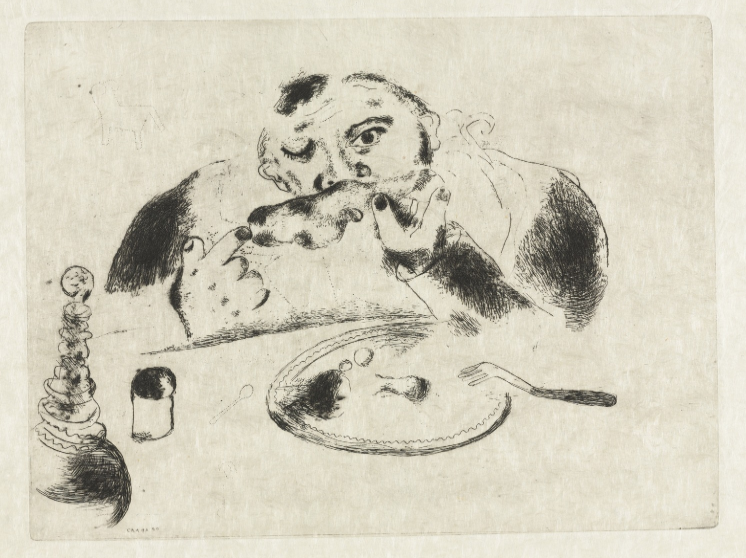
“Got any suckling pig”” Chichikov asks a peasant woman at an inn. “’Right’. ‘With horse radish and sour cream?’ “With horse radish and sour cream’. ‘Bring it here then!’” When Chichikov dines at Sobakevich’s estate, he knew he’d met his culinary match, his gastronomic equal. “This one’s no novice when it comes to eating,” Chichikov thinks, “he helped himself to about half of a saddle of mutton and proceeded to gnaw it clean and suck dry every last bit of bone…The saddle of mutton was followed by round cheese tarts, each larger than a good-sized plate; then a turkey, about the size of a calf, stuffed with all sorts of things—eggs, rice, liver, and God knows what; all of which formed a heavy lump in the eaters’ stomachs. When they rose from the table, Chichikov felt himself about forty pounds heavier.”

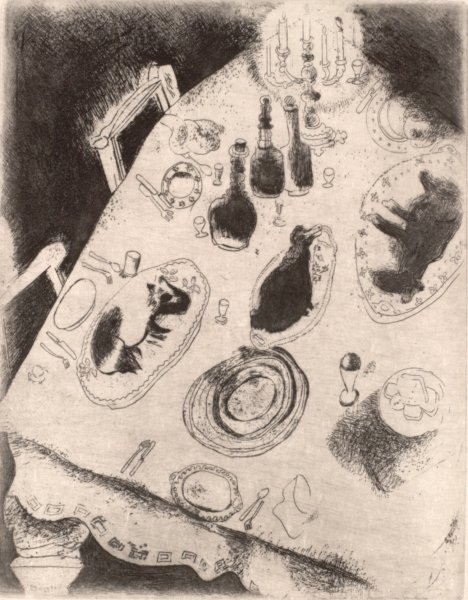
Marc Chagall’s illustrations from Dead Souls

Gogol hadn’t finished with food by the time he worked on Part 2 of Dead Souls, before he threw much of it in the fire. What survives as drafts feature food, and Chichikov is still munching his way across provincial Russia, still dining with provincial gentry, freeloading as ever. On one occasion he’s the guest of an obese foodie, Piotr Petukh, who eats himself and invitees out of house and home. Good job he lives in the cheaper countryside, Chichikov muses to himself; in Petersburg or Moscow, his generous hospitality would fast render him a pauper.

“The servants kept coming and going with remarkable speed,” writes Gogol, “constantly bringing something in a covered dish from which the sound of sizzling butter could be heard…Chichikov ate virtually twelve pieces of something and was thinking, ‘Well now our host isn’t going to add anymore’. Quite wrong: without a word, Petukh put on his plate a rack of veal, with kidneys, spit-roasted, and what a calf, too. ‘I reared it on milk for two-years’, said the host. ‘I looked after it as if it were my own son’. ‘I can’t’, said Chichikov. ‘Try it first and then say I can’t’. It won’t go down. I’ve no room’.” Still, Chichikov does try it and, rather inevitably, found room, “when it seemed that no more could be crammed in.”

Our hero went to bed with his stomach “taut as a drum.” And even then, lying there, he could hear his host Petukh talking in the kitchen with his chef about next day’s lunch, making plans for another feast, giving precise instructions about its preparation. “’Make the fish pie with four corners’, Petukh said, sucking his teeth and taking a gulp of air. ‘Put the sturgeon’s cheeks and dried spine in one corner, put the boiled buckwheat in the second corner, with mushrooms and onion, and some sweet milk and the brains and a bit of this and that, you know what…And make sure it is browned on one side, you know, and a bit less done on the other side. And bake the underneath so that everything is absorbed, so that all the taste comes through, so that it all, you know, not crumbles but melts in your mouth, like snow, so that you don’t notice!’ As he said this, Petukh smacked his lips and chomped.”

“And to garnish the sturgeon,” he adds, “cut the beets in the star shapes with smelts and milk-cap mushrooms, and add some, you know, turnip and carrot and broad beans and a few other things, so we have a garnish, as big a garnish as possible. And put a bit of ice into the pig’s belly to make it swell up nicely.” “And Petukh ordered many more dishes. All that Chichikov heard was ‘and fry it and roast it and let it stew nicely’. When Chichikov got to sleep, turkey was being discussed.”

This is hilarious, deadpan humor, written clinically and matter-of-factly; but it’s Gogol at his comic best, the master of satire, its darkest. (I’ve always thought it a pity that André Breton never included Gogol in his masterly collection of surrealist black humor, Anthologie de l’humour noir.) Like Petukh, Gogol is obsessed by food, but his parodies of his characters’ obsessions seem equally a parody of himself, of his own obsessions, because he’s able to see through them, recognize them, pull tongues at himself. One of his weirdest tongue pullers is Diary of a Madman, where even the dogs have their minds’ fixated on food. About having nothing to eat, one says: “I must confess that would be no life for me. If I didn’t have woodcock done in sauce or roast chicken wings, I don’t know what would become of me…Sauce goes very well with carrots or turnips, or artichokes…” Remember, Gogol’s eponymous madman hears dogs talking to each other in human language.

But Gogol’s catalogue of gastronomic delights also exhibits real insight into food, into its preparation and meaning in life. He fretted about noses, especially his own, another obsession; and yet without a sense of smell, there’d be no sense of taste, nothing to salivate about. And Gogol lets us sniff the culinary gorgings he presents for us. For good reason did Nabokov say that “the belly is the belle of his stories, the nose their beau.” Perhaps not unsurprisingly as well, Gogol not only loved to eat; he took enormous satisfaction cooking for others, for his friends, finding in Italy a culture with a deep sensitivity and appreciation of food, of its conviviality, one of the joys of collective life, pure and simple, like eating cabbage soup around the rural Russian kitchen table.

In Rome, meanwhile, he’d mastered the art of how to prepare baked macaroni, something of a house specialty when friends came over to via Sistina. He was fanatical about his macaroni, ritualistically make masses of it, piping hot, sizzling from the oven, drooling with copious dollops of butter and grated parmigiano. He’d never skimp on making it as creamy and delicious as possible, with calories galore. Gogol’s spirits would rise whenever he had the chance to serve up his macaroni to friends. “Opening the lid, with an especially bright smile for everyone at the table,” Pogodin remembers, “he’d exclaim: ‘Now fight over this, people!’”

The only problem was that while Gogol loved food, food didn’t always love him. He suffered over it, suffered some mix of constipation and diarrhea, compounded by (and related to) his arch-complaint: hemorrhoids. Was this prompted by overeating? Too much of the wrong foods? Too much fat? Too much butter and cheese? Gogol would pile on the butter, devour parmesan, indulge in the most indulging foods—and afterward complain about his stomach. Go figure…

Was it a genuine nervous stomach? Or just Gogol at his most hypochondriacal, always super-sensitive about his own health? “I’m afraid of the hypochondria,” he wrote Prokopovich from Geneva (September 19, 1837), “which is changing me and is right on my heels.” “My stomach is nasty,” he says, “to an impossible degree; and although I eat very moderately now, it absolutely refuses to digest. After my departure from Rome, my hemorrhoidal constipation began again, and would you believe it, if I have no bowel movement during the whole day I feel as if my brain had some kind of cap pulled over it, which befogs my thoughts and prevents me from thinking. The waters didn’t help me at all, and now I see that they are terrible rubbish, I just feel worse, my pockets are light and my stomach heavy.”

You have to know who your real friends are to write them letters like this.

Elsewhere, to Pogodin from Naples (August 14, 1838), he says: “my hemorrhoidal disease has turned all its force on my stomach. It’s an unbearable disease. It’s drying me up. It tells me about itself every minute and hinders my work.” Gogol seemed trapped in a vicious cycle of real ailment and imagined ailment; the latter hypochondria triggered the former, and the two probably fueled each other. As Gogol wrote a few years earlier (1836), from Paris: “my doctor found symptoms of hypochondria in me, resulting from the hemorrhoids; and he advised me to amuse myself…there are a multitude of places for walks…enough for a whole day’s exercise—which is essential for me now.” Sometimes, says Gogol, “I feel awful crap in my stomach, as if someone had driven a whole herd of horned cattle in there.”

***

In an insightful essay, “The Hunger Artist: Feasting and Fasting with Gogol,” published in The Global Gourmet (June 28, 2008), the food scholar Darra Goldstein assesses Gogol’s digestive torments. Her theory is that Gogol suffered from what today has been diagnosed as irritable bowel syndrome (IBS), “which presents itself in a number of different ways,” Goldstein says. “Some people endure constipation,” she says, “others diarrhea; some, like Gogol, suffer from both. In all cases, IBS causes great discomfort and distress and can be disabling.” “Emotional conflict or stress is often believed to trigger the condition,”Goldstein says, “though most likely IBS results from both stress and improper diet.”

Gogol’s IBS might have been triggered by the fattiness of his diet, by all that cheese and butter, by all the rich food he seemed drawn to; his nervous reactions and hypochondria sought only to make compound matters. He seems to realize this himself, writing to Pogodin from Rome (October 17, 1840): when his stomach plays up, he says, “the nervous disorder and irritation increased terribly; a heaviness and pressure in the chest which I had never before experienced grew strong. Fortunately,” Gogol goes on, “the doctors found that I haven’t consumption, that this was an extreme irritation of the nerves and a stomach disorder which stopped digestion. This didn’t make me feel any better…A painful anguish which has no description was combined with this. I was brought to a state that I absolutely didn’t know where to turn, where to find support. I couldn’t stay calm for two minutes in bed or in a chair or on my feet. Oh, it was terrible.”

“There’s still no cure for IBS,” notes Goldstein, “and apart from recommended moderation in diet—something Gogol seems to have been temperamentally incapable of—there is no real treatment.” Moderation around food was especially hard for Gogol, thinks Goldstein, doubtless correctly, as “his illness, his gut feelings, fed his art. His source of torment—his appetite—became his inspiration, his muse, transforming into literature the hunger that affected his whole being. His gourmandizing bespoke something beyond a mere physical urge; his hunger was existential, not easily satisfied.” All of which strikes as a more wholesome and accurate assessment of Gogol’s gastric literature.

I say this because it’s suggested that Gogol’s obsessions with food are really transferences of his repressed obsessions with sex. Gogol was a strange man, for the most part a-sexual though with evident homosexual tendencies; yet there’s nothing repressed about his obsessions with food. It is what it is. Nabokov made the same point of Gogol’s nose fetish, locating it as much in Russian folkloric history and culture as in psychology and psychoanalysis.

To that degree, Gogol’s foodie manias reflect the experience of growing up, of a rural upbringing—quite the reverse of anything repressed: these Russian festivals and village fairs from his childhood, source material for his early Ukrainian stories, abound with food and drink, and toast life’s pleasures. If anything, they were more collective “blow-outs,” what François Rabelais in sixteenth-century France called “ripailles.” This medieval tradition had its own vitality in the Russian rural provinces, defined seasonality and collective memory, the good fortune of being alive, that you can enjoy it, if only for a day. Who knows or cares about tomorrow?

What took place weren’t simply meals shared by the townsfolk but celebrations of conviviality and appetite, celebrations of terrestrial life itself. Affirmed was abundance and generosity, gorging and over-indulgence in the absence of moderation. Three-cheers to excess! It’s surely not too far removed from how Gogol implicitly used his prodigious food and feast scenes. Food, for him, was more anthropology than sexology, something more personally cultural and historical. Food gave Gogol, the writer, insights into the Russian psyche, into everyday cultural life, especially everyday provincial life. (Food never figures in the same way for an urban Petersburg gentry; there it really does become something repressed.)

A meal, in this provincial context, could be something soothing, an act of diplomacy, a moment when you sit around the dinner table, perhaps with an enemy. When the two Ivans—once dear friends, neighbors so close and intimate they were like brothers—had their great tiff, falling out over a trifle, with one Ivan calling the other Ivan a “goose”—the town tried to reconcile the quarrel by organizing a sumptuous dinner. Food was taken as something placatory, a ritual that could bring people together.

“I will not describe the courses,” Gogol’s narrator says, before going on to describe the courses: “I will make no mention of the curd dumplings with cream sauce, nor of the dish of pig’s fry that was served with the soup, nor the turkey with plums and raisins, nor the dish which greatly resembled in appearance a boot soaked in kvass, nor of the sauce, which is the swan’s song of the old-fashioned cook, nor the dish which was brought in all enveloped in the flames of spirit.” Still, even this great feast couldn’t bring the former friends together, such was their animosity toward one another; even food couldn’t make this little world less gloomy, says Gogol, at the end of his story.

Gogol was a great populist when it came to food, a democrat who wanted to share his meals with others, with friends, who enjoyed cooking for others, and dining out amid people, oftentimes with “the people.” (He rarely dined alone.) This was particularly so in Rome, where he was fond of the more plebian, down-to-earth taverns, rubbing shoulders with the common folk. The Russian historian and memoirist, Pavel Annenkov, who wrote an early Pushkin biography, remembers visiting Gogol in Rome in the 1840s. “My friend Gogol took me to the famous Lepre tavern, where at mealtimes, at long tables, crossing the filthy floor, a diverse crowd gathers: painters, foreigners, abbots, citizens, farmers, and princes join in a general conversation, devouring the very dishes that, in truth, thanks to the chef’s long experience, are impeccably cooked.” (Annenkov lived with Gogol for two months in Rome and in his reminiscences said that he copied large sections of Dead Souls, listening and trying to follow Gogol’s rapid-fire dictation.)

Interestingly, at the same time as Annenkov was visiting and dining with Gogol in Rome, he was also engaging in a lively dialogue with a certain Karl Marx in Paris. The twentysomething Marx and Annenkov (1813-1887) were practically contemporaries, and seemed to find agreement in their criticism of anarchist Pierre-Joseph Proudhon. Annenkov met both Marx and Engels in Brussels in the spring of 1846, witnessing a fierce public debate between Marx and Weitling. Later, in December 28, 1846, from Paris, Marx wrote Annenkov a very long letter in what Marx admitted was his “bad French,” addressing the defects of Proudhon’s Philosophie de la misère. Annenkov told Marx on January 6, 1847, that “your opinion of Proudhon’s book produced a truly invigorating effect on me by its preciseness, its clarity, and above all its tendency to keep within the bounds of reality.”

When Annenkov published his reminiscences of an Extraordinary Decade, 1838-1848, he was perhaps the only man alive to have rubbed shoulders with both Gogol and Marx. Turgenev called Annenkov “a master at crystallizing the specific character of a period.” That extraordinary decade, of course, was to produce not only dramatic political upheavals throughout Europe, but also, and maybe not uncoincidentally, texts like The Communist Manifesto (1848), as well as some of Gogol’s best short stores, especially “The Overcoat” (1842).

No matter where he went, whether eating high or low, Gogol was forever fastidious about his food. Annenkov remembers he often asked Orillia, Lepre’s legendary old waiter, rumored to have been in Moscow with Napoleon’s army, to change any dish he didn’t find to his liking. Fyodor lorden (always lower case “l”), a Russian engraver friend of Gogol and sometime via Sistina neighbor, recalled that at the Lepre (“hare” in Italian) “you could meet people from all parts of the world; at every other table another language was being spoken, of which Russian reigned over the rest, outmatching them in the noise of loud arguments.” By all accounts, the Lepre was the cheapest and most democratic of Rome’s trattorias, with one of the best cuisines. (In the 1850s, a decade on from Gogol, Herman Melville, a regular, marveled at the quality and price of a full meal: nineteen-cents.)

Nothing remains of the Lepre today. There are no images (apart from a painting of a mother with her two daughters, lunching heartily at an establishment thought to be the Lepre), and no physical remnants left inside the courtyard of the Palazzo Maruscelli Lepri, where the Lepre was located—via Condotti, 9-10, exactly opposite Caffè Greco. The palazzo itself was constructed in 1660 for the Maruscelli family, who sold it later in the eighteenth-century to the Lepri family, wealthy Lombard merchants who’d settled in Rome a century prior. But the Lepris fell on hard times during the nineteenth-century, and the marquis, on the verge of financial ruin, began renting out rooms in the palazzo’s courtyard. The family’s cook had always dreamed of opening his own restaurant and offered to feed the marquis and his entire family for five sous each, provided they let him open a small trattoria in the kitchen on the ground floor of the building. The marquis agreed.

The trattoria, inaugurated as “Trattoria della Barcaccia”—on account of the “Fountain of the Barcaccia” [Longboat] facing the Spanish Steps—later changing its name to “Trattoria della Lepre,” quickly became one of the most famous eating houses frequented by tourists and émigrés. The Lepre was famous for another reason, because it’s reputed to have served supplì, the famous Roman street food, its first recorded mention in Roman history, in 1874, when the deep-fried, golden and crispy risotto rice croquettes, filled with mozzarella, minced beef and tomato sauce, were listed on the Lepre’s antipasto menu. It’s the sort of snack Gogol would have doubtless wolfed down.

Gogol lapped up the tavern’s raucous atmosphere, its culture and honest cuisine. Before long it became a surrogate members club for Russian expats, especially Russian painters, where they could listen to articles from the Russian press read aloud. It was at the Lepre where Gogol first heard and appreciated the Romanesco sonnets of Giuseppe Gioachino Belli, voiced by the renegade poet himself, in Roman dialect, in the speech of Trasteverines—i trasteverini. Belli satirized the clerics and the popular classes of his day, castigating the hypocrisy of the former and the passivity of the latter. His verse, unpublished in his lifetime, was rooted and voiced in the language of his chosen constituency: the unflinching everyday reality of Rome’s underclass.

(Anthony Burgess, a fan, translated some of Belli’s sonnets, putting them into Mancunian slang in his 1977 novel, Abba Abba, emphasizing cultural translatability if not literary accuracy. Burgess said “Belli was the great master of the dialect and scholarly recorder of Rome’s filth and blasphemy.” Abba Abba, a fictional account of Belli meeting the English poet John Keats, another Rome denizen, presented seventy-one of Belli’s Roman sonnets in its second part, translated by J.J. Wilson, a pseudonym for Burgess himself—his full name is actually John Anthony Burgess Wilson. Burgess wanted to call his novel Belli’s Blasphemous Bible, but publishers Faber & Faber, fearing libel, balked, talking Burgess out of it.)

Gogol was privileged to hear Belli reading at the Lepre and expressed his enthusiasm in his letters. He wrote Maria Balabina (end of April 1838): “Not one event takes place here without some witticism or epigram being made up by the people. But you probably haven’t happened to read the sonnets of the present-day Roman poet Belli, which, however, one must hear when he reads himself. In them, in these sonnets, there is so much salt, so much totally unexpected wit, and the life of present-day Trasteverines is so faithfully reflected in them that you will laugh, and the heavy cloud which so often floats down on your head will float away together with your tiresome and annoying headache.” High praise indeed!

Gogol sang Belli’s praises in 1839, on a Roman steamboat bound for Marseille, when he encountered the French literary critic Charles Augustin Sainte-Beuve. Gogol seemed to have made a big impression on Sainte-Beuve, who felt compelled to write about his maritime brush with the Russian writer, about his conversations, reviewing at the same time the recent French publication of Gogol’s Cossack novel, Taras Bulba: “Monsieur Gogol told me of having found a true poet,” Sainte-Beuve recalled, “a popular poet, called Belli, who writes in the language of trasteverines, but makes sonnets follow and form poems. Gogol spoke to me in depth and in a manner to convince of the original and superior talent of this Belli, who rests so perfectly unknown to all travelers.”

Sainte-Beuve commented “it is doubtful that any Frenchman had ever read one of Monsieur Gogol’s original productions; I, in this case, was like everyone else. I can, however, claim the advantage of having met the author in person, and I had, after his precise and strong conversation, rich in observations of morals, grasped a foretaste of what must have been original in the works themselves. And Monsieur Gogol, in effect, seems to attach himself before all else to the fidelity of morals in the reproduction of the true and of the natural, whether in the present time or in the historical past; the popular genius preoccupies him, and no matter where its look reveals itself, it pleases Gogol to discover and study it.”

It was at establishments like the Lepre where Gogol consumed popular history, quite literally, keeping his eyes peeled for popular geniuses, for artists such as Belli. But like many things with Gogol, this didn’t last forever. The Lepre was his favorite only for a while, until he switched to the Falcone not far away. “I no longer dine at the Lepre,” he told a friend, “where you don’t always find quality ingredients. Better is the Falcone,” he said, “near the Pantheon, where the mutton rivals those from the Caucasus.”

Thinking of food as ever.

***

Indeed, thinking of food, I decided I needed to get out into Rome myself, needed to see traces of Gogol’s culinary world, remnants of his dining dens. It’s late July, a hot and sunny afternoon; Rome is inundated with its summer tourist season. Everywhere seems insanely busy. Today, I look like a tourist myself, dressed in shorts and baseball cap, armed with a camera; an intellectual tourist with a mission. I’m standing outside Gogol’s old apartment again, at via Sistina number 125, about to follow the path he likely took to dine. I begin the steady climb toward the Spanish Steps, then down the steps, past la fontana della Barcaccia, immediately accessing via Condotti. Soon the Caffè Greco appears to the right, shuttered, closed for its habitual summer recess.

Facing are numbers 9 and 10 via Condotti, a regal looking five-story building, once the Palazzo Maruscelli Lepri, with its grand entrance arch still remaining, leading you into a darkened courtyard. Gogol would have walked through this doorway, into this darkened corridor, on his way to the Lepre, situated somewhere inside. I’m lucky today, because the doorway is open. So I wander in, take a nose around; the portiere doesn’t seem bothered by my taking photos. There’s absolutely nothing remaining here of any popular eating place, zilch remnant. The tone of the present Palazzo resembles the rest of via Condotti, these days super-upscale and wealthy: Gucci is to the left, Bulgari is to the right, each either side of the entrance arch. Would Belli have pulled tongues at this in his verse? Would the flamboyant Gogol ever have worn Gucci?

I continue along Condotti, toward via del Corso, which I head down, southward. I’m on my way to Gogol’s other favorite eating joint, the Falcone, at Piazza dei Caprettari, not far from the Pantheon. It’s incredibly crowded, uncomfortably so, and I dodge people along the pedestrianized section of Corso, watching out for scooters and bikes. I make a right turn, walk southwest. The Falcone was fifteen minutes away from the Lepre. I’m not sure which route Gogol would have taken, but have a hunch he would have wanted to stroll past the Basilica San Lorenzo in Lucina. I go down via di Campo Marzio, onto via della Maddalena. In the 1840s, there’d be no need to avoid the Pantheon; you could walk in front of it unjostled, unharrassed by crowds of people: you could stop, briefly, admire, look on in awe. Those days have passed.

A couple of minutes east of the Pantheon is the Piazza dei Caprettari; on one corner is number 56, the Falcone. I never realized the site is next door to my beloved Roman pen store, the Antica Cartotecnica, which has repaired some of my old fountain pens with patient, artisanal care. Such a low-tech, independent, labor-of-love enterprise is a rarity in the center of any capital city, That’s the good news. The bad news is that there’s no more Falcone, nothing left of it, replaced by a fancy looking new restaurant called “Idylio.” Its three-course lunch menu starts at seventy euros. The restaurant, headed by the acclaimed Italian chef Francesco Apreda, has one Michelin star, and is run in conjunction with the nearby Pantheon/Iconic Rome Hotel. Gucci-clad Gogol might’ve loved to dine here, devoured probably great cuisine; at someone else’s expense, though. (“Idylio,” incidentally, is a short poem that idealizes peaceful rural life, focusing on everyday simplicity and beauty.)

It’s hard to know whether my Rome is more or less interesting than Gogol’s. Things change, have to change; he knew that, I know that. So much of Rome’s physical landscape remains, however, has hardly changed, and I’m conscious I can walk streets Gogol walked through, am surrounded by buildings that surrounded Gogol. Nothing has been razed and rebuilt—it is impossible to knock anything down in much of Rome, given its strict historic preservation laws, just as it’s impossible to build anything new. The route I’ve just taken is comparable to Gogol’s, and I feel blessed to be able to follow in his footsteps.

When it comes to content, to what lies within, Rome’s central city fabric has been flattened by mass tourism; almost everything that was once “popular” with Romans themselves has been wiped out. The center is less diverse, culturally and socially, largely emptied of popular characters, of struggling artists and poets, of émigré dissidents arguing over politics, of a cheap fare nourishing them alongside the city’s working classes. Am I disheartened? Not really. I’m just glad to be here, in a Rome that today is what it is. Gentrification has taken place. Yet compared to the other big cities I’ve lived in—London and New York especially—it hasn’t wiped out everything. My old pen store, after all, neighbors a Michelin star restaurant and where else in the world would that be the case?

To hear Belli’s verse, in its modern day incarnate, you’d have to journey elsewhere in the city, somewhere peripheral, marginal. For the moment, I’m off walking again, in what is still an eminently walkable urban environment, not despondent in the sunshine. I head across town, across the Tiber, over the Ponte Garibaldi, into Trastevere. I’m off to see the last trace of Belli, of the poet himself, a prominent statue of the man in his very own piazza—Piazza Giuseppe Gioachino Belli—posthumous immortalization. Belli was born on September 7, 1791, and died, aged seventy-two, of a sudden apoplectic fit, on December 21, 1863. He led a bizarre double-life: a shadowy clandestine writer of vernacular verse, hanging out in rough and tumble dive Roman taverns by night, reading his obscenities aloud; by day holding down a respectable job, a theatrical censor in the papal court.

Belli’s statue has a commemorative wreath on it; I’m not sure why. The poet dandy is dressed in a suit and waistcoat, his greatcoat wide open and flowing. He’s donned in a distinguished looking top hat. But the structure looks a bit worse for wear, maybe a bit unstable, because it is wrapped in a supporting brace, perhaps heralding some kind of renovation. Still, it’s a wonderful re-creation of the poet; up close you can see that his smart garb is shabby, rumpled, though his gaze is vivid, wistful. Head dipped, he’s lost in thought, crafting some risqué line in his head. The statue was consecrated in 1913 and is dedicated to Il Popolo di Roma—to “the People of Rome”—who are lovingly evoked at the back of Belli: a half a dozen or so grizzled and gnarled figures, Trastevere’s working populace, the subject matter of his sonnets. I snap away at their faces, worn but not worn-out, faces still somehow beautiful, authentically real.

It’s often said that Belli’s poetry dealt with Rome’s six “Ps”—pope, priests, princes, prostitutes, parasites, and the poor. Here we have the poor, the forgotten people in history that Gogol once spoke about—though here they’re not entirely forgotten. We could imagine these characters snuggled around the Lepre, with Gogol lurking somewhere in their shadow, smiling, laughing at the elemental verse of his poet friend, feeding Gogol’s stomach with “proper” words and scoff: “Yeah, when it comes to cooking, lard’s best…puts hairs on your chest! With bacon it’s a dream, with rarebits it’s the business, chicken too, and roasted meat, and as for stews and sauces, works a treat.”

‘Now, Doc, this fever what I’ve got,’ I went;

‘it means I have to watch out what I scoff?’

He goes, ‘One’s fine when eating wholesome stuff,

my man—one has to eat, mm? Excellent!’

So I eats, whole, some stuff, just like he said:

whole cantaloup, whole cheese, whole loaf of bread,

salami, watermelon and a hen…

Sod it, he should’ve spoken proper when

he came that day to brandy words about:

‘Scoff top-notch tucker pal, but don’t pig out’.”

Posted in All | Leave a comment

PICTURING GOGOL

A fifteen-minute stroll from Caffè Greco, west toward the Tiber, north in the direction of Piazza del Popolo, takes you to Via di Ripetta, which I head up, a narrow corridor running parallel to the river. I pass the Mansoleum of Augustus, the Academia Belle Arti Roma, and a few artisanal artist stores that look like they’ve been here forever, maybe even around when Gogol paced this beat. After a few minutes, the cobbled passageway of Via del Vantaggio bisects Ripetta, and I turn left along it, toward number 7, at the river end of the street. On the building’s wall, at first-floor level, is a plaque, faded over time, announcing that “the great Russian painter Alexander Ivanov, lived and worked here from 1837 to 1858.”

Ivanov, one of Gogol’s closest friends, perhaps his most intimate of intimates in Rome, spent twenty-eight-years living in the city; arriving in 1830 on a student scholarship to study renaissance painting, he never returned. His building along Via del Vantaggio is everything you’d imagine for a struggling artist: a garret-studio, on a little street, romantically rundown and worn, a quaint, quiet corner of Rome’s historic center, off the beaten tourist track. Tourists cram the city all the year round, treading very well beaten tracks; yet usually you don’t have to stray too far, wander into some unsuspecting and unspectacular corner of city, to find the coast clear. As I snap photos, I’m the sole person about.

Ivanov worked here day and night on his great religious masterpiece, “The Appearance of Christ to the People,” twenty-years in the making, much admired and encouraged by Gogol, finished only a year before Ivanov’s untimely demise with cholera in 1858. Gogol never saw it completed. In Rome, he and Ivanov became an inseparable couple, inspiring one another. In Gogol, Ivanov saw a writer-prophet, a verbal messenger from God; in Ivanov, Gogol acknowledged the conveyor of the spiritual image, an artist-prophet, the incarnation of the writer’s faith in the power of art and image. Gogol became a staunch advocate of Ivanov’s, writing letters of support for the painter, requesting funds for him to finish his great masterwork. Gogol often tagged on appeals for money for Ivanov with appeals for money for himself, maintaining that artists were better patronized than writers; scholarships and grant organizations (like the Russian Society for the Encouragement of Artists) existed for them, whereas for struggling writers there was nothing.

Gogol’s profile, “The Historical Painter Ivanov,” appearing in the notorious Selected Passages from Correspondence with Friends, reads one part eulogy, another part cap in hand appeal to find alms for his artist friend, starved (sometimes literally) of resources. “He goes his own way,” writes Gogol of Ivanov. “He isn’t only not seeking a professorial post and worldly advantage, but he seeks absolutely nothing, because for a long time he has been dead to everything in the world except his work…This lesson is necessary so that others may see how it is to love art: that it is necessary, like Ivanov, to die to all enticements of life; like Ivanov, to instruct oneself and consider oneself an eternal student; like Ivanov, refuse oneself everything, even an extra dish on feast days; like Ivanov, to wear a simple pleated jacket when at the end of one’s resources and scorn vain conventions; like Ivanov, to endure all, despite one’s lofty, delicate spiritual makeup.”

Ivanov was a poor talker, only able to express himself in paint. Yet he was a good listener, and it was Gogol, despite being three-years Ivanov’s junior, who did most of the talking, who assumed the lead role. The painter was infatuated with the writer, holding the latter in enormous esteem, so much so that Ivanov even included Gogol in his epic canvas, as an old man in the extreme left of the frame, standing in the water with a walking stick, an emaciated figure, uncannily resembling what the writer might have looked like had he grown old, had he made it into his seventies, wizened and stooped, piously devout, almost bald yet recognizable from his prominent snout. (Ivanov also added a discreet image of himself, sitting on the ground in the background, in Christ’s shadow, a bearded wanderer wearing a floppy hat, his profile looking upward, as youthful as he would have been when he began his painting.)

In the early 1840s, Ivanov painted two portraits of Gogol, as the writer had stipulated, “in great secrecy from everyone,” together with numerous pencil sketches, mini masterpieces in their own right. The first portrait was undertaken in September 1841; the second, more famous image of Gogol, executed in 1843, is an intimate rendering of the writer looking disheveled and dissolute, like it was painted the morning after a late night; Gogol lounges in his red dressing gown; his hair and moustache are tousled and roughed up, his eyes a little glassy, almost bloodshot. Did Gogol wander over in his dressing gown to pose in Ivanov’s studio? Or did Ivanov come to Gogol, to Via Sistina, working there from sketches of his friend, relaxed, in his domestic habitat, comporting himself without pretense, his public mask removed?

Gogol trusted Ivanov’s brush, had confidence in the discretion of his friend, portraying a purer image of how Gogol looked when he stared into his bathroom mirror each morning. When Gogol saw Ivanov’s picture, he admired and appreciated it, yet dreaded ever seeing the portrait reproduced. After Pogodin received a lithograph, the editor reprinted it without permission in his review The Muscovite for its readers to see, and Gogol’s dread of seeing himself paraded before the world, in casual garb, reached pathological proportions. He felt betrayed by a man whom he thought was a friend.

He wrote Shevyrev on December 14, 1844: “it cannot be comprehensible to someone else, why the publication of my portrait is so unpleasant to me…I am depicted there as I was in my own den. I gave this portrait to Podogin as a friend, in no way suspecting he would publish it. Judge for yourself whether it is useful to exhibit me before the world in a dressing gown, disheveled, with long rumpled hair and moustache…but it is not grievous to me myself that I was exhibited like a debauchee.” (After Gogol’s mother obtained a copy, son begged mother “to hide it in a back room, sew it up in a canvas and don’t show it to anyone to make a copy from it, not even my sisters.”)

Gogol’s attitude to portraiture was an odd mix of egoism and humility, an arrogance and a conceit of seeing himself portrayed, of wanting to see himself exhibited on canvas, immortalized and famous, yet horrified and paranoid about being displayed before the world. Portraiture, for him, became a mysterious dialectical force, both demonic and divine. He seemed unable to defy it, to avoid it, because Alexander Ivanov wasn’t the only artist he entrusted to paint him; Fyodor Möller (1812-1874), Baltic-born of German stock, was another, a painter who’d arrived in Rome in 1838 and for number of years was Gogol’s neighbor at number 43 Via Sistina.

An admirer of Ivanov, Möller soon entered Gogol’s inner fold, and he and Gogol spent a lot of time together, drinking tea and philosophizing, and Möller accompanied Gogol on his regular long jaunts around Rome and its environs. Möller recalls how they’d sometimes walk for hours on end without ever saying a word to each other; Gogol was content merely to have a companion by his side, feeling no reason to talk, humming to himself merrily.

It was out on one of their walks in 1840 when Möller made his first portrait of Gogol. This initial alla prima effort shows a radiant Gogol dressed in travel-cloak, face illuminated by rays of setting sunshine. Head lowered, his expression is sly, somewhere in between a smile and a frown. For many years, Möller kept this portrait in his own possession, eventually selling it in 1870 to Moscow’s Tretyakov Gallery, where it hangs today.

Möller’s second portrait, made in April 1841, mimics Ivanov’s, and captures the writer at home, wearing another dressing down, a fawn stripped one, with his pajama top open, revealing part of Gogol’s bare chest. This time, though, Gogol’s hair is neatly coiffed, his little moustache coquettishly manicured. His face is plumper than Ivanov’s image, pink round cheeks giving him a healthier looking glow, highlighting how, despite literary fame and prominence, Gogol was still rather baby-faced.

Möller’s best-known portrait was his third, painted at the end of 1841, commissioned by Gogol’s mother, Maria Ivanova Gogol-Yanovskaya. A more classical, formally-posed Gogol looks neat and dandy, smartly dressed in elegant button-downed frock-coat and silk scarf, stylishly knotted at the neck, with a classy looking gold chain dangling around his front. This is the writer with a glint in his eyes, and just a hint of a grin, ready to dine with mother in some fancy restaurant.

Möller’s portrait was highly acclaimed, reckoned to capture Gogol’s true appearance, something seemingly accessible only to an intimate. In 1845, Gogol said “Möller’s portrait was the only one to give a good likeness.” Until 1919, the portrait remained in the Gogol household, whereupon it was transferred to the Yaroshenko Museum in Poltava, Ukraine. During World War II, though, it disappeared; thought destroyed, it never showed up again. This image of Gogol that Möller created in Rome, today likewise displayed in Moscow’s Tretyakov Gallery, is thus a copy.

***

Interestingly, and surely not uncoincidentally, while Ivanov and Möller were painting portraits of Gogol, Gogol himself was immersed in creating (and re-creating) his own Portrait, one of his best-known short stories. He’d originally published it almost a decade earlier, in Arabesques (1835), “a mishmash” collection (according to Gogol) of fiction and non-fiction, of essays on art and architecture, on the Middle Ages, on Pushkin, alongside two other brilliant stories, The Nevsky Prospect and Diary of a Madman. On March 17, 1842, Gogol wrote Peter Pletnev, editor of The Contemporary (Pushkin’s journal): “I’m sending you my story, ‘The Portrait.’ It was printed in Arabesques, but don’t let that worry you. Read it through and you will see that only the canvas of the former story remained, and everything is embroidered on it anew. In Rome, I reworked it completely.”

The Portrait (Take-1) had been written before he’d met either Ivanov or Möller; it’s fascinating to speculate whether in Ivanov Gogol had found a real life reincarnation of the fictional artist who cameos near the end of the story, and who embodies Gogol’s own artistic ideals, or if Ivanov had himself became a creation of Gogol, mimicking and fulfilling this ideal, the spiritually pure artist whose canvas left viewers gasping in awe.

Vissarion Berlinsky, the well-known liberal critic, thought the supernatural in Take-1 too clumsy, not leavened by the story’s brilliant realism, a feature, Berlinsky said, that made Gogol’s most unbelievable and incredible moments believable and credible. Gogol, as ever, took only part of Berlinsky’s critique to heart; in Take-2 he’d never abandon his torquing of reality, never expunge the surrealist flourishes that made his ordinary so extraordinary, his satire so biting, his creations so idiosyncratic and original. He was much too subtle an artist to capitulate to either the dullest period-piece realism or the most contrived and fantastical surrealism. Gogol would forever work against predictability, often turning his own inventiveness against itself, just when we’d least expect it, having us, his readers, twist and turn as his characters twist and turn, as he himself twists and turns, gyrating to some weird cosmic force.

Indeed, Gogol’s The Portrait once had a powerful gyrating effect on me, too, a ghostly presence when I think about it now, remembering the mornings, years gone by, when I used to walk my daughter to school. Along a narrow old lane, near the town center, by the cathedral, we’d pass a little pub called “The Prince Albert.” On a pole sticking out above the pub’s entrance hung a portrait of the said Prince Albert, Queen Victoria’s husband, painted by royal artist John Partridge in 1840. On windy days, the prince oscillated in the breeze. Every morning I’d grin, laugh to myself, sometimes laugh out loud. It got a bit boring for my daughter, for she knew what I was laughing at. After all, I’d tell her every day, “you know, that Prince Albert up there, he’s a dead ringer for Gogol.” She knew, too, that I meant Nikolai Gogol, a longtime favorite of mine. The thin prominent nose, the vivid eyes, the little well-groomed moustache, the general affected air, camp despite the military regalia—all that was Gogol to a T!

I’d actually seen for myself Möller’s best-known image of Gogol in 2016, not knowing then it was a copy, at London’s National Portrait Gallery, displayed at an exhibition called “Russia and the Arts.” This was Gogol at his most Prince Albertian—or was it Prince Albert at his most Gogolian? The notion that Gogol had a doppelgänger, that Prince Albert was secretly Gogol, or that Gogol was secretly Prince Albert, sneaking out of Russia, condemned for his mockery of provincial officialdom in the rollicking drama Government Inspector, eloping clandestinely into British royalty, struck me as itself quintessentially Gogolian.

Roaming Europe under an assumed identity was as bizarre and surreal as only Gogol could render believable. “There was always something bat-like or shadow-like in his flittings from place to place,” Nabokov says. “It was the shadow of Gogol that lived his real life.” His antics when traveling were legendary, often assuming fictitious names like Gogel and Gonel, hating having to show his passport. Play-acting was a standard repertoire, feigning losing his documents, rummaging through his suitcase, causing a scene and getting angry, swearing, manically throwing out his clothes until customs officials finally gave up and let him pass. (When younger, Gogol sometimes signed himself off “0000,” four-zeros stemming from the four “o”s in “Nikolai Gogol-Yanovsky,” his full name. “The selection of a void,” suggests Nabokov, “and its multiplication for concealing his identity, is very significant on Gogol’s part.”)

Maybe I’d read too much Gogol to think up such a pairing, even though Gogol and the German-born Prince Albert (1819-1861) were actual contemporaries, both dying relatively young, each aged forty-two. Yet it was seeing Prince Albert with his bird-like nose, and glimpsing Gogol’s image in London’s Portrait Gallery—with his own famous beak—that had me recall The Portrait; and I’m having a déjà vu sensation here in Rome thinking about it, standing outside Ivanov’s old building, remembering how Prince Albert’s eyes used to stare out like the eyes that leapt out on Gogol’s poor young artist Chartkov, The Portrait’s (Take-2) protagonist.

Gogol has Chartkov rifling through dusty worn paintings one day at a cheap Petersburg art shop. There he stumbles across a portrait of an old man, with a gaunt, high-cheek-boned face and bronze skin. Most extraordinary of all were the eyes. After much deliberation, and bargaining with its owner, the young artist parts with his last few kopecks and staggers back with the canvas to his draughty studio in the grungiest part of town. Once there, says Gogol, “the two terrible eyes fixed directly on him, as if preparing to devour him.”

At nightfall, trying to doze on the sofa, Chartkov can’t bear the thought of those eyes staring at him like some terrible phantom. He tosses a bedsheet over the portrait. But the moonlight only intensifies its whiteness and ghostly presence, “endowing it with a strange aliveness.” As Chartkov falls asleep, Gogol’s quill springs into action. The white sheet is no longer there; the old man has stirred. Suddenly, leaning on the frame with both hands, he thrusts both legs out to free himself of his confinement. Chartkov attempts to scream yet has no voice. The old man steps down, takes out a sack containing packets of fabulous golden rubles. One pack drops to the floor; Chartkov runs over, clutches it, tries to prize it open but can’t. He cries out—and wakes up.

Chartkov’s heart pounded “as if the last breath was about to fly out of it.” Could it have been a dream?” he wonders. “My God, if I had at least part of that money,” he sighs. Awake, he removes the sheet and sees the old man still inside his frame, his “living, human eyes peering straight into him.” Sweat dripped from Chartkov’s brow, cold sweat. He wanted to back away from those eyes, “but felt as if his feet were rooted to the ground. And he saw—this was no longer a dream—the old man’s features move, his lips begin to stretch toward him, as if wishing to suck him out…With a scream of despair, Chartkov jumps back—and woke up.” “Could this, too,” Gogol asks, “have been a dream?”

Now, his heart is pounding so intensely, it’s on the point of bursting. Terrified, Chartkov dared look again at the portrait; the sheet was still over it. So perhaps it had been a dream after all? And yet, as he continued to look, the sheet began to move once again, hands fumbling under it, inside it, desperately trying to throw off the cover, doing so with menace and impatience. “Lord God, what is this!” Chartkov cries, not believing his eyes, and, crossing himself desperately, suddenly wakes up.

By morning, the room is bleak and gloomy; “an unpleasant dampness drizzled through the air.” It seemed “that amidst the dreams there had been some terrible fragment of reality.” Then a knock at the door heralds the arrival of the landlord and a police inspector, “whose appearance,” Gogol says, “as everyone knows, is more unpleasant for little people.” The landlord, a retired civil servant, “an efficient man, a fop, and a fool, who had merged all these sharp peculiarities in himself into some indefinite dullness,” wants the unpaid rent. Chartkov, with little else, offers him his paintings. But the landlord scoffs, uninterestedly. Meanwhile, the inspector examines the portrait of the old man. As he clumsily picks it up, its frame splits apart. One side falls to the ground along with a packet, wrapped in blue paper, with the inscription “1,000 Gold Rubles.” Chartkov, like a madman, rushes over, seizes the heavy packet.

His woes are over, or so it would seem. Now he has a fortune—as foreseen in his dream. He pays off the landlord, installs himself in a swanky bourgie apartment along the Nevsky Prospect, gets his hair curled, begins sporting fashionable tailored suits, dines at fancy French restaurants, and struts along the sidewalk admiring himself like the most elegant of dandies. Strangely, too, Chartkov’s reputation as a great artist soars. He gets a Petersburg newspaper to publish an article he’d written himself, about his own extraordinary talents, a brilliance worthy of any Titian or Van Dyck. Petersburg’s elite become mesmerized by a new genius in town, and flood him with commissions.

At first, his portraits glow with subtle brush strokes and masterful shading. But sitters want less, are thrilled by cliched images, by empty smiles and upper-crust stiffness. The shallower the portrait, the better—and the more he’s in demand. He’s rewarded with everything: money, compliments, handshakes and kisses, invitations to dinners, to glamorous soirées. Soon, says Gogol, “it was quite impossible to recognize in him that modest artist who had once worked inconspicuously in his hovel.”

The years pass, and slowly but surely the luster of riches and finery wears thin. Chartkov tires of churning out hundreds of the same portraits, of the same faces, whose poses and attitudes he knows now by rote. “His brush was becoming cold and dull, and he imperceptibly locked himself into monotonous, predetermined, long worn-out forms.” What’s more, “he was already beginning to reach the age of maturity in mind and years and already began to gain weight and expand visibly in girth.”

By midlife, Chartkov had become blasé, banal in his state of mind, banal in his state of brush. “Even the most ordinary merits,” Gogol writes, “were no longer to be seen in his productions, and yet they still went on being famous, though true connoisseurs and artists merely shrugged as they looked at his latest works.” He’d “touched upon the age when everything that breathes of impulse shrinks in a man,” says Gogol,

when a powerful bow has a fainter effect on his soul and no longer twines piercing music around the heart, when the touch of beauty no longer transforms virginal powers into fire and flame, but all the burnt-out feelings become more accessible to the sound of gold, listen more attentively to its alluring music, and little by little allow it imperceptibly to lull them completely. Fame cannot give pleasure to one who did not merit it but stole it. And therefore all his feelings and longings turned toward gold. Gold became his passion, his ideal, fear, delight, purpose.”

Still, one event shook Chartkov deeply, and “awakened all his living constitution.” When the Academy of Art invites him to judge a new work by a young Russian artist, an Ivanov figure, already being hailed a great genius, he’s skeptical. After seeing the canvas in the gallery, surrounded by hordes of visitors, he’s stunned: the purest, most immaculate conception hangs on the wall, a painting so modest, so divine that tears flow down the cheeks of onlookers. Chartkov is blown away, stands motionless, “open-mouthed before the picture.”

His whole being, says Gogol, “is reawakened in one instant, as if youth returned to him, as if the extinguished sparks of talent blazed up again.” The blindfold suddenly falls from his eyes, and he realizes he hadn’t heeded his wily old professor’s advice from long ago. He’d ruined his best years, neglected the long, arduous lesson of gradual learning. Instead, he’d become that dreaded species: a fashionable painter. (One wonders if John Partridge, Prince’s Albert’s depicter, ever felt the same way, ever regretted his life as a court artist, whipping off those fawning portraits of royalty and society people?)

Chartkov could no longer bear those lifeless pictures, the portraits of buttoned-up hussars and state councilors, of eternally tidied ladies; he orders them out of his studio. Then he remembers the strange portrait he’d purchased, which had kindled all his vainest impulses, and heralded his demise. A rage bursts into his soul. Bile rises up in him whenever he sees a work marked with the stamp of greatness. He begins to buy up great masterpieces, hauling them back to his room, where he tears them apart, shreds them, cuts them to pieces in a savage orgy of destruction that portends Chartkov’s auto-destruction, bizarrely mimicking Gogol’s own auto-destruction. A cruel fever, compounded by galloping consumption, eventually sees our artist off. “His corpse was frightful,” Gogol notes. “Nothing could be found of his enormous wealth; but seeing the slashed remains of lofty works of art whose worth went beyond millions, its terrible use became clear.”

***

In his epilogue to The Portrait (Take-2), Gogol tells us that the old man with those terrible eyes had been a dreadful moneylender, a loan shark who extorted Petersburg’s poor, sometimes extorting even Petersburg’s rich. Calamity befell upon everybody who took money from him. He possessed some dark curse, damning him and anyone he touched. Even the artist who painted his portrait was struck down by demons, managing to cast them off only by becoming a repentant hermit monk. The painting similarly imparted devilish forces, and tragedy afflicted everyone who owned it, who felt its burning eyes. At the story’s close, as the painting is about to be auctioned off, the painter’s son suddenly appears, demanding the thing be burned, destroyed at all costs—or else.

Gogol worked over The Portrait many times, adding and amending, chopping and changing, deftly touching it up in Rome, reshaping it into one of his finest stories, with some of his best writing; still only in his early thirties, he seemed to have reached the peak of his literary powers, a maestro of the shorter vein. His evocations of Chartkov’s dream phases are so vivid that they capture in prose exactly the blurring of Rapid Eye Movement sleep from wide-awake experience, the imagining of real life, sounding like we’re reading Chartkov in real time, only to find that Gogol wakes us up to the fact it had been a dream all along.

Gogol, meantime, tells us plenty about the role of the artist in our society, about the dichotomy between artistic integrity and everyday materialism, between the art of pure creation and the act of earning a living. It equally says a lot about Gogol’s own plight in the world, too, about his allegiances with “little people,” about how art for him ought to make the highest service toward the moral good. He knew that in a society dictated by money values and governed by shallow, buttoned-up people, genuine artistic passion will always be up against it. Artists like the young Chartkov (and Ivanov) are isolated and destitute, dedicated to their creation, yet fair game to be bought off, commissioned as hired hands, seduced by all the trappings of high society. (Ivanov never relented, of course, was never bought off, never sold out his great romantic dream for art, and that’s likely why Gogol admired him so.)

In 1844, two-years on from Gogol’s Portrait, we might recall Karl Marx in his Parisian garret, a young man not much older than a struggling Chartkov, pillorying, with Gogolian irony, “The Power of Money in Bourgeois Society.” Money, says Marx, “is the universal whore, the universal pimp of men and peoples,” the “inversion of all human and natural qualities.” Marx calls money a “divine power,” “as the estranged and alienating species-essence of man which alienates itself by selling itself.” Money turns one thing into another, inverts everything it touches, converts people and objects into their opposites, into “contradictory qualities” antagonistic to their own qualities.

As such, money “transforms loyalty into treason, love into hate, hate into love, virtue into vice, vice into virtue, servant into master, master into servant, nonsense into reason and reason into nonsense.” And a money tag transforms bad art into a good art, the rich artist into a veritable genius. With its implicit disdain for how money corrupts, The Portrait exhibits more than a hint of young Marx’s romanticism, cautioning us about wish-fulfilment, that we better watch out what we dream for in youth because we might get it later in life. Dreams, needless to say, are a motive force of our lives; yet in a society that conjures up canned dreams, they’re also dark places where danger lies to ambush, where manufactured dreams are available to anyone—at a price. Which reinforces something I suspect I knew all along laughing each morning at Prince Albert long ago: that Gogol’s Portrait is really a picture of ourselves.

Posted in All | 1 Comment

GOGOL IN ROME

It’s a bright, remarkably mild, late-January morning. I’m standing on the shady side of the street near Piazza Barbarini, in the heart of Rome’s commercial district, looking at the sun strike Via Sistina, number 125. The Ukrainian-born scribe, Nikolai Gogol (1809-1852), lived on the top floor of this handsome five-story sandstone building. A commemorative plaque on its outside wall has a familiar profile of the writer, with his famous beak-like nose, and an inscription: IN QUESTA CASA DOVE ABITÒ DAL 1838 AL 1842 — PENSÒ E SCRISSE — Il SUO CAPOLAVORO. In this house lived Gogol, from 1838 to 1842. He thought and wrote his masterpiece. Gogol first arrived in Rome on March 26, 1837, and for the next decade, on and off, the Italian capital became his beloved home away from home. In this very apartment, he wrote the bulk of Part 1 of Dead Souls, his unfinished epic “prose poem” to old Russia.

At street level, near the building’s doorbells, there’s another, smaller plaque, in gold, with another profile of the writer, looking the dapper dandy we know him to be. The plaque, Casa di N.V. Gogol, implies his apartment is now a little museum open for visits by appointment only, something I’ll follow up on another day.

Via Sistina is a narrow artery that climbs steadily a quarter of a mile to the top of the Spanish Steps, lined today with an array of trinketry tourist stores, restaurants, shoe shops, jewelers, and a theater. From here you get an impressive, uninterrupted, straight-line view of Piazza della Trinità dei Monti, with its fifteenth-century renaissance church and imitation Egyptian obelisk—Obelisco Sallustiano—constructed in the early part of the Roman Empire. Gogol knew Trinità church well, would have entered it many times, doubtless prayed in it, walked by it most days on his way to Villa Borghese, one of his favorite Roman stomping grounds.

I stroll up Via Sistina, absorbed in Gogol’s Rome, thinking about the letters I’d been reading lately, where he’d waxed lyrical, sometimes ecstatically, about the Eternal City: “I have never felt so immersed in such peaceful bliss,” he wrote on February 2, 1838. “Oh, Rome, Rome! Oh, Italy! Whose hand will tear me away from here?” Looking up at Via Sistina this glorious morning, at the brilliant blue sky, I understand another effusive Gogol dispatch from the spring of 1838: “How beautiful the blue patches of sky are now—between the trees barely covered with a fresh, almost yellow, greenery, and even cypresses, dark as a raven’s wing…What air!” “You ask me where I am going this summer,” he wrote his friend Alexander Danilevsky (April 23, 1838), “Nowhere, nowhere but Rome.”

An inveterate walker, Gogol journeyed on foot to Villa Borghese, up Via Sistina and onto Viale della Trinità dei Monti, often composing as he moved, dialoguing with himself, enacting aloud scenes from his writings. To the passerby, this diminutive man with shoulder-length, slicked-down locks and a daintily waxed moustache, tapping his walking stick–his “wanderer’s staff”–as he went, would have cut a decidedly weird figure. He looked like a cross between Charles Baudelaire, the Parisian poet-flâneur, and the mysterious “V” from V for Vendetta, the flamboyant action hero who, donned in Guy Fawkes mask, avenged political wrongdoers. (Gogol’s cheeks, too, occasionally bore the same hint of red blusher.) Gogol became legendary not only for his writings, but also for his strangeness: aloof and self-obsessed, insufferably hypochondriacal, friends and admirers forgave his erratic and unpredictable behavior, taking it as a symptom of genius.

A daguerrotype of Gogol taken in Rome in 1845, with his slim ivory-knobbed cane

I’d read a lot of Gogol in my time, knew about his idiosyncrasies, about his bizarreness; but never before had I associated him with Rome. And yet, now, I’m on a Roman Gogolian pilgrimage, toying with the idea of writing about his works, about him, about him and me in Rome, about my Gogol: not the reactionary religious zealot he became later in life, denouncing everything he’d hitherto written, all his liberal tendencies, all his brilliant Petersburg stories, in the awful Selected Passages from Correspondence with Friends; nor, either, the pyromantic Gogol who tossed drafts of Part 2 of Dead Souls (five-years hard graft) into the fire, starving himself to death in the process. Plastered in blood-sucking leeches and dowsed with freezing cold water, Gogol’s end seemed to re-enact the agonizing and feverish climax of his own Diary of a Madman, art somehow mimicking life: “They’re pouring cold water over my head! What have I done to them? Why do they torture me so? My head is burning and everything is spinning round and round. Save me! Take me away!”

No, my Gogol is the comic wizard with a penchant for the “little man,” for the bullied and bludgeoned who invariably lose yet occasionally get revenge—though never, in Gogol’s hands, in any classic heroic sense. All Gogol’s heroes are anti-heroes. This is the Gogol who sniffed out phoniness and had it in for hypercritical liars, for important persons in authority, the Gogol who, in a letter (March 30, 1849), once said: “The words populism and nationalism are fashionable now, but so far these are just shouts which spin heads and blind the eyes” (Gogol’s emphases).

My Gogol is the brilliant creator, the engaged humorous admired by the likes of Marx (who, remember, in old age taught himself Russian and took pleasure reading his two favorites: Pushkin and Gogol); Antonio Gramsci (whose Prison Notebooks reference Village Evenings on a Farm Near Dikanka, stories narrated by a Ukrainian bee-keeper Panko, dear to the heart of the Sardinian native); Walter Benjamin and an Arcades Project fascinated by Gogol’s evocation of crowds; Marshall Berman, whose Gogol in All That is Solid Melts into Air presents “the special magical aura of the city at night”; and Guy Debord, who, in the late 1980s, urged himself to read and reread, in the following order, The Government Inspector, The Quarrel Between the Two Ivans, The Nevsky Prospect, and The Overcoat. Debord also liked to quote one of Gogol’s final, mysterious messages, found on a scrap of paper after his death: “Be a living soul, not a dead one.”

My Gogol, then, isn’t so much what Gogol was as what he is to me and what he can become for us today. I say this mindful of the fact that large swaths of his Ukrainian homeland, his “Little Russia,” the “bewitched places” evoked in early stories, now lie in rubble, destroyed by Russian forces. Mariupol, for instance, once a vibrant Ukrainian city, site of the annual Gogolfest, an internationally renowned arts and literary festival, honoring its literary patron saint, is these days described as “a tangled mess of crumpled buildings and a place of shallow graves.” Thousands of civilians have been killed during the fighting, and “Mariupol has suffered some of the worst destruction in war-scarred Ukraine.”

Meanwhile, Myrhorod, a small town of some 40,000 people, immortalized in Gogol’s short story collection, with classics like Old-World Landowners, Viy, and The Quarrel Between the Two Ivans, has been shelled by Russian missiles yet largely spared the most active warfare. It’s since become a regional hub for refugees fleeing their war-torn homes elsewhere in the Ukraine. What would Gogol have made of such conflict? Hard to say.

His tales of the bucolic charm of Ukrainian village life, with its fairs and songs, frequently feature not-too-charming drunken debauchery and the devilish machinations of witches, wizards, and demons. When Gogol’s Viy was put to film in 1967, it became the Soviet regime’s first gothic horror show, one of the scariest movies I’ve ever seen, up there alongside The Exorcist—spine-chillingly terrifying in its special effects about the most demonic of all demons, a massive humanoid creature, Viy, haunting the corpse of a beautiful young maiden. This is how Gogol saw life in his homeland: not straightforwardly happy-go-lucky; terror and the abyss are never far away…

I pass Trinità dei Monti church, retracing Gogol’s steps toward the Villa Borghese, walk by Villa Medicis. Despite the populism and nationalism still spinning people’s heads and blinding eyes, I’m grateful to be alive this fine morning, to be here in the sunshine, with Gogol. I’m even overheated, take off my scarf, stop off at Borghese’s expansive Piazzale Napoleone, to admire the sweeping vista over Western Rome. In luminous light, St. Peter’s dome hovers majestically in the near distance.

Ancient and modern Rome lies before me, the dead and ruined commingling with the living, with its rooftops and terraces, churches and statues, domes and bell-towers and collapsing walls—with a bustling humanity little changed since Gogol’s day. Gogol loved to immerse himself in Rome’s bustling humanity and took long walks that often finished up at the Vatican. Thereafter he’d lie on the dome’s interior cornice, near the base of its drum, marveling at Michaelangelo’s Sistine Chapel, joking to friends about how he’d swapped one St. Peter—St. Petersburg—for another.

I navigate the myriad paths of Villa Borghese’s two-hundred-acre arcadian parkland, created in 1605 on Cardinal Borghese’s former vineyard, and stroll along a track beside the Casina del Lago, the “little house on the lake,” a café with a crowd sitting al fresco in the warmth. I go by the lake, watch tourists out on rented paddle boats, and head toward Gogol—toward, that is, a 2.8-meter-high bronze reincarnation of the man, oversized, tucked away under a Black Popular tree, just across the street from the National Gallery of Modern and Contemporary Art.

Gogol was a little man yet a giant among nineteenth-century authors. That’s maybe why his commemoration is so big, the creation of Georgian-Russian sculptor Zurab Tsereteli (1934- ). “A Master Ahead of His Time,” it’s called, erected in 2002, something not only massive but also aptly surreal. A booted and seated Gogol supports his head on his lap, a masquerade ball-mask of his own face, with that prominent snout, glancing slyly sideward, not a little playfully, unnervingly, a stare that’s the stuff of nightmares.

Here we have a two-faced Gogol, explained, perhaps, by the inscription on the monument’s base, an extract from an 1842 Gogol letter, in Russian and Italian: “I can write about Russia only in Rome. Only there does Russia stand before me in all its hugeness.” In looking at Rome, in living in it, in breathing in its air, only then, says Gogol, could he see Russia close up, feel and conceive the land in all its vastness. Russia and Rome were constantly on Gogol’s mind, hence the double vision, the existential schizophrenia. He needed warmth to write about cold, brightness to describe dreariness, vibrant metropolitan noise to convey dismal provincial quiet.

“I’ve lived for almost a year in an alien land,” he wrote his friend Mikhail Pogodin (March 30, 1837). “I see beautiful skies, a world rich in arts and man. But did my pen rise to describe things capable of striking anyone? I couldn’t devote a single line to what is alien…and I preferred our poor, our dim world, our smoky huts, the bare expanses, to the best skies which look down on me more amiably.” A few years later, he tells another friend Peter Pletnev (March 17, 1842), “In Rome I wrote in front of an open window, fanned by salubrious air which does wonders for me.” And then, seven-years on, another dispatch, this time to Count Tolstoy (August 20, 1849): “salubrious air and warmth which is not from a stove are essential to my mind and body, especially when I am working.”

But Rome’s torrid summer heat equally prompted some typically bizarre Gogolian reactions. In a letter to Danilevsky (May 16, 1838), he asks for help “picking out a wig for me.” Gogol wants to shave his head, he says, “not so that my hair will grow this time, but for my head itself, to see if it will help the perspiration and along with it the inspiration to come out more intensely. My inspiration is clogged up; my head is often covered in a heavy cloud which I have to try constantly to dissipate, and meanwhile there is so much that I still have to do. A new kind of wig which fits any head has been invented; they are made not with iron springs but with gum-elastic ones.”

All the same, Gogol did pen a piece about Rome, “a fragment,” he called it, about the fate and fortune of Rome and the Italian peoples—even if, we can surmise, it is the fate and fortune of the Russian peoples as much in mind. The fifty or so pages of Rome [Rim] are relatively insignificant in Gogol’s overall oeuvre. There’s little Wow! here, little storyline or character development. What we do get, though, is a sense of Gogol’s deep feelings for the city, his love affair with it, his romance with its bricks and mortar and culture.

Always intended as a longer work nowhere near completed, his “fragment” lacked something, even on its own terms; Gogol knew it, because, in 1842, when Pogodin published it in his new journal, The Muscovite, Gogol submitted it reluctantly, feeling pressured. He told his friend Sergei Aksakov (letter, March 13, 1841), “that he [Pogodin], if a Russian feeling love for the fatherland beats in his heart, he should not demand that I give him anything.”

Rome is uncharacteristically humorless, too overloaded with adjectives and adverbs, with hyperbole and elaborate descriptions that bury any semblance of plot. After a while, we recognize it’s Rome itself that’s the plot, that’s the subject and object of Gogol’s concern. The tale is cued by the introduction of a stunningly beautiful young woman called Annunziata, a Madonna whom we thought was set to be Gogol’s heroine, his metaphor for the city. Yet soon she fades from the scene, and attention shifts to the adventures of a twentysomething Roman prince, whose family has fallen on hard times; his father died with piled up debts, and the prince’s uncle bankrolls the young man’s sojourn in Paris, sending him off to study in the French capital.

He’s immediately smitten with a sparklingly modern Paris, a joyous contrast to the moldy backwardness of his homeland, encased in its dead past. Everything in the City of Light delights our prince, its art and culture, its crowds and street life, its hustle and bustle. Here is a city that moves, that’s alive, forward-looking. Gogol’s prose sometimes sounds like a chip off Baudelaire’s block, with his lyrical renderings of the Parisian phantasmagoria. For a few years, the prince is ecstatic, thrilled by his new environment, dazzlingly happy with his new life. But as time goes by, the razzle-dazzle of Paris begins to wear thin. Before long, his burning desire is to return to old Rome, to reconnect with what he once knew—or rather to see it again with fresh eyes, with more mature, reinvigorated eyes.

After a tearful homecoming, he delights with a city he was once saw as unworthy. What used to appall our prince now enchants him. Almost immediately “a majestic idea” comes to him, that a “higher instinct” prevails in Rome, that it hadn’t died but is irresistible; that it has “eternal domination over the whole world,” a “great genius floating over it,” a genius holding sway “by means of its very decrepitude and ruin.” The miracle of Rome is that it haunts like a living phantom. Rome isn’t dead, could never die: “in the very ruins and magnificent poverty there wasn’t that oppressive, penetrating feeling that involuntarily envelops a person who contemplates the monuments of a nation that has died while still alive. Here there was the opposite feeling; here was a luminous, solemn serenity.”

So speaks our prince and so, presumably, does our friend Gogol–our Niccolò, as Italians knew him. In the tale’s denouement, the prince gets tangled up in a crammed street carnival along Via del Corso, Rome’s principal north-south shopping thoroughfare, an Italian Nevsky Prospect. There, amid the throng, he glimpses Annunziata for the first time, the radiant image Gogol created at the beginning of his tale. “Looking at her,” our prince says, “it became clear why Italian poets compared beautiful women to the sun.” She was “a complete beauty,” a beauty that merits being seen by everyone. He sees her, yet… yet… jostled by the crowd, he just as quickly loses her. Is it love at last sight?

He struggles to free himself from the hordes of people, to find her, to follow her, to look at her again: who is she anyway? What’s her name? Where does she live? Where is she from? We’ll never find out. In pursuit, he crosses the Tiber, enters Trastevere, starts to climb toward Monteverde, when, all of a sudden, a marvelous panorama of the Eternal City, his Eternal City, opens up in front of him, a “whole bright heap of houses, churches, domes, and sharp spires powerfully illuminated by the brilliance of the sinking sun.” “My God,” he says aloud, “my God, what a view!” In awe of what he sees, “he forgets himself, forgets about the beauty of Annunziata, forgets about the mysterious fate of his people”—he even “forgets all else that exists in the world.” He’s found his great beauty, his grande bellezza, the great love of Gogol’s life. (In Paolo Sorrentino’s La grande bellezza, the Italian director’s 2013 cinematic homage to Rome, the film opens on a site where the prince likely stood, at the terrace facing the Fontana dell’Acqua Paola. Soundtracked by David Lang’s sacred I Lie, the breathtaking view that overcame our prince overcomes a Japanese tourist, who collapses and dies of a heart attack.)

***

It’s a few days since my jaunt up Via Sistina and around Villa Borghese. I’m sipping cappuccino late Monday morning at the Caffè Greco along Via dei Condotti, one of Rome’s fanciest shopping streets. It’s another Gogolian favorite. Indeed, he had his preferred table here, popping over from his apartment, descending the Spanish Steps, onto the Piazza di Spagna, and making the minute or so stroll from the top of Condotti. It’s a quiet time to come. I’m sitting at one of the red velvet-covered benches, alone at a little table, listening to Mozart gently hum at just the right volume. There’s an oldie-worldly feel to the place, a hushed nineteenth-century elegance. The waiters and waitresses all wear black dress suits, and sport black and white bow ties.

I’ve a discrete corner to think about Gogol, to muse on what I want to write about him, about the works that mean so much to me, about his time in Rome, about my time in Rome pondering his time. Caffè Greco is like a surrogate art gallery with walls full of paintings and old photographs, memorabilia of its long history—Rome’s oldest café, established in 1760. Judging by the languages I hear spoken, the clientele is predominantly Italian and Russian tourists—well-heeled, prepared to fork out the 14 euros a small cappuccino set me back, the most expensive I’ve ever drunk anywhere, more expensive even than Paris’s Café de Flore.

Deep inside Caffè Greco, on a side wall, is a small commemoration to Gogol, a little rectangular plaque dating from 1902, in Russian, inaugurated at the fiftieth anniversary of writer’s death. In an alcove not far away, there’s a small, fascinating, easy to miss, oil painting of the man, sitting at a similar table to mine, drinking from the same type of coffee cup, surrounded by a host of friends, some wearing top hats. Gogol, hair neatly parted at one side, is turning toward the painter, wearing a natty white suit with a white starched high-collared shirt. How did the perennially hard-up, debt-ridden, Gogol afford such café society?

In his own lifetime, after all, he made no money from literature; and apart from a brief, lowly civil service post in his youth, and a disastrous (and equally brief) stint as a Medieval History lecturer at the University of St. Petersburg (1834-5), for which he had no qualifications or calling, Gogol never had any paid job. He was always broke and got by because of masterful freeloading, a long-practiced talent of converting loans into gifts. Looking at the lovely little oil painting of him now, it’s clear that one of the mates around Gogol’s court would have picked up the tab.

Upon closer inspection, it appears the picture here wasn’t posed for in Gogol’s age, but is in fact a relatively recent affair, a twentieth-century creation, painted in 1969 and signed off in red ink by a Russian artist called Bocharov (his first name in the bottom right of the canvas is indecipherable). One assumes it was based on solid historical evidence, on where Gogol sat, on how he dressed, with accurate details of Caffè Greco’s interiors, circa 1840.

Other images of  Caffè Greco suggest that today’s décor and furniture look pretty much like yesteryears. The whole ambience feels the same as the Gogol painting’s. Where was the writer sitting, I wonder, at which table? Which one was his fav? When I order another cappuccino, I ask the waiter if I can move to the table that had just become vacant, right under Gogol’s canvas. I tell him, in my awkward Italian, I want to be near Gogol. The waiter says that Gogol’s table, the one he’s at in the painting, his preferred, is actually over there, nearer the entrance to the café’s seating area. The waiter explains, pointing, that the large canvas in Gogol’s picture is that one there, of Venice, on the other side of the column. I’m grateful for the clarification, ask if I can move again, to Gogol’s table, thrilled to reposition myself at his pew.

With me is a book of Letters of Nikolai Gogol, edited in the 1960s by Carl Proffer, a tatty University of Michigan Press hardback that I’m slowly working my way through, trying to get a better picture of the man inside the works. One letter, from September 1839, describes Gogol’s method of composition: “it’s strange,” he says, “I am not able to work when I am devoted to seclusion, when I have no one to chat with…I was always amazed at Pushkin who had to take himself off to the country alone and lock himself up in order to write. On the contrary, I could never do anything in the country; and in general I cannot do anything where I am alone and where I experience boredom…the more gaily I spend the eve before, the more inspired I was returning home and the fresher I was in the morning.”

A lot of Gogol’s letters have him on the cadge for money or complain about his ailments, about his constipation and diarrhoea, about his poverty, chiding his friends for abandoning him, for misunderstanding him; he promises to pay them back the money he owes, if only he could. (In the early 1840s, Gogol is reputed to have amassed debts exceeding 18,000 rubles.) Some letters pour his heart out about Dead Souls, his struggles to write it, his run-ins with the Russian censors, about how this work sustains him, makes him happy; he’s unhappy when not writing.

Other letters are to his mother and sisters, giving them a ticking off because they worry about him traveling too much; why can’t he be a good boy, they ask, and come home to settle in Moscow? He, in turn, gives them a ticking off for mismanaging their financial affairs, for not really knowing who he is. Many later letters express Gogol’s deepening religiosity, his divine calling as a writer, as a prophet. In very few letters does he come across as a nice human being. One, to Pogodin (December 28, 1840), has him trying to exonerate his behavior: “Oh! You should know that he who is created to create in the depth of his soul, to live and breathe his creations, must be strange in many respects…How painful it is sometimes.”

Gogol clearly needed people, friends, around him, those who tolerated him; he was gregarious in his introversion. So it’s not surprising to see him sitting with an entourage, surrounded by friends. He was perhaps a typical artistic émigré in Rome, living not far away from where, two decades earlier, Keats and Shelley had lived, holding a similar romantic disposition toward his adopted city; a typical artistic émigré in the sense of willfully choosing displacement, of having the privilege of self-imposed exile. Gogol wandered around a lot of Europe before he found Rome, bivouacking in Lübeck, Hamburg, Baden-Baden, Geneva, Paris, Vienna, among other places. Still, no matter where he went, he’d always remain very Russian, seeking a society of his compatriots; in Rome, his circle of friends and acquaintances was fairly large, yet he wasn’t, despite speaking good Italian, intimate with any Italian.

The happiness he tasted in Rome derived precisely from this sense of displacement, of being Russian anywhere, everywhere, a fugitive Russian, a Little Russian. For someone of Gogol’s personality, if he’d put down roots in Italy, established the same deep connection he had with his native soil, even attempted to, he’d have likely finished up hating the place; Rome would have become something real, like Russia, no longer a mythical paradise of the imagination, no more the place where he felt exotic dislocation.

Sitting in the Caffè Greco, looking around me, at everything exotically strange yet captivating, I begin to understand the privilege of my own displacement, related somehow to Gogol’s. Sort of. I never dreamed of living in Rome (that dream was always of New York), never dreamed of Italy, had no expectations or preconceptions about the place, nothing that could lead to eventual disappointment, to feeling underwhelmed. The day I arrived in Rome to live, journeying by car from the UK with my cat, was the first time I’d ever set foot in town. I’ve no ambitions about my current life, other than to live it out fully, to try to stay healthy, and maybe keep writing. I never dreamed I’d want to write a book about Gogol in Rome, about our being together, about my sitting here, with him, this sunny morning over a cappuccino.

Posted in All | Leave a comment

ANDRÉ BRETON’S PEN

One of the many mysteries of André Breton’s great surrealist classic, Nadja, from 1928, is whatever happened to his pen? Whatever happened to it in the text and in real life?

Nadja is a strange romance, perhaps the strangest ever written, a novel where dream and reality blur, where we’re left wondering if anything here really happened—this infatuation with a woman, this infatuation with the streets of Paris. Breton’s other infatuation was with writing itself, in his small, careful cursive, oftentimes in different colored ink—turquoise was a particular favorite. Writing for him was an art-form, an act of artistic creation, which was why many of his books and poems were illustrated by artists, usually renowned ones.

At 42 rue Fontaine, his longtime home in Paris’s 9th arrondissement, Breton’s creative den, cluttered with rare objets d’arts, books, papers, paraphernalia, and original canvases by the likes of Picasso, Miro, and Max Ernst, Breton also had a collection of a dozen or so ornately designed dipping pens with exotic holders. In his archives, now digitized and accessible online, we can see one vivid photo of eight Breton pens dear to his heart; he kept them all his life. Some come from Asia and have feather and mother-of-pearl handles; others are French with lacquered and gilded wooden holders; there’s another with an Italian neo-Renaissance winged Sphinx, and another again with an art nouveau metal holder, topped with a leaf and three brass iris flowers.

Screenshot Breton pens

Pride of place in the collection, however, is a nib with a brass penholder, a straight, cylindrical handle and flattened from the middle to end, bearing a decorative pattern. It was Guillaume Apollinaire’s own trusty writing instrument, gifted to Breton by Apollinaire’s widow, Jacqueline, not long after her husband’s death on November 9, 1918. The two men were close friends; Jacqueline said it is what Guillaume would’ve wanted. It became one Breton’s most precious items among the many precious items he cherished in his collection.

There’s little doubt that Breton used Sergent Major dipping nibs, manufactured by Blanzy Poure & Cie, France’s most prominent nib maker based in Boulogne-sur-Mer. Breton would’ve known the northern coastal town well: it was the birthplace of artist Valentine Hugo, who’d illustrated some of his texts, and with whom Breton had had a tumultuous affair in the early 1930s. Marcel Proust was another Sergent Major nib user, writing with nothing else. He had his housekeeper Céleste Albaret, the faithful “Françoise” in his great novel, go out and purchase Sergent-Majors by the box loads. Proust attached each nib to very basic holders—porte-plumes. “It was astonishing how fast he could write,” Céleste said, “especially sat in bed in a position nobody else would find comfortable.”

IMG_2279

Breton, too, had his own bedside encounters with Proust, when the budding surrealist was cash poor and in need of a job. In 1920, Gaston Gallimard recruited the young poet to work at La Nouvelle Revue Française, earning 400 francs per month (around $28), dealing with the journal’s subscriptions and correspondence with authors, but also, more especially, acting as a proofreader for none other than Marcel Proust. It’s the only instance of Breton having the paid work he so despised; wage-labor, he’d said in Nadja, wasn’t where life’s meaning was at. Proust only ever worked at night, exclusively at home, so Breton was obliged to start work at 44 rue Hamelin at 11 o’clock. On his debut visit, Breton had already eaten supper. Yet when he arrived, Proust insisted on a sumptuous dinner, a delivery from the Ritz hotel! Proust ate none of it himself, surviving exclusively throughout the evening off strong café au lait. Breton politely consumed the meal, knowing next time to desist from eating anything.

Proust had been enthusiastic about Breton’s and Philippe Soupault’s Magnetic Fields (1919), the duo’s opening salvo in the poesis of “automatic writing.” Maybe Proust appreciated the concept because his own rapid-fire, convoluted prose and notion of “involuntary memory” was a sort of automatism. The only difference, of course, was that afterward Proust, like his peer James Joyce, and contra the dictates of Breton’s First Manifesto of Surrealism, would infinitely rework his manuscript, erasing much and adding even more before undertaking another round of revisions and rewrites, and then another. Breton remembers Proust as incredibly courteous, a gracious host, appreciative of the young man who spent entire evenings, until dawn, reading aloud the galleys of Le côté de Guermantes; and while Breton’s aesthetic tastes never really tallied with Proust’s, he warmed to the man himself, always holding a fond memory of spending time with him and of being briefly privy to his vast literary labyrinth.

Breton didn’t last long at Gallimard, needless to say; a poor proofreader, his heart was probably never in it. The first galleys of the third volume of A la recherche du temps perdu were riddled with more than 200 erratas, spotted by Proust yet missed by Breton. With this in mind, one might wonder, eight years on, whatever happened during the proofreading of Breton’s own Nadja? Was it an editor, somebody other than Breton himself, who’d decided to remove the reference to Breton’s pen?

In 2019, Gallimard published a lavish and very beautiful facsimile boxset of the original, longhand Nadja manuscript, deemed a French National Treasure. So exquisitely reproduced, if was as if possessors could now inspect closeup Breton’s actual smudged pages, thumb through what seemed barely dried black ink. The twenty-five majestic, actual-sized leaves, numbered in red crayon at the top right of each page, were of a large format, stretching much longer than standard A4 paper, unlined and crammed with neat, straight, and tightly knitted small script, totally legible with minimal crossings out.

Breton initially had great difficulties composing his life-changing encounter with Nadja, a fling that took place over the autumn of 1926. At the book’s beginning, kicking off with its famous line, “Qui suis-je?”—“Who am I?”—Breton tells us that he spent the whole of August 1927 sojourning alone at the Manoir d’Ango in the Normandy resort of Varengeville-sur-mer, “in a hut on the edge of woods,” where, he said, he could write by day and “hunt owls” at night. Yet despite the peace and quiet, the writing was painfully slow, didn’t flow easily; nor did the recollection of what happened with Nadja, his thoughts and emotions, the style and tone he wanted to adopt. Nothing came easy. It was, he admitted to wife Simone Kahn, a tortured, stop-go affair: the text crawled along a passage a day, in a kind of anti-automatism. To compound matters, close friend Louis Aragon was staying nearby with then-partner Nancy Cunard, and Aragon was working on his own book, Treatise on Style, tossing off fifteen-pages a day, zipping along with blissful ease, which further discouraged Breton. To console himself, Breton said writing for Aragon usually came easier: his text here, Breton said, was “barely human, as always.”

There’s one particular sentence in Breton’s handwritten draft that surrounds the mystery of the pen. In Richard Howard’s English translation, still the go-to Anglophone rendering, achieved in the late 1950s, Breton’s entry for “6 October” is translated as follows: “So as not to have too far to walk, I go out about four intending to stop in at the Nouvelle France café, where Nadja is supposed to meet me at five-thirty. This gives me time to take a stroll around the boulevards: not far from the Opéra, I have to pick up my pen at a shop where it is being repaired.” Pen enthusiasts like me might ask: which pen? And what was wrong with it? Was Breton writing his text at Manoir d’Ango with that pen, after having retrieved it? Or was it still at the pen store, assuming he never picked it up? We’ll never know the reality of which pen and why; and we’ll likely never know the mystery of why, from the longhand original—the text Richard Howard appeared to be working on—Breton’s pen episode would later get edited out?

IMG_2277

Indeed, Gallimard’s published text of 1928 says: “le temps d’un detour par les boulevards jusqu’à L’Opéra, où m’appelle une course brève.” Here, in the first printing, and in the versions that have persisted throughout Nadja’s French publishing history, Breton had “time to take a detour around the boulevards, up until the Opéra,” to make “a brief errand” [“une course brève”]. The pen is no more, mysteriously absent from the text. By way of comparison, let’s look at Breton’s actual manuscript, at the large facsimile I have in front of me, which says: “6 Octobre…tout en faisant un detour par les boulevards, non loin de L’Opéra, j’ai à aller retirer d’un magasin de reparations, mon stylo” [“all in making a detour by the boulevards not far from the Opéra, I had to go and collect my pen from the repair shop.”]

IMG_2283

Why the discrepancy between what Breton wrote by hand and what would later appear in print? Breton’s decision or the editor’s? And did he ever go over the proofs himself? Or was he as careless with his own as he was with Proust’s? Somehow this doesn’t quite stack up. Breton was a fastidious man by nature, a pen aficionado and collector, and it seems oddly out of character he would want to see the allusion to his pen, important enough to receive a role in his original draft, get overlooked. The differing versions of Nadja haven’t been commented upon anywhere in the Breton literature; even the extensive notes accompanying Nadja in Breton’s Oeuvres Complètes (Tome 1), which discuss almost everything else in the text, every line, remain silent on the erasure of Breton’s pen.

I’ve often thought about why over the years this episode has piqued my curiosity. Maybe it’s because I’m smitten by fountain pens myself. In a sense, it was Breton who got me smitten in the first place, seeing his handwritten manuscripts years ago, his meticulously crafted letters (check out the gorgeous correspondence with his young daughter Aube in the 1940s), all realized in vividly colored inks, and all seemingly achieved with some sort of fountain or dipping pen. Unique works of art realized with a unique writing instrument, manufactured by skilled craftsman: one work of art creates another; form and content conjoin in the process of longhand writing. Maybe this also relates to what Walter Benjamin meant by the “aura” of the original, the allure of seeing a writer’s own script, witnessing something singularly unique.

Contemporaries, Benjamin and Breton may have actually met each other, fleetingly, like ships in the night, in 1940, in Marseille, when both were fleeing Nazi occupation. Benjamin’s close friend Gershom Scholem says Benjamin and Breton did correspond, although there’s no trace of these letters; and a year after Nadja’s publication, Benjamin wrote a dense essay on the Surrealist movement—“the last snapshot of the European Intelligentsia”—with extensive commentary on Nadja. Breton’s book was a marvel, Benjamin said, for it revels in a certain kind of intoxication, a “profane illumination,” he called it, a secular and materialist epiphany, yet no less inspiring for all that. Surrealist writings like Nadja, Benjamin said, give rain-blurred windows, quiet squares, shabby hotels, and ruined arcades a dreamlike texturing. They become ordinary things exploded, souls awoken, brought to life, rendered ecstatic and romantic, maybe even revolutionary.

Breton made it out of Marseille, sailing to Martinque on a rusty paquebot in March 1941; Benjamin perished in September 1940, in Portbou, a crummy border town, crossing the Pyrenees into Spain only to find the frontier closed that day, and with the wrong exit visa in his pocket. Unable to go on, in a flea bit hotel, he swallowed his morphine stash. Five years earlier, Benjamin had published a brilliant essay, one of his best-known: “The Work of Art in the Age of Mechanical Reproduction,” examining the condition of art in an age of brazen capitalist technological development; what was getting lost and what, equally, might be gained.

Typically, Benjamin expresses his considerable wisdom dialectically. Sometimes, he says, losing a work of art’s aura may not always be bad. After all, a loss of halo ushers in all sorts of democratic possibilities for popularizing art, for making it readily accessible to a lay public. On the other hand, something is forsaken: “what withers in the age of mechanical reproduction,” he says, “is the aura of the work of art…its presence in time and space, its unique existence at the place where it happens to be.” Art can be reproduced and copied on postcards and posters, re-represented cheaply and ubiquitously, in infinite ways, endlessly, seen and appreciated without the the large expense of visiting a museum or gallery. Art thus becomes less elitist, potentially less glorifying, maybe less fascist, Benjamin says. And yet, with excessive mechanical reproduction, art works become so well-known they’re rendered clichés and banalities. The presence of the original gets lost; gone, too, is “the concept of authenticity.”

Ironically, only through mechanical reproduction could I glimpse Breton’s Nadja, hold it in my own hands, inspect it at my leisure, possess it. Gallimard’s reproduction became almost the real thing for me, the nearest I’d ever get to experiencing the aura of the original for myself. At least it offered a flavor of this aura: I could examine it, check out its ink, see it crafted by hand, with a fountain pen; I could share something intimate with the author, his crossings-out, his hesitant hand, his stutters and doubts, his uncertainties, yet also where his pen seemed to flow fluidly and confidently.

Maybe what gets lost in our age of mechanical reproduction isn’t so much the aura of the original as the magical act of you doing the producing, of you doing the handwriting, you as the author of your own works. Longhand isn’t the same as typing words into a computer, tapping SMSs and e-mails with your fingers and thumbs—none can replace the handwritten script, the act of writing itself. The lack is the aura of intimacy and proximity of the writer with the blank page. The aura is your own personality getting expressed through handwriting; the joy of gripping your favorite pen, the angle at which it makes contact with the page, the tactile sensation of the nib touching paper, affected by its thickness or thinness. There’s an aura here, something lost or never discovered through digital technology, where everything is repeatable and unoriginal, carried out by everybody in the same way, facilely, mediated by the same sort of machine, which behaviors in the same manner for no matter who. Even your choice of font is conditioned by somebody else.

What’s lost in the age of mechanical reproduction is the human connection between the writer and the human mind, the author as creative producer. The writing instrument becomes the point of mediation, the link between the person and the page. The pen expresses itself across a white surface with the speed of the subjective mind, has to keep up with the writer’s thought-process. It can’t skip or hard start, requires a feed that feeds, that supplies sufficient ink through its channel, up through its slit, onward up to the nib’s point of impact. “The speed of thought is no greater than the speed of speech,” Breton wrote in The First Manifesto of Surrealism, “and that thought doesn’t necessarily defy language, nor even the fast-moving pen” [“la plume qui court”.] The fast-moving pen, it would seem, is a vital part of surrealist armory.

When Breton wrote Nadja, some of the more advanced fountain pens were known as “safety fillers” on account of their retractable nibs and novel “eyedropper” filling systems. Early fountain pens had the advantage over dipping pens because there was a consistent ink flow. But the problem was leakage. Carrying around a fountain pen was hazardous. Even when capped, pens seeped ink, staining your hands and clothes. With the retractable nib, though, a seal was formed to prevent leakage. The pioneering pen maker of Breton’s era was the “Simplo Filler Company,” a forerunner of Montblanc.

In 1906, in Berlin, a German designer and pen enthusiast August Eberstein paired up with banker Alfred Nehemias to establish the Simplicissimus-Füllhalter pen company. A year later, they abbreviated its name to the snappier Simplo Filler Company, moving base to Hamburg. Their first pen, produced in 1909, was the “Rouge et Noir,” perhaps in a nod to Stendhal’s novel. The Rouge et Noir championed the telescopic, retractable nib; the pen was explicitly marketed as a safety pen, guaranteeing zero ink leakage. Slimline, in black ebonite hard rubber, with a striking red finial and a fourteen-carat gold nib, the pen was a real beauty.

Unknown

In 1910, the first “Montblanc” Montblanc appeared, with an all-white finial, after a trio of German businessmen, Wilhelm Dziambor, Christian Lausen, and Claus Johannes Voss took over the Simplo Company; during a card game one night they mused about what to call their new pen enterprise; someone said, why not call it “Montblanc” (single word), given our pens were black on the bottom and white at the top. The name stuck. By 1913, the six-pointed white snowflake had been adopted as the company’s logo, and almost every pen made since has borne this now-iconic symbol. In 1924, when Breton launched his First Manifesto of Surrealism, Montblanc introduced their Meisterstück [“Masterpiece”] series of fountain pens, with nibs bearing the engraving “M” and “4810,” signifying the height in meters of Mont Blanc, Europe’s tallest and permanently snowcapped mountain. Both pen and movement celebrate their centennial this year, 2024; a coincidence or what? Something fortuitous or foreordained?

Perhaps it goes without saying that the enthusiast who loves handwritten manuscripts might themselves enjoy putting ink on the page; that they, too, might yearn to produce something unique, desire to leave their own trace on paper, want to experience the joy of a fountain pen, feel its buttery smoothness or its feedback (oral as well as physical) as it connects with the page, as something that hitherto didn’t exist suddenly gets created, and with an ink of your choice and a font of your fashioning. And what about the paper, so crucial for fountain pen users? Whether it is glossy or coarse, whether it bleeds or ghosts ink? And what’s its quality, its grammage per square meter (psg)? Lined or unlined? Dotted? Loose-leaved or in a notebook? There’s a subtle artistry and chemistry involved in the unique act of longhand, a process that’s a wonder to behold when paper, pen, and ink find expressive unity. Forget about an iPad.

For decades, I’ve written with a fountain pen, loved using them. All my books have been drafted in longhand with some sort of fountain pen. I’ve kept these notebooks and seeing them stacked up is sometimes more pleasurable than looking at the finished books themselves. At first, I wrote with a low-budget Waterman, which adequately laid down a decent line and performed well. Later, it was a Lamy Safari; more recently, I’ve upgraded to Montblancs, invariably vintage, frequently purchased used online (eBay) or during my periodic strolls around antique stores and flea markets in cities. I write these words with an almost-fifty-year-old Montblanc 146, with a rare eighteen-carat nib. It writes as well now as it did fresh out of the box. Until you’ve written with a Montblanc it’s hard to convey just how well they perform, the difference in quality, and how I managed with anything else beforehand. Somedays my Montblanc seems to write by itself; I’m merely the holder; words flow from it; it becomes the subject, I the object.

IMG_2278This pursuit for pens has assumed a private passion, replacing my former habit of worming in used bookstores. My exploration of cities becomes a pretext for a quest for a vintage fountain pen. I’ve found some real gem Montblancs over the years, and often not as expensive as you might imagine with such a luxury brand, several from Rome’s wonderful Borghetto Flaminio Flea Market, a little north of Piazza del Popolo. The used Montblanc market is populated by a markedly different consumer than the business types who purchase pens new at glitzy high-end boutiques, and for whom Montblancs are status symbols rather than passions about writing. Part of the joy of the pursuit for the used pen is the thrill of anticipating how it might write; it’s also the expectation of finding something, or of it finding you, as Breton might have said, of it happening at a bargain in a neighborhood you’d previously not known.

Breton was fascinated by flea markets and pedestrian urban exploration. In Nadja, he describes how, on Sunday mornings, he visits the vast flea market at Saint-Ouen in northern Paris. “I go there often,” he says, “searching for objects that can be found nowhere else: old-fashioned, broken, useless, almost incomprehensible.” At bazaars like Saint-Ouen, he says, he delivers himself to chance, revels in circumstances “temporarily escaping my control.” Breton was a man who once gave one of life’s great directives: “expect all good to come from an urge to wander out ready to meet anything.”

Almost a decade after Nadja, in Mad Love, Breton tells of another trip to Saint-Ouen, “on a lovely spring day in 1934. “This repetition of setting,” he qualifies, alluding to his excursion in Nadja, “is excused by the constant and deep transformation of the place.” There’s enough novelty going on, Breton hints, that you’ll never exhaust your visits, never walk through the same waters twice.  The flea market isn’t like the chain store: it’s constantly changing, full of novelty and surprise, always with an “intoxicating atmosphere of chance.” “It is to the re-creation of this particular state of mind,” Breton says in Mad Love, “that surrealism has always aspired.” “I am only counting on what comes of my own openness, my eagerness to wander in search of everything, which, I am confident, keeps me in mysterious communication with other open beings, as if we were suddenly called to assemble.” “Independent of what happens, or doesn’t happen,” he adds, “it’s the expectation that is magnificent.”

These are wonderfully uplifting, inspiring passages from Breton, and they splendidly evoke my own serendipitous quest for finding the perfect pen—the idea that I might find somewhere, somewhere hidden and unsuspecting, in some old store in some old part of town, a used and bargain Montblanc fountain pen, lurking there, waiting for me. It’s a search that incorporates three experiences: a collecting experience, a writing experience, and an urban experience, a trinity that’s interrelated and an essential aspect of who I am, qui je suis. Over the years, I’ve collected a lot of Montblancs, mainly used, usually vintage, stemming from the 1950s to the 1980s; very occasionally I’ve splashed out on new pens, and have other, non-Montblancs, several Japanese, including the ginormous Namiki Emperor, with its vivid Vermillion Urushi lacquering. But old Montblancs are my fav.

IMG_2275

What attracts me about these pens is their craftsmanship; that, in our throwaway, short-term culture, when new objects tend to be of a poor quality specifically designed not to last, intended to be constantly renewed or superseded by “better models”—forcing the consumer to buy them again and again, and again—that there’s an object of quality, beauty, and simplicity that, if cared for, endures forever: a black, “precious resin,” torpedo/cigar-shaped object with a gold nib, an object that you can fill and refill, that’s created by the hand of a specialist manufacturer, by a nib meister; an antidote to our crass disposable age. And besides, once you have these pens, with a little tailoring, a little use of micromesh pad, of differing grits, differing degrees of coarseness, you can shape and reshape your nib to your very own specification, honed to the precise angle at which you grip your pen. The pen and the writing experience become uniquely yours.

Some days, when I don’t feel like writing, I’m content merely to admire my pens, to look in awe at their nibs, to examine the meticulous detail and precision of their construction. I’ve got a few Montblanc 149s, often called the diplomats’ pen, the signature Montblanc Meisterstück, the top of its range and most famous writing instrument, with a large ink capacity, a so-called “Grail pen.” Since the early 1950s, the 149 has set the standard of what a fountain should be, becoming synonymous with style and quality, a pen where form and function achieve perfect symmetry. Girthy, you really feel you’re holding something special; it’s hard to keep your eyes off the large eighteen-carat, number 9 nib, difficult not to be mesmerized by the sheer radiance of its glint.

All of this, I know, has spawn from my encounter with André Breton, somehow flowed from his pen, from the mysteriously missing pen in Nadja‘s French publication. One might say that my interest in pens is a kind of “mad love”—something convulsive, something frequently done out of compulsion; I’ve bought a pen, wanted it, even while I’ve many others like it in my collection, often the same models, often while I could barely afford them. It says something of my convulsive personality, of not doing things in half-measures, of rarely considering the future implications of my actions and purchases. I used to have a similar weird compulsion for James Joyce’s books; every time I went into a used bookstore, and every time I spotted a copy of Ulysses or Finnegans Wake, no matter whether I already had that particular edition or version, I’d buy it anyway, acquire it. I’ve countless copies of each on my bookshelf. It always strikes anybody seeing them—anybody who doesn’t know me—as odd.

Maybe it all this harks back to those enigmatic, closing pages of Nadja, when Breton muses on beauty, on its jolts and shocks, on its emotional charge—on the need for beauty to be CONVULSIVE or it will never be. “A work of art,” he says, “should arouse a physical sensation,” and such is the case with a beautiful fountain pen, a magic wand that at its best writes through its own desire, out of its own volition, creating by itself, as if it were a mind in itself, an instrument with an unmediated immediacy and intimacy with the page, an object that’s also a subject. In fact, not an inanimate object at all, but something distinctively alive, a genie released from a bottle of ink, expressing its magical powers across a sheet of paper. In the end, you got to hand it to Breton: he, like a great pen, really feeds your imagination with ink.

Posted in All | Tagged , , , , | Leave a comment

A LIFE FULL CIRCLE: GRAMSCI IN SARDINIA

And so I went to Sardinia, searching for Gramsci’s phantom. An hour’s fight from Rome’s Ciampino took me to Cagliari, Sardinia’s principal city, to its small airport on the island’s southernmost tip. Then I drove a little Mitsubishi rental one-and-a-half hours northwest, chugging along a largely empty central E25 highway, battling a stiff cross wind, onward toward the twelfth century town of Santu Lussurgiu. Santu Lussurgiu is a labyrinth of narrow cobbled streets, many scarcely wider than my tiny car. With a couple of modest supermarkets, a butcher’s store, a few sad, lonely cafés, a population of around 2,500, it felt more like a large village, the sort of place where any strange car, unfamiliar to locals, provoked incredulous stares, as if an alien had landed from another planet.

I’d come excitedly to Santu Lussurgiu. I’d found inexpensive bed and breakfast accommodation in the same building, Sa Murighessa, where a teenage Gramsci lodged during his junior high school years. With its thick stone walls, wooden beamed ceilings, and granite staircase, Sa Murighessa today is one of a group of beautifully renovated buildings belonging to the Antica Dimora de Gruccione, a so-called “albergo diffuso,” a special kind of traditional inn. Room and board are provided in assorted historic buildings scattered around one another (hence diffuse); an old family house typically forms the heart of the albergo’s hospitality, for guests’ meals and collective conviviality.

antica-dimora-del-gruccione-santu-lussurgiu-sardegna-sa-murighessa-1-800x900antica-dimora-del-gruccione-santu-lussurgiu-sardegna-sa-murighessa-sa-murighessa-facciata-800x900

Sa Murighessa has a plaque on its outside wall, memorializing Gramsci. He himself, though, remembers it as a “miserable pensione.” “When I attended junior high school at Santu Lussurgiu,” he told Tatiana (September 12, 1932), “where three professors quite brazenly made short shrift of Instruction in all five grades, I used to live in a peasant woman’s house (I paid five lira a month for lodgings, bed linen, and the cooking of the very frugal board) whose old mother was a little stupid and forgetful but not crazy and was in fact my housekeeper and who every morning when she saw me again asked me who I was and how it was that I had slept in their house.”

The actual school, Ginnasio Carta-Meloni, at via Giovanni Maria Angioi 109, was a few minutes’ walk away. It no longer exists. These days, it’s a private residence, smartly maintained with an ochre-colored façade, with another brown plaque on the outside wall, announcing “I passi di Gramsci Santu Lussurgiu” [the steps of Antonio Gramsci Santu Lussurgiu], which, in three languages (Italian, Sard, and English), says: “Here was located the Gymnasium Carta-Meloni during Antonio Gramsci’s Studies, 1905-1907.” Underneath is a citation from Prison Notebooks: “culture isn’t having a well-stocked warehouse of news but is the ability that our mind has to understand life, the place we hold there, our relationship with other people. Those who are aware of themselves and of everything, who feel the relationship with all other beings, have culture…So anyone can be cultured, can be a philosopher.”

IMG_2037

Gramsci hated his junior high school; they were wretched years, he said. Even as a young lad he could see through his teachers, didn’t respect them, knew their inadequacies. A precocious intelligence was already manifest. In another letter to Tatiana (June 2, 1930), he writes: “one day I saw a strange little animal, like a green grass snake yet with four tiny legs. Locally, the small reptile was known as a scurzone, and in Sardinian dialect curzu means short.” At school, he asked his natural history teacher what the animal was called in Italian and the teacher laughed, saying it was a basilico, a term used for an imaginary animal, something not real. Young Antonio must be mistaken because what he described doesn’t exist. His school chums later made fun of him, too. “You know how angry a boy can get,” he tells Tatiana, “being told he is wrong when he knows instead that he is right when a question of reality is at stake; I think that it is due to this reaction against authority put to the service of self-assured ignorance that I still remember the episode.” He’d already from an early age developed a nose for sniffing out authority put to the service of self-assured ignorance.

Nino had a set routine in those school years, leaving Ghilarza early Monday morning, on a horse-drawn cart, traveling the twelve-miles over the tanca (pastureland) on a dirt track, returning either Friday afternoon or Saturday morning, often on foot. The area could be hairy, bandit and cattle-thief country. Years later he remembered an incident walking with a friend, coming back from school one Saturday morning, plodding along a deserted spot when, all of a sudden, they heard gun shots and stray bullets whistling by. Quickly they realized it was they who were being shot at! The duo scrambled into a ditch for cover, hugging the ground for a long while, until they were sure the coast was clear. “Obviously,” he tells Tatiana, “it was a bunch of fellows out for a laugh, who enjoyed scaring us—some joke, eh! It was pitch dark when we got home, very tired and muddy, and we told nobody what had happened.”

Back then, getting to and from school on foot would have taken Gramsci most of the day, even without being fired upon, and several hours by horse-drawn cart. In more modern times, on Sardinia’s surprisingly smooth, well-maintained country roads, you can zip along the SP15 in a shade over twenty-minutes. Though if you motor too fast, you’ll miss much of what’s noteworthy about the island’s landscape. Not least its stones. John Berger is right when he says that “in the hinterland around Ghilarza, as in many parts of the island, the thing you feel most strongly is the presence of stones.” “Sardinia is first and foremost a place of stones.” “Endless and ageless dry-stone walls separate the tancas,” Berger says, “border the gravel roads, enclose pens for the sheep, or, having fallen apart after centuries of use, suggest ruined labyrinths. Everywhere a stone is touching a stone.” Berger reckons that stones “gave Gramsci or inspired in him his special sense of time and his special patience.” Stones are silently there, stoic and solid, resistant to time, enduring the passage of time, unmoved, knowing that life on earth goes on over the long durée. This notion was surely not lost on its native radical son.

IMG_1926IMG_1929

licensed-image

Under a blazingly hot sun, in the lizard-dry countryside before me, I could feel the presence of stones, thick basalt blocks dramatically stacked up one on top of the other, forming the most archaeologically significant feature of Sardinia: nuraghi—tall dry-stone towers, some over forty-feet high. Throughout the island there are around 7,000 nuraghi remaining, important testimonies of Sardinia’s Bronze Age. Nuraghe Losa, on the Abbasanta plateau, a mile or so outside Ghilarza, has an imposing central rectangular keep, surrounded by outer rings of stone walls. It’s now a UNESCO site of world heritage. Other nuraghi, like Nuraghe Zuras, are off the beaten track, along a narrow grassy path off the SP15. I could tell Zuras hadn’t been visited for some time: the grass beside it was over-grown, full of weeds; some giant stone blocks, centuries old, had collapsed; the brown sign, detailing the site’s history, had broken away from its posting and lay upended on the ground.

IMG_2076

IMG_2075

IMG_2074

Like most nuraghi, Zuras has a single entrance, low and narrow, with an interior staircase. Zuras looked so forlorn that I was reluctant to crouch and enter the pitched darkness. What lay inside? An animal’s lair? A bees’ nest? Masses of cobwebs? Snakes? I didn’t fancy finding out. Nobody knows the precise function of nuraghi, excepting that they weren’t, like ancient Egyptian pyramids, burial grounds, places of the dead: nuraghi were very much structures for the living. Most likely they mixed protective and defensive activities, offering shelter to shepherds during inclement weather, and lookout posts for military surveillance; once ascended, they afford dramatic vistas across the whole countryside.

Stones figure prominently in Sardinian imagination and meant a lot to Gramsci; he’d touched many, collected many scattered around the surrounding tanca. At home, he spent hours with a chisel smoothing those stones down, shaping them into pairs of spheres of commensurate sizes, as big as grapefruits and melons, hollowing out little grooves inside each rock. Once ready, he’d insert into the holes pieces of a broom handle he’d cut up, foot-long lengths. He’d then join the spherical stones together, forming homemade, makeshift dumbbells. Gramsci used six stones to make three sets of dumbbells of varying weights, and with them, every morning, as hard as he could, as disciplined as he was, he did exercises to strengthen his weak body—his arms, shoulders, and back muscles, making himself more robust to confront the great and terrible world he knew lay beyond.

***

The Gramscis lived in the center of Ghilarza, at number 57 Corso Umberto I, still the town’s main drag. The house was built in the early nineteenth century, with two floors, divided into six rooms: three on the ground floor, with an inner courtyard, and three on the upper floor. From the age of seven until twenty, Gramsci shared the abode with his mother, father, and six siblings—Gennaro, Grazietta, Emma, Mario, Teresina, and Carlo. In what would become a life of lodgings, hotel rooms, clinics, and prison cells, the Ghilarza house was the only place he’d ever call home, always remember affectionally; a haven he’d return to nostalgically in his prison letters, cherishing it as a site of Gramscian collective memory. The plain, white-walled stone building, with a little upper-floor iron-grilled balcony, is today fittingly preserved as Casa Museo Antonio Gramsci, exhibiting a small yet significant array of Gramsci memorabilia for public viewing.

Months prior, I’d corresponded with the museum to arrange a visit. They’d welcomed me yet said: “the Casa Museo Antonio Gramsci is closed for major restauration works. But you can visit a temporary exhibition in the premises of Piazza Gramsci, right in front of the museum house. The temporary exhibition contains a chronological journey through the life of Gramsci and preserves a large part of the objects, photos, and documents present within the museum itinerary. The exhibition is accompanied by captions in Italian and English…We await your e-mail to plan your visit. See you soon!”

And now I was parking my car along Corso Umberto I, headed for Piazza Gramsci. To the left, looking spick and span, I recognized from photographs Gramsci’s old house; the adjoining properties, at numbers 59 and 61, were covered in plastic sheeting, concealing the building works going on within, the said renovation of the museum complex. Almost opposite, on the other side of the street, I noticed something that would have doubtless thrilled Gramsci: the offices of a small, independent publishing house, a radical Sardinian press whose name sets the tone of its politics: Iskra Edizioni, after Lenin’s fortnightly socialist newspaper, produced in exile in London then smuggled back into Russia where it became an influential underground paper. Iskra Edizioni, founded in Ghilarza in 2000, tries to keep alive Sardinian folk traditions and dialect, and deals with translations of academic books and reissuing of militant texts “that can no longer be found on the market.”

IMG_1990

Around the corner is Piazza Gramsci. Two young women welcomed me into the museum’s makeshift store, full of everything Gramsci: tote bags and tee-shirts, posters and notebooks, magazines and books, modestly for sale, all tastefully displayed. Then I was led into two temporary exhibition spaces where, left to myself, I was alone with Gramsci, overwhelmed because he was everywhere. What initially struck was his bed, a little single divan—a very little iron-framed divan, with two walnut wood panels serving as the head and end boards. It was its size, its smallness, that most affected me. If Gramsci slept here until the age of twenty, you get a sense of his diminutive stature—it was like a kid’s bed, not much bigger than a cot.

IMG_1985

Nearby, a pewter washbasin and a glass cabinet containing a red and blue plaid shirt, worn by Gramsci in prison, together with toothbrush, comb, shoehorn, and shaving blade. Another glass cabinet had two grapefruit-sized stones, with two little grooves, the remains of Gramsci’s dumbbells, overlaying a series of family photos, Gramsci’s birth certificate, and a telegram Tatiana sent Piero Sraffa, dated April 26, 1937: “GRAMSCI COLPO APOPLETICO GRAVISSIMO, TATIANA.” [“GRAMSCI SUFFERED SERIOUS STROKE, TATIANA”] Above it something even more disturbing: dressed in a dark suit, a photo of Gramsci on his deathbed, taken by Tatiana.

IMG_1934

IMG_1953

Tatiana did several things for her dead brother-in-law: besides taking care of his notebooks and arranging his burial, she had two-bronze casts made, one of his right hand, his writing hand, the other a death mask, the most haunting object of all the museum’s exhibits. Gramsci looks unrecognizable—bloated, with puffed up round cheeks, far removed from the youthful images of him with flowing locks of curly black hair and those famous rimless spectacles. It was a far cry indeed from how he was remembered at High School: “he may have been deformed,” old school chum Renato Figari recalled, “but he wasn’t ugly. He had a high forehead, with a mass of wavy hair, and behind his prince-nez I remember the bright blue of his eyes, that shining, metallic gaze, which struck you so forcibly.”

IMG_1969

IMG_1966

Why bloated? It’s hard to say. Poor prison food? Medication for his illnesses? Sedentary life in a cell? Before incarceration, Gramsci was a great walker, covering vast distances on a foot, as a child and adolescent in Sardinia, and as a student in Turin, where he seemed to know old backstreets intimately; and even immediately prior to his arrest, he’d take long strolls around Rome, encountering comrades in cafés, hoofing around town to attend one meeting or another. Yet now I was looking at the cast of a man who’d aged dramatically, gained weight, and looked well beyond his forty-six years. Maybe Tatiana wanted to retain the image of her brother-in-law, whose metallic, piercing gaze was no more. Maybe she wanted to demonstrate to the world what the fascists had done to him. Lest we forget.

It was difficult not to be stirred by the exhibit, not to be affected; but I knew I had one other thing to do in Ghilarza: I had to go and see his mother, whose remains lay on the edge of town in the municipal cemetery. An attractive arched stone entrance led you into a magnificent Cypress tree paradise, aglow in gorgeous late afternoon light. Giuseppina Marcias Gramsci’s grave has a prime site in the cemetery, with little around it, marked by a horizonal marble headstone, still bearing the flowers of the small commemoration of a few weeks earlier, on April 27. A Gramsci citation is chiseled into the foot of the marble, words taken from a letter he’d written his sister Grazietta (December 29, 1930), expressing concern about his mother’s health: “Ha lavorato per noi tutta la vita, sacrificandosi in modo inaudito.” [“She had worked for us all her life, sacrificing herself in unimaginable ways.”] Gramsci’s actual letter continues: “if she had been a different woman who knows what disastrous end we would have come to even as children; perhaps none of us would be alive today.”

IMG_2007

IMG_2004

Over dinner that evening, back at my albergo, I leafed through a publication I’d picked up during my museum visit, “Mandami tante notizie di Ghilarza.” Its title is a quote from another Gramsci letter to his mother (April 25, 1927): “Send me lots of news about Ghilarza”; a glossy magazine produced by the Fondazione Casa Gramsci Onlus, centering on “Paesaggi gramsciani: il santuario campestre di San Serafino”—“Gramscian Landscapes: The Rural Sanctuary of San Serafino.” San Serafino was one of his favorite boyhood stomping grounds, in a childhood much more adventurous out of school than in, a little village four miles from home, a journey Antonio would have doubtless made on foot.

The village and its chapel overlook Lake Omodeo. The lake runs into River Tirso at the Tirso River Dam and the magazine reproduces a facsimile of a postcard of the “Diga del Tirso” not long after its construction, one Tatiana had sent Gramsci on August 2, 1935, presumably when she was visiting his family in Ghilarza. Three other large-sized facsimiles feature in the magazine, letters Gramsci sent to his mother. One, from October 19, 1931, is worth citing at length:

“Dearest mamma, I received your letter of the fourteen and I was very glad to hear that you’ve regained your strength and that you will go for at least a day to the San Serafino festival. When I was a boy, I loved the Tirso valley below San Serafino so much! I would sit hour after hour on a rock to look at the sort of lake the river formed right below the church to watch the waterhens come out of the canebrake and swim toward to the center, and the heaps of fish that were hunting mosquitos. I still remember how I once saw a large snake enter the water and come out soon after with a large eel in its mouth, and how I killed the snake and carried off the eel, which I had to throw away because it had stiffened like a stick and made my hands smell too much.”

These lines told me where I needed to head next morning: to San Serafino, to another paesaggi gramsciani. The village was deserted when I pulled up; only a couple of languid dogs greeted me, wandering over unconcerned, not even bothering to bark, showing no signs of malice. They sniffed around me for a while, harmlessly, before lumbering back to where they came from. San Serafino village looked like a small vacation resort, shuttered up, with a series of uniform stone rowhouses, all seemingly unoccupied in non-summer months. The village’s centerpiece is a lovely chapel, pristine and somehow majestic in its understated, white-walled simplicity. In the near distance, below, a picturesque glimpse of Gramsci’s favorite lake. Herein my next mission: get to the lake, try to sit on a rock and look out as Gramsci had looked out.

IMG_2063

I went on foot. Crossing a main road bereft of any traffic, the signage reminded me, if I ever needed reminding, that I was in Gramsci country. I took a photo. At the roadside, an old hand-painted sign indicated, in yellow, “Lago,” with an arrow pointing its direction. I followed it, descending a little gravel path. Not a sole in sight. Soon the lake came into view, Lago Omodeo, and finding a rock to sit on at the water’s edge, I wondered whether perhaps I’d discovered Gramsci’s actual rock, where he’d sat for hour upon hour. It was May and baking hot, 100 degrees, without shade. So I knew my visit needed to be brief, imbibing the atmosphere, getting some sense of what Gramsci experienced, of what he’d loved, and what he might have loved again.

IMG_2068

IMG_2070

***

In truth, I had no real idea what I was searching for, here or anywhere else in Sardinia. I was embarked on a peculiar research project, very unmethodological, impossible to conceive in advance, having little inkling what I’d expect to find, let alone how I would go about trying to find it. And what was this it I sought anyway? I knew that part of it was wanting to see Gramsci’s family house and museum, that I wanted to see some of the more tangible remnants of Gramsci’s Sardinian world, artefacts and documents; but there were other things I was after, too, less tangible aspects of this world, more experiential aspects, things subjective rather than objective, sensory rather than strictly empirical. Or, at least, the sort of empirical that’s hard to qualify and impossible to quantify: a smell, a texturing of the cultural and natural landscape, of Gramsci’s environment, the look on people’s faces, the region’s light and warmth, its dusty aridness, the sun beating down, the sun setting, the sun rising, the faint ripple of the lake below San Serafino, the buzzing of insects, the sound of silence, the presence of stones. 

I suppose I was accumulating impressions, and what impressions I’d accumulated I was now trying to recapture on the page back in Rome, where I write, reconstructing my trip from memory, realizing how much of it seemed to pass in a haze. I remember the day after San Serafino, going to Ales—I had to go to Ales (pronounced “Alice”): it was Gramsci’s birthplace, after all, an hour’s south of Ghilarza, a town of 1,500 people that never lets you forget it is his paese natale; it was home only for a matter of months (the family upped sticks shortly after Antonio’s birth to Sorgono, before permanently moving to Ghilarza). Another scorchingly hot afternoon, a fierce sun beating down. God knows how it’s possible that the thermometer could rise even more in July and August. Little wonder Gramsci always felt cold in prison.

IMG_2081

There was no shade in Ales, nowhere open, no place to eat, to buy food, to drink anything—and hot, hot, hot. Yet I was there for Gramsci, and it was endearing how much due care and attention Ales devoted to him. His actual birthplace—a two-story, yellow-façade house at Corso Cattedrale, 14—is now a cultural center hosting talks, book launches, and movie-showings, and still keeps the Gramscian red flag flying: one poster in the window read: “STOP ALL EMBARGO CONTRO CUBA.” Gramsci’s life and thought crops up everywhere in Ales, almost on every street corner, by way of a novel series of plaque-posters detailing his lifeline and different aspects of his work. It had all been lovingly curated and presented, and proclaimed Ales as a “laboratorio di idee,” a laboratory of ideas, inviting visitors “conoscere Antonio Gramsci camminando nel suo paese natale”—“to know Antonio Gramsci by walking in his hometown.”

IMG_2110

IMG_2111

IMG_2108

IMG_2113

And I did walk, headed for another landmark, another Piazza Gramsci, with its modern stone sculpture garden that looked weather beaten, worn away by the sun, nicely done but utterly deserted by day because of so little shade. As I strolled, by chance I spotted one of the most interesting signs of Gramsci, an impromptu sign, unprogrammed, indicating that the man isn’t only remembered but that he’s also somehow alive in people: graffiti on a rusty old door of an abandoned building, which piqued my attention and brought a smile to my face: “SONO PESSIMISTA CON INTELLIGENZA,” all of which presumably implies that the daubers were somehow optimists of the will—“ottimista per la volontà,” as Gramsci said, summing up my own sentiment about our post-truth world.

IMG_2109

Not far from the graffiti was the loveliest Gramsci homage I’d ever seen, the loveliest and cleverest: a giant mural painted on the side of a whole building, in bright color, huge and stunning, without any trace of desecration, sparklingly clean and vivid. What was so interesting and clever was its blending of reality and fantasy; illustrating some of Gramsci’s childhood adventures with hedgehogs, apples, and snakes; yet also showing him older, smiling, reunited with his two sons, a family portrait, a what might’ve been image if he’d returned to Sardinia, if Delio and Giuliano had somehow made it out of the USSR, come back to Italy to see dad—big ifs. Where was mom Giulia? The mural was so vast that I had a hard time properly capturing it on camera.

IMG_2115

IMG_2091

IMG_2089

To the uninitiated, the hedgehog-apple imagery might be perplexing. For insight let’s invoke a letter (February 22, 1932) from father to son Delio:

“One autumn evening when it was already dark, but the moon was shining brightly, I went with another boy, a friend of mine, to a field full of fruit trees, especially apple trees. We hid in a bush, downwind. And there, all of a sudden, hedgehogs popped out, five of them, two larger ones and three tiny ones. In Indian file they moved toward the apple trees, wandered around in the grass and then set to work, helping themselves with their little snouts and legs, they rolled the apples that the wind had shaken from the trees and gathered them together in a small clearing, nicely arranged close together. But obviously the apples lying on the ground were not enough; the largest hedgehog, snout in the air, looked around, picked a tree curved close to the ground and climbed up it, followed by his wife. They settled on a densely laden branch and began to swing rapidly, with brusque jolts, and many more apples fell to the ground. Having gathered these and put them next to the others, all the hedgehogs, both large and small, curled up, with their spines erect, and lay down on the apples that then were stuck to them; some had picked up only a few apples (the small hedgehogs), but father and mother had been able to pierce seven or eight apples each. As they were returning to their den, we jumped out of our hiding place, put the hedgehogs in a small sack and carried them home…I kept them for many months, letting them roam freely in the courtyard, they would hunt for all sorts of small animals…I amused myself by bringing live snakes into the courtyard to see how the hedgehogs would hunt them down.”

Ales’ mural offered a beautiful pictorial rendering of Gramsci’s beautiful narrative tale of hedgehogs carrying apples on their backs, gathered together, about to chomp away on their harvested feast. The stars twinkle overhead and a glowing moon gives the whole scene a magical milky charm. Gramsci, aged and portly as he was toward the end, is here radiantly alive, neatly attired in suit and tie, a proud father, arms around his two sons either side of him—a what might have been prospect, a Gramsci family romance, a happier epilogue to the tragic story we know really ensued.

That happy image of Gramsci disturbed me for some time. I remember passing a morning in Santu Lussurgiu, strolling around its old center and then around what’s a sort of small outer suburb, a ring of houses built sometime over the past fifty-years, well after Gramsci’s day. I was deep in thought about Gramsci—not about Gramsci the young lad but Gramsci the older man, the person who might have returned to walk the streets where I was walking. In olden times, Santu Lussurgiu was the site of Sa Carrela è Nanti, a folkloric horse race, a tradition held every Mardi Gras. Horses used to gallop through audience-flocked streets at breakneck speeds, with pairs of riders dressed in flamboyant traditional costumes, donned in obligatory Zoro-like masks. The old town’s walls are still adorned with framed photos of this crazy equine event, now defunct, I looked at some showing the spectacle and its crowds as late as the 1980s.

Perched up on high in Santu Lussurgiu, where you get a sweeping vista of the whole town, is a massive white granite statue of Christ, with placating arms stretched out, and a bright red heart that looks slightly ridiculous, like it’s pulsating, beating for the salvation of the town’s residents. (It resembles Jim Carrey’s heart in The Mask, beating for Cameron Diaz.) I negotiated Santu Lussurgiu’s streets, climbed upward to get a close up of Christ, and witness that panorama before Him. All the while, I tried to visualize Gramsci back here, living in Santu Lussurgiu, imagining his niece Edmea finding Uncle Nino a room, probably near to where he used to lodge, in the old quarter, in a little stone house where various relatives could come and go, cater for his needs, help him recover, regain his strength, his zest for life.

IMG_2051

IMG_2052

IMG_2053

He might have taken short walks in the fresh air, got himself some false teeth, eaten healthily again, found peace and quiet and maybe resumed his work, his letter writing, reconnecting with the outside world, with all the people and places he’d formerly known. Maybe he would have taken the odd aperitivo in town, with his father Francesco, who might have lived himself had his son also lived. Gramsci Sr. and Jr. might have tippled with the town folk; son would have enjoyed speaking their language, their dialect. It could have been right out of the leaves of Machiavelli, of Gramsci’s hero’s life in exile. For downtime, while working on The Prince, Machiavelli loved to sneak through the secret underground passageway of his Chianti wine cellar and pop-up next door at a raucous tavern (L’Albergaccio). He’d guzzle wine, chinwag with peasants and wayfarers, play cards and exchange vulgarities with the butcher, miller, and innkeeper. “Involved in these trifles,” Machiavelli said, “I kept my brain from growing moldy.”

Gramsci’s post-prison life might have been no less bawdy, a homecoming dramatic and heart wrenching, like a scene from Cinema Paradiso—when, after a thirty-year absence, Salvatore, the famous film director, finally returns to his Sicilian native village, attending the funeral of the old cinema projectionist, Alfredo, whom he’d adored as a kid. But maybe Gramsci’s return would’ve been less mawkish; he wasn’t one for fainthearted nostalgia, would have probably been harder, followed the words of the island’s poet laureate, Sebastiano Satta: “His bitter heart lurches./ He does not cry:/ Sardinians should never cry.”

On the other hand, we might wonder how long Gramsci’s convalescence may have lasted before he’d gotten itchy feet, yearned for contact with the wider world again—for engaging politically again. Could he really accept, as he’d hinted to wife Giulia in 1936, “a whole cycle of his life definitively closing”? He’d spent a decade of sedentary life, cut-off from life within four narrow walls; it would be hard to imagine, as a free man, him wanting to sit around all day, behind a desk or in a bar, leading a quiet, mediative and contemplative existence. He’d surely have gotten bored after a while, a country boy who’d tasted the forbidden fruits of cosmopolitanism—in Turin and Vienna, in Moscow and Rome—a roving journalist, activist, and intellectual, a man who’d met Lenin and Victor Serge, who read in different languages, who’d prided himself on his internationalist outlook. Wouldn’t village life have soon become too stifling, too parochial?

Another question we might pose about Gramsci’s return to Sardinia is: did he really plan on staying long? Or was it just easier for him to flee Sardinia than mainland Italy—as he’d apparently told Tatiana, and as she’d written to her sister Eugenia in Moscow? A month prior to Gramsci’s passing, Tatiana told Eugenia (March 25, 1937): “Antonio believes it would be a lot easier to escape from Sardinia than from Italy. We can’t mention it, or rumors will start.” From what would he be fleeing? The Italian fascist authorities? The Russian Communist Party and its apparatchik, suspecting Gramsci as a closet Trotskyite? The Nazis, who’d soon be jack-booting across Europe? And where else might he go?

Gramsci never knew anything about the German bombardment of the Basque town of Guernica; it took place after he’d had his stroke, on April 26, 1937, the day prior to his death. And yet, maybe Gramsci had anticipated a darkening of Europe, was fearing the worst, knew something was brewing, that fascism was not only alive and well but would soon brazenly expand its reach, morph into Nazism? Maybe he feared what was in store for his beloved island should war break out. Mussolini saw Sardinia as a stepping-stone for enlarging his Mediterranean empire. Because of its strategic positioning—only 8 miles from French Corsica—and the importance of Cagliari for launching attacks on Allied shipping in the Mediterranean, Sardinia suffered heavy bombing.

At the same time, the island also had a strong anti-fascist resistance movement, which supported the Allies, and played a significant role in eventual Italian liberation in 1943. If he’d stayed in Sardinia, what role would Gramsci have assumed? A leader of the underground resistance movement? A free man yet a communist enemy of the Nazis, a man who would need to battle on three fronts—against the German Nazis, the Italian fascists, and the Russian Stalinists. Whatever the case, it’s clear his Sardinia peace would have been short-lived, lasting a couple of years only.

On the other hand, would he have opted to join the dissident exodus from mainland Europe? It’s fascinating to consider that the northern Sardinian port of Porto Torres had a direct ferry line to Marseille; from Porto Torres Gramsci could have eloped to the southern French city. Although under German occupation, Marseille’s shady underworld of crime and opportunism, its rowdy bars and back alleys around the Vieux Port, its seafaring and immigrant culture, meant it slipped through the tightening grip of the Gestapo. The city’s cracks offered elicit protection for assorted refugees, dissidents, and Jews, while becoming a wartime waystation for the passage out to the new world. (One of Gramsci’s contemporaries, Walter Benjamin, born 1892, famously didn’t make it out, crossing the Pyrenees from Marseille in September 1940 only to find the Spanish border closed. Stranded, without the right exit visa, he preferred suicide to being sent back, overdosing on morphine in a cheap Portbou hotel.)

Might Gramsci have shacked up with the celebrated artists and intellectuals on the outskirts of Marseille, at the Villa Air Bel, before setting sail in March 1941 on Le Capitaine Paul Lemerle, a converted cargo boat, for Martinique? What a mesmerizing proposition that would have been. Onboard were 350 refugees, as well as a glitterati of creative dissents, castaways of old Europe, including anthropologist Claude Lévi-Strauss, photographer Germaine Krull, surrealist painter Wifredo Lam, the “Pope” of Surrealism himself, André Breton, his wife, the painter-dancer Jacqueline Lamba, together with their six-year-old daughter Aube. The anarcho-Bolshevik revolutionary Victor Serge, himself no stranger to political persecution and imprisonment, was another passenger, accompanied by his twenty-year-old son, Vlady, a budding artist.

Serge and Gramsci were kindred spirits, contemporaries who knew each other in Vienna in the mid-1920s. (There’s a touching photograph of them together, a group shot on a Viennese street, with optimism in the air and a grinning Gramsci.) Serge was remorselessly scathing about people he didn’t like or rate—his Notebooks, 1936-1947 are full of selected character assassinations—yet was generous about those he knew and/or admired, like Gramsci.

21272649_10155837900785815_1997818477512623208_n

A few years after his arrival in Mexico, Serge wrote in his Memoirs of a Revolutionary perhaps the nicest portrait of Gramsci ever written:

“Antonio Gramsci was living in Vienna, an industrious and Bohemian exile, late to bed and late to rise, working with the illegal committee of the Italian Communist Party. His head was heavy, his brow high and broad, his lips thin, the whole was carried on a puny, square-shouldered, weak-chested, hunchbacked body. There was grace in the movements of his fine, lanky hands. Gramsci fitted awkwardly into the humdrum of day-to-day existence, losing his way at night in familiar streets, taking the wrong train, indifferent to the comfort of his lodgings and the quality of his meals—but, intellectually, he was absolutely alive. Trained intuitively in the dialectic, quick to uncover falsehood and transfix it with the sting of irony, he viewed the world with exceptional clarity…a frail invalid held in both detestation and respect by Mussolini, Gramsci remained in Rome to carry on the struggle. He was fond of telling stories about his childhood; how he failed his entry into the priesthood, for which his family had marked him out. With short bursts of sardonic laughter, he exposed certain leading figures of fascism with whom he was closely acquainted…a fascist jail kept him outside the operation of those factional struggles whose consequence nearly everywhere was the elimination of the militants of his generation. Our years of darkness were his years of stubborn resistance.”

Amid an atmosphere of fugitive uncertainty and fear—fear of being torpedoed or detained by Vichy-controlled Martinique—Serge and Gramsci would’ve had plenty to talk about aboard Le Capitaine Paul Lemerle, plenty of time to argue, to agree and disagree, to agree about disagreeing. Both had the capacity of conviction, believing in the unity of thought, energy, and life, yet were critical of all forms of fanatism. Both knew every idea is subject to revision in the face of new realities. Both would have agreed that the old world was dying and little was left of what they’d known, of what they’d struggled for (Serge’s own title for his memoirs was originally Memories of Vanished Worlds); both knew the new world had yet to be born and monsters lurked in the interregnum, in the darkness at dawn, in the unforgiving years they were each living out. Both would have shared prison tales of hardship and disappointment, told jokes with an inmate gallows humor they knew firsthand.

They’d have likely discussed the relative merits of anarchism and Marxism, agreed about the disasters of Stalinism, found common ground on the need to rebuild socialism through a Constituent Assembly. (In his Notebooks, Serge said socialists “ought to seek influence on the terrain of democracy, in the Constituent Assemblies and elsewhere, accepting compromise in an intransigent spirit.”) They’d have converged and diverged in their views about Georges Sorel, the French political theorist, agreeing about aspects of his anarcho-syndicalism, particularly on the general strike, about its “mythical” nature, that it was a “concrete fantasy” (as Gramsci called it) for arousing and organizing a collective will; yet would have disagreed about Sorel’s ethical repugnance to Jacobinism, which Gramsci recognized as “the categorical embodiment of Machiavelli’s Prince.” The jury would have been out on Gramsci’s feelings about Sorel’s “moral elite,” which Serge liked, the idea that history depends on the caliber of individuals, on how fit and capable they are for making revolution. Maybe Gramsci might have agreed; perhaps this was just another notion of an “organic intellectual”?

After landing in Martinique, where might Gramsci have gone? Followed comrade Serge to Mexico? Taken André Breton’s route, found refuge in New York? They never let Serge into America; no Communist Party member, existant or previous, was ever granted entry; Gramsci would have experienced a similar fate. Mexico would have been the more likely bet. Serge’s weak heart didn’t last long in high-altitude Mexico City: a cardiac arrest struck him down in the back of a cab in 1947. It took several hours before his body was identified. Vlady recalls finding his father on a police station slab. Son noticed the sorry state of dad’s shoes, his soles full of holes, which shocked Vlady because his father had always been so careful about his appearance, even during times of worst deprivation. A few days on, Vlady sketched dad’s hands, which were, as Serge had described Gramsci’s, very beautiful. Not long after, Serge’s final poem was discovered, drafted the day before he’d died, called “Mains”—”Hands”: “What astonishing contact, old man, joins your hands with ours!

Unknown

IMG_1947

I know, I know–all of this is idle conjecture about Gramsci, maybe even pointless wish-imaging. It didn’t happen. What really happened happened: Gramsci died, never made it out, was never reunited with Serge. While we can act and should speculate on the future, we can’t change the past, the course of a history already done. That past can be falsified, erased and denied, of course, as people in power frequently do—remember Gramsci’s youthful article from Avanti!, penned in 1917, documenting a common bourgeois trait, prevalent today, of renaming old city streets, of coining new names for neighborhoods where a working class past was vivid. “Armed with an encyclopedia and an ax, they proceed to demolish old Turin,” Gramsci wrote of his adopted city. Streets are the common heritage of people,” he said, “of their affections, which united individuals more closely with the bonds of a solidarity of memory.” 

So we can’t reinvent Gramsci’s past, shouldn’t reinvent that past. But we might keep his memory alive, find solidarity in that memory, keep him free from any renaming, from the encyclopedia and the ax. His phantom, his death mask, can haunt our present and our future. To remember what happened to him is never to forget his dark times, the dark times that might well threaten us again. Victor Serge recognized this, somehow knew it was his friend’s powerfullest weapon. Twelve-years after their Viennese encounter, “when I emerged from a period of deportation in Russia and arrived in Paris,” Serge writes in Memoirs of a Revolutionary, “I was following a Popular Front demonstration when someone pushed a communist pamphlet into my hand: it contained a picture of Antonio Gramsci, who had died on April 27 of that year.” What should we do with this picture in our own hands? Remember it and pass it on. 


Posted in All | 5 Comments

GRAMSCI, DEAD AND ALIVE

The final week in April was a biggie in the Gramsci calendar at Rome’s Non-Catholic cemetery. The 25th was “Liberation Day,” a national holiday here in Italy, commemorating the victory of the nation’s Resistance movement against Nazi Germany and an Italian fascist state; and two-days later, on the 27th, was the commemoration of Gramsci’s death at the hands of the said fascist regime. Liberation Day has an obvious attraction for Gramscians. Alas, the event itself came too late for the man, toasted eight-years after his demise. Yet he’s remembered, honored on this day, as an inspiring icon in the victory over fascism. That his brain continues to function—on the page, in dozens of languages, across cultures, in people’s lives—immortalizes him as one of fascism’s greatest failures.

The 25th saw Gramsci admirers and well-wishers appear in droves, showing up non-stop throughout the morning, between 9am and 1pm, from the cemetery’s opening until its half-day closing. Before long, Gramsci’s grave was aglow with flowers and bouquets, and volunteers from the Fondazione Gramsci held an early morning vigil. A group of twenty or so people, mainly elderly women, paid homage, some lovingly tending the flowers around the tombstone and casket, doing so as if they were communing with a dearly departed loved one, a deceased husband or father, meticulously arranging everything, clearing away the dust and debris from Gramsci’s little patch. And then there was a moving reading, a middle-aged man reciting one of Gramsci’s letters to his younger brother Carlo (from December 19, 1929):

It seems to me that under such conditions prolonged for years, and with such psychological experiences, a man should have reached the loftiest stage of stoic serenity and should have acquired such a profound conviction that man bears within himself the source of his own moral strength, that everything depends on him, on his energy, on his will, on the iron coherence of the aims that he sets for himself and the means he adopts to realize them, that he will never again despair or lapse into those vulgar, banal states of the mind that are called pessimism and optimism. My state of mind synthesizes these two emotions and overcomes them: I’m a pessimist because of intelligence, but an optimist of the will.

Later in the morning, a much younger bunch arrived, eighteen masters students from the Erasmus University Rotterdam in the Netherlands, wanting to see Gramsci, a multinational crew hailing from all over the world, from Ireland and Colombia, from the Lebanon and Switzerland, from France and Germany, from Spain and the UK. Ordinarily, a group of this size would have to book in advance to gain entry; but on this exceptional day an exception was made, and I was asked by the Visitors Office to lead them to Gramsci’s grave, to supervise them a bit. Standing before Gramsci, beside his floral tribute, I couldn’t help chipping in a few words of my own, about his being at the Non-Catholic cemetery, about how it all came to be, and about the significance of today for Gramscians.

Then I asked, why Gramsci? What did he mean to them, twentysomething graduate students in Public Policy; to which Sinead, from Ireland, answered that he corrected several things Marx got wrong, or else understated—about culture and ideology, about the importance of things that weren’t just economic, but were superstructural, and no less important for that. Another said his anti-dogmatism had universal appeal, that he spoke to their generation, went across generations. “Look, we’re here, right,” somebody said. “That alone is testimony, isn’t it”—testimony to his enduring appeal, to young and old progressives—though perhaps not quite alike.

The encounters on the 25th were smaller dress rehearsals for the main event on April 27: the commemoration of the main man, a commemoration that was also a celebration of his living on, of still breathing life, inspiring in us moral strength, reminding us, in case we forget, that together we bear within ourselves our own destiny, that everything depends on us, on our energy, on our will, on our iron coherence of the aims we set ourselves. Gramsci famously transcends optimism and pessimism, overcomes them, keeps hope alive: for us he is both dead and alive, the dialectical incarnation of commemoration and celebration, of the past and the future, of our grieving his life yet thriving off his thought, off his example.

Hence the significance of April 27—indeed so significant in the cemetery’s activities that it warranted a very special act: the opening of “La Porta di Gramsci,” “Gramsci’s Gate,” a large pair of heavy iron gates along via Nicola Zabaglia, which, when pulled apart, offer immediate access to Gramsci’s tomb. (The door’s key fob is marked “Gramsci’s Gate.”) With these doors open, cemetery volunteers, including yours truly, had to stand guard, turning away any non-Gramscian. We needed to be on the lookout for potential fascist disruptors, too, while steering regular visitors toward the main entrance around the corner on via Caio Cestio. Those in the know come to the side gate, come every year, to celebrations organized by Rome’s Fondazione Gramsci and the Italian branch of the International Gramsci Society, headquartered in the United States.

IMG_1915

Point to note: the two groups don’t get along, don’t talk to one another, are at odds with each other; and on the morning of the 27th they conduct their own separate ceremonies. It’s a sectarian tiff, seemingly baseless for the uninitiated, baseless even for the initiated. The Fondazione Gramsci accuse the International Gramsci Society of being traditoritraitors. For what reason? It’s hard to tell. When I heard the likes, it reminded me of Nikolai Gogol’s short story The Quarrel of the Two Ivans, about two dear friends who fall out. Once, the two Ivans were inseparable, so close that they loved each other like brothers, living in houses next to one another in a little Ukrainian village, sharing meals together, united by much more than mere name—until, until… one day they have a nonsensical tiff about a rifle and one Ivan calls the other Ivan “a goose”—“How dare you, in disregard of all decency, call me a goose.”

And that’s that, the collapse of a beautiful friendship, like calling someone a Stalinist or Trotskyist, a revisionist or Hegelian, even a “traitor.” Gogol ends his short story on a depressing note, that our world is “rather gloomy, gentlemen,” when friends with more similarities than differences can’t get along—didn’t Freud call it “the narcissism of minor difference”?

One wonders what Gramsci himself might have made of the squabble between the two Ivans, between the Fondazione Gramsci and the International Gramsci Society, between two groups who speak in his name, who operate in his honor, who keep his thought and legacy alive, and yet who can’t get along, overcome their grievances. Is it really respecting Gramsci’s legacy? Didn’t Gramsci have the ability to unite warring, ideologically divided factions? Wouldn’t he have been dismayed, particularly later in his life, at such sectarian mentality?

At ten-thirty, the Fondazione Gramsci unveiled a large wreath of crimson roses, adorned with their organization’s banner, and fifty or so people, most on the older side of the age spectrum, gathered around Gramsci in hushed reverence. Sometimes it seemed more like embarrassing silence, like waiting for Godot, expectant of something that didn’t look like happening. Eventually, something did happen, someone read aloud an extract of Pasolini’s poem “Le ceneri di Gramsci,” “Gramsci’s Ashes”: “and you, here, banished with your hard, uncatholic grace, registered among the dead foreigners: Gramsci’s ashes…Torn between hope and disillusion…the darkness of the foreign garden, you are dead and we are likewise dead with you, in this humid garden. Only here, you see, on foreign ground, may you rest, still an outcast.”

The meeting of the International Gramsci Society at midday was livelier, a more numerous affair: a hundred and fifty people of varying ages, including a lot of younger folk, congregated with a red rose in hand. It was a badge of entry at Gramsci’s Gate, a lovely gesture, especially when we think of the significance of roses for Gramsci, the cultivator of flowers, nurturing his little garden, his tiny plot along Turi’s prison wall, as if he were trying to establish his own mini-utopia, full of beauty yet something durable, with a capacity to survive all weathers and occasionally to pique with its thorns.

Onlookers heard speeches and readings of Gramsci’s letters to his mother:

Dearest mamma…I can’t give you many details about the accusations against me, since up to now I haven’t been able to understand exactly what they are. In any case, the issue is clearly political…One simply has to have a great deal of patience. I have a ton of it, wagonfuls, whole housefuls. Do you remember what Carlo used to say when he was little and had eaten some special dessert?—‘I want a hundred housefuls of it!’…But you, too, must be good and patient. Your letter shows me that you are quite the opposite. You write that you feel old, etc. Well, I’m sure that you’re still very strong and resilient despite your age, the sorrows you have known, and the great efforts that you had to make.     (February 26, 1927).

Dearest mamma…I no longer know what to write to comfort you and set your mind at peace…I’m neither a child nor simpleton, don’t you agree? My life has always been ruled and directed by my convictions, which certainly were never passing whims nor momentary improvisations.   (December 12, 1927)

Dearest mamma…Prison is a very ugly thing; but for me dishonor due to moral weakness and cowardice would be even worse. So you mustn’t be alarmed and grieve too much, and you must never think that I’m downcast and desperate. You must have patience and in any case you mustn’t believe the nonsense they publish about me.   (March 12, 1928)

Dearest mamma, I would really like to embrace you and hold you tight to make you feel how much I love you and how I would like to console you for this sorrow that I’ve caused you: but I couldn’t have acted otherwise. Life is like that, very hard, and sometimes sons must be the cause of great sorrow for their mothers if they wish to preserve their honor and their dignity as men. I embrace you tenderly, Nino.    (May 10, 1928)

Someone else spoke about having just returned from Latin America, and about how many young people over there were inspired by Gramsci’s life and writings, how it was thrilling to see his thought speak to those of different tongues and cultures, retaining its significance across time and space—Gramsci was a true internationalist, he said, and in that sense it struck me then that Pasolini’s poem got Gramsci wrong, objecting to his being put to rest amongst “foreigners.”

I’ve got to admit I’m not too keen on Pasolini’s tribute to Gramsci: too downbeat for me, too chauvinistically Italian, wanting to narrow Gramsci’s breadth of appeal, reclaiming him as an Italian fit only for Italian soil, buried exclusively amongst Italians. He was a Sardinian-Italian Internationalist married to a Russian. “On foreign ground, you’re still an outcast,” Pasolini says, without seeing how inclusively global he was, how inclusively global he continues to be.

Then a journalist from the leftist newspaper Il Manifesto made his way forward and began discussing the campaign to get a commemorative plaque at the Quisisana clinic. He reminded everybody that, on this very day, Gramsci died in northern Rome, about six miles up the road, and there’s still no memorial for him there. He mentioned the petition, still ongoing, trying to accumulate signatories, and the fact that there needed to be popular pressure on the municipality and on the clinic, which, he said, confirming something I knew already, is a privately-owned establishment, controlled by a family with deep fascist sympathies; we should organize round getting Gramsci memorialized as Quisisana. To which everyone clapped.

By morning’s end, Gramsci was blooming with flowers. The single rose I saw on his casket several months ago had now propagated into something vaster, into a whole rose movement, into a plurality of roses, a great floral remembrance, a stunning reminder that, yes, Gramsci was right, might always be right: that flowers will outlast weeds and today I’ve just witnessed my Roses for Gramsci, smelled them, watched them grow into something fecund and meaningful. I forgot about any comradely disagreement.

IMG_1912

As I stood guard at Gramsci’s Gate, keeping an eye out for those who came and went, I was really more a spectator than a participant, a fly on the Aurelian wall. But this gave me the mental space to reflect upon what I was witnessing; what was bringing these people together, what did they see in Gramsci, and who were they? Maybe what Gramsci brings to the table, to their table, is his special notion of intellectuals, a breed of people who have the capacity to think and struggle for a better society.

I don’t mean this rhetorically; it’s a more modest, everyday understanding, of making justice ordinary, of bringing Marxism closer to home, of embedding it in the context of real people’s lives, of ordinary people united by their capacity to think. They were all intellectuals in the Gramscian sense of the term. Everyone is an intellectual, Gramsci says, but not all in society have the function of intellectuals. “Each person,” he says, “outside of their professional activity, carries on some form of intellectual activity, they are ‘philosophers’, an artist, somebody of taste, they participate in a particular conception of the world, have a conscious line of moral conduct, and therefore contribute to sustain a conception of the world or to modify it, to bring into being new modes of thought.”

I suspect this describes a lot of the people who showed up on the 25th and 27th: they hold a particular conception of the world and a conscious line of moral conduct, drawing from Gramsci, that tries to ward off reactionary conceptions of the world. In their own everyday lives, they’re likely “permanent persuaders,” some sort of organizer or instructor or teacher, maybe not teachers in the formal sense of an occupation; rather they’re political animals involved in the dissemination of modes of behavior and codes of conduct. They distinguish themselves, as Gramsci says, “less by their profession than by their function in directing the ideas and aspirations of the class to which they belong,” a class that somehow speaks in the name of the working class.

Likely the aspect defining these “neo-organic intellectuals”—those Gramscians without a discernible Party—is that they’re all involved in the transmission and absorption of critical ideas, all, somewhere and somehow, involved in a struggle for an anti-capitalist life. They’re all trying to make an ordinary life a little less ordinary, and Gramsci is their guiding spirit, somebody worth following, a moral compass, a symbol of resistance and dissent. At some point in their lives they’ve probably also asked themselves the probing Gramscian question: “What is man?”–or “What is a person?”

Likely, too, they’ve accepted his response, used it to enlighten their lives. “When we ask, ‘what is a person’,” Gramsci says, “we really mean, ‘what can a person become?’, whether or not a person can control their own destiny, can ‘make themselves’, can create a life for themselves. Therefore we say that a person is a process, and precisely the process of their actions. When we consider it, the question ‘What is a person?’ isn’t an abstract or ‘objective’ question. It stems from what we have thought about ourselves and others, and, relative to what we have thought and seen, we seek to know what we are and what we can become…we want to know this ‘now’, in the given conditions of the present and of our ‘daily’ life.”

It’s a form of self-enquiry undertaken by intelligent people. What’s crucial, Gramsci says, is to conceive a person, and to conceive of oneself, as “a series of active relationships,” as “an ensemble of relationships.” “Individuality, while of the greatest importance,” he says, “isn’t the sole element to be considered.” “Personality is the whole mass of relationships,” and “the acquiring of a personality means acquiring of a consciousness of these relationships.” The enquiring person, in short, knows that there’s a reality beyond the self, that we belong to a society with others, constituted by others, by ourselves with others.

***

There’s plenty that strikes about Gramsci oeuvre, but one thing is perhaps unique: that it inspires a body of thought as well as the inspiration of the man himself. Gramsci wasn’t an ogre or despot, an autocrat or dogmatist, wasn’t a towering leader or alpha male. He was a victim without ever wallowing in victimhood. He never wanted anybody to shed him any tears. His stoicism and patience warrants admiration. He was an underdog, an invalided subaltern, concerned about the state of his underwear and fussing over how he could find the right needle to darn his socks. This is what makes him so approachable, reveals his human face, a frailty and humility—remember his first apologetic prison letter to landlady Clara Passarge? Such humble qualities seemed to attract women followers, explaining why the majority of people gathering around Gramsci on the 25th and 27th were in fact women; not just elderly women, but younger women, too. Women comprise a sizeable contingent of his fan base, always did.

Indeed, Gramsci’s whole life was populated by women; he was surrounded by them—by his wife, his sister-in-law, his sisters, his landlady, and his mother. Everywhere women were the protagonists in his life. (Sraffa was the sole male persona, his only male friend of any significance.) Even today, most days, it is women from the Fondazione Gramsci who come to tend his grave, who place fresh flowers on it, who dispense with old ones, who tidy up the soil and wipe off the dust. It’s done with the same tireless dedication of Tatiana’s long ago, and it’s a loyalty that continues, never ceases to tire.

The single most dominant woman for Gramsci was, of course, his mother, Giuseppina (“Peppinna”) Marcias Gramsci, a native Sardinian, who raised Nino and his six siblings almost singlehandedly, often with little help from husband, Francesco, a man of Albanian decent. Francesco was employed in the Land Registry Office of Sorgono, a neighboring village; but between 1898-1904 he was imprisoned for the misuse of public funds, for “financial irregularities.” After his release, work was scant and money scarce for the Gramscis. Giuseppina was the daughter of a local tax collector, better educated and more cultivated than a lot of other Ghilarza housewives. But Francesco’s jailtime meant financial hardship and not a little humiliation for Gramsci’s mother.

She wasn’t forgotten on the day of her son’s anniversary. As events unfolded in Rome, a similar ceremony took place in Ghilarza’s small public cemetery. The newspaper L’unione Sarda reported on a “touching and simple floral tribute to his mother’s tomb on the 87th anniversary of Antonio Gramsci’s death.” A handful of people congregated, and a wreath was laid down by Galatea Gramsci, “the niece of the thinker, who read out a letter from prison written to Gramsci’s mother.” The commemoration was organized by Ghilarza’s “Museo Casa di Antonio Gramsci,” whose president, Catherina Pes, spoke about the ongoing building works undertaken at the museum, the site of Gramsci’s childhood home. She explained what the museum is doing to preserve Gramsci’s legacy. “The works are slightly late,” she admitted, but we’re reassured “that by July [2024] the renovations will be completed, and we will make the structure accessible to everyone again.” For the time being, Pes said, “part of the collection can be admired in the nearby premises of Piazza Gramsci.”

image

The most poignant of all Gramsci’s letters to his mother was dated March 8, 1934: “I don’t know much about your health,” Gramsci says. “Teresina writes little and the same goes for Grazietta. I hope from now on to write regularly, even though not too often. Dearest mother, I embrace you with all my affection, together with everyone at home.” We know she never read this letter. We know it because his mother had already been dead for fifteen months, passing away on December 30, 1932. But nobody had the heart to tell Nino. Tatiana said they were reluctant for fear of pushing him over the edge, that he’d be unable to withstand the shock; it would propel him down the abyss he’d been staring down. Tatiana said his physical and mental health had deteriorated over the past year and a half to such a degree that he no longer had the strength even to write regular letters; since 1933, his correspondence had noticeably trailed off. All of which bodes the question: did Gramsci ever find out the truth? Did he ever know his mother was dead?

What is evident is that his final months were mysterious, not least concerning what he’d do after April 21, 1937, once freed. Sraffa’s testimony hinted at expatriation to the USSR, being reunited with his family, continuing the communist struggle. A clearcut decision, no? But then, suddenly, a change of plan, opting instead to return to Sardinia. Why? In the early 2000s, Antonio Gramsci Jr., Gramsci’s grandson, Giuliano’s son, intrigued, undertook his own investigation into the matter. He looked into the history of the Schucht family and tried to reconstruct the life of his grandfather around its conclusion. (In 2012, Gramsci Jr. presented his thesis to an audience at Turin’s Teatro Vittoria. The talk was translated into English and published as “My Grandfather” in the November/December 2016 issue of New Left Review.)

The Schuchts, Gramsci Jr. says, were longstanding friends with the Ulyanovs, Lenin’s family. The Register of Biographical Records of Lenin reveals that Gramsci met the Bolshevik leader at the Kremlin on October 25, 1922, and the two men, despite more than a twenty-year age gap, got along. Lenin was impressed with the young Italian. He favored him as the head of the Italian Communist Party, in preference to Amadeo Bordiga, who disappointed Lenin with his sectarian rigidity. The record says that they spoke about Italy’s “southern question,” about the state of the Italian Socialist Party, and its possible fusion with the communists. Yet after Lenin’s death, in January 1924, things under Stalin turned sourer, more suspicious.

Delving into the Russian State Archives, Gramsci Jr. discovered a complex picture of his grandfather’s relationship with the Soviet security service, the NKVD. In 1936, they wanted Gramsci to tell them everything he knew about the Italian Trotskyists. Gramsci Jr. suggests that Gramsci Sr. might have balked at the prospect. That his emigration might be conditional on him collaborating with the Soviet secret service was troubling. Or, as Gramsci Jr. wonders, “did they simply wish to make him aware, indirectly, that he still carried the taint of Trotskyist sympathies, having written a letter in defense of Trotsky to the Central Committee of the CPSU in October 1926?”

Was it at this moment, then, Gramsci Jr. muses, that his grandfather wrote to his family “begging them urgently to find him a room in Santu Lussurgiù”? Was it his worsening health, coupled with the worsening political climate in the Soviet Union, that hastened the dramatic change of course, having him select retirement on his native island? And what a hero’s return it was meant to be, scheduled for April 27, 1937. Niece Edmea, daughter of eldest brother Gennaro, had found uncle a very nice room in the village where Gramsci passed his Junior High School days; and the family was naturally over the moon, thrilled about his imminent return, like Odysseus’s epic homecoming to Ithaca. Gramsci’s father, Francesco, then in his 79th year, was especially ecstatic about being reunited with his long-lost son, not seen since 1924, an absence of thirteen hard years.

On the morning of the 27th there was great hoo-hah and anticipation, tremendous expectation in the Gramsci household. But by evening when Nino failed to show, everybody wondered what had happened, why the delay, why no word about his arrival? They didn’t know until the next day the awful truth, listening to a radio broadcast, that he’d died in Rome the day before, on the fated day of his return. Francesco, devastated, screamed, “Assassins, murderers, they’ve killed my boy, killed my boy!” It was too much to endure. Two-weeks later, on May 16, 1937, Francesco himself was gone, passing away of a broken heart; the Gramsci family tragedy was complete.

Seven decades on, Gramsci’s youngest son, Giuliano, began his own enquiry, a very personal one, into his father’s legacy, and into his own legacy with his father. What could he say to a father he’d never seen? The question formed the basis of a book, Papà Gramsci, created in dialogue with the Italian lawyer and writer Anna Maria Sgarbi—a series of twenty imaginary letters an octogenarian Giuliano, a retired music professor from Moscow’s Music Conservatory, a man who’d always preferred music to politics, finally wrote to his late departed father. “Dear Papa, I’ve aged, am eighty years old. You are always the same—young, intelligent, sharp, and handsome. I’ve never touched you with my hands, but always caressed you on paper and embraced you in my dreams.”

IMG_1923

Giuliano’s letters are emotionally charged, his heart laid bare to his father; some of the contents, Giuliano knew, would have upset papa, and it’s a good job he never knew—it would have only added to the dreadful sufferings already inflicted upon him: “Dear Papa,” he begins, “my infancy, my childhood and adolescence passed without freedom, with a fear of everything…You know, Papa, when I finished first in class I received a book as a gift from school, with a cover of leather, entitled ‘Thank you, comrade Stalin, for all our happy childhoods’. It told of Stalin’s heroic deeds, from his youth to these days, and also contained poems, not so beautiful. I remember one by the poet Stalsky, and this is what it said:

In the cloudy sky

above the snow-capped peaks

eagles fly

and the first eagle is

Lenin,

the second is

Stalin,

and eaglets,

their children

and pupils,

fly around”

The day I received the gift book at school,” Giuliano says, “I went home happy and proud because it was a reward for good academic performance. Mamma dampened my enthusiasm, taking the book from me and putting it aside, without even leafing through it. I missed you very much at that moment.

Dear Papa, when Delio died in 1982, I had a real deep feeling of loneliness…He was in great pain waiting for the title of admiral and was sent into retirement. He wanted promotion more than anything in the world, and when he was forced to retire before reaching this milestone, he fell ill with a severe depression that led to his death…His body was placed in the tomb of grandpa [Apollo] Schucht, where mother already rested. She died due to her illness in 1970. I remember mother, with her grace and elegance, her wonderful violin playing, in the nursing home for old Bolsheviks in Peredelkino near Moscow. I couldn’t do much for her—her illness devoured her…

Every now and then, when I looked at Delio, you came to mind. Delio loved to dance foxtrots and tangos, he danced everywhere; music was moving for him—joy, passion, abandonment. For me it is Bach and Vivaldi…I would have loved for him to speak to me as a brother, tell me his anxieties and desires, his disappointments. He left without leaving signs of weakness, and just before closing his eyes forever, he wanted to wear your glasses, because he often said that your glasses were the ones worn by all the intellectuals, the cultured people. Chekhov also wore glasses like yours, the ones without a frame, with narrow lenses perched on the nose. A hug, Giuliano.

Just before Papà Gramsci was released, Gramsci’s youngest son wrote a taster article on the 70th anniversary of his father’s death. “Mio Padre Gramsci” appeared in the Italian national newspaper Corriere della sera (April 27, 2007) four-months prior to Giuliano’s own passing in Moscow, at the age of 81. (As such, Papà Gramsci is even more poignant because of its posthumous publication.) In “Mio Padre Gramsci,” Giuliano maintained two things: firstly, his father has been dispatched to “the museum of antiquity,” now pretty much a forgotten man in Italy; and, secondly, “had he survived the atrocities of prison and found refuge in Soviet Russia, he wouldn’t have had an easy time under Stalin’s regime, and almost certainly would have perished in some Gulag in Siberia.”

The life and death of Antonio Gramsci, we might say, was stuck between the rock and the hard place; but Giuliano was wrong about dad: he’s remembered, not forgotten, he’s still an inspiration for everyone, I’d seen it for myself, seen how he’s someone who still helps us navigate the rocks and hard places that besiege us everywhere today. And so, on the 27th, after everyone had left the cemetery, I closed Gramsci’s great iron gate for the morning, heard it creak and clang shut, locking it, knowing he was safe for another day. Alone, in the stillness, I was able to admire the gorgeous display of flowers and wreaths next to him, the well-wisher notes and kind words. No, he’s not forgotten, I reassured myself; no, he’s not forgotten, I can reassure Giuliano in his far-off resting place.

Then I remembered what Gramsci said in one of his last letters to Giulia (July 1936), when he was still mulling over his future prospects. “I don’t know what to do,” he said, still unsure, telling his wife: “it seems to me that if I go back to Sardinia, a whole cycle of my life perhaps will be definitively closed.” There and then I realized I had to go to Sardinia soon, had to go to discover it with my own eyes, had to feel the place. I had to find out where Gramsci came from, and where he was about to go back to. I had to try to comprehend what might have been. I had to try to square that circle, understand how the cycle of his life might have been closed, and how, somehow, it still remains open…

Posted in All | Tagged , , , , | 1 Comment

87TH ANNIVERSARY OF THE DEATH OF ANTONIO GRAMSCI

April 27, 2024 is the 87th anniversary of the death of Antonio Gramsci. Here are some photos of a commemoration event, beside his grave, today at the Non-Catholic Cemetery in Rome, an annual gathering, organized by the Fondazione Gramsci and International Gramsci Society.

IMG_1912

IMG_1893

IMG_1888

IMG_1870

IMG_1901

IMG_1890

Posted in All | 3 Comments

GRAMSCI AND HIS FRIEND ‘S’

I was in New York recently, where I once lived, some twenty-years back, there to visit my old friend and mentor, my old university teacher—and now he is old—an 88-year-old David Harvey, the world-renowned Marx scholar. I hadn’t seen him for a while and was keen to catch up, to hear his news and tell him some of my own, about my life in Rome, about my work on Gramsci. Ever so brilliant, it’s good to get some tips from David, some inspiration, a little encouragement, as well as a bit of critical feedback.  As usual, too, in his company, we did a lot of talking and eating, some drinking, and together we rode the East River ferry over to Brooklyn and back, just for the fun of it, on a bitterly cold afternoon. It’s one of David’s favorite Big Apple past times; he does it alone most days; during Covid lockdowns, he said, it was an al fresco lifeline.

David is always working on some book or another and his latest is The Story of Capital, another iteration bringing Marx alive, of showing how the great bearded prophet can still help us understand our very troubled world. “The duty of the author,” says David in the book’s “mission” statement, “is to create an audience rather than to satisfy one. When Marx wrote,” he says, “most workers were illiterate. The audience he sought to shape was comprised largely of self-educated artisans in the throws of transformation into industrial labor. Marx sought to teach them that another world of laboring and living might be possible…In this book,” David says, “the perspective of the emancipated worker will be our helpmate and guide.”

During our conversations, we got onto the subject of Gramsci and his friend Piero Sraffa, whom David remembers from his undergraduate days at St. John’s College, Cambridge in the mid-1950s, whose grounds were next to Trinity’s, where Sraffa had a research fellowship. These days, David forgets plenty of things he did last week, but he vividly remembers seeing Sraffa well over half a century ago. He still holds the image of a middle-aged man standing, hands behind his back, staring at a twentysomething David and his pals playing tennis. Sraffa bizarrely held his gaze, appeared rather odd, like another eccentric Cambridge type. Afterward, wondering just who was this strange character staring at them, he was informed it was non-other than Piero Sraffa, the famous Italian economist, friend of an even more famous economist, John Maynard Keynes, and of an equally eccentric (and famous) philosopher called Ludwig Wittgenstein—and, of course, Sraffa was Antonio Gramsci’s final friend, an ever loyal friend, the only friend Gramsci had at the end of his life, one of the last people to see Gramsci alive. There he stood standing, looking at a young English Geography undergraduate who, decades later, living in New York, was destined to become a famous interpreter of Karl Marx.

sraffasq.jpg

David spoke about Sraffa’s economics, about his stellar reputation, about him never publishing much, about his magnum opus, The Production of Commodities by Means of Commodities, from 1960, a rather slim deal, barely reaching 100 pages, filled with as many simultaneous equations as actual written text. Sraffa was, by all accounts, a brilliant mathematician and logician, with a razor-sharp mind. Wittgenstein, himself no slouch at the intelligence stakes, said that after talking with Sraffa he felt like a tree that had just had its branches hacked off, pruned for its own good.

Yet, as a writer, Sraffa seemed forever blocked, finding it difficult to lay words down on the page, no matter what the language, whether in native Italian or adopted English. (He’s reputed to have begun The Production of Commodities in 1926!) He knew this, too, was painful aware of it, confessing to Gramsci’s sister-in-law Tatiana (August 23, 1931) that “in the past Nino [Gramsci] always chided me for having too many scientific scruples, saying that this stopped me from writing anything: I have never been cured of that illness.” Ironically, Sraffa sometimes threw this judgment back in Nino’s face, criticizing his work on the history of Italian intellectuals, joking that his friend was likewise crippled with those same “scruples,” wanting to read everything before he could say anything.

And Gramsci admitted as much to Tatiana (August 3, 1931), in a tone not unreminiscent of Piero’s: “you must remember that the habit of rigorous philological discipline acquired during my years at the university imbued me, perhaps excessively, with methodological scruples.” Tatiana didn’t contradict her brother-in-law: “you used to rebuke Piero constantly for his excessive scientific scruples that prevented him from writing anything; it seems that he has never cured himself of this illness, but is it possible that ten years of journalism have not cured you?”

With Tatiana, Sraffa was the gossamer thread that connected Gramsci to the outside world. He co-managed Gramsci’s bureaucratic and administrative affairs; regularly visited his friend in confinement; picked up the tab of his friend’s medical bills (like the costs of Formica and Quisisana clinics); brought the criminality of Gramsci’s brush with fascism to international attention. Sraffa was instrumental in getting a letter, “The Methods of Fascism: The Case of Antonio Gramsci,” published in the Manchester Guardian (October 24, 1927), penned by “an Italian in England.”

IMG_1859

Piero and Nino exchanged ideas, criticized one another, encouraged each other; Nino often used Piero, seven-years his junior, as an intellectual sounding board, as a trusted interlocutor, asking for advice, for suggestions, whether his friend could chase up a source, a book or journal, a magazine or newspaper article, could he confirm this fact and that, find out some precise detail about Croce’s historical studies, if Machiavelli ever wrote anything about economics, or David Ricardo about philosophy. Sraffa opened an account at a Milan bookstore, Sterling & Kupfer, from which Gramsci obtained unlimited numbers of books, as many as he was allowed on the inside.

Sraffa secured Gramsci a subscription to the Manchester Guardian, which Gramsci read with intent, practicing his English, preferring the northern broadsheet to the London Times: “London stands to Rome as Manchester to Milan,” he told Tatiana (January 26, 1931), “and the difference appears also in the weekly publications. Those of London are too full of weddings and births of lords and ladies and by comparison I still prefer pages about the cultivation of cotton in northern Egypt.” Gramsci asked Tania to write Sraffa, telling him: “I am making rapid progress in reading English; it is much easier for me than German. I read fairly rapidly.”

Sraffa, meantime, became an intermediary between Gramsci and the exiled PCI leadership, bivouacking in Paris; and he made trips to Moscow to see Gramsci’s wife and sons, relaying family news in both directions. Sraffa spent the summer of 1930 in the USSR visiting Giulia in a convalescence home. In August, he was joined by his Cambridge economics colleague Maurice Dobb, a party member, and together they did a series of guided factory tours.

Sraffa never renounced his political independence, was never a card carrier. He was “a communist without a party,” he said, a Marxist who hardly ever mentioned Marx, a radical who turned himself into a reserved English gent, as discreet in his public life as he was in his private life. The Production of Commodities by Means of Commodities is the epitome of such discretion, fascinating, as Sraffa’s other Cambridge colleague, Joan Robinson, said, “by the crystalline style in which it is written.” (David also remembers Joan Robinson at Cambridge, decked out in a Chinese jacket and red star Mao cap.) Without explicitly stating it, Sraffa justified Marx’s labor theory of value, that the rate of exploitation is more fundamental than the rate of profit on capital.

The Production of Commodities by Means of Commodities also quietly shredded neoclassical economic theory, pulling the rug from beneath the feet of bourgeois orthodoxy, demonstrating the tautology of its supply and demand nostrums. That the rate of profit is measured by the productivity of capital is a meaningless nonsense, Sraffa said, something that sent you round in vacuous circles: you have to know the level of prices to know the value of capital, and you have to know the rate of profit to know the level of prices. Supply and demand explains nothing, grips onto nothing, fetishizes everything. Sraffa sticks to his Marxian guns, agreeing with Marx (and Ricardo) that the prices of commodities are proportional to the labor-time required to produce them. The real nub of economic theory, he said, is value, the rate of exploitation of labor.

Sraffa was brilliant at revealing how prices relate to value. He offered an ingenious solution to the “transformation problem” in Marxist theory, using algebra to work out the conversion of commodity values into market prices, calculating how the rate of exploitation is related to the rate of profit on capital, a puzzle Sraffa reckoned was more analytical than actual. The real economics of capitalism, he said, functioned precisely as the Marx of Volume One of Capital had posited it. The equations, said Sraffa, qualifying his own contribution, “show that the conditions of exchange are entirely determined by the conditions of production.”

***

Gramsci and Sraffa first encountered each other in 1919, in Turin, via an intermediary, Umberto Cosmo, who’d actually taught Sraffa Italian at high school; Cosmo went on to hold a professorship at the University of Turin where Gramsci became one of his brightest literature students. When Gramsci founded the magazine L’Ordine Nuovo [The New Order] on May Day 1919, Sraffa joined its editorial team and soon their friendship thrived. Sraffa reported on economic affairs and penned several important articles on labor struggles in the US and Britain. (His name, though, never figured as author, nor was Sraffa ever listed on the magazine’s masthead.) L’Ordine Nuovo ran as a “weekly review of socialist culture”; “its only unifying sentiment,” Gramsci said, “arose out of a vague passion for a vague proletarian culture. We wanted to act, act, act.”

The paper sought to transcend sectarianism, promote open discussion, the exchange of ideas, and actively encouraged comradely disagreement and debate. No Party vehicle, never slavishly following any official line, its perspective, said Gramsci, was autonomous and international. In April 1924, he and Sraffa voiced their own pointed disagreement about how to fight fascism. “From an old subscriber and friend of L’Ordine Nuovo,” Gramsci cued Sraffa’s contribution, “we’ve received the following letter.” “I stand by my opinion,” Sraffa began, “that the working class is totally absent from political life. And I can only conclude that the Communist Party, today, can do nothing or almost nothing positive.”

Workers these days, Sraffa said, don’t see concrete problems as political problems: they present themselves as something resolvable “individually” and “privately,” as actions done purely “to preserve job, pay, house and family.” As such, said Sraffa, “I don’t think that a relaxation of fascist pressure can be secured by the Communist Party; today is the hour of democratic opposition, and I think it is necessary to let them proceed and even help them. What is necessary, first of all, is a bourgeois revolution, which will then allow the development of a working-class politics.”

The Communist Party “commits a grave error,” Sraffa said, “when it gives the impression it is sabotaging an alliance of oppositional forces”; it’s “only afterward, after the fall of fascism, that the Party will have to distinguish itself as the party of the masses; and certainly the Southern question and unity of the working classes and peasants will be in the forefront. But not today.” Its function for now, Sraffa concluded, signing off simply as “S.,” “is that of a coach-fly”—after La Fontaine’s fable, where a group of horses dragging a heavy load up a steep hill has a fly hovering over them; the fly believes it’s his own effort that makes the horses’ arduous ascent successful.

In his tart response, Gramsci said “this letter contains all the necessary and sufficient elements to liquidate a revolutionary organization such as our party is and must be. And yet, this isn’t the intention of our friend S., who even though he isn’t a member, even though he’s only on the fringes of our movement and propaganda, has faith in our party and considers it the only one capable of permanently resolving the problems posed and the situation created by fascism.” Our friend S., Gramsci said, treads on dangerous ground, reducing the efficacy of a powerful oppositional force. He dissolves its impact, relegates it to another reformist entity—to another passive non-force—which was part of the problem in letting fascism grow in the first place.

“Our friend S. doesn’t adopt the viewpoint of an organized party,” said Gramsci. “So he doesn’t perceive the consequences of his views or the numerous contradictions into which he falls.” What is required is a leading light, a beacon, Gramsci said, “a role of guide and vanguard,” and that’s precisely what the Communist Party offers—or should offer; “an organized fraction of the proletariat and of the peasant masses, i.e. of the classes which are today oppressed and crushed by fascism… If our party doesn’t find for today independent solutions of its own to Italian problems, the classes which are its natural base would turn over en masse toward other political currents.” Our friend S., in sum, “hasn’t yet succeeded in destroying in himself the ideological traces of his democratic-liberal intellectual formation, normative and Kantian rather than dialectical and Marxist.”

***

That strange figure David saw all those decades ago harbored something deep: he was one of the last people to see Gramsci alive twenty-years earlier. He and Gramsci met a final time at Quisisana clinic on March 25, 1937, in Rome, exactly a month and two days before Gramsci’s passing. With ever declining health, Gramsci had obtained yet another transfer, ridding himself of the Formia clinic, arriving at Quisisana on August 24, 1935, where, in northern Rome, he would conclude his days—not far from where this end had begun on November 8, 1926, on that long night of his arrest. When Sraffa came in March, Gramsci knew he was due to be released on April 21; he’d been considering his future, what he’d do as a free man, where he’d live. He and Sraffa discussed it.

Two options presented themselves to Gramsci: either emigrate to the USSR, rejoin his wife and sons, repair their relationship, and continue to pursue his political activities; or else return to Sardinia, retire, and try to recuperate his health in his native village. It seemed the former option was preferable to Gramsci, because Sraffa already had documentation from the Soviet authorities that would enable the process. At their meeting, Gramsci said he also had an important message he wanted his friend to convey to the PCI leadership in Paris, a piece of advice, a recommendation about its strategy, about what it should do after the fall of fascism, which, like Gramsci, appeared on its death throes.

Gramsci’s position had now taken on a new turn, evolving since his disagreement with Sraffa a decade or so prior. No longer did he believe there could be a direct passage from fascism to socialism. Some interim position, a tactical transitional phase would be necessary, and here the only realistic option, he said, was to develop a “Constituent Assembly,” an alliance between the PCI and other anti-fascist parties. Thus his message to the PCI: “The Popular Front in Italy is the Constituent Assembly.” Pass it on.

The record indicates that, as ever, Sraffa was loyal to his friend. He immediately communicated Gramsci’s message to Togliatti, through the intermediary Mario Montagnana, Togliatti’s brother-in-law, a member of the PCI Central Committee in Paris. Years later, in a letter dated December 18, 1969, addressed to the labor historian Paolo Spriano, Sraffa declared: “I remember with certainty one of the last times I visited him at the Quisisana in Rome, Gramsci asked me to transmit his urgent recommendation that the policy position of the Constituent Assembly be adopted; I reported this in Paris.”

What did Party bigwigs make of Gramsci’s recommendation? It’s hard to tell. Negatively, likely, incredulously, probably; maybe Gramsci was proposing something that further isolated him from Togliatti et al., from those men at the top? Was it a volte-face by the Party’s co-founder? Had the fascists softened him, eventually destroyed his brain, finally stopped it from working? Or had his terrible ordeal and sufferings made him acutely aware of the gravity of the situation—one in which the Party’s cushy leadership, safe and sound in a distant city, had little real inkling? Maybe Gramsci’s affirmation of a Constituent Assembly mimicked the pragmatism of Soviet’s New Economic Policy (NEP), when, in 1922, Lenin insisted on a little dose of free market capitalism to help stimulate the ailing communist economy, allowing state enterprises to operate on a profit basis.

Or maybe it was simply Gramsci’s savvy realpolitik, a leaf out of the playbook of his hero, Machiavelli. Now, the most efficacious immediate strategy of Gramsci’s party, of the Modern Prince—which, remember, is no longer a superior individual leader but the popular masses wedded to the party—is that of the wily fox not the roaring lion. Thirteen-years on, Gramsci knew all-too-well the traps and snares out to ambush the lion, understood them because he’d fallen for them. Now, he recognized that the struggle for post-fascist hegemony required a period of consent, of incorporation and inclusiveness—not of direct oppositional assault. Had Sraffa been right all along?

On the other hand, maybe this just harked back to the so-called “dual perspective,” something Gramsci had outlined in notebook 13 on Machiavelli, discussing it with his fellow inmates at Turi prison as early as 1930. It was really all about the ebb and flow of political action, the vicissitudes and vagaries of doing politics, where force and consent, fortune and virtue change, blow in the wind, and any Modern Prince needed to anticipate in which direction it breezed. After fascism’s demise, and prior to the proletariat seizing power, Gramsci thought there’d likely be an intervening, transitional period; the Party should take this into account. He didn’t see any absolute separation between the moment of consent and the moment of force, between reform and revolution: it wasn’t about two forms of “immediacy,” Gramsci said, “which succeed each other mechanically in time.” Rather, the two co-exist and represent two ways of fighting, provided they’re dialectically conjoined.

The important thing, Gramsci said, “is seeing them clearly: in other words, accurately identifying the fundamental and permanent elements of the process.” He again illustrates the point through Machiavelli, his favored man of thought and action, a partisan and creator, “an initiator” who spoke to Gramsci “in the future tense” (as Althusser said), Italy’s first Jacobin. “Machiavelli neither creates from nothing,” Gramsci said, “nor does he move in the turbid void of his own desires and dreams. He bases himself on effective reality” (emphasis added). And so, perhaps, now, in 1937, near the end of his life, offering it as a sort of last political will and testament, Gramsci recognized that the most effective reality was the “Constitutional Assembly,” something politically “conjunctual” rather than “organic.” The Modern Prince, Gramsci knew, just as the old Prince of Machiavelli knew, that in politics you’re judged by only one criterion: success.

***

Interestingly, a fellow inmate of Gramsci’s at Turi prison, another political prisoner, was a former railway worker and Party member called Athos Lisa. Lisa (born 1890) was almost an exact contemporary of Gramsci’s and remembers the two-week stint of morning lectures Gramsci gave prisoners in the autumn of 1930. Lisa’s “Report” on Gramsci’s political views in prison formed part of a memoir, kept secret in Lisa’s lifetime, and only discovered by his widow after Lisa’s death in 1965, tucked away in the bottom of his desk drawer. (An English translation of this “Report” appears as an “Annexe” to Perry Anderson’s book version of The Antinomies of Antonio Gramsci.)

Lisa’s “Report” claimed Togliatti concealed Gramsci’s message about the Constituent Assembly, passed on by Sraffa, because the PCI was peddling its own illusions that a socialist revolution was just around the corner, and that the Party was the only opposition to fascism. Togliatti, in other words, rejected Gramsci’s views. But Lisa made it clear that, for Gramsci, the Constituent Assembly wasn’t a permanent state of PCI Being, only a temporary waystation toward a more distant goal, and this goal remained steadfastly communist, an affirmation rather than dilution of Gramsci’s militant politics.

He was still fully committed to overthrowing the capitalist state, through military organization and violence, if necessary, through revolution. The Party needed to create hegemony in the classic Leninist sense, laying the groundwork for its “war of position,” developing the conditions for the decisive moment of struggle when heavy hammer blows could be inflicted on the bourgeois state apparatus, shattering it irrevocably; and a new form of government would succeed it, a socialist state—an “integral state,” Machiavelli had called it.

Under Togliatti’s watch, the PCI buried Gramsci’s view not because of its reformism but because of its revolutionary thrust, going much further to the Left than anything the Party was really envisaging, notwithstanding its anti-capitalist bluster. For that reason, said Lisa, Gramsci announced his lecture series as “a punch in the eye” to the PCI’s official line. What’s more, after the fall of fascism, Gramsci said that Italy must purge itself of its reactionary past, that every fascist minister should be banished from the state apparatus, for good, excluded from ever practicing government anywhere, in any capacity, at all times.

As history had it, in 1946 a Constituent Assembly became political reality in Italy, took over the helm of government, yet with a bitter twist—with a punch in the eye, if you will, to Gramsci. To be sure, almost every politician and prefect who’d served under Mussolini remained in office somewhere, and their careers prospered, including Enrico Macis, the infamous Judge of the Special Tribunal who’d sentenced Gramsci to his slow prison death. (Between 1927 and 1943, this Special Tribunal had passed over 4,500 sentences, totalling around 28,000 years of imprisonment, including 42 death sentences, of which 31 were fulfilled.) And, incidentally, in that same 1946 government, was Gramsci’s former PCI running mate, Palmiro Togliatti, who became Minister of Justice. The PCI’s rightward drift was assured, had commenced early, silently and unabatedly, and would continue its slide until eventual dissolution on February 3, 1991.

***

“Dear Friend,” wrote Tatiana to Sraffa on May 12, 1937, “I waited so long to answer and to describe our great misfortune in detail… I want you to write to me whether you think it useful, or, rather, absolutely necessary, that you put Nino’s manuscripts in order.” “I thought it best to put off sending anything,” Tatiana said, “in order to find out whether you are willing to take charge of, and revise, this material, with the help of one of us in the family.”

“The cremation has already taken place,” Tatiana told Sraffa, almost matter-of-factly. “Nino suffered a cerebral hemorrhage the evening of April twenty-fifth.” That day, she said, he seemed his usual self, maybe even more serene than he had been of late. He ate his dinner as usual, soup with pasta, a fruit compote, and a bit of sponge cake. Then he left to go to the bathroom. But he was brought back in a chair, carried by several clinic nursing staff. He’d had a seizure, lost control of the whole of his left side, and collapsed on the floor, managing to crawl to the bathroom door to cry out for help. He was put back into bed and attended to by assorted doctors.

Nino lost all sensitivity and mobility on his left side, Tatiana said, and became very weary. The doctors applied leeches to bleed him yet he started vomiting and breathing with difficulty. The patient’s condition, doctors said, was “extremely grave.” “I was forced to protest violently against the priest and sisters who came in,” Tatiana told Sraffa, “so that they left Antonio alone.” Then he seemed to settle and breath more easily. “But twenty-four hours after the attack,” Tatiana said, “the violent vomiting began again, and his breathing became terribly painful.” “I kept watch over him all the time. But he took a last deep breath and sunk into a silence that never could change.” The doctor confirmed Tatiana’s deepest fears, that he was gone, that it was all over, at 4.10am on April twenty-seventh; the sisters came to carry his diminutive body to the mortuary chamber.

Rome’s Police Chief issued the following notice that same day: “I report that the transportation of the body known as Antonio Gramsci, accompanied only by relatives, took place this evening at 19:30. The hearse proceeded at a trot from the clinic to the Verano cemetery where the body was deposited to await cremation.

“Carlo and I were the only persons present,” Tatiana said in her letter to Sraffa, “except for the numerous police guards who followed the body out and watched the cremation. Now the ashes have been deposited in a zinc box, laid inside a wooden one and set in a place reserved by the government…I will request authorization to transport it.”

***

Tatiana miraculously smuggled Gramsci’s manuscripts out of the Quisisana clinic, Lord knows how, and Sraffa’s friend, Raffaele Mattioli, Managing Director of the Banca Commerciale Italia, helped her use a safe deposit box at the bank’s Rome head office, to preserve the notebooks, keeping them out of the dirty maulers of the fascist authorities. Later, they were mailed to the USSR, arriving in Moscow in July 1938, a little more than a year after Gramsci’s death. At the Quisisana clinic, a memorial plaque was put up in the deceased communist’s honor, yet has since been removed: the clinic’s owner, Giuseppe Ciarrapico, who died in 2019, aged 85, had requested it in his will. In recent times, the plot has thickened and now Left and Right tussle around the legacy of Gramsci at Quisisana.

Ciarrapico himself was a former senator in Silvio Berlusconi’s Popolo delle Libertà [The People of Freedom] party, a redoubtable fascist and multimillionaire embezzler, convicted several times for financial misdemeanors, helping himself in the early 2000s to 20 million euros of public monies. Along with an array of health clinics (like the Quisisana), Ciarrapico owned bottled water plants, restaurants, air-taxi services, publishing houses and newspapers, and was President and owner of A.S. Roma football club, which he’d acquired in 1991. A nasty character, of a nasty family, who still own Quisisana.

In December 2023, the cold case of getting a plaque installed at Gramsci’s death site reopened. After a presentation of the agenda at Rome city council, incumbent Democratic Party (PD) Mayor Roberto Gualtieri said he was committed to the proposed plaque, born out a petition organized by the leftist newspaper Il Manifesto, with over 2,500 signatories. The Quisisana clinic confirmed it was “largely satisfied” with the favorable vote for affixing a commemoration, likely something erected on the inside rather than on the outside. “The vote,” commented the first signatory, Erica Battaglia (PD), “allows for a faster and more inclusive process to give just memory to one of the most important political and philosophical thinkers of the twentieth century.”

After I returned from New York, I was curious if there’d been any activity at Quisisana, any hint that a plaque might go up somewhere soon? And so off I went again on another little Gramsci adventure, visiting another site of his buried past, riding a Lime rental bike the four miles or so from my Monti home, journeying beyond Villa Borghese, to the clinic that today is known as Casa di Cura di Quisisana, in the smart bourgie neighborhood of Parioli.

Along via Gran Giacomo Porro, Casa di Cura di Quisisana is plush with its marble pillared rotunda entrance. Flanked by luscious palm trees, it looks more like the glitzy casino at Monte Carlo than any healthcare institution; the mind boggles comparing it with what the British National Health Service (NHS) could ever serve up. The security guard at the reception paid me no attention as I waltzed in, faking authority, looking like I knew where I was, where I was headed, and I ventured toward the clinic’s pleasant little café to the left, with bright sunshine flooding through its windowed back wall. I ordered an obligatory espresso, which I drank, as you do, in a couple of gulps standing at the bar. Then I sat down, surveyed the surroundings, looking at the crucifixes adorning the walls, at the well-heeled people coming and going. I’ve no idea whether the clinic was as upscale in Gramsci’s day, whose costs were borne by Sraffa. What I do know is that Gramsci was under constant police surveillance here, and never left the premises.

IMG_1844

IMG_1846

On one wall I noticed a framed photograph showing Quisisana under construction, with its scaffolding gaping, and I couldn’t help noticing the date—1926—ironically the year of Gramsci’s arrest. As I sat there, I held my own private communion: I was tremendously moved by the thought that, here, 87 years ago, Gramsci died, in this very building, and I was sitting in it, in Rome, now, it was incredible, on a Friday afternoon in April, a beautiful warm sunny day, thinking wouldn’t it be nice to see a large mural of Gramsci in the café on one of its walls; maybe an image of him in his youth, looking vibrant and a little dash, with a simple inscription below—I don’t know, maybe something like, è qui che morti Gramsci. It was here where Gramsci died. Wishful thinking, perhaps, because we’ll have to wait and see what transpires, what Rome city council’s motion might eventually bring forth, and what the rightist Ciarrapico family accepts in its private fiefdom. Watch this space…

IMG_1858

Posted in All | Tagged , , , , | 2 Comments