September 11

Today, September 11, is a terrible date in New York’s collective memory, a day of mass death and destruction surpassed only by the coronavirus. But September 11 is also awful for New York in another sense: seven years back, the city’s great humanist critic, Marshall Berman, died of a heart attack. New York seemed smaller after Marshall’s death. Few modern thinkers ever thought about their hometown the way Marshall did. 

EDC4B3D7-4EB5-4741-A15E-D3A33FEF866D

I got to know Marshall well when I moved to New York at the millennium. He was enthusiastic about my coming. Terrif, he said, New York needs people like me, newcomers who care about it, who have the emotional resources to care, who open themselves up to the city, embrace it, who willingly want to live here rather than just grudgingly work here. He said as much in his co-op board letter, recommending my wife and I for the tiny apartment we were buying, seven blocks south of Marshall’s. I’m not sure the board really understood what he meant. I remember him saying, shortly afterward, something like: you have to love New York for its faults, you have to learn how to live with its faults, embrace them, embrace everything, warts and all. You have to look the negative in the face and live with it. Marshall knew I knew this was Hegel’s maxim, the speculative German philosopher who taught Marx plenty. In 1807, Hegel said: “Spirit is a power only by looking the negative in the face and living with it. Living with it is the magic power that converts the negative into being.” 

It was classic Marshall, his energy of thought. It was how he could be a positive critic, a man whose life and thought derived its strength from the depressive position, from the critic as artist. “The life of the spirit isn’t the life that shrinks from death and keeps itself untouched by devastation,” said Hegel, “but rather the life that endures it and maintains itself in it. It wins its truth only when, in utter dismemberment, it finds itself.” This is maybe why Marshall could write such memorable lines like: “Even as New York fell apart, it rose.” I wonder now, hearing Marshall’s voice in my head, whether he was really warning somehow, telling people something we should heed, something I thought I was able to heed: looking the negative in the face and living with it, not walking away from it.

I’d learned so much from listening and reading Marshall. The pages of his masterpiece All That Is Solid Melts Into Air, devoted to “Modernism in the Streets,” are particularly inspiring, some of the best Marshall ever wrote. He was proud to have written them: “People have especially enjoyed my take on Baudelaire,” he said, “on the connections between metropolitan life and inner life.” “I’ve had many happy hours ‘doing’ Baudelaire, bringing out his romance of a city of crowds, vibrating with mutual fantasy and desire.” “Baudelaire imagines a new form of writing that is also a new form of urban development,” Marshall said, “and also a new form of democratic citizenship, and also a new way of being alive.” 

I’ve often wondered whether this is Baudelaire talking, or Marshall. I’m rooting for Marshall. He makes Baudelaire better, more hopeful, less exclusively French, more universal, more eternal: so long as we have cities, Marshall’s Baudelaire will always lurk around some dark corner, even at its darkest hours. As ever, it’s an interpretation that comes with a dialectical twist. “We can hope, as Baudelaire sometimes hoped, for a future in which joy and beauty, like the city lights, will be shared by all,” Marshall said. “But our hope is bound to be suffused by the self-ironic sadness that permeates Baudelaire’s city air.” 

I hung out a lot with him in my New York’s years. He always made an effort to see me. He incorporated me into his daily life, which revolved around childminding, looking after his son Danny, a little boy back then. We’d sometimes sit in the park, at the end of my street, West 93rd, across from the Turin apartment building. A gap in the wall led to a path up to the kids “Hippo Park,” to a family of hippopotamuses wallowing in a soft foam lake. I’d sit on one hippo while Marshall sat awkwardly on another larger hippo, the pop hippo. It wasn’t most people’s idea of great intellectual, sitting on a hippo in a tie dye t-shirt on a summer’s morning, in a pair of shorts and sandals. But Marshall wasn’t your average great intellectual. 

C7BB2E1A-33B9-4A8C-A4D4-556B626DA2C7

He sometimes pointed stuff out, indicated across the street, to somebody who once lived in that building over there, to some incident a while back in the park here, when you couldn’t walk around after twilight. To see kids back in the park, he said, was wonderful. He could remember a time when there were no kids. You can’t understand everyday city life, he said, without kids. And you can’t understand kids in cities without playgrounds. Grace Paley knew that, he said. Some of his happiest moments have been in playgrounds, with his own kids, seeing other smiling families, moms and pops of all colors, talking all kinds of languages, goofing around with their kids.

Marshall loved Grace Paley because of kids. He quoted a Paley line in many pieces he wrote, the same line, over and over again. I guess it spoke to him somehow. It said something about kids, and about his cherished, long lost South Bronx: “the block is burning down on one side of the street, and the kids are trying to build something on the other.” The twin plagues besieging New York and America nowadays would have tested Marshall’s optimism. He never did live to see Greta Thunberg’s generation. But he may be right yet: those kids across the street, in the charred ruins we’ve left them, are trying to build something else. 

We miss you, Marshall

Posted in All | Leave a comment

Easy on Main

Earlier this week I was fortunate enough to participate in a Zoom book launch of Mindy Thompson Fullilove’s latest creative endeavor, Main Street. I plead guilty to a certain partisan partiality here, because I wrote its foreword. A hundred-plus kindred tuned in across global time zones, drifting in from Japan and France, the UK, onwards over both US coasts. But the real epicenter of the encounter was Orange, New Jersey, Mindy’s hometown, base camp for her political and educational exploits. If ever there were any awards for a New Jersey “organic intellectual” (in the Gramscian sense), Mindy would bag the lot each year. Friends, family, and a diverse array of people touched and influenced by her work, several New Jersey town mayors included, all joined in the party, feting Mindy.

Main Street appears as another instalment of Mindy’s attempt to ward off bad urban karma. She may hail from the East yet acts like the Good Witch of the North, knowing that behind every evil spell lies a counter-spell to undo it, one that can change the course of the hurricane. She knows that while there are plenty of evil spells fracturing US neighborhoods, counter-spells can unite them; that while evil spells create division and hate, counter-spells spread joy and love; that while evil spells turn life into a dark puzzle, counter-spells unpuzzle, make life collectively human and thrilling.

One of Mindy’s best spells is no hocus pocus. It insists that communities discover what they’re FOR, find something that might bring people together in a positive sense, affirming the creative, not merely denouncing the negative. Part of this magic is earthily unmagical; it asks communities to look within themselves, to see what they’ve already got, to reclaim their hidden assets, not just commiserate their more obvious deficits. It’s as easy, and as complex, as ABCD—Asset-Based Community Development. Find solidarity, celebrate your achievements, no matter how small or seemingly insignificant.

Such a spirit infuses Main Street, her companion volume to two previous hits, Root Shock and Urban Alchemy, the fulfilment of an urban trilogy pursuing the theme of what’s wrong and what’s right about urban America. Scott Fitzgerald said in The Crack-Up that “the test of a first-rate intelligence is the ability to hold two opposed ideas in mind at the same time, and still retain the ability to function. One should, for example, be able to see that things are hopeless and yet be determined to make them otherwise.” Under the awful presidential watch of Trump, this is the agenda Mindy has now set herself.

Mindy’s text was written before Covid-19 assailed the world, killing and upending social life as we once knew it. But with its priority accorded to acts of human kindness and community solidarity, Main Street’s program is crucial during crisis. Implicit within its pages is the message that those old inequities, the short-term greed and divisions that pervade our society, that have been manufactured by our leaders, can no longer cut it; business-as-usual economic distancing must never return. As I write, not a few of Mindy’s Main Streets will see their commerce on the brink of collapse, if they haven’t collapsed already. An early victim was her beloved Irish pub, Coogan’s, in Washington Heights, shutting its doors under New York’s March lockdown, never to reopen. (A special part of Mindy’s book launch was presenting a “Love my ’Hood” award to Coogan’s former owner Peter Walsh, a man now pledging to fight for small businesses throughout the land.)

Some of the wonderful characters she introduces to us may also be no more. And yet, Mindy shows us why these Main Streets lived on so vibrantly in the first place, and why it is vital for our public health that we keep them in life. At a time when presidents and prime ministers bully and sprout lies, Main Street assembles a series of gentle voices and honest testimonies. We listen up as Mindy scours the Main Streets of a hundred and seventy eight cities in fourteen countries. Her avowed mission is nothing less than “to discern the contribution of Main Street to our collective mental health.”

Mindy’s Main Streets are full of cells and soft tissue where streets are arteries that need to flow to nourish the entire body politic. But Main Streets need independent structuring as well, a particular set of architectonics in order to function healthily. They’ll require clear demarcations, specific relationships to surrounding buildings, and definite borders—borders that are open and porous, that loop and curl into backstreets, that have walkable links and accessible transit connections all around. Main Streets need to be discrete though not too discrete: they can’t be ghettos hacked off from the rest of the city, engulfed on all sides by busy highways.

Mindy has drifted through a lot of Main Streets, walked them, observed, talked to people, ordinary people as well as professional practitioners. While she got to pace many miles of New York’s Broadway, ate French patisseries as a flâneuse in Gay Paree, sipped çay in Istanbul, and chilled in Kyoto’s dazzling Zen temples, her real concern is Main Street, USA, the more modest main stems of provincial America. There, she paints her canvas as sensitively as Edward Hopper, touching up with a few hues he left out. She has us journey to Baltimore and Brattleboro, Charlottesville and Cleveland, Memphis and Minneapolis, Salt Lake City and St. Louis. Many more of her Main Streets are closer to home, in New Jersey—in Asbury Park and Englewood, in Jersey City and Livingston, in Maplewood and Newark, in Tenafly, and, of course, in Orange.

She even pays homage to Sauk Centre, Minnesota, with its daddy Main Street of them all, the Main Street Sinclair Lewis used for Main Street, his 1920 allegory of the narrowness of small town USA. “Main Street is a frustrating book,” Mindy writes near the end of her own Main Street. Carol Kennicott, Lewis’s protagonist, “is perfectly good and perfectly inept,” she says. “But the narrator’s deeper impatience is with the status quo and its ability to suck the life out of good people who want to make things better.”

It’s hard to imagine life getting sucked out of Mindy. During her launch, she read out passages from her book, and we got a flavor of its paean to the complexity and diversity of human life, to the beauty of it, but also to the difficulties of it. While listening, I could visualize Mindy strolling through Main Street America on a sunny Sunday afternoon, looking and hearing, interrogating the cityscape with compassionate embrace. For my bit in the evening’s proceedings, I suggested that if ever she needed a theme tune for these jaunts, and for her book, I’d like to propose Thelonious Monk’s “Easy Street.” It’s a number that bobs along with the same playfulness, the same lyricism, the same dissonant chords and off-kilter rhythms of urban daily life itself, and of Mindy’s evocations of it.

Nonetheless, there’s a little dialectical twist to the jaunt: Easy Street is something of an ideal rather than a reality these days, a vision that’s economically and politically under fire. Easy Street’s sweet life won’t come about easily. None of this, of course, was lost on Monk himself. We might remember that “Easy Street” appears on his album Underground, released in 1968, a year as racially fractious and fraught as our own. Its sleeve image has become almost as famous as the music inside—Monk at an upright piano, in his beat-up subterranean lair, coming on like Ralph Ellison’s invisible man, a resistance fighter and urban guerrilla glaring at the camera, telling us he’s taking no more fascist shit.

It’s quite probable, then, that for Main Street to become Easy Street, for love to trump hate, we’ll need to engage in similar combat, in some kind of struggle and resistance, battling the injustice and autocracy everywhere in our midst. And so I think Mindy leaves us with a vision of urbanism and society not only worth endorsing and cherishing, but also something to fight for, to struggle over. Thank you, Mindy, for giving us such a precious gift of hope, a tool kit for our post-pandemic future.


Posted in All | Leave a comment

Surrealist Encounters—When We Could Still Have Them

In June 1933, launching the first issue of the Surrealist magazine, Minotaure, [1] poets André Breton and Paul Éluard conducted a survey that posed two questions to its readers: “What do you consider the most important encounter of your life? To what extent did this encounter strike you as being fortuitous, or preordained?” These questions seemed to be a mould for some special pass key, one that could unlock a buried treasure trove of the mind. Once unearthed, a profound emotional response is triggered; nobody is immune from it. Doesn’t everyone, if they really thought about it, have an encounter they’d consider the most important of their life?

What would Breton have said himself? Maybe it was his encounter with Nadja, the luminous adventure he’d recount in his “novel” Nadja, from 1928? Somehow he’d be effected forever more. He had never seen such eyes before. Was Nadja fated to enter his life? Nadja, the phantom woman who’d chosen for herself the name “Nadja” because in Russian it marked the beginning of the word for hope, and because she, Nadja, was only a beginning. One of the strangest romances ever written, Nadja leads us into that liminal zone where dream and reality blur and where we’re left wondering if any of this really happened at all—this infatuation with a woman, this infatuation with the streets of Paris.

Often we’re not sure if Nadja is a person or an event or a metaphor for the Surrealist city itself, or just a figment of Breton’s fertile and sometimes febrile imagination, an unconscious wish-image. Perhaps it’s all those things. “Who is the real Nadja,” Breton wrote. “The one who told me she had wandered all night in the forest of Fontainebleau with an archaeologist who was looking for some remains which, certainly, there was plenty of time to find by daylight… I mean, is the real Nadja this always inspired and inspiring creature who enjoyed being nowhere but in the streets, the only region of valid experience for her, in the streets?”

And yet, she was real. Nadja really did exist, a twenty-something woman, semi-destitute, alone, a beguiling presence, perhaps a bit mad. Or maybe she was made mad by a world ill-equipped for her, a woman free from conventional appearances and conventional discretion, from conventional behaviour, a woman, Breton said, who seemed to “foment a private conspiracy” inside her own head, inside her own imagination. Nothing about Nadja’s sense appeared common.

Hailing from the curiously named Saint-André, a commune now part of metropolitan Lille, in Northern France, Nadja’s real name was Léona Delcourt, born 1902. In 1919, aged seventeen, she’d had a fling with an English soldier, who’d stuck around after the Great War, the result of which was Marthe, Léona’s illegitimate daughter. The birth, in 1920, caused a scandal; not wanting to bring shame to her family, Léona immediately escaped to Paris, leaving baby Marthe with her grandparents. The mother had to save herself somehow. Léona was now her past. Her only future was Nadja, her new beginning. [2]

E6AAA343-428E-4010-B487-4092A3554409

With no high-school diploma and little means, in fragile health (asthmatic) and with few prospects, Nadja lived in a shabby rented room at the Hotel Becquerel, rue Becquerel, in Montmartre. Her ambition, never realized, was to work in fashion. She refused a job offer in theatre because of insultingly poor pay. She sat in cafés instead, often writing letters, walked the streets, occasionally went to the cinema; for a while she had an elderly male “benefactor.” One time Nadja was arrested at the Gare du Nord for transporting two kilos of cocaine in her handbag and hat, bought in the Hague. Never an addict, nor any kind of real trafficker, she took the risk only for the money. Still, it was clear to the police then that she was a psychologically troubled young woman. They questioned her at the 18th arrondissement’s police station, releasing her later without charge. (One of the few written records of Nadja’s existence—still officially “Léona Delcourt”—is this police report, from March 21, 1927.) It had been the autumn prior, out on the street, late on a gloomy, idle afternoon, that Nadja and Breton first set eyes on each other.

In Nadja, the encounter was recorded as October 4, 1926. But Nadja’s letters to Breton, of which a dozen or so are beautifully preserved as part of Breton’s Archive, the encounter may have actually been on October 7. Why did Breton, so meticulous a man, say October 4? And why, too, did he say along rue Lafayette, when, in another of Nadja’s letters (January, 27 1927), she recalled the site of the encounter as near the entrance to the Saint-Georges métro station, almost a mile from rue Lafayette? Perhaps it was Nadja who’d misremembered? We’ll never know. Yet this is how Breton memorably described their coming together:

[A]fter stopping a few minutes at the stall outside the Humanité bookstore [rue Lafayette] and buying Trotsky’s latest work, I continued aimlessly in the direction of the Opéra. The offices and workshops were beginning to empty out …[and] people on the sidewalk were shaking hands, and already there were more people in the street now. I unconsciously watched their faces, their clothes, their way of walking. No, it was not yet these people who would be ready to create the Revolution. I had just crossed the street whose name I don’t know, in front of a church. Suddenly, perhaps still ten feet away, I saw a young, poorly dressed woman walking toward me, she had noticed me, too, or perhaps had been watching me for several moments. She carried her head high, unlike everyone else on the sidewalk. And she looked so delicate she scarcely seemed to touch the ground as she walked. A faint smile may have been wandering across her face. She was curiously made up, as though beginning with her eyes, she had not had time to finish… Perhaps I had never seen such eyes. Without a moment’s hesitation, I spoke to this unknown woman, though I must admit that I expected the worst.

Yet she did respond. And it wasn’t the worst. She smiled, Breton noted, “quite mysteriously and somehow knowingly.” (His italics.) She claimed to be going to the hairdresser, which, he sensed, was a lie. They stopped at a café terrace near Gare du Nord and there Breton “took a better look at her.” “What was so extraordinary about what was happening in those eyes?” he wondered to himself. “What was it they reflected—some obscure distress and at the same time some luminous pride?” They talked, awkwardly, hesitantly, for a while, and arranged to meet again the following day. About to part, Breton wanted “to ask her one question which sums up all the rest, a question only I, probably, would ever ask, but which has at least once found a reply worthy of it: ‘who are you?’ And she, without a moment’s hesitation: ‘I am the soul in limbo’.” [3]

There’s something charming and chivalrous about Breton’s tonality here, about his whole portrayal of Nadja, the touching passages he’d eventually put down in a book she always knew he’d write. “You will write a novel about me, André,” she’d said. “I am sure you will. Don’t say you won’t. Be careful: everything fades, everything vanishes. Something must remain of us…” I’m moved each time I read words like these. Breton seems honest about trying to enter Nadja’s mind, about entering into her desolate space, on her terms, genuinely out to understand his attraction, their mutual attraction, their fleeting Surrealist encounter, enduring for an eternity.

Perhaps encounters like these are really modern encounters. Or are they already archaic in our pandemic age? They symbolize, symbolized, what the Surrealists called the “new spirit,” a thoroughly urban spirit, were men and women “freely” encountered one another, by chance, by objective chance, out in the public realm; never, certainly, on equal terms, but the gaze would cut both ways, would look back. People watched one another, lost and found one another, did so amid the throng. It was the stuff of modern poetry as well as modern life. In one of the last letters Nadja ever wrote to Breton (January 27, 1927), she, too, remembered seeing him for the first time, in the memorable scene he had described, “with a blank look on your face,” she’d said, standing out in the crowd “like a ray of calm grandeur.” The radiant light seemed to get “caught up in the curls of your hair.”

When Breton wrote Nadja he was thirty years old, only six years Nadja’s senior. They belonged to the same generation, living out an interregnum between wars. Perhaps they sensed the impending doom. He’d quit his medical studies; and, while fascinated by medicine, especially psychiatry, he had no more pretensions about practicing it—indeed about practicing any profession. By the early 1920s, Breton had already vowed to devote himself exclusively to literature, art and Surrealism. Surrealism would be his day as well as his night job. He’d suffer financially for it, but stuck throughout to his belief that “there’s no use being alive if one must work. The event from which each of us is entitled to expect the revelation of life’s meaning—that event which I may not yet have found but on whose path I myself seek—is not earned by work.” (Again the italics are Breton’s.)

The other thing about Breton was that he was already married. He tells Nadja this but somehow she’d guessed. She probably recognized this marriage was kaput, was effectively over. Breton had met Simone Kahn in Luxembourg Gardens and they’d wed in 1921. She’d been a frequenter of La maison des amis des livres, along rue de l’Odéon, in the 6th arrondissement, the nation’s first female-owned and run bookstore, Adrienne Monnier’s passion. Simone interested herself in art and the avant-garde and so her liaison with Breton was always likely to happen. She’d participated in early Surrealist ventures around unconscious “automatic writing.” But she and Breton drifted apart, eventually divorcing in 1931, though they remained on amicable terms.

She knew all about her husband’s thing with Nadja, and was, to a certain degree, complicit in it. She and Nadja spoke at least once to each other over the telephone. And Nadja wrote to Simone. Breton told Simone about Nadja. He told her what he and Nadja did together. They met in cafes. They wandered the streets. They talked. They argued. They fell silent. Breton recounted the first kiss, their debut evening together, in a flea-bitten hotel, how they took late-night trains beyond Paris, to provincial faubourgs, where everything was closed and there was nothing to do, nowhere to stay.

Breton lends Nadja his books, hoping she won’t read them. One was Les pas perdus [The Lost Steps], a series of essays published in 1924, an important Surrealist opening gambit, bits and pieces on artists and figures like Max Ernst and Marcel Duchamp, Lautréamont and Jacques Vaché; some are collaborative commentaries written with Philippe Soupault and Louis Aragon—“L’esprit nouveau,” for instance—as well as a position statement on Surrealism’s relationship to Dada. Nadja is intrigued, bemused by its title. “Lost steps?” she queried. “But there’s no such thing!” Her life, however, would suggest otherwise: it was full of lost steps; or at least full of past footprints she’d taken care to efface, purposely wanted to cover over. It’s evident that their affair is stormy. We know it from the letters she’d write Breton, frequently shifting between the formal and informal, between vous and tu, depending upon mood. Nadja rarely bothered with punctuation.

Many bore the letterheads of the cafes she sat in. Café Terminus at Gare St. Lazare was a favourite; another was Café de la Régence, along rue Saint-Honoré; elsewhere, Chez Graff, near Place Blanche in the Pigalle, a café Breton didn’t much like, despite being near to his own apartment at 42 rue Fontaine; ironically, its location today bears his own name: Place André Breton. Another haunt was Café Wepler, Place Clichy, immortalized by Henry Miller, a regular in the early 1930s, who’d always hope to encounter some acquaintance or another there, if only to bum a meal.

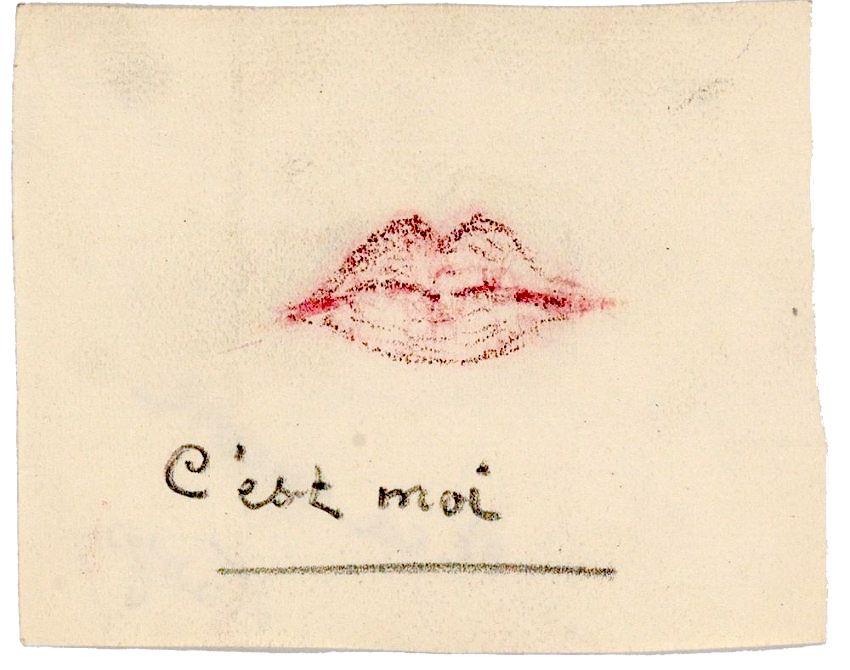
In one letter (October, 9 1926), only days after they’d first met, Nadja tells Breton: “I’ve some things to say to you, come and listen to me this afternoon around 5:30pm at the little café on rue Lafayette. There’s a misunderstanding between us. I will explain it to you. I want to see you again—Nadja.” (Was the French postal service almost as good then as our e-mail today? Or did Nadja deliver her letter by hand?) In another correspondence, Nadja kisses the page in red lipstick, leaving her luscious pouting imprint, alongside the inscription: “C’est moi.” “GARDER SUR VOUS!” is emblazoned overleaf. “It’s me.” “KEEP IT WITH YOU!”

056B4B6D-49DA-47E7-B461-8E422393D269
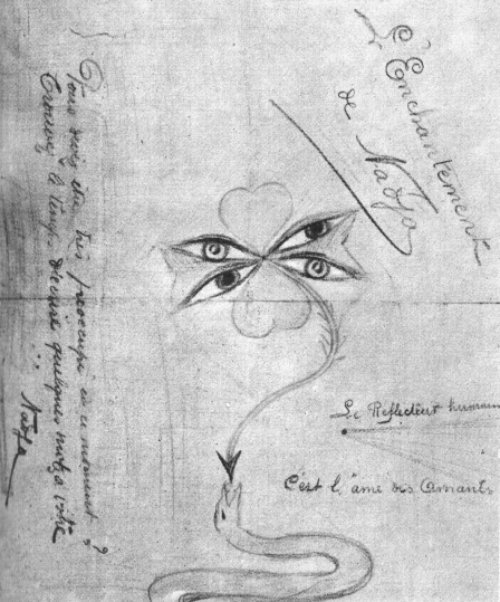
Nadja makes pencil sketches in cafes, too, doodling and designing mysterious creatures from her dreams; she never had the inclination to draw before encountering Breton. Some sketches are naïve; others move and intrigue him. Nonetheless, he keeps them, seemingly all, for the forty remaining years of his life. “Nadja has invented a marvelous flower for me,” he wrote. It was “La fleur des amants”— “The Lovers’ Flower.” “It is during a lunch in the country that this flower appeared to her,” Breton said, “and that I saw her trying—quite clumsily—to reproduce. She comes back to it several times, afterwards, to improve the drawing and give each of the two pairs of eyes a different expression. It is essentially under this sign that the time we spent together should be placed, and it remains the graphic symbol which has given Nadja the key to all the rest.”

8F809ADB-3CAA-4100-AD77-9D166B46AFC4
Nadja evidently loved Breton. He was her “Saint André,” her “Lion-King,” paired with herself, Lionne, after Léona, the “Lionne-Reine”—the Lioness-Queen. Breton is deeply affected by Nadja. And yet, he knows, when he’s writing about her, recalling what had happened to them over that late 1926/early 1927 period, so paltry a time-span, that he didn’t truly, deeply, madly love her. How did he know?

“I had not been granted the realization until today,” he mused in the closing sequences of Nadja. It had been a car ride they’d taken together, returning to Paris from a trip to Versailles. Nadja was beside him. Suddenly, without any warning, she pressed her foot down on his, on the accelerator, and tried to cover his eyes with her hands, “in the oblivion of an interminable kiss, desiring to extinguish us, doubtless forever.” They might collide at full speed, with one of the splendid trees lining the route, in a frenzied test of love, of two lovers deciding to spectacularly end it together, in a poetic suicide pact. But Breton hadn’t yielded to the desire and it was clear then, at that moment, how he really felt, perhaps how he’d always felt, about Nadja.

She was, for him, a concept of love, an abstraction. Was he a rat, a sleaze-bag, leading her on this way, using her as literary grist? Perhaps. For he loved her intellectually, as a sort of metaphysics. On November, 8 1926, Breton wrote his wife Simone, explaining himself, typically cryptically, outlining to her, and maybe to himself, what might be this thing called love: “I don’t love her,” he said. “She’s only capable of calling into question all that I love and the manner in which I have to love.”

Nadja established Breton as the magus of Surrealism; his bewitching book set the high bar of the Surrealist love encounter, and of how objective chance might underwrite this encounter. The encounter strikes. Sometimes it strikes. It strikes like a meteor. Like a rain shower immediately bursting into flames. In post-pandemic times, will it ever strike again?

ENDNOTES
[1] Minotaure was the Surrealists’ “Artistic and Literary Review,” running thirteen issues from June 1933 up until the onset of the Second War War in 1939. Founded by a young Swiss publisher Albert Skira, whose eponymous press had that year opened an office in Paris. Breton and Pierre Mabille assumed editorial direction. The pedigree of contributors is staggering, running like a Who’s Who of the modern movement. The list of artists illustrating Minotaure’s lavish frontispieces is alone enough to set the remarkable tone: Pablo Picasso, Marcel Duchamp, Salvadore Dali, Joan Miró, René Magritte, Henri Matisse, André Masson, André Derain, Max Ernst, and Diego Rivera. We’ll never see the likes of Minotaure again. Then again, maybe we will.

[2] The Dutch novelist Hester Albach once went in search of the real Nadja, and produced an affecting homage, a sympathetic biography with fictional flourishes, translated into French as Léona: héroïne du surréalisme (Actes Sud: Arles, 2009). Albach tracks Léona’s enigmatic existence and traces out a life that would end in 1941, aged thirty-eight, in a Bailleul mental asylum, not far from her birthplace. She’d been interned since Spring 1927, certified as hysterical and maniacal, likely schizophrenic.

[3] This translation is Richard Howard’s 1960 Grove Press rendering of Breton’s original French: “Je suis l’âme errante.” I’ve always thought that “the soul in limbo,” while poetic, was never quite right. It somehow casts resigned light on Nadja’s tragic yet more affirmative response: “I am the wandering soul.”

Posted in All | Leave a comment

Over the Rainbow — Pynchon and the Pandemic

Toto, I have the feeling we’re not in Kansas any more…”
— Dorothy, arriving in Oz

CE0B9AB2-7B18-445B-B8ED-35FC3D041DBC

Maybe it was all those rainbows in lockdown that got me thinking about Gravity’s Rainbow, Thomas Pynchon’s masterpiece from 1973. His rainbow had been there all along, on my bookshelf for more than thirty years, lying unread. I’d heard plenty these days about virtual reading groups tackling Moby-Dick, discussing Ahab’s monomania alongside the President’s. But Melville’s Great White isn’t a patch on Pynchon’s V2. Here was a book, and a man, for our times, a maestro. He’d made self-isolation a life-form, paranoia a permanent mode of being, quarantining himself for a half-century or more, avoiding everybody in his splendid velvet underground. I remember the old days, when I lived in a broom closet on the Upper West Side, when you could venture out without fearing crowds, happily strolling down Broadway to Zabar’s. Back then, I’d even discovered where the great recluse actually lived, on West 81st Street, twelve blocks down from me. But it’s only now, years later, that I seem really ready to deal with Pynchon’s rainbow, to enter his Zone and get it, to finally feel its curve, unmistakably.

They say you can’t hear the killing. It’s a silent death. If you hear the explosion you’re still alive—this time. But what about the next one to drop? Early on in Gravity’s Rainbow, the mad neurologist Doctor Spectro explains, “Imagine a missile one hears approaching only after it explodes. The blast of the rocket, falling faster than sound—then growing out of it the roar of its own fall, catching up to what’s already death and burning. . . A ghost in the sky.” The virus is like this ghost in the sky, a silent passing. You don’t know until afterward, once the coughing starts, the fever begins, exploding after you’ve already been hit, catching up to what’s already death and burning. The rainbow is the pandemic’s trajectory, the curve under which comes life or death.

The English statistician Roger Mexico and servicewoman Jessica Swanlake lie awake under the threat of this rainbow, snuggled up in bed, their affair in hiding, hearing a rocket strike close by. Their hearts pound. Will the invisible death train spare them? My wife and I have wondered likewise these past months, lying awake in bed, in quarantine, our hearts pounding. Outside, the traffic stopped. We talked about the day’s news—the bad news, the numbers, our fears, what will happen tomorrow, another day having passed. After a while, we stopped talking, just listened together in the silence.

From my bed comes an urge to run lose like Tyrone Slothrop, Pynchon’s alter-ego anti-hero. The British and American military are running psychological tests on him in London, Pavlovian experiments. Yet he wrenches himself free from their grip, and embarks on a search for himself and a rocket in the Zone—in the ruins of Occupied Europe. It’s 1944-5, the War is officially over, yet somehow battles still rage. In the Zone, reality isn’t what it appears. There, a destructive military machine morphs into a destructive economic machine, squabbling over war spoils, trying to cash in on rocket technology. Industrial cartels (ICI, Shell, GE, Agfa, I.G. Farben) scramble for a piece of the peace.

Slothrop’s knows it’s a scam, that there are sinister forces orchestrating it all, out to get him, never coming clean. Today, we’d place the pharmaceutical, medical insurance and techie cartels at the top of this roster of schemers. Plots get overlaid with counter-plots, about which ordinary mortals have little inkling. Slothrop’s right, of course; but the problem here is that reality follows one of his “Proverbs for Paranoids”: “If they can get you asking the wrong questions, they don’t have to worry about answers.” Another problem seems our big problem: “There’s nowhere to go, Slothrop,” someone warns him, “nowhere.” And it’s true, a pandemic means literally that: it’s everywhere, and we’ve no place to hide, not for long anyway, notwithstanding one’s privileges.

The Zone unsettles in war’s aftermath. Perhaps it is unsettling because, as we ease lockdown, it mirrors our own disarray and chaos. We bury the dead while convincing ourselves the worst is over. A crisis of truth-telling, a battlefield of unknowns and imponderables, of information blockage. Science versus anti-science. Public health paling beside private gain. In our Zone, free-floating anguish prevails.

Slothrop chased the rainbow from point to point. Its arc reduced itself to a series of equations, to aerodynamics and electronics, to propulsion and insulation, to guidance systems. His quest was for a rocket—an “R”—with a serial number 00000, pointing northwards. Epidemiology has its own “R” factor, pointing outwards, exploding everywhere. This is the reproductive value of a virus, how infectious it is, the average number of people a single individual might infect with it. Our quest is for a R-0 or below (an R-negative), suggesting the virus’s passage is diminishing. An R value above 1 is bad, since infection is spreading exponentially, being silently passed on to an ever increasing number of persons.

Maybe Pynchon, our Laureate of intrigue and paranoia, should write his next book about the pandemic, calling it R. After all, he’s already written a V., as well as a sort of V2, Gravity’s Rainbow. Why not R-Zero, about a search for an epidemiological Holy Grail—a Coronavirus vaccine? An older rocketman Slothrop might engage in this latest mission, peeling back the investigative layers it’ll likely necessitate, haunting the laboratories and corridors of institutional darkness. The novel might try to resolve the conundrum of our times: entropy, the measure of disorganisation in a closed system, the collective chaos resulting from cosmic heat-death. It might be a field guide to entropy management, offsetting our thermodynamical gloom.

In the 1850s, German physicist Rudolf Clausius said the entropy of an isolated system always continually grew. Order and predictability gradually decline. In an early Pynchon story, “Entropy,” from 1960, the character Callisto thought this an adequate metaphor to apply to our lot. “He was forced,” Pynchon says, “in the sad dying fall of middle age, to a radical reevaluation of everything he had learned up to then; all the cities and seasons and casual passions of his days had now to be looked at in a new and elusive light.”

Callisto confronted entropy the same way Pynchon confronts it: by hermetically sealing himself off, constructing in his apartment a tiny enclave of regularity in the city’s chaos. It’s one mode to survive a pandemic. But it mightn’t be the most resilient method to maintain healthy human relations. Perhaps the other solution is the alternative Pynchon touts in the final part of Gravity’s Rainbow—a counterforce, a dialectical ballet of force meeting an opposition, a collision that establishes a new order. “Creative paranoia,” Pirate Prentice reminds Roger Mexico, “means developing at least as thorough a We-system as a They-system.”

A counterforce is scattered throughout the Zone, even throughout our Zone. It’s there to disarm and dismantle the Man. Melvillians believe Ahab is the Man, the avatar of our times, the narcissist who eventually sinks his ship. Yet the masochistic nazi rocket captain Blicero–“White Death”—seems more representative of our demented political incumbents, who climax in tyranny, in seeing giant penises launch into the sky, photo-shooting the countdown. As the rockets rain, falling at nearly a mile a second, there’s still time, Pynchon says, if you need comfort, to touch the person next to you, that there is always a hand to turn the time. This thought alone is enough to bring on a moment’s soporific calm—before another restless night.


Posted in All | 2 Comments

Remembering Spalding Gray

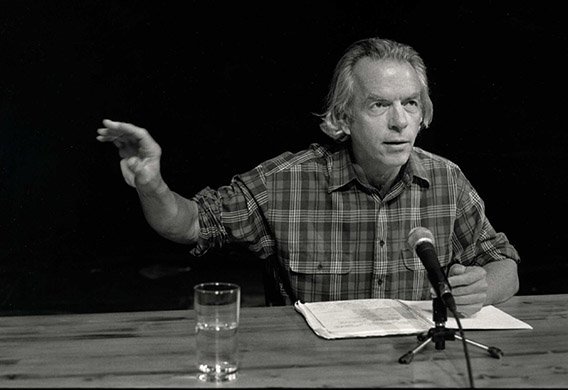
Spalding Gray, who died in 2004, would have been 79 on June 5, 2020. Here is my personal remembrance of a sadly missed storyteller and artist.

I was so excited waiting in line to enter. I was there early, eager and jittery. The line was long. People straggled out onto promenade next to the Thames. I hoped C. would arrive soon. It was our first real date together. Friday evening, the day after my thirty seventh birthday. I’d bought two tickets to see one of my heroes perform at Royal Festival Hall, on London’s South Bank, someone I’d never seen live before: Spalding Gray. The line was edging indoors, and I knew that once we were in, in our seats, and Gray had commenced, cleared his throat for the first time, nobody would be allowed late entry. I began to get tense as seven-thirty struck. The show was due off at seven-forty-five. Still no signs of C. anywhere. I got worried. I’d have to choose soon. Go in alone, or be loyal, wait for C., and, if she’s late, miss the show. I got really edgy as seven-forty approached. She wasn’t about. Maybe she’d mistaken the venue?

***

I remember the previous evening telling her all about Spalding Gray. Who was he? she’d wondered. How to describe what he did? I wondered. He was a monologist, I said. What’s a monologist? she said. Someone who sits behind a desk with a glass of water, I said, and, without props or fancy effects, for an hour-and-a-half talks about themselves in front of an audience. Oh, she said. He tells stories, I said, that make people laugh and think and sometimes cry. He tells of his everyday adventures, his inner thoughts, his doubts and hang ups, his euphoric moments. He’s hilarious, I said.

But, listen, I said, he’s no stand-up (or sit-down) comic: this is profound existential and psychological inquiry, “a way of taking full responsibility for my life,” Gray says, “and also a more therapeutic way of splitting off a part of myself to observe another part.” People can relate to what he says, I said. They find him funny—darkly, ironically, hypochondriacally funny. Here is ego and id dialoguing with one another, doing it in public. What Gray says is both rehearsed and improvised, structured and destructured, depending on his mood, depending on the audience’s reactions. No monologue is ever the same, even if it’s the same monologue. It’s always a work in progress; the wheels spin each night.

Gray comes from Barrington, Rhode Island, I said; but his angst, his self-dramatizing hyperbole, his arrogances and insecurities, make him, for me, quintessentially a New Yorker. “For thirty four years I lived with you,” he once said of his adopted home town, “and came to love you. I came to you because I loved theater and found theater everywhere I looked. I fled New England and came to Manhattan, that Island off the coast of America, where human nature was king and everyone exuded character and had big attitude. You gave me a sense of humorbecause you are so absurd.”

Gray made New York home in 1967. He got involved with its underground experimental theater community, under Antonin Artaud’s and Jerzy Grotowski’s spell; and with Liz LeCompte, Gray’s girlfriend at the time, joined Richard Schechner’s Performance Group. A few years on, he and LeCompte broke off to form the Wooster Group, headquartered at a grungy loft space, the Performing Garage, along Wooster Street in SoHo. The troupe and the venue quickly became the springboard for Gray’s monologue career. What if I spoke my own words, he wondered, instead of somebody else’s? What if I used myself to play myself? What if, he joked, “I began playing with myself?”

The Wooster Group became Gray’s first audience. He’d perform short monologues in front of its members, twenty-minute stints in which he’d unearth childhood memories and reminiscences of his mother, her decent into madness and eventual suicide at fifty two. These performances, sat behind a simple wooden table, became the beginnings of public autobiography. Each day, “when I’d come in for rehearsal,” Gray said, “they would ask me to tell it [the monologue] again, and I did, while Liz taped it. Each day it was embellished and edited and grew as a text until at last we transcribed it.”

The big break through came with Swimming to Cambodia, a watershed monologue, still his best-known, a virtuoso performance mixing personal and political history—the story of a genocide, a film about that genocide, and Gray’s bit role in that film about that genocide. Gray became the US Ambassador in Roland Joffé’s 1984 Oscar-winning The Killing Fields, about two New York Times reporters who’d uncovered the US’s secret bombing of Cambodia in the early 1970s. The covert campaign was designed to drive the Vietcong out of Cambodia yet instead only stirred things up. The Vietcong retreated to the Cambodian bush, hitched up with a bunch of ruthless guerrillas—the Khmer Rouge, led by Pol Pot—who then initiated the worst auto-homeo-genocide in modern history, the said Killing Fields.

Gray’s monologue was about this movie and this real human tragedy. Soon afterward, his monologue about this movie became a movie about his monologue. In November 1986, director Jonathan Demme shot two consecutive performances of Gray’s Swimming to Cambodia before a live audience at the Performing Garage, as close as you could get to being there without actually being there. At first Demme wasn’t turned on. “Before I’d seen Spalding perform,” he confessed, “I was horrified at the idea of being trapped in a room with just one person speaking at a desk. I didn’t want to see him, even though everyone kept telling me how much I’d love him. When I finally did go to one of his shows I was instantly won over.”

The film’s prologue is my favorite scene. There, we track Gray pacing Lower Manhattan’s streets, notebook under arm, en route to his performance. He looks like the struggling artist he is, or at least was then: forlorn, a bit down at heel, traipsing across Canal Street amid speeding traffic, piled up garbage and graffiti, greatcoat collar turned up; a Dostoevskian underground man fighting off his existential chills. But there’s a slyness about him, too, a sprightliness to his gait, an air of anticipation and optimism, bobbing up and down merrily to Laurie Anderson’s jaunty soundtrack. Moments later he approaches the steel entrance door of the Performing Garage, with its green sign overhead almost winking at us. Next thing he’s on stage, sat at trademark desk, sipping water, taking a deep breath, ready to begin.

This was 1980s New York. Living for the city in that decade had been rough. Fiscal crisis still bit deep into public budgets; factories were closing; decline and hard drugs expressed themselves out on the street, scarred the city’s fabric, even as Wall Street boomed and financiers laughed all the way to the bank. Ironically, crisis meant that abandoned old industrial spaces, like the Performing Garage itself, were affordable for a while, to struggling artists who sometimes made great art amongst the debris, in these ruins, without hot water.

I remember seeing this same 1980s New York cityscape before, elsewhere on film, in My Dinner With André, which similarly starts off with a theater guy—Wally Shawn—trudging through Lower Manhattan, similarly in a greatcoat, similarly surrounded by blight, litter and bleak emptiness, similarly crossing Canal Street. As Wally walks we hear his voice-over dialoguing with himself, telling us of his artistic woes: “The life of a playwright is tough,” he says. “It’s not easy, as some people seem to think. You work hard writing plays, and nobody puts them on. You take up other lines of work to try and make a living—acting, in my case—and people don’t hire you. So you spend your days crossing the city back and forth doing the errands of your trade.”

I told C. that evening how my acquaintance with Gray first came about through Marshall Berman, through All That Is Solid Melts into Air. Marshall said Gray’s early play, Rumstick Road, developed between 1975-8 as part of the Wooster Group’s Three Plays in Rhode Island, was “a powerful confrontation with home and with ghosts.” Rumstick Road, after Gray’s childhood home address, tries to understand his mother, her malaise and gradual disintegration, his family as well as Gray himself, as a child and as an adult, as a man-child—“to live with what he knows and with what he will never know,” Marshall said. Its dialogue speaks to anybody who’d lost somebody, especially one’s mother. In Rumstick Road, Gray for the first time talks directly to the audience, dramatizes his dreams and reveries; there’s dance, abstract movement and music; original reel and audio recordings of his mother and father and grandmother, even of his mother’s shrink (with Gray miming his words); and photos and slides of his family and two brothers, all seemingly hunky dory in suburban Rhode Island, circa 1950s.

Rumstick Road, said Marshall, suggests that “a kind of liberation and reconciliation is possible for human beings in this world.” This liberation can never be total, Marshall thought, “but it is real, and earned: Gray has not merely looked into the abyss but gone into it and brought its depths up into the light for us all. Gray’s fellow actors have helped him: their intimacy and mutuality, developed through years of work as a close ensemble, are absolutely vital in his labor of discovering and facing and being himself.” Still, the play, and the actual experience of his mother’s suicide, would remain an open wound for Spalding Gray. How could it be otherwise? For much of his youth, he remembers trying to help his mother through long periods of depression. She might suddenly turn to him and ask: “How shall I do it, dear? How shall I do it? Shall I do it in the garage with the car?”

***

An emerald apparition approached, flapping in the breeze, a blast of verdant light, arriving just in the nick of time, with barely a minute to spare. She was wearing her new green jacket, bought that very afternoon, especially for the occasion, a special occasion almost missed. But she’d made it, apologized for her tardiness. So much to do today, she said, and she took time out to go clothes shopping, too. Had to run all the way across Waterloo Bridge. She was here, C., and now we could both go in, take our seats, ready ourselves for the monologue Spalding Gray was calling It’s a Slippery Slope.

FFBBB811-D9FD-4393-8D71-0D18E9AC77F3

It was a packed house, over a thousand people. I never knew he had so many UK fans. The atmosphere was electric. I had to admit, and did admit it to C., that I was terribly nervous; not about being with C. so much, but nervous that she might be disappointed with Spalding Gray, that she wouldn’t like him. And I was nervous he’d fluff his lines, that something would go wrong, and I would be disappointed. There was a sudden hush, and then he appeared, discretely, very unspectacularly. Yet there he was, sure enough, Spalding Gray, in the flesh, wearing a red and gray checked flannel shirt. He sat down and paused, calmly took a sip of water, looked up, and then, in a dulcet voice very familiar to me: “The first mountain I ever remember seeing was framed in the pane of my geometry class window at Fryeburg Academy in Maine in 1956.”

After a couple of moments I knew he was going to be just fine. Skiing no longer became a gray area: now it was a Gray area, a tale of a mid-life crisis, of a man trying to find his balance in life and on skis, a man who, no matter what, “was always a little bit not present.” “I’m tired of being a VICARIAN,” Gray told his partner Renée. “I want to live a life, not tell it! I want to turn right on skis!” At a ski lesson, he’s the only one in class who can’t turn right. Right, left, right, left, they all went, snaking gently down the bunny slope. While he: left, left, left, then right, left, right…then bam, down he went, into the snow. Just a simple shift of weight was all you needed, and you could turn right, then left, then right again, and left—“Oh my God, Spalding,” his inner cheerleader voice began saying, at those rare moments of equilibrium, “you’re skiing!” Then: CRASH! He’d be in the snow again. “If I was not whole and completely there and balanced on my skis,” Gray said, “I would be DOWN! The mountain would HIT me hard.” A metaphor about existence, maybe, for a life full of sharp twists and turns, hard bumps and tight corners. You need to be able to wiggle every which way to keep your balance.  

There was a lot going on in Gray’s life just then. Before long, the monologue took on a serious, almost painful tone. Off piste, things were more unbalanced. He spoke about his own suicidal tendencies, fantasies about how he was going to do it, now that he was fifty two himself, the age his mother ended it all. “I was reversing my history,” he said. “Mom was no longer going mad, my inner kid was going mad and saying, ‘Hey, Mom! Hey, Renée, look at this—look at what it looks like to go crazy.’ The craziness manifested itself in imitations of Mom’s behavior, or my actually becoming like her.” He said he was beginning to act up in public places, much the same way his Mom acted up. “I’d be muttering to myself,” he said, “and involuntarily shouting out.” Yet this was New York City, and nobody really noticed or cared. Or if they did notice, they joined in. “I can remember screaming in the streets at night,” Gray said, “and hearing my scream picked up by other people who passed it on down the street for blocks and blocks. What started out as real panic was turned into a performance by the people.”

When I heard this, I thought it a tremendously affecting eulogy to New York. The city could participate in a collective reenactment of Aristotle’s Poetics: acting out tragic drama, people engaged in a public catharsis, like Aristotle suggested theater should be—a communal release, a cry for HELP, a cleansing of tragedy. “When Mom let out a few of these yelps in a Rhode Island supermarket,” Gray said, “they put her in a straight jacket and gave her shock treatments. If Mom had lived in New York City, she’d still be alive today.” This was the killer line. Cities should release repression rather than enforce it. There, in the streets, we bring our worst feelings to the surface and work through them as a public.

Gray’s personal life was getting complicated and self-destructive. He confessed to an affair he’d had, was still having, with a younger woman called Kathie; and she was pregnant with his child. But he doesn’t want the kid, doesn’t want to be a father, tells Kathie “get rid of it.” He acts crummily, is in denial. On a whim he marries longtime girlfriend Renée, consummating a relationship they’d begun in 1979, hoping it would extinguish the burning hot affair, and refreshen a stale relationship—Renée, like Liz LeCompte before her, wasn’t only Gray’s confidante and lover; she was also his theatrical soulmate and creative advisor, almost his business manager. Yet the affair hots up even more. Renée has had enough, hears about the pregnancy, leaves Gray, clears out of their SoHo loft. Gray goes to see Kathie and his eight-month-old son, Forrest, and suddenly has the exhilarating experience of fatherhood; a new life as a family man beckons. “Bending over him, I looked down into his eyes, and fell in. I did not expect the gaze that came back, it was absolutely forever. Long, pure, empty, mere being, pure consciousness, the observing self that I’d always been trying to catch was staring back at me; they were no-agenda eyes.”

Kathie moves into his loft with her seven year old daughter, Marissa. Now, with  Forrest, they were a foursome; domestic chaos is thrust upon him. But it’s maybe a first glimpse of real happiness, even of contentment, of being there and only there. And there it seems like he’s come to life again, earned the sort of liberation that Marshall had hinted at; never total, but real. Out skiing in Vermont, at the end of the day, at the end of his monologue, alone in contemplation, he skis through the twilight like a demon. Left, right, left, right he goes, tucking behind a seventy year old man, who is “skiing the most beautiful, carved, Tai Chi-like turns.” “And later I bid him farewell,” Gray said, “knowing I have seen both a person and an apparition, the spirit of the future.”

Gray thought he was undergoing a meltdown, was self-destructing, disintegrating. But instead he brought new life into the world, rejuvenated, grew up, accepted responsibility for his new creation, and for being a grown up. There was a split and then a fusion, a passionate embrace. For that he gave himself a big high-five. “I knew now,” he said, “that I had to stay alive to help this little guy through.”

***

Exiting the auditorium I was dying to know what C. thought. She could see I was ebullient, thrilled by the experience, absolutely not disappointed. But what about her? I’d heard her laugh a few times, giggle at Spalding a bit. Then she turned to me and said she’d really enjoyed it, didn’t understand everything, but that he was great. She said he was special. He was brave, she said. You mean confessing in public? I said. No, not really that, she said. It’s just the idea of sitting there alone, at a desk, talking to lots of people without anything. That was a brave. There’s nothing to protect you from flopping. It’s so low-tech, isn’t it, I said, in a world saturated by technology. Nobody would ever believe it possible. Engaging an audience like that.

We’re so used to seeing flashing images, shifting images, loud, pulsating music and dramatic effects and gimmicks. We’ve almost lost the ability to sit still and listen to somebody tell a story, one human being communicating with other humans beings, without mediation, through language and nothing else. It was how Wordsworth said a poet should address their audience: “using the language of real men,” “a man speaking to man.” It was why Gray didn’t really like his monologues becoming films. It was real life he was after, not reel life. Although, you know, he’s a bit weird, isn’t he, C. said, a bit strange. I guess it was true. Most people I love are strange, a bit weird somehow.

Years later, she told me what she liked most about things then, about seeing Spalding Gray and others, was how it was all new and unknown to her, a great adventure; being exposed to it was a thrill and a pleasure. That was what was most important, even if she didn’t get it all, or even if she didn’t like everything. I mean, she said, he was a shit toward his old girlfriend, Renée, wasn’t he, how he’d betrayed her, cheated on her, abandoned any sense of loyalty. It was all immediate gratification for him. Selfish, just about him, she’d said, any woman could see that. His monologues were definitely stories for guys. He’s a bit too obsessed with sex, she’d said.

We did see Spalding Gray perform again a couple of years on, at the Lincoln Center, after we’d moved to New York, a new monologue, Morning, Noon and Night, about a single day in the life of his new domesticity, Gray’s Joycean moment. Now, he became a sort of Leopold Bloom, an ironical Everyman. He’d had another kid, another boy, Theo, only a few months old, moved to east end of Long Island, to the quaint town of Sag Harbor, buying an old house next to a whalers’ church, straight out of the opening scenes of Moby-Dick. It was a strange Odyssey he’d recounted that night at the Vivian Beaumont Theater, a charming, less conflicted and angst-ridden tale about the daily round of fatherhood, bike riding with Forrest, eating ice cream together, meals and bath time with Theo, an ordinary life made a little less ordinary through the wave of Gray’s magic wand.

But then something terrible happened. In June 2001, he was in Ireland celebrating his sixtieth birthday, out driving one night with friends, along a deserted country road, with Kathie at the wheel and Spalding in the back. Out of nowhere, at a sleepy junction, a speeding mini-van, driven by a local vet, struck them head-on. Gray, who wasn’t wearing a seatbelt, broke his hip and smashed his forehead against the back of Kathie’s head; both were unconscious for a while. Kathie seemed okay, suffering only bruises and minor injuries, nothing permanent. But Gray couldn’t walk; his head swelled up. He had hip surgery, sciatic nerve damage, which left him with a numb foot.

Bone fragments pressed against the right frontal lobe of his brain, the part that enables you to think reflectively and maintain steady focus. It seemed he had brain damage. Titanium plates were fitted. His face was disfigured and he could no longer walk properly, no longer hike nor ski. Nor, apparently, could he do his monologues as before. Gray sunk into a deep depression, deeper than ever. Meanwhile, he decided to sell his old Sag Harbor house, the one lovingly depicted in Morning, Noon and Night, buying another newer and bigger property nearby, more practical for his enlarged family. Immediately, though, regret seized him. Selling it had been “catastrophic.” He tried to buy it back. But the new owners weren’t interested. His depression worsened. Then he started to leave suicide notes on the kitchen table.

Gray had been a depressive most of his adult life, like me. In early 2004, when I was living in France, I learned he’d finally gone through with it, had committed suicide. It was a bitter blow, crushing for my own wobbly midlife. With his watery disappearance in New York Harbor, after throwing himself off the Staten Island Ferry, in bleak mid-winter late one night, part of my New York drowned, too. Poor Spuddy Gray. He could tell a life but couldn’t quite live a life. How he tried. I hope it doesn’t happen to me.


Posted in All | 1 Comment

BEAT CITY 4 — Emancipation of the Shufflers Passing By

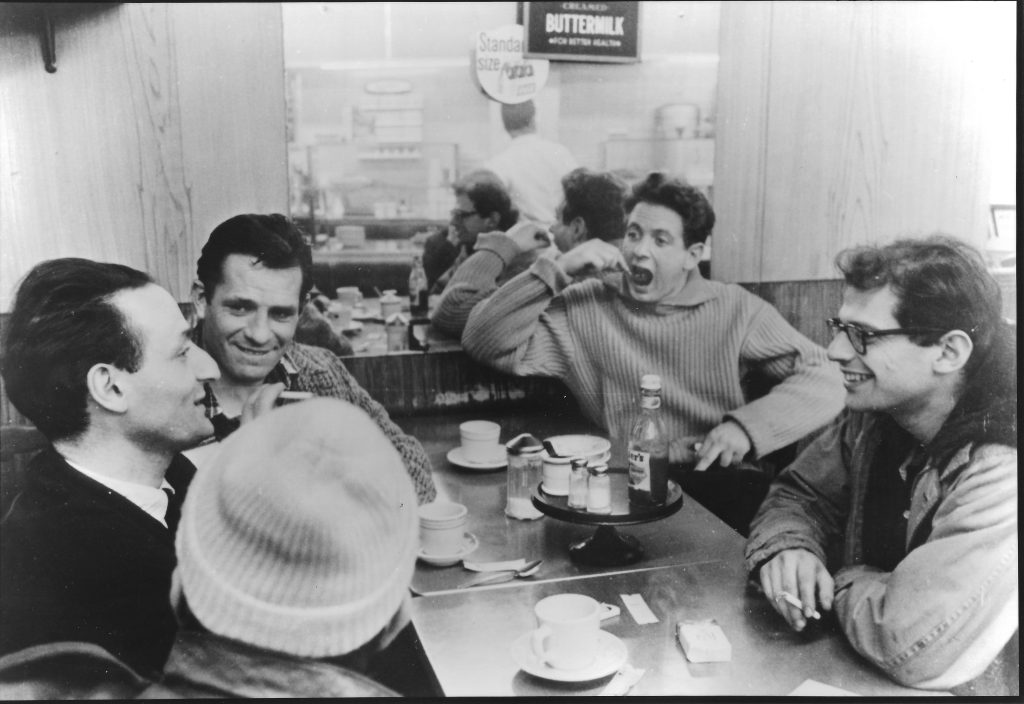
“If you ride around on the subway with Jack,” Kerouac’s friend “Davey” Amram remembered, “or just go out on the street, he would talk to everybody, be natural and real with anybody.” “We used to walk around New York’s streets for hours,” said Amram. “One time we were hanging out with Allen Ginsberg, and there was a guy we met on the Bowery. He was a full-time wino named Buddy.” They all decided to go to Allen’s place with Buddy, and read poems. “I just listened,” Amram said.

They sat up all night. Ginsberg read his poems and Buddy, supping wine, would say, “Yeah, that’s pretty nice. I can dig that.” Then Kerouac read out his own and “Buddy would flip out and scream with laughter and slap his knee…he liked Allen’s poems, but he really identified with Jack’s. And Jack said, real quietly while Allen was reading a poem, ‘These guys are where I get so much inspiration from and learn so much from. They are the true poets of the streets’.” [1]

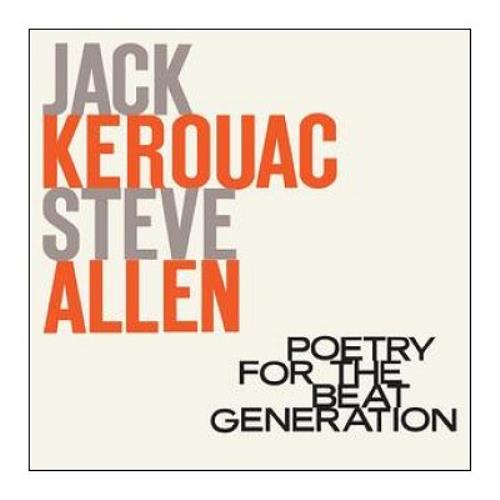
When Kerouac starred on Steve Allen’s Plymouth Show in 1959, the host asked Jack “How would you define the word ‘Beat’?” Kerouac didn’t hesitate in his response to Allen, saying, shyly yet assertively, “sympathetic.” He wasn’t being frivolous; Kerouac meant it and we can hear this sympathy resonating in his long blues prose poems, like Bowery Blues, dated March 29, 1955.

The Bowery was one New York landmark that captivated Kerouac and the Beats in their gnostic search for human truth. (Burroughs lived at number 222 in the mid-1960s, in a windowless apartment he called “the bunker,” really an old locker room of the former YMCA building.) For most of the twentieth-century, the strip, running from Third Avenue at East 6th Street and Cooper Square, down to Canal Street in Chinatown, was America’s most notorious skid row. Its flophouses and bars and sidewalks literally flagged out the end of the road for many denizens, a final port of call for the castoffs and casualties of Great America. It was an eternal source of attraction and repulsion for Kerouac, of sorrow and pity, and if we listen to the Bowery Blues in Poetry for the Beat Generation we can feel that pathos, as well as the compassionate embrace, for Bowery bums and winos, for lost souls like Jack’s buddy Buddy.

Interestingly, there’s a wonderful cinematic document of the Bowery from Kerouac’s time called On the Bowery, produced the same year as On the Road (1957), by indie filmmaker Lionel Rogosin. It’s a peculiar documentary, one part actual footage of the winos and bums and rag and bone men of what the Bowery’s own Mission Minister said was “the saddest and maddest street in the world and that might be an understatement”; many of the most vagrant vagrants we see carted off in a police paddy-wagon; they’re better off behind bars.

Yet the other part of Rogosin’s film is overlaid with performing actors, like Ray, from Kentucky, a dead ringer for Neal Cassady, who even worked the railroad before his luck ran out and he hit the bottle. Ray befriends Doc Gorman, once a genuine doctor but now a wily street veteran, an old rogue who scams his way through life, preying off the likes of Ray in dive bars and crummy SRO hotels.

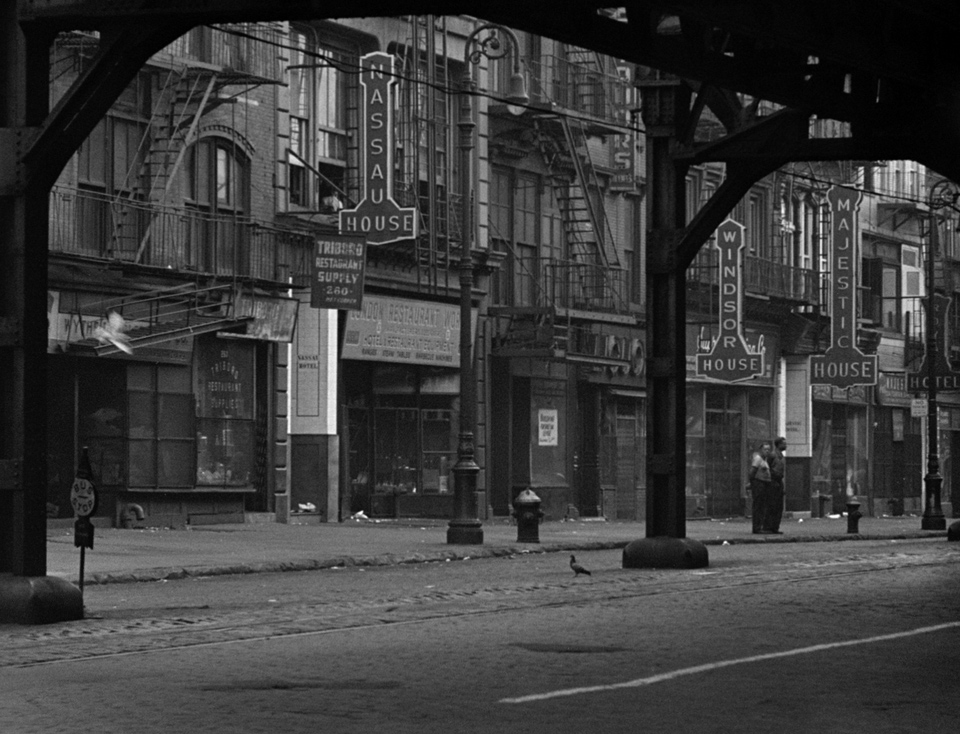
The other looming presence, casting a dark shadow across much On the Bowery, is the overhead El, then in the process of being torn down, a redundant giant somehow adding further grit to Rogosin’s already gritty camera, as it pans images of real streets and real soup kitchens with real human flotsam and jetsam. At the end of On the Bowery, one old crony muses, watching Ray bidding them all a “final” goodbye, “Everybody tries to get off the Bowery.” To which his pal, shaking his head knowingly, adds “He’ll be back!”

8CAD7688-96B4-4784-95AC-627F09563CFA

“LATE COLD MARCH AFTERNOON,” Kerouac begins Bowery Blues, “the street (Third Avenue) is cobbled, cold, desolate with trolley tracks.” He’s sitting in the Cooper Union cafeteria, in its “Foundation Building” at Cooper Square, composing his poem, penciling impressionistic lines against a muzak, which, he says, is “too sod.” It’s an overcast, chilly, melancholic day, and Jack seems to feel the melancholy in his bones, gazing out the window on to Third Avenue, observing “cold clowns in the moment horror of the world.”

In those days, pretty much anybody could wander in and out of Cooper Union, an arts and science institution founded in 1859 by wealthy New York industrialist and philanthropist Peter Cooper. Cooper was prominent in the Gilded Age, an anti-slavery liberal progressive, a fervent believer that education should be free and open to all. Since inception, Cooper Union was intended to be an East and West Village community resource; its library and cafeteria were open late so working folk could eat and borrow books after hours, when their day’s toil was done. Cooper Union’s shibboleth back then was that every accepted student be granted a full-tuition scholarship.

Over the years, Cooper Union formed three Art, Architecture and Engineering Schools, though in 2014 it abandoned its long legacy of free education. These days, Cooper Square is dominated by the main campus building, at number 41, a controversial glitzy post-modern, deconstructed structure, costing 100 million dollars, accelerating the gentrification of the neighbourhood. Melancholy Beatsters, scribbling poetry in pencil, aren’t very conspicuous anymore.

“A funny bum with no sense trys to panhandle,” writes Kerouac in Bowery Blues, “and is waved away stumbling,/he doesnt care about society women embarrassed with paper bags on sidewalks—Unutterably sad the broken winter shattered face of a man passing in the bleak ripple.” “I shudder as at the touch of cold stone to think of him,” says Kerouac, “the sickened old awfulness of it like slats of wood wall in an old brewery truck.”

The same broken humanity that occupies Rogosin’s frame populates Keroauc’s prose: seafarers who’ve jumped ship, “bleeding bloody seamen…/sad adventurers/Far from the pipe/Of Liverpool…/Streaked with wine sop”; others “who’ve lost their pickles on Orchard Street”; and “old Irishmen/With untenable dignity/beer bellying home…/Paddy McGilligan/Muttering in the street…/Sad Jewish respectable/rag men with trucks.” The whole damned lot “with tired hope/Hope O hope/O Bowery of Hopes!”

“The story of man,” Kerouac says, “Makes me sick/Inside, outside,/I dont know why/Something so conditional/And all talk/Should hurt me so.” “And I see Shadows/Dancing into Doom…God bless & sing for them/As I can not.” “Then it’s goodbye/ Sangsara/For me,” he writes in the concluding stanza. Sangsara is the Buddhist cycle of birth and death, the continuous wheel of suffering. Does Jack want to give up and die that cold March day? It appears so. “Okay./Quit,” he says. But he doesn’t quit. Instead, Sangsara is his epiphany, his insight into life’s impermanence, into the reality of his “non-self,” revealed to him on the Bowery: “He’ll be back!”

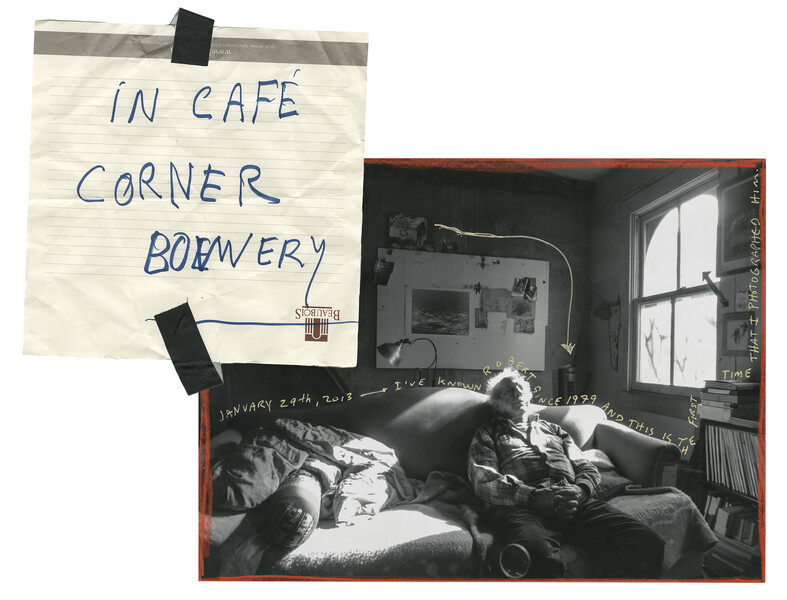
The strangest thing about the Bowery was that it was an area of New York that successive artists and writers dug most of all, finding creative stimulation amongst the human commiseration. Amid the grunge and desolation, a ragged community of dislocated and creative odd-balls discovered a certain liberty. A big attraction, needless to say, was the neighbourhood’s cheapness. Artists undertook quasi-legal rehabs of former Bowery industrial lofts, giving them work and living space at relative low cost. Jack’s photographer friend Robert Frank loved the Bowery and set up home and shop there in 1968, at number 184. (In 1980, he moved around the corner, onto Bleecker Street. By then, though, as rents began to soar, he and artist wife June Leaf spent most of their time up in Nova Scotia.) [2]

200DA0F8-38E7-4B25-A763-631893AF243F

But it wasn’t just the low-cost that enticed. When Albert Camus came to town in 1946, like Sartre and de Beauvoir the year prior, it was the Bowery he wanted to see first: “Night on the Bowery,” Camus wrote in his journal, “Poverty—and a European wants to say: ‘Finally, reality’.” Sammy’s Bowery Follies, at 267 Bowery—a self-avowed “alcoholic haven” since 1934—was one venue Camus particularly adored and spent time in, drinking and mixing with Bowery bums; at Sammy’s, whose last orders came in 1970, vaudeville really required no stage. On the Bowery, bare life lurked, existentialism was on the street, expressed itself in dive bar banter, especially after dark.

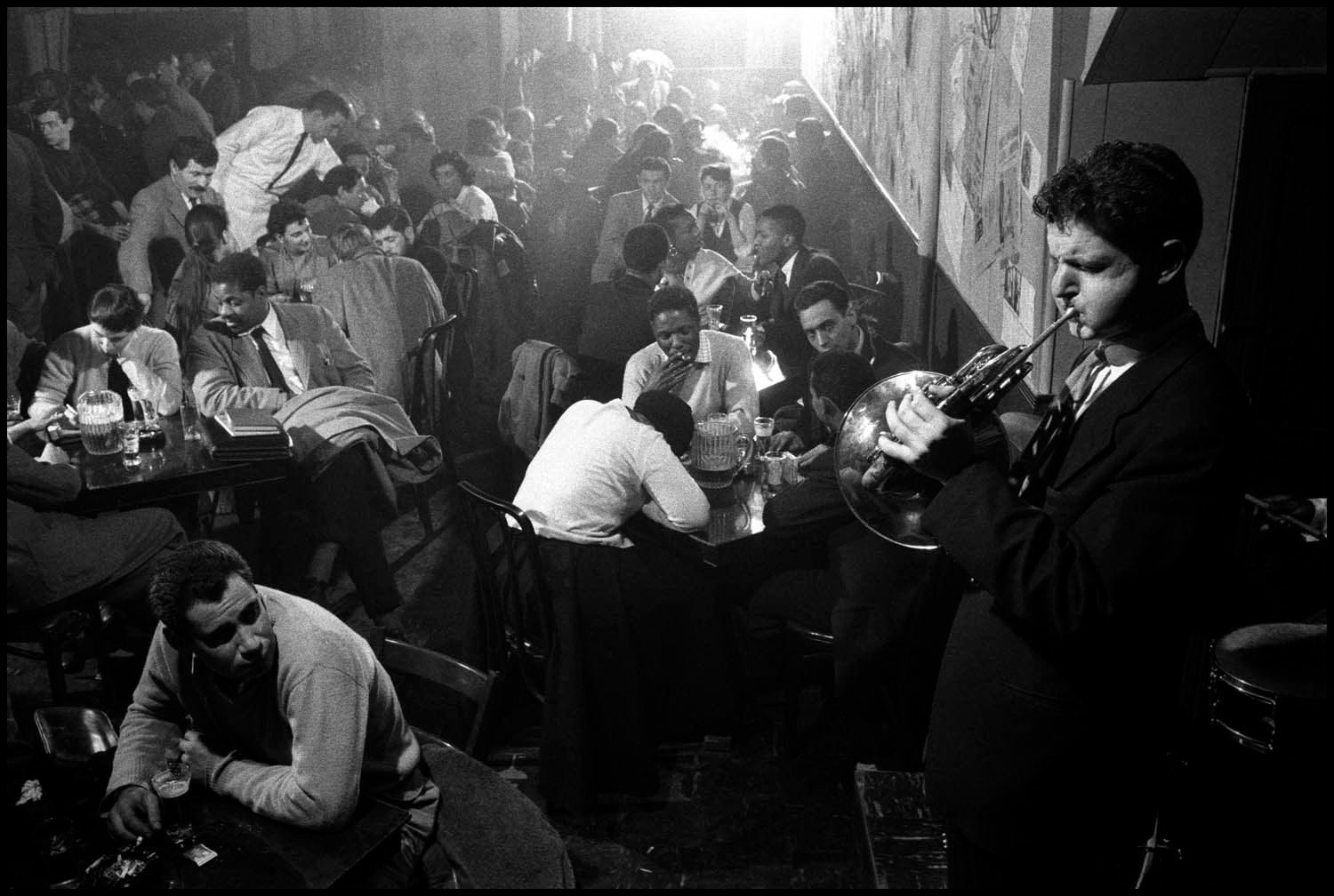
One of the city’s best jazz-joints, the Five Spot Café, likewise found cheap haven for awhile on the Bowery, between 4th and 5th Streets, staging jam sessions with jazz’s greatest—like Bird, Monk, Mingus, Coltrane, and Ornette Coleman, who’d just transplanted himself from the West Coast. It was one of Burt Glinn’s favourites venues to photograph. Here’s his luscious shot of Davey Amram blowing his French horn, before the Five Spot’s racially-mixed audience, a minor miracle in the 1950s.

70AA6F65-C152-4BCB-B331-F8A2076F053C

JACK’S OTHER GREAT HYMN to pavement pathos and hobo rags is MacDougal Street Blues, penciled June 26, 1955. Its three “Cantos” embody almost all Beat street sensibility and wisdom. Kerouac’s street becomes something transcendental, a world-beyond, a wild wilderness for Bodhisattva meditation. It’s a shifting scene full of sidewalk strollers eating ice cream on a lovely June Sunday afternoon, struggling Greenwich Village artists selling their wares, eccentric winos and chessmen of Washington Square, homeless bums panhandling and old bohemian barflies, like the legendary Joe Gould, holding court in the Minetta Tavern, corner of MacDougal and Minetta Lane. All the while, overhead, Kerouac says, “is a perfect blue emptiness of the sky.”

The goofy foolish
human parade
Passing on Sunday
art streets
Of Greenwich Village

Slow shuffling
art-ers of Washington Sq
Passing what they think
Is a happy June afternoon
Good God the Sorrow
They don’t even listen to me when
I try to tell them they will die

Unrepresented on the iron fence
Of bald artists
With black berets
Passing by
One moment less than this
Is future Nothingness Already

The Chess men are silent, assembling
Ready for funny war—
Voices of Washington Sq Blues
Rise to my Bodhisattva Poem
Window

Parading among Images
Images Images Looking
Looking—
And everybody’s turning around
& pointing—
Nobody looks up
And In
Nor listens to Samantabhadra’s
Unceasing Compassion

Why are you so tragic & gloomy?
And on the corner at the
Pony Stables
Of Sixth Ave & 4th
Sits Bodhisattva Meditating
In Hobo Rags
Praying at Joe Gould’s chair
For the Emancipation
Of the shufflers passing by

Joe Gould was one of the most infamous Village street shufflers, immortalised in Kerouac’s early New York days by New Yorker reporter Joseph Mitchell. In 1942, Mitchell had written his celebrated profile of Gould—“Professor Sea Gull”—and one can speculate whether Kerouac had ever read this piece. Mitchell was of an older generation, a Village denizen himself, a street-smart journalist, who, like Kerouac, was an intrepid urban legman, with sympathies for the downtrodden. His New Yorker “Profiles” were the last time the Condé Nast magazine would ever write about poor, ordinary, non-celebrity people. Mitchell did so with considerable literary dash. (His great hero was James Joyce.) Joe Gould became Joe Mitchell’s masterwork; and “the penniless and unemployable little man” even became a kind of alter-ego for Mitchell.

Gould, wrote Mitchell, “came to the city in 1916 and ducked and dodged and held on as hard as he could for over thirty-five years.” He “looked like a bum and lived like a bum. He wore castoff clothes, and he slept in flophouses or in the cheapest rooms in cheap hotels. Sometimes he slept in doorways. He spent most of his time hanging out in diners and cafeterias and barrooms in the Village or wandering around the streets or looking up friends and acquaintances all over town or sitting in public libraries scribbling in dime-store composition books.” For years, Gould said he was at work on his epic masterpiece, “An Oral History of Our Time,” and for that he was always on the cadge for money, for contributions towards “The Joe Gould Fund.” Gould said this was his life’s endeavour, going about the city listening to people, eavesdropping, and writing down whatever he heard that sounded revealing, no matter how idiotic, obscene or trivial it might be to others.

He claimed he’d already amassed millions of words in this Oral History, filled hundreds of composition books, scattered all around town, hoarded for safe-keeping by assorted friends. He bragged it was a study of modern America as historically important as Gibbon’s treatise on ancient Rome. Yet before Gould died, in 1957, of arteriosclerosis and senility, aged sixty-eight, Mitchell came to recognise something he’d long suspected: the Oral history didn’t exist, had never existed. Gould’s entire oeuvre amounted to just a few bad poems, a “chapter” on the death of his father—written, rewritten and revised over and over again—together with a gibberish disquisition on how tomato consumption spread a disease Gould called “solanacomania.” But that was all. Nothing else. He’d duped everybody, Mitchell included.

9A00C900-933D-4B3C-A75A-08A0DFA57E7A

In 1964, more than twenty-years after his first assignment, Mitchell completed a second and longer New Yorker piece about this enigmatic little man—“Joe Gould’s Secret”—revealing the awful truth. [3] At the same time, Mitchell anticipated his own awful truth, his own secret, finishing his article with a confession: he’d been at work on his own version of Gould’s oral history, a Bildungsroman novel, autobiographical, about a young man coming up from North Carolina to conquer New York’s reporting world, a man who falls in love with a woman and with a city. This man would poke around every one of city’s hundreds of neighbourhoods, in a soul searching mission, a quest for self-discovery, not in “the lofty, noble silvery vertical city but in the vast, spread-out, sooty-grey and sooty-brown and sooty-red and sooty-pink horizontal city; the snarled-up and smouldering city, the old, polluted, betrayed, and sure-to-be-torn-down-any-time-now city.”

Mitchell had provided a disguised synopsis of a promised book, a book he’d never write, seemingly couldn’t write. Meanwhile, his 1964 profile, revisiting Gould, was valedictory, the last thing Mitchell wrote. Up until his death in 1996, Mitchell came almost every day to his New Yorker office, typed away, immaculately attired as ever, in collar and tie and trademark hat, yet produced nothing more, no more Profiles, no novel, not anything. What had he been typing away at all those years? Nobody knows.

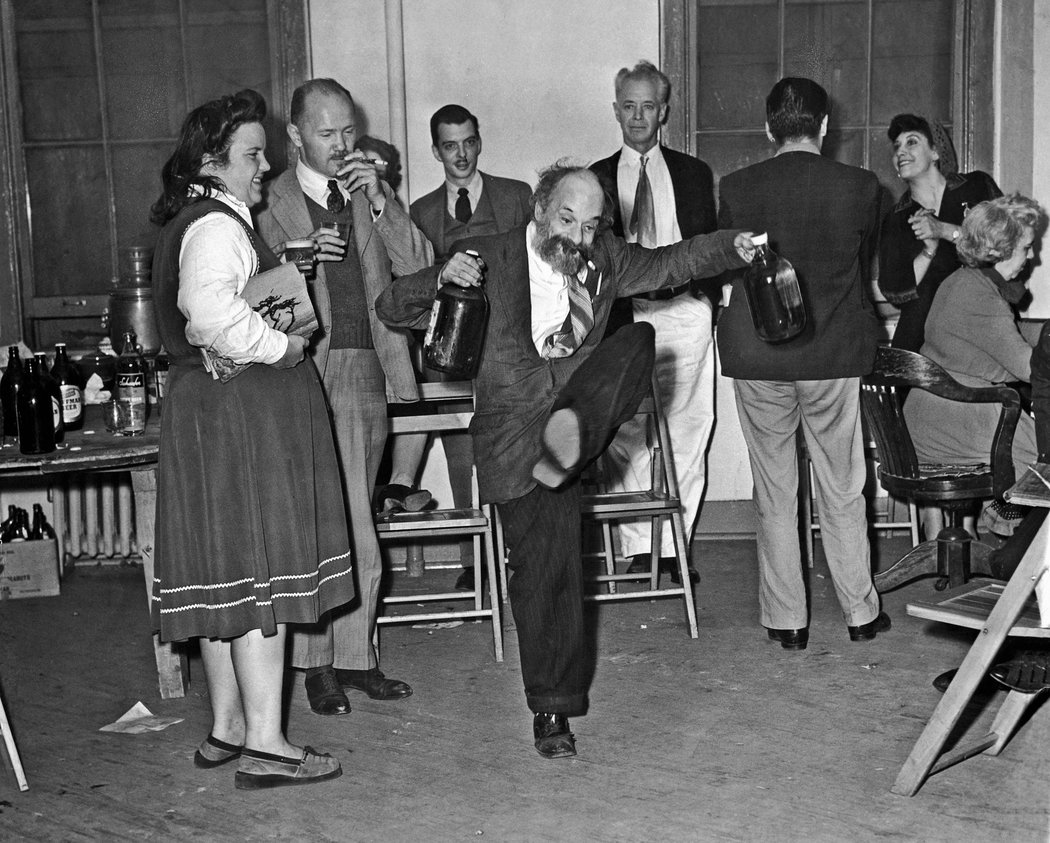
SOMETIMES, WHENEVER MITCHELL received mail addressed to Joe Gould, he’d forward it to the Minetta Tavern, Gould’s home away from home. [4] There, each evening, the Village vagrant got a free spaghetti and meatballs dinner, made from leftovers, his sole meal of the day. In an unspoken agreement with the proprietor, he was the “authentic” house bohemian; and clientele usually bought Gould a glass of wine or a beer or a martini. His best-known antic was imitating the flight of a seagull, hopping and skipping and leaping and lurching about, flapping his arms up and down and cawing like the sea bird. He claimed he’d long ago mastered the language of seagulls, learned it in boyhood, when he spent hours sitting at Boston harbour.

One time Mitchell received a letter from a neighbourhood artist called Sarah Ostrowsky Berman, warning of how Gould was “in bad shape.” The writer said she felt “the city’s unconscious may be trying to speak to us through Gould. And that the people who have gone underground in the city may be trying to speak to us through him. People who never belonged anyplace from the beginning. Poor old men and women sitting on park benches, hurt and bitter and crazy—the ones who never got their share, the ones were always left out, the ones who were never asked.” Perhaps the Beats, too, had heard this city’s unconscious speaking out—Kerouac hadn’t called his crew the subterraneans for nothing, once saying homeless underground people had good reason to cry, for everything in the world is stacked against them.

Kerouac had written movingly about homelessness in his debut novel, The Town and the City (1950), an adolescent Bildungsroman the likes of which Mitchell couldn’t quite pull off, where alter-ego Peter Martin attempts to exorcise ghosts of his small town past in Galloway (Lowell), only to have to confront the equally troubling demons of big city (New York). One raw Sunday afternoon in winter, Peter finds himself on the Bowery, “when the cold ruddy light of the sun was falling on dusty windows and streaming through El girders black with soot, he saw three old men, old Bowery bums, lying on the pavement against a wall trying to sleep, on newspapers.”

He stops to look at them. “They looked dead,” Peter says, “but then they stirred and groaned and turned over, just like men do in bed, and they were not dead. He thought of what must have happened to them that they slept on the pavements of November, and that their only belongings in the world were the filthy clothes that covered them. It also flashed through his mind that they were old men as well, rheumy-eyed, sorrowful, sixty or so, shaking with palsy, fixed against the weathers and miseries as though driven through with a spike, sprawled there for good. He had to walk away, he cried.”

Around the time Peter cried, his creator heard in person the city’s unconscious speaking out through Gould, knowing Professor Seagull’s notoriety first-hand; Burroughs also remembers witnessing Gould’s seagull act. Indeed, not long after Mitchell’s profile first appeared in The New Yorker, both Kerouac and Burroughs had Gould cameo in their jointly-written novel And the Hippos Were Boiled in Their Tanks. That was in 1944, and the Minetta Tavern was then their local hang out; Gould’s Village was similarly the Village of Kerouac, Ginsberg, and Burroughs. It was likewise the Village of their mutual friends, Lucien Carr and David Kammerer, the two principal characters—real-life characters—fictionalised in And the Hippos Were Boiled in Their Tanks. In August 1944, a nineteen-year-old Carr had stabbed to death Kammerer, fourteen-years his senior, in Riverside Park on the Upper West Side, dumping the body in the Hudson. It was front-page news, an older-guy-stalker impulsively killed by a younger victim in a drunken quarrel.

In those days, Kerouac and Burroughs were unpublished unknowns; the former had yet to go on the road and the latter’s drug habit was still soft. For decades their novel remained unpublished, the manuscript even thought lost. But it resurfaced, eventually getting published in 2008, with chapters sequentially written by Mike Ryko (Kerouac) and Will Dennison (Burroughs), in a remarkable recreation of wartime bohemian New York, a sort of Beat pre-history, Beatnik life and times avant la lettre. And there, in all his mad, eccentric glory is Gould, too, whose table at Minetta’s Ryko, Dennison and their girlfriends often shared. They said they frequently had “a good time listening to Joe Gould and basking in the suggestive dialogue around him.” Sporting his cane, Gould sometimes followed them to parties, participated in their haphazard drinking and drifting, in their talk-ins and poetic excess.

Today, everything here, Mitchell’s stories included, sound like period pieces, a tale of another era when Gould-like eccentrics, urban cast-offs and subterraneans found a little space to exist in the city. It was an era when they were tolerated and occasionally encouraged, when they had some underground as well as a few overground haunts to roam in, their own secret language-game, muttering the city’s unconscious. Gould had its history in his head. The Beats spent the following decades trying to transcribe those words on the page, in poetry and prose. If there was a singular impulse, perhaps we can think of it as a body of work dedicated to the emancipation of street shufflers who once passed by—passed by before they were chased away.


NOTES

[1] I’m citing Amram from the wonderful testimonies of Jack’s Book (1978), compiled by Barry Gifford and Lawrence Lee. David Amram is still with us today, ninety this year, and well-known as a composer and conductor of orchestral and chamber works, many bearing a distinctive jazzy penchant. In his early Beat days, he wrote the musical score for Frank’s Pull My Daisy, and was a young sideman (French horn) for Thelonious Monk and other jazz stars. Later, Amram composed film soundtracks and worked with the New York Philharmonic as a composer-in-residence. In 2002, his Beat remembrance, Offbeat: Collaborating with Kerouac, appeared, followed five years on by Upbeat: The Nine Lives of a Musical Cat. Amram’s other claim to fame was to appear with Kerouac (and Philip Lamantia and Howard Hart) at New York’s first ever jazz poetry reading, at the Brata Art Gallery on East 10th Street. The historic event was organised by poet Frank O’Hara, who’d later achieve notoriety with Lunch Poems, published by City Lights in 1964.

[2] Kerouac and Frank, just two years apart in age, were like two peas in pod, outsiders both, with roaming “eyes” for “American-ness”; the former, of French-Canadian extract, the latter, a Swiss-born immigrant. When Kerouac wrote, in his famous introduction to Frank’s The Americans, that “after seeing [Frank’s] pictures you end up finally not knowing any more whether a jukebox is sadder than a coffin,” you could say much the same thing about Kerouac’s prose. In April 1958, he and Frank undertook their own road trip together, from NYC to Florida, described in Kerouac’s essay “On the Road to Florida.” “It’s pretty amazing,” Kerouac said, “to see a guy, while steering at the wheel, suddenly raise his little 300-dollar German camera with one hand and snap something that’s on the move in front of him, and through an unwashed windshield at that.” After awhile, “I suddenly realised I was taking a trip with a genuine artist and that he was expressing himself in an art-form that was not unlike my own.”

[3] Joe Gould’s Secret became a film in 2000, staring Stanley Tucci as Mitchell and Ian Holm as Gould. The atmosphere of Greenwich Village in the 1940s is beautifully evoked, yet the movie only scratches the surface of the deep and complex psychologies of both Joes.

[4] Minetta Tavern first opened its doors in 1937 and lives on—though is much less rougher around the edges, reinventing itself in 2009, to attract a more upmarket and tonier crowd. The tavern’s website says, “Since its renovation, Minetta Tavern has best been described as ‘Parisian steakhouse meets classic New York Tavern’.” “The Tavern,” the site continues, “was frequented by various layabouts and hangers-on including Ernest Hemingway, Ezra Pound, Eugene O’Neill, e. e. Cummings, Dylan Thomas, and Joe Gould, as well as by various writers, poets, and pugilists.” Yet at $22 for a glass of Chardonnay, and $33 for a “Black Label” prime- cut beef burger, the only layabouts and hangers-on these days ascend from Wall Street.


Posted in All | 2 Comments

BEAT CITY 3 — Goofing at the Table

My favourite Beat diner image is an inspiring black & white shot, taken in a long lost Lower East Side diner.

90CF1089-F783-480E-A335-0808BAABF6E1

In the photo, we can see Kerouac (left, front on) sat at a booth with poet friends Allen Ginsberg (glasses) and Gregory Corso (wearing hat), musician David Amram (tooth-picking), and actor Larry Rivers. Rivers seems to be the centre of attention, doing most of the talking, relating some yarn or another. Gripped, Kerouac and Ginsberg are grinning.

The quintet were taking a break from filming Robert Frank’s Pull My Daisy, a twenty-six minute miracle scripted, with an ad-lib narration, by Kerouac himself. The 1959 film is an improvised alchemy that relives scenes from the ordinary madness of the life of Neal Cassady with his wife Carolyn. Frank said Pull My Daisy “was made by non-professionals in search of a freer vision.” Kerouac said of Frank, in his introduction to the Swiss photographer’s masterpiece, The Americans, from 1958, a roving series of black and white images of postwar America, “You got eyes.”

The impulse of Pull My Daisy, like so much Beat art, is a city of poets who are ordinary people and a city of ordinary people who are also poets. In grungy affordability, they mix the artistic—the late night parties, the jam sessions, the beautiful sociability of fellow-travellers, Ginsberg and Corso arguing about Apollinaire (as they do in Pull My Daisy)—with the everyday familio, in lofts and coffeehouses. The diner, of course, was one place where this commingling became most commonplace and epic. Poetics there tapped the taken-for-granted, expressed a vernacular as ordinary as the diner’s counter and grill in the photo, with its “BUTTERMILK” plaque on the sidewall mirror. For its literary hub, the Formica table, with stock items of the Beat trade: cups of coffee, salt and pepper pots, a Ketchup bottle, cigarette packets, scraps of paper. The overall impression of the image is earthy and youthful, happy and fraternal, full of promise for what lies ahead. But there’s a presence of the moment, too, a now, of being there and only there—spontaneously captured by photographer John Cohen’s lens. That’s what seems inspiring: unselfconscious being there.

I’ve never seen any caption for this photo. But if I were to give it one myself I’d call it Goofing at the Table. Webster’s Dictionary says “goofing” means “to spend time foolishly,” playing around, behaving sillily, goofing off school or work, killing time, idly avoiding one’s duties. Goofing here comes across as something pejorative, as dead time, as wasting one’s time, as being somehow unproductive. And yet, for the Beats, goofing signifies something else: a richness, a virtue, the poet’s muse, a moment when the senses are fully alert—when, as Allen Ginsberg says, “lightening strikes in the blue sky.”

“Goofing at the table” is actually a line from Mexico City Blues, Kerouac’s best-regarded set of poems, written in the Mexican capital between August and September 1955. He was shacked up then in a hut along Calle Orizaba, on the roof of a building where William Burroughs once had an apartment. (Burroughs had shot and accidentally killed his wife Joan there, in a drunken party stunt, playing William Tell with a water tumbler.) “I took a little dobe block up on Bill’s roof,” Kerouac said, “2 rooms, lots of sun and old Indian women doing the wash…perfect place to write, blast, think, fresh air, sun, moon, stars, the roof of the city.”

In “candlelight in a lonely room,” high on morphine and marijuana, Kerouac scribbled the 242 choruses (stanzas) of Mexico City Blues, riffing on memories of his late father and older brother Gerard (dead aged nine of rheumatic fever), on past New York kicks, on Nirvana and Buddhism, on Mexico and dope, climaxing with a lovely paean to bebop giant Charlie Parker, “the prefect musician,” who, “with lidded eyes,” “looked like Buddha.” Kerouac explained at the start of Mexico City Blues, “I want to be considered a jazz poet blowing a long blues in an afternoon jam session on Sunday.” [1]

Here, then, in that Sunday afternoon jam session, are Choruses 80-83, hooting a few glorious notes to the American diner:

[80th Chorus]

“GOOFING AT THE TABLE/‘You just dont know.’/‘What dont I know?’/‘How good this ham n eggs/is/‘If you had any idea/ whatsoever/How good this is/Then you would stop/writing poetry/And dig in.’‘It’s been so long/since I been hungry/it’s like a miracle’/Ah boy but them bacon/And them egg–’”

9F1338AE-002D-4D4F-8A22-4E1722FD8455

[81st Chorus]

“Dem eggs & dem dem/Dere bacons, baby/if you only lay that/ down on a trumpet/Lay that down/solid brother/’Bout all dem/bacon & eggs/Ya gotta be able/to lay it down/solid —/All that luney/& fruney”

[82nd Chorus]

“Fracons, acons, & beggs,/Lay, it, all that/be boppy/be buddy/I didnt took/I could think/So/bepo/beboppy/Luney & Juney/—if—/that’s the way/they get/kinda hysterical/Looney & Boony/Juner & Mooner/Moon, Spoon, and June.”

[83rd Chorus]

“Dont they call them/cat men/That lay it down/with the trumpet/…I call em/ them cat things/ ‘That’s really cute,/that un’/ William/ Carlos/ Williams.”

This last allusion is to Beat godfather poet, a reluctant kindred soul. Williams was of an older generation, a man of two personas: one half “square,” straight-laced professional; the other, his shadow self, a radical experimenter, a “hip” creator, the man who inspired the Beats. By day, it was Doc Williams, the family practitioner of native Rutherford, New Jersey, where he delivered 2000 babies and cared for countless patients in a medical career spanning 1910-1952. By night, and at spare moments, “Bill” Williams scribbled verse, became a major innovator in American poetry, a leading twentieth-century literary modernist, contemporary of T.S. Eliot and Ezra Pound; yet unlike them, not a wordsmith of the scholastic meter but a bard of the vernacular voice.

Williams’s masterwork is the long poem Paterson, after the New Jersey city, Allen Ginsberg’s birthplace. Paterson spans five books, written between 1946 and 1958; its refrains follow the flowing rhythm of the city’s Passaic River with its dramatic Great Falls. The Passaic and Paterson became for Williams what the Liffey and Dublin were for James Joyce, both a place and a person, a metaphor and medium through which the personal and public merged into one great epic universal. “A man in himself is a city,” said Williams, “beginning, seeking, achieving and concluding his life in ways which the various aspects of a city may embody.”

Early on in Paterson, Williams offers advice to the would-be poet: “Say it! No ideas but in things.” Stick to the concrete; keep direct contact with the external phenomenal world; write it from actual experience, from events and objects; express how real people talk, how they sound. Kerouac and Ginsberg, especially, took heed, worked through Williams’s homily. In 1950, Ginsberg, then a young unknown of Paterson, wrote to the old maestro who’d just written a poem about Paterson. Williams was so knocked out that he replied, saying, “I’m going to put this letter in my book, do you mind?” “Gee,” Ginsberg said, “I’m going to be immortal because I thought he was immortal.”

Ginsberg’s letter, letting rip about himself and his New York writer pals (like Kerouac), made it into Book 4 of Paterson. Ginsberg also sent along a few of his own poems. “I do not know if you will like my poetry or not,” he wrote Williams, “that is, how far your own inventive persistence excludes less independent or youthful attempts to perfect, renew, transfigure, and make real an old style or lyric machinery.” As it happened, Williams didn’t much care for Ginsberg’s poems. But he saw the potential, and was typically gracious and encouraging. Six years on, with his epic Howl, Ginsberg learned Williams’ lesson. “The whole point,” he said, “is that from the subjective babble, meandering, thinking, and daydreaming you’ve got reality all of a sudden, shifting and becoming aware of the actuality outside, just like Williams was writing about actualities.”

This, too, is what Kerouac meant by “laying it down solid”: digging immediacy, finding the right note, blowing it, getting it down on the page, in ink, in pencil; a poet cat man, “sketching” honest feelings from actuality: the taste of dem eggs & dem dere bacons, the hunger, the joy of food, gobbling it all down greedily. “I made a pome out of it,” Kerouac says in “Goofing at the Table.” Indeed he did. No ideas only things; simple, ordinary stuff rendered artistic, made poetic, brought alive. Such is Kerouac’s poetics, like his prose: a depiction of sensations and experiences, the restless search to give ordinary life deeper meaning and freer expression. Sometimes he didn’t even know himself whether he wrote prose or poetry. Either way, he said, he wanted to be sincere.

The analogy with jazz is nowhere more evident than when you hear Kerouac reading his poems to musical accompaniment. His best poetry recording, which includes “Goofing at the Table,” along with other choruses of Mexico City Blues, is Poetry for the Beat Generation—Kerouac’s collaboration with pianist and TV talk show host Steve Allen, released again in that big Beat bluesy year of 1959.[2] The history of the recording harks back to December 1957, when Allen first heard Kerouac read at the Village Vanguard, Greenwich Village’s legendary jazz venue. Kerouac was on an up-curve then: the previous September, On the Road had received a rave review in the New York Times, and the novel was a bestseller, Kerouac a big star.

Vanguard’s owner, Max Gordon, thought Kerouac’s voice might click at his jazz club, so he engaged the beatster for seven evening shows. Drunk on opening Xmas night, Kerouac discovered he’d forgotten to bring On the Road. “He leafs through lots of little pads filled with the tiniest hand-lettered notes,” Village Voice reporter Tony Ortega recalls (“Jack Kerouac Live at the Village Vanguard,” The Village Voice, December 25, 1957). “When I write I print everything in pencil,” Kerouac tells Ortega. “Swigging from an always handy drink,” Jack is nervous, fidgety and sweaty that night, before a full house. About to go on stage he decides not to read to music, to go it alone, to read jazz without any jazz. “He slurs over the beautiful passages as if not expecting the crowd to dig them,” says Ortega, “even if he went slower.” But they do dig him, his whirlwind fifteen-minute stint. “The applause is like a thunderstorm on a hot July night.”

Steve Allen dug Kerouac, too, asking afterwards if he could accompany Kerouac at the piano for the second show. He did, and from that night’s performance came the idea for Poetry for the Beat Generation, as well as a guest appearance on Allen’s Plymouth Show, where Kerouac read with tremendous emotional depth the closing sequence of On the Road—“nobody knows what’s going to happen to anybody beside the forlorn rags of growing old.”[3]

1C1CE851-B272-41D0-8C06-42D2A46E46E1

For the recording of Poetry for the Beat Generation, Jack remembers “going into the studio to meet Steve at 1P.M.” He came carrying a massive suitcase full of loose manuscripts. Allen asks Kerouac, “‘What’ll read?” “Anything you want,” Kerouac says. Allen begins stroking cords on the piano. “They were pretty,” Kerouac says. Reaching down into the suitcase, he digs up at random some typed sheets, shows them to Allen who says, “OK.” Allen starts to play, signals to the sound engineer, and they roll. Between cuts Kerouac takes a hit from his Thunderbird wine, passing it to Allen, “who drank with charitable gaiety.” “He was nice,” Kerouac says. “We finished the session in an hour. The engineers came out and said, ‘Great, that’s a great first take.’ I said, ‘It’s the only take.’ Steve said, ‘That’s right’, and we all packed up and went home’.” And here, for all to hear, is Kerouac and Allen’s spontaneously improvised GOOFING AT THE TABLE: https://youtu.be/3mw-xI0UUt8

There’s a little coda to this tale, telling us a few things about Kerouac’s America and why the Beats were beat with it. Although Poetry for the Beat Generation was recorded in March 1958, it didn’t make vinyl until June 1959. Why the delay? The problem was Dot Records, who produced the recording and were scheduled to distribute the album. But after hearing the disk, company president Randy Wood decided to pull the project, turning prissy, saying he thought certain passages “in bad taste,” and that his company “would never distribute a product that’s not clean family entertainment.” Wood’s reaction struck many as bizarre. If clean family fun were record companies’ primary motivation, much of rock ’n’ roll history wouldn’t exist. Even Dot Records’ vice-president Bob Thiele was bemused. While Poetry for the Beat Generation clearly isn’t for kids, Thiele said, neither are Walt Whitman or e.e. Cummings. But should that invalidate their artistry or genius?

After his tiff with Wood, Thiele quit Dot, taking the master tape of Kerouac and Allen’s recording with him. A smart move. The rest, we might say, is music legend. With Steve Allen, Thiele founded the Hanover label, really a vehicle to give Poetry for the Beat Generation a public hearing, finally bringing to melodious life the goofy jazz cadences of Kerouac’s voice and poetics. Thiele would soon establish himself in jazz annals, heading up Impulse! records between 1961 and 1969, producing many stellars like Charles Mingus, Dizzy Gillespie, Sonny Rollins, and, perhaps above all, John Coltrane, most famously A Love Supreme. A year before he died in 1996, Thiele released a memoir whose title bore Louis Armstrong’s famous hit: What a Wonderful World.

IF KEROUAC’S VERSE SPEAKS a jazz register, we can hear the musicality of the city, too, the joys and melancholy of urban life, its camaraderie and loneliness, its blues. Often, like Williams’ Paterson, or Baudelaire’s Paris, the city itself became the subject of the poetry, Kerouac’s mindmatter muse. Mexico City Blues is one obvious example, yet so is San Francisco Blues and Washington D.C. Blues. Sometimes Kerouac narrowed it down even more, unique in his oeuvre in that he wrote poems about specific streets, such as Bowery Blues, MacDougal Street Blues and Orizaba 210 Blues (the latter about a single building, on whose roof he once lived). Along the way, he penciled “Tangier Poems,” “Haikus in Berkeley,” as well as “Pomes on Doctor Sax” from hometown Lowell. The city, as such, was Kerouac’s standard measure, its idiom his pitch. His was an aural as well as oral gift, a refined sense and sensibility for the street, and, as I’ll discuss next time, for its unrefined habitués.

NOTES

[1] Grove Press published Mexico City Blues in November 1959, after Lawrence Ferlinghetti’s City Lights rejected it. Grove was a tireless supporter of Beat literature and owner Barney Rosset was close to both Kerouac and Ginsberg. He pumped much of his own family fortune into promoting literary experimentation and free expression, winning landmark court cases against the censorship of Henry Miller’s Tropic of Cancer and D.H. Lawrence’s Lady Chatterley’s Lover (the latter also in 1959). Meanwhile, Rosset brought the European avant-garde to American audiences, notably Jean Genet, Samuel Beckett and Eugène Ionesco.

[2] Coincidence or not, it’s worth remembering that the other great American blues poem of the decade, Miles Davis’s Kind of Blue, likewise hailed from 1959.

[3] Other accounts report that Kerouac had a disastrous week at the Vanguard and his stint was prematurely terminated. It’s hard to know who to believe. Voice’s Tony Ortega implied that Kerouac went down really well—one bartender called Jack “a beautiful cat.” What seems clearer is that showbiz Steve Allen was sufficiently impressed to want to cut a record with Kerouac.

Posted in All | Leave a comment

BEAT CITY 2 — On the Road and On the Sidewalk

THAT ARTISTIC ROMANTICISM I spoke about last time evoked the thrill and possibility of urban life. Inscribed in the art, in the activity of that age, in its human poetry, was something about the city itself; how the creative energies of artists and writers were nurtured in city, were nurtured by the city. At the same time, Beat culture helped shape this energy, helped nurture this urban communion for awhile. In other words, it both tapped and enriched the energies of the post-war American city. Yet it came with a few contradictions.

One was the sense of liberation embodied in Beat books like On the Road, which marvelled at blasting across the great American plains, journeying coast to coast, in cars and on buses. Such was “the purity of the road,” the freedom “of moving and getting somewhere, no matter where, and as fast as possible and with as much excitement and digging of all things as possible.” “There was nowhere to go but everywhere,” Kerouac says. To move meant “leaving confusion and nonsense behind and performing our one and noble function of the time, move. And we moved!” At one point, Neal Cassady shouts “we gotta go and never stop going till we get there.” “Where we going man?” “I don’t know but we gotta go.” [1]

But to get there you needed to arrive someplace, and that someplace, that there, was invariably a big city—a Denver or Los Angeles, a New Orleans or Chicago, a New York or San Francisco. Thus the dramatic tension underwriting On the Road: between the road-going and what happens afterwards when the car is parked, or when you get off the bus, touch sidewalk, and hit the bar or diner. At these moments, the immensity of the road shifts gear into the intensity of the city. And there, in neutral, protagonists inevitably had to confront themselves.

On the Road affirms this fluidity between road-going and big city, moves between a purity and a profanity, and that includes a profanity of the city within the self. The city is where the Beats worked themselves over, often turning this working over into an art form. They revelled on both flanks, loved purity and profanity, dug the immensity of the road as well as the intensity of the sidewalk: “Suddenly I found myself on Times Square,” Kerouac says early on in On the Road. “I had traveled eight thousand miles around the American continent and I was back on Times Square; and right in the middle of the rush hour too, making me see with my innocent road eyes the absolute madness and fantastic hoorair of New York with its millions and millions hustling forever for a buck among themselves.”

And yet even back then this peculiar conjoining between road and sidewalk was coming unstuck. Not only through the commercial upscaling destroying cheap rents, but also through the same moving impetus that powered On the Road cross country. The development promises of mobility and liberty that Kerouac revealed to a whole younger generation were, for instance, the same development promises that the era’s titanic expressway builder, Robert Moses, revealed to a whole nation. We’ve seen Burt Glinn photographing interior Beat spaces at night; by day, Robert Moses was blasting bulldozing his way through entire cityscapes, with little concern for what lay within. “When you operate in an overbuilt metropolis,” he liked to boast, “you had to hack your way with a meat ax.” Suddenly, road and sidewalk were moving in opposite directions, wrenched apart by a deadlier dialectic.

Several of Kerouac’s most cherished neighbourhoods, like the West and East Villages, would have been butchered by the mighty meat ax had Moses’s multi-story Lower Manhattan Expressway been realised. But the plan was quashed, largely because of a coalition of vociferous residents, led by the legendary urbanist Jane Jacobs, who’d mobilised to “KILL THE XPRESSWAY NOW!” By the early 1960s, Manhattan’s West Village had been designated a slum by city planners and government officials. The data proved why. It was overcrowded and run down, in the way of the automobile, the modern future.

In February 1961, a month after the manuscript of Jacobs’s famous book, The Death and Life of Great American Cities, had been submitted to the publisher, a campaign to save the West Village was unleashed. Jacobs was chip off the Beat’s own block. A Beat mom, we might say. She even liked to tipple gin in an old Beat watering hole, the White Horse Tavern, along her Hudson Street block. (For a time, Kerouac lived above the tavern, in a tiny apartment.) Jacobs wrote lovingly about grubby streets and busy sidewalks and workaday neighbourhoods. Cities aren’t reducible to statistics and population densities, she’d said, to something “officially” mapped. There’s a lot more going on, as the Beats knew, a lot more there there, a lot more Wow!

One thing Jacobs insisted upon, like the Beats, was that cities need hearts. Big cities usually have more than one heart. Yet always these hearts beat at crowded intersections, have corner stores and corner cafés, corner bars and corner public squares. And hearts thrive off diversity not homogeneity. The liveliest city blocks mingle high and middling yield with low with no yield enterprises. But as the decades were to unfold, high yield steadily became the only asking price, forcing many corner enterprises and corner people out of business and out of the neighbourhood. Bustling city hearts, once saved from Moses’s wreckers’ ball, increasingly got economically razed (raised) by financial investment. Out of the old vibrant mix came not much mix: city hearts were ripped out, became functionally and financially standardised, clean and predictable the way they are today. Their blood ran thin. Their hearts no longer Beat.

“ACROSS THE STREET you can see the ruins of New York already started,” wrote Kerouac, perceptively, in his introduction to The Beat Scene. He’s watching the old Globe Hotel, on the corner of 44th Street and 8th Avenue, being torn down. “An empty tooth-hole,” he says, “right off 42nd Street,” making way for something fancier. Kerouac would have been standing somewhere near Times Square, on a street corner “sketching,” as he was wont to do, looking around, feeling and listening, depicting streets like a painter would but doing it with words, creating verbal images from scenes and sounds, “slapping it all down,” he says, “shameless, willy-nilly, rapidly until sometimes I got so inspired I lost consciousness I was writing.” Much of what Kerouac was seeing and sketching was already history, about to be razed and forgotten, rebuilt anew.

For awhile, though, there was no better place to sketch than Times Square. The Square marked journey’s end somehow, the road’s terminus; at the same time as it staked out the beginnings of another adventure, another voyage, down a rabbit hole into the city’s bowels. Times Square was Beat home-ground, where they held court, where the world of road-going encountered the crossroads of their world. This was where the city’s heart throbbed. Things here were chancy and risqué, spontaneous and wondrous, a giant antechamber off which a myriad of other hidden chambers led, full of hipsters and hustlers, castoffs and bums, lost kids and street punks, pimps and prostitutes, buskers and poets, lonely underground men trying to fight off the existential chill, seeking kindred company.

On the corner of 42nd Street and 7th Avenue was Grant’s cafeteria, “our favoured dining place,” Kerouac says. “For 65 cents you get a huge plate of fried clams, a lot of French fried potatoes, a little portion of cole slaw, some tartar sauce, a little cup of red sauce for fish, a slice of lemon, two slices of fresh rye bread, a pat of butter, another ten cents brings a glass of rare birch beer—What a ball it is to eat here!” Twenty thousand customers a day, he reckons, fifty thousand on rainy days, one hundred thousand on snowy days. “Operation twenty-four hours. Privacy—supreme under a glary red light full of conversation—Toulouse-Lautrec, with his deformity and cane, sketching in the corner—You can stay there for five minutes and gobble up your food, or else stay for hours having insane philosophical conversations with your buddy and wondering about the people.”

F24E77B9-5CA6-4193-8C03-2F9635F45C37

“Why does Times Square feel like a big room?” Kerouac asks.

“There’s a whole floating population around Times Square,” he says, “that has always made Bickford’s their headquarters day and night.” Bickford’s, another popular cafeteria, nearby at 225 West 42nd Street, “the greatest stage on Times Square,” Kerouac calls it. Under its glowing submarine light, “many people have hung around there for years, man and boy, searching. God alone knows what, maybe some angel of Times Square who would make the whole big room home, the old homestead… civilisation needs it.”

F19E9524-2136-4EC4-A07F-CC9862B4CA15

In the old days, Beatsters went to Bickford’s in search of the mythical Herbert Huncke, the poor, shady Times Square hustler, the original, almost archetypal Beatnik, the Raskolnikov of 42nd Street, a quintessential William Burroughs junkie. In the 1940s and ’50s, Huncke haunted Times Square and Times Square haunted him. He “used to come in and out” of Bickford’s, Kerouac says, “in an oversized black raincoat, looking for somebody to lay a pawnticket on—Remington typewriter, portable radio, black raincoat—to score some toast (get some money), so he can go uptown and get in trouble with the cops.” The poets came to Bickford’s “to smoke a peace pipe, looking for the ghost of Huncke or his boys, dreaming over the fading cups of tea.”

Bickford’s was a Beat Mecca, and “if you went there every night and stayed there you could start a whole Dostoevsky season on Times Square.” So the road did eventually lead to the whole world, just as Kerouac said, led into Times Square. Its streets took you onto the sidewalk, and that sidewalk spilled into the diner, a terrain the Beat’s made their own. They made its down at heel banality somehow literary, casting neon-light on low American culture and highbrow existentialism, blending Maxwell House with Prince Myshkin. It was probably the last time we’d ever see high and low culture mixing, public and private spaces flowing into one another, coming together in a city that was still accessible, open and brimming with cheap thrills. The greatest trip of all.


NOTES

[1] These citations, like all others I am using from On the Road, are taken from Kerouac’s “Original Scroll,” his “uncut” first draft version, hammered out on rolls of teletype paper. In the eventual “novel” edition, published in 1957, a lot of the juicier action is edited out; and the names of protagonists became fictionalised. But the usage of real names—including the narrator’s—together with full disclosure, makes the unexpurgated On the Road more graphic, rawer and wilder. Read as a memoir, everything sounds more convincing, madder, and even more inspiring. Then, too, the fact that the book has no real storyline or structure hardly matters.

Posted in All | 1 Comment

BEAT CITY 1 — Burning Like Roman Candles

One of the many amazing things about the Beat generation is just how photogenic its protagonists were. They liked taking pictures of themselves, and celebrated photographers of their age, such as Robert Frank, did too. Magnum photographer Burt Glinn also had eyes for the Beats. A sumptuous new collection of previously unseen Glinn images, called The Beat Scene (Reel Art Press), tops anything ever before glimpsed. Part of the novelty of these images isn’t so much that they again capture the thrill of the Beat movement (and moment)—the cheap diners of Times Square and East Village, the basement and second-floor bars, the grungy apartments and jazz jams and poetry readings of Greenwich Village and North Beach—but that they capture this one-take spontaneity in glowing and hitherto unseen colour.

USA. New York City. 1959. Grant's Timesquare.

USA. New York City. 1959. Grant’s Times Square.

Glinn died in 2008, aged 82, leaving a vast and disorderly archive at his East Hampton home. He spent a good deal of his own career on the road. But rather than bum rides, Life magazine and Magnum Photos paid him handsomely for his globe- trotting assignments. He’d seen much, through his camera lens, arriving in Havana the same year he’d photograph the Beats (1959), only to discover that Cuba was revolting; for ten days Glinn documented the mayhem and the majesty of Fidel Castro, risking life and limb amid the fireworks and gun blasts.

He also photoed English royalty, the St.Moritz jet set, shot rich and famous movie stars and politicians, the landscapes of the South Seas and Japan, of Russia and Mexico, documented wars and invasions—even captured the back of Nikita Khrushchev’s bald head, backdropped against Washington’s Lincoln Memorial. (Glinn said he’d arrived late for the event and could only hastily get a rear shot; but it would become more famous than any full frontal of the Soviet leader.)

And yet, maybe above everything else, Glinn had a unique feel for the Beats, an odd-ball affinity for “the mad ones,” as Jack Kerouac wrote in On the Road, “the ones who are mad to live, mad to talk, desirous of everything at the same time, the ones that never yawn or say a commonplace thing, but burn, burn, burn like roman candles across the night.” Now, we can glimpse those roman candles burning for ourselves, in glorious colours.

The story goes that when Michael Shulman and Tony Nourmand at Reel Art Press planned a Burt Glinn retrospective, they were rummaging through his Long Island studio with widow Elena, delving into an old colour archive. They innocently asked Elena “What else do you have of the Beats that we haven’t seen before?” She pulled out boxes full of colour slides, material that hadn’t been opened for years, perhaps not ever. Holding a few up to the light, Shulman and Nourmand shrieked with excitement, “seeing amazing photos from long ago in a contemporary light.” “The vivid colours,” they recognised, “seen through Burt’s painterly eye, give us a new insight on the reality of the Beat daily life.”

IT WAS BACK IN 1948 when Kerouac, sitting around with John Clellon Holmes (author of Go and The Horn), tried to think up the meaning of the Lost Generation and its “subsequent Existentialism.” After awhile, Jack reflected, “You know, this is really a beat generation.” Suddenly, Kerouac recalls, “Holmes leapt up and said ‘That’s it, that’s right!’” The label stuck. So here we had it, Beat, “a swinging group of Americans intent on joy…a generation of crazy illuminated hipsters,” Kerouac said, “rising and roaming America, serious, curious, bumming and hitchhiking everywhere, ragged, beautification, beautiful in an ugly graceful new way—a vision gleaned from the way we had heard the word beat spoken on street corners on Times Square and in the Village, in other cities in the downtown-city-night of postwar America—beat, meaning down and out but full of intense conviction.” That was Beat. “Live your lives out? Naw, love your lives out.”

We can see a lot of that love in Glinn’s photos, the ragged beautification that Kerouac talks about. In fact, a Kerouac essay, “And this is the Beat Nightlife in New York,” introduces Glinn’s images and its message flows through the entirety of The Beat Scene. Kerouac reminds latter-day viewers that this nightlife has nothing to do with nightclubs, nor with spending money; “it’s a complete nightlife in the truest sense,” he says, well off the radar of commercial night-spots, where you need “mucho money.” In this twilight realm we find the broken ghosts from the penniless wilds, defunct nocturnal treasures like the Half Note Club and Five Spot Café, Gaslight Café and Seven Arts Coffee Gallery, and Grant’s and Bickford’s cafeterias.

One popular all-night joint was Hell’s Kitchen’s Seven Arts Coffee Gallery, at 9th avenue and 43rd street. A grungy set of stairs, with tatty walls adorned with scotch-taped notices, led revellers up to a second-floor sanctum, to an art gallery-cum-bar-cum-coffee shop-cum-poetry stage. A sign overhead says “POETS READ EVERY FRIDAY NIGHT AT 2 A.M.” Once inside, there’s Kerouac himself, shot in black and white, standing amongst crowds of people in a cramped room, all snuggled around little tables. Kerouac sports a raincoat and beret, grips a scrap of paper. What’s he reading out aloud? We’ve no idea. A Haiku? A poem from his Book of Blues?

8E058AF3-BB7B-472A-8DE2-94D01150F394

USA. New York City. Jack Kerouac and John Rapinic at the Seven Arts Cafe. John is the owner. 1959.

As we leaf through The Beat Scene, Kerouac suddenly appears in full colour, talking with John Rapinic, Seven Arts’ owner. That raincoat and beret, we discover, are matching greyish-green; the colour seems to matter, alters the look and feel. The Seven Arts’ walls come alive, too, in moody red, bearing vibrant abstract expressionist canvases. With colour, the scene leaps out before us; or else maybe permits us to leap into it.

Glinn’s pictures freeze-frame the kinetic humanity of that era, the jazz improvs and poetry readings, the art openings, the dancing and prancing, the couples frolicking in cold-water lofts, the drinking and smooching, the celebrations to life and liberty—they’re there on the page, in rich and evocative technicolour. More than sixty years have passed, yet we’re blessed being able to inhabit this history vicariously.

Sometimes it doesn’t even look like history. Everything looks weirdly contemporary, right down to the haircuts, to the beat- up tennis shoes, to the chinos and white T-shirts. It could almost be a fashion shoot for The Gap. I stress “almost” because there’s a crucial difference, a refreshing contrast to our day: an utter absence of anything commercial, of any branding or labels, of any product placement or scam to fleece us of money.

Equally noteworthy is how immediate and connected everybody is, sitting on one another’s lap, whispering in each other’s ear, engaged in intimate and intensive conversation, making eye contact, focussing on one another, face to face, nose to nose. And all because there weren’t any cellphones or screens around. Nobody cut themselves off with headphones, fiddled with gadgets or got distracted by electronic gismos— just an honest sociability, the nemesis of our alienated Information Age. People created their own entertainment, made their own music and art, their own sounds and rhythms, their own home-baked spontaneity. At these venues, participants themselves were the venue, the entertainment. It was purely inter- subjective; a lifetime burning in every moment.

GLB1959011K105

USA. New York City. 1959. A Beatnik party at an artist’s loft on Cristie and Division streets. The band is the Walter Bows Band.

A CRITICISM OFTEN VOICED against the Beats is how it was boy’s own stuff, that women figured only as muses or decoration, as “minor characters” (Joyce Johnson), left behind “off the road” (Carolyn Cassady). While it’s true that the movement was overarchingly male, both gay and straight, Glinn’s photos suggest something more nuanced. If anything, there’s a ubiquity of women in The Beat Scene, many in the heart and heat of the action, gutsily holding their own alongside the men, conversing and gesticulating, dancing and painting, reciting poetry, affirming their sexuality, creating and making their own noises, their own quieter history.

USA. San Francisco. 1960. David Stone Martin party.

USA. San Francisco. 1960. David Stone Martin party.

One image is of an eighteen year old poetess, Barbara Moraff, whom Kerouac called “the baby of the Beat Generation,” standing at the Seven Arts Coffee Gallery, reciting her verse to an enthusiastic crowd. A native of New Jersey’s most poetic town, Paterson, immortalised by William Carlos Williams and Allen Ginsberg, Moraff was one of the nation’s most talented young poets. Meanwhile, other women artists fill Glinn’s frame, like San Francisco painters Judy Smith, Emily Eugenia Frost and Jay DeFeo, working in their studios. Touching up a massive eleven feet by eight feet encrusted oil canvas, DeFeo crouches on her stepladder, busily making a name for herself among North Beach Beats.

Some of Glinn’s most sensitive portrayals are of the New York-based artist Helen Frankenthaler, with a similar penchant for giant abstractions. There are three or four of Frankenthaler working off the floor. She’d been inspired by a visit to Jackson Pollock’s Long Island barn, seeing him spread his canvases par terre, ferociously dancing on and around them, in dirty dungarees, dripping cheap paint, scattering rusty nails, and stubbing out cigarette butts. Only Frankenthaler’s action paintings were of a gentler quality. She diluted her paints, almost to the consistency of watercolours, letting them soak into the canvas to leave softer, ethereal stains, opalescent wisps of colour.

A9B31A2F-C5BC-4B4A-BB08-EC5CAC564C5E

USA. New York City. 1957. Painter Helen FRANKENTHALER works on an abstract expressionist painting in her studio.


EEBBD972-041B-464F-9273-2B5227767B29

Frankenthaler’s status as a rising star began to twinkle eight years earlier, in 1951, when, at the tender age of twenty two, she and ten other women (together with sixty men!) were selected to exhibit in the historic Ninth Street Show. In its aftermath, Frankenthaler and four female peers became internationally renowned. The writer Mary Gabriel uses the moniker Ninth Street Women to locate Frankenthaler, Grace Hartigan, Joan Mitchell, Elaine de Kooning and Lee Krasner as groundbreaking, odds-defying women artists of the Beat era.

Glinn shoots Frankenthaler siting with Hartigan and Joan Mitchell one evening, engaging in pleasantries together, alongside a female admirer. But the apparent sorority here was misleading: in a cut-throat man’s art world, ambitious women like these were propelled into rivalry, often sniping at one another. Joan Mitchell, as hard a drinker and swearer as a lot of the men, labeled Frankenthaler a “tampon painter.” In the end, Mary Gabriel sets the record straight, pointing out that of the Ninth Street Women only Frankenthaler has anything displayed today at MoMA. For the most part—and this for the women as much as for the men—that decade’s exuberance and carefree hopefulness, lovingly instantiated through Glinn’s lens, was the first and last waltz of an artistic urban romanticism.

[*This is the first of series of posts to follow on the Beats]

Posted in All | Leave a comment

Marx, Dead and Alive

This essay originally appeared at Monthly Review online (November 26, 2019)

It’s late November, nine months since I last stood in Highgate cemetery, beside Marx’s vandalised grave. It’s a chilly autumnal morning, damp and grey, and even before midday the light is already starting to fade. I am here to speak with Ian Dungavell, of The Friends of Highgate Cemetery Trust, who’d said, via email, that he’d be more than happy to talk to me about Marx’s ransacked resting place, about what’s been happening there since last February’s attack.

Ian is a tall, athletic-looking man (he’s a passionate swimmer), in his early fifties. He greets me warmly at the East Wing’s entrance, dressed in a black wind-cheater bearing the cemetery’s logo. As we stroll over to Marx, he talks enthusiastically about his 53,000 grave, 37 acre fiefdom, about what it means to keep it all together, looking after the long as well as recent dead. It’s a non-stop task for the Friends, he says; trees forever fall over; weeds and weather erosion overwhelm a lot of old, untended graves. And since people are always dying, there are space constraints, plot sharing, all of which is an inevitably costly and time consuming affair.

The Friends of Highgate Cemetery Trust is a registered charity and survives off donations and gifts from wealthy benefactors. A lot of the workforce manning the wheelbarrows and entrance points are volunteers, both local Highgate residents, who see the cemetery as part of the neighbourhood’s heritage, and other Londoners attracted by the specialness of the place. Ian tells me that since they began charging an entry fee in the early nineties (currently £4), finances have perked up, drawing a not-inconsiderable sum when one considers that around 100,000 visitors pass through the cemetery’s gates each year. Marx grabs the majority of grave-spotters’ attention, he says. People come from all over the globe to walk around the cemetery, either by themselves, unaccompanied, or in group guided tours. Marx is usually high up on the list of must-sees.

After a couple of minutes, we approach Marx and for an instant I hold my breath, wondering what state the great man might be in. Good news: the red paint has gone; the marble plinth looks clean and back to normal, just as I remember it from former times. What a relief! “Yes,” Ian says, “the attacker used water-based paint, which could be removed with blasts of heated water from a powerful thermal spray. It took the best part of a day for a skilled conservator to get rid of it, but there are still traces of red if you look hard.” The attack had probably been carried out in the early hours, Ian recalls, “as when I arrived first thing in the morning, after being notified of what had happened, the paint was still wet.”

Marx’s grave is quite peculiar at the cemetery because it’s actually the domain of the Marx Grave Trust, a different charitable organisation to the Friends of Highgate Cemetery. The Grave Trust owns and maintains Laurence Bradshaw’s Marx tomb, inaugurated in 1956, at a ceremony presided over by Harry Pollitt, then the British Communist Party’s General Secretary. Bradshaw, an artist and sculptor, was himself a Party member, had been since the early 1930s. His most famous work was designed “to be a monument not only of a man,” Bradshaw said, “but to a great mind and great philosopher.” He wanted the site to convey “the dynamic force of Marx’s intellect.” Which is probably why he made it so big. Since 1974, the bust and headstone have been designated a listed monument, reaching the highest Grade-1 status in 1999.

Thus the bust and headstone are the Marx Grave Trust’s responsibility, not ours, Ian says. Though, obviously, “we’ve been working together to supervise the repairs.” The marble tablet looks like it’s on the mend, too, the one that had been brutally and maniacally walloped with a lump hammer. I run my hands over it, touch the lettering with my palm, only to discover that it’s a mock up panel. It’s really a photo printed on the plastic board that estate agents use to advertise their wares; the giveaway is that if you look closely you can see the screws holding it in place. “Ah,” Ian says, “that’s our little trick for the time being.” “The Grave Trust is still trying to decide what to do with the original tablet. One suggestion is to replace it behind reinforced glass, but,” he says, “I’m not so keen on that.”

To prevent further attacks, “some want to put the whole tomb behind high railings.” Again, says Ian, he’s against it. People can always climb over. “What are we to do? Put up barbed wire around it?” “It’s a cemetery,” he says, “and that sort of thing seems out of place, even distasteful, here.” “To convert the place into a prison seems wrong to me,” he maintains.1 “I think what shocked people most about last February’s vandalism was its ferocity,” he continues, “that it was a terrible violation. Whatever your views about Marx, cemeteries are sites of peace, reflection and remembrance, not places of aggression and violence.” “It’s really interesting, isn’t it,” he resumes after a brief pause, “how certain people would want to go to such lengths to smash Marx. What is it about the man and his ideas that seem to threaten people so much after all these years? Do they really think they’re going to destroy the ideas by destroying the grave? It’s interesting how people feel so afraid of Marx. Is there any other intellectual throughout history that is like that?”

We lighten the conversation for a minute, joke about the flowers left around the base of the plinth. The “Sainsbury’s” supermarket label is still vividly apparent on some of them, bearing the tag £2.98, “reduced from £4.” “You’d have thought they’d have at least taken the price off,” Ian says. We laugh together. And we agree: surely Marx is worth more than even the original £4!

Ian has a PhD in architectural history and is keen to point out some of the fine-grain features of Bradshaw’s original design. Marx’s plinth is Cornish granite, but it is only a covering, he says. Inside is brick. “It would have been better if the entire structure were solid granite. Yet in the mid-1950s it was clearly too costly for the British Communist Party who paid for it.” If you look closely you can see traces of previous attacks, like the NF bomb from the 1970s. One time, in the 1960s, Ian says somebody tied a rope around Marx’s massive bronze bust and toppled it. The bronze head was found on the ground. It was put back, he says, and is now firmly attached to the plinth, thank goodness!” The 1960s, apparently, was a dismal period for the cemetery, when it fell on financially hard times. The owner then was a pretty horrible property developer, Ian tells me, who wanted to sell Marx to the Soviets, ship his whole tomb and remains to Moscow. But the Russians, with their own problems of what to do with embalmed Lenin, weren’t interested.

The patch immediately in front of the grave, a two-metre square area, is now paved over with black granite. “That was paid for by the Chinese government,” Ian says. “We wrote to them asking for a contribution and they obliged by financing the whole amount.” In fact, he confirms that the Chinese are amongst the most frequent visitors to Marx’s grave. Just last night, Ian says, “around 3:50pm, ten minutes before the cemetery was due to close, a minibus rolls up full of wealthy Chinese businessmen, dressed immaculately in suits, wanting to see Marx. This happens quite often, Chinese businessmen coming to see Marx.” “On these occasions, I feel a responsibility for showing them around personally, even if it is after hours. Marx continues to fascinate the Chinese.”

It’s ironic, I think to myself, how for decades the Chinese people were force-fed Marx when their peasant society could hardly digest him. Marx’s thought, outlining the inner contradictions and human misery stemming from modern industrial capitalism, was poorly suited to agrarian China. Only now, with China’s massive and dramatic industrial development, do they seem ready to really get Marx. Doubtless these businessmen know it. Combining the worst features of capitalism and communism, now they can begin to see how Marx might be their future guide. He’s somebody who can lead them into their modern-day, twenty-first century industrial contradictions, together with the class antagonisms that’ll likely reveal themselves in the years ahead. China’s engagement with Marx—dead and alive—may only just be beginning.

Standing in front of Marx with Ian Dungavell, I remember High Hopes, Mike Leigh’s tragicomedy from 1988, the British director’s take on the fear and misery of Thatcher’s third term. It’d been a long time since Ian had seen it, he says. One memorable scene is where Leigh’s hero Cyril and heroine Shirley jump on their motorbike to pay homage to old Marx here at Highgate. The duo are all out of sync with value system of their age, with the Iron Lady’s greedy individualism. They’re happily shacked up in a condemned little council flat behind King’s Cross, two socialists a bit lost in the free-market world, wondering what’s left, what’s to be done to survive. Cynicism and despair almost overwhelm Cyril; but Leigh’s humour, and Shirley’s love, keep him fresh, keep his hopes high. So off they go, up to Highgate cemetery, Cyril and Shirley, on a Marx pilgrimage; and like Ian Dungavell and me today, they stand before Marx, confronted by that giant bust and colossal brain.

“He’s a bit big, iny?” says Shirley. “He was a giant,” says Cyril. “No, I mean ’is head,” Shirley qualifies. “He’s all right,” says Cyril. “What he done was he wrote down the truth. People was being exploited. The Industrial Revolution—they was forced off the land into the factories. There weren’t no working class before then. Marx set down a programme for change.” “I wish I’d brought some flowers now,” says Shirley. “Don’t matter, does it, flowers,” Cyril quips. “What d’ya mean, it don’t matter?” Shirley asks, surprised. “He’s dead,” Cyril says. “Well, you’re goin’ on about ’im,” says Shirley. “I’m talking about his ideas,” Cyril says. “I know,” says Shirley. Then she reads the inscription on the plinth: Philosophers have only interpreted the world in various ways; the point, however, is to change it. “There you are.”

Shirley wanders off, inspects the other graves and the cemetery’s wild flowers. Cyril stays put, ponders over Marx’s quote. He says nothing, just gazes up at the bust. He’s so close to Marx that he’s almost looking under the revolutionary’s massive chin, eyeing his bearded profile from below, his forehead and protruding brow, his huge bushy eyebrows around those intense eyes staring out. Cyril stares, too, but in wonderment, in some strange personal cosmic reverie. Mike Leigh gives us a long, quiet frame, a sequence not risked very often in modern action-obsessed commercial cinema. The camera lingers on Marx. Nothing happens. All we hear is the gentle breeze, the birds, and Cyril’s inner thoughts, his doubts, his admiration.

We listen to Cyril’s brain ticking over; Marx’s inanimate bronze seems to be listening, too, cogitating with Cyril, alive amongst the cemetery’s dead. Suddenly, Cyril jolts out of his reverie, and blurts aloud: “The thing is, change what? It’s a different world now, innit? By the year 2000, there’ll be 36 TV stations, 24 hours a day, telling you what to think.” Then another pause, another quiet reflection; then, out of the blue, almost arguing with himself: “Pissing in the wind, innit.” It’s the “innit” that suggests Cyril isn’t quite sure, that maybe following Marx mightn’t really be pissing in the wind, and that even pissing in the wind is to relieve oneself.

Karl Marx's grave at Highgate cemetery in London, England

Parting with Ian Dungavell, I thank him, we shake hands, and he’s gone, off up the lane back to work, leaving me alone with Marx and my camera. I took a photo (above). Then I think: Marx knew how capitalist society was a sorcerer that mesmerises people, that has us piss in the wind, believe in the crap it feeds us. In the Manifesto, he said “modern bourgeois society” had even mesmerised itself, that its ruling class “is no longer able to control the powers of the nether world they’ve summoned up with their spells.” This is especially worrying now, because never has modern bourgeois society been so full of conjuring tricks as today, carried out by joker politicians who’ve lost all control of what they’re doing, of what they ought to be doing; they’ve long ago lost contact with ordinary people’s everyday reality. But that doesn’t seem to bother them, nor bother the people they govern. They’ve cast spells the likes of which we’ve never seen before. They’ve become sorcerers of collusions and conspiracies, of tricks and deceptions, of fake news and endless, unbelievable, sleights of the economic and political hand. Bizarrely, many people seem to want to believe these sleights of hand, this smoke and mirrors, this visceral wand-waving that summons up the emotions, the unthinking senses. The greatest spell they’ve cast is that we can’t see how they’ve turned us into toads.

***

It’s time for me to leave Marx now, leave the dead Marx at the cemetery. I walk up the lane that Ian took a few minutes earlier, carrying Marx inside me, his living spirit, those ideas that threaten reactionaries so much. Perhaps this spirit can be the kind of counter-magic we need more than ever, something that can transform us back into thinking human beings again. Maybe Marx can give us the critical faculties we need nowadays, to get an analytical grip on the current impasse. I stroll back to the entrance gate. My mind wanders. Our life is afflicted with the insomnia plague that Gabriel García Márquez outlines in One Hundred Years of Solitude. When the insomnia plague hits Macondo, the sick person no longer sleeps a wink. At first, the townsfolk aren’t alarmed. On the contrary, they’re happy in their hallucinogenic state: there’s much work to do building up the new town and barely enough time to do it; so much the better, then, if they don’t sleep.

But soon people traipse around busying themselves with all manner of inane activities, fidgeting about and telling each other the same old jokes over and over. After a while, the most fearsome aspect of the insomnia plague strikes: memory loss. People forget the past and begin to lack any awareness of the present, of their own being, until they sink into “a kind of idiocy,” Márquez says. Meantime, the person no longer dreams, loses the capacity to imagine a future. They enter instead into an eternal present, a senseless state that sounds a lot like our senseless state today. So-called “screen-time insomnia” does an effective job of numbing us even more. Excessive screen-time and taking smartphones to bed effect our brain cells, prompt attention span deficiencies and sleeplessness. It’s particularly apparent amongst teenagers. Yet adults seem equally mesmerised by the blue light that screens emit, muddling our brains as to whether it is actually day or night time. We, too, thereafter, sink into a kind of collective idiocy that makes us easily manipulable.

And yet, in One Hundred Years of Solitude, Márquez’s hero, the radical liberal freedom-fighter, Colonel Aureliano Buendía, conceives a novel method to protect himself against memory loss. As soon as he begins having trouble remembering objects’ names, he decides to mark each one with labels. All he has to do is read the inscription in order to identify them. With a ink brush he marks everything with its name. Then he realises that one day people might also forget not only the names of things, but where they came from, and what use they have. Thus he stuck signs on things, like on a cow, saying: “This is a cow. She must be milked every morning so that she will produce milk, and milk must be boiled in order to be mixed with coffee to make coffee and milk.” So it went, to prevent reality slipping away. But the system demanded so much vigilance and moral strength that many succumbed to the spell of an absurd reality.

As our reality seems to slip evermore into absurdity, Marx can help us put labels back on things, help us not forget the value of written letters. He can ensure we remember where things come from, who made them, and how they function in society. The Marxist label recalls that a thing is really a social relation, a social process that requires deeper and wider understanding. Things get mist-enveloped and we need a thought-procedure that can penetrate this fog, help us grope our way through the haze. Marx’s ideas can keep our brains and our bodies alert. They can put our individual lives not only in a relative, collective perspective, but also in some sort of historical continuum. Who we are hinges on who we once were and who we might become in the future. Past and future are internalised in the present, and the present is always open-ended and fluid, never fixed or forever given, written in stone. Nor even cast solid in bronze.

That’s the dead Marx. The living Marx can help us stay vigilant. He can ward off magic spells, repel the incantations of demagogic magicians. Marx’s thought can act as a revelatory power, alerting us to anything phoney and false, to hollow promises and lurid conspiracies. For the Marx who’s alive, as Cyril says, “it don’t matter, does it, flowers.” “Well, you’re goin’ on about ’im,” says Shirley, and it’s true, I have been going on about him here. “I’m talking about his ideas,” Cyril says, helping me along. “I know,” says Shirley. I can hear Shirley in my head now, reading the inscription on the grave’s plinth: Philosophers have only interpreted the world in various ways; the point, however, is to change it. “There you are,” she says afterwards. There you are indeed.

Notes

  1. For the record, the sole concession to modern security has been the installation of three very discrete, almost invisible, CCTV cameras around the grave, perched up in nearby trees, with highly-sensitive night vision.
Posted in All | Leave a comment