
The final week in April was a biggie in the Gramsci calendar at Rome’s Non-Catholic cemetery. The 25th was “Liberation Day,” a national holiday here in Italy, commemorating the victory of the nation’s Resistance movement against Nazi Germany and an Italian fascist state; and two-days later, on the 27th, was the commemoration of Gramsci’s death at the hands of the said fascist regime. Liberation Day has an obvious attraction for Gramscians. Alas, the event itself came too late for the man, toasted eight-years after his demise. Yet he’s remembered, honored on this day, as an inspiring icon in the victory over fascism. That his brain continues to function—on the page, in dozens of languages, across cultures, in people’s lives—immortalizes him as one of fascism’s greatest failures.
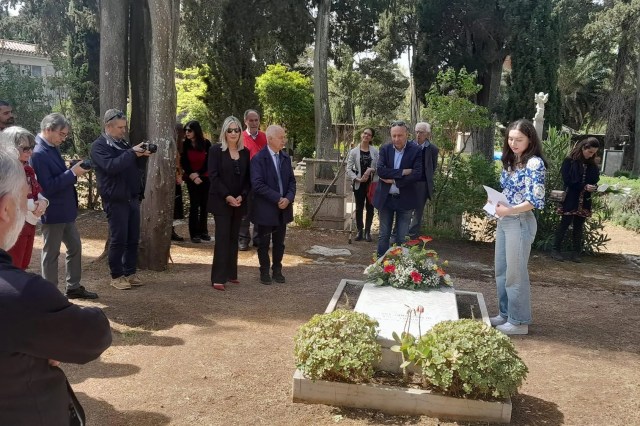
The 25th saw Gramsci admirers and well-wishers appear in droves, showing up non-stop throughout the morning, between 9am and 1pm, from the cemetery’s opening until its half-day closing. Before long, Gramsci’s grave was aglow with flowers and bouquets, and volunteers from the Fondazione Gramsci held an early morning vigil. A group of twenty or so people, mainly elderly women, paid homage, some lovingly tending the flowers around the tombstone and casket, doing so as if they were communing with a dearly departed loved one, a deceased husband or father, meticulously arranging everything, clearing away the dust and debris from Gramsci’s little patch. And then there was a moving reading, a middle-aged man reciting one of Gramsci’s letters to his younger brother Carlo (from December 19, 1929):
It seems to me that under such conditions prolonged for years, and with such psychological experiences, a man should have reached the loftiest stage of stoic serenity and should have acquired such a profound conviction that man bears within himself the source of his own moral strength, that everything depends on him, on his energy, on his will, on the iron coherence of the aims that he sets for himself and the means he adopts to realize them, that he will never again despair or lapse into those vulgar, banal states of the mind that are called pessimism and optimism. My state of mind synthesizes these two emotions and overcomes them: I’m a pessimist because of intelligence, but an optimist of the will.
Later in the morning, a much younger bunch arrived, eighteen masters students from the Erasmus University Rotterdam in the Netherlands, wanting to see Gramsci, a multinational crew hailing from all over the world, from Ireland and Colombia, from the Lebanon and Switzerland, from France and Germany, from Spain and the UK. Ordinarily, a group of this size would have to book in advance to gain entry; but on this exceptional day an exception was made, and I was asked by the Visitors Office to lead them to Gramsci’s grave, to supervise them a bit. Standing before Gramsci, beside his floral tribute, I couldn’t help chipping in a few words of my own, about his being at the Non-Catholic cemetery, about how it all came to be, and about the significance of today for Gramscians.
Then I asked, why Gramsci? What did he mean to them, twentysomething graduate students in Public Policy; to which Sinead, from Ireland, answered that he corrected several things Marx got wrong, or else understated—about culture and ideology, about the importance of things that weren’t just economic, but were superstructural, and no less important for that. Another said his anti-dogmatism had universal appeal, that he spoke to their generation, went across generations. “Look, we’re here, right,” somebody said. “That alone is testimony, isn’t it”—testimony to his enduring appeal, to young and old progressives—though perhaps not quite alike.
The encounters on the 25th were smaller dress rehearsals for the main event on April 27: the commemoration of the main man, a commemoration that was also a celebration of his living on, of still breathing life, inspiring in us moral strength, reminding us, in case we forget, that together we bear within ourselves our own destiny, that everything depends on us, on our energy, on our will, on our iron coherence of the aims we set ourselves. Gramsci famously transcends optimism and pessimism, overcomes them, keeps hope alive: for us he is both dead and alive, the dialectical incarnation of commemoration and celebration, of the past and the future, of our grieving his life yet thriving off his thought, off his example.
Hence the significance of April 27—indeed so significant in the cemetery’s activities that it warranted a very special act: the opening of “La Porta di Gramsci,” “Gramsci’s Gate,” a large pair of heavy iron gates along via Nicola Zabaglia, which, when pulled apart, offer immediate access to Gramsci’s tomb. (The door’s key fob is marked “Gramsci’s Gate.”) With these doors open, cemetery volunteers, including yours truly, had to stand guard, turning away any non-Gramscian. We needed to be on the lookout for potential fascist disruptors, too, while steering regular visitors toward the main entrance around the corner on via Caio Cestio. Those in the know come to the side gate, come every year, to celebrations organized by Rome’s Fondazione Gramsci and the Italian branch of the International Gramsci Society, headquartered in the United States.

Point to note: the two groups don’t get along, don’t talk to one another, are at odds with each other; and on the morning of the 27th they conduct their own separate ceremonies. It’s a sectarian tiff, seemingly baseless for the uninitiated, baseless even for the initiated. The Fondazione Gramsci accuse the International Gramsci Society of being traditori—traitors. For what reason? It’s hard to tell. When I heard the likes, it reminded me of Nikolai Gogol’s short story The Quarrel of the Two Ivans, about two dear friends who fall out. Once, the two Ivans were inseparable, so close that they loved each other like brothers, living in houses next to one another in a little Ukrainian village, sharing meals together, united by much more than mere name—until, until… one day they have a nonsensical tiff about a rifle and one Ivan calls the other Ivan “a goose”—“How dare you, in disregard of all decency, call me a goose.”
And that’s that, the collapse of a beautiful friendship, like calling someone a Stalinist or Trotskyist, a revisionist or Hegelian, even a “traitor.” Gogol ends his short story on a depressing note, that our world is “rather gloomy, gentlemen,” when friends with more similarities than differences can’t get along—didn’t Freud call it “the narcissism of minor difference”?
One wonders what Gramsci himself might have made of the squabble between the two Ivans, between the Fondazione Gramsci and the International Gramsci Society, between two groups who speak in his name, who operate in his honor, who keep his thought and legacy alive, and yet who can’t get along, overcome their grievances. Is it really respecting Gramsci’s legacy? Didn’t Gramsci have the ability to unite warring, ideologically divided factions? Wouldn’t he have been dismayed, particularly later in his life, at such sectarian mentality?
At ten-thirty, the Fondazione Gramsci unveiled a large wreath of crimson roses, adorned with their organization’s banner, and fifty or so people, most on the older side of the age spectrum, gathered around Gramsci in hushed reverence. Sometimes it seemed more like embarrassing silence, like waiting for Godot, expectant of something that didn’t look like happening. Eventually, something did happen, someone read aloud an extract of Pasolini’s poem “Le ceneri di Gramsci,” “Gramsci’s Ashes”: “and you, here, banished with your hard, uncatholic grace, registered among the dead foreigners: Gramsci’s ashes…Torn between hope and disillusion…the darkness of the foreign garden, you are dead and we are likewise dead with you, in this humid garden. Only here, you see, on foreign ground, may you rest, still an outcast.”
The meeting of the International Gramsci Society at midday was livelier, a more numerous affair: a hundred and fifty people of varying ages, including a lot of younger folk, congregated with a red rose in hand. It was a badge of entry at Gramsci’s Gate, a lovely gesture, especially when we think of the significance of roses for Gramsci, the cultivator of flowers, nurturing his little garden, his tiny plot along Turi’s prison wall, as if he were trying to establish his own mini-utopia, full of beauty yet something durable, with a capacity to survive all weathers and occasionally to pique with its thorns.
Onlookers heard speeches and readings of Gramsci’s letters to his mother:
Dearest mamma…I can’t give you many details about the accusations against me, since up to now I haven’t been able to understand exactly what they are. In any case, the issue is clearly political…One simply has to have a great deal of patience. I have a ton of it, wagonfuls, whole housefuls. Do you remember what Carlo used to say when he was little and had eaten some special dessert?—‘I want a hundred housefuls of it!’…But you, too, must be good and patient. Your letter shows me that you are quite the opposite. You write that you feel old, etc. Well, I’m sure that you’re still very strong and resilient despite your age, the sorrows you have known, and the great efforts that you had to make. (February 26, 1927).
Dearest mamma…I no longer know what to write to comfort you and set your mind at peace…I’m neither a child nor simpleton, don’t you agree? My life has always been ruled and directed by my convictions, which certainly were never passing whims nor momentary improvisations. (December 12, 1927)
Dearest mamma…Prison is a very ugly thing; but for me dishonor due to moral weakness and cowardice would be even worse. So you mustn’t be alarmed and grieve too much, and you must never think that I’m downcast and desperate. You must have patience and in any case you mustn’t believe the nonsense they publish about me. (March 12, 1928)
Dearest mamma, I would really like to embrace you and hold you tight to make you feel how much I love you and how I would like to console you for this sorrow that I’ve caused you: but I couldn’t have acted otherwise. Life is like that, very hard, and sometimes sons must be the cause of great sorrow for their mothers if they wish to preserve their honor and their dignity as men. I embrace you tenderly, Nino. (May 10, 1928)
Someone else spoke about having just returned from Latin America, and about how many young people over there were inspired by Gramsci’s life and writings, how it was thrilling to see his thought speak to those of different tongues and cultures, retaining its significance across time and space—Gramsci was a true internationalist, he said, and in that sense it struck me then that Pasolini’s poem got Gramsci wrong, objecting to his being put to rest amongst “foreigners.”
I’ve got to admit I’m not too keen on Pasolini’s tribute to Gramsci: too downbeat for me, too chauvinistically Italian, wanting to narrow Gramsci’s breadth of appeal, reclaiming him as an Italian fit only for Italian soil, buried exclusively amongst Italians. He was a Sardinian-Italian Internationalist married to a Russian. “On foreign ground, you’re still an outcast,” Pasolini says, without seeing how inclusively global he was, how inclusively global he continues to be.
Then a journalist from the leftist newspaper Il Manifesto made his way forward and began discussing the campaign to get a commemorative plaque at the Quisisana clinic. He reminded everybody that, on this very day, Gramsci died in northern Rome, about six miles up the road, and there’s still no memorial for him there. He mentioned the petition, still ongoing, trying to accumulate signatories, and the fact that there needed to be popular pressure on the municipality and on the clinic, which, he said, confirming something I knew already, is a privately-owned establishment, controlled by a family with deep fascist sympathies; we should organize round getting Gramsci memorialized as Quisisana. To which everyone clapped.
By morning’s end, Gramsci was blooming with flowers. The single rose I saw on his casket several months ago had now propagated into something vaster, into a whole rose movement, into a plurality of roses, a great floral remembrance, a stunning reminder that, yes, Gramsci was right, might always be right: that flowers will outlast weeds and today I’ve just witnessed my Roses for Gramsci, smelled them, watched them grow into something fecund and meaningful. I forgot about any comradely disagreement.

As I stood guard at Gramsci’s Gate, keeping an eye out for those who came and went, I was really more a spectator than a participant, a fly on the Aurelian wall. But this gave me the mental space to reflect upon what I was witnessing; what was bringing these people together, what did they see in Gramsci, and who were they? Maybe what Gramsci brings to the table, to their table, is his special notion of intellectuals, a breed of people who have the capacity to think and struggle for a better society.
I don’t mean this rhetorically; it’s a more modest, everyday understanding, of making justice ordinary, of bringing Marxism closer to home, of embedding it in the context of real people’s lives, of ordinary people united by their capacity to think. They were all intellectuals in the Gramscian sense of the term. Everyone is an intellectual, Gramsci says, but not all in society have the function of intellectuals. “Each person,” he says, “outside of their professional activity, carries on some form of intellectual activity, they are ‘philosophers’, an artist, somebody of taste, they participate in a particular conception of the world, have a conscious line of moral conduct, and therefore contribute to sustain a conception of the world or to modify it, to bring into being new modes of thought.”
I suspect this describes a lot of the people who showed up on the 25th and 27th: they hold a particular conception of the world and a conscious line of moral conduct, drawing from Gramsci, that tries to ward off reactionary conceptions of the world. In their own everyday lives, they’re likely “permanent persuaders,” some sort of organizer or instructor or teacher, maybe not teachers in the formal sense of an occupation; rather they’re political animals involved in the dissemination of modes of behavior and codes of conduct. They distinguish themselves, as Gramsci says, “less by their profession than by their function in directing the ideas and aspirations of the class to which they belong,” a class that somehow speaks in the name of the working class.
Likely the aspect defining these “neo-organic intellectuals”—those Gramscians without a discernible Party—is that they’re all involved in the transmission and absorption of critical ideas, all, somewhere and somehow, involved in a struggle for an anti-capitalist life. They’re all trying to make an ordinary life a little less ordinary, and Gramsci is their guiding spirit, somebody worth following, a moral compass, a symbol of resistance and dissent. At some point in their lives they’ve probably also asked themselves the probing Gramscian question: “What is man?”–or “What is a person?”
Likely, too, they’ve accepted his response, used it to enlighten their lives. “When we ask, ‘what is a person’,” Gramsci says, “we really mean, ‘what can a person become?’, whether or not a person can control their own destiny, can ‘make themselves’, can create a life for themselves. Therefore we say that a person is a process, and precisely the process of their actions. When we consider it, the question ‘What is a person?’ isn’t an abstract or ‘objective’ question. It stems from what we have thought about ourselves and others, and, relative to what we have thought and seen, we seek to know what we are and what we can become…we want to know this ‘now’, in the given conditions of the present and of our ‘daily’ life.”
It’s a form of self-enquiry undertaken by intelligent people. What’s crucial, Gramsci says, is to conceive a person, and to conceive of oneself, as “a series of active relationships,” as “an ensemble of relationships.” “Individuality, while of the greatest importance,” he says, “isn’t the sole element to be considered.” “Personality is the whole mass of relationships,” and “the acquiring of a personality means acquiring of a consciousness of these relationships.” The enquiring person, in short, knows that there’s a reality beyond the self, that we belong to a society with others, constituted by others, by ourselves with others.
***
There’s plenty that strikes about Gramsci oeuvre, but one thing is perhaps unique: that it inspires a body of thought as well as the inspiration of the man himself. Gramsci wasn’t an ogre or despot, an autocrat or dogmatist, wasn’t a towering leader or alpha male. He was a victim without ever wallowing in victimhood. He never wanted anybody to shed him any tears. His stoicism and patience warrants admiration. He was an underdog, an invalided subaltern, concerned about the state of his underwear and fussing over how he could find the right needle to darn his socks. This is what makes him so approachable, reveals his human face, a frailty and humility—remember his first apologetic prison letter to landlady Clara Passarge? Such humble qualities seemed to attract women followers, explaining why the majority of people gathering around Gramsci on the 25th and 27th were in fact women; not just elderly women, but younger women, too. Women comprise a sizeable contingent of his fan base, always did.
Indeed, Gramsci’s whole life was populated by women; he was surrounded by them—by his wife, his sister-in-law, his sisters, his landlady, and his mother. Everywhere women were the protagonists in his life. (Sraffa was the sole male persona, his only male friend of any significance.) Even today, most days, it is women from the Fondazione Gramsci who come to tend his grave, who place fresh flowers on it, who dispense with old ones, who tidy up the soil and wipe off the dust. It’s done with the same tireless dedication of Tatiana’s long ago, and it’s a loyalty that continues, never ceases to tire.
The single most dominant woman for Gramsci was, of course, his mother, Giuseppina (“Peppinna”) Marcias Gramsci, a native Sardinian, who raised Nino and his six siblings almost singlehandedly, often with little help from husband, Francesco, a man of Albanian decent. Francesco was employed in the Land Registry Office of Sorgono, a neighboring village; but between 1898-1904 he was imprisoned for the misuse of public funds, for “financial irregularities.” After his release, work was scant and money scarce for the Gramscis. Giuseppina was the daughter of a local tax collector, better educated and more cultivated than a lot of other Ghilarza housewives. But Francesco’s jailtime meant financial hardship and not a little humiliation for Gramsci’s mother.
She wasn’t forgotten on the day of her son’s anniversary. As events unfolded in Rome, a similar ceremony took place in Ghilarza’s small public cemetery. The newspaper L’unione Sarda reported on a “touching and simple floral tribute to his mother’s tomb on the 87th anniversary of Antonio Gramsci’s death.” A handful of people congregated, and a wreath was laid down by Galatea Gramsci, “the niece of the thinker, who read out a letter from prison written to Gramsci’s mother.” The commemoration was organized by Ghilarza’s “Museo Casa di Antonio Gramsci,” whose president, Catherina Pes, spoke about the ongoing building works undertaken at the museum, the site of Gramsci’s childhood home. She explained what the museum is doing to preserve Gramsci’s legacy. “The works are slightly late,” she admitted, but we’re reassured “that by July [2024] the renovations will be completed, and we will make the structure accessible to everyone again.” For the time being, Pes said, “part of the collection can be admired in the nearby premises of Piazza Gramsci.”
The most poignant of all Gramsci’s letters to his mother was dated March 8, 1934: “I don’t know much about your health,” Gramsci says. “Teresina writes little and the same goes for Grazietta. I hope from now on to write regularly, even though not too often. Dearest mother, I embrace you with all my affection, together with everyone at home.” We know she never read this letter. We know it because his mother had already been dead for fifteen months, passing away on December 30, 1932. But nobody had the heart to tell Nino. Tatiana said they were reluctant for fear of pushing him over the edge, that he’d be unable to withstand the shock; it would propel him down the abyss he’d been staring down. Tatiana said his physical and mental health had deteriorated over the past year and a half to such a degree that he no longer had the strength even to write regular letters; since 1933, his correspondence had noticeably trailed off. All of which bodes the question: did Gramsci ever find out the truth? Did he ever know his mother was dead?
What is evident is that his final months were mysterious, not least concerning what he’d do after April 21, 1937, once freed. Sraffa’s testimony hinted at expatriation to the USSR, being reunited with his family, continuing the communist struggle. A clearcut decision, no? But then, suddenly, a change of plan, opting instead to return to Sardinia. Why? In the early 2000s, Antonio Gramsci Jr., Gramsci’s grandson, Giuliano’s son, intrigued, undertook his own investigation into the matter. He looked into the history of the Schucht family and tried to reconstruct the life of his grandfather around its conclusion. (In 2012, Gramsci Jr. presented his thesis to an audience at Turin’s Teatro Vittoria. The talk was translated into English and published as “My Grandfather” in the November/December 2016 issue of New Left Review.)
The Schuchts, Gramsci Jr. says, were longstanding friends with the Ulyanovs, Lenin’s family. The Register of Biographical Records of Lenin reveals that Gramsci met the Bolshevik leader at the Kremlin on October 25, 1922, and the two men, despite more than a twenty-year age gap, got along. Lenin was impressed with the young Italian. He favored him as the head of the Italian Communist Party, in preference to Amadeo Bordiga, who disappointed Lenin with his sectarian rigidity. The record says that they spoke about Italy’s “southern question,” about the state of the Italian Socialist Party, and its possible fusion with the communists. Yet after Lenin’s death, in January 1924, things under Stalin turned sourer, more suspicious.
Delving into the Russian State Archives, Gramsci Jr. discovered a complex picture of his grandfather’s relationship with the Soviet security service, the NKVD. In 1936, they wanted Gramsci to tell them everything he knew about the Italian Trotskyists. Gramsci Jr. suggests that Gramsci Sr. might have balked at the prospect. That his emigration might be conditional on him collaborating with the Soviet secret service was troubling. Or, as Gramsci Jr. wonders, “did they simply wish to make him aware, indirectly, that he still carried the taint of Trotskyist sympathies, having written a letter in defense of Trotsky to the Central Committee of the CPSU in October 1926?”
Was it at this moment, then, Gramsci Jr. muses, that his grandfather wrote to his family “begging them urgently to find him a room in Santu Lussurgiù”? Was it his worsening health, coupled with the worsening political climate in the Soviet Union, that hastened the dramatic change of course, having him select retirement on his native island? And what a hero’s return it was meant to be, scheduled for April 27, 1937. Niece Edmea, daughter of eldest brother Gennaro, had found uncle a very nice room in the village where Gramsci passed his Junior High School days; and the family was naturally over the moon, thrilled about his imminent return, like Odysseus’s epic homecoming to Ithaca. Gramsci’s father, Francesco, then in his 79th year, was especially ecstatic about being reunited with his long-lost son, not seen since 1924, an absence of thirteen hard years.
On the morning of the 27th there was great hoo-hah and anticipation, tremendous expectation in the Gramsci household. But by evening when Nino failed to show, everybody wondered what had happened, why the delay, why no word about his arrival? They didn’t know until the next day the awful truth, listening to a radio broadcast, that he’d died in Rome the day before, on the fated day of his return. Francesco, devastated, screamed, “Assassins, murderers, they’ve killed my boy, killed my boy!” It was too much to endure. Two-weeks later, on May 16, 1937, Francesco himself was gone, passing away of a broken heart; the Gramsci family tragedy was complete.
Seven decades on, Gramsci’s youngest son, Giuliano, began his own enquiry, a very personal one, into his father’s legacy, and into his own legacy with his father. What could he say to a father he’d never seen? The question formed the basis of a book, Papà Gramsci, created in dialogue with the Italian lawyer and writer Anna Maria Sgarbi—a series of twenty imaginary letters an octogenarian Giuliano, a retired music professor from Moscow’s Music Conservatory, a man who’d always preferred music to politics, finally wrote to his late departed father. “Dear Papa, I’ve aged, am eighty years old. You are always the same—young, intelligent, sharp, and handsome. I’ve never touched you with my hands, but always caressed you on paper and embraced you in my dreams.”
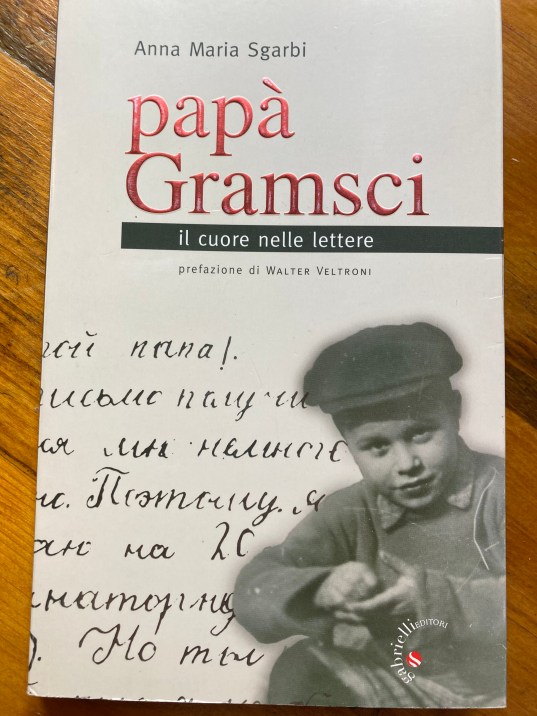
Giuliano’s letters are emotionally charged, his heart laid bare to his father; some of the contents, Giuliano knew, would have upset papa, and it’s a good job he never knew—it would have only added to the dreadful sufferings already inflicted upon him: “Dear Papa,” he begins, “my infancy, my childhood and adolescence passed without freedom, with a fear of everything…You know, Papa, when I finished first in class I received a book as a gift from school, with a cover of leather, entitled ‘Thank you, comrade Stalin, for all our happy childhoods’. It told of Stalin’s heroic deeds, from his youth to these days, and also contained poems, not so beautiful. I remember one by the poet Stalsky, and this is what it said:
In the cloudy sky
above the snow-capped peaks
eagles fly
and the first eagle is
Lenin,
the second is
Stalin,
and eaglets,
their children
and pupils,
fly around”
“The day I received the gift book at school,” Giuliano says, “I went home happy and proud because it was a reward for good academic performance. Mamma dampened my enthusiasm, taking the book from me and putting it aside, without even leafing through it. I missed you very much at that moment.”
Dear Papa, when Delio died in 1982, I had a real deep feeling of loneliness…He was in great pain waiting for the title of admiral and was sent into retirement. He wanted promotion more than anything in the world, and when he was forced to retire before reaching this milestone, he fell ill with a severe depression that led to his death…His body was placed in the tomb of grandpa [Apollo] Schucht, where mother already rested. She died due to her illness in 1970. I remember mother, with her grace and elegance, her wonderful violin playing, in the nursing home for old Bolsheviks in Peredelkino near Moscow. I couldn’t do much for her—her illness devoured her…
Every now and then, when I looked at Delio, you came to mind. Delio loved to dance foxtrots and tangos, he danced everywhere; music was moving for him—joy, passion, abandonment. For me it is Bach and Vivaldi…I would have loved for him to speak to me as a brother, tell me his anxieties and desires, his disappointments. He left without leaving signs of weakness, and just before closing his eyes forever, he wanted to wear your glasses, because he often said that your glasses were the ones worn by all the intellectuals, the cultured people. Chekhov also wore glasses like yours, the ones without a frame, with narrow lenses perched on the nose. A hug, Giuliano.
Just before Papà Gramsci was released, Gramsci’s youngest son wrote a taster article on the 70th anniversary of his father’s death. “Mio Padre Gramsci” appeared in the Italian national newspaper Corriere della sera (April 27, 2007) four-months prior to Giuliano’s own passing in Moscow, at the age of 81. (As such, Papà Gramsci is even more poignant because of its posthumous publication.) In “Mio Padre Gramsci,” Giuliano maintained two things: firstly, his father has been dispatched to “the museum of antiquity,” now pretty much a forgotten man in Italy; and, secondly, “had he survived the atrocities of prison and found refuge in Soviet Russia, he wouldn’t have had an easy time under Stalin’s regime, and almost certainly would have perished in some Gulag in Siberia.”
The life and death of Antonio Gramsci, we might say, was stuck between the rock and the hard place; but Giuliano was wrong about dad: he’s remembered, not forgotten, he’s still an inspiration for everyone, I’d seen it for myself, seen how he’s someone who still helps us navigate the rocks and hard places that besiege us everywhere today. And so, on the 27th, after everyone had left the cemetery, I closed Gramsci’s great iron gate for the morning, heard it creak and clang shut, locking it, knowing he was safe for another day. Alone, in the stillness, I was able to admire the gorgeous display of flowers and wreaths next to him, the well-wisher notes and kind words. No, he’s not forgotten, I reassured myself; no, he’s not forgotten, I can reassure Giuliano in his far-off resting place.
Then I remembered what Gramsci said in one of his last letters to Giulia (July 1936), when he was still mulling over his future prospects. “I don’t know what to do,” he said, still unsure, telling his wife: “it seems to me that if I go back to Sardinia, a whole cycle of my life perhaps will be definitively closed.” There and then I realized I had to go to Sardinia soon, had to go to discover it with my own eyes, had to feel the place. I had to find out where Gramsci came from, and where he was about to go back to. I had to try to comprehend what might have been. I had to try to square that circle, understand how the cycle of his life might have been closed, and how, somehow, it still remains open…

 andy merrifield
Dear Andy,
Well, this one moved me to tears. Perhaps because I have been a bit depressed lately, but mainly because what you wrote is moving. I think Gramsci is very much alive, and will be all the more so when we publish your book!
Take care and solidarity,
Michael
LikeLike