
Last Sunday, I took a rare outing beyond Rome, fifteen miles southeast to Ariccia, a historic small town in the Alban Hills, close to the picturesque volcanic lakes of Albano and Nemi. Contiguous to the larger Albano Laziale and a more famous Castel Gandolfo, site of the Pope’s summer residence, Ariccia has narrow streets with endless traffic and a main square, the Piazza di Corte, crammed with people sitting in glorious spring sunshine.
In the first half of the nineteenth century, Ariccia, like neighboring Albano and Castel Gandolfo, was a destination, well-known for welcoming artists and writers, those fleeing Rome’s torrid summer heat as well as embarked on the “Grand Tour” of Europe. In its heyday, the Locanda Martorelli became the town’s famed stopover inn, with an impressive list of former frequenters: playwright Henrik Ibsen, children’s fabulist Hans Christian Andersen, American poet Henry Longfellow, artists Friedrich Overbeck and J.M. Turner (whose 1827 painting moodily depicts Lake Nemi), and a certain Russian scribe called Nikolai Gogol.
Nowadays, it’s easy to miss the Locanda Martorelli, a rather forlorn, tatty looking building in dire need of a rehab and refresh. A banner on one moldy window says it’s now the “Museo del Grand Tour”; yet its rusty mailbox dangles from the wall and the whole place looks like a while since it received any visitors. There’s a fading plaque at second floor level listing past luminary guests—one name missing, though, much to my chagrin, is Gogol’s, who’d been a regular at the inn, journeying often to the region with his Russian pals, artists Alexander Ivanov and Fyodor lorden, and the writer Pavel Annenkov.
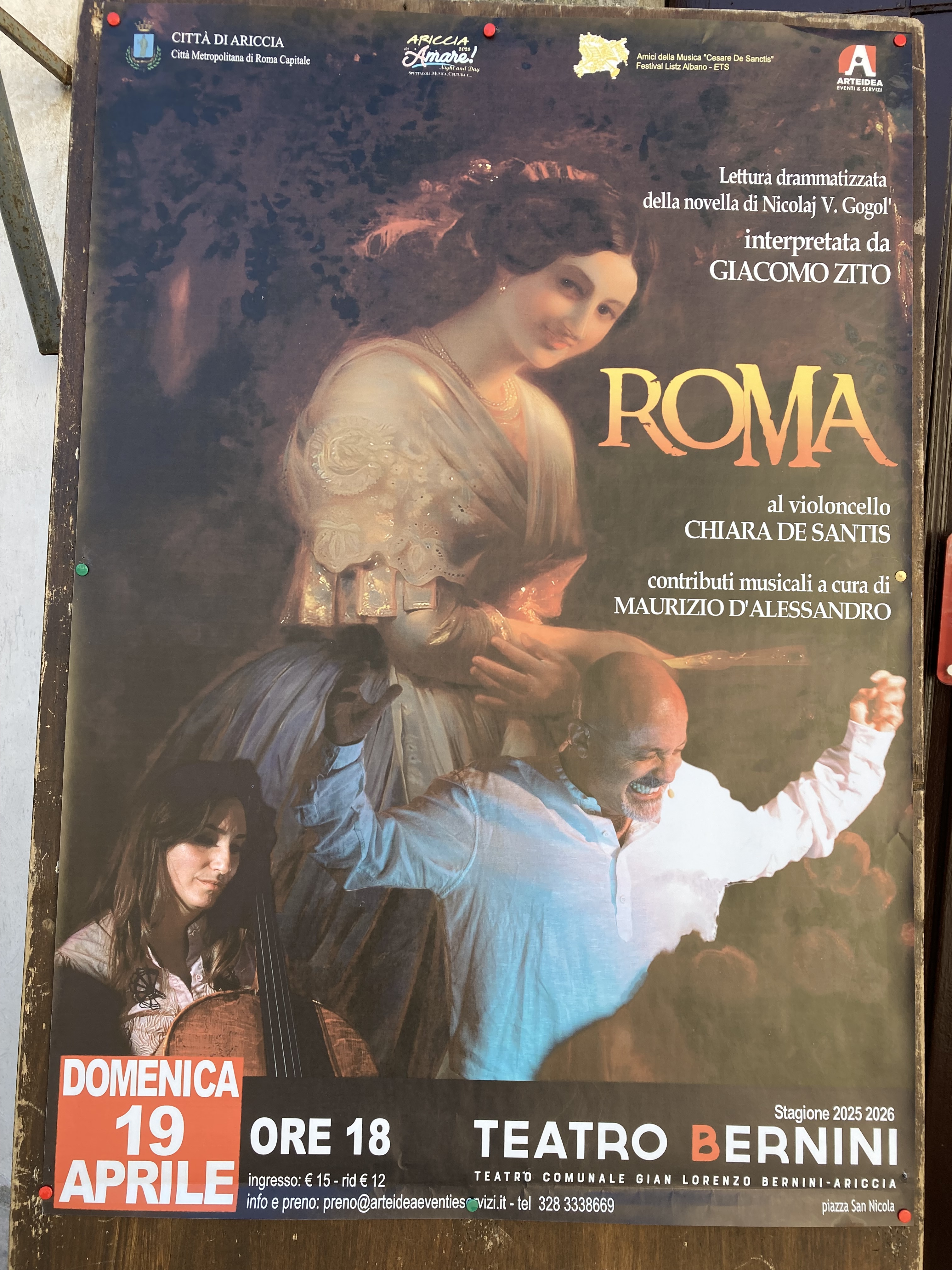
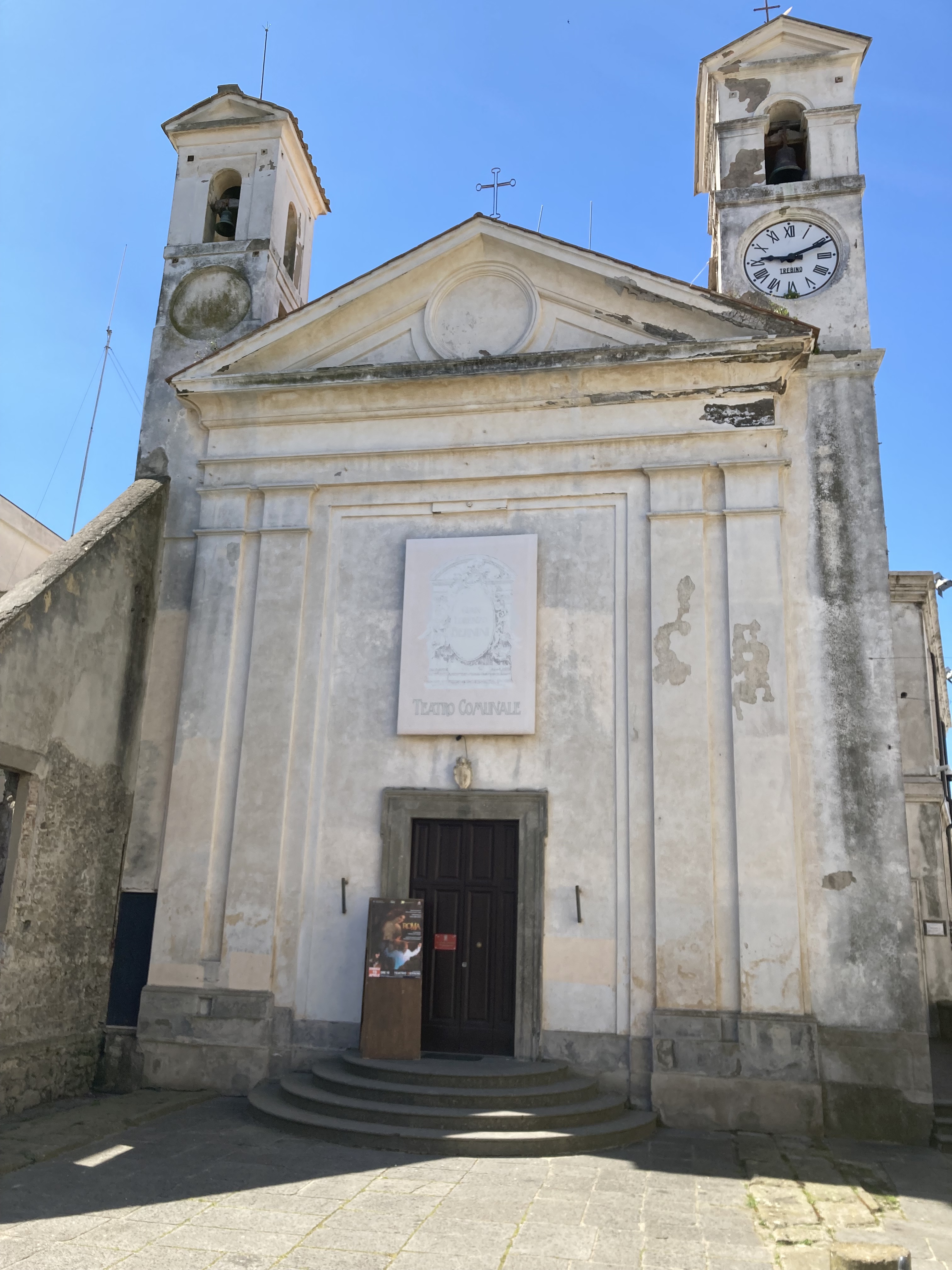
Curious to see another one of his Italian haunts, Gogol was my principal reason for coming that Sunday; the other prompt was I was eager to catch the finale performance of a reading of his story “Rome,” staged that evening at Ariccia’s communal “Teatro Bernini.” The theater, I’d soon discover, is a little gem, charmingly novel, because it occupies a church commissioned by Pope Alexander VII, dating from 1665, appropriately named Saint Nicolas. It was deconsecrated in 1870 and acquired by the municipality a few years later. Since 2008, it has been the residence of a successful and vibrant repertory theater, with a seating capacity of around 100 people.
Gogol loved his visits to the Alban Hills. “A few hours later,” Annenkov writes in his Literary Reminiscences, “we were in Albano, and both during the journey and upon our arrival in the small-town Gogol seemed perfectly at peace…From the mountains of Albano, a magnificent vista opens out onto Rome and its surrounding countryside. A distant, silent plain, strewn with ruins and seemingly inhabited solely by the sun—which transforms the light and colors from hour to hour—set against the motionless backdrop of the city and the azure dome of St. Peter’s. Above all, in the evening, at twilight, when the shadows of the ancient tombs and aqueducts lengthened and deepened, the scene took on a stern grandeur that almost invariably had a mysterious effect upon Gogol.”
It seemed fitting, then, that the locale should be putting on Gogol, and in front of a packed house. Not a free seat anywhere. In fact, people were sitting impromptu in the aisles and on the stairwell of the steeply tiered seating structure. Entering the theater had been frustrating, a bit of an ordeal, standing outside under a blazing sun for half an hour or more, watching the line ahead inch painfully toward the door. Once on the inside, the slowness was revealed: admission was old style; nobody had purchased a ticket in advance, only made a reservation. At the door, names were ticked off, you paid, and each visitor received a handwritten ticket!
Before the lectern, a slim, tanned, bald Giacomo Zito stood, a dapper man in his fifties, with a manicured goatee; beside him sat cellist Chiara de Santis, who would strum soulful cords to Zito’s enactment of “Roma,” in all its unabridged fullness. For the next one and a half hours, he read, often at breakneck speed, he modulated his speech, he acted out scenes, paused, whispered, gestured, but most of all bellowed out a dramatic effusion of words, set against a background of evocative images of the Alban Hills of Gogol’s day and of the old Rome his young prince, freshly returned from Paris, would grow to adore.
And Gogol’s muse, Annunziata, was introduced, the stunning belle of Albano, whom we know was modeled on a real person—Vittoria Caldoni (1805-1890)—the most popular painters’ muse of the age; over 100 paintings of her survive. (Ivanov’s portrait is perhaps one of the most famous.) “Everything about her recalls those ancient times,” Gogol wrote of Annunziata (Caldoni), “when marble came to life and sculptors’ chisels gleaned. Her thick pitch-black hair rises in two rings of a weighty plait over her head and spills into her neck in four long curls. No matter which way she turns the radiant snow of her face, her image has been entirely engraved on your heart.”
Zito was at his most theatrically best expressing Gogol’s dialogue, a street scene where his young prince plunges into teeming working class Trastevere, seeking out the old servant Peppe.
“‘Does Sior Principe wish to see Peppe?’
He raised his head: Siora Tutta was sticking her head out of the window opposite…‘Of course he came to see Peppe, didn’t you, Prince? Didn’t you come to see Peppe? To see Peppe?’
‘What Peppe, what Peppe!’ Siora Susanna continued, gesturing with both hands…
‘There’s Peppe!’ Siora Susanna exclaimed.
‘Here comes Peppe, Sior Principe!’ Signora Grazia shouted energetically from her window.
‘Peppe’s coming, he’s coming!’ Siora Cecilia chimed in from the corner.
‘Principe, Principe! There’s Peppe, there’s Peppe (ecco Peppe, ecco Peppe!)! the urchins on the street shouted.
‘I see him, I see him’, the prince said, deafened by the lively shouting.
‘Here I am, eccelenza, here I am!’ Peppe said, taking off his cap…
This is what the prince was thinking about: Peppe can search out and learn the beauty’s name, where she lives, and where she’s from, and who she is. In the first place, he knows everyone and thus more than anyone else he can find friends in the crowd, he can have them investigate, he can drop into all the cafés and osterias, he can even talk about it without arousing any suspicion based on the figure he cuts. And although he’s sometimes a blabbermouth and a scatterbrain, if I bind him with his word as a true Roman, he will keep it all a secret.”
We know how Gogol wound up his tale: with his young prince, at the end of June carnival day, standing before the shining panorama of his eternal city, high up on the Janiculum Hill. “My God, what a view!” And so “the prince caught in its embrace, forgot himself, the beauty of Annunziata, the mysterious destiny of his people, and everything else in the world.” And so Zito capped it off beautifully, in solemn Italian, fading out along with the setting sun: “Dio, che vista! Il principe, preso nel suo abbraccio, dimenticò se stesso, la Bellezza di Annunziata, il misterioso destino del suo Popolo e tutto quanto c’era al mondo.”
Despite my still-meagre grasp of Italian, it was hard not to be taken by Zito’s performance, by his delivery of Gogol’s tale. Somehow, it went beyond language. I understood all. Afterward, I reflected upon what I’d seen, what I’d heard, and remembered something someone once said of Gogol: if you hadn’t heard him read, you didn’t really know his works. While this dramatically curtails any knowing audience (!), after listening to Zito, I sort of grasped what this might mean, began to understand the story in a somewhat different light, to appreciate more what I’d always thought overwritten, too laden with adverbs and adjectives, with over-the-top florid description.
Yet hearing the rhythm and breakneck cadence of Zito’s interpretation, those adverbs and adjectives and thick descriptive glosses now sound well-chosen. An exaggerated oral performance, a rapid-fire, manic explosion of words and intonations, voiced by an actor, seems to get Gogol right, brings him alive, mimics what many confirmed about how brilliant a reader he was of his own works. They need acting out and performed to tap their true glory.
Anybody who has ever enjoyed Gogol’s masterpieces like “The Overcoat,” “The Nose,” “How the Two Ivans Quarreled,” and certain sections of Dead Souls, or has ever read or seen performed “The Government Inspector,” will recognize that “Rome” is in the minor register, a markedly inferior piece in Gogol’s overall oeuvre—which is why he was reluctant to publish it as a “fragment.” Remember he was pissed off with his friend Pogodin who released it in 1842 in his journal The Muscovite, against Gogol’s wishes. Gogol clearly saw it as unfinished, as incomplete and unpolished, as a work in progress—a work in progress never consummated.
But there was something extra going on that evening, too, vividly apparent from audience reactions at the Bernini theater: everybody listened in hushed reverence, with hardly a splutter or whisper to be heard. The story had resonated with Italians, gripped them, seemed to enter their hearts and minds. If they’d never read any other Gogol tale, this one would be sufficient unto itself, because it touched them as a people. With real meaning and genuine authenticity, enough to convince a native, Gogol’s “Roma” evoked their city, their land, their spirit. Gogol had reached some part of the Italian psyche that went beyond St. Petersburg, even beyond Rome. They were on the scent of Gogol whether they knew it or not. And so was I. As our planet continues to go to pot, I sometimes stand on the same spot where his young prince once stood in Gogol’s imagination. I forget about myself and everything else in the world.


