THE SUBALTERN IN GRAMSCI

DiLAG

Gramsci saw the whole of the Italian “South” as a kind of goblin, as a character who got and keeps getting a bad rap, like Rumpelstiltskin. In late 1926, a month or so prior to his arrest, he was at work on a long essay about the Italian South, Alcuni temi della questione MeridionaleSome Aspects on the Southern Question. The piece was never completed; it was rudely interrupted; and while there’s a lot left dangling, there’s plenty for us still to glean. Gramsci was addressing his Marxist comrades, notably comrades from the north, in a tone that’s critical, enquiring, taking to task all camps, typically trying to get at the truth—warts and all. Gramsci chastised a Right northern bourgeoisie as well as a Left industrial proletariat, northern Marxists as well as southern liberals, workers from the north as well as a gentry from the south.

Point is that all this is voiced by a lad from the south. Gramsci’s political awakening occurred in the north, yet his cultural allegiances always rested with the south. He grew up in peasant society, spoke local Ghilarza dialect, and probably didn’t hear Italian itself until he reached grammar school; and then, in Turin, through his college professors. As a poor, set-apart kid, encountering official Italian was likely both a source of liberation and a lesson in officialdom, the tenor of a ruling class authority he was out to smash.

So part of Gramsci’s struggle was to invent not only a different kind of Marxism, but also a different kind of language, a different political register that spoke neither raw dialect nor elitist Italian. In a sense, amalgaming the two interested the linguist in him, mixing the language of the countryside with that of the city, reconciling the expressive powers of vernacular with the sobriety of reason, converting a commonsense into good sense; a Marxism neither flaky idealism nor iron-law materialism yet something else again—a concrete, authentic, philosophy of praxis sensitive to place, culture, and tradition. There’s a lot more there there in his Marxism.

We can witness this flowing through “Some Aspects on the Southern Question.” He’s especially skeptical of how his factory council comrades want to resolve southern “backwardness.” By smashing the capitalist factory autocracy, they say, smashing an oppressive state apparatus, a workers’ state would then smash the chains that bind peasants to the land. Taking over industry and the banks would swing the enormous weight of the state bureaucracy behind the peasants, helping them vanquish in their struggle against southern landowners.

Gramsci doesn’t buy into this northern patronage, into the communist “magical formula” (as he labels it). He doesn’t believe the solution to the “Southern Question” lies in the hands of a northern workers vanguard. Northern communists, he says, have more in common with their bourgeois antagonists, a lot more than they consciously appreciate. They’ve been “unconsciously subjected to the influence of bourgeois education, to bourgeois press, to bourgeois traditions.”

“It’s well known,” Gramsci says, “what kind of ideology has been disseminated in myriad ways among the masses in the north, by propagandists of the bourgeoisie: the south is the ball and chain which prevents the social development of Italy from progressing more rapidly; southerners are biologically inferior beings, semi-barbarians or total barbarians, by natural destiny; if the South is backward, the fault doesn’t lie with the capitalist system, but with nature, which has made southerners lazy, incapable, criminal and barbaric.”

Left-wing positivism has often reinforced southern inferiority: “science was used to crush the wretched and exploited, but this time it was dressed in socialist colors and claimed to be the science of the proletariat.” Factory workers and Marxist intellectuals, Gramsci says, have to rethink this approach so that the Left can become politically effective throughout all Italy. Proletarians and their leaders “must strip themselves of every residue of corporatism, every syndicalist prejudice and incrustation,” he says. They need to overcome distinctions between one trade and another, between factory workers and artisans, industrial laborers and toilers on the land, between the city and the countryside—between a north and south embedded in peoples’ heads.

Spatial antagonisms—urban versus rural, north versus south, etc.—tend to occlude basic class questions, says Gramsci, and one of the biggest problems here is organizing. In the south, urban forces are subordinate to rural forces, the city kowtows to the countryside. In the Mezzogiorno, the countryside is less progressive than the city; but southern urbanism, unlike its northern counterpart, isn’t industrial, and can’t be organized in the same fashion as a giant car plant; the culture and history of Naples is different from Turin and Milan. And yet, given the dominance of the industrial north, and the greater leverage of its factory workers and unions, the latter has to convince southern rural and urban working classes that they’re all brothers and sisters in the same struggle.

The schism between city and countryside, in other words, is much more nuanced than crudely meets the eye. Indeed, Gramsci warns about the ideology of appearances. “The relations between urban population and rural population,” he says, “aren’t a single, schematic type.” Figuring out their dialectical specifics, as well as fulfilling an educative and directive role, is the task Gramsci ascribes to “organic intellectuals,” a species of thinker and activist different from “traditional” intellectuals: the latter, he says, operate more conciliatory—lawyers, doctors, notaries, teachers, priests, bureaucrats, and technocrats—professionals who, wittingly or unwittingly, usually prop up the status quo rather than tear it down. Left organic intellectuals, on the other hand, feel the elemental passions of “the people” and become “permanent persuaders.” They critically explain the movement of history, as well as the working class’s interests in that movement. In Italy, as elsewhere, organic intellectuals help forge a “national-popular collective will.”

***

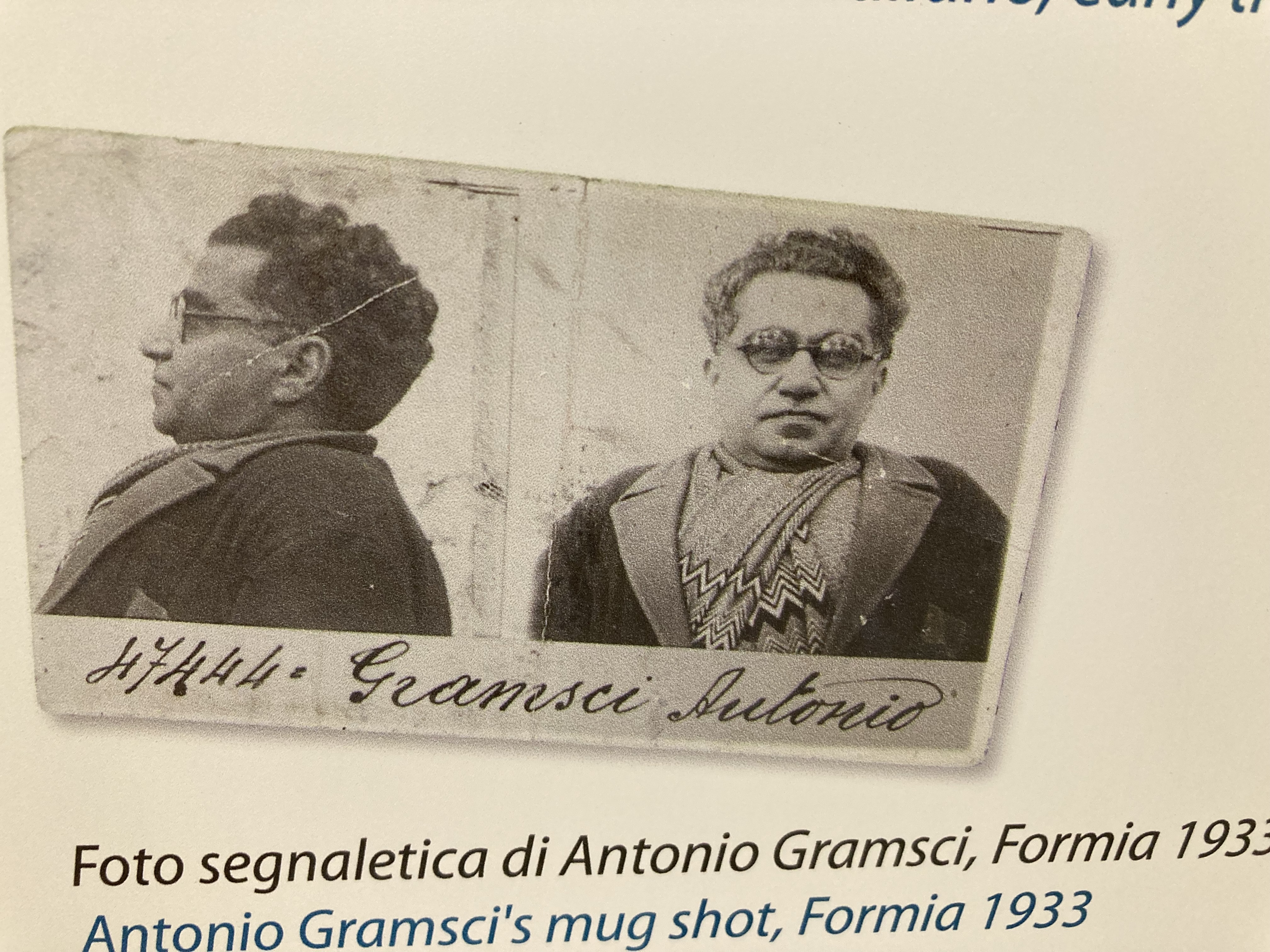
Gramsci’s health worsened toward the end of 1933. Sister-in-law Tatiana and longtime Gramsci friend, Piero Sraffa, a renowned economist at the University of Cambridge, made frequent appeals about getting him moved and better cared for. After Turi’s prison doctor also recommended a transfer, the fascist government eventually authorized Gramsci’s shift to Professor Giuseppe Cusumano’s health clinic in Formia, a coastal town 100 miles south of Rome. Although still under police surveillance, Gramsci could go out for occasional short walks, accompanied by an approved individual. Every Sunday, Tatiana journeyed down by train from Rome, and together they’d walk along the beachfront; sometimes brother Carlo came, and a few times Sraffa himself, from the UK.

Gramsci’s poor health, though, meant he couldn’t fully benefit from his newfound conditional liberty. A cleaner at the Cusumano clinic recalled her initial glimpse of the new patient: “small, hunchbacked, wrapped in a black Sardinian shepherd’s cloak, between two policemen.” “I was disappointed,” she said. “They told me Gramsci was the leader of the communists, a revolutionary, and I’d imagined him tall, imposing, not so small, minute, tired; but his eyes were clear, alive, penetrating, they dug into you. It was clear he was an extraordinary man.”

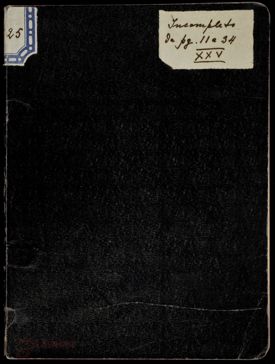
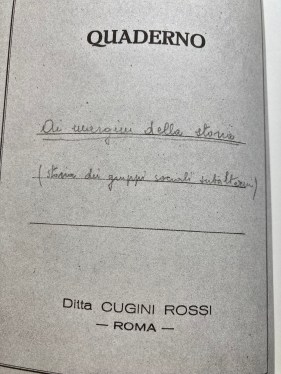
Significantly, Gramsci was now allowed access to all his notebooks at the same time—at Turi, he was only able to see five in one go. Thus he began recopying old raw notes, modifying them, expanding them here, deleting them there, collating them, grouping them together into “special” single topic themes. In July 1934, Gramsci started to assemble Notebook 25, Ai margini della storia [storia dei gruppi sociali subalterni]On the Margins of History [The History of Subaltern Social Groups], bringing his scattered writings from Turi together into a 160-page composition notebook, larger-sized than he typically used before, and a different brand—”Ditta CUGINI ROSSI ROMA.”

iiif-gramsci-qc-0001_Q_20_XXV_R_E_V_Q_20_XXV_R_E_V_copertina.jpg

IMG_1782

Evidently, he’d anticipated a bigger project—on slaves and plebians from ancient Roman and medieval Italy, on peasants and proletarians, on subaltern social groups’ connection to history and economics, to commonsense and folklore, to spontaneity and intellectuals—on the potential for them acquiring “hegemony”; developing their own autonomous political consciousness; revolting against the bourgeoisie; taking their subordination out of the realm of civil society and politicking around the state, maybe one day becoming a state themselves. There was enough material here, Gramsci felt, to constitute an extended monograph, kickstarted with that essay on the southern question almost a decade earlier. He’d left the first ten-pages of notebook 25 blank, readied for an introductory text and a summary index that, with ever-failing health, he never managed to create. Hence Tatiana marked Quaderno 25 (XXV) “Incompleto.”

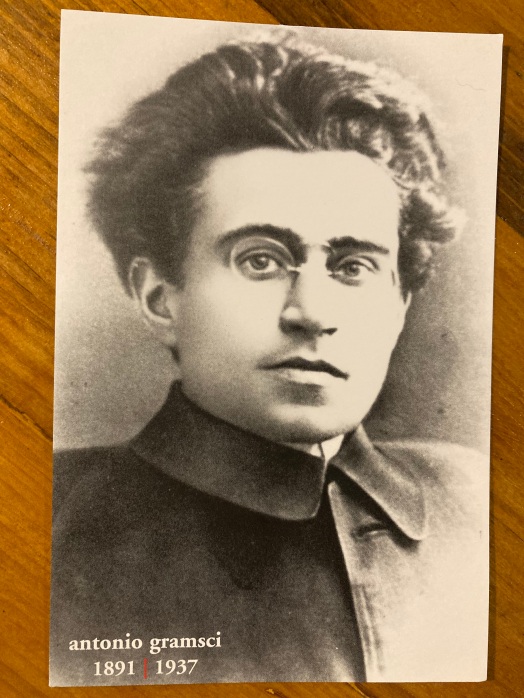
Gramsci was an original, a chip off the old block, the first Marxist ever to mobilize the term “subaltern.” He never knew it, of course, but he single-handedly invented a whole new discipline: “Subaltern Studies,” with its emphasis on the ignored and neglected in western history, as if it were the only History. Now, Gramsci’s southern question has enlarged to embrace the global south, a southern global imagination, those excluded “from historiography of the dominant classes, although protagonists of real history.”

In 2021, Columbia University Press thought Gramsci’s treatment of subaltern social groups sufficiently important to warrant English translation (by Joseph Buttigieg and Marcus Green), and a “critical edition” of notebook 25, combining allusions to subalternity from other Gramsci notebooks. The project would compensate for the short shrift Selections from Prison Notebooks initially afforded the topic—with no index entry for a thematic so personally and politically vital to Gramsci, the dark-skinned, hunchbacked goblin, a pariah from a culture different to the dominant. He empathized with subalterns, knew them, recognized them, because he came from them, recognized himself in them.

“Often,” Gramsci says, “subaltern groups are originally of a different race (different religion and different culture) than dominant groups, and they’re often a mixture of races…The question of the importance of women is similar to the question of subaltern groups… ‘masculinism’ can be compared to class domination.” Subaltern classes, he says, are portrayed “as having no history,” “people whose history leaves no traces in the historical documents of the past.”

Subalterns have to prize themselves free from the subjection dominant forces impose upon them. They also have to prize themselves free from their own passivity. This is hard, Gramsci admits, because “we’re all conformists of some conformism of another, always man-in-the mass or collective man”; we all belong to a particular social grouping that transmits, for better or for worse, its own uniform mode of thinking and acting. To that degree, one needs to be hard on oneself as well as on one’s antagonists; one needs to struggle against the world while struggling against oneself, internalizing at the same time as externalizing rebellion.

“When one’s conception of the world isn’t critical and coherent,” Gramsci says, “but disjointed and episodic, one belongs to a multiplicity of mass human groups.” The trick “is to criticize one’s own conception of the world,” to make “a coherent unity and to raise it to the level reached by the most advanced thought in the world.” “The starting point of critical elaboration,” he says, “is the consciousness of what one really is, and ‘knowing thyself’ as a product of the historical process to date which has deposited in you an infinity of traces without leaving an inventory.”

The subaltern, more than anybody else, needs to know themselves connected to the historical process, know themselves as being on the receiving end of this process, know how they’ve been undermined by that process, and sometimes how they’ve undermined themselves in that process. One problem is that even when subalterns rebel, “they’re in a state of anxious defense.” “Every trace of autonomous initiative, therefore, is of inestimable value.” (Gramsci captures here the perennial condition of the modern Left: in a state of anxious defense.)

The other problem is that when subaltern groups aren’t looked down upon, scorned and abused, they’re patronized, treated as “humble.” It’s a characteristic attitude, Gramsci says, of a lot of intellectuals, even well-meaning ones. For the Italian intellectual, “humble indicates a relationship of paternal protection, the ‘self-sufficient’ feeling of one’s own undisputed superiority; like the relationship between two races, one superior, the other inferior; like the relationship between adult and child in old schooling; or, worse still, like the relationship of a ‘society for the protection of animals’ or like that of the Anglo-Saxon Salvation Army toward the cannibals of Papua.”

It’s sensibility in stark contrast to Dostoevsky’s, Gramsci says, as depicted, for instance, in The Insulted and Injured (1861), a novel never terribly well favored by Dostoevsky afficionados, his first after Siberian exile. But Gramsci had spotted something in it that struck a suggestive political chord. “In Dostoevsky,” he says, “there’s a strong national-popular feeling, namely, an awareness of a mission of the intellectual toward the people, who may be ‘objectively’ composed of the ‘humble’ but must be freed from this ‘humility,’ transformed and regenerated.”

Gramsci doesn’t mention it by name, but this idea of “a mission of the intellectual toward the people” emerged in Russia during the early 1860s, expressed most fervently in the “Narodnik” movement. Young progressive urban intellectuals, dressed in simple peasant garb, fled cities and went “to the people,” canvasing across the countryside, inciting revolt against Tsarist rule. They lived amongst the people, merged with the people, taught them, learned from them, and tried to fight for their collective interests. Gramsci saw in the Narodniks a model for catalyzing revolt, a prototypical representation of the organic intellectual, somebody who could help the subaltern speak without ever putting words in their mouths.

***

The Cusumano clinic was a dreadful place for Gramsci. His letters indicate shoddy treatment. Tatiana claimed her brother-in-law’s health went further downhill. He had to endure incompetent medical care, she said, inedible food, and no hot water for bathing. He suffered the “neglect, indifference, indolence” of the clinic’s staff. Tatiana was damning. Adding to existing health woes, Gramsci developed a hernia, requiring the surgery he never got. His nervous and digestive systems were kaput. He was feverish, seized by tremors. Even holding a pen was a chore. Urinal infections meant frequently pissing blood.

And he couldn’t sleep: “The Cusumano family has arrived,” he told Tania (July 22, 1935). “Over my head there’s a continuous to and fro from five in the morning until midnight… I’m a sick person and every slightest rustle agitates me enormously. I will recover from many ailments and precisely from those which at the moment are the most tormenting.” “I am absolutely determined,” he added, “to leave the Cusumano clinic and as soon as possible.”

IMG_1962

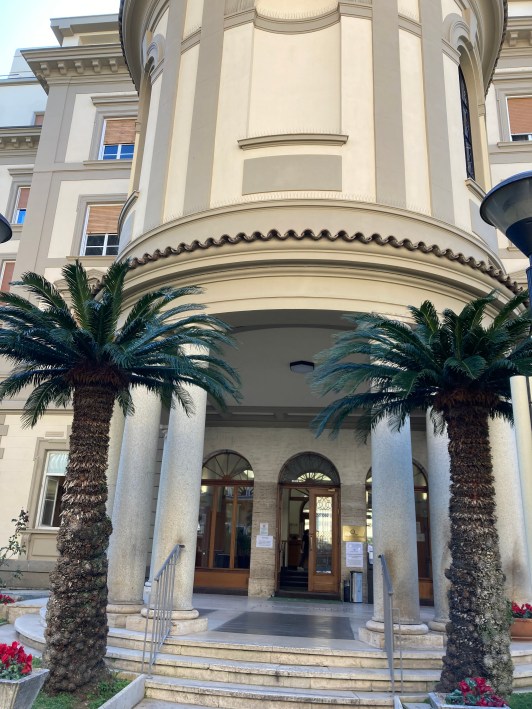
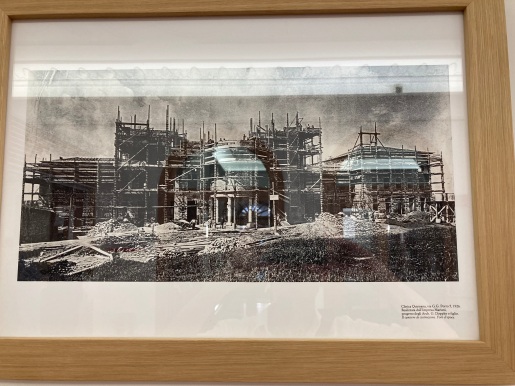
I was intrigued about this clinic in Formia, long since shutdown. I understood the building still stood, overlooking the beach, and so, one Sunday morning, early March, on an unseasonably blustery, rainy day, I got into my car and made the two-hour trek down from Rome. Waves crashed into Formia’s waterfront wall; walking the half a mile or so from the center of town, along via Appia Lato Napoli, toward number 30, necessitated a salty sea spray drenching. Then the former clinic appeared, a standalone, six-story cream structure, a lot smaller than I’d imagined, with decorative pink cornices, green shutters, and small balconies. Once it would have had a certain grandeur, an architecture suggesting 1920s construction. In Gramsci’s day, it would have felt almost new. In our day, it’s a condo apartment complex, opposite a gas station. Although occupied, most of the windows are shuttered up, maybe for the season, and overall the place strikes as in need of a little care and attention, a rehab and refresh.

IMG_1800

I peered through a glass main doorway, into a tired looking entrance foyer, with plant pots and ornately patterned brown tiling. Doubtless the exact same floor once walked upon by Gramsci, wrapped in his Sardinian shepherd’s shawl. A large arched window at the far end, with traces of its former splendor, opens onto sea, offering an impressive view; yet, again, today, everything seems worn and musty, its better days behind. At the upper right of the entrance doorway, on the outside wall, a faded marble plaque, inaugurated on April 27, 1945, the eighth anniversary of Gramsci’s death, commemorates his miserable Formia sojourn.

IMG_1797


IMG_1795

QUI

ANTONIO GRAMSCI

CAPO E FONDATORE DEL P.C.I

VISSE IN PRIGIONIA

PER CRIMINALE PERSECUZIONE FASCISTA

FACENDO OLOCAUSTO DELLA

A SERVIZIO DEL POPOLO E DELL’ITALIA

    27 APRILE 1937                                                                          27 APRILE 1945

HERE

ANTONIO GRAMSCI

LEADER AND FOUNDER OF THE ITALIAN COMMUNIST PARTY

LIVED IN CAPTIVITY

FOR CRIMINAL FASCIST PERSECUTION

MAKING A HOLOCAUST OUT

OF SERVICE TO THE PEOPLE AND ITALY

The surrounding grounds, a parkland full of abandoned olive trees, has fallen into rack and ruin, with overgrown grass and weeds, rotting, upsized paddle boats, and rusty marine equipment. It’s inexplicable how rundown everything is. In other circumstances, it might have been a mini paradise by the sea. Gramsci and Tania would have strolled around this patch sometimes. “I’ve seen some little boys catching fish in the sea,” Gramsci said, in an undated letter to Guilia, one of only a handful written from Formia, “with a hollow brick (filled with air); they filled a small bucket with it.”

IMG_1794

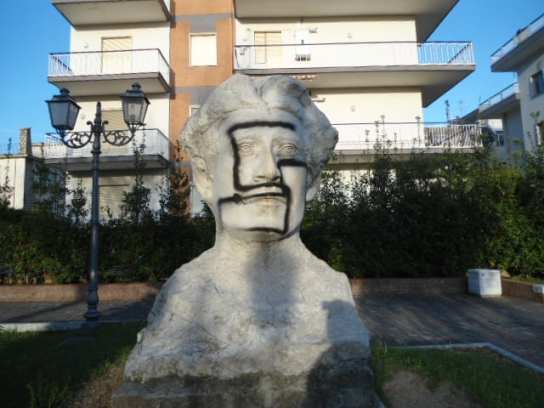
The letter is quoted on another plaque commemorating Gramsci, at a park along via Giuseppe Verdi—Parco di Gramsci—a few minutes on foot from the former clinic. The greenspace’s centerpiece is a large marble bust of the man himself, in his younger days, without glasses, looking like a Greek God, dating from April 27, 2000, the 63rd anniversary of Gramsci’s passing. There are two granite writing tablets below, again Greek-style. One says Gramsci was “locked up by the fascist regime, gravely ill, at the Cusumano clinic in Formia, from December 7, 1933 to August 24, 1935,” concluding with the infamous words of the public prosecutor at Gramsci’s mock trial: “For twenty years we must prevent this brain from functioning.”

IMG_1786

The adjacent tablet cites his letter about the kids fishing on Formia’s beach, accompanied with words to son Delio, from a 1936 letter: “I think you like history just as I did when I was your age, because it deals with human beings. And everything that deals with people, as many people as possible, all the people in the world as they join together in society and work and struggle and better themselves should please you more than anything else… I embrace you, Papa.”

Gramsci’s Park, alas, resembles Gramsci’s old clinic: jaded and shoddy, falling apart. Maybe it’s just the inclement weather, but everywhere around seems desolate, uncared for, graffiti splattered. The parks furniture and kids’ playground need an overhaul. By all accounts, the site was in an even worse state of disrepair a decade ago. For a while, back then, it was closed for renewal. But the refurbishment hasn’t worn well, and today the park looks a lot like it did in those former days. One image, published in the local newspaper Latina24, from 2014, shows Gramsci’s bust scarily daubed with a swastika, and it reminded me of the desecration of Marx’s Highgate grave in 2019.

parco_gramsci

It’s hard to know what was being remonstrated here. Was it that local Nazis didn’t like Gramsci? Or was it that the perpetrators thought Gramsci a Nazi? Both are hard to square. Both disturb with their wanton ignorance—though, of course, Nazis aren’t usually known for their smarts. The other thing that disturbs is that the culprits probably hailed from the subaltern classes that Gramsci singles out; someone excluded, unemployed, alienated, having little going on in their lives, with dismal future prospects, and a present full of discontentment. Their resentment prefers lashing out rightward. You’d have thought we’d learned our lesson from the past.

Walking back into town, dampened by the weather and by what I’d seen, feeling a bit dismal myself, I began reflecting on Gramsci’s subaltern social groups, on what it might mean nowadays. A week or so prior to my visiting Formia, I’d read a piece in The New York Times (February 26, 2024), “The Mystery of White Rural Rage,” by Paul Krugman, about rural America, about the baffling political backlash of rural populations. Agricultural employment has declined and small-town manufacturing has all but collapsed. American farms produce five-times more than they did seventy-five years ago with two-thirds less employment. The US has become richer from agriculture, yet rural areas have become a lot poorer. Employment opportunities have dwindled and a loss of dignity around work sets the tone for many rural dwellers, the majority of whom are white.

Anger is voiced against federal government and urban America. Poor city minorities and immigrants have been favored over hard working white Americans, they say, even though federal programs helping poor rural areas—social security, Medicare, and Medicaid—are disproportionately financed by urban areas. Hence there’s actually a de facto net transfer from urban to rural areas. Paul Krugman wonders why, instead of supporting Joe Biden, who has generally been favorable to rural America, bilious rage gives the thumbs up to Donald Trump—“a huckster from Queens, who,” says Krugman, “offers little other than validation of their resentment.”

It’s a curious reinvention of Gramsci’s “southern question.” Only now the southerners in question are those not only geographical southern, but culturally southern, too, people from the periphery who feel that periphery inside them, their own peripheralization from the core, from the north, from urban areas, as if their history is getting overlooked. Occluded in the process are, as Gramsci had it, basic questions of class, of why poor “southerners” don’t identify with poor “northern” folk, yet instead endorse a rich northern real estate fraudster. It’s beguiling. The other point is how subalternity takes on different skin hues—populations who, to greater or lesser degrees, are now marked by outsiderness, by exclusion and neglect, a feeling that their history and culture isn’t acknowledged by the perceived powers that be.

Gramsci’s southern question essay hoped for a Left turn in southern sensibility. Yet current climes suggests otherwise, that certain subalterns value more the visceral bleat of the Right. Krugman reckons white rural rage “is arguably the single greatest threat facing American democracy,” and laments, “I’ve no good ideas about how to fight it.” Meantime, white rural working classes give gung-ho support to politicians who tell them the lies they seemingly want to hear. Gramsci knew about baffling reactionary politics, about how, sometimes, many subalterns end up voting for politicians and programs that go against their better interests. He tried to tell people the truth and got locked up for it.

Marxists once used to talk about “false consciousness,” the obverse of “knowing thyself.” For decades, false consciousness went out of fashion, yet lately it’s well and truly back in vogue, assuming an almost objective status, blurring reality and make-believe, so entrenched has it become in our society, so ubiquitous in our mass and social media, so commonplace in the misinformation sprouted by our politicians. All of it conspires to convey an implicitly distorted sense of reality, handy for vested political and economic interests—like it always did. A form of widespread brainwashing, where it’s easier to be believed for peddling lies than for telling the honest truth.

Gramsci emphasized the need for intellectuals to correct misconception, to persist in telling the truth, to go and voice it to the people. But maybe intellectuals have turned away from the people, just as the people have turned away from intellectuals. Maybe we’ve let the people down, retreated to our college campuses, given ourselves over to management committees and research assessments. We’ve been busier raising money rather than raising a ruckus. We’ve been bought off by the good life or else gotten complacent.

Or maybe a lot of us have simply gotten depressed about a Left always being in “a state of anxious defense,” forever on the backfoot, or more often entirely lame, and we’re happier sitting behind our desks writing stuff like this. Organic intellectuals have gone elsewhere for nourishment, turned traditional. Or perhaps the most effective “permanent persuaders” have been those on the right-flank, relentlessly inveigling people that lying is the winning ticket, that crank demagogues will really make things great again.

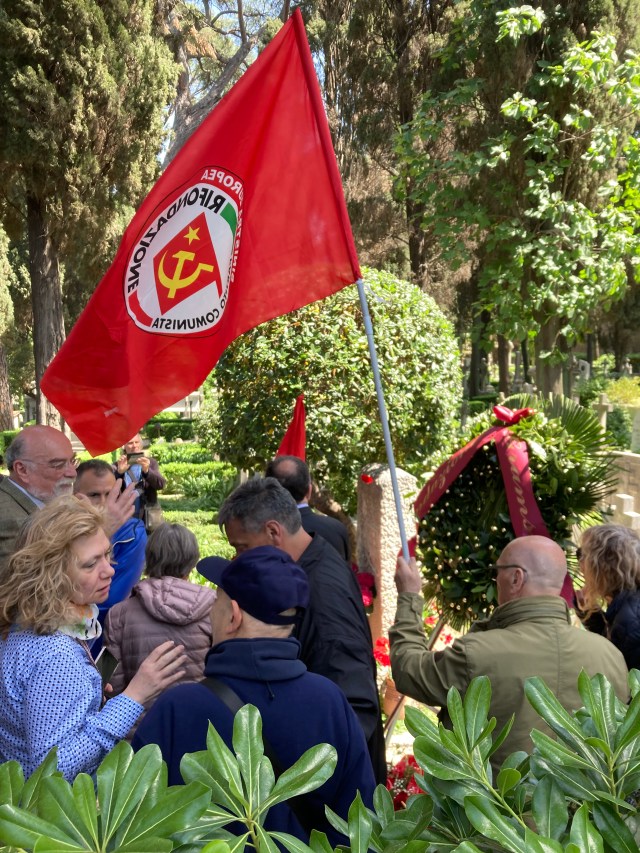
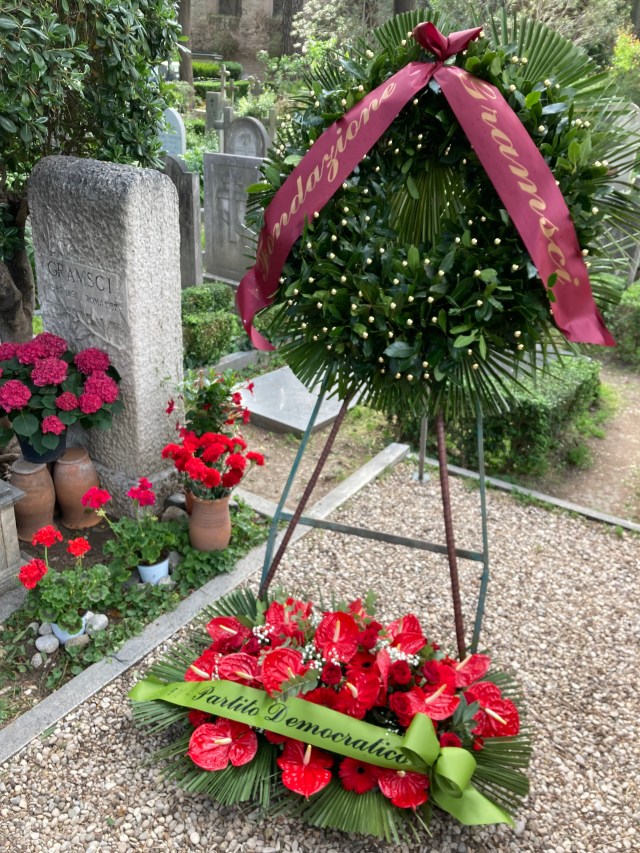
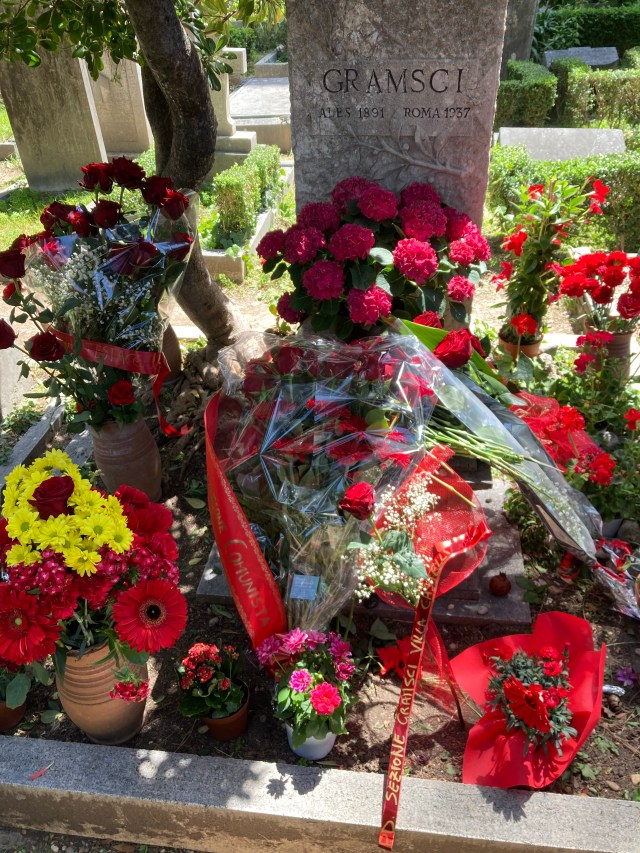
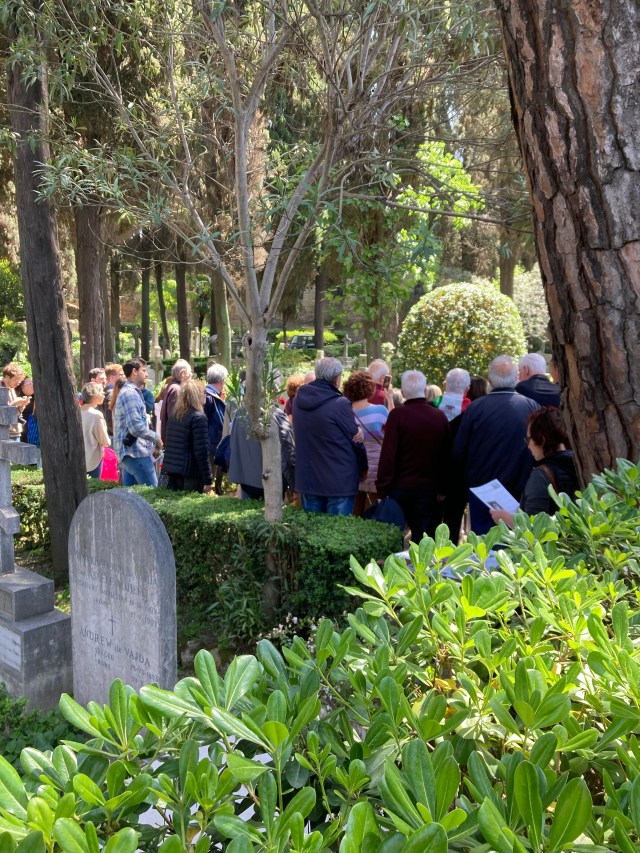
Notwithstanding, Gramsci continues to inspire, come what may. He inspires me, at least, and the countless people I’ve seen coming to the cemetery to pay their respects. He especially inspires in these dire circumstances because he was a Marxist who’d made dire circumstances something of a specialty. The idea that things might get better, that people matter, that not everybody is innately bad or a fool, that the truth will prevail in the end, is something he never ceased to endorse. It’s a belief-system that comes without guarantees, and often Gramsci made statements that were positive but then tinged them with doubts and caveats, with criticisms of criticisms. “Everything that deals with people,” we can remember him telling his son, “as many people as possible, all the people in the world as they join together in society and work and struggle and better themselves should please you more than anything else. But is it like that?”

I really hope it is…

Posted in All | 4 Comments

GRAMSCI’S GOBLIN

It’s easy to miss the Fondazione Gramsci, tucked away off the street in a little building along via Sebino, at number 43A, in Rome’s Trieste neighborhood. Its glass door entrance lies at the end of a discreet courtyard, modestly beyond the gaze of any undiscerning passersby. On the afternoon of my visit–a mild, gray, late January day–things were brightened by the warm welcome I’d received. I said I was a big Gramsci fan, had written a few things about him, and came curious about the Fondazione’s resources. I’d heard about their extensive library, crammed with every Left book under the sun, in scores of languages, which I now saw filling the glass cabinets on the walls of the main biblioteca. I said I wanted to tap Gramsci’s digital archive as well, especially those legendary prison notebooks, whose real thing, I knew, were housed in a special vault somewhere on the Fondazione’s premises.

Those premises reminded me a lot of the long-lost Brecht Forum in New York—the same low-tech shabbiness, a bit worn and grungy. The array of tatty desktops harked back to another age, somehow bygone, pre-Apple. The Fondazione’s young librarian came over to assist me, going out of her way to log me onto the system’s mainframe, telling me in perfect English that she had digitized much of the Gramsci material, all to be scrutinized without cost or subscription, with a clarity that almost lets you smudge your own fingers in Gramsci’s ink. Working so intimately with Gramsci’s writings must have been very exciting, I say to her. She smiled. “Yes,” she said, “it was.” She loves her job.

Now, we can inspect for ourselves Gramsci’s meticulous notebooks, his perfectly legible cursive, his precise crossings-out, done with exactitude, with a ruler, diagonal lines methodically scoring out words, sometimes whole pages; Gramsci added and eliminated text with characteristic calculation. His handwriting is so neat, so error free, that we know it represents ideas and material already worked through, already drafted out in rough beforehand. Here we have “special,” self-copyedited, clean versions of his thought, preserved for immortality.

Gramsci was finicky about the type of notebook he wanted. He wrote his sister-in-law Tania (February 22, 1932), “can you send me some notebooks, but not like the ones you sent me a while ago, which are too cumbersome and too large; you should choose notebooks of a normal format like those used in school, and not too many pages, at the most forty or fifty, so that they are not inevitably transformed into increasingly jumbled miscellaneous tomes. I would like to have smaller notebooks for the purpose of collating these notes, dividing them by subject, and so once and for all putting them in order. This will help me pass the time and will be useful to me personally in achieving a certain intellectual order.”

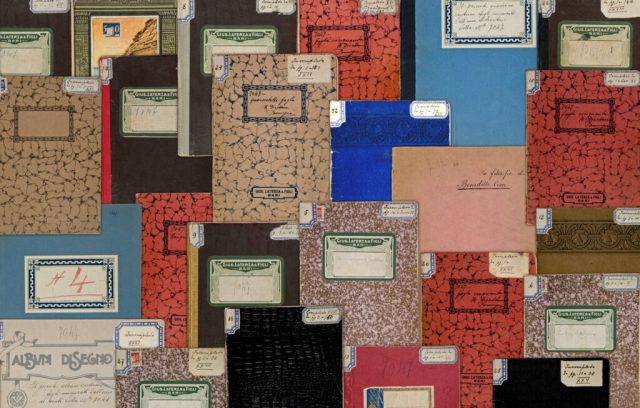
Each notebook bears on its cover the imprint “Gius. Laterza & Figli”–Giuseppe Laterza & Sons, a Bari-based family business, a stationer and publisher (still around to this day). Some covers are ornately designed, with elaborate art deco patterning; a few have images of ancient Egypt; all have front labelling marked with Gramsci’s prison number, 7047, together with a sentence he wrote, indicating the subject matter inside. After Gramsci’s death, Tania glued another marker on the upper righthand side, deeming each notebook either “Completo” or “Incompleto,” while assigning them Roman numerals. The bulk of the notebooks are 15 X 20.6 cm in size, containing 97 leaves with twenty-one, single-spaced lines on each sheet. The parsimonious Gramsci wasted nothing, filling up both sides of the page.

IMG_1747

A few notebooks are larger format, 20.8 X 26.7 cm, and in one, atypical case, Quaderno XXXI from 1932, he used an artist’s sketchpad, 23 X 15 cm, blank-paged, with a beautiful deco Album Disegno frontispiece, marked “Incompleto” by Tania. Gramsci had singled-out here his translation of the Brothers Grimms’ tale about a little goblin called “Rumpelstilzchen” (retaining its original German spelling), copying it out in neat, corrected form for his sister Teresina’s children in Ghilarza. The write-up was never completed, even though Gramsci had finished the translation two-years earlier, appearing in full alongside other Brothers Grimm stories in Quaderno B (XV).

IMG_1751

Gramsci told Teresina (January 18, 1932) “I’ve translated from German, as an exercise, a series of popular tales, exactly like the ones we liked so much when we were children and that actually resemble them to some extent, because their origin is the same. They’re a bit old-fashioned, homespun, but modern life, with the radio, airplane, the talkies…has still not penetrated Ghilarza deeply enough for the taste of today’s children to be very different from ours at that time. I’ll make sure to copy them in a notebook and send them to you as soon as I get permission, as a contribution to the imagination of the little ones. Perhaps the person who reads them will have to add a pinch of irony and indulgence in presenting them to the listeners, as a concession to modernity.”

Gramsci gives pride of place to Rumpelstiltskin, labeling the eponymous protagonist “coboldo” and not the “tremotino” used in more standard Italian translations. “Coboldo,” from the Latin cobalus (meaning “rogue”), comes close to the English “kobold,” from pagan mythology, a hobgoblin who haunts households and plays mischievous tricks, especially if it feels neglected or offended; Gramsci says the tale reminded him of the Sardinian folkloric legends that had kindled his own homespun island imagination. If anything, Gramsci physically resembled the deformed goblin–tiny and hunchbacked; both, too, were outsiders and pariahs with mischievous, stubborn streaks. Remember Gramsci refused to plead for clemency, seeing that as a capitulation to fascism, as an implicit admission that he’d recanted his Marxist views. In this sense, the frank, if austere, goblin way spoke personally to the sly and stoic Gramsci, appealed to him as a state of being in the capitalist world.

Rumpelstiltskin-Crane1886

Rumpelstiltskin said his name was unusual and Gramsci sometimes said his own name was unusual, too. Is your name “Gasparo, Mechiore, Baldassare?” the queen asked the goblin in Gramsci’s translation. “Is it Gatarino, Saltamontore, Tombatore? Giovanni or Giuseppe?” In “my journey through this ‘great and terrible world’,” Gramsci tells Tania (February 19, 1927), “I’m not known outside a rather restricted circle; therefore my name is mangled in the most unlikely ways: Gramasci, Granusci, Gramisci, even Garamascon, with all the most bizarre in-betweens.”

The goblin, like Gramsci, is portrayed as the villain, when the real villains–the miller, his daughter, the king–are presented as good and upright; it’s they who live happily ever after. And yet, Rumpelstiltskin is the only honest soul amongst them, the only character true to his word. The miller is a liar who gives away his daughter to the king. The miller says she can spin straw into gold, which she can’t. The king, who’s nasty and greedy, is impressed. He carts her off and locks her up in a dungeon with a spinning wheel. If she can turn the piles of straw into gold then he’ll marry her; if not, it’s off with her head. The king is excited at the prospect of so much wealth and will stop at nothing to get it. “I’ll be back in the morning for the gold,” he says. As night falls, the girl is at a loss living up to her father’s conceited promise. She starts to cry.

Suddenly, a funny little goblin appears, asking the reason for her tears. He listens with a sympathetic ear. After she explains, he laughs. “Is that all? Why, I can do that in a twinkle,” he says nonchalantly. For him, you don’t have to be very clever to spin lots of gold (they do it all the time on the stock market, spinning yarns all the way to the bank); nor do you have to work particularly hard. Rumpelstiltskin knows that making lots of money is no big deal, that there are other paradigms to life, other less venal and more magical ways to find fulfilment. He spins the gold in return for the girl’s pretty necklace.

Next morning, the king is delighted. That evening, Rumpelstiltskin returns and spins more gold, this time in exchange for the girl’s ring. The king, again, is thrilled. On the third evening, the miller’s daughter has nothing more to give the goblin, so she promises him her first-born child. This time, he fills the whole room with gold, and the king goes wild with excitement and marries the girl that very same day. The kingdom rejoices at the marriage and later at the birth of the queen’s beautiful daughter.

When the goblin hears the news, he comes back for the baby. “Remember,” he says, “there was an agreement, and you’re bound by that.” The queen weeps, goes down on her knees, begs him not to take her baby away. Again, the goblin sympathizes, and says, “All right, my name is unusual, if you can guess it, you’re released from the promise.” He’ll be back tomorrow, he says. But the queen plays crooked and sends a servant to snoop and find out his name. A while later, the servant returns, grinning all over. “I followed him to a little shack, deep in the forest, and there I heard him singing his song, and he bawled out his name.” Next morning, the goblin reappears before the queen. She utters his name and, “spitting and squealing, he vanished out of the window like a balloon when you take your fingers off the nozzle.” Nothing is ever heard of him again. Meanwhile, the king, the queen, and the young princess live happily…blah, blah, blah.

This warped and shallow value system is inculcated in us early. If you follow its rules, you get rewarded accordingly. You’ll live happily ever after, not rot in jail. But the reality of the tale is that its winners do everything we know a ruling class does: it lies and cheats, boasts and breaks deals, spies on you if need be, and always sends others to do its dirty work. Moreover, it rarely keeps its word. The queen breaks her compact. The king has no other interest than accumulating wealth; he doesn’t even love the woman he married. Everybody is duplicitous and conniving. They’re all phony schemers, out to extract something from somebody else–all except the ugly goblin Rumpelstiltskin.

In all, Gramsci translated twenty-four Brothers Grimm tales (actually twenty-three with one unfinished piece). They’ve since been collected together under the rubric Favole di libertà: la fiabe dei Fratelli Grimm tradotte in carcere, implying that if your body is incarcerated, then there are other possibilities to reimagine a liberty of the mind, a liberty of the imagination; and Gramsci seems drawn to fairytales for these motives. He knew the Brothers Grimm’s work was firmly rooted in German folklore, just as his own Marxism was rooted in Italian folklore, in its culture and regionalism, in its “non-official” subaltern tradition.

Some of Gramsci’s translations are done for personal amusement; others to gift to nephews and nieces who never knew Uncle Antonio. Despite the simplicity and naivety of the tales, Gramsci thought there was something here for adults, too, something political about folkloric tales, about their function within a particular oppressed stratum of society; an educative element, which is why, in Quaderno 27 (XI), he devotes singular attention to “observations on folklore” [Osservazioni sul folclore]. Gramsci suggests folklore should be studied as “a conception of the world and life implicit to a large strata of society, in opposition to ‘official’ conceptions of the world.” It has, he says, “sturdy historical roots” and “is tenaciously entwined in the psychology of specific popular strata.”

Gramsci, as ever, is dialectical, conceiving folklore critically and inquisitively, not narrow-mindedly. “Folklore mustn’t be considered an eccentricity,” he insists, “as an oddity or a picturesque element, but as something which is very serious and is to be taken seriously.” And he takes it seriously, even while he sometimes laughs out loud. He acknowledges its ties with religion and superstition, to “crude and mutilated thought.” Nonetheless, with folklore, “one must distinguish various strata,” Gramsci says, “the fossilized ones which reflect conditions of past life and are therefore conservative and reactionary, and those which consist of a series of innovations, often creative and progressive, determined spontaneously by forms of life which are in the process of developing, in contradiction to the morality of the governing strata.” “Only in this way,” says Gramsci, “will the teaching of folklore be more efficient and really bring about the birth of a new culture among the broad popular masses.”

***

As I was leaving the Fondazione Gramsci, the young librarian urged me to help myself to Gramsci paraphernalia on a bookshelf near the door, to books and pamphlets, as well as to wonderful Fondazione-produced postcards of the covers of Quaderni del carcere, in gleaming color. It was a treasure trove of Gramscian regalia. I wasted no time packing my shoulder bag with a big-formatted Fondazione publication called Antonio Gramsci e la grande Guerra, lavishly illustrated with fascinating reproductions of pre-prison Gramsci letters (from 1915-16), on Avanti! (Edizione Torinese) headed notepaper. I also bagged an interesting French booklet entitled Les cahiers de prison et la France, together with a text, Gramsci in Gran Bretagna, discussing the reception of Gramsci in the UK, notably the brilliant reinterpretations of Eric Hobsbawm, Perry Anderson, and Stuart Hall. And, needless to say, I grabbed a stash of those glossy postcards.

QUADERNI_02-1-1024x653

Exiting, and reflecting upon what I’d just seen in the archive, I realized how much of what Gramsci wrote was really about self-expression, about collecting and collating his own thoughts, putting them in intellectual order, clarifying his own position often vis-à-vis an antagonist. Before his arrest, Gramsci saw himself as a journalist-activist. He never wrote elaborate tomes, extended monographs, never had any inclination to do so. His writings were short, pithy, quickly drafted political interventions, polemical engagements with the urgency of the moment.

“In ten years of journalism,” he told Tania (September 7, 1931), “I wrote enough lines to fill fifteen or twenty volumes of 400 pages each, but they were written for the day and, in my opinion, were supposed to die with the day. I have always refused to permit publication of a collection of them, even a limited one.” In 1918, an Italian publisher wanted to publish his Avanti! articles, with “a friendly and laudatory preface,” “but I refused to allow it,” Gramsci says. A couple of years on, he apparently had a change of heart, letting Giuseppe Prezzolini’s publishing house convince him to issue a collection of newspaper pieces. But then suddenly got cold feet and told Tania, “I chose to pay the cost of the part of the type already set and withdrew the manuscript.”

Still, a major component of those writings, both inside and outside prison, had an explicit pedagogic intent: that of popularizing Marxism, of trying to communicate socialist ideas with an immediacy that resonated with a wider, lay public, sometimes with an immediacy that resonated with Gramsci himself. Large tracks of the prison notebooks were really thoughts toward Gramsci’s own version of a “Popular Manual of Marxism,” doubtless in mind when musing on folklore and common sense, and certainly in mind when launching his “critical notes” against Bukharin’s “Popular Manual.” The “Popular Manual” was Gramsci’s shorthand for Nikolai Bukharin’s Theory of Historical Materialism: A Popular Manual of Marxist Sociology, published in Moscow in 1921. What disappointed Gramsci most of all here was its missed opportunity: the book’s promising subtitle bore scant resemblance to its contents.

Bukharin’s position expressed the vulgar materialism of the era, Gramsci says, reducing Marxism to a positivist (and positive) science. (In the 1930s, Bukharin himself became a skeptic of Stalin’s regime, opposed the first Five-Year Plan and the collectivization of agriculture. Accused of conspiracy, a show trial found him guilty. He was executed in 1938.) Bukharin, says Gramsci, began all wrongly, and “should have taken as his starting point a critical analysis of the philosophy of common sense.” Common sense, says Gramsci, “is the folklore of philosophy, and, like folklore, takes countless different forms.” Common sense needs transcending, for sure, not wholesale rejection. It’s the breeding ground of good sense, after all, of a materialism much more realistic and a lot richer than Bukharin’s, something both critical and curious, open and ironic, maybe even folkloric—a mischievous “goblin” sort of Marxism that speaks the twisted language of ordinary people, for better or for worse.

One thing surely not lost on Gramsci when translating the Brothers Grimm is how God awful their characters are, how scheming and duplicitous, how untruthful and dishonest. Some Grimm tales are just that: grim, darn right nasty, and their moral message is hard to grasp—if, indeed, there is any moral message to grasp. It’s like reading the daily news. You know, once upon a time there was a nasty ex-President who wanted to seize power again… Maybe that’s Gramsci’s point? That life actually is “great and terrible,” and only by confronting its pitfalls and perils, its terrors and turmoil head on, never capitulating before its nastiness, can we hope to maximize a great that’s increasingly hard to see.

Pessimism or optimism? Gramsci probably wouldn’t have framed it as such, never would have conceived our world nowadays so dualistically, so either/or. This is him talking in 1929, powerfully articulating his position to younger brother Carlo: “humans bear within themselves the source of their own moral strength, that everything depends on us, on our energy, on our will, on the iron coherence of the aims that we set ourselves and the means we adopt to realize them, that we will never again despair and lapse into those vulgar, banal states of mind that are pessimism and optimism. My state of mind syntheses these two emotions and overcomes them.” Gramsci’s fairytales, we might say, spin yarns about the realm of necessity.

Posted in All | 5 Comments

GRAMSCI’S ANIMALITY

“I want to plunge into animality to draw from it new vigor” — Gramsci, New Year’s Day, 1916

One of the central “living” attractions of Testaccio’s Non-Catholic cemetery is its stray cats, a colony of twenty-five or so semi-feral moggies. We know from old paintings of the nearby Pyramid, especially those by the Roman artist Bartolomeo Pinelli, that cats have freely roamed the area for over 150 years. Nowadays, tourists and locals alike come to see the cemetery’s gatti, longtime beneficiaries of well-wisher donations and skilled volunteer caregivers, cat men and women who regularly nourish and tend the cat colony’s veterinarian needs. (The most famous of the cemetery’s felines is the late “Romeo,” a three-legged tabby who passed away in 2006, laid to rest in his own mini-tomb not far from Gramsci’s.)

Many cats have their favorite spots where they’re often seen sniffing the scent of late departed ones, their bones and ashes. Gramsci, too, has a familiar prowler and protector, a big white and gray with an apparent penchant for revolutionary communism. He’s always wandering about the PCI founder’s tomb, oftentimes lying across his casket, or else upright on it, head aloft, proudly standing to attention, on the lookout for reactionary trouble; a mini militia of one keeping a left paw out for old Gramsci. Perhaps we might label this loyal moggie, “The General,” after Engels’s old sobriquet, and our General knows intuitively, like most animals, where his bread is buttered–who is friend or foe. Gramsci, of course, was a dear friend, an animal lover whose humanist life and thought forever embraced non-human comradery.

96cd8572-6499-4ef4-be5a-8f8e92ca311e

Prison Notebooks sets the tone with “Animality and Industrialism,” Gramsci’s original work-in-progress header for the section he’d eventually label “Americanism and Fordism.” No metaphor intended. The history of industrialism, Gramsci says, “has always been a continuing struggle against the element of ‘animality’ in man.” “It has been,” he adds, “an interrupted, often painful and bloody process of subjugating natural (i.e. animal and primitive) instincts to new, more complex and rigid norms and habits of order, exactitude and precision which are a necessary consequence of industrial development.” Animality, we might say, is a more instinctive life spirit, something looser, more rambunctious and libertine, potentially more subversive, unsettling for the soberer necessities of workforce obediency. As Gramsci puts it, “the exaltation of passion cannot be reconciled with the timed movements of productive motions connected with the most perfected automatism.”

That’s why the bourgeoisie must constantly wage war against animality, why its “puritanical struggles” get embedded in the state. Gramsci reckons it’s another historical instance of how “changes in the modes of existence and modes of life have taken place through brute coercion, that is to say through the domination of one group over all the productive forces of society.” New forms of productive organization beget new kinds of “education,” new forms of coercion and consent to condition people to industry’s developmental needs. Henry Ford was a classic pioneer, patrolling not only how his workforce labored on the assembly line (deploying F.W. Taylor’s “scientific management” techniques), but also how workers led their private lives, monitoring how they spent their wages, advocating a “morality” more appropriate for the “true” America—at least for a certain stratum of its populace.

With his infamous phrase “trained gorilla,” Taylor threw back in the faces of workers the whole idea of animality. Gramsci calls it “brutally cynical.” Yet, in truth, he also knew that such repetitive, soul-sapping activity–indeed any kind of grinding, contentless work in whatever division of labor…blue-collar, white-collar, no collar or otherwise–is a venture no gorilla would ever likely deign to undertake. “I prefer not to,” they’d probably say, if they could talk human language. Or else they’d become, as John Berger said in his well-known essay “Why Look at Animals?” (1977), like an animal in a zoo, “lethargic and dull. (As frequent as the calls of animals in a zoo are the cries of children demanding: Where is he? Why doesn’t he move? ‘Is he dead?’).” (Berger also reminds us how most modern techniques of social conditioning were first established with animal experiments.)

Gramsci defends animality against the “moral order” of social conditioning–in both its capitalist and communist guises. In Prison Notebooks, he expressed disagreement with a certain “Leone Davidovi,” aka Leon Trotsky, who’d been pro the rationalization and militarization of work under Soviet communism: “every worker feels himself a soldier of labor,” Trotsky said, “who cannot dispose of himself freely; if the order is given…he must carry it out; if he does not carry it out, he will be a deserter who is punished.” Gramsci says this military model was “a pernicious prejudice and the militarization of labor a failure.” The fact that the worker no longer has to think about their work and gets no immediate satisfaction from carrying out its repetitive tasks, means, Gramsci says, that they have opportunities to think about other things, perhaps even leading to “a train of thought that is far from conformist.”

Eight months before the October Revolution, a youthful Gramsci had already mulled over how bourgeois discipline ought to differ from socialist discipline–how the former’s mechanical and authoritarian paradigms are at variance with socialist paradigms. Bourgeois discipline, he wrote in La città futura, “keeps the bourgeois aggregation firmly together. Discipline must be met with discipline.” Everybody obeys in the bourgeois state. Its model, Gramsci says, is English colonialism in India, ironized in Rudyard Kipling’s short story “Her Majesty’s Servants” (from The Jungle Book): horses obey the soldiers riding them, soldiers obey sergeants, sergeants obey lieutenants, lieutenants captains, captains majors, majors colonels, colonels brigadiers, brigadiers generals, and generals the Viceroy who in turn obeys the Queen. Everybody moves in unison, has their role strictly defined, drilled into them, each and all obeying one another in a tight, rigid hierarchy, extendedly reproduced. “Thus it is done,” says Kipling, “because you cannot do likewise, you are our subjects.”

Socialist discipline, by contrast, “is autonomous and spontaneous,” says Gramsci. “Whoever is a socialist or wants to become one does not obey; they command themselves; they impose a rule of life on their impulses, on their disorderly aspirations.” The discipline imposed on citizens by the bourgeois state turns them into subjects. Socialist discipline is counter wise, turning subjects into citizens: “a citizen who is now rebellious, precisely because they have become conscious of their personality and feel it is shackled and cannot freely express itself in the world.” Maybe this is what Gramsci meant by animality: something unshackled, not caged in a zoo.

***

In a letter to Delio from 1936, Gramsci is a little stern, warning his young son of the dangers of “anthropomorphism,” of attributing human traits to animals. In this case, it is elephants Delio has referred his father to. Delio had had the bright idea that elephants might one day evolve and walk on two legs, becoming, like humans, capable of conquering the forces of nature. Yet papa reverses the anthropomorphic hypothesis of Delio’s, querying “why should the elephant have evolved like man? Who knows whether some wise old elephant or some whimsical young little elephant doesn’t from his point of view think up hypotheses as to why man has not become a proboscidiform creature.” Then, a few sentences on, maybe wary that he’s getting heavy with his son, Gramsci softens his tone, and through animals tries to kindle his son’s vivid imagination (rather than dampen it): “in the courtyard,” he tells Delio, “I always see two pairs of blackbirds and the cats who crouch in ambush, ready to pounce; but it doesn’t seem that the blackbirds worry about it and their flitting about is always gay and elegant. I embrace you. Papa.”

Animals help Gramsci connect with his long-lost son. Giuliano is too young to really write to his father, so dad’s focus is on Delio, often desperately attempting to embrace a child he was conscious of losing touch of–going to school, reading books, growing up, becoming Russian, speaking Russian–all of it, slipping away from Gramsci’s grasp; and his letters reveal the frustration and desperation of a father who wanted to know, who tried to cling on. “In truth,” he told wife Giulia (letter dated December 14, 1931), “I’m unable psychologically to establish a rapport with them because concretely I know nothing about their life and their development.”

He tries very hard in many letters, oftentimes too hard, talking to a child as if he were an adult, only underscoring the growing distance–the emotional, temporal, and spatial distance–from him and his family. Gramsci didn’t always know it, but Giulia herself was frequently absent from childrearing, institutionalized with periodic mental breakdowns and bouts of depression, leaving Gramsci’s sons in the care of his other sister-in-law, Eugenia. Once close, over the years mutual resentment grew between Eugenia and brother-in-law Antonio.

“When I was a boy,” Gramsci again writes Delio (February 22, 1932), “I raised many birds as well as other animals: falcons, barn owls, cuckoos, magpies, crows, goldfinches, canaries, chaffinches, larks, etc. I raised a small snake, a weasel, a hedgehog, and some turtles…I amused myself by bringing live snakes into the courtyard to see how the hedgehog would hunt them.” Little wonder, then, does Gramsci recommend to his son Kipling’s story about Rikki-Tikki-Tavi, the intrepid snake-sleighing mongoose from The Jungle Book. Rikki-Tikki-Tavi is one of Kipling’s most endearing (and enduring) characters, a featherweight who takes out heavyweights, huge Cobras and Black Mambas. His “business in life,” Kipling says, “was to fight and eat snakes.” A little underdog–or undergoose–who tackles bigger, more powerful foe, brandishing agility and cunning. Perhaps it’s not too difficult to see why Gramsci might be so charmed by the tale.

rikki01

Kipling, peculiarly, appears as one of Gramsci’s favorite authors. The English novelist, short story writer, poet, and journalist crops up often in Gramsci’s works–in his letters, Prison Notebooks, and cultural essays–sometimes in surprising contexts, reappropriated in unexpected, imaginative ways. (In prison, Gramsci even translated Kipling’s most famous poem “If–,” published in 1910, once Britain’s best loved verse.) Although he won the Nobel Prize for Literature in 1907, when Gramsci read him Kipling was scarcely known in Italy. Thus it’s not entirely clear how Gramsci got wind of the colonial scribe, all the more given his right-leaning, anti-communist politics, and racist language–notwithstanding an enormous sensitivity to teeming, poor, Indian street life. (Kipling did make the Italian news in May 1917, when, at the behest of the Daily Telegraph, he visited the Italian front to write a series of first-hand dispatches, later published in pamphlet form as The War in the Mountains: Impressions from the Italian Front; Gramsci would have likely known about such a trip and read Kipling’s five articles in Risorgimento Press’s Italian paperback edition.)

In Quaderno No.3, Gramsci makes a comment on Kipling that reads like a note to self: “Could Kipling’s work serve to criticize a certain society that claims to be something without developing the corresponding civic morality within itself, indeed having a mode of being contradictory with the goals that it verbally sets itself.” “Kipling’s morality is imperialistic,” Gramsci says, “only when it is closely linked to a very specific historical reality: but images of powerful immediacy can be extracted from it for every social group that fights for political power.”

We know from Gramsci’s letters that he’d read Kipling in French. (Kipling himself was an ardent Francophile.) Ironically, Kipling’s poetry was admired by interwar Soviet avant-garde writers, so one might surmise that Gramsci picked up on Kipling through those channels; but that doesn’t quite stack up, because Gramsci had already referenced The Jungle Book well before the Bolsheviks had seized power. In fact, Gramsci sometimes signed off his Avanti! and Il Grido del Popolo [The Cry of the People] articles with the pseudonym “Raksha,” after the formidable she-wolf protector of Mowgli, The Jungle Book’s “man-cub,” whom Raksha adopts as part of her wolf family, fending off the notorious tiger Shere Khan when he tries to eat baby Mowgli. Raksha becomes a kind of animal organic intellectual, clearly inspirational for Gramsci.

Meanwhile, Kipling’s darker tales, like “The Strange Ride of Morrowbie Jukes” (1885), spoke to Gramsci on a gut level. In the story, men are burned at the stake and then tossed down a deep sandy pit, left for dead but still somehow living; a dwelling place of the dead, says Kipling, “for the dead who do not die but may not live.” An old Indian adage cues the text: “alive or dead–there is no other way.” In prison, in confinement, teeth falling out and health rapidly declining, Gramsci begged to differ, as apparently does Kipling, prefiguring Beckett’s gloomy oeuvre by half a century. “The Strange Ride,” Gramsci tells Tatiana (December 9, 1926), “immediately leaped to my mind, so much that I felt I was living it.” And, again, ten-days on (December 19, 1926), he repeats the message: “you must believe me when I say that my reference to Kipling’s short story was not an exaggeration.” (Remember, too, how Gramsci’s catchphrase that “the world is great and terrible” was borrowed from the Tibetan Buddhist lama who’d starred in Kipling’s Kim.)

Gramsci is keen to share with Delio Kipling’s cheerier tales. The Jungle Book’s mongoose “is eaten up from nose to tail with curiosity. The motto of all the mongoose family is ‘Run and find out’; and Rikki-Tikki-Tavi was a true mongoose.” “I think you know the story of Kim,” Gramsci writes his son (February 22, 1932); “but do you know the tales in The Jungle Book and especially the one about the white seal and about Rikki-Tikki-Tavi?” The latter story’s climatic scene is Rikki-Tikki’s showdown with the cobra Nagaina, who, along with husband Nag, had terrorized Teddy’s household, the boy who’d befriended Rikki-Tikki. (Rikki-Tikki had already seen off Nag.) “Now I have Nagaina to settle with,” the mongoose says, “and she will be worse than five Nags, and there’s no knowing when the eggs she spoke of will hatch. Goodness!” All’s well that ends well, though.

“The White Seal” features another unlikely hero from The Jungle Book, only his domain is the chilly high sea; a cub called Kotick who grows up into a mighty white seal whose sole purpose in life is “to find a quiet island with good firm beaches for seals to live on, where men could not get at them.” Other seals made fun of Kotick, with his crazy ideas of imaginary islands. Everywhere he went, seals told Kotick the same thing: seals had come to islands once upon a time, “but men had killed them all off.” Still, one day, Kotick vowed he’d lead the seal people to a quiet place. At the story’s close, he roared to the seals: “I’ve found you the island where you’ll be safe, but unless your heads are dragged off your silly necks you won’t believe.”

Gramsci’s most famous animal story is now a children’s text frequently read by teachers throughout Italy’s elementary schools: Il topo e la montagna [The Mouse and the Mountain]. In a letter dated June 1, 1931, Gramsci says to his wife, “I would like to tell Delio a tale from my town that seems interesting. I’ll summarize it for him and Giuliano. A child is sleeping,” Gramsci begins. There’s a mug of milk ready for him when he wakes up. But a mouse sneaks in and drinks the milk. In the morning, when the child opens his eyes, seeing no milk, he starts screaming. Then his mother screams.

The mouse realizes what he’s done and, feeling guilty, runs to the goat to find milk. The goat will give the mouse milk if he can get grass for the goat to eat. The mouse goes into the fields looking for grass but, lacking water, the fields are all parched. The mouse goes in search of a water fountain. The fountain, however, has been ruined by war and the water is seeping out into the ground. The mouse goes to the mason, hoping he can repair the fountain, yet the mason lacks stones. The mouse goes to the mountain and then, says Gramsci, “there’s a sublime dialogue between the mouse and the mountain, which has been deforested by speculators and reveals everywhere its bones stripped of earth.”

IMG_1690

The mouse recounts the entire story to the mountain and promises that when the child grows up, he’ll replant trees on the mountain’s plains. So the mountain gives the mouse stones, and the child eventually has so much milk that he can bathe in it. And when the child grows up, he does as the mouse had promised and plants trees, and everything changes: “the mountain’s bones disappear under new humus, atmospheric precipitation once more becomes regular because the trees absorb the vapors and prevent torrents from devastating the plain. In short, the mouse conceives of a true and proper five-year plan. Dearest Giulia, I really want you to tell them this story and then let me know the children’s impressions. I embrace you tenderly.”

***

Gramsci felt “very poignant regret” about being an absent father, deprived of the chance of watching his kids mature, of sharing in the development of their personalities. Perhaps he felt this regret even more than his inability to be a political man of action, something he strived to do, vowed, since his student days in Turin. Some Gramsci scholars have pointed out this dialectic tugging away inside him, the perpetual torment between a political man and a family man, poignantly expressed in one of his staple pieces of reading–“Canto X” of Dante’s Inferno, the first book of The Divine Comedy, which Gramsci had studied off and on for more than twenty-years, reading and rereading it, able to recite it from memory.

The late Frank Rosengarten, who edited and introduced Columbia University Press’s wonderful two-volumes of Gramsci’s Letters from Prison (the only complete English edition), highlights Gramsci’s “little discovery” with Canto X, where “two dramas” unfold: the political drama, enacted by the character Farinata, and the personal drama of Cavalcante. Gramsci wrote Tatiana on August 26, 1929 that “I’ve made a little discovery about this canto by Dante that I believe is interesting and in part corrects Croce’s thesis on The Divine Comedy, which is too absolute.” Rosengarten says Gramsci was original and correct in his belief that everyone had overlooked the plight of Cavalcante, who, in hell, was anguished by the uncertain fate of his son, Guido.

Cavalcante’s cameo plays second fiddle to the seemingly more important political tragedy of Farinata. Gramsci suggests that in Canto X Dante wasn’t so much concerned with politics as with the sufferings of a heart-stricken father. Canto X becomes personal as well as political for Gramsci, the double commitment and tussle of a man who fought for his socialist ideals and a husband and father tormented by the forced separation from his wife and sons: “Weeping, he said to me: ‘If through this blind/ Prison thou goest by loftiness of genius,/ Where is my son? and why is he not with thee?’” In a sense, then, we might conclude that animality speaks to both flanks of Gramsci’s personality, to the libertarian thinker and to the father storyteller, protective of his offspring, displaying real gifts for narrating fables in his letters, for telling stories about animals.

That libertarian also knew another animal fable, one we’ve yet to mention, a strictly adult affair about realpolitik, about Machiavelli’s Centaur–the half-human, half-animal figure, with its dual powers. “You must understand,” says Gramsci, quoting Machiavelli’s The Prince, “that there are two ways of fighting: by the law and by force. The first way is natural to men, the second to beasts.” Any successful movement, Gramsci believes, again following Machiavelli, must be able to assume both the nature of humans and beasts, the nature of the fox as well as that of the lion; “for while the latter cannot escape the traps laid for him, the former cannot defend himself against the wolves”; the strategic ferocity of the lion and the tactical cunning of the fox, a blend of force and consent, of coercion and persuasion in the struggle for a popular Left hegemony.

Machiavelli, of course, says nothing about mongooses; yet for Gramsci this sort of animality meant fatherly urging, encouraging his sons to think critically while always keeping their imaginations alive, getting “eaten up from nose to tail,” like Kipling’s Rikki-Tikki-Tavi, “with curiosity,” sniffing about for adventure, always being inquisitive, wanting to know why, forever “running and finding out.” A little lesson in everyday life that one–not only for kids and other animals, but for grown-up humans, too.

***

IMG_1696

The General is out and about on patrol today, on duty again, pacing around Gramsci, doing his drills, his rounds of surveillance, ensuring that all’s well. It’s a lovely, bright, autumn morning, cool relief from the summer’s heat. A sweet light strikes upon Gramsci’s tomb, as it so often does. The General–let’s relabel him “Gramsci’s cat”–seems as content as ever as another cemetery day begins its quiet course. Perhaps he won’t mind if I cite to him, gently under my breath, a few lines from Dante’s Canto X, as Gramsci might have liked: “Now onward goes, along a narrow path/ Between the torments and the city wall,/ My master, and I follow at his back.”

I sit on Gramsci’s bench and watch Gramsci’s cat strut back and forth along the narrow path, between his master and the Aurelian city wall, and remember that the drama of Canto X actually takes place in a cemetery. “The people who are lying in these tombs,/ Might they be seen?” Suddenly, Gramsci’s cat leaps onto my lap, rubbing his head against my chest. If you sit here long enough, calmly enough, and are respectful enough toward Gramsci, he will surely do the same for you. I begin to stroke him, ruffling my hands through his thick fur. “Be pleased to stay thy footsteps in this place,” we say to each other, unspokenly. I’m communing with a cat and a dead Marxist in soft Roman sunshine, trying to keep alive our conversation, and thinking that maybe I’m beginning to get what animality might really mean.

Posted in All | 2 Comments

A ROSE FOR GRAMSCI

A few weeks ago, I was standing under the entrance arch of the Hotel Villa Morgagni along via Giovanni Battista Morgagni, in Rome’s northeastern Nomentano neighborhood. It’s a smart looking mansion-cum-townhouse, built in a turn-of-the-century Liberty style, with some fetching Art Nouveau flourishes. Since the early 2000s, the property has been owned by the Italian businessman Adartico Vudafieri, a former rally car champion, who’d transformed it into a 4-star, 34-room, luxury boutique hotel, equipped with jacuzzies and conference room facilities.

IMG_1590

Ninety-seven years back, via Giovanni Battista Morgagni, number 25, was a more modest lodging house, home of a quietly discreet pensionante called Antonio Gramsci. It was here, around 10:30pm on November 8, 1926, that Mussolini’s fascist henchmen, who’d been surveying Gramsci’s every move in the months prior, raided his room, confiscated his documents, and arrested him as an “enemy of the state.” (It wasn’t the first time his room had been ransacked.) He was carted off to Rome’s Regina Coeli penitentiary and immediately placed in solitary confinement. A small plaque on the hotel’s gatepost, with a poignant inscription, commemorates Gramsci’s sojourn at Morgagni, memorializing him as a rare “leader who knew how to listen”:

IMG_1588

Gramsci’s landlady, Clara Passarge, a Prussian-born woman, was particularly disgruntled by those evening’s dramatic events, taking it very badly. Gramsci was her and husband Giorgio’s favorite tenant–the “professor” they affectionately called him, on account of his bookish nature, a scholarly-looking little man forever transporting caseloads of texts and papers to and from his rented room. (The professorial assumption wouldn’t have been unreasonable: Sapienza University of Rome was, after all, only a block away down the road from his dwelling.) Gramsci, of course, was no university academic. Journalist, Italian Communist Party’s (PCI) general secretary, he’d already been elected to Italy’s Chamber of Deputies, a position that should have given him immunity from such a politically motivated arrest. But Mussolini had schemed up Special Laws of Defense, rendering illegal any form of anti-fascist activity, depriving Gramsci and hundreds of other progressive deputies of their parliamentary mandate.

For a customarily cautious man, whose careful analysis had seen fascist forces brewing, it was a mystery why Gramsci had left himself so open to arrest. He knew he was being followed, watched everywhere and at all hours; he’d felt “the storm coming,” he told sister-in-law Tatiana (“Tania”), “in an indistinct and instinctive way.” Meanwhile, fearing for the safety of pregnant wife Giulia and infant son Delio, he insisted they return to Moscow, where Gramsci’s second son, Giuliano, who would never see his father, was born on August 30, 1926.

In a way, Gramsci seemed more bothered about the “trouble and inconveniences” he’d caused the Passarges the night of his arrest. The first of his famous Letters from Prison, written in the Regina Coeli penitentiary (undated), addressed to his landlady, is a touching expression of regret: “Dearest Signora, first of all, I want to apologize for the trouble and inconveniences I have caused you, which in truth formed no part of our tenancy agreement.” Gramsci asks her to forward onto him a few of his books, including his beloved Divine Comedy, and “prepare some of my underclothes and hand them over to a good woman called Marietta Bucciarelli, when she comes on my behalf.” “If my stay in this place,” Gramsci adds, “should last long, I think you should consider the room free and do as you wish with it. You can pack the books and throw away the newspapers. I apologize again, dear signora, and offer my regrets which are as deep as your kindness is great. My regards to signor Giorgio and to the young lady [Clara’s daughter]; with heartfelt respect, Antonio Gramsci.” The letter is all the more touching because it never reached its destination.

A few weeks on, Gramsci again wrote his landlady (November 30, 1926), telling her he’d been three days in a Palermo jail. “I left Rome on the morning of the twenty-fifth,” Gramsci said, “for Naples, where I stayed for a few days and was devoured by insects. In a few days, I will leave for the island of Ustica, to which I have been assigned for my confino. During my journey, I was unable to send back the keys to the house: as soon as I arrive at Ustica I will forward them immediately and I’ll send you the precise address and instructions for sending me or having sent to me the things that I’ll be able to keep here and that may be useful to me. My health is fairly good; I’m a bit tired, that’s all. Inform Maria if she comes to see you and ask her to give my regards to all my relatives and friends who still remember me. Kind regards to signor Giorgio and to the signorina, cordially, A. Gramsci.” Again, the letter never found its destination, again confiscated by Mussolini’s political police. (Both letters, incidentally, never saw the public light of day until the early 1970s.)

As it happened, signora Clara didn’t last long after Gramsci’s arrest; likely he’d suspected all wasn’t well. He’d asked Tania (March 19, 1927), “How is my landlady, or did she die?” “I’m afraid the scene of my arrest may have helped accelerate her illness,” he confessed, “because she liked me very much and looked so pale when they took me away.” Gramsci said he’d received a letter from Giorgio Passarge in early January 1927, “who was desperate and thought that his wife’s death was immanent, then I no longer heard anything. Poor woman.” Signora Passarge would pass away on February 19, 1927, aged sixty-five.

***

IMG_1587

Not long after my visit to Gramsci’s old lodgings and site of arrest, I discovered something I’d hitherto not known: Clara Passarge is likewise a denizen of Rome’s Non-Catholic Cemetery. I’d spotted her gravestone, looking rather forlorn and untended, on one of my regular inspections of the tombs and their environs. Seeing Gramsci and his former landlady reunited, sharing the same abode again, struck me as a strange quirk of fate, just as my witnessing it strikes me as a strange quirk of fate, finding myself before both of them now, a volunteer at the cemetery.

Clara’s grave prompted me to look her up in the cemetery’s death register, where I managed to track down the original, handwritten entry. Then I did the same for Gramsci, wondering why I hadn’t done so before; sure enough, he’s there, too, registered in the same hand a little more than a decade after the “signora’s” passing.

To say that Clara’s grave looked forlorn and untended isn’t exactly the whole truth. For there’s another story to her being at the cemetery, another connection involving an impressive, far from forlorn, white marble sculpture located just behind Clara’s tombstone, tucked into an alcove of the Aurelian wall. It’s a striking, haunting, structure known as “The Bride,” a life-size (and life-like) reclining young woman, on her deathbed; a rose is sometimes placed in her hand, a gesture said to bring good luck to the giver. The bride in question is Elsbeth Wegener Passarge, none other than Clara Passarge’s eldest daughter, who died in 1902, tragically of typhus, at the age of age 18. She was born in Prussia to Clara’s first husband (Giorgio was Elsbeth’s stepfather), yet grew up in Rome, later engaged to be married to an Austrian sculptor Ferdinand Seeboeck. The couple were deeply in love. But the husband-and-wife pairing wasn’t meant to be, and as a memorial to his late fiancée, Ferdinand created “The Bride,” with, on its base, written in Italian and German, the following words: “She passes from a sweet dream of love to the life of angels.” It took Ferdinand thirty-years to get his sculpture installed in its current site, during which time he’d relinquished his own plot beside his bride, in favor of her mother, Clara, whose remains now lie beside her daughter’s, and not in the marked grave nearby.

IMG_1626

***

The day I discovered Clara’s tombstone, Gramsci’s marble casket was adorned with a beautiful red rose. At that moment, sitting close by on what I now like to call “Gramsci’s bench,” was an elderly gent, in his mid-seventies, portly with long, flowing gray hair, clad in scruffy shorts and a stained white undervest. Beside him a shopping bag full of old clothes. Maybe he was homeless or semi-destitute? He looked content next to Gramsci, and, as I passed, taking a photo of the red rose on the casket, I engaged him in conversation. He was an old communist, he said, and Gramsci his hero. He comes here often, to pay his respects. Was it he, I wondered, who’d laid that red rose?

IMG_1611

For a while, we spoke about Giorgio Napolitano, a former high-ranking PCI leader, modern Italy’s longest standing President, who died in late September, aged 98, and who’s about to be laid to rest in the Non-Catholic Cemetery. The man in the white vest said Gramsci was better known abroad than in Italy; I was inclined to concur, but knew, too, that plenty of Italians, many young Italians included, visit the cemetery to see Gramsci, and talk about him as if he were still alive and kicking. Then the man in the white vest mentioned Benedetto Croce and Giovanni Gentile, two of Gramsci’s interlocutors and antagonists. I said, as a by-the-way comment, that Antonio Labriola, an older generation Italian Marxist, another early influence from Gramsci’s Turin student days, frequently referenced in The Prison Notebooks, is buried not far away, in an impressive, opulent looking grave in the Zona Prima. The man in the white vest seemed to want to talk more about Gentile and Croce and about Gramsci’s views on education.

Croce’s was a liberal, Gentile a fascist. Both started out as vaguely marxisant Hegelian philosophers, before the former drifted toward the center and the latter toward the far-right. Each wrote about education; in the early 1920s, Gentile became Mussolini’s Minister of Education. But Gramsci rejected, on the one side, Croce’s liberal reductionism, which saw civil society as the realm of free individuality, somehow apart from the state, and, on the other, Gentile’s statist reductionism, where civil society got devoured entirely by the state. Gramsci’s line is more subtle. He never makes any “organic” distinction between state and civil society. The separation, he said, is analytical and methodological; state and civil society are conjoined, dialectically intertwined, operative together, yet theoretically distinguishable.

From prison, Gramsci cast a keen critical eye on the so-called Gentile Reform Act of 1923, where, amongst other things, religious education had become compulsory in elementary schools. Letters from Prison frequently ask Tania for copies of Gentile’s texts and speeches, a lot featured in a rather ominous sounding Educazione Fascista. Gentile’s educational reform also introduced an entrance exam for acceptance into middle-school, which, says Gramsci, privileged upper-class kids, relegating their working class and peasant counterparts to technical and training schools.

Gramsci was a bit old school in his educational beliefs. He says Gentile’s education act failed to provide the specific teaching of Italian grammar, thereby excluding “the national-popular masses from learning language, confining them to the ghetto of dialect.” (Gramsci advocates the teaching of Latin, for instance, because it “combines and satisfies a whole series of pedagogic and psychological requirements.”) “Active” schools, he says, aren’t elitist institutions nor sites of rote and factual inculcation. Yet neither should they encourage liberal laissez-faire free-play and voluntarist free-will, where individualities are seen as beyond any conditioning social relations and social institutions. Gramsci calls for a “nexus between instruction and education,” a curriculum that teaches critical, socially aware thinking at the same time as develops students’ creative capacities, accustoming them to reason, to think abstractly and schematically, while “remaining able to plunge back from abstraction into real and immediate life.”

For Gramsci, self-discipline and self-control are vital in learning. Students need to condition themselves to long hours of concentration, he says, to sitting still, developing bodily endurance as well as a lively mind, training their muscles and nerves as well as their brains. Learning can be tough, he says, an ethos likely gleaned from his own history as a lowly youth and studious prison inmate. It isn’t only manual labor, he says, that requires sweat and toil. Indeed, if ever the working classes were to develop their own brand of hardy and smart “organic intellectuals,” with the appropriate attributes and skills to help transform society, they’ll need, Gramsci thinks, an educational system very different from the one Gentile is proposing.

***

The man in the white vest and I shuck hands and we bid each other arrivederci. Wandering back to my duties at the cemetery’s Visitor’s Center, leaving him with Gramsci and that red rose, I realized I’d forgotten to ask if it was him who’d laid the flower there. I never got the chance to talk with him, either, about the significance of roses for Gramsci and how growing them became almost as much a passion as filling his thirty-three scholastic notebooks.

After Gramsci was transferred in July 1928 to the Turi prison for the infirm and disabled in Bari, Calabria, along a sidewall of its courtyard, in a little plot of soil, he began to grow different plants and flowers. His letters to Tania and Giulia thereafter begin to fill up with news of their progress. On April 22, 1929, he wrote Tania: “On one fourth of a square meter I want to plant four or five seeds of each kind and see how they turn out.” He asks his sister-in-law if she can get hold of sweet pea, spinach, carrot, chicory, and celery seeds.

Gramsci says he’s become more patient, “but only by virtue of a great effort to control myself.” He seems to take inspiration from his flowers and plants, from their slow and persistent growth, from the rose he’s trying to cultivate, patiently and persistently–against all odds. “The rose has fallen victim of a dreadful sunstroke,” he says, “all the leaves in the more tender parts are burnt and carbonized; it has a desolate, sad aspect, but it is putting out new buds.” Seemingly referring to himself, he adds: “It isn’t dead, at least not yet.” In Gramsci’s letters, the plight of his dear rose strikes as an allegory of his own dear plight.

“The seeds have been very slow in pushing up small sprouts,” he tells Tania, again maybe referring to himself and to the life of a Marxist radical; “an entire series obstinately insists on living an underground life.” Each day, Gramsci says, he’s seized by the temptation to pull at them a little, making them grow a little faster. “I remain undecided,” he admits, “between two concepts of the world and of education: whether to follow Rousseau and leave things to nature, which is never wrong and is basically good, or to be a voluntarist and force nature, introducing into the evolution the expert hand of humanity and the principle of authority. Until now the uncertainty persists and the two ideologies joust in my head.”

Still, Gramsci’s voluntarist environmentalism–the intervention of human authority and action–doesn’t brutally impose itself on nature. He lovingly cares for his rose, admires its beauty and tenderness, the delicate texturing of its petals, its poetic quality, the radiance of its blossoming, often sounding the way Saint-Exupery’s petit prince would sound a decade on, nurturing his own rose; at the same time, Gramsci marvels at how robust his rose is, how hardy, struggling to survive, persisting on living, sometimes on the point of death, yet pulling through with new buds despite the impending “solar catastrophe.”

Elsewhere, Gramsci says to Tania: “The rose is beginning to bud after it had seemed reduced to desolate twigs. But will it manage to survive the approaching summer heat? It looks puny and run down to be up to the task. It is true of course that, at bottom, the rose is nothing but a wild thorn bush, and therefore very vital.” Again, maybe with himself in mind, we might recall one revealing letter he’d written Tania, earlier on in his incarceration (February 19, 1927), taking the boat with other prisoners to Ustica. One of the banished was an “anarchist type,” Gramsci says, called “Unico,” a sort of superintendent, who upon hearing Gramsci introduce himself to other inmates, “stared at me for a long time, then he asked: ‘Gramsci, Antonio?’ ‘Yes’, Antonio! I answered. ‘That can’t be’, he retorted, ‘because Antonio Gramsci must be a giant and not a little squirt like you’.”

On February 10, 1930, Gramsci writes Tania: “So, then, become more energetic; cure your will too, do not let the southern winds fill you with languor. The bulbs have sprouted already, indeed some time back; one of the hyacinths already shows the colors of its future flower. Provided the frost doesn’t destroy everything. The rose has also borne new buds; it is wilder than ever, it seems a thorn bush instead of a rose, but the vegetal vigor of the thorn bush is also interesting. I embrace you affectionately. Antonio.”

***

Today, October 17, 2023, Gramsci’s grave was covered with brilliant flowers, blooming everywhere, a sight to behold. Who could have placed them all here? Today, as well, I began to think about what it was I wanted to stress in this blog. If last time I spoke of stones and a sense of obligation—obligation to Gramsci, to Marxist politics, to the Left, a sentiment somehow reinforced by the little grapefruit-sized rocks a deformed Gramsci had lifted as a child–now, I think it’s the rose I want to emphasize, a rose for Gramsci, and the notion of resilience. Not just of our intervening to nurture nature, to sustain ourselves ecologically, but of an individual capacity for resilience, a stoicism to resist, to learn and educate oneself, to promulgate a politics of emancipation even in incarceration, even in an inferno resembling Dante’s.

IMG_1629

“It seems to me that under such conditions prolonged for years,” Gramsci told his younger brother Carlo (December 19, 1929), “and with such psychological experience, a person should have reached the loftiest stage of stoic serenity and should have acquired such a profound conviction that humans bear within themselves the source of their own moral strength, that everything depends on them, on their energy, on their will, on the iron coherence of the aims that they set for themselves and the means they adopt to realize them, that they will never again despair and lapse into those vulgar, banal states of mind that are called pessimism and optimism. My state of mind syntheses these two emotions and overcomes them: I’m a pessimist because of intelligence, but an optimist because of will.”

Today, those Gramsci’s flowers remind me of Elsa Morante’s epic novel called History, on the horrors of Nazism/fascism, and the rape of a young woman by an adolescent German soldier (killed a few days later on the front) and her fierce battle to raise her bastard child in the horror of it all, in a world Gramsci often said was “great and terrible,” and her hope that hope would win out in the end, and her final words, Morante’s final note, borrowing from a Gramsci letter, never mentioning him by name, only his Turi prison number…7047: “All the seeds have failed except one; I don’t know what it is, but probably it is a flower and not a weed.” That’s it, that’s what I want to say: flowers will always outlast weeds.

Posted in All | 14 Comments

JOHN BERGER AND GRAMSCI IN ROME: PERSONAL REFLECTIONS

I’m sitting at the bar of Blackmarket Hall in Rome, a trendy food and drink hang out not far from my new home in Monti. It’s Friday night and the joint is heaving. I’ve had a couple of glasses of wine and a whole world spins around in my head. I’m conscious that I’ve been inactive for a few months now, feeling exhausted, a bit overwhelmed by the practical chores my recent move necessitated. My brain felt dead. Yet sitting here, amid a crowded scene of noisy, young revelers, listening to seventies funk music boom out, tunes I remember first-time around, I knew I had to try to do something creative again soon.

The feeling–a kind of urgency of the moment–was prompted by what I was reading. I had with me a copy of John Berger’s book of essays, The White Bird, from the mid-1980s, taking it along to offset my aloneness. A book is always a good cover for the solitary person in public, an effective disguise. I was in awe at how good these pieces were. White Bird’s most famous essay is “The Moment of Cubism”; but tonight, I guess I was having my “Moment of John Berger.” I remember John once telling me–or else I’d read it somewhere–that he’d hated White Bird; when it first appeared, in disgust, he threw it across the room, launched it like a missile. He never thought it any good. My God, what could he have been thinking? Was he talking about its form or content? Its content, after all, while previously published material, is as brilliant as I recall, maybe even better now than upon my first reading decades ago.

IMG_1410

There are bits and pieces on Italy–John was always fond of neighboring Italy; for years he lived just across the frontier in Haute-Savoie, itself once part of Italy, traveling up and down the country extensively, frequently on his motorbike. (One journey is beautifully recreated in To the Wedding.) In White Bird, John talks a lot about Italy, about Danilo Dolci’s Sicilian Lives, about Italian painting and films like Open City and Bicycle Thieves, about having his rucksack stolen in Genoa from the back of his old Citroën 2CV car. There’s also a lovely evocation of the poetry and life of the Roman Leopardi, one of Nietzsche’s favorites, as well as a compelling essay on Van Gogh, called “The Production of the World.” This one wasn’t about Italy, of course; yet on my Italian Friday night, an essay I’d read many times, seemed to speak to me like never before.

John would have been roughly my age when he wrote about Van Gogh here. He confesses to feeling washed out, at a low ebb, metaphysically exhausted. I was feeling washed out intellectually, too, wondering what I’d do next, thinking I’d produced all I could, even talking about going into early retirement. I was still dizzy from my new life, living out a bit part in a Fellini movie, my very own 81/2, thrilling yet surreal, not feeling quite a whole number yet. I was suffering the same sense of unreality that John spoke about.

He’d hummed and harred about going to a meeting in Amsterdam, he says. In the end, he decides to go. And what transpires is a strange encounter with Van Gogh’s paintings, with cornfields and potato eaters, pear trees and peasants dozing under giant haystacks, all of it kindling something inside him, unleashing a rebirth of sorts. “Within two minutes,” he says, “and for the first time in three weeks–I was calm, reassured. Reality had been confirmed. The transformation was as quick and thoroughgoing as one of those sensational changes that can sometimes come about after an intravenous injection.”

“These paintings,” John says, “already very familiar to me, had never before manifested anything like this therapeutic power.” And so, that night, sitting alone at a bar in Rome, John’s own words, already very familiar, had never before manifested anything like this therapeutic power. Reading him was like being hooked up to an intravenous drip: forget the wine. The transformation was immediate. Reality had been confirmed. I snapped out of it, would get writing soon. I’d start that night; in fact, already had started that night, scribbling in my mental notebook, beginning to write this.

After I’d finished dinner and requested il conto, the young man behind the bar, who’d been serving me all night, asked what I’d been reading. I showed him White Bird, enunciating the author’s name, an English writer and critic who died in 2017 at 90, and who, I said, was widely available in Italian. “Never heard of him,” he told me, almost apologetically. “That’s a pity,” I said, “because he’s really something, a knockout read. You should check him out, his novels and criticism.” I added that, actually, I’d written a book about him–a remark I immediately regretted, feeling like a drunken jerk, bragging about former glory days, like in the Springsteen song.

A week or so on, John was still with me, there in spirit. Or, better, I was still with him. When in Rome, I told myself…well, what better thing to do than to visit Gramsci, the great Marxist, whose grave lies in the city’s “Non-Catholic Cemetery” in Testaccio. Testaccio was a popular working-class neighborhood, housing thousands of industrial workers from nearby Ostiense, and probably best-known for Rome’s famous slaughterhouse, at Mattatoio, in its heyday Europe’s largest and most advanced. (Decommissioned in 1975 and partly renovated into an experimental cultural and arts center, with a farmers’ market, the huge complex remains mostly rundown, its old stockyards frequent hangouts for homeless populations.)

IMG_1418

The Non-Catholic Cemetery is just a short stroll away. Like Paris’s Père Lachaise and London’s Highgate, it is a grave-spotter’s paradise. The English romantic poet John Keats is its most popular denizen, followed by his famous champion, Percy Shelley. Gramsci, who occupies a secluded southwestern spot, is third on the visitor’s roster. The day of my homage was searingly hot, over 40 degrees, and sitting on a wooden bench facing Gramsci, amid the din of cicadas, squawking birds, and mosquitos chomping at the bit, ancient cypress trees and pink flowers everywhere in bloom, I thought I’d landed on some distant tropical shore. The Aurelian city-walls, towering over one side of the cemetery, made everything feel like a magic kingdom surrounded by a vast moat, cut off from the crazy chaos of the rest of the city; the Egyptian pyramid of Caius Cestius, its 36 meters poking out between the shrubbery, only added to the sense of otherworldliness.

Gramsci had a truly torrid life, rotting in a fascist jail for a decade; yet his final resting place is lovely, serene in its elegance and simplicity. A small, upright stone slab reads:

GRAMSCI

ALES 1891  ROMA 1937

Its base is a marble casket, with a Latin inscription:

CINERA

ANTONII

GRAMSCII

Gramsci’s ashes. Gramsci’s sister-in-law, Tatiana Schucht, a Soviet citizen and sister of Giulia, the revolutionary’s wife, was instrumental in securing him a plot at the cemetery. She’d been a student in Rome, living with her father, Apollo Schucht, who’d fled Tsarist rule. Tatiana was devoted to her brother-in-law; and, in Giulia’s absence (in the Soviet Union), cared for him during his confinement. In 1938, a year after his passing, and with Mussolini’s approval, she managed to get him a three-square-meter plot at the “English Cemetery.”

In 1957, Gramsci’s ashes were moved to another, larger plot, its current location, where I’m sitting now. At the back of Gramsci’s headstone, I can see it if I bend my head round, is the name Apollo Schucht, Tatiana’s father, inscribed as a memorial, as well as Nadine Schucht-Leontieva, her eldest sister, who’d died in 1919. Tatiana is the great unsung heroine in the Gramsci saga, her brother-in-law’s political and emotional lifeline, not only burying him but keeping him alive, too, recovering all of his thirty-three notebooks, one of the most original and prodigious documents of western Marxism.

IMG_1411

Next to me that day, sharing the wooden bench, is a man in his mid-twenties, wearing Air Pods, unperturbed about someone sitting so closely. We didn’t say a word to each other; there seemed no point. For a while, I savor the setting, the peace, the moment, my Gramsci moment. Then one of the best essays written about Gramsci comes to mind; no surprises it’s John’s, the “open letter” he’d fired off to Subcomandante Marcos, the Zapatista insurgent in Chiapas. John’s letter, featured in his The Shape of a Pocket (2001), is a dispatch of great lyrical beauty, about “pockets of resistance,” about hope and disobedience to the neoliberal world order; it’s also about Sardinia and its stones, and about Gramsci, the island’s radical patron saint.

“The least dogmatic of our century’s thinkers about revolution,” John writes Marcos, “was Antonio Gramsci, no? His lack of dogmatism came from a kind of patience. This patience had absolutely nothing to do with indolence or complacency.” “Gramsci believed in hope rather than promises,” says John, “and hope is a long affair.” Gramsci was born in the village of Ales and between six and twelve went to school in the nearby town of Ghilarza, in central Sardinia. When he was four years old, as he was being carried, Antonio fell, crushed his back; a spinal malformation ensued, as well as permanent ill-health.

IMG_1365

All around Ghilarza are stones, piles of stones, massive granite and limestone, others are smaller rocks gathered and stacked on the poor, arid soil. Stones played a crucial role in Gramsci’s life, John tells us. In Ghilarza, in a museum consecrated to his memory, a glass cabinet has a couple of local stones, about the size of grapefruits, which, every day, as a little boy, Gramsci lifted up and down to strengthen his weak shoulders and deformed back. Similar stones line the front of his grave now, perhaps not uncoincidentally chosen, placed there by well-wishers and followers in the know. I photograph some. They’re also about the size of grapefruits. On a few, words are written, in assorted languages: “Vous avez lutté. Nous luttons. Nous continuons à lutter” [“You struggled. We struggle. We continue to struggle”]. Some stones tack down handwritten notes: “The old world is dying and the new world struggles to be born; now is the time of monsters.”

IMG_1366

It’s a poetic rendering of a famous Gramsci’s passage, written in June 1930, in a translation often attributed to Slavoj Žižek. “The old world is dying,” says Gramsci, in a more literal version, “and the new cannot be born; and in this interregnum a great variety of morbid symptoms appear.” Gramsci meant a rift between past and future, between a present of great uncertainty, hobbled by morbidity, and a future stymied by monsters lurking around every corner; some, alas, hold office. Still, morbid politics doesn’t reflect a monster’s strength, Gramsci says, so much as belies their weakness, is a condition of their fragility, a crisis of their authority.

Monsters aren’t able to exert their “hegemony” no matter how many Capitols they storm or wars they manufacture. They bully and manipulate, for sure, might even dominate; but they’re rarely leading or in control. What emerges, says Gramsci, is a “form of politics that’s cynical in its immediate manifestation.” Meantime, he says, “the great masses have become detached from their traditional ideologies, no longer believing in what they used to believe previously.” The “physical depression,” Gramsci concludes, might “lead in the long run to a widespread skepticism, and a new ‘arrangement’ will be found.”

In a letter to Tatiana, Gramsci says: “I don’t like throwing stones in the dark; I like to have a concrete interlocutor or adversary.” He was keen to stress the polemical nature of his prison writings, something that would enlarge his “inner life” in a tiny cell. They would constitute a vast intellectual undertaking, we know, begun in earnest in 1928 after the public prosecutor sentenced his brain to stop functioning for twenty-years. Yet incarceration of a sickly body, besieged by uremia, hypertension, tubercular lesions, and gastroenteritis, could never restrain the brilliance of an active, inquisitive mind.

One of this mind’s desires was to overcome the divide between Marxism and everyday experience, between “a philosophy of praxis” and people’s actual consciousness. “The popular element feels,” says Gramsci, “but doesn’t always know or understand.” Demagogues prey on this slippage, stoke up people’s raw feelings and visceral emotions, dislodge them from sound understanding, orchestrate “passive revolutions.” On the other hand, “the intellectual element knows but doesn’t always feel.” Gramsci thinks these are “two extremes” that shouldn’t necessarily be separate. By “popular element,” he meant ordinary people who frequently intellectualize yet don’t function as intellectuals. This isn’t to prioritize one over the other so much as an appeal for knowledge and feeling to mutually interlock, to dialectically fuel each other.

What people feel largely stems from commonsense, Gramsci says, from something immediate in their lives, from gossip and chatter, folklore and faith, vernacular and idiomatic language–from lotteries and tabloid newspapers, Twitter feeds and social and mass media. Gramsci was a steely politico yet generous in his sympathy of popular culture; ambivalent toward it, needless to say, because of its contradictoriness, because of its conservatism, its reactionism. All the same, commonsense could be “part critical and progressive,” he says, something coherent with a “healthy nucleus.”

The latter is the basis of Gramsci’s “good sense,” a commonsense purged of stupidity, relieved of misconception. Good sense is what intellectuals–especially “organic intellectuals”–have to “renovate,” he says, somehow have to “make critical.” To do so, he reckons, “the demands of cultural contact with the ‘simple’ must be continually felt.” I can see John nodding in agreement, hear him saying “yes, yes, yes.” He certainly tried to keep this “organic cohesion” alive, the cultural contact with the simple continually felt throughout his long career of writing and activism. I remember him writing about other figures from Italian popular culture, too, about other artists and intellectuals likewise inspired by Gramsci, and by the cultural contact with the simple. One was filmmaker, poet, and essayist Pier Paolo Pasolini.

John quotes Pasolini in an essay he wrote in 2006 about Pasolini’s 1963 film La Rabbia [Rage]: “For we never have despair without some small hope.” Pasolini also loved Gramsci, even created an affecting poem about him, “The Ashes of Gramsci” (1954), reciting it beside the Sardinian’s tomb (in its old location). It took one to know one: a poem written by a man assassinated by fascists about a man assassinated by fascists.

“Here you lie, exiled, with cruel Protestant
neatness, listed among the foreign
dead: Gramsci’s ashes… Between hope
and my ancient distrust, I draw near you, happening by chance on this meagre greenhouse, in the presence of your grave, in the presence of your spirit, afoot, down here among the free

And, of this country which would not let you rest,
I feel this an injustice: your mental strain

— here among the silences of the dead — what reason our troubled destiny

Will you ask of me, dead man, unadorned,
that I abandon this hopeless
passion to be in the world?”

John watched Pasolini’s film more than forty-years after its making. It had never been publicly shown in Pasolini’s lifetime. In 1962, Italian TV had an idea to ask Pasolini to make a documentary about why everywhere in the world there was fear of war? He made the film but when the TV companies saw it, they balked, got cold feet. John thinks La Rabbia “is a film inspired by a fierce sense of endurance, not anger. Pasolini looks at what is happening with unflinching lucidity.” And his answer to the original question was simple: “The class struggle explains war.”

John says two anonymous voices are spoken in the film, two of Pasolini’s friends, one of whom was likewise John’s friend: the painter Renato Guttuso, whose artwork was chosen to adorn the first postwar membership card of the Italian Communist Party’s (PCI). Guttuso drew particular inspiration for his neo-realist paintings from two sources: Picasso’s Guernica and Gramsci’s Prison Notebooks.

A little while after my cemetery visit, I had another experience with John in Rome, an uncanny one, this time also encountering Renato Guttuso. I was in a branch of the large bookstore chain Feltrinelli, perusing the art section, looking at images rather than texts I could still barely understand–when, all of a sudden, right in front of me, almost beckoning me, finding me rather than I finding it, was John’s book on Renato Guttuso. It had been freshly put into Italian by a small Palermo press, under the stewardship of journalist, essayist, editor, and translator, Maria Nadotti. Maria has been a dedicated champion of John over the years; and through her books and translations has made his work accessible to Italian audiences. In 2019, she produced a wonderfully quirky collection about John’s passion for motorbikes, Sulla motocicletta, with a translated piece from yours truly, on “Spinoza’s Motorcycle,” my riff on John’s riff on the Dutch philosopher from Bento’s Sketchbook.

IMG_1433

Maria’s latest translation, like Sulla motocicletta, is a lovely little work of art in its own right, produced by an independent press that appears less concerned with bottom-line dictates than with creating an object of intense beauty, a labor of love with artisanal integrity, never intending it to be anything commercial. A few years ago, I’d sent Maria an email, congratulating her on Sulla motocicletta, receiving a response: “I miss John enormously,” she’d said. “The only way I find to compensate for his physical absence is to work on his texts, words, ideas, and to keep ‘conspiring’.” And so here was Maria again conspiring with John, resuscitating a book over half-a-century old, with a publisher based in Guttuso’s native Sicily.

What’s fascinating about Guttuso is that it was, in fact, John’s first book, from 1957. And yet, oddly, it was a ninety-page text written in English that never appeared in English, going straight into German under the auspices of Dresden’s Verlag der Kunst, edited by John’s friend Erhard Frommhold. (John says he was always indebted to Frommhold; it was he who’d given John the belief that he could become not only a writer but a writer of books.) Maria had somehow managed to unearth John’s original dog-eared typescript from his British Library archives, with handwritten annotations and missing pages, and set herself the task of reconstructing it, of recreating it in Italian. How thrilled John would have been had he seen it!

IMG_1434

At one point in her introduction, Maria’s discusses the link between John and Elizabeth David’s Italian Food, a book of Guttuso’s generation, and how Guttuso had been commissioned to do its illustrations. Apparently, John had a copy of Italian Food when he lived in London, cooking from it often at his flat at 4 Nutley Ter in South Hampstead, without ever realizing that inside was Guttuso’s artwork. One of the book’s most arresting images is of a lone workman, dressed in simple jacket and stripped shirt, eating a pasta lunch, literally shoveling it into his mouth ravenously; a tumbler of red wine lies beside him. Guttuso captures the intense, quasi-religious devotion of a man to an everyday meal, savoring it as if it were his last supper. Elizabeth David quickly realized that “the dangerously blazing vitality” Guttuso invested in the commissioned artwork, became “an integral part of my book.”

A similar image of the pasta-lunching laborer, perhaps the same laborer–the lithograph’s master copy–can be seen tacked to the wall of Guttuso’s studio at Rome’s Villa Massimo, in a photo taken of a wistful painter in 1956. Nearby are Guttuso’s cult heroes, similarly tacked to the studio’s wall: a poster of Picasso’s Guernica, and below it, a couple of tatty photographs of Antonio Gramsci. John writes about Guttuso’s “inherent connection between art and politics: politics being used in the broadest sense of the word to describe that struggle of social forces which underlies any particular social order.” He says that “Guttuso reacted strongly against the neo-classicism being encouraged by the fascists.” On the other flank, his adherence to the Communist Party and avant-garde modernist art, to so-called picassismo, also meant a sometimes fraught relationship to the Party, with its espousal of Socialist Realism, mimicking Gramsci’s own fraught relationship to the Party he’d helped found. The pair’s “cultural politics” was mistrusted by those who saw Marxism as the iron laws of economism.

fig3_resize.width-1200

When Gramsci died, Guttuso would have been a young man of twenty-six. We can assume they never met. But Guttuso would have absolutely encountered first-hand Gramsci’s one-time friend and co-founder of Ordine Nuovo newspaper, Palmiro Togliatti, the PCI’s Secretary, formerly Gramsci’s closest political ally and fellow Party brainchild. (Togliatti and Gramsci fell out not long after the former took the PCI’s helm in 1927, each taking opposing stances toward Stalin’s Marxist-Leninist orthodoxy.) John points out that Guttuso’s own commitment to the Party and to the working-classes was no less resolute because of his expressionist art. “It is the everyday life of Italy,” he writes, “the carrying in of the weight of the harvest, the determination of the miner, the setting up of the telegraph poles throughout the landscape, the terracing of the hills, that Guttuso celebrates.”

Maybe this reflects what John says defines Guttuso’s art: “that it is outstanding because it so obviously implies an ambitious and compelling sense of obligation” (emphasis added). “One can only grow through obligations,” repeats John, in a phrase he attributes to Antoine Saint-Exupéry. “Obligation” is the operative word, a sense of service and commitment, duty-bound, an acknowledgement of a necessary interaction between art and life. John goes to pains to underscore this notion of obligation, and I wonder now, after drafting these words, after working through my thoughts about John, kickstarted by my re-reading of White Bird–whether that night at the bar in Monti, whether it was obligation I felt, an obligation to keep John’s spirit alive, to continue to struggle artistically and creatively as he had struggled, to “conspire” with him as Maria Nadotti had said, and to continue to keep the Red Flag flying; to be obligated to Gramsci, too, a sentiment reinforced by those stones I’d seen at his graveside, stones about the size of grapefruits he’d exercised with as a small boy.

So a strange sense of obligation had come over me at the cemetery as well, compelling me to return there, where I spoke to Tatiana, a good omen maybe, the coordinator of the Visitor’s Center. She’d told me that they were always looking for responsible volunteers to work here, young as well as older people. The cemetery is a private institution, she said, receives no public funding, and survives exclusively off donations and volunteer services. And it is still active, welcoming visitors at the same time as it respects families of the deceased, holding funerals and burials, tending gravestones, ensuring the general upkeep of a magnificent verdant landscape.

In my book Marx, Dead and Alive, I wrote about Marx in London’s Highgate Cemetery, shocked at the desecration of his tomb by vandals; they’d daubed it with red paint and walloped it with a lump hammer; I’d been attracted by the specialness of Highgate, by its peacefulness and tranquility, and dismayed at the demented violence shown toward it and Marx. I guess I felt something similar here in Rome now, felt an allure and fascination, and maybe, in these right-shifting political times, also had a similar concern for Gramsci’s fate, that he was safe, because I decided, there and then, to offer my services as a volunteer at the cemetery if they wanted me.

A few days on, I met Yvonne, the cemetery’s Director, an American who’s lived in Italy for twenty-five years and has a PhD in Art History. She wondered why I wanted to volunteer. I said I had time and wanted to be near Gramsci. Yvonne feels strongly about the contemplative atmosphere of the cemetery, about its slow, “unplugged” ambience. Visitors need to be sensitive, she’d said, that the cemetery is a site of peace, reflection, and remembrance, not another tourist spectacle for Instagram selfies or posting comic videos. She wants to nudge visitors off their cameras and iPhones, get them into “live” experience.

After my “interview,” Yvonne welcomed me to the cemetery, happy to have me onboard, but suggested I continue to learn Italian. Then she admitted that she had used Gramsci in her own studies on the conservation of historic sites in Orte, a town fifty miles north of Rome. Gramsci, she said, was for her the cemetery’s most important person, its special VIP. As I exited, excited about my new parttime role, walking up via Caio Cestio back into the bustle of the city again, I thought to myself that, henceforth, I’m not only going to try to keep Gramsci’s spirit alive–now, incredibly, I’m also going to keep an eye on him dead.

*Coda: Maria Nadotti and John visited Rome’s Non-Catholic Cemetery together on October 12, 2014. “John sat a long while,” Maria told me recently, “beside the grave of Gramsci, then drew a stone in a sketchbook. Finally he put the drawing on the grave among the other stones.”

Maria took three photographs of John. “It was a very intense private moment,” she said, “but I believe that John would be happy to share it and make it public.”

I am very grateful to her for letting me post these images:

01_14.10.12 John Berger disegna davanti alla tomba di Gramsci_MNadotti
02_14.10.12 John drawing for Gramsci_MNadotti
03_14.10.12 John at Gramsci's grave_MNadotti


Posted in All | 8 Comments

DADA NEW YEAR: Tristan Tzara’s Boom, Boom, Boom

I know I’m not the only one thinking that our world has lost its mind. It’s not easy being some relatively sane person nowadays. At the best of times, politics is bankrupt. At its worst, it’s toxic, dominated by demagogues, liars and cheats. Their falsehoods fly wholesale, rarely disgruntling masses of people, let alone damaging a demagogue’s political career. On the contrary, it seems to assure this political career, guarantees it somehow, because now there’s a “popular” willingness to believe in falsehoods, falsehoods decoupled from any reality. That’s where the madness resides. In my sixth decade on earth, I can’t ever remember life being so miserable and desperate.

A little while ago, though, I read something that oddly cheered me up, revealing to me that our world has often been miserable and desperate. It was written by one of the pioneers of the Dada movement, Tristan Tzara, an essay called “Some Memoirs of Dadaism,” published in July 1922 in an unlikely Vanity Fair. It’s amazing to think that the now-glossy Condé Nast publication once aired its likes; it’s equally amazing, reading Tzara, how much his time sounds a lot like our time. Listen to him scene-setting the birth of Dada, in Zurich, circa 1916, as Great War carnage raged:

DADAISM is a characteristic symptom of the disordered modern world. It was first inspired by the chaos and collapse of Europe during the war. To the exiled intellectuals of Switzerland, humanity seemed to have gone insane–all order was crashing to destruction, all values were turned upside down–and, in accordance with this spirit, we began a set of wild practical jokes, elaborately silly meetings and fantastic manifestoes which burlesqued, in their violence and absurdity, the absurdity and violence of the life around them.

2560px-Tristan_Tzara_1920

Tzara was barely twenty years old when absurdity and violence surrounded him. Dada, he said, grew out of disgust for this world, for its war and politicians, for its businessmen and values. “Dada,” he said, “took the offensive and attacked the social system in its entirety, for it regarded this system as inextricably bound with human stupidity, the stupidity which culminated in the destruction of man by man.” A group of young people, Tzara included–exiled painters and poets, draft dodgers and deserters, Bohemian castoffs and plotting revolutionaries–began meeting in Zurich’s Cabaret Voltaire, an obscure nightclub along an obscure street, across from where an obscure Lenin lived.

For six months, the joint came alive, begat Dada, “the virgin microbe.” Discussions and outlandish performances quickly became legendary, the talk of the town, the talk of all Europe. Nights at the Cabaret Voltaire became “Dada nights,” nights of intoxication, of music and dance, of manifestoes and poems, of paintings and passions, of carnivalesque theatrics. Hugo Ball, the Cabaret’s co-founder, played the piano; partner Emmy Hennings, the other founder, sang, read, and danced; ditto Sophie Taeuber; Richard Huelsenbeck banged a giant drum; a balalaika orchestra struck up the band; Hans Arp, Hans Richter, and Marcel Janco provided artworks, and designed collages, costumes and masks.

Tzara, a small, monocled, intellectually uninhibited young man, recited Dada manifestoes and read poetry in French and Romanian from the scraps of paper he’d pull out of his pocket. His performances were animated by screams, sobs, and whistles. One time Tzara read a newspaper article while an electric bell kept ringing–so loudly that no one could hear what he said. Missiles were often tossed at those on stage; so were eggs and cabbages, together with the odd beefsteak. Exasperated audiences shouted and insulted performers; exasperated performers shouted and insulted audiences. Dada nights meant raucous laughter and frequent barnies. “In the presence of compact crowds,” said Tzara, “we demanded the right to piss in different colours.”

8c78c4fd-1408-44e5-a77c-5a6969dd7d46_570.Jpeg

Legend has it that he and Lenin used to play chess together at another favourite Zurich haunt for dissidents, the Café de la Terrasse. (Apparently, Lenin sometimes went to the Cabaret Voltaire, an unassuming presence with a goatee and “Mongoloid features,” sitting on the second row, laughing along at the high jinks.) If we can believe Tzara’s testimonies, this stuff of legend and of Tom Stoppard’s Travesties was actually true. In the late 1950s, Tzara said: “I knew Lenin personally in Zurich, played chess with him. But to my great shame, I have to admit, at the time I didn’t know Lenin was Lenin. I only learnt it much later.”

Tzara probably wasn’t very accomplished at chess. Too many rules, too strict a movement of the pieces, too much cunning strategy–all poorly suited to the impetuous twentysomething’s poetic sensibility. Lenin, on the other hand, already then well into his forties, was likely a savvier player, more formidable: after all, he was always strategizing, always biding his time, coolly planning moves ahead, forever assessing an opponent’s strengths, preying on their weakest links. Tzara, by contrast, would have felt straightjacketed by the game’s mechanics. He’d have wanted his pawns to move sideways and backwards, his bishops to jump like knights, rooks to shift diagonally, his king to be a queen.

And if Lenin was at the board trying to forge a heroic “new man,” Tzara’s archetypal anti-hero was an “approximate man,” a person with a slippery identity, incomplete, stuttering, elusively located between language and nationality, shrugging off anything essential or logical, anything rational or normative, moving in the cracks of those black and white chequerboard squares. “Take a good look at me,” Tzara’s approximate man would taunt his audience. “I am an idiot, a clown, a faker./ Take a good look at me!/ I am ugly, my face has no expression, I am small./ I am just like you all!”

Lenin was discrete, cagily plotting behind closed doors; Dadaists made explicit public nuisances of themselves, reminding the world that there were independent men and women beyond war and nationalism, and who live for other ideals. Tzara said poetry was political because it was anti-literature, a whole way of life, a mode of being-in-the-world, intense and corrosive, a profound scream, a kick up society’s ass. “We repudiated all distinctions between life and poetry,” he said, “our poetry was a manner of living.” Poetry meant scandal, meant “sabotaging the realisation of the exterior world and its unacceptable manifestations.”

One disarming weapon of Dada sabotage was the “sound poem,” with its unsettling noises and auditory sensations, utterances and stammers, fulfilling Dadaists’ insistence that “thought is made in the mouth.” The sound poem was a provocative linguistic experiment, marking a shift away from the meaning of words to the meaning of sounds, freeing words from syntax–indeed, freeing language from language itself. Language had been misused and abused, corrupted and fabricated by politicians and demagogues, whose words manipulated mass audiences. So, said Dadaists, let’s refrain from using words, let’s not enter their linguistic terrain of engagement. Thus, for Tzara, to strip language of meaning was to create new language with fresh meaning. It was to negate ruling class language-games, to say NO to their rules, to their terms of reference, where meaning had lost meaning because it voiced lies.

Tzara wanted to break with modern forms of expression. He liked to recite, alongside Huelsenbeck’s beating drum, his own drum beat, inspired by authentic African chants: “boomboomboomboom drabatja mo gere, mo drabatja boooooooooooo.” Meanwhile, “Toto-Vaca,” repeating the idea of voicing “unknown words,” became Tzara’s take on a Māori poem, which, he said, he discovered in an anthropology magazine. Its verses appear on a recording called Dada Manifesto: Poèmes, Délires & Textes, and we can now hear for ourselves the amazing, haunting sounds that once haunted audiences at the Cabaret Voltaire. “Toto-Vaca” invents sound, Tzara said, and tries to mimic the caws, chirps, and guttural cries of the native New Zealand bird, the Kiwi.

“La Panka” is another Tzara poem with disturbing phonics, literally sounding-out the tumult and seismic tremors of the earth, of our eruptive society, emphasising long, prolonged and rattling enunciations: “De la teeee ee erre mooooooot/ Des bouuuules,” as in “tremblement de la terre,” or “earthquake” in English. To hear La Panka read aloud is to shudder, to shiver at its foreboding: “je déchiiiiiiire la coliiiiiiiiiii/ ine” (“I tear up the hill”); and “iaoai xixixi xixi cla cla clo/ drrrrrrrrrrrrrrrrrrrrrrrrrrr.” It’s a sound that gets under your skin, like the terrifying stuttering of the ghost of Christmas past, or maybe like the sound you’d make if you covered your ears, creating your own background noise, screening out something you don’t want to hear, the sort of thing a child does to avoid hearing, to avoid being scorned. Maybe it’s like drowning out somebody else’s obnoxious noise, some obnoxious ad or message, the ideological white noise that invades our lives.

Decades after his first hearing, the Marxist philosopher Henri Lefebvre vividly remembered the impact of Tzara’s sound poems. “Dada made a tabular rasa of the past,” Lefebvre impressed, and reconstructed language on the basis of “a kind of stuttering spontaneity,” which “challenged scholarly language and the art of discourse.” Lefebvre’s first published article, in 1924, in the Philosophies journal he helped found, was an insightful and positive review of Tzara’s Dada Manifestoes, and afterwards the two twenty-year-olds got to know one another (Tzara, born 1896, was five years Lefebvre’s senior); later they reconnected, fighting together for the Resistance movement in Toulouse; by then, each man was a card-carrying Communist, a ticket Tzara would never relinquish.

“From its first manifesto in 1918, Dada,” Lefebvre said, “condemned the West’s logocentrism and eurocentrism with a deliberately infantile formula: Dada was the first and final stammer. When Tristan Tzara, young and fiery, proclaimed that Europe–its thought and politics and all it had once been–was nothing but boom-boom-boom, this went very far. It was a puerile term that stunningly evoked the drums of infancy, grand military bands, politicians’ rhetoric, and exploding bombs. Dada was negativity on the threshold of the modern world; three knocks that strike its door are the boom-boom-boom of Tristan Tzara. Period.”

Lately, we might add the boom-boom-boom of assault rifles spraying bullets in public schools and shopping malls across America, and the louder and faster beatings of our hearts under stress. Indeed, our world continues to be punctuated by exploding bombs and military bands, by guns shots and political incantation–by the din of a Trump rally and the anxiety of our economically and ecologically crisis-ridden age. Our airwaves, too, are overwhelmed with explosions, of loud yet hollow words. We’re literally saturated with visceral language: from Twitter feeds and commercial news channels to imbecilic incumbents and political wannabes broadcasting fake facts and bawling insults. People en masse have been dumbed down by words, seduced by their ubiquity, lobotomised by their inanity. Ironically, too few words collectively stack up to saying too much. They over-multiply as they over-simplify. Nonsense goes viral.

Decent people have responded by invoking reason, tempering the tonality of debate and discussion, suggesting that we should try to uphold the truth and correct misconception. But you have to wonder if this modus operandi is really fit for purpose anymore. Maybe progressives need something more radical instead, something more Dadaist, something that drowns out their noise with our noise. Maybe it’s time to kick up a scandal, Dadaist-style, and create a new spirit of negativity, start afresh by creating a tabula rasa, sweeping everything away of this miserable status quo. “Everything?” an older generation of liberal fathers enquired of Turgenev’s young “nihilist” Bazarov. “Everything,” repeated Bazarov, “with indescribable composure.” “At the present time the most useful thing is negation—so we deny … The first thing is to clear the field.”

Tzara said that Dada “was born of a revolt common to youth in all times and places.” Whenever he said “we,” it was this generation Tzara had in mind, an adolescent generation, his own, a generation of twentysomethings who’d suffered during the 1914-18 war, “in the very flesh of its pure adolescence suddenly exposed to life, at seeing the truth ridiculed, clothed in the cast-off garments of vanity or base class interest.” Today’s youth are likewise seeing their pure adolescence exposed to life and liars; they, too, are watching the truth being ridiculed, clothed in the cast-off garments of political vanity and crass class interest. Thus, we might wonder, are there budding young revolters waiting in the wings somewhere now, heirs of Dada, plotting a scandal in the ruins of our society?

Could an avant-garde ever be invented again? A critical, revolutionary avant-garde, neo-Dadaist, pioneered by the many disgruntled young people the world over who know, as Johnny Rotten knew in 1977, that there’s no future? Is there anybody, any group or collectivity that can follow the lead of those youngsters who lit up the night at the Cabaret Voltaire? Dada, the movement the most provocative and most volatile, the most destructive yet most creative… where are its latter-day offspring, prising open a new future?

Maybe what this offspring lacks are sites of incubation, cradles to nurture a new movement, places where young people can congregate, can encounter one another, get politicised, entertain themselves, cafés and bars and youth centres that might mimic the sort of freedoms that neutral Switzerland (and Zurich) supplied during the war years, where outcasts and kindred found comradery, expressed themselves freely, and where Dadaists built a global movement without really recognising it–a movement that reminded us that there are independent young people who reject war and nationalism, and who live for other ideals, still live for them.

A key lesson that Tzara taught Henri Lefebvre remains key: “that a real work of art is lived out, that a written oeuvre subordinates itself to a style of life.” Tzara’s oeuvre was his life, his life his oeuvre, a certain manner of living and being in the world. Creating new Cabaret Voltaires in person is also to create Cabaret Voltaires of the mind, to live out this radical sensibility with others, everywhere, at all times, to bring poetry to life, to sound it out in the streets and in daily life. Guy Debord always said it was modern poetry that led him and the Situationists into the street. “We were a handful who thought it necessary to carry out its programme in reality, and certainly to do nothing else.”

Part of that programme united two prongs that over time have been ripped apart: desire and refusal, a will to live an alternative, authentic, passionate and adventurous life, at the same time as refusing to submit to the unfortunate rules and ideological norms of current society, to its dullness and sadness, to its inauthenticity. It’s a refusal to believe in its beliefs, in its lies; not to be “proud” but indignant, to be disgusted. We could say that it is to be all ears for the three knocks at its door: the boom-boom-boom of Tristan Tzara. Period.

Posted in All | Leave a comment

SURREALISM IN THE HIGH STREET

Some days, the music seems over for Main Street GB, for the great British High Street. And when the music’s over, in the immortal words of The Doors, “turn off the lights.” British High Streets have had their lights turned off long ago. We’ve canceled our subscription to the resurrection. Few joyous sounds are heard. A stroll down the local High Street isn’t so much a jaunt along Easy Street as a plunge into “Hard Times,” something Dickensian, full of bleak houses. Indeed, COVID sealed the already-precarious fate of High Street commerce. Long-range entropy turned into sudden catastrophe.

Store closures, bordered up premises, dreary, disheveled streets, with dreary, disheveled people, worn down by life’s hardships, strike as the order of the day. Under a typically gray British sky, everything becomes even more depressing, if that’s possible. Those businesses still in business, like the ubiquitous array of High Street chains—Boots, W. H. Smiths (surely the dreariest store in the land), Superdrug, etc., etc.—hardly raise one’s spirits. They’re about as inspiring as a stick of celery in a lonely field.

2418.jpg

Well before COVID, the British High Street was on the rocks. Yet after successive lockdowns, estimates reckon 11,000 stores have gone under, tipping a lot of High Street retailing over the edge. Unit vacancies currently stand at around 16 percent. The bulk of the casualties are chain outlets, unsurprising given that for decades chains have colonized our High Streets everywhere. They’ve monopolized and driven out smaller businesses. They’ve been pretty much all the High Street commerce we’ve had. But in killing off the competition, they overextended; and now, overextended, they’re downsizing, leaving people with no alternative. Save thrift (charity) stores. Up to 18,000 more stores, restaurants, and leisure outlets could fold as major retail groups like Debenhams, Topshop, and Dorothy Perkins collapse. Meanwhile, Marks & Spencer, with reported losses for 2020/1 of over £200 million, have axed over 100 of its stores nationwide; more closures are imminent.

House of Fraser (owners of Debenhams and Topshop) have also shut over 100 stores, including their London flagship at the iconic art deco building on Britain’s prime High Street, Oxford Street. Billionaire Mike Ashley’s Sports Direct bought House of Fraser in 2018 but has struggled ever since. According to one business commentator, “House of Fraser stores are drab, staff levels are low, and service terrible.” It’s pretty damning. Stores have failed to adapt to consumer demands, critics say, for both an in-house and online consumer experience. And now they’re paying the price (“What Does the Closure of House of Fraser’s London Flagship Mean for the UK High Street?” Retail Gazette, November 23, 2021).

Retail analysts reckon further troubles are in store for the British High Street. The challenge is how to reinvent it, how to make High Streets and city centers less reliant on chain retailing, maybe even less reliant on retailing tout court. In the meantime, the predictable and boring High Street we once knew is soon destined to become a whole lot worse: deserted, boarded-up, jobless. For decades, we’ve been in a grip of a Hobson’s choice, between a sterile wilderness, on the one hand, or a dead wilderness, on the other. Alternatives have been throttled by market forces, by a lack of imagination and political will. Identikit Britain needs a new value system for its cities and towns.

***

Growing up in Liverpool in the 1970s, I remember a time when you couldn’t get a decent cup of coffee anywhere on the High Street. This was very troubling for me, a wannabe French surrealist shacked up in gloomy Garston. Those surrealists used to drink a lot of coffee. They liked to talk and hang out in cafes. And with all that caffeine inside them, afterward they liked to walk the city streets. In those streets, they said, you could discover novelty and chance encounter. That’s the meaning of life in the city, they said, novelty.

A bit later, I read Jane Jacobs. Jacobs drank more gin than coffee. She particularly liked her local—New York’s “White Horse Tavern,” along the same Greenwich Village Hudson Street block she lived. Jacobs didn’t much like what planners had done to cities both sides of the Atlantic, nor what they were to mastermind. They peddled the silly idea that functional separation was the way forward, that spaces should have mono-uses—work here, residence there, leisure someplace else. Jacobs said this destroyed the mixed land uses and diversity that made neighborhoods vibrant, that brought life to cities of all shapes and sizes.

Decades on, weird things happened to our cities. Since Margaret Thatcher, we’ve not had much planning, even of the sort Jacobs dissed. The “free” market has decided things. And the free market soon discovered coffee. We have more places nowadays to drink coffee than the surrealist could ever have imagined. We know something’s up when Whitbread, the brewery group, started shutting its High Street pubs and diversified into coffee, supplying us with a Costa Coffee on every street corner—or on every other street corner, next to every Co-op, with a Starbucks and Caffè Nero close by. The surrealists can get their caffeine rush. But where, after supping, would they wander, seek out that novelty and fleeting delight?

Once the famine, lately the feast, an orgy of sameness. Steadily but surely, up and down the country, in that free market economy, our big cities and little towns have become alike. Predictable chain stores dominate, too ubiquitous to mention. When Whitbread acquired Costa in 1995 for £19 million, it had 39 stores. When Whitbread went on to sell Costa to Coca-Cola in 2018 for £3.9 billion, there were thousands of stores—in fact, 2,700 as of 2021. Since the pandemic, though, Costa-Cola has slashed 1,650 jobs, amid store closings and staffing purges nationwide—including 40-odd closures on mainland China. (I remember a few years ago flying to Australia, waving goodbye to a Costa at my Heathrow gate, only to be greeted by another Costa hours later, stepping off the plane at Dubai.)

Maybe it’s just me, but there’s something about the taste of chain store coffee; Costa’s, like all the rest of them, has a sharp metallic bitterness about it, only ever tasting one way, irrespective of the store, irrespective of who makes it. Little wonder most people want to drown that bitterness with masses of milk and sugar, or with frothy cream and chocolate and Lord knows what else. Personally, I like to think coffee drinkers might opt for a less reassuring sterility of taste and place if they were given the choice. Perhaps it’s too late. Perhaps they’ve already been conditioned into knowing only that taste. Which, of course, was the chains’ principal objective in the first place.

I’m old enough to blame it on Thatcherism. Planning was bad, but no planning is worse. Though let’s be clear: it’s not like there hasn’t been any planning; more that our local authority planners have been bought off by those same big chains. They’ve had their pockets lined and political ambitions anointed. They’ve granted planning permission where they shouldn’t have, given it for anything and to anybody who’ll bring commerce to town, kowtowing to big chains most of all, offering them the kinds of tax breaks and rent holidays they’d never dare offer struggling independents.

Our local politicians and planners believe big chains are the most economic reliant, the most economically resilient. Famous last words. It’s a warped understanding of monopolistic economics, and of what a rich urban culture should be all about. Meanwhile, honest planners haven’t been very imaginative, or have given up too depressed. They should’ve read more French surrealism. And more Jane Jacobs. Nor has the free market been very free. Our cities are arenas for high yields only, for gleaning land rent, for making property pay any way it can. People are priced off the land. Only rich companies can afford to stay put. And then they leave.

***

Surrealism has been on my mind penning these words because I’ve just visited a big exhibition at London’s Tate Modern gallery: “Surrealism Beyond Borders.” Many years ago, I swore I’d never go to another museum to see another Surrealist exhibit. I’d seen hundreds. They’d usually been curated pretentiously, smacking of pomposity and self-importance. They never captured the surrealism that I carried around in my head. Catalogues, compiled by art critics, invariably stressed fantastical juxtapositions and counter-hegemonic practices, liberational assemblages and strategies of defamiliarization—academic jargon destined for Private Eye’s “Pseud’s Corner.” Usually, too, these exhibitions of artworks by artists that hated conformism and predictability were colossally conformist and predictable, and such was the Tate’s. Still, inexplicably, I went, somewhat predictably.

The exhibit, initially unveiled at New York’s Metropolitan Museum of Art in late 2021, was vast, spanning eleven large rooms of the Bankside gallery, with paintings, drawings, photos, pamphlets, and films of surrealisms from around the globe, beyond a Paris-centric identity: from Osaka and Bogota, Mexico City and Cairo, Haiti and Havana, Mozambique and Korea. Points of transnational convergence were highlighted, shared political allegiances; shared fears, too, about the state of world, about colonialism and war, about exile and authoritarianism, about civil rights and the plight of the creative artist in repressive societies. Those concerns never seem to die out entirely.

The collection was also keen to place greater emphasis on surrealist women artists, like Leonora Carrington, Kati Horna, Frida Kahlo, Françoise Sullivan, Dorothea Tanning, and Remedios Varo; and on non-white males, like the voodoo-Afro-Cuban painter Wifredo Lam (with a Chinese father), and the American trumpeter, poet, painter, and black power activist Ted Joans, whose “Long Distance” exquisite corpse drawing game, produced over 30 years and pasted together from 132 collaborators on three continents, concertinas to over 35 feet in length, unfolding as almost the backbone of the whole exhibition. “Jazz is my religion,” said Joans, “and surrealism my point of view.”

C6782957-4D49-49F7-B33B-6FFDD9F0A3C6

While much of “Surrealism Beyond Borders” left me cold, typically dissatisfied, walking out the door, I knew, like other Surrealist exhibitions I’d seen, it didn’t leave me with nothing: I’d had an encounter of sorts, getting me daydreaming about something. Besides all else, it made me think that those surrealist painters, photographers, and writers had much more interesting lives than ours, more experimental, more tumultuous lives; and they lived in more interesting places, more alive cities. I still dream of a piece of their action. But changing our way of seeing cities is more vital now than what changes our way of seeing a painting in an art gallery. The surrealists tried to make art-form a life-form. They drew on dreams and desire in conscious life. They wanted each to mutually inspire, to conspire as a new reality. The unconscious and conscious were to come together somehow, to encounter one another, to find a home in the city.

boots

Encounter here meant more than mere meeting or rendezvous, more than a simple get-together; a complex get-together, perhaps, an interesting encounter, a contradictory, even conflictual encounter, an encounter that stimulates, that enlivens the senses, that teaches. That’s what cities ought to be, surrealists said: sites of encounter, sites of “superior events,” as Breton put it. That’s how urban dwellers could prosper, could feel more alive, be less bludgeoned by drudgery. Surrealists wanted people to inhabit a landscape of dream and desire, and Surrealism built this dream house in the ashes of the dominant order, out of disgust and distrust of this order; and so should we.

Surrealism rings out like a public payphone waiting to be randomly picked up. Its call needs to be answered, its message passed around; its sound needs to resound, to echo beyond the museum walls. It needs to drift into the streets, out onto the High Street, where it’s really meant to be. Surrealism needs to find a voice again, become a soundscape, like a Ted Joans poem, played to jazz, to Monk, or to an Archie Shepp horn. At the Tate, one of the few highlights for me was watching Joans in action, reading aloud to Shepp’s tenor sax, in William Klein’s film of the 1969 Pan-African Cultural Festival in Algiers. Shepp, a self-avowed communist (as well as poet and playwright), idolized Charlie Parker before finding his own innovative voice in the early 1960s playing with the legendary avant-garde pianist Cecil Taylor. If only our cities could resemble in form and content the lyrical atonal notes of tracks like “Lazy Afternoon.”

The surrealists were wont to shock and exaggerate and André Breton particularly like to invoke Lautréamont’s exaggerated verse to shock most. Breton loved Lautréamont’s Maldoror (1869), a poetic flight of fancy, the epic odyssey of Maldoror, “the prince of darkness,” whose bizarre hallucinations became Surrealist touchstones: “the fortuitous encounter on a dissection table of a sewing machine and an umbrella.” Refrains like these, intending to provoke outrage, reveled in encounters between absurd things that were very hard for ordinary folk to get their heads’ round. Yet the message was brought to earth later by Thomas Pynchon, himself no stranger to the genre. Pynchon said he’d discovered Surrealism in the 1950s and took for it “the simple idea that you could combine inside the same frame elements not normally found together to produce illogical and startling effects…but any old combinations of details will not do.”

But the contrasts between the ideals of “Surrealism Beyond Borders” and the London cityscape are stark; and it’s impossible to get that contrast inside the same frame. Exiting the Tate Modern that day, I crossed over the Thames on Norman Foster’s Millennium Bridge (co-designed by sculptor Anthony Caro), intent on a Surrealist dérive around central London. (On opening day, in June 2000, Londoners nicknamed this structure the “Wobbly Bridge,” as the slender ribbon of steel swayed alarmingly in the cross breeze blowing off the river.) Directly ahead is St. Paul’s Cathedral. Passing along St. Paul’s Churchyard, I’m headed west on Ludgate Hill. Already those chains are in abundance. There’s Côte Brasserie (higher end faux French restaurant chain), Sports Direct, McDonald’s (practically facing St. Paul’s), and Wagamama (fusion Asian food chain). Walking along, I’m greeted by Costa Coffee, Greggs (the dreadful British bakery chain, with 2,000 outlets nationwide), and Pret à Manger.

Ludgate Hill is lined with “TO LET” signs both sides of the street, flagging the ubiquity of office and retail vacancies. As I approach Farringdon Street, Leon (fast food chain) is on the corner, near Holland & Barrett (vitamin, nutrition supplement and health food chain). Over Farringdon Street, there’s Marks & Spencer, more empty stores with “TO LET” signs, Boots, Sainsbury’s Local, and then KFC. It’s a motley array of sameness. No matter where you go, whether you’re in central London or central Bury, these chain outlets are all absolutely the same everywhere: same store furniture, same colours, same layout, same menus, same décor, same shelf stock, same staff uniform, same smell, same feel, same same.

Turning right up Fetter Lane and another Holland & Barrett, with Pizza Express opposite. For a while, retailing disappears. Few people are about. The street is desolate. Fetter Lane becomes New Fetter Lane with office space on each side of the street, many new, sleek glass buildings. Their height, while medium rise, is too tall for the narrowness of the street, so everything feels enclosed. The space is dead. Defoe would have walked these same streets, as would his sympathetic, eccentric flâneur, H.F., as would Moll Flanders (Newgate Prison, after all, is just around the corner). Plague notwithstanding, these streets would have been more bustling then, more intensely alive, densely populated by people and dwellings, neighborhoods not yet emptied out by office space—by now-redundant office space. These streets were coffined even when their offices were alive with occupants.

Now, there’s around 58 million sq. ft. of empty office space in London. Commercial property specialists suggest that with flexible work trends and remote working—the future long-term trend for around half of the UK’s workforce—unused commercial office space will continue to grow. Few businesses now want to commit to long-term leases; over 60 percent of the office space providers offer reduced rates or rent holidays. As of March 2022, weekly London office occupancy was 31 percent, compared with 63 percent pre-pandemic. Lights on, nobody at home. Soon, too, these lights will turn off. (Even so, with the prevalence of cranes in the City of London, offices are plainly still getting built, and still, unbelievably, gaining planning approval.)

It’s hard for pedestrians not to feel the disconnect here, the way Jean-Paul Sartre’s protagonist Roquentin felt it in Nausea: a human being encountering cold inanimate objects, objects everywhere around you, that tower over you, that provide the context of your life—objects you must live with yet are somehow cut off from you, beyond you, against you. They make you shudder with that feeling, with the nausea that overcomes you, that alienated subjectivity. It’s the landscape of money and finance, of High Street chains that enchain, that flatten life, that reduce much that surrounds us to a passive one-dimensionality. It brings on nausea. Or, rather, as Roquentin mused, “it is the Nausea. The Nausea isn’t inside me,” he said. “It is everywhere around me…It is I who am inside it.”

New Fetter Lane opens out onto High Holborn, and I turn left headed west, passing Wasabi (sushi chain), over Gray’s Inn Road, encountering more office buildings, then Caffè Nero, another Greggs, and a (public) street sign with a McDonald’s “M” on it, attached to a lamppost, giving directions to the said hamburger joint. Then Dorothy Perkins, Superdrug, another Boots, and another Leon; soon another McDonald’s sign, similarly positioned on the public byway (how do they get away with it? Maybe because there’s no mention of McDonald’s by name, nor any image of their food), Blackwell’s (chain bookstore), and another Pret à Manger. I cross the bottom of Red Lion Street, passing another Pizza Express, just before Procter Street, I’m greeted by another Pret à Manger, hardly 400 yards from the previous one. Crossing Procter Street there’s another Superdrug, another Caffè Nero, New Look (clothes chain) and another Costa Coffee on the corner of Kingsway, next to Holborn Tube Station, with another Wasabi on the other side of the street.

Over Kingsway comes another Sainsbury’s Local and another sign for McDonald’s. I decide to walk up Southampton Row, headed north now, passing a batch of vacant stores, looking like they’ve been vacant since well before the pandemic. There’s a lot of litter swirling about and the landscape is worn and forlorn. I cross over Vernon Place, with another Sainsbury’s Local to my left, and another Holland & Barratt to my right, then Ryman (stationary chain). Soon Taco Bell, facing which is another Costa Coffee, and McDonald’s. Russell Square appears immediately to my left and after a little while I turn right onto Bernard Street, encountering another Pret à Manger and Tesco Express, before joining the south end of Marchmont Street, opposite Russell Square Tube Station.

Now, in the heart of Bloomsbury, for the first time on a foot journey nearing 3 miles, things get more interesting. I head up Marchmont Street, with the Brunswick Centre on the right (a concrete, high-density, modernist housing structure, built between 1965—73), and the Marquis Cornwallis pub appearing to my left. Just afterward comes Marchmont Street’s Post Office, lined outside by a large fruit and vegetable stall, my first glimpse of anything fresh. Immediately following it also my first glimpse of anything independent: “Bloomsbury Building Supplier,” a locally owned hardware store and paint and plumbing supplier. It’s been around here for thirty years, probably more. I know this because, in the mid-1990s, I used to live around the corner, on Coram Street, and the hardware store was already well established then, frequented by me included. Not far away, on the other side of the street, is Alara Health Food and Organic café, another independent and longstanding feature of the block. Ditto “Gay’s the Word,” an independent LGBT bookstore, set up by a group of gay socialists in 1979, still miraculously hanging on.

1_bedroom_flat_to_rent_1440126644072415666

There are other wonderful independent bookstores along Marchmont Street: SKOOB and Judd books, the latter being one of my all-time favs, dear to my heart when this was my neighborhood. It’s still run by the same two guys, now a lot grayer. SKOOB, nestled in the Brunswick Centre, 50 yards off Marchmont Street, is a more recent arrival. I remember it years ago at Sicilian Avenue, off Kingsway; and Judd Books was called “Judd Street Books 2” then, since the original Judd Street books was on nearby Judd Street, a little farther north, just south of King’s Cross Station. That location always felt peripheral to me; the owners agreed, eventually amalgamating their stock in the Marchmont Street premises, retaining the Judd Street name but later dropping “Street.”

Marchmont Street was the London street I loved best. It was where I wanted to live, on it or nearby. It didn’t only have bookstores and cafés; it also had an arts cinema, “The Renoir,” still has it, in the Brunswick Centre, a stone’s throw from my apartment. The neighborhood was my little utopia for a while. If anything, the changes taking place there over past decades, rather amazingly, have probably been for the better. The street hasn’t lost its charm. Independents have been able to flourish, despite rising rents. This is a segment of London I know intimately, and it was always the intended terminus of my walk across town. I confess it, like the philosopher Louis Althusser “confessed” about his “reading” of Marx’s Capital, his “guilty” reading. He was no innocent reader, and neither am I, similarly reading central London’s landscape with intent, like Althusser read Marx’s landscape in Capital, unpacking meaning, probing absences and presences, sights and oversights, the visible and the invisible. I could never be an innocent flâneur, a casual stroller through town, mimicking the casual reader strolling through a text. Instead, there’s too much interrogation going on, too much critical investigation, so I confess my crime, my guilty reading, my partial eying of the cityscape around me.

Marchmont Street, for me, was the nearest thing in the UK that resembled anything Jane Jacobs evoked in Death and Life of Great American Cities. Here, I thought, were some of the inspiring qualities of her “intricate street ballet,” ebbing and flowing in its “morning rituals,” in its “heart-of-the-day” and “deep night” ballets. Marchmont Street likewise exhibited mixed-use diversity and clientele—young and old, students and bohemians, Asian kids and families, tourists and locals, yuppie professionals and poorer working classes, blacks and whites, gays and straights—out in public in a central London street. A real rarity. A community center, a hardware store, a launderette, a dry cleaner, a post office, a bakery, a dentist, a newsagent, three hairdressers, a health food store, a Halal food store, two pubs, a betting shop, several cafes (independents as well as a Costa), three bookstores, a Waitrose supermarket (nearby in the Brunswick Centre), a cinema, together with Chinese, French and Indian restaurants, all relatively happily share the space of one small neighborhood block.

In bygone days, a café called Valencia served as my surrogate living room. It’s still around today, though with a bit of garish makeover since my residency. I used to sit there for hours, up on a stool overlooking a window, drinking coffee, losing myself, trying to find myself, all the while watching the world go by outside. Inside, I felt a part of this outside action; detached from it, anonymous, sufficiently absent, yet absolutely present. I surveyed the crossroads, the junction with Tavistock Place, monitoring things to the west and east, everything to the north; and, turning around, I could glimpse stuff to the south as well. I could see all, from this panoptic patch on planet earth. Sometimes, while I sat, I thought I didn’t have to go out into the world anymore, because, here, the world sort of came to me. I’d sip cappuccino, stare out the window, listen to the radio, feel the pulse of neighborhood life going about its daily round. I spent so much time there that its owners—two Egyptian brothers—used to give me a present every Christmas.

Those café days along Marchmont street convinced me that the Surrealists and Jane Jacobs knew what they were talking about when they talked about cities. One feature Jacobs insisted upon was that cities need hearts. If we open our ears, we can hear that heart beating, a human sound, like music. There’s a natural anatomy to urban hearts. Big cities usually have more than one heart, just like they have more than one High Street, one Main Street. Yet always these hearts will beat at busy pedestrian intersections. “Wherever they develop spontaneously,” Jacobs said, hearts “are almost invariably consequences of two or more intersecting streets, well used by pedestrians.” They’ll have corner stores or corner cafés, corner pubs or corner public squares. Hearts thrive off diversity not homogeneity. Rich people and rich businesses see city hearts as profitable financial investments, as organs to pump up and artificially inseminate. Under their watch, cities might look pregnant with possibility. But their real hearts have become sclerotic.

Nevertheless, on odd occasions, by some minor miracle or another, streets like Marchmont Street cling on to life, continue to have beating hearts. They retain diversity, manage to hold on to street spontaneity, to a certain kind of urban ambiguity. Things that shouldn’t co-exist do co-exist. Perhaps it’s no irony that one of our prophets of ambiguity, the poet and literary critic William Empson (1906-1984), twice opted to live along Marchmont Street; once between 1929-1931, and again between 1934-1936, at number 65, in a second-floor apartment now commemorated by a blue memorial plaque. Empson’s Seven Types of Ambiguity, published in 1930 at the tender 24-year-old—precociously begun as a Cambridge University undergraduate–became a landmark in poetry criticism and was likely fine-tuned and finished off at his Marchmont Street abode.
imagesWhether deliberate or subconscious, Empson said that the best poetry makes the best and subtlest uses of ambiguity. So should the best and subtlest urban planning and design. Maybe, then, we can conceive Empson’s critical and creative treatise about poetry as a manifesto about the form and functioning of our cities. At its best, the city is a sort of poetic text, with the same rhymes and rhythms, same ambivalences and ambiguities as those of the best literary refrains.

For many people, city life is ambiguity, a constant struggle between the realm of necessity and the realm of freedom, a balancing act between working and living, an active tension and perpetual contradiction. Marx himself devoted much attention to this ambiguity, to how the two collided in the socialist imagination, and how the Good Life involves liberation as well as livelihood. In Volume Three of Capital, he says the realm of freedom begins only where the “mundane considerations” of necessity cease. Freedom begins, in other words, when basic needs for food and shelter are satisfied. A shortening of the working day, he says, is a prerequisite for making people freer and happier, for enabling ordinary folk to undertake more edifying activities that the world of work usually denies.

All kinds of aesthetic and creative endeavors might thereafter be released, even if it’s just having more time to paste postage stamps in an album or chase butterflies in a field (which Breton loved to do at his home in St.Cirq Lapopie). Thus, sensual stimulation—pleasure, adventure, experiential novelty—is also a basic human need, Marx thinks, even though it’s a category invariably commandeered by the idle rich, by the independently wealthy. Marx, however, insists that sensual stimulation is a right for everyone, not just for an entitled minority, who buy or inherit their privileges, who monopolize them at the expense of everybody else.

Marx always held this ambiguity between freedom and necessity in creative tension. He seemed forever torn between a workerist, Promethean vision of life, and an Orphean passion for play and pleasure. He tended to favor the former later in life and the latter in his youth. He knew, needless to say, that the two realms needed conjoining, that ethics and aesthetics had to co-exist. Yet he never quite figured out how to conjoin the two Marxes in his Marxism. Maybe for good reason: not only did he say he wasn’t a Marxist, but he equally rejected utopian thought because it tended to favor one over the other: either a dour, closed, anti-human system or a self-realization based on “mere fun” and “mere amusement.”

That said, Marx never positioned himself in the center, never chose compromise. Instead, he challenges us to imagine critical and radical forms of an Open Society, a society where people might work (necessarily, without surplus time) and be free, feel at once whole and more alive. He roots for a social and physical environment where the possibilities for human passion might heighten; where our senses—seeing, feeling, hearing, smelling, tasting, desiring, and loving (all Marx’s words)—blossom as “organs of individuality” and “theoreticians in their immediate praxis.”

Here the city comes into its own as a life-form and life-force, as a normative social space, where civic and cultural spaces, High Streets and backstreets exist to promote and give scope to intense human experience and diverse human activity. In them, people might inhabit and participate in a more wholesome reality, a bit like a busy local farmers’ market, where, al fresco, crowds congregate expectantly and the countryside encounters the city in all its ambivalence, like the fruit and veg being sold: misshapen, frequently dirty and battered, yet invariably flavorful and of high-quality. Products are unalienated, just as direct engagement with producers is unalienated, just as the space itself expresses an honest clarity. Above all, everything tastes, and in our contemporary processed age that’s saying plenty. Items on sale are the kind of products dumped by big chain supermarkets, whose stock are perfectly formed, mass-grown specimens, utterly devoid of dirt and flavor, like big chain cities.

A farmers’ market isn’t, of course, the only possible paradigm for wholesome urban space. Maybe another is the flea-market, something cherished by the Surrealists, especially by André Breton. Remember, early in Nadja, Breton wandering around Paris’s great open-air marché aux puces at Saint-Ouen? He loved doing it every Sunday afternoon, he said, best of all with a friend. A little beyond what’s now the Boulevard Périphérique, not far from the Porte de Clignancourt, Saint-Ouen’s flea-market has been around since the early 1870s, when ragpickers, clochards, and bric-à-brac dealers, deemed insalubrious by the bourgeois powers-that-be, were evicted from central Paris.

They soon installed themselves and their makeshift street bazaar in the northern periphery’s no-man’s-land zone and have been there ever since. The flea-market thrived as a venue where Parisians could hunt down trouvailles, find antique oddities, upscale garbage, arcane wares (fossils, taxidermy, rusty old mechanical devices, etc.), as well as the occasional period treasure and artistic masterpiece—all at a price you could haggle over. For the surrealists, Saint-Ouen epitomized a site of the chance encounter, with objects and people; surprises lurked around every corner and under each pile of junk. The surrealists would unearth here the artistic throwaways and ready-mades they’d make legendary.

In Nadja, Breton describes how, one Sunday, he and Marcel Noll visit Saint-Ouen. “I go there often,” says Breton, “searching for objects that can be found nowhere else: old-fashioned, broken, useless, almost incomprehensible, really perverse objects in the sense I mean and love.” At bazaars like Saint-Ouen, Breton says he delivers himself to chance, revels in circumstances “temporarily escaping my control,” gaining entry “to an almost forbidden world of sudden parallels, petrifying coincidences, and reflexes peculiar to each individual, of harmonies struck as though on the piano, flashes of light that would make you see, really see.” Breton was a man who once gave one of life’s great directives: “Expect all good to come from an urge to wander out ready to meet anything.” In a beguiling passage in Nadja, he says “I almost invariably go without specific purpose, without anything to induce me but this obscure clue: namely that it (?) will happen here.” (The point of interrogation is Breton’s own. What is the “it” in question? Who knows? Can anybody know? That’s Breton’s point.)

Breton at the Flea market

Several years later, in Mad Love, he recounts another trip to Saint-Ouen, this time with sculptor Alberto Giacometti, on “a lovely spring day in 1934.” “This repetition of the setting,” he qualifies,” alluding to Nadja, “is excused by the constant and deep transformation of the place.” There’s enough novelty going on, Breton hints, that you’ll never exhaust your visits, never walk through the same waters twice. Saint-Ouen is constantly changing, is the source of constant change, even to this day, and always there’ll be “the intoxicating atmosphere of chance.” “It is to the recreation of this particular state of mind,” he puts it in Mad Love, in Giacometti’s company, “that surrealism has always aspired.” “Still today,” says Breton, “I am only counting on what comes of my own openness, my eagerness to wander in search of everything, which, I am confident, keeps me in mysterious communication with other open beings, as if we were suddenly called to assemble.” “Independent of what happens, or doesn’t happen, it’s the expectation that is magnificent.”

In these passages, Breton touches on some of the grand themes of the Surrealist movement: an openness to novelty and chance; a celebration of adventure, of plunging into the unknown, somewhere unforeseen, impossible to anticipate in advance, someplace where an encounter happens—an “it,” as he calls it. Meanwhile, the expectation of finding something, some new novelty or discovery, some trouvaille, is just as important as actually finding it, as actually realizing the expectation. And, finally, for Breton, such above traits are distinctively human traits, putting us in “mysterious communication” with one another. We need this mysterious communication somehow, and we’re prepared to assemble around it. There’s a generosity of spirit here, and one question we might ask ourselves now is: are we already picking up that ringing surrealist public payphone?

It probably sounds bizarre but maybe the thrift (charity) stores we’ve seen burgeon up and down the land, even before COVID, are the closest things we might encounter to the surrealist flea-market. Don’t they touch on the same sort of serendipitous experience? As businesses fold on the High Street—failed independents, runaway chains—thrift stores have moved in, occupying empty units, becoming a ubiquitous presence everywhere; a predictable external sight, perhaps, yet an internal adventure for everyone who crosses their threshold. Some people hate thrift stores: they smell musty, of body odor, and they’re full of trash, and you never know who’s worn those clothes. Others, seemingly the majority of people, love them. Maybe because of our deep-down yearning for novelty, maybe it’s that which is borne out in thrift stores? The human need for experiencing the unexpected? You’re not sure what you might find in each visit, what shirt or blouse or jacket lurks on the rack, what record or DVD or used book, what household ware or piece of furniture; and at what price, something cheap, something designer, something you never thought you wanted and had no intention of ever going out to buy. And even if you find nothing, you’ve been stimulated, were expectant.

Indeed, you enter each store with a sense of expectation. A bit of adventure to the usual everyday mundanity. Of wanting to dig around stacks that don’t resemble anything you’d find in a chain store. You already know what you might find there, in an environment that’s anodyne and sterile, uniform and highly organized, programmed; that offers no real choice with its rows and rows of stuff, piled high. No serendipity, no novelty, no surprise. Nothing is left to chance. The atmosphere is oppressive, the staff alienated. Not so with the thrift store. A welcome antidote to the predictability and sterility of the High Street. A relief to pass time in a more friendly, relaxed, and informal ambience, where people freely chose to be in, to work in. Besides, isn’t it a good thing for the environment that those items are getting recycled, that there’s less waste? And because thrift stores are registered charities, aren’t they generally supporting a good non-profit cause, as are the people who shop there? Worlds removed from businesses answerable to shareholder greed.

But thrift stores are ambiguous, too. If they didn’t exist, there’d be gaping holes along the High Street. Isn’t that good? Yes and no. There are more than 10,000 thrift stores in the UK; others seem to sprout every day, almost overnight. Charities receive mandatory 80 percent relief on business rates if their premises are “wholly and mainly” used for charitable purposes. In many instances, local authorities, keen to keep footfall on the High Street, desperate to fill vacant units, have topped up this relief to 100 percent, basically meaning big, rich multinational charities like Oxfam are exempt from paying business rates. The little entrepreneur who wants to start up her café business in the empty spot next door won’t get off as lightly, will be compelled to pay the market rent as well as the going business rate. That way, the proliferation of charities along the High Street guarantees market rents will never go down, even with an over-supply of retail rentals. Charities effectively mask capitalist failure without ever resolving the causes of this failure. And unlike an independent business, who pay salaries to any employee, charities benefit from volunteer labor. They thus offer novelty on the High Street without ever offering paid work on the High Street.

Yet maybe the future of the High Street isn’t about paid work anyway. Nor about conventional retailing, conditioned by the laws of exchange-value. Maybe it’s more about entertainment and leisure, about use-value, novelty, and human encounter rather than strict monetary, financial encounter. Since COVID, some local authorities have balked at offering full rate relief to charities. There have been other appeals, too, to abolish rate relief entirely, to get charities to cough up fully on business rates; it’s a rebate that’s effectively worth around £2 billion each year. (Even if the rate were only 50 percent, £1 billion might accrue for other uses, be put into a national fund that could support regional small businesses, especially in distressed areas.) Is there another urban strategy that might nurture thrifts alongside independent activities, like artisanal pop-up stores, temporary art galleries, and attic sale activities?

Can’t the High Street be pedestrianized on certain days and hours to encourage more regular street markets and farmers’ markets, pop-up events, and street dining. The pedestrianization of Soho, which shuts off its 17 streets to vehicles between 5pm and 11pm to accommodate outdoor dining, offers a remarkable vision of a “hospitality recovery plan” (as Westminster City Council calls it). Sitting on chairs around tables from adjacent restaurants and cafés, Soho streets bustle with people. An amendment to dining laws, announced this year in the Queen’s Speech, has made road closures and outdoor leisure a permanent feature of some of central London’s neighboring High Streets.

image

Can’t empty commercial units also be rezoned, converted into affordable housing, bringing people to live in town centers, at the same time as doing away with uniform opening hours, so that central spaces might be alive at all hours, not just at pub hours at night. Some independents might close after lunch and reopen later in the early evening, stay open late, a feature, for instance, of the smallest, most provincial French towns, which tend to come alive at evening time, when in Britain their counterparts are deserted and already dead. Mightn’t we do away with uniformity altogether, put a ban on chains (get bold!), instigate commercial rent control, and induce people to experience a more obscure clue: namely that it (?) will happen here; yes, happen even on your High Street.

Why can’t central government empower local authorities to empower local, independent businesses? Real empowerment, I mean—empowerment of ideas. Many people, lacking money capital, have capital inside their heads awaiting realization. That’s the alternative. That’s the opportunity. Cities and small towns have lacked any sense of participatory democracy for a long while, and chains are a sure way to foster disempowerment in work and in urban life. Our retreat to online shopping is merely a symptom of High Street alienation. Yet it isn’t hi-tech urban design that’s at stake; more low-budget city acupuncture, of finding new ways to recreate old stuff, of poking into things meticulously and lovingly to enable sociability, like at the flea-market—not rolling in roughshod with the bulldozer and a new Tesco superstore.

It’s more about nurturing street space, developing floor-space, re-energizing vacant units. The essential thing is to construct a human space in which experiential communication can be most effectively transmitted. Streets are communicating vessels, after all, capillary tissuing, where exterior and interior worlds constantly interchange and flow into each other. Physicality morphs into sociality, and vice versa. The more we stay passive objects, in a wilderness of sameness, of mono-space, the less we actively participate in the production of our own life, and the less we get out of this life. Could there ever be a sense that curious objects might induce curious people to one day create curious cities?

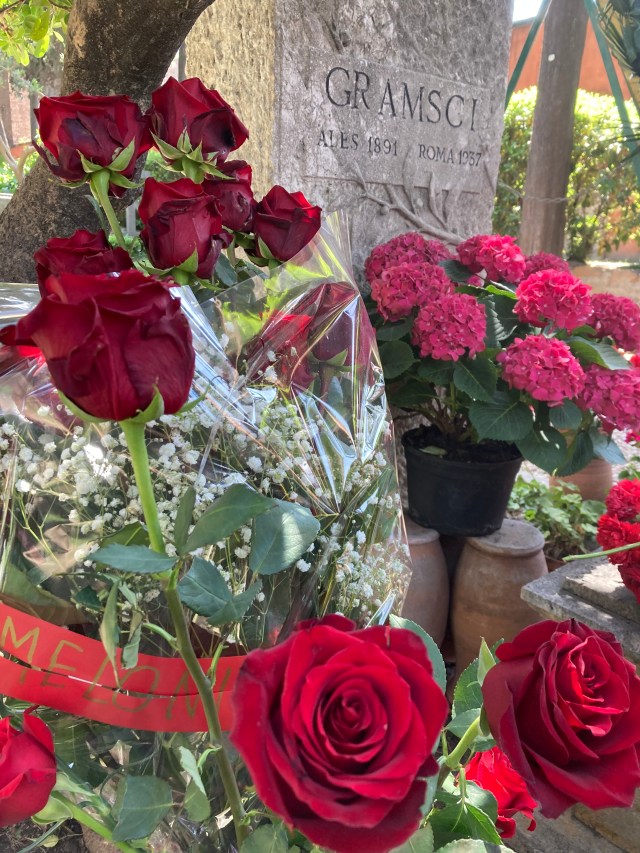
Posted in All | 1 Comment

NEW YORK: Forest of Symbols

New York has an office space problem, a glut. It also has a retail store problem: empty units standing out like missing teeth. Those gaps are everywhere in town, especially in Manhattan, glaring cavities. Recently, I decided I wanted to photograph them, vowed to walk around everywhere to assess the extent of the required dental work. But soon I realized so much had gone that I’d be snapping away all day, and most of the night, doing so along every street (and avenue), in every neighborhood.

In many cases, empty stores are directly related to empty offices. Workers no longer in the workplace spell shuttered up coffee shops, dry cleaners, lunch restaurants and bars, even newsstands—those small businesses that once served commuting office workers. New York’s Comptroller’s Office reckons vacant commercial premises across Manhattan have seen a sharp hike; in some parts of midtown, one in three retail spaces now lie fallow (see “Fewer Workers Planning to Return, Hurting Manhattan’s Comeback,” The New York Times, April 12, 2022).

New York’s newly incumbent mayor, ex-NYPD cop Eric Adams, has been pushing for a recovery plan based on thousands of workers returning to midtown and lower Manhattan offices. The city’s 1.3 million private-sector office workforce, the mayor says, needs to get back to their desks. He wants crowds returning to central business districts, workers breakfasting, lunching, and dining there again, supporting small enterprises that will fast disappear without sustained patronage.

Adams’s mantra, though, is falling on deaf corporate ears. Some of the city’s biggest firms are urging employees otherwise. The management consultancy giant PwC told its 40,000-strong workforce it can now work remotely forever. Law firms and publishers like Penguin-Random House are following suit. Spotify has a 17-year lease on 16 floors of No.4 World Trade Center (at $2.8 million a month) but told its staff they can “live anywhere in the US.” Facebook voiced likewise to its thousands of NYC employees, throwing into question what’ll happen to their home at midtown’s James A. Farley Building. The insurance company TIAA, Verizon, as well as many other big techies (like Google), are all instigating hybrid working practices, insisting there’s no compulsion to get back into the office. JPMorgan Chase, New York largest private sector employer, said only half its 271,000 employees would return to the office five days a week. So despite the mayor’s pleas, in-person work presence looks like a blast from the past, not a glimmer of hope for the future.

The decline of Manhattan office workers is set to disrupt New York’s collective life. For one thing, it threatens to undermine the city’s real estate-reliant tax base. Overly reliant tax base, more like. Offices: can’t live with them, can’t live without them. Pre-COVID, office buildings in Manhattan supplied more than a quarter of New York’s property tax revenue—money used to fund public schools, the police, parks, and public infrastructure. With 19 percent of Manhattan’s office space available for lease, a near record high, the dark days of the seventies’ fiscal crisis loom. Downtown, 21 percent of offices have no tenant. And without a regular stream of commuters, the region’s mass transit systems will face even greater budget cuts, disproportionately harming those workers who still show up to work. Reduced funding means poorer service and crappier facilities. At the April 2022 Brooklyn subway shooting, recall that none of the station’s CCTV cameras functioned. Rising subway crime will also present real and imagined obstacles to sustained usage, persuading many New Yorkers to think otherwise, if they can, about the daily commute.

And yet, while office occupancy dips, the city’s residential property values and rents soar, somehow defying gravity. Large swaths of the city’s public life are destined soon to deteriorate, languish because of lack of funding; still, private sector rents rose 33 percent between January 2021 and January 2022; and in neighborhoods like Brooklyn’s Williamsburg and Manhattan’s Upper West Side, 40 percent gains have been reported. (Average sales prices for Manhattan apartments jumped 12 percent during the first quarter of 2022.) This seems inexplicable, even obscene, while so much of the city still reels from COVID.

After offering discounts, landlords are beginning to turn the screw again. For tenants who stayed during the pandemic, the goodwill is over; and for returnees, they’ll have to pay even more than they did before they left. Property owners say they’re trying to regain lost income and compensate for escalating costs of utilities and property taxes (“Rents are Roaring Back in New York City,” The New York Times, March 7, 2022). But hikes have only worsened the city’s chronic affordability problem. Some 45,000 people currently live in shelters; 5,000 make do—or not—on the streets. Homeless encampments across the city have been aggressively dismantled by NYPD’s Sanitation Department and Department of Homeless Services. The mayor is keen to highlight the “moral failings” of homelessness, clearing away the homeless for their own good.

Meanwhile, converting New York’s 700 underutilized hotels into affordable housing encounters legal and technical barriers. A new $100 million fund to motivate developers to convert empty hotels into residences wallows because of regulatory red tape. Here, as with flexible work models, city policymakers have been slow off the mark, hardly grappling with what all this portends for the Big Apple’s future. New York state has yet to relax zoning regulations, further hampering the conversation of office space into residential housing, including accommodation for low-income New Yorkers. So it goes.

***

I walked past Kurt Vonnegut’s old townhouse the other day, at East 48th Street, a narrow, white, three-story building, mid-block between Second and Third Avenues. I was thinking about the expression he’d made famous in Slaughterhouse 5: “so it goes.” Vonnegut said the Tralfamadorians uttered the phrase each time they encountered a dead person. So would he, Vonnegut said, in his novel. But I wasn’t thinking so much about corpses that day, about dead people, even though I could have easily been—Russian shells, after all, were raining on the Ukraine, circa 2022, much like Allied firebombs had destroyed Dresden, circa 1944. Instead, I was thinking about Vonnegut’s expression in conjunction with something I’d read in that morning’s New York Times, rolling my eyes, because of the awful familiarity of it: urban policy reverting to its old playbook of quack ideas. I’d been hearing this stuff for decades. So it goes.

000DFE03-5AF7-40BD-A1D3-E47411B1DF71

New York, like elsewhere in America—really like everywhere in the world—is handy at doling out huge amounts of public money to line the pockets of an already-immensely wealthy private sector. Thus The New York Times was reporting on how Albany was soon about to foot the bill for the Bills, for a new billion-dollar football stadium in Buffalo, even as the Bills lost four straight Super Bowls. Critics have damned this spectacular deal—costing New York state $600 million and Buffalo’s Erie County an additional $250 million—as an egregious case of corporate welfare; forking out huge sums of public, tax-payers money to subsidize a team owned by billionaires. It’s miraculous how the state finds ready money for private services after crying poverty for public services. So it goes. Even pro-capitalist economists wonder about the effects new mega-projects like this have on civic bottom lines. “Large subsidies commonly devoted to constructing professional sports venues,” they say, “aren’t justified as worthwhile public investments” (“Public Will Foot Most of $1.4 billion Cost for Stadium. Buffalo Fans Cheer,” The New York Times, April 17, 2022). Much the same can be said about other mega-projects.

Unquestionably, the biggest folly—the most egregious of egregious mega-projects—is New York City’s Hudson Yards. This 12-acre site, west of Penn Station and Madison square Garden, had once been gritty rail tracks and storage yards for Long Island Rail Road trains. Completion isn’t destined until 2024; yet much is already in place. Hooking up to the High Line and a revamped No. 7 subway station, Hudson Yards is meant to symbolize the pride and joy of a post 9/11 Big Apple, a celebration of Michael Bloomberg’s Mayoral years, his bleeding edge: New York, Inc.

Now, a $25 billion mega-plan brings shingled blue-glass skyscrapers, office space, deluxe condos, and high-end retailing galore, to say nothing of an eco-arts center and bizarre pedestrian walkway called “The Vessel.” Touted as Manhattan’s Eiffel Tower, designed by Brit Thomas Heatherwick, the Vessel is a $200 million 16-story stairway to nowhere, resembling a truncated giant honeycomb. Nearby, comes the “Shed,” a $500 million eco-friendly arts center and performance space, looking like an aircraft hangar wrapped in a gray down comforter. The structure is a movable feast, a shell that glides along rails, seating 1,200 people at any one time, “physically transforming itself,” the hype says, “to support artists’ most ambitious ideas.” In 2013, the City of New York handed over $50 million towards the project, to Related Companies and the Oxford Properties Group, representing the single biggest capital grant given in that year.

The bourgeoisie tears away sentimental veils, Marx famously said in the Communist Manifesto, and puts in its stead “open, shameless, direct, bare exploitation.” In all this—in open, shameless, direct, bare exploitation—we are, at Hudson Yards, on familiar ground. So it goes. The New York Times architectural critic, Michael Kimmelman, called the development “a supersized suburban-style office park, with a shopping mall and a quasi-gated condo community targeted at the 0.1 percent.” It’s the largest private real estate venture in US history, and in the brazen world-leader of private real estate deals that’s saying a lot.

In office, Bloomberg pumped 75 million public dollars into the development, matching it with a similar sum from his own deep pockets. Meanwhile, BlackRock, a midtown investment company, managing a $6 trillion portfolio, wrote off $25 million in state tax credits, to buffer the move of its 700 workforce to Hudson Yards, less than a mile westward. Some estimates suggest the whole initiative has totaled as much as $6 billion in tax breaks and public finding. Socialism for billionaires is how the scam has been described—even as those self-same scammers wax lyrical about the virtues of the “free market.”

Still, one of the most startling of Hudson Yards’ scams, reputed to have amassed some $1.6 billion’s worth of financing, is even more insidious, only quite recently becoming public news (see Kriston Capps, “The Hidden Horror of Hudson Yards Is How It Was Financed,” CityLab, April 12, 2019). It centers on the controversial investor visa program called EB-5, part of George Bush senior’s immigration reform of the early 1990s. Bizarre as it may sound, the program lets immigrants secure visas in exchange for investment in the US economy. We’re talking here about super-rich foreigners, people who can pump between $500k and a million bucks into American real estate. That enables them—with no questions asked, no hoop-jumping—to gain fast-track visas, for work or study. (It has been something of a favorite in pre-COVID years amongst wealthy Chinese families.) The monies are supposed to go into federally-targeted areas, into poor and distressed neighborhoods across America, so-called TEAs—Targeted Employment Areas.

But the jurisdiction of TEAs—where its boundary lines are drawn—is rather loose, hence open to meddling and manipulation. And in New York, the Empire State Development, a public-private organization under New York state’s banner, is the arch-meddler and manipulator. Somehow, it managed to secure Hudson Yards TEA status, stretching its remit into poor census tracks of Harlem. As such, funds intended for real estate aid in poverty-stricken neighborhoods, like Harlem, were siphoned off and redirected into a super-luxury mega-development. “Think of it a form of creative financial gerrymandering,” is how Kriston Capps put it. That’s how developer Related Companies raked in around $380 million at Hudson Yards, bypassing distressed area scrutiny through a greedy audacity that beggar’s belief. Or perhaps not, in what was (is?) Trump’s America. (And, by the way, son-in-law Jared Kushner had been busily promoting Kushner Companies’ projects with EB-5 investors in China.) So it goes.

In our post-COVID workplace, though, this the notion of “bleeding edge” takes on a rather different significance. Vampires have sucked blood dry. There’s nothing left to bleed: empty offices and stores bereft of people characterize Hudson Yards, feeling a lot like the collapse of the dot.com sector in the noughties, highlighted in Thomas Pynchon’s own Bleeding Edge (2013). Depopulated officescapes, unused cubicles in open-plan ghost spaces, gather dust. “Eerily deserted,” said The New York Times (“How the Pandemic Left the $25 billion Hudson Yards Eerily Deserted,” February 2, 2021). Kohn Pederson Fox Associates’ 100-floor pinnacle office and residential building at 30 Hudson yards, taller than the Empire State Building, has around 500,000 square feet of unleased office space, casting a dark shadow across the shiny glitz. Hundreds of its condos remain unsold. With unpaid debts of more than $16 million, retail anchor tenant Neiman Marcus recently filed for bankruptcy, breaking its lease. At least four other upscale stores and several restaurants have likewise gone belly up.

When I strolled around Hudson Yards one lovely spring afternoon, the High Line was packed with people basking in the sunshine. Yet they were voting with their feet. Because, on the inside, inside the shopping mall, those crowds thinned to a trickle. Listless shoppers aimlessly wandered a complex whose scale is so massively oversized. Everything felt alienating, unlived in and dehumanized. Even the giant Whole Foods Market felt processed, supersized, starkly empty of organic humankind. Passivity prevailed in Hudson Yards’ rarefied air, both inside and out. In the chilly open-air shade, a small group of overseas tourists gathered at the base of the Vessel. They looked bored, perhaps puzzled why the structure was “temporarily” off-limits to visitors. Maybe they didn’t know the Vessel’s true claim to fame?

67B7038E-C3B1-4B61-AB0B-5199BA5F7547

The Vessel first closed in January 2021 immediately after a 21-year-old man leapt to his death from its 150-foot spiral staircase. The previous December, a 24-year-old Brooklyn woman had similarly jumped, following the death of a 19-year-old New Jersey man, an inaugural suicide, in February 2019. Witnesses then said there had been prolonged screaming as onlookers realized in horror what had happened. And just two-months after the Vessel reopened, in May 2021, amid a fanfare about a design overhaul to lessen the risk of suicides, a 14-year-old boy plunged to his death. Inexplicably, the height of the railings around the walkways, barely chest-high, hadn’t not been altered. Police confirmed it as a fourth suicide. Initially “envisioned as a shared, immersive design experience,” the Vessel’s future now remains uncertain. It was meant to be Hudson Yards’ quirky centerpiece, the brainchild of billionaire real estate developer Stephen M. Ross of Related Companies; instead the Vessel may well be a tragic metaphor of our anxious age, when so many tendered-aged people have decided to end it all. And when so many people have become so disgustingly rich.

One can only shudder at the public money squandered there. Especially in a development so utterly banal, such a colossal white elephant. There’s nothing at Hudson Yards to satisfy even a five-minute attention span. There’s no intrigue, nothing that grips, no curiosity, no messy city life. In fact, here one finds the sort of banality and predictability only money can buy. Hudson Yards’ banality resides in the predictability of its form and function, in its predictable sleek glass and steel architecture, catering for a predictable array of financial and high-tech services, multinational corporations and accountancy firms, banks and management consultancies, high-end retail giants, each aimed at a predictable bunch of wealthy consumers. All real urban texturing and spontaneous novelty is expunged. I took a photo showing how the development jars with its surroundings, with real life nearby.

843CA4F2-77F6-4318-B0B1-41A26E98B6D9

I remember the spring prior to the first COVID lockdown, doing a big walk around Hudson Yards with my friend and former teacher, the urban theorist David Harvey. It had been a soaking wet afternoon, chilly and gray, and we both tried our utmost not to let the weather, nor the awfulness of this project, dampen our spirits. Wandering around, David and I spoke of something he’d written about over thirty years ago, in his book Consciousness and the Urban Experience: “the restless analyst.” It’s the mythical figure haunting The American Scene (1907), Henry James’s roving travelogue around fin-de-siècle America. James had been away from the US for twenty-five years, living in Europe. As a “returning absentee,” between 1904-05, he spent a year rediscovering his native land, indignant at much he saw; many changes, he said, became “a perpetual source of irritation.” “Charming places, charming objects,” James wrote, “languish all around the restless analyst, under designations that seem to leave the smudge of a great vulgar thumb.”

The gaze of James’s restless analyst was the gaze of “an inquiring stranger.” This character likely came to mind at Hudson Yards because we, too, felt like “inquiring strangers,” out of place and similarly indignant at much we saw. In Consciousness and the Urban Experience, David said he’d “long been impressed with this character the restless analyst. It seems to capture the only kind of intellectual stance possible in the face of a capitalism that reduces all aspects of social, cultural, and political (to say nothing of economic) life to the pure homogeneity and universality of money values and then transforms them according to the roving calculus of profit.” So it goes.

***

For around thirty-years, I’ve regularly gone to sit on a bench in front of Jackson Pollock’s Autumn Rhythm at the Metropolitan Museum of Art on Fifth Avenue. I’ve always thought it a rather marvelous painting, the product of Pollock’s tremendously productive year of 1950. Its black and white skeins and swirls, spirals and splatters, drips and dollops of paint, poured from Maxwell House coffee cans and spilt from wooden sticks, engulf this vast 17ft by 8ft brown canvas. (If you go up close, you can also see other colors, like teal blue.) Autumn Rhythm radiates an immense electrical charge, a kinetic energy that always seemed to me quintessentially urban, even though Pollock executed it on the floor of a small-town Long Island barn. The critic Clement Greenberg said this Pollock “action painting” represented “the crisis of the easel picture.” All bets in modern art, he meant, were now summarily off. Here was something volatile, original, without a traditional beginning, middle or end, breaking free of its borders, painted only because you could stand on it, and dance around it.

162F455C-88CD-4F89-A4BA-FA6EBDFF8419

For a long while, I’ve believed this canvas also represented the crisis of the classic framing of the city, wrenching us away from how, for instance, the Impressionists depicted Paris: with blurry, shifting brush-stroke movement, yet always with a movement bound by a certain coherence, by a certain pictorial ordering, by a certain perspective of where the city centered and where it ended. Whereas with Pollock, this linear ordering is obliterated. Instead, he’s letting us glimpse a deregulated sort of capitalism unleashed, whirring before you, with its spirals of capital sloshing around the globe, creating nodal points that gel as cities, as spaces like Hudson Yards, that flow into circuits of real estate development, into global money markets. Here, in short, is a graphic depiction of contemporary finance capitalism in motion.

A decade or so ago, when the Occupy movement was taking hold across the globe, I had another idea about Pollock’s imagery: that it was equally a representation of resistance, a pictorial depiction of the act of fusion, of people coming together, and that those great whirls and curves, puddles and dribbles, those wiggly threads of splattered black and white paint were actually points of convergence, nodal spaces that people occupied, that blazed new territories of possibility, all somehow connecting with one another. Indeed, Pollock was illustrating nothing less than a radical geography of mass encounter. In retrospect, the notion strikes as rather quaint, pre-Trump, before COVID, B.C.

Now, though, sitting in front of Autumn Rhythm, April 2022, I’ve something else in mind, another thought about what Pollock might mean, for cities and life, a quieter vision. (You had to hand it to the man for sparking impulses!) Like all his best art, it’s not so much what Pollock himself meant in his paintings, if he meant anything at all; it’s more what it means to you when you encounter his paintings, what it does for you, says to you: all metaphorical and inspirational potential resides firmly in the eye of the beholder, in the head of the restless analyst. Before me now, before Autumn Rhythm, after visiting Hudson Yards, I’m seeing something else, sensing something else. Maybe it has to do with autumn, which had never occurred to me until now. When somebody once asked Pollock how he represented nature in his paintings, he famously responded, “I am nature.” Maybe, now, we can grasp autumn as implicit in the picture, as subliminally there, autumn as a season when things fall from trees, when mushrooms appear, when nature dies off, rots, only to nourish the earth as mulch for future growth.

Lately, I’d been reading a memoir by the Canadian forest ecologist Suzanne Simard, Finding the Mother Tree: Discovering the Wisdom of the Forest (2021). Doubtless Simard has helped me re-envision Pollock, affected my re-visioning of him and of city life. Simard has been thrilled by British Columbia’s old-growth forests since she was a kid, when she foraged mushrooms and huckleberries, even taking to eating handfuls of dirt, too, relishing, like Gabriel Garcia Marquez’s Rebeca from Hundred Years of Solitude, the taste of damp raw earth. This taste never went away. Now, as a sixty-something college professor, she has become an authority on the forest’s undergrowth. Decades back, Simard noticed how commercial logging hacked down diverse old forests and replaced them with homogeneous plantations, stripping the soil of its underbrush. The logic went that without competitors, and with more space for light and water, young saplings would thrive. But they didn’t. Frequently they withered and died, proving more vulnerable to disease and climatic stress than trees in entangled ancient forests.

Simard discovered the reason why lay in mycorrhizal networks, the threadlike fungi that envelop and fuse with trees. Here, beneath ground, something amazing takes place. These fungi pass on to trees nutrients—phosphorous and nitrogen—and help extract the water required for photosynthesis. Around 90 percent of trees depend on these mysterious underground mycorrhizal networks—mykes is the Greek word for fungus and rhiza root—which link trees, even trees of different species, sharing life, knitting together the earth’s soils in a complex system of symbiosis. When we see mushrooms sprouting, this is just one part of the story, only the fruiting body of fungi, its blossom, the visible realm where spores are produced and transmitted. A lot more of the action is subterranean, occurs deep down. Carbon, water, and nutrients pass from tree to tree via underground circuits, shifting resources between the oldest and the biggest to the youngest and smallest, from strongest to weakest.

Mycorrhizal networks are delicate gossamer webs of tiny threads, which, if we could dig underground, we’d not only see them as tissue stitching together much life on earth—we’d also glimpse an intricate fractal patterning resembling Jackson Pollock’s Autumn Rhythm. We’d see the paint of his spirals and whirls, his nodes and synapses, as the constitutive ingredient of these mycorrhizal webs: the mystical and magical substance called mycelium. If you teased apart the mycelium found in a teaspoon of soil, it might stretch to over a mile of thread. Mycelium operates more as a process than a thing, possessing an innate directional memory that spreads outwards radially, forming a spidery circle of filaments in all directions—sound familiar?

Mycelium expands until it touches something, finds something to latch on to, to feed on and nourish, anything dead or alive, organic or inorganic, decaying and decomposing—not only tree roots and plants but old books and carpets, bits of wood and floorboards, trash and food waste, moldy wallpaper and even cigarette butts. (Check out a Pollock action canvas like Full Fathom Five (1947), which features assorted moldy objects, like cigarette butts, embedded in the paint.) Half-jokingly, Simard says these material filaments of mycelium constitute the “Wood Wide Web,” nature’s very own broadband, traversing humous subsoil everywhere. Channels for resource exchange and communication are here always open, without tariff or subscription. In this other-worldly kingdom, the “internet of things” is nothing new: “smart” forests have been around for thousands of years.

While Simard says conflict in a forest is undeniable, she knows, too, that life abounds there because of negotiation and reciprocity, because of widespread mutuality. Earlier in her career, these ideas were disparaged by her male “growth and yield” forest colleagues. Nowadays, Simard’s vision of a forest ecology based on cooperation and selflessness has seeped into the mainstream, even gotten written into college textbooks. Hers isn’t so much a critique of Darwin—who, remember, stressed contest and self-interest in the evolutionary process; it’s more a little caveat, a modest rejoinder. When we think about sustaining life on earth, fungi teach us that real resilience comes about through cooperation not die-hard competition.

Loggers replacing diverse forests with homogeneous plantations sounds uncannily like the dynamics of today’s urban environments, where developers similarly create homogeneous plantations out of messy old human woodland, hacking through the city’s old growth, disturbing well-established urban ecologies. Stripped bare of human undersoil, devoid of any selfless life, our cities likewise wither from frailty. Only the richest survive in privately managed enclaves that exhibit little biodiversity. In these new forest wildernesses, people are forced to compete with one another, compete in labor markets, pit themselves against each other in unaffordable housing markets. Our human mycorrhizal networks have been uprooted long ago. We’re all here in a state of root shock. Thus Simard’s fungal studies provoke us to re-evaluate the whole notion of cooperation in urban life, particularly pressing nowadays given that a pandemic has threatened that collective life.

Mega-projects alter the metabolism of city life and, directly or indirectly, kill off the city’s old-growth forest. That forest, for sure, probably required some sort of nourishment at the time; it was already likely getting contaminated by invasive forest management. But now it’s gone, the city has less undergrowth than before, less resilience, and is set to wither like the newly laid forests Simard witnessed in commercial “fast-food” forestry. Trees are dependent on their connection to the soil and to one another—just like buildings and humans. We, too, exist in a complex web of social relations between ourselves and surrounding objects. Demolishing and upscaling buildings severs this symbiosis, disrupts the organic balance between people and people, between people and buildings—between human space and physical space. In the social world, there are also mycorrhizal networks that help shape life. They offer support and cooperation, supply nutrients to people, especially to the weakest, and sustain the social structure of a shared soil. Fungi don’t discriminate between species. They channel nutrients to multiple tree species. Theirs is a wonderous society of mutual aid. It prevails in the natural world so why can’t it prevail in the human world as well? And why can’t it prevail between different races and different kinds of human beings?

Perhaps we need another narrative about urban forests, a city equivalent of Jean Giono’s brilliant tree narrative, The Man Who Planted Trees (1953), about the French shepherd who over four decades disseminated hundreds of acorns, turning a Provençale wilderness into a wooded Garden of Eden. If only our developers and planners thought this way. Giono’s account was so compelling that many people believed the selfless shepherd existed. Fictitious or otherwise, here was a man who cared about what surrounded him, a sort of public figure, whose environmental management became a nurturing labor of love. His was a peasant’s view of forest management and perhaps we need a peasant’s view of city management, too, like the peasant of Louis Aragon’s Paris Peasant (1926).

This surrealist classic—a “modern mythology,” Aragon called it—gives us similar ideas about forestry management, but its thicket is a dense city. It’s a field-manual about how we might treasure and preserve what we have in this forest, before it’s too late—Aragon’s beloved arcade, Passage de l’Opéra, was then about to be demolished to make way for an access route to the Boulevard Haussmann. Aragon himself had many times sauntered through the Passage de l’Opéra, under its glass canopy, tapping some of its hidden mysteries and charms. He delighted in the outmoded, in what you could find in the city’s undergrowth. There, you could stumble upon all kinds of secret lairs and earths, nests and rabbit holes; “a dark kingdom,” Aragon said, “that the eyes of humans avoid because its landscape fails to flatter them.” The peasant’s Paris is a city of full of trees and mossy old-growth, constantly under assault—arracher, déchirer, tondre [to uproot, rip up, mow] are words that feature in Paris Peasant. The city’s “glowing woodland” [buisson ardent] is, he says, perennially getting supplanted by commercial forestry, destroying much quirky, eccentric shrub life nestled within it.

The peasant is born on the land, is of the land, lives off the land. Only in this case, it’s the urban land we’re talking about, how we might cultivate an urban garden, one belonging to the whole community; how we might collectively sustain this “enchanted forest” [forêt enchantée], how we might dig away at it, manage it, renew it, without destroying its enchantment. Aragon wants us to cultivate this garden like a poet might conceive a poem, an everyday poem, like an ordinary stroll down Main Street, humming to yourself. The life of Aragon’s peasant is hauntingly poetic, full of dreams. But while the peasant’s dream is poetic, it isn’t idealist. Nor is it abstractly philosophical. Peasants tend not to think in terms of abstractions. Their world is practical and concrete. They pragmatically labor the land, doggedly struggle for survival.

And that’s how we need to cultivate our urban policy, how we need to doggedly foster our mycorrhizal networks, our relationship between buildings and streets—the complex ecosystem that constitutes our public realm. This is our shared forest, the surroundings that form our habitat, the one we work on and work with, the one we make and frequently break. Maybe someday we’ll dream the peasant’s dream, the dream of a harvest moon, when cooperative roots push up and nourish the earth, and ripen into gorgeous fruits and crops. Over eons, through symbiosis and coevolution, our natural forests have grown tall. They were once small, puny, yet developed over time into a collective form of life that is mighty and magnanimous. Could we imagine our urban history rising to such luminous heights?

One thing is certain: No peasant ever dreamt of towering office space.

Posted in All | Leave a comment

Far From the Madding Crowd?

There’s something about urban crowds, about hordes of people in the city, in public. There’s nothing like it, never will be. I miss it. I miss being amongst people, lots of them. After months of lockdowns and isolations, I know I’m not the only one, that a lot of other people miss other people, too, miss diversity and colors, shapes and faces, movement and dynamism, stuff that kindles our imagination, that challenges us, that makes modern life tick, worth living; many friends have told me likewise, and many people have told my friends likewise as well.

Far from the madding crowd? I’m not so sure. That might’ve once been an ideal in people’s heads, and still is for some; and, of course, a lot of people have sought this ideal out, fled cities for what they perceive as the relative safety and harmony of smaller towns and countryside, to say nothing about its affordability. Still, many others who’ve isolated themselves, who’ve become solitary citizens, are reassessing whether a life cut-off is a deep-down human impulse.

But the concept of “far from the madding crowd” holds a persuasive sway over our collective psyche. We probably have the English novelist Thomas Hardy to thank for that—his Far from the Madding Crowd, I mean, published in 1874, Hardy’s acclaimed masterpiece and first literary success. There Hardy riffed on Thomas Gray’s poem “Elegy Written in a Country Churchyard,” an 18th century lyric classic, much admired by T.S. Eliot, with its gentle meditation on the quietness of English rural life, on the forgotten dead in a graveyard: “Far from the madding crowd’s ignoble strife,” wrote Gray. “Their sober wishes never learn’d to stray;/ Along the cool sequester’d vale of life/ They kept the noiseless tenor of their way.” Yet Hardy’s book, a sunny one for him, with an atypical happy ending—Bathsheba finally succumbs to loving Gabriel and marries him—is nonetheless unsettling, not quite what we might think it is.

Was Hardy ironizing? Likely, insofar as his is a text full of erotic energy and macabre scenes (like the corpses of a mother and baby), lulling unsuspecting readers out of any pastoral complacency or Victorian prudery. In fact, far from the madding crowd has plenty of “ignoble strife”; and “the cool sequestered vale of life” is but a proxy for repressed violence and despair. With its fire and thunderstorms, its life-threatening elemental eruptions, its shooting, Far from the Madding Crowd might even be a staple read for our COVID age, bringing us closer to why madding crowds are so vital to being alive in the first place.

In an odd sense, it was far from the madding crowd where I began yearning for ignoble strife more than ever, for more noisy tenor to the quiet, secluded life I’d hitherto been compelled to lead. (I say “compelled” while recognizing the privilege of being able to withdraw.) In early summer, 2021, after the first lockdown eased, I got into my car and drove to Hay-on-Wye, a famed “book town” in Powys, South Wales, right on the English border. The village is packed with used bookstores; they’re literally everywhere, and in pre-COVID times Hay-on-Wye was renowned for its jammed literary festivals and vibrant bookfairs. The couple of days I spent worming its stores and thumbing its books, everything was eerily quiet, as if the end of world were nigh, soon about to happen. And I often found myself alone in the stacks, communing quietly with characters in the text, much as I’d been doing for months at home.

A disused movie theater now houses the Hay Cinema Bookshop, the town’s oldest book haven, founded in 1965, a vast two-floor emporium of used, remainder, and antiquarian books, of all genres. If the 200,000-odd volumes inside don’t grab you, then outside, in a couple of gray steel containers, its bargain section will, with an array of sell-off and damaged books, many gems going for a pound. In amongst them, I discovered a text that had a strange effect on me; not because of its writing but for what was on its cover. At first, I was appalled that someone would cast off such a handsome copy of F. Scott Fitzgerald’s A Life in Letters, a big-formatted Penguin book published in 1998. Within its leaves is some marvelous correspondence between the author of The Great Gatsby and his young daughter Scottie, then a student at Vassar College. “Some time when you feel very brave and defiant,” dad Scott wrote, “and haven’t been invited to one particular college function read the terrible chapter in Das Kapital on ‘The Working Day,’ and see if you are ever quite the same.” Elsewhere, Fitzgerald reminds his daughter “that Marxism doesn’t concern itself with vague sophistries but weds itself to the most practical mechanics of material revolution.”

9780141181127-uk

But these golden nuggets about Fitzgerald’s radical politics didn’t grip me quite like the beautiful glowing Azur of Raoul Dufy’s cover, a sweeping impressionistic vista of Nice, France, painted in 1926 from on high, from Castle Hill, with the city’s famous Promenade des Anglais curving around the Mediterranean’s Baie des Anges (Bay of Angels), disappearing into the distance at Cannes. There were palm trees and people, carriages and boats, sea and a yellowed-domed Casino (before it and its pier burned down)—an allure and romance that Dufy makes throb with his delicate brush. Some involuntarily memory had suddenly been activated in my brain. I wanted to go there, desperately, to Nice, wanted to enter this shifting scene, feel its energy, absorb people by the sea, remembering how, long ago, in the early 1980s, on a backpacking vacation, I’d once strolled down the Promenade des Anglais. Now, I needed to return, had to return.

Miraculously, two months later, in August, in the height of summer, fully vaccinated, I was there again, back on a Promenade des Anglais flocked with people and boiling hot. I was walking along what must be one of Europe’s greatest public spaces, stretching four miles from Quai des États-Unis (United States Quai) to Nice Airport, hugging a coastline and a sea the colors that Dufy’s paint hadn’t exaggerated. It was as if the sun were burning away people’s fears, cleansing the air of virus, lulling everybody, perhaps, into a false sense of collective security. All of us were mingling along the vast promenade that rich English Victorians had constructed.

Promenade-des-Anglais-Nice-Postcards-.jpg

Since the late eighteenth-century, aristocratic Brits had been coming to Nice, chasing the sun in winter; and in 1820 some proposed paving a walkway along its Mediterranean seafront. The Holy Trinity Anglican Church, headed by Reverend Lewis Way, coughed up funds, and by 1860 the magnificent iconic promenade bore the name of its Anglo benefactors. In recent years, walkway space has increased, getting widened at the expense of traffic flows; dedicated bike lanes have also been put in place, to the degree that, now, “La Prom” brings together every walk of life—buskers and ramblers, flâneurs and artists, roller-skaters and baby-strollers, wide-eyed tourists and seasoned locals, old and young alike—all moving and chatting, sitting and playing in a giant open-air democracy by the sea. It felt like uninterrupted liberty to move, to linger, to simply sit on one the promenade’s many fixed chairs and people watch, confirming William H. Whyte’s homily about urban life: that the most fascinating thing for people in public is to observe other people in public.

To suck in its balmy, salty air, to imbibe its crowded vibe, was to photosynthesize amid an ocean of people. Strolling along, I felt like a character from Edgar Allan Poe, from his Man of the Crowd—although I was pretty sure this sensibility wasn’t exclusive to me nor to men alone. We were all somehow “People of the Crowd.” “For some months I had been ill in health,” Poe had his protagonist tell us, “but was now convalescent.” For some months, we’d all been ill in health, and now, here, the lucky ones, were convalescing together, trying to recover from an illness that had shaken us to our existential core, that still might shake us to the core.

IMG_6373

“Merely to breathe was enjoyment,” Poe’s hero says. “I felt a calm but inquisitive interest in everything.” Again, I knew what he meant, think a lot of others on the Promenade des Anglais knew what he meant, too. “Dense and continuous tides of population were rushing past…and the tumultuous sea of human heads filled me with a delicious novelty of emotion.” Soon, our man of the crowd contemplates, as I contemplated, “with minute interest the innumerable varieties of figure, dress, air, gait, visage, and expression of countenance.” We were all “refusing to be alone,” as Poe might have said. Maybe we were men and women yearning to be close to the madding crowd, dreaming of becoming part of it.

In Vieux Nice—the city’s old town—throngs of people jostled one another, and energy levels were just as high as densities. In confined spaces, like lining up for ice cream at Gelateria Azzurro, along the narrow rue Sainte-Réparate, or grocery shopping at Cours Saleya’s daily market, mask-wearing became more common. On these occasions, it’s easy to understand why crowds and city streets have so kindled the French literary imagination, becoming as much part and parcel of the French vie quotidienne as baguettes and red wine. In “Crowds” (Les Foules), from Le spleen de Paris (1862), Baudelaire said “a singular intoxication” awaits everyone who knows how “to take a bath in the multitude.” Himself an avid admirer (and translator) of Edgar Allan Poe, Baudelaire likens this experience to a “universal communion,” to a profane joy, the “feverish pleasure” of people discovering one another on a packed street. True enough. On the other hand, might we wonder whether Baudelaire’s ideal of losing oneself in the crowd requires, under COVID, a more cautious reading: mightn’t intoxication now be deadly, a feverish pleasure that poses grave dangers of losing yourself forever?

***

Epidemiologists say COVID-19 “is primarily transmitted person-to-person by close contact through respiratory droplets.” The scholarly journal Communication Physics (August 23, 2021) confirms, however, that “the role of population density is an open question with evidence for and against its influence on epidemic spreading.” The journal adds that “merely the density of contacts, while relevant at a neighborhood level, isn’t enough to explain the mechanisms of spread.” In similar vein, the International Journal of Environmental Research and Public Health (September 2021), which features a detailed COVID study from Malaysia, reckons that population density is a factor in the spread of disease yet caveats and riders remain. Density alone doesn’t answer the fundamental question as to why there’s a “chaotic spread of disease at the population level.”

Other studies highlight positive correlations between COVID and the “compactness of people.” Yet here again, there’s no consensus on the direct effect of population density on numbers of virus cases. The Malaysian survey showed that in districts with more than 250,000 inhabitants, and with a density of more than 500 persons per square kilometer, approximately 1.5 people were infected with COVID—which is to say hardly any more than in less densely populated areas. Each time the population density increased by 1 individual per square kilometer, there was a tiny increase of 1.38 in the active COVID cases. The study said attack rates of the epidemic in some instances were higher in smaller districts than larger ones, a feature borne out in parts of China, suggesting there are “proxy drivers of contact rates.”

The World Bank, too, not long ago released findings on the role of density and the spread of COVID, saying there’s no direct causality between the two. “Density matters, but not much.” The world’s most densely populated cities in East and South-East Asia—e.g., Seoul, Tokyo, and Shanghai—have had very low levels of infection compared with sprawling U.S. cities. In China, cities with the highest infection rates were those with relatively low population densities, in the range of 5,000 to 10,000 people per square kilometer.

In New York, the first wave of COVID killed more than 20,000 in a few months. Nobody knew what was happening. It seemed like a nightmare from the Middle Ages, black plague striking down everybody. How could people protect themselves? Run away? Pray for deliverance? People panicked, justifiably. Was it New York’s openness, America’s gateway to the world, with too much human coming and going, that sparked mass infection? Was it the city’s uniquely high population density, like Manhattan’s whopping 27,000 people per square kilometer, together with its reliance on mass transit mixing? Or was it lifestyle, that New Yorkers always dined out and rarely stayed in? Maybe it was some combination of all these things? (Some of the city’s highest infection rates turned out to be in lower density Staten Island.)

As it transpired, Big Apple denizens soon wised-up, began protecting themselves, started wearing masks, got vaccinated. Then came vaccine passes and more enlightened public health precautions. Ever since, the city has fared well on the health front, better than other places in America, better than many low-density cities like Dallas, even better than many small towns and rural areas. The city has gone on to suffer less COVID deaths than elsewhere in America, making it one of the nation’s safer places for human life and limb.

All of which poses the question: are dense cities per se the problem when it comes to COVID? Maybe we should reframe this question: Is there any such thing as per se when we talk about cities? Aren’t cities reflections of what is happening in our society, for better or worse? Don’t our economics and politics get inscribed in city life, flourish in cities, get intensified in cities, oftentimes plague cities? To attribute causation to cities in themselves, in other words, is to fetishize the city, is to misinterpret how cities are both reflectors and shapers of wider social and cultural processes. Sometimes cities exacerbate social woes; elsewhere they might be palliative or even curative for those woes. It all depends. To give up on cities, to run away from them, to wag the finger at them, in other words, strikes me as problematic. We need a different conversation about cities and our society, and about our society in cities.

High-density crowds, of course, are one of the great virtues of cities, perhaps the greatest virtue, the innumerable encounters between different people, and the sociability that prevails from this diversity. Sometimes sociability doesn’t prevail; conflict rules—social breakdown and separation. Yet maybe the dilemma of COVID urbanism isn’t so much about crowd avoidance as crowd management, about how one responds to the crowd, in the crowd, how people act toward one another, respect (or disrespect) one another (through mask-wearing, social distancing, etc.), how people understand themselves as people in public, not as individuals simply doing what you like amongst people. How do democratic institutions respond to crowds, how do they manage (or mismanage) crowds, nourish a general will while guarding against the flouting of individual rights? Something crucial in any crowd management is to differentiate between crowds and crowding, especially overcrowding. What we’re talking about here is overcrowding that scars everyday urban living for many people.

Overcrowding is different to density; the two terms shouldn’t be used interchangeably since they’re distinguishable. Overcrowding can be just as palpable in low-density areas as in high-density ones; and high-density doesn’t necessarily equate to overcrowding. Plenty of the world’s richest neighborhoods—like Manhattan’s Upper East Side or Monte Carlo—are mega-dense yet certainly not overcrowded (Monte Carlo is second on the world’s densest urban roster, and perhaps the wealthiest, with a 32 percent millionaire population!). Overcrowding is where households have more occupants than rooms (excluding bathrooms), and where people can’t avoid close contact with each other. As a lot of multi-occupants tend to be poorer, and their jobs more menial, they don’t have the luxury of homeworking, either. And even if they did, they’d have nowhere at home to work. Occupants come and go at all hours, depending on work shifts, and expose themselves and their housemates to people at large, to greater risk of infection.

A study in Chicago found no correlation between population density and COVID infection rates (see “In Chicago, Urban Density May Not Be to Blame for Spread of the Coronavirus,” ProPublica, April 30, 2020). But what it did find was a direct link between overcrowding and infection. “The communities hardest hit by the virus in Chicago,” the report says, “are low-density black and Hispanic neighborhoods, including ones where economic decline and population loss have caused more people to live in the same household.” In Englewood, a Chicago neighborhood hit especially hard by the 2008 housing market collapse, foreclosures and dwindling affordable stock have left less-resourced denizens with few options. Home ownership is off-limits; ditto high-rental units. So many people, particularly younger people, are forced to live with relatives, with parents or aunties and uncles who, decades ago, could muster the means to buy into the city’s housing stock. “There’s a lack of basic life essentials in the community,” one local politician says. “This is the culmination of decades of disinvestment.” “This is not about disparities in behavior or preventable cases of COVID, where, if people just knew more information, they’d be social distancing.” “It’s really a sad tale of people who know what’s coming, but there’s nothing they can do about it unless you give them housing or get them out of this predicament.”

Even before COVID struck, the Guardian warned of “Shoebox Britain,” of “how shrinking homes are affecting our health and happiness” (October 10, 2018). Britain’s speculatively induced housing crisis has pushed more and more people into homes that are shrinking and multi-occupied. The slicing and dicing up of houses and office buildings has been ongoing for a while, recalling the dark, Dickensian era of tenements and rookeries, only it’s 21st-century style. The walls are closing in for many people and there’s no way out, especially during a pandemic. Home offers no escape, no refuge, no haven in an anxious world. Only confinement, engineered by market-driven expansion, resulting in a sense of isolation and claustrophobia inside that’s almost as hazardous to human health as the outside. It is overcrowding spawned by inequality, by greed; an introverted low-density overcrowding, economically manufactured, far-removed from the extrovert delights of the high-density crowd.

“Shoebox Britain” slams decades of neoliberal urban policies. Successive government ministers (irrespective of political persuasion) have relaxed planning regulations and encouraged more and more housing development that’s rarely “affordable.” Developers and landlords always find loopholes in these regulatory changes, for corner-cutting and boosting profits. Meanwhile, local authorities, desperate for alternatives to their dwindling housing stock, have little choice but to steer needy residents over to these exploitative private landlords. And given there are few resources to monitor the quality of accommodation, it’s invariably squalid, a threat to physical as well as mental health.

Curiously, Britain’s neoliberal cities have had “lockdown” policies well before anybody heard of COVID. For years, rogue landlords and developers have been converting—locking-down—single-family homes into tiny apartments for housing benefit claimants. By including a token shared facility, like a minuscule kitchen, these developments are treated as internal apartment-shares and planning permission can be by-passed. The rental streams generating from six crappily constructed studios is exponentially greater than a three-bedroomed share in the same property. And it’s the taxpayers who line the landlord’s pockets, because the state is effectively picking up the rental tab. Is this “warehousing” of human life ever likely to protect anybody under COVID? Is it ever likely to enhance human wellbeing, post-COVID? It’s hard to imagine, unless something changes, unless greater space, affordability, and dignity can be established in urban living. Cities need to thrive on collective use-values, not wither as privately appropriated exchange-values.

***

Since time and immemorial, debates have unfurled about the relationship between density and crowding and the health of city dwellers. More insightful past commentators, like social psychologist Jonathan Freedman, argue that density and crowding are neither good nor bad. Instead, says Freedman, in his still-valuable Crowding and Behavior (1975), crowding and density intensify the effects of preexisting social situations, much as COVID has intensified preexisting social situations. High-density crowding does have effects on people; yet these effects depend on other factors in the situation. High-density, says Freedman, might cause people to be friendlier but also less friendly, just as crowding might produce great mutuality as well as greater malaise. Crowding can be negative when it creates its dialectical other of isolation and stress, when overcrowding is pressured and forceable; yet crowding might elsewhere mean the vitality of having many people about, constant “eyes” on busy streets (as Jane Jacobs liked to emphasize) that ensure social interaction and neighborhood safety.

If a social situation is bad, says Freedman, when people feel cut off and vulnerable, economically deprived, high density will likely aggravate an already fraught situation. Poorer people often feel powerless, subject to forces beyond their control, and living in a badly maintained high-rise with hundreds of peers might exaggerate feelings of uninhabitability. In this context, density and crowding, rather than poverty and inequality, are conveniently blamed for any social pathology. Conversely, if the situation is structured so that people aren’t cut-off or withdrawn, and a building or neighborhood nurtures positive feelings of empowerment and collaboration, cheerier outcomes might ensue. Better things might even get encouraged by high-density crowding.

This was always William H. Whyte’s central point in his pioneering The Last Landscape (1968), a book that boldly makes “the case for crowding.” (Since his bestseller from the late fifties, The Organization Man, “Holly” Whyte had consistently been a thorn in the side of conventionality; he was also a staunch early advocate of Jane Jacobs, helping kickstart her career.) Whyte says official U.S. land policy, as elsewhere, has invariably been contra higher density; “decentralist” by nature, with the primary thrust of “moving people outward; reducing densities, loosening the metropolis, and reconstituting its parts in new enclaves on the fringe.”

But Whyte isn’t advocating stacking everybody up in giant towers. High-density, he says, doesn’t mean only high-rise; actually, a tight-knit patterning of low buildings can exhibit surprisingly high rates of people per acre, sometimes even greater than twenty-story towers placed apart, where interstitial spaces are frequently empty and institutional, hardly inviting for lingering or leisure. They’re wastes of space, dead zones. Whyte wants to fill them with vitality, with healthy congestion. Here he similarly draws the distinction between “overcrowding”—too many people per room—and density—the numbers of people per acre. “Overcrowding does make for an unhealthy environment,” Whyte reckons, whereas “high density may or may not.” Besides, he says, everyone is always bemoaning the bad consequences of overcrowding; but what, he wonders, about “undercrowding”? “Researchers would be a lot more objective if they paid as much attention to the possible effects on people of relative isolation and lack of propinquity. Maybe some of those rats they study get lonely too?”

The thesis is challenging in an age of COVID, where crowding has aided the proliferation of infection rates while at other times has offered an antidote, the potentiality of a mutual aid, bulwarking the spread of infection. Unsurprisingly, apart from the deadly effects of physical illness, COVID has traumatized people’s psychological wellbeing, too. Medical practitioners now speak of a “second pandemic,” the chronic anxieties and depressions afflicting populations, especially those witnessing high body counts. The phenomenon has stimulated a lot of research into how lockdowns have disrupted communities and heightened loneliness, impacting hardest upon people already socially, economically, and medically vulnerable. The evidence is clear enough: social distancing has stressed mental health; yet it has unfolded differently in high-density neighborhoods compared to those where conditions of “undercrowding” and “overcrowding” persist.

Up and down the UK, resident groups and community associations, in conjunction with legions of volunteers, have forged “COVID-19 Mutual Aid Groups,” stepping in to provide practical and emotional support in neighborhoods where government and private sector programs haven’t reached. Sociability here has bolstered mental health, helped counteract so-called “corona-related loneliness.” What’s happened in Britain is typical of what’s happened everywhere across the globe: an upsurge in community and voluntary activism, a “social cure” to pandemic fallout, having ordinary citizens resolve their own problems collectively. Notably, communities who’ve coped best with COVID tend to be more cohesive and selfless; residents there have a stronger sense of belonging and place attachment. And frequently, they’re located in densely populated urban areas. High-density neighborhood propinquity seems to accord more opportunities for mutual aid. The experience of a collective fate has led to a collective bonding that tries to change this fate.

A British study called “The Mental Health Benefits of Community Helping During Crisis,” published in The Journal of Community and Applied Social Psychology (April 5, 2021) discovered that for enhancing wellbeing “unity is essential.” Their findings suggest that, perhaps somewhat paradoxically, crowding doesn’t so much spread infection as provide a social prophylactic to counteract it. Another study from Italy (“COVID-19 in Our Lives,” Journal of Community Psychology, December 20, 2021) reiterated the point, adding how a “feeling of responsibility” to protect the community was also consistent with an adherence to nationwide social distancing policies. A sense of belonging, in short, together with a sense of responsibility, enabled individuals and groups “to look at uncertainty, both dampening it and managing it.” “If a person’s tie with a community includes the feeling of responsibility for what happens,” the study said, “individuals will feel the desire to act and reflect on what to do to maintain a connection with their community.”

Research carried out in Spain on “The Role of Sense of Community in Harnessing the Wisdom of Crowds” (Journal of Business Research, November 12, 2021) echoed these takeaways. But here the notion of “crowding” assumes another inflection. For the crowds in question are virtual, and constitute people who participated in “crowdsourcing,” in the “co-creation” of knowledge. They’re individuals communicating and collaborating with each other via online groups. The concept being that in times of COVID emergency, the “collective mind” can generate greater wisdom and mobilize itself more effectively. It was precisely this hypothesis that Spanish researchers wanted to test out, examining the efficacy of a sample of virtual communities who’d “achieved a high level of social interaction when face-to-face communication wasn’t possible.”

Social media, they say, drew together various “stakeholders,” and “allowed crowds to launch online communities, sharing feelings and information and even contributing to the resolution of individuals’ concerns and problems, eventually reducing feelings of loneliness and promoting positive values.” It’s not clear the extent to which these virtual communities might ever be converted into actual offline associations, doing practical work in kind, post-COVID, rather than just over the airwaves, on computer screen. Does the immaterial ever materialize into real place-based crowdsourcing? Moreover, it’d be interesting to know, too, if crowdsourcing flourished in conditions of undercrowding, if it helped reduce physical isolation and disempowerment? Maybe crowdsourcing works best in neighborhoods where stronger senses of real community already prevail? Still, the mitigating effects of virtual communication is nonetheless apparent—the human contact, the conversation, the emotional care, the empathetic solidarity, were all real enough, sustaining for people during confinement. (Curiously, as well, the researchers confirmed how “the wisdom of the crowds was an effective solution for identifying misinformation and verify fake news and alternative facts.”)

The virtual crowd will never replace the crowd in the street, the physicality of bodies, bodies really co-present in space. At least it’ll never replace it for me. Crowds offer energy releases, glorious and often maddening comings together of individuals and groups—crowds of protesters and demonstrators, crowds of shoppers and aimless strollers. Sometimes crowds can be led astray, manipulated, deceived en masse, warped by advertising and misinformation, sheepishly following one another, rallied on by demagogy; other times crowds dramatize the power people lack, express real truths about injustice, and voice political ambitions before the political means necessary to realize them are created. Either way, the crowd on the street is different from the crowd on the screen. There’s a special texturing to masses of people, in the open air, in the sunshine, even in the rain, an electricity generated by pure physical encounter.

That said, maybe the sensibility of the online group and the “weak-ties” that ensue, doesn’t only simulate; perhaps it can also stimulate an awareness of real crowds, the strong-ties of emergent public citizens? Perhaps a willingness to join crowdsourcing reflects a greater readiness to want to join the crowd, a desire to participate socially and politically, to affirm a public spirit, to go beyond a private self hemmed in by two dimensions, and by four walls. The Spanish crowdsourcing researchers said their participants “felt connected with crowds, sensed that individuals belong to the community, and built close friendship ties among participants.” “Feeling loyal to the crowd,” they said, “contributed to finding common ground in cohesion and compatibility.” “It provided mutual support and promoted collaboration and teamwork to foster resilience in the face of a pandemic.”

Feeling loyal to the crowd” is an exciting term. Maybe it’s another way of voicing Baudelaire’s ideal of “peopling your solitude”; of not only losing yourself in the crowd, but finding yourself, too, of feeling at home even when you’re not at home, doing it safely, healthily. Baudelaire’s register is romantic and melancholic; yet it’s somehow more optimistic than Thomas Hardy’s. Maybe it’s more comforting, too, less threatened by the madding crowd, about the human merging that takes place in urban life, about the experience “of being oneself and someone else,” as Baudelaire says, “adopting every profession, every joy, every misery, as one’s own.” The psychic rewards are enormous. “What people call love is awfully small,” writes Baudelaire near the end of “Crowds,” “awfully restricted, and awfully weak, compared with that ineffable orgy, that holy prostitution that gives itself totally, poetry and charity, to the unexpected that appears, to the unknown that passes by.” Merging with the urban crowd won’t ever prevent a pandemic; nor will it fully resolve the sadness and loneliness lying at the core of much human life. But it might help us understand each better, help us absorb our sorrows and celebrate our joys. It might shed light on dark shadows and enlarge the whole horizon of our being alive.

Posted in All | Leave a comment

100 YEARS IN FULL BLOOM

100 years ago, in Paris, February 2nd, James Joyce celebrated his fortieth birthday by raising a glass (or two…) to Ulysses, his great epic novel, launched into the world in all its full, if later revised, glory, that same day–this very day. Hats off here not only to author and book but also to the intrepid Sylvia Beach, whose Shakespeare & Company bore the moral and financial brunt of its initial publication.

FKkzw6HWYAEUHox

Between 1914 and 1921, Joyce worked on his modern, single-day interpretation of the Homeric tale as he embarked on his own personal Odyssey around Europe—in Trieste, Zurich, and Paris. After the thrill of its release, though, his book met with widespread prudery. Customs officials in New York orchestrated an Auto de Fe of hundreds of copies. Authorities at London’s Croydon Airport similarly seized the book. A boat load got pulped at Folkstone harbour.

img_38-8

“I can discover no story,” said Archibald Bodkin, Director of British Public Prosecutions. Bodkin was happy to ban a book he’d barely read. “I have not had the time, nor may I add the inclination to read through this book. I have, however, read pages 690 to 732,” he claimed. “In my opinion, there is a great deal more here than mere vulgarity or coarseness, there is a great deal of unmitigated filth and obscenity.”

It wasn’t until 1936 before censorship relaxed: “Standards in these matters are constantly changing,” Britain’s Home Office said in November of that year. “Having applied these tests to Ulysses, “we are of the opinion that the book was not obscene and having regard in addition to its established position in literature decide to take no action.”

A century on, Ulysses continues to incite passions and stir up controversy. The book is slow, critics complain, overly complicated, boring, too low-brow, too high-brow; its lyricism gets overwhelmed by numbing verbosity; there’s not much action, no plot, little direction to the narrative: a funeral, a lot of boozing, a bit of sex (recalled, never actual), masturbation and defecation, breaking wind and nose-picking, trips to the beach, to a newspaper office, to a library, a hospital, then a brothel; characters wander Dublin musing and muttering to themselves, blathering on, frequently in Latin.

In short, Ulysses is hard going, a rather dismal affair, exerting heavy demands on readers’ attention spans. Even one of Joyce’s most ardent admirers, F. Scott Fitzgerald, wished the book had been “layered in America.” “There’s something about middle-class Ireland that depresses me inordinately,” Fitzgerald said, “gives me a sort of hollow, cheerless pain.” What someone also said of Gogol might equally stand for Joyce: “seldom has nature created a man so romantic in bent, yet so masterly in portraying all that is unromantic in life.”

Still, for readers courageous enough, hardy enough, perhaps even imaginative enough, Joyce takes you into the richly textured life-world of Dublin’s Odysseus, Leopold Bloom, wife Molly (Penelope), and the youthful Stephen Dedalus, whom we met in A Portrait of the Artist as a Young Man. In each, we catch glimpses of our own life-world, hear our own thoughts, witness our own dramas unfolding within the text; seeing them in print, and hearing them in our heads, helps us somehow. Protagonists’ experiences become our experiences, their anguishes our anguishes, their struggles our own. Human strengths and weaknesses tempest-toss before us. It’s a full fathom five for anybody willing to take the plunge, for everyone with sufficient breath to make it through, to be affected for evermore by something rich and strange.

Bloom is the gently twinkling lodestar. Jew and socialist, forty years old like his creator, an outsider in a hostile land (much like our own), Bloom quietly struggles to get on by, to keep his marriage intact, to come to terms with loss (death of baby son, Rudy, after 11 days). It’s a loss that gives Ulysses its ever-present emotional tug, straining relationships between husband and wife. At Barney Kiernan’s, Bloom gets lured into squabbles about politics. The drinks flow. Our Everyman encounters the jingoism of the “citizen,” a menacing nationalist who froths at the mouth like his pet mut. He comes on like a rampant Brexiteer or Trumpite about to storm the Capitol, a one-eyed Cyclops who even sounds like one of the Proud Boys, waving the “Make America Great” flag: “broadshouldered deepchested stronglimbed redhaired freelyfreckled shaggybearded widemouthed largenosed longheaded deepvoiced barekneed brawnyhanded hairylegged ruddyfaced sinewyarmed hero.” The citizen and his cronies mock Bloom for his superior intellect, for his Jewishness, for his preaching of love: “I mean the opposite of hatred,” he stammers. “Force, hatred, history, all that. That’s not life for men and women, insult and hatred.” Of Bloom, Joyce always said: “he’s a good man,” an open man, too, “preferring to see another’s face and listen to another’s words.”

Meanwhile, the brooding Stephen, “the beautiful ineffectual dreamer,” comes “to grief against hard facts.” Like Joyce himself, Stephen once frolicked in “gay Paree” before receiving the fated, misprinted telegram: “Nother dying come home father.” Stephen’s day begins at Martello Tower, taunted by Buck Mulligan, friend, enemy, and tower mate, who thinks Dedalus killed his mother, refusing to kneel to God before her, on her last breath. Stephen gives back the tower’s key to Mulligan: “I will not sleep here tonight. Home also I cannot go.” “Loveless, landless, wifeless,” his daily perambulations begin, his entering the world “to seek misfortune.” Stephen collects his wages from Mr. Deasy, the reactionary headmaster of the private school where he teaches. Indebted, his measly three pounds and twelve shillings won’t go far. “I foresee,” says Mr. Deasy, “that you will not remain here very long at this work. You were not born to be a teacher.” “A learner rather,” Stephen retorts. “Life is the great teacher.”

Stephen, like Bloom, suffocates in provincial narrowness: “Coffined thoughts around me, in mummycases, embalmed in spice of words.” After drinks in Burke’s pub, he heads to Nighttown, the red-light district. A paternal Bloom discreetly follows. Joyce’s parallel narrative begins to converge. At Bella Cohen’s bordello, Stephen hallucinates about his dead mother and is confronted by two soldiers, Privates Carr and Compton. “What’s that you’re saying about my king?” Carr cries out at Stephen. “I’ll wring the neck of any fucking bastard who says a word against my bleeding fucking king.” “Let my country die for me,” Stephen quips, before getting “biffed” by Carr. Bloom intervenes.

Now, “Blephen and Stoom” find unity in metaphysical disunity; poet and practical man conjoin, two world-historical temperaments—the artistic and the scientific—embrace one another in a union we need more than ever. The pair wander empty darkened streets, rest awhile at a cabman’s shelter, slowly wending their way back to Ithaca, to 7 Eccles Street, where Molly sleeps. Would Stephen accept asylum here? Bloom enquires later over cups of cocoa. “Promptly, inexplicably, with amicability, gratefully it was declined.” Both must seek their separate passage. His peregrinations over, his Odyssey done, Bloom, weary, heads upstairs, seeking reconciliation. “He rests. He has travelled.”

In a stunning literary and psychological dénouement, Ulysses ends with Molly’s stream of unpunctuated consciousness. “Theyre not going to be chaining me up no damn fear,” she tells us. Visions and opinions, confessions and perceptions, judgements and recollections gush forth in one of modern literature’s greatest set-pieces. With immense warmth and sensuality, Molly’s soliloquy reaches its climax with her first self-giving to Bloom, “the day I got him to propose to me.”  He “kissed me under the Moorish wall and I thought well as well him as another.” Moments before we heard her tell herself she’ll get up tomorrow, make him breakfast, give him one more chance. A few hours earlier, she’d cuckolded him. (She and Bloom hadn’t had sex together for ten years, since Rudy’s death.) “I liked him because I saw he understood or felt what a woman is and I knew I could always get around him.” Well as well him as another: “would I yes to say yes my mountain flower and first I put my arms around him yes and drew him down to me so he could feel my breasts all perfume yes and his heart was going like mad and yes I said yes I will Yes.”

C1Ha3QgUkAAh7FS

Ulysses says Yes when all around us today there’s so much No, so much death and division. Its closing lines, uttered inside the head of Molly, offer us an opening, words of affirmation, a great gust of generosity and paean to the life-spirit. And while we might quibble whether this is really a woman thinking aloud, behind its daring verbal dexterity and linguistic inventiveness a simpler homily lurks: life can be as epic as we try to make it, as Homeric as we live and retell it to ourselves. Fantasy, imagination, memory, regret, yearning… it’s all there; Joyce shows us how. He urges us “to domesticate the epic.” He gives us plenty to think about during a pandemic.

His is a literature and life pitched at ground level, practiced as a “shout in the street.” We can shout it out ourselves if we like, insist, as Ulysses insists, that we don’t have to genuflect to God or nation but can face the world standing up, on two legs, without crutches, here and now, together, looking within ourselves and at our relations with other people. Thus, for all its passionate inwardness, Ulysses is a great social text, an outwardly public document, with its motley crew of characters looking into themselves only insofar as they’re looking out onto the world, out onto our own world. Can we uphold Joyce’s visionary grandeur in these broken times? Can we follow Bloom’s long-wave thinking, maintain his good cheer come what may, retain an optimism of the intellect as well as that of the will? Bloom was surrounded by bigots just like us. Force, hatred, history, all that… That’s not life for men and women, nor for anybody else. It’s the very opposite of that that is really life.

À la tienne, Jim, on your special day!

Posted in All | 1 Comment