Towards a Metaphilosophy of the Urban

This essay was first published in Antipode Foundation on 4th December 2015

I suspect I’m not the only one thrilled by the prospect of seeing Henri Lefebvre’s great philosophical tract, Métaphilosophie, from half-a-century ago, finally make it into English. Thanks to the dedicated steady work of Stuart Elden, rapidly becoming Lefebvre’s Anglophone ambassador (I’m tempted to say an English Rémi Hess, but that wouldn’t be kind), and David Fernbach’s considerable translation skills, Metaphilosophy is due out next spring with Verso. This might well be the philosophical event of 2016. The translation has a wonderful postface essay by Marxist scholar Georges Labica, a former philo prof at Nanterre. Labica says Métaphilosophie is a very important book, as important for us today as it was important for Lefebvre himself back then. Indeed, it’s perhaps Lefebvre’s most important work, says Labica, a milestone text, the most satisfactorily executed and the best organised of all his books, demarcating what he once did from what he would soon do, punctuating his own past from an emergent future. Here, we have Lefebvre ploughing the land and planting seeds for what would eventually bloom into books on space and urbanism, and a third volume of Critique of Everyday Life (in 1981), which, remember, is subtitled “Towards a Metaphilosophy of Everyday Life.”

Labica also thinks Métaphilosophie is one of Lefebvre’s most ambitious undertakings, his towering engagement with Hegel and Marx, with Nietzsche and Heidegger, with poetics and polemics, with himself and the world he knew, the world he wanted to change. Feuerbach also has a cameo in Métaphilosophie, the man famously taken to task by Marx, the man from whom Marx took much; Lefebvre similarly wants to transform the world along with abstract, contemplative philosophy; he knows that’s the point. But Métaphilosophie is equally an accomplished book of interpretation, written by a sexagenarian philosopher-poet at the top of his game, an ancient Greek who’s also a heterodox Marxist, a Fourierian utopian who’s a Heraclitian nomad, forever flowing, never wanting to step into the same philosophical waters twice. Thus, into the Anglosphere enters Metaphilosophy, “a philosophical text,” Stuart Elden says in his contextualising intro, “that seeks to leave Philosophy behind”; it’s a study, says Elden, “of productive tensions.”

***
Lefebvre was always slippery about what he meant by “metaphilosophy.” And he’s as slippery as ever in Metaphilosophy itself; rarely do we get a straight answer, rarely does he want to systematise himself, explain his thought in a way that cuts it up, that boxes it off. He seems to suggest metaphilosophy is philosophising beyond pure philosophy, a sort of free play with big concepts, with thoughts above and beyond academic philosophy, beyond the institution of philosophy, a philosophy without borders and limits, a holistic approach to social, existential and political questions, a philosophy that realises itself through political practice. He knew full well the tag would confuse, would likely perplex any interlocutor, befuddle even the initiated.

Take an instance from 1974. Dialoguing on “Evolution or Revolution” in Amsterdam’s Lutheran church with eminent political philosopher Leszek Kolakowski, Lefebvre gleefully proclaimed himself something else than mere philosopher. “No,” he said, “I consider myself a metaphilosopher, that is to say, I don’t build a system. I aim to take from philosophy those ideas which are capable of arousing a critical consciousness, ideas that are destined for a higher and at the same time more profound consciousness of the world in which we live.” “Mr. Kolakowski,” mediator Fons Elders wonders, “do you agree with this idea of metaphilosophy?” “First of all,” says Kolakowski, “I don’t understand what it means exactly… this metaphilosophy?” Defending himself, Lefebvre responds: “I’d like to return to the idea of metaphilosophy. First, Marx has said that the revolution, the way he thinks it, conceives it, and projects it, is not a philosophy, but the realisation of philosophy. In the course of its history, philosophy creates a certain idea of the human being, and the revolution realises this idea, but not without modifying and transforming it. Metaphilosophy is the idea that philosophy leads towards an idea or a projection of a human being, which revolution realises.”

Overcoming philosophy—dépassement de la philosophie—is, accordingly, a key item in the construction of metaphilosophy. Philosophers deal in abstract thought, in rarefied concepts, often without social content; and, as people, they tend not to be too connected with an everyday public. Meanwhile, everyday people aren’t terribly smitten by philosophy, nor by philosophising. Life is just too practical, too pragmatic; big ideas seem too remote from this reality. Thus the twain rarely meets, this schism between the abstract and the concrete, between ambitious thought and courageous action, which, Lefebvre thinks, is a big problem for both constituencies, for enlightened philosophers as well as alienated people—or is that the other way around? Philosophy needs to bed itself down in everyday life, needs a creative, poetic and active impulse, really an amalgam of all three, bringing theory and practice into unity, into a transformative and creative mutation, into a productive confrontation. “It behooves metaphilosophical thought,” Lefebvre says, “to imagine and to propose new forms, or rather a new style that can construct itself practically, and realise the philosophical project by metamorphosing the everyday.”

Those three impulses transpire and conspire in Métaphilosophie as praxis, poiesis and mimesis. Praxis comes from Marx, of course, and is Marxist in orientation, emphasising relations of production, relations between people, social relations, social activity, concrete practice in the sense that Marx identifies in his Theses on Feuerbach: “Feuerbach, not satisfied with abstract thinking, wants sensuous contemplation; but he does not conceive sensuousness as practical, human-sensuous activity” (5th thesis); “All social life is essentially practical. All mysteries which lead theory to mysticism find their rational solution in human practice and in the comprehension of this practice” (8th thesis).

Poiesis, for its part, is a sort of praxis as well, stemming from the Greek root “to make.” But not produce in the technical sense; more to create from ideas something beautiful, to create an oeuvre, a work of art, poetry or theatre, even a city, the spontaneous creation of social participants, of citizens united. It can also mean to fashion the self in a creative, poetic act; in Introduction to Metaphysics, Martin Heidegger saw poiesis as the original site of the disclosure of Being. “All creation isn’t poiesis,” Lefebvre tells us, “but all poiesis is creation.” This poetic blush has us glimpse Nietzsche and Heidegger, brings poetry to bear on technology, spontaneity on rationality, freedom on necessity, Becoming on Being. The link between praxis and poiesis, says Lefebvre, is a the link “between repetition and creation, between discourse and speech.”

The contradiction gets mediated, he says, by mimesis, something more than just “imitation.” We get a hint of this again from the ancient Greeks, especially from “imitative poets” like Homer, whose likes Plato wanted to banish from the city. Imitation is a form of representation; for Plato, it’s the notion that imitative poets represent people behaving immoderately. Imitation is a “copy of the truth,” Plato says, how things appear; not good: a misrepresentation of human virtue. Lefebvre flirts with this idea, but sides with Homer rather than Plato. Mimesis doesn’t directly coincide with imitation, he says, but instead can be a creative message bearer, too, a “perception and intuition.” It situates formalism, is about difference as well as repetition, a kind of habitus that enables social reproduction to unfold, to unfold as before; but it’s also something that breaks out of repetition, out of simple reproduction, permitting something else to take hold, to take form. Mimesis, in short, is inherent in both poiesis and praxis; it’s about—using the language of Critique of Everyday Life (volume 3)—“continuity and discontinuity.”

***
In Métaphilosophie, Lefebvre roots for a totality without totalisation. He knows that in any totalisation like global capitalism there’s always leakiness, always ruptures, always internal contradictions that both structure and de-structure. Totalisation can never be total. When mimesis, poiesis and praxis encounter one another, weird and wonderful things emerge from the mix. Totalisation secretes willy-nilly a “residual element,” its Other, its shadow. Every totalising system, explains Lefebvre, “leaves a residue, which escapes it, which resists it.” There are always people who don’t fit into any whole, old Henri included. They’re the stuff left over after all the sums have been done, after everything has seemingly been accounted for; le reste after la somme. They’re philosophical anti-concepts, an affirmation of remainders, of marginal dregs, of the power of the ragged and irreducible.

Early in Métaphilosophie, Lefebvre tells what he means by irréductible. Totalising systems tend to “expulse” a residue, he says, which is essential in its irreducibility, in its implacability, in its refusal to sit down and comply. Philosophy “expulses” the everyday and the ludic; technocracy expulses desire and imagination; bureaucracy expulses individual deviancy and subversion; reason and rationality expulse irrationality and spontaneity. To affirm residue, says Lefebvre, is to affirm a romanticism, a revolutionary romanticism, concocted from “certain essential themes of Marxism: negativity, contestation, radical critique.” To talk about a residue is thus to talk about what another romantic, John Keats, called “negative capability”: the capacity of human beings to transcend and overcome their contexts, to live with contradictions, to resist contradictions, to innovate and blast through contradictions, to blast through social confinement, through confining totalising contexts and structures.

Actually, Lefebvre’s “method of residues” doesn’t so much draw upon as “parody” another nineteenth-century Brit, “the well known and little employed scientific method left by the empiricist philosopher John Stuart Mill.” In A System of Logic (1843), Mill said “the residue of the phenomenon is the effect of the remaining antecedents.” But “our method,” Lefebvre counters, “contains several articles: to detect residues—to wager on them—to demonstrate how they’re a precious essence, to reunite them, to organise their revolt and totalise them.” Each residue is an irreducible yearning to be pulled together. To reassemble residues is, for Lefebvre, to think revolutionary thought, “a revolutionary thought-act” [pensée-acte]. Waxing lyrical and political in the important climatic sections to Métaphilosophie, Lefebvre reckons that throwing in your lot with residues is “to inaugurate an act of poiesis,” is to declare war, to step up to the plate, to bat against mimesis, against crushing totality, to challenge it to a duel, “to toss the glove in the face of established powers.” It’s “to rise up, in grand defiance, against systems and acquired forms, and to seize from them other forms.”

***
Five years on from Métaphilosophie, Lefebvre wrote his best text on the city, La révolution urbaine. Yet even here—especially here—it seems the spirit of metaphilosophy is still getting worked through, that the notion of an ontological overcoming remains vital. Only now, what’s being overcome is the city itself, a breaking of the chains of mimetic repetition; a not so romantic revolution, an urban revolution. Ambivalence is legion; the dialectic highly charged. Because just as metaphilosophy is built upon the ruins of traditional philosophy, so, too, is urban society built upon the ruins of the traditional city. “Metaphilosophy,” he says in La révolution urbaine, “freed itself from philosophy like urban society emerges from the exploding city.”

Urban society, then, is itself a metaphilosophical category, a discontinuity within a continuity, a difference in repetition, a breakdown of old industrial society, with its traditional city, and its supersession—its overcoming—by a novelly new urban form: diffusive, unbound and planetary in its reach, beyond the breach. Thus the profoundly anti-philosophical problem of metaphilosophy is displaced onto the profoundly practical plane of urban society, where it transpires as a complex theoretical and political dilemma. Otherwise put: the urban is the arena where praxis, poiesis and mimesis are brought to metaphilosophical judgment.

The metaphilosophical ambition Lefebvre sets himself in The Urban Revolution is nothing less than an attempt to forge a “new humanism” out of the “bad side” of capitalist development. For the revolution in question is a drama in which the ruling classes have played the lead role. It’s they who’ve initiated the will to totalise the productive forces, to colonise and commodify land everywhere, to valorise people and nature, to frack value from human nature. Just as they’ve fracked deep into the earth and power-drilled monetised value from nature, ruling classes have begun fracking deeply into human nature as well, power-drilling value from different aspects of our everyday life, from the public realm, from all sorts of mysterious fees and charges slapped onto things, from land and real estate. The urban process is really the progressive production of evermore frackable spatial units. It’s a process of creative destruction, of economic, political and ecological transformation; and it’s global and ongoing, bounded only by the upper limits of planet earth itself. “The urban problematic, urbanism as ideology and institution, urbanisation as a global tendency,” Lefebvre says in La révolution urbaine, “are worldwide facts. The urban revolution is a planetary phenomenon.”

Imagery such as this has sparked lively debate in urban studies, homing in on the notion of “planetary urbanisation.” Philosophers, as yet, haven’t come onboard. Metaphilosophers and metageographers appear to be taking note. Still, confusion abounds. But if we read closely what Lefebvre seems to be saying about both planetary urbanisation and metaphilosophy, we can glean productive insights from the combination, even guiding political thoughts, ideas that can transcend blind fields and help residues see the light.

Lefebvre’s allusions to “planetary urbanisation” are scattered throughout La révolution urbaine. Its most explicit reference, maybe, comes in his valedictory essay from 1989, the two-page “Quand la ville se perd dans une métamorphose planétaire,” published a couple of years before his death. His language there is worth pondering on for a moment. Menace stalks us, Lefebvre says; not so much the menace of “planetary urbanisation” as “the planetarisation of the urban” [la planétarisation de l’urbain]. The ordering of the phrase is telling. The urban doesn’t so much spread per se as it becomes a vortex for sucking in everything the planet offers: its capital, its wealth, its culture, and its people. It’s this sucking in of people and goods and capital that makes urban life so dynamic, and so menacing, because this is a totalising force that also “expulses” people, that secretes its residue. And it’s this expulsion process that makes urban space expand, that lets it push itself out. It’s an internal energy that creates outer propulsion, an exponential external expansion. The will to totalise literally expulses a residue whose ranks are swelling as we speak.

Residues are the subject matter of any metaphilosophy of the urban, of any planetarisation of the urban. Point to remember: while metaphilosophy is trying to figure out the totalisation of the urban under capitalism, it should not itself be a totalising theory. It’s a theory of residues within a vortex. Lefebvre even goes as far as to say that within this urban vortex a new humanism bases itself on “revolutionary citizenship.” He implies that this is what he really meant by “the right to the city” all along, that it’s about residues reclaiming their rights to the city they’ve been expelled from, a revolutionary citizenship that has nothing to do with a passport: citizenship here lies inside and beyond a passport, inside and beyond any official documentation. It doesn’t express a legal right bestowed by an institution of the bourgeois nation-state.

The method of residues is the reality of residues, the reality of all those expulsees, all those banished from the trappings of neoliberal urban reality. The residues are the disenfranchised constituency haunting the global banlieue. I like to call this residue a shadow citizenry: the remainders and irreducibles who live out the periphery, who feel the periphery inside them, who identify with the periphery, even if sometimes this periphery is located in the core. They’re the superfluous ones, the NINJA (No Income, No Job, No Asset) generation, the M15 Indignados on the streets of Spain, occupiers denouncing unearned plenty and growing wealth inequality, Greeks who feel the brunt of the Troika, dispossessed Arab and African youth in French suburbs, Palestinians lobbing rocks at Israeli tanks, Kobane Kurds, Detroiters beholden to “Emergency Managers,” “June Days” Brazilians protesting public transport hikes, looters in London and Stockholm, occupiers in Gezi Park and kids in Hong Kong’s Occupy Central, undocumented migrants, refugees rejected and rebuked, profiled and patrolled, no matter where they wander. Residues are anybody and everybody who has had their homes repossessed, who has defaulted on their loans, who’re debt encumbered, whose pensions are kaput, whose immediate future is kaput.

Residues exist in the realm where social exclusion meets spatial marginality. They’re a minority that’s increasingly a majority, a new majority: if anything, residues are the new norm, the new planetary default position. So many people have been pushed off-limits that it’s extended the limit of limits, created an even larger social space for the concept of citizenship, for a revolutionary citizenship denied, or else one yet to be invented. The task of a metaphilosophy of the urban is quite simply—or quite complicatedly—to help reassemble and unite this disparate mass of planetary residue; it’s not to cosy up to institutional power, to placate the rich while pleading for the poor. Neither is “planetary urbanisation” about creating abstract, systematised theory, since all that seems alien to Lefebvre’s tastes and contrary to his opinions. He was, after all, the arch-anti-systematiser, a man of the margins, of the periphery. Metaphilosophy of the urban isn’t to formalise theory, isn’t to produce “nice” urban theory so far removed, so disembodied from critical reality, that everybody is happy with its formulation, especially the donors and funders. Wasn’t this precisely Lefebvre’s beef with philosophy: that it had become an institutional discourse associated with a university and a state?

Today, the institutionalisation that menaces planetary urbanisation mimics the institutionalisation that Lefebvre said menaced structuralism in the 1960s: the reign of structuralism, he said, chimed nicely with the state’s structuration of urban reality. Structuralism’s preoccupation with “system” and “systematisation,” he said, “dehydrates the lived” and ended up as an ideological apologia for the bureaucracy it sought to critique. Now, though, the discourse of planetary urbanisation is menaced by another form of institutionalisation: its big-scale reach, its will to systematise, to formalise holistically, attracts its big-scale namesakes; not so much states as planetary institutions—the UN-Habitats, the LSEs, the Harvards of this world, the off-shore university franchises, the big grant-givers and big data-drivers, the smart city initiatives and creative classes, the urban futures labs and urban age programmes, etc., etc.—the list goes on and on, inevitably following the money and flourishing the career. The hashtag is mimetic rather than poetic; rarely do residues get a look in, except as audiences.

Therein, too, professional urbanists confer, the new Lefebvrian cybernathropes. These guys (and gals) have so many university Chairs around the world that they’re now caricatures of the old Woody Allen gag (from Annie Hall): soon they’ll be able to assemble complete dining sets. Indeed, they have plenty of chairs and dining sets already, enough to furnish a large amphitheatre, for one of their TED talks. Professional urbanists lurch towards technocracy not metaphilosophy: They’re antithetical to all metaphilosophy stands for, to all Lefebvre stood for, all he desired, all we should desire. “Metaphilosophy does away with this servitude,” he insisted, half-a-century ago. The sentence somehow jars in our times. It expresses my biggest fear with the coming of Metaphilosophy: that we’ve lost the will to overcome it.


Posted in All | Tagged , , , , , , , , , , , , , , , , , , , | Leave a comment

From the Underground to The Circle, and Back Again

Since my late teens, I’ve had a penchant for Russian literature. It started with Dostoevsky. It may have been because we were both clerks—Dostoevsky’s “underground man,” that is, he’d been a clerk, too, a petty clerk in the Russian civil service. That could have been our initial bonding, the basis of our strange friendship. I’ll always remember what Dostoevsky said at the start of his novella, Notes from Underground: “It goes without saying that both these Notes and their author are fictitious. Nevertheless, people like the author of these notes may, and indeed must, exist in our society, when we take into account the circumstances under which that society has been formed.” We hit it off immediately, despite our epochal differences, despite our age gap (he was forty), our different tongues. Like him I was rude and enjoyed being rude. It was all I could do, of course, for not taking bribes, for not wanting in. I was serving my time, paying my penance, as a wages clerk at the dock board in Liverpool; it was around 1978, not long before the power cuts. An OPEC oil embargo had sent advanced economies into giddy noise dives, and the Sex Pistols had had a debut hit, “Anarchy in the UK.” These were heady times, full of crises and chaos, of psychological alienation and economic annihilation, of Punk Rock and Disco, of Blue Mondays and Saturday Night Fever.

During the candlelit doom of Callaghan’s “Winter of Discontent” (1978/9), blackouts, strikes and piled up rubbish seemed the social order of the day. The decade was dramatised by a sense of lost innocence. I watched my adolescence dissipate into damp Liverpool air, into a monotone grey upon grey. I was adrift, often between jobs, between tiresome, pointless office jobs that in Liverpool most people thought I was lucky to have. I was a self-avowed underground man; Dostoevsky populated my imagination. Before long, I could recite passages of Notes From Underground by heart. In around one hundred pages, our anti-hero, our “PARADOXICALIST—as Dostoevsky called him—uttered an unnerving yet strangely uplifting refrain. This paradoxalist was woven from a weird cloth. He teems with opposite elements. He calls himself an insect and a mouse and takes pleasure from his own suffering. He seems stark raving mad. Or maybe he’s completely normal… maybe it’s the world that’s stark raving mad, that drives people over the edge, into action.

The underground man reads a lot, maybe even thinks too much too often, has a “hysterical craving for contrast and contradiction.” Sometimes he wants, needs, to plunge headlong into society, to feel its thrills and dangers, its delights and disorder. Phoney order bores him, disgusts him. He has to get out. Out of his self and out into the world. One night he passes a tavern and glimpses a ballroom brawl. There, a six-foot-plus army officer, brandishing billiard cues, is dispatching assailants out of the window. In enters the underground man, yearning to be thrown from the window himself. But “without a word of explanation,” he’s placed aside. The officer passes by “as though he hadn’t noticed me.” “I could forgive blows,” the underground man says, “but I absolutely cannot forgive him for having moved me, for having completely failed to notice me.”

How to get even, how to make the officer take notice of him? How to make the world take notice of him? A duel? A literary quarrel? A missive in the mail? The underground man spots his enemy strolling along the Nevsky Prospect, St. Petersburg’s main boulevard, rarely moving aside for anybody and trampling right through people. This bully just strolls right though everybody, like they’re empty space. Ordinary people move aside, “wriggle like eels” and make way for him, for professional authority figures like him, for those in power, for those with power. What if you don’t move aside? What if you stand your ground? The idea takes hold.

At first, the underground man balks. In one attempt, and at the last second, he loses his nerve and steps aside. Another time, ready to go for it, he stumbles and sprawls across the sidewalk, falling at the officer’s feet. Afterwards, he’s feverish for days. Then one afternoon, unexpectedly, he sees his antagonist again, out on the Nevsky. This time, closing his eyes, he doesn’t budge an inch, not one inch! “He did not even look round and pretended not to notice me,” the underground man beams. “But he was only pretending, I am convinced of that. I am convinced of that to this day! Of course, I got the worst of it—he was stronger, but that wasn’t the point. The point was that I had attained my goal, had kept my dignity. I’d placed myself publicly on an equal social footing.” And so, “perhaps I am more alive than you are,” the underground man taunts. “Take a closer look at it! We don’t even know where life lives now, or what it is, or what it’s called…”

***
There’s something going on here inside the underground man’s head that Dostoevsky calls “intensely developed individuality.” It’s a “positive disease,” he says, a “hyperconsciousness,” a “feeling that one has reached the last barrier.” Realising back then that it couldn’t have been otherwise, that it couldn’t have been any different, was the reason why I wanted it to be otherwise, wanted it to be different, just for the hell of it, just for spite. It had to change, it could change… bah, what did it matter if it changed or not… I vacillated, was grimly determined, was determined to be grim. Like a lot of people in this era, I’d reached the final barrier; my hopeless situation meant it was never hopeless, that it could be changed… I had no idea then how it could change, what would happen next, where I could go, what I could do…

Meanwhile, I watched Dostoevsky up the ante with his underground paradoxicalist. Hyperconsciousness, apparently, emerges through “the intricacies of sensuality.” Underground people revel in it; they can never be organ stops or piano keys, coolly reasoning beings. We feel. We act stupidly sometimes, impulsively, often irrationally. We could never live in any Crystal Palace, never abandon our own free will. “Let me ask you now,” Dostoevsky says: “what can one expect from this person if they’re endowed with such strange qualities?” They wouldn’t be in love with any Crystal Palace, with any “pure” rationality, with any “two times two equals four.” Now, “two times two equals four is a fine thing,” says Dostoevsky, but after two times two equals four “there’s nothing left to do, or even to learn.” It’s a done deal: “everything will be computed and designed with such exactitude that no more actions or adventures will be possible in the world.” And yet, just when Dostoevsky fears most this hyper-professionalised world of logic and logarithms, he jolts: “I wouldn’t be surprised in the slightest if, suddenly, for no particular reason, in the midst of the universal future rational wellbeing, somebody were to appear and, putting their hands on their hips, would say to us all: ‘how about it, why don’t we knock this rational wellbeing into smithereens with one swift kick, with the sole purpose of sending all these logarithms to the devil!’”

The target of Dostoevsky’s vitriol—the “Crystal Palace”—is Nikolai Chernyshevsky’s radical utopia, descriptions of which form the most radiant passages of the latter’s novel What Is To Be Done?, appearing in 1863, two years before Dostoevsky’s Notes from Underground. Key scene is protagonist Vera Pavlovna’s fourth dream phase, imagining human perfectibility, an ideal symbolised by a “building, an enormous building, such as are now in but a few capitals… or no, there is not a single one like that now! It stands amid fields and meadows, gardens and woods… There is nothing like it now; no, but there is one that points towards it—the palace which stands on Sydenham Hill. Glass and steel, steel and glass, and that is all. No, that is not all, that is only the shell of the building… But there, inside, there is a real house, an enormous house. It is covered by this crystal and steel building as by a sheath. . . Life is healthy and quiet here. It preserves freshness.”

Chernyshevsky had visited Joseph Paxton’s famous pinnacle of Hyde Park’s 1851 Great International Exhibition, after it had moved to Sydenham Hill. Dostoevsky, too, had been there, in 1862, and wrote about it in Winter Notes on Summer Impressions, his European travelogue from 1863. He’d gasped for breadth at Paxton’s Crystal Palace, at the sight of this incarnation of ultimate truth, but recoiled in horror at the thought of living in a society modelled on it: “you feel that here something has been achieved, that here there is victory and triumph. No matter how independent you might be, for some reason you become terrified. ‘Hasn’t the ideal in fact been achieved here?’ you think. ‘Isn’t this the ultimate?… Isn’t it in fact necessary to accept this as the truth fulfilled and grow dumb once and for all?’’’

In the late 1950s, the novelist and satirist Alan Harrington explicitly drew on Dostoevsky in his quirky non-fiction account of Life in the Crystal Palace. One time friend of Beat writers Jack Kerouac and Allen Ginsberg, Harrington (1939-1997) was a chip off Dostoevsky’s own block, typically mixing black humour with poetic imagination, mockery (and self-mockery) with biting social critique. Life in the Crystal Palace centres around Harrington’s many years working in Public Relations for an unnamed giant US corporation (Standard Oil, in New Jersey), and “begins,” the book’s blurb says, “where The Organization Man [William H. Whyte’s classic] left off, vividly reporting the author’s experiences. It says to those who yearn for perfect security, ‘I’ve had it, and I gave it up.’ And it tells why.” Dostoevsky’s spirit haunts Harrington’s years at the Corporation, having a job for life, being a company man, wearing an ordinary grey suit, having security, a pension, a chance to live without anxiety, an entire lifetime as an employee, a protected man, amiable, decent, polite, cooperative, what could be better? And the Crystal Palace, the glimmering symbol of corporate professional life, seems nothing less than the headquarters of the Good Society, of the happy life.

Here all frustrations are banished. “Even in younger men,” Harrington says, “the hard muscle of ambition tends to go slack after awhile… gradually you become accustomed to the Utopian drift… when we moved to the suburbs, the company paid its employees moving expenses and helped them settle in their new homes.” “I began to feel,” says Harrington, “what I now recognise was a gradually deepening contentment. If you are on the watch for symptoms, here are a few: (1) You find that you are planning your life defensively, in terms of savings plans and pensions, rather than thinking speculatively. (2) You become much less impatient over inefficiency, shrug your shoulders and accept it as the way things are. (3) Your critical faculties become dull; you accept second-best; it seems unsporting to complain. (4) Nothing makes you nervous. (5) You find that you are content to talk to people without saying anything. (6) You mention something like ‘our Human Development Department’ to outsiders and learn with surprise that they think you made a joke.”

“I can’t even get sick anymore,” says Harrington. “This will sound ridiculous, but when the company obtained a supply of influenza shots, I found myself in the absurd position of refusing one. For some reason I wanted a chance to resist the flu in my own way. What is the moral of all this? I am not quite sure, but some time ago Dostoevsky put it in Notes from Underground: ‘In the Crystal Palace suffering is unthinkable. You believe, do you not, in a Crystal Palace which shall be forever unbreakable—in an edifice, that is to say, at which no one shall be able to put out his tongue, or in any other way to mock?… I should fight shy of such a building.”

***
Underground man Harrington could never accept the numbing security of the big corporation. At heart, he’s a dialectical personality, fighting shy of such an edifice, standing up to the monotony of cubicle life, wanting to stick his tongue out—just for the hell of it—to live a bit, out on the edge. Circa 2015, it’s a curious thing rereading Alan Harrington’s tale of bygone corporate America. It’s a curious thing, too, rereading Dostoevsky in mature adulthood, now that my underground days seem so long ago. The underground is still in me; yet even thinking nowadays that professional life is based on any kind of rationality seems absurd to the grown up me. The problem with two times two equals four is that most professionals accept its principle, but end up sticking their tongues out to it, too; sometimes, when it suits them, two times two equals five is an very fine thing. Today’s austerity measures, we know, are based as much on nonscience (and nonsense) as any kind of rational science. So the underground person sticking tongues out, contesting structures of power, acting out on the Nevsky Prospect somewhere, is up against something much more than either Dostoevsky or Harrington could ever have imagined in their day. Hurrah for the underground! But it’s a different underground now, and underground people are different; so are our assailants, our antagonists. “I wonder what he’s doing now,” asks Dostoevsky, “that dear friend of mine? Who’s he trampling on now?”

If we want to see the real incarnation of Dostoevsky’s Crystal Palace in the Third Millennium professionalised world, we should look no further than Dave Eggers’ The Circle, his barely fictionalised parable of The Corporation, the omnipotent, multi-grained, decaffeinated dream conglomerate of Google, Microsoft, Facebook and Paypal, set in a dazzling Californian campus, “wild with Pacific colour.” The Harrington utopia of a job for life has suddenly transformed itself into a dystopic job to the Death, death in paradise, where once flabby contentment now gives way to lean jittery anxiety; life in work means having no life, living in permanent fear of being dispensable, performing worse than your counterparts, your peers. Nothing is hidden anymore; all is transparent, trackable, observable, quantifiable; nobody doesn’t participate. As somebody reminds protagonist Mae Holland, the young woman who’s recruited wholesale into the Circle’s professionalised ideal, “don’t you see that it’s all connected? You play your part. You have to part-icipate.” At the Circle, your PARTICIPATION RANK is common knowledge; everybody knows it. “We see this workplace as a community,” another colleague reminds Mae, “and every person who works here is part of that community.”

If the performance stacks up, everything is yours. But the performance never lets up, has to get better, faster, more efficient; nothing short of a perfection is permitted, a perfection in which there’s everything left to do. The Circle gets under your skin; you become it; you sleep it, eat it, procreate it. This isn’t so much a suburban Leave it to Beaver as The Day of the Locusts; but the locusts are now inside you, inside your head, eating away, and we have to fight mightily not to let them in. Yet Mae is smitten and bitten, and sounds a lot like Chernyshevsky’s Vera Pavlovna but in wide awake time: “a few thousand Circlers began to gather in the twilight, and standing among them, Mae knew that she never wanted to work—never wanted to be—anywhere else. Her hometown, and the rest of California, the rest of America, seemed like some chaotic mess in the developing world. Outside the walls of the Circle, all was noise and struggle, failure and filth. But here, all had been perfected. The best people had made the best systems and the best systems had reaped funds, unlimited funds, that made possible this, the best place to work. And it was natural that it was so, Mae thought, who else but utopians could make utopia?”

Eggers even has an underground man, a guy called Mercer, Mae’s ex-boyfriend, a loser because he doesn’t want in, knows it’s a scam: He’s there to pull tongues at the Crystal Palace. Mae once loved him but now hates his guts. He’s her past, the mess outside, antiquarian bullshit; he spends his time making chandeliers out of dead animal parts. “Here’s the thing,” Mercer tells Mae in one fraught scene, “and it’s painful to say this to you. But you’re not very interesting anymore. You sit at a desk twelve hours a day and you have nothing to show for it except for some numbers that won’t exist or be remembered in a week. You’re leaving no evidence that you lived. There’s no proof.
‘Fuck you, Mercer.’” Mae rejoins.
“And worse,” he says, “you’re not doing anything interesting anymore. You’re not seeing anything, saying anything. The weird paradox is that you think you’re at the centre of things, and that makes your opinions more valuable, but you yourself are becoming less vibrant. I bet you haven’t done anything offscreen for months. Have you?
‘You’re such a fucker, Mercer.’”

But fucker Mercer’s big problem is his problem of wanting out. Somehow, he’s worse being off-line than on, worse unplugging himself, and fleeing, than standing his ground and engaging. It’s like standing under a tree during a lightening strike. He writes Mae one last note: “By the time you read this, I’ll be off the grid, and I expect that others will join me. In fact, I know others will join me. We’ll be living underground, and in the desert, in the woods. We’ll be like refugees, or hermits, some unfortunate but necessary combination of the two. Because this is what we are. I expect this is some second great schism, where two humanities will live, apart but parallel. There will be those who live under the surveillance dome you’re helping to create, and those who live, or try to live, apart from it. I’m scared to death for us all.” He’s right to be scared: fleeing in his pickup truck, drones hunt him down; SeeChange cameras track him. In fierce determination to get out, to escape beyond their gaze, Mercer ploughs his vehicle through a crash barrier and careens down a gorge below, dead, very dead indeed. Everything is on film, recorded, remarked upon: “Mae, you were trying to help a very disturbed, antisocial young man. You and the other participants were reaching out, trying to bring him into embrace of humanity, and he rejected that.”

***
There’s actually another underground man in Eggers’ life in the Crystal Palace. In a lot of ways, this character is more politically satisfying than Mercer, more our real dialectical personality. He’s an amateur masquerading as a pro, an insider who’s also an outsider. Wearing “an enormous hoodie,” he even looks like a contemporary underground man, an occupier or black bloc revolter. This underground man is none other than the Circle’s boy-wonder visionary, Tyler Gospodinov, the company’s first “Wise-Man,” whom everybody knows as “Ty.” Mae knows him as Kalden, Ty’s amateur alter-ego, his shadow self, a kind of Edward Snowden whistleblower who warns of the closing of the Circle, of the totalitarian nightmare he’d help create. He’s not running away from anything: he’s hacking it, trying to disassemble it, from the inside. But he needs help; he reaches out to Mae, seeing her as ambivalent, as still a potential subverter, as a twisted dialectician. Yet as things move, she’s too far gone; she’s straight. The other Wise-Men, says Kalden, have “professionalised our idealism, monetarised our utopia.” They “saw the connection between our work and politics,” he says, “and between politics and control. Public-private leads to private-private, and soon you have the Circle running most or even all government services, with incredible private sector efficiency and an insatiable appetite.”

Kalden knows more than Mercer. He’s an outsider-insider, a maggot in the apple, trying to eat his way out from the core. He’s not so much a Great Refuser as a Double Agent, calling out to others, to fellow underground men and women, those who aren’t unplugged and off-line but are tuned in, masters and mistresses of both worlds, knowing the limitations of each. But they know what’s what, know how to strategise, how to disrupt. Their value systems are intact; authentic, we might say. All know how resistance these days isn’t so much about what you do as who you are: it’s an ontological reality more than epistemological, something that cuts right inside you, into your beliefs, into your democratic hopes, into your anti-corporate desires. Resistance, in other words, needs to be wholesale, a total way of Being. The enigma of revolt is to make revolt enigmatic, from the inside as well as the outside, don’t make it obvious, nor even direct. If only our professional antagonists could be nailed in the street, bumping them out of the way! “There used to be an option of opting out,” Kalden says at the end of The Circle. “But now that’s over… The Circle needs to be dismantled.”

Posted in All | Leave a comment

The Madhouse and the Whole Thing There: A Note on Amateurs and Professionals

I’m still tinkering around with this theme of “amateurs” and “professionals.” I’m writing a longer piece, which I’ve filed under my “Work in Progress” rubric, but I wanted to share a little extract here of where my head is currently at. These days, pros dominate not only urban studies but every aspect of economic and political life. Professional ideology is normalised into the very being of working life and career ambitions. Lots of educated people are “hailed” into professionalism much the same way Althusser said ideology “recruits” individuals as class subjects. “Hey, you there!” says Althusser. We’re hailed, interpellated. And somehow we know it’s us who’s being called. “Yep, I’m here.” This hailing interpellates concrete individuals as professional class subjects, enabling people to willingly and gladly swallow the corporate line, to speak the business speak, to lean in, to internalise the mantras, to participate readily as a team player in the organisation, in “our” organisation. We become believing professional subjects, breathing the company, even at weekends.

Maybe it’s just me but whenever I hear business types speak their banalities, or even academics talk about research assessments and finance, about grant money and committees for this and that, I feel the same sense of outsiderness and stupefaction as Dostoevsky’s Underground Man. I love the scene when he goes to a reunion of his old school pals. They’re all “successes,” of course, yet only capable of thinking about promotion. He’s struck by “the pettiness of their thoughts, the stupidity of their pursuits, their games, their conversations.” “They talked about excise duty,” he says, “about business in the Senate, about salaries and promotions, about His Excellency, and the best means to please him, and so on, and so on.” It all sounds somehow familiar.

One vital counter to all this is CONFRONTATION, of amateurs being subversive, of not swallowing professional soundbite, of shrugging off professional ambition, of refusing professional recruitment. “Hey, you there!” “NO, NOT ME!” Amateurs need courage; we need to fiercely guard our independence and resist professional domestication, immunise ourselves against professional lures, against incorporation into the corporation, academic or otherwise.

Remember one of Edward Said’s amateur heroes—or amateur anti-heroes—Bazarov, from Turgenev’s Fathers and Children (1862). Bazarov sets the tone, dictates a standard; he might be our conscience. Bazarov has a hard time with the mealy-mouthed elders of his day, with the liberals and reactionaries who tell you to respect the law and obey the current order of things. Bazarov embraces progressiveness, scoffs at mediocrity, assails clichés. He’d doubtless scowl at the professional spin you hear these days. Bazarov regards everything with scepticism. And he doesn’t take fools gladly. He’s at two with the world he’s compelled to live in. Bazarov doesn’t kowtow to any authority, doesn’t acknowledge any superior. He’s an unrelenting questioner, a devastatingly confrontational intellect, a dedicated amateur, a dialectical spirit. Either society has to go or he goes.

In Chapter Ten of Fathers and Sons, we glimpse Bazarov in action, tackling head on Pavel Petrovich, the “funny old” liberal uncle of Bazarov’s friend Arkady.

“At present,” says Bazarov, “the most useful thing is negation.”

“Everything?” wonders Pavel Petrovich.

“Everything.”

“How can that be? Not only art, poetry—but also—terrible to say—”

“‘Everything,’ repeated Bazarov with indescribable composure.”

In fact, Bazarov is a lot like his alter ego a century on, Guy Debord, the Situationist muckraker, another dialectical spirit, who practiced as well as preached détournement, the pillorying and hijacking of all things, the negation of all “professional” things—of bourgeois art and literature, of bourgeois politics and urbanism, of bourgeois spaces and ideas. “All my life,” Debord said at the beginning of Panegyric, his slim autobiography, “I’ve seen only troubled times, extreme divisions in society, and immense destruction; I have taken part in these troubles.” Debord was a prophet of storms: he lived through a lot of them, conjuring up a few more in his own imagination. “I went slowly but inevitably,” he says, “toward a life of adventure, with my eyes open. I couldn’t even think of studying for one of the learned professions that lead to holding down a job, for all of them seemed completely alien to my tastes or contrary to my opinions.”

But Debord the destroyer was also Debord the creator of the greatest dialectical prose poem crafted by an amateur: The Society of the Spectacle, from 1967. One of its best lines is its opener, perhaps one of the best political lines ever written: “All that was directly lived has moved away into a representation.” The Society of the Spectacle’s 221 strange, elegant theses, aphoristic in style and peppered with irony, give us stirring crescendos of literary power, compelling evocations of a professional “spectacular” world in which division spells unity, appearance essence, and falsity truth. In this topsy-turvy world everything and everybody partakes in a perverse paradox, a paradox denied. What the young Marx said in 1844 still holds: “I am ugly, but I can buy for myself the most beautiful women. Therefore I am not ugly… I, in my character as an individual am lame, but money furnishes me with twenty-four feet. Therefore I am not lame. I am bad, dishonest, unscrupulous, stupid; but money is honored, and therefore so is its possessor… money is the real mind of all things and how can its possessor be stupid?”

Debord wanted to resist the reality of this professional non-reality, this world in which ugliness signified beauty, dishonesty honesty, stupidity intelligence. He wanted to subject it to his own dialectical inversion, to his own spirit of negation. We’d do well to take heed. Scathing of the “professional underlings of the spectacle,” as he called them, Debord wrote a follow up to his original masterpiece, twenty-one years later: Comments on the Society of Spectacle. He felt beholden to write again about our times, about times even more dire than before, because, he said, it seemed nobody else would. What he’d spotted was a spectacular coup d’état, a society gone madly professionalised, earmarked by several distinctive features: incessant technological renewal; integration of state and economy; generalised secrecy; unanswerable lies; and an eternal present.

Techno-gizmos proliferate at unprecedented speeds; commodities outdate themselves almost each week; nobody can step down the same supermarket aisle twice. The commodity is beyond criticism; useless junk nobody really needs assumes a vital life force that everybody apparently wants. The state and economy have congealed into an undistinguishable unity, managed by professional spin doctors, spin-doctored by professional managers. Everyone is at the mercy of the professional expert or specialist, and the most useful expert and specialist is he or she who can best lie. Without any real forum for dissent, public opinion has been silenced. Masked behind game shows, reality television and CNN, news of what is genuinely important, of what is really changing, is seldom seen or heard. Professional ineptitude compels not laughter but universal respect, as if that offers some kind of guarantee.

At times, you get the sense Debord follows Stephen Dedalus from Joyce’s The Portrait of Artist as a Young Man, even if he does it as an older man, expressing himself in some mode of life and art as freely as he can, and as wholly as he can, using for his defense his only arms: “SILENCE, EXILE, CUNNING.” Debord said he’d cherished the pleasures of exile as others had suffered the pains of submission. Is this impulse expressive of the amateur plight today? Maybe all amateurs are likely to be in some kind of metaphysical exile, out of place, displaced, living life, as James Joyce says, this time in Finnegans Wake, “in the broadest way immarginable.” Yet I wonder, too, if amateurs nowadays can’t afford the luxury of staying silent, that they should air their dialectical contradictions, express them as loudly as they can, in public, battle for them, exteriorize them, alongside other amateurs.

To be sure, as Debord himself knew: “in an unified world there is no exile.” There is no real exile for the amateur, no geographical safe haven to flee to, no without the spectacle—only a refusal to perform within it, or to perform in a different subversive way; to be restless and questioning, sceptical and adversarial, caring for ideas that are ambiguous and contradictory, ironic and even comic. Dialectical amateurs will revel in expansiveness, in conflict and contradiction, just as pros will doubtless demand consensus and reconciliation. The pro’s media machine wants simple soundbite and clarity; the dialectical amateur affirms complexity and paradox—thoughts and ideas that can’t be distilled into trite banalities.

Maybe William Empson’s work on poetic ambiguity (Seven Types of Ambiguity) works itself through the amateur personality as a psychological and social ambiguity, as an ambiguity that animates amateur art as well as politics, that mobilizes metaphor (I); that turns opposites into new ideas (II); that puns—think of the wonderful chaosmos of James Joyce, a world in which everybuddy lived alove with everybiddy else, preventing everybully taking over (III); that uses surprising words to reveal internal conflict (IV); that expresses “fortunate confusions” as random, unexpected words prompt fresh, unexpected thoughts and deeds (V); that fills in ambiguities left through professional emptiness, through lack of content, through stupid contentless banality (VI); and that, finally, recognizes the power of certain oppositions, that they’ll never be entirely resolved, and so be it (VII).

Most ambiguities, says Empson, are beautiful: they hold things together in dynamic tension; they don’t imply uncertainty but convey honesty; they don’t lack clarity but express tension, essential contradictions that form a necessary totality, tensions that must be conveyed and addressed, sometimes sustained. Such provides a richer meaning to words and actions, and to politics. The amateur personality will be a complex residue, a minority, a normative type, someone who ought to be, who we now need more than ever, a real intellectual, a real critic as artist, a creative destroyer, an ordinary amateur citizen with magical powers, with negative capabilities.

En route, we’ll see how amateur personalities will likely be fragile characters, too, minor characters who’ll need other minor amateur characters for support, other fragile dialectical personalities. Our inner contradictions must be expressed as collective enunciations, as an active dialectical solidarity. Together, we can create something positive, fuse all our negative energies and conjoin into something amateurishly affirmative, living beyond the negative. The maths is simple: the multiplication of negative integers stacks up into a positive whole number. Such is the creative ambiguity, the affirmation of our own amateur minority-hood, and no less inspiring for that. On the contrary, always on the contrary: we have just cause to celebrate our becoming-amateur, our collective and dialectical joyfulness in the madhouse and the whole thing there. [1]

Note

[1]  I’m paraphrasing Empson’s poem, from 1949, “Let it Go.”

Posted in All blogs | Tagged , , , , , , , , , | 1 Comment

Vernacular Values: Remembering Ivan Illich

By Andy Merrifield

I’ve been revisiting the great maverick radical Ivan Illich, who died in 2002, aged 76. Illich was an Austrian who had no real homeland, a Jew who became a Catholic, a Priest who denounced the Vatican, a global intellectual who toured continents on foot. He lived a rich life as an ascetic, studying crystallography in Florence, medieval history in Salzburg, and theology and philosophy in Rome. He spoke at least half a dozen languages though reputedly worked in ten. With a vast polemical oeuvre, Illich laid into Western institutions, into medicine and schooling, into law and labour, into transportation and energy policy; he was a Marxist who castigated Marxism, a socialist against welfarism. In the early 1950s, he was a parish pastor in Manhattan’s Washington Heights, then one of New York’s poorest neighbourhoods; populated by fresh-off-the-boat Puerto Ricans, it wasn’t so much a job of preaching as outreach practice, a learning rather than teaching experience. Illich later went against the immigration flow, moving to Puerto Rico himself, becoming vice-rector of its Catholic University in Ponce. He didn’t last long, though, getting kicked out for outspokenness on Papal abortion policy, together with its silences on the Bomb.

In 1961, Illich went to Mexico and founded his infamously brilliant Centro Intercultural de Documentación (CIDOC), a language and research centre, really a free university in an old hacienda at Cuernavaca, the Aztec’s former summer residence, a half-hour’s drive south of Mexico City. Illich taught and dialogued there with everybody and anybody: with do-good missionaries and hippie misfits, with drop-outs and emissaries, with Peace Corp volunteers and Kennedy envoys; soon enough he’d have them all denouncing US imperialism and capitalist industrial development, questioning technocracy and actually-existing democracy, Western cultural values and Third World military dictatorship. CIDOC’s radicalism and independent thinkery attracted streams of converts, nourished all the while by Illich’s boundless energy, by his spirit of conviviality and charisma—tall and thin, cosmopolitan and elegant, he enjoyed nothing more than a glass of wine and serious conversation. (André Gorz, for one, came to pay homage and took much from the man about post-work and political ecology.[1])

image

Ivan Illich in Mexico

image

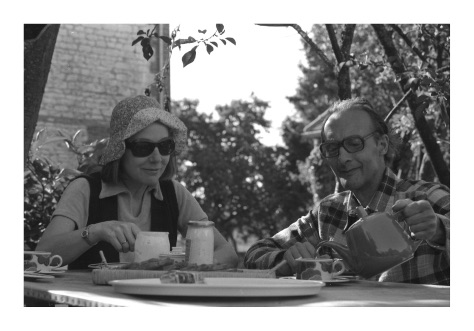
Andre Gorz and Dorine in Vosnon, France

Illich had it in for professional institutions of every kind, for what he called “disabling professions”; this is what interests me most in his work, this is what I’ve been trying to revisit, trying to recalibrate and reload, in our own professionalised times. I’ve been trying to affirm the nemesis of professionalism: amateurs. Illich said professionals incapacitate ordinary peoples’ ability to fend for themselves, to invent things, to lead innovative lives beyond the thrall of corporations and institutions. Yet Illich’s war against professionalism isn’t so much a celebration of self-survival (letting free market ideology rip) as genuine self-empowerment, a weaning people off their market-dependence. We’ve lost our ability to develop “convivial tools,” he says, been deprived of our use-value capacities, of values systems outside the production and consumption of commodities. We’ve gotten accustomed to living in a supermarket.

***

Illich’s thinking about professionalisation was partly inspired by Karl Polanyi’s magisterial analysis on the “political and economic origins of our time,” The Great Transformation (1944). Since the Stone Age, Polanyi says, markets followed society, developed organically as social relations developed organically, from barter and truck systems, to simple economies in which money was a means of exchange, a mere token of equivalent worth. Markets were always “embedded” (a key Polanyi word) in social relations, always located somewhere within the very fabric of society, whose institutional and political structure “regulated” what markets could and couldn’t do. Regulation and markets thus grew up together, came of age together. So “the emergence of the idea of self-regulation,” says Polanyi, “was a complete reversal of this trend of development … the change from regulated to self-regulated markets at the end of the 18th century represented a complete transformation in the structure of society.”

We’re still coming to terms with this complete transformation, a transformation that, towards the end of the 20th century, has made the “disembedded” economy seem perfectly natural, perfectly normal, something transhistorical, something that always was, right? It’s also a perfectly functioning economy, as economic pundits now like to insist. Entering the 1990s, this disembedded market system bore a new tagline, one that persists: “neoliberalism.” Polanyi’s logic is impeccable: a “market economy can exist only in a market society.”

Inherent vices nonetheless embed themselves in this disembedded economy. Land, labour and money become vital parts of our economic system, of our speculative hunger games. But, says Polanyi, land, labour and money “are obviously not commodities” (his emphasis). “Land is only another name for nature, which is not produced by man,” he says; “labour is only another name for human activity which goes with life itself”; “actual money … is merely a token of purchasing power which, as a rule, is not produced at all, but comes into being through the mechanism of banking or state finance.” Thus “the commodity description of labour, land and money is entirely fictitious,” a commodity fiction, the fiction of commodities.

Still, we live in fictitious times (as filmmaker Michael Moore was wont to say): land, labour and money as commodities provide us with the vital organising principle of our whole society. So fiction remains the truth, and fictitious truth needs defending, needs perpetuating; the postulate must be forcibly yet legitimately kept in place. But kept in place how, and by whom? By, we might say, a whole professional administration, by a whole professional cadre, by a whole professional apparatus that both props up and prospers from these fictitious times. Professionalism is the new regulation of deregulation, the new management of mismanagement, an induced and imputed incapacitation.

And so a vast array of professional and specialist bodies, Illich says in Disabling Professions (Marion Boyars Publishers, 1977), “now dominate the creation, adjudication and implementation of needs.” “They are more deeply entrenched than a Byzantine bureaucracy,” he says, “more international than a world church, more stable than any labour union, endowed with wider competencies than any shaman, and equipped with a tighter hold over those they claim as victims than any mafia.” Expert managers and specialist middle-managers step up to the plate to bat at all levels of government; ditto health systems; ditto educational policy; ditto the business of science, its R&D, its scientific patents and intellectual property rights.

Unaccountable agents head up the upper-echelons the Ministry of Finance and its regime of Accountancy Governance; elite technocrats and cabinet plutocrats, economists and accountants, consultants and advisors, think-tanks and for-profit public agencies now offer not-so-laissez-faire encouragement to self-regulating market intensity; it is these actors who try to maintain the functioning credibility and sustained viability of this fictitious commodity system, a reality of lies wherein economic crises are terribly truthful. Here the rule of experts might constitute a government for the people; but it ain’t ever going to constitute a government of the people. That’s why, insists Illich, our democratic prospects hinge on our ability to disable these disabling professions.

Illich’s hope against hope is for a “post-professional ethos” in which people recognise the professional emperor’s new clothes, that we’ve all been had, are still being had, that those guys are starkers and we should know it. Professionals need to be challenged by people power, by mass amateurism asserting its popular will, a will that also needs to be a collective political force. Out of this post-professional vision we might create new tools of conviviality, another kind of human sociability, a collective commons beyond monetary speculation, beyond professional mismanagement. And we might do it now. What might get affirmed aren’t only “use-values” but “vernacular values,” embedded economic activities, a new social imaginary.

Vernacular values are intuitive knowledges and practical know-how that structure everyday culture; they pivot not so much—as Gramsci says—on common sense as on “good sense”. They’re reasonable intuitions and intuitive reason: words, habits and understandings that inform real social life—the real social life of a non-expert population. Illich reminds us that “vernacular” stems from the Latin vernaculam, meaning “homebred” or “homegrown,” something “homemade.” (We’re not far from the notion of amateur here.) Vernacular is a mode of life and language below the radar of exchange-value; vernacular language is language acquired without a paid teacher; loose, unruly language, heard as opposed to written down. (“Eartalk,” Joyce called it in Finnegans Wake, a language for the “earsighted.”) To assert vernacular values is, accordingly, to assert democratic values, to assert its means through popular participation.

***

Illich harks a paean to citizenly action, to a shadow citizenry trying to outflank a shadow ruling class, even trying to outflank “Shadow Work,” as he calls it, recognising how much of what we see as “informal” and “unproductive” labour (revolving around reproduction) could underwrite a more radicalised ideal of subsistence; a “style of life,” Illich says, in which people have reduced their market dependence. They’ve done so “by protecting—by political means—a social infrastructure in which tools are used primarily to generate use-values that are unmeasured and unmeasurable by professional need-makers.” Excessive wealth and prolonged formal employment form part and parcel of the same problem; they must be overcome, negated. We work longer and longer merely to pay off our debts, to afford more and more commodities we’re told we need, can’t live without. Such is “impoverished wealth,” Illich says, a wealth too rare to be shared and too destructive of the liberty of those who have none; a double whammy of poverty on each flank.

One of Illich’s most militant battle cries is something he called the right to useful unemployment. It was a counterfactual plea, going against the flow of a Left in the 1970s who was still championing full employment. André Gorz, for one, was convinced by this plea, becoming its ablest and most vocal disciple. In the 1980s, bidding “farewell to the working class,” he said it was “no longer a question of winning power as a worker, but of winning the power no longer to function as a worker.” It’s not that the working class is an entirely dead species, says Gorz, reiterating Illich’s ideas; it’s more that it has been displaced, acquiring “a more radical form in a new social arena.”

What Gorz calls a “non-class” has an “added advantage over Marx’s working class”, because, he says, it’s “immediately conscious of itself”: “This non-class encompasses all those who have been expelled from production by the abolition of work, or whose capacities are under-employed as a result of industrialisation … It includes all the supernumeraries of present-day social production, who are potentially or actually unemployed, whether permanently or temporarily, partially or completely. It results from the decomposition of the old society based upon the dignity, value, social utility and desirability of work.”

Illich chips in to add how professionals peddle the privileges and status of the job: they adjudicate its worthiness and rank, while forever tut-tutting those without work. Unemployment “means sad idleness, rather than the freedom to do things that are useful for oneself or for one’s neighbour”. “What counts,” Illich says, “isn’t the effort to please or the pleasure that flows from that effort but the coupling of the labour force with capital. What counts isn’t the achievement of satisfaction that flows from action but the status of the social relationship that commands production—that is, the job, situation, post, or appointment.”

Effort isn’t productive unless it’s done at the behest of some boss; economists can’t deal with a usefulness of people outside of the corporation, outside of stock value, of shareholder dividend, of cost-benefit. Work is only ever productive when its process is controlled, when it is planned and monitored by professional agents, by managers and the managers of managers. Can we ever imagine unemployment as useful, as the basis for autonomous activity, as meaningful social or even political activity?

The utopian element is unashamed. It’s a wish-image of the future that rarely gets a look in anymore. Can we envisage a world in which time isn’t squandered as mindless working time? Work for most people usually means time spent doing something that has absolutely no meaning for the doer: an alienated activity, with an alienated product (if there is a product), controlled by an alienating organisation, all conspiring to shape an alienated self. Many 20- and 30-somethings are now learning how to reevaluate their “career” choices, as well as the whole notion of career itself, because they’re smart enough to know that they might not have anything deemed “a career” anymore. In fact, there’s a whole generation of college educated 20-somethings who know they’ll never work a “proper” salaried job. Neither are they turned on by temping or interning. They know they can never count on a pension or any “right to work.”

Perhaps, during crises, we can hatch alternative programmes for survival, other methods through which we can not so much “earn a living” as live a living. Perhaps we can self-downsize, as Illich suggests, and address the paradox of work that goes back at least to Max Weber: work is revered in our culture, yet at the same time workers are becoming superfluous; you hate your job, your boss, hate the servility of what you do, and how you do it, the pettiness of the tasks involved, yet want to keep your job at all costs. You see no other way of defining yourself other than through work, other than what you do for a living. Perhaps there’s a point at which we can all be pushed over the edge, voluntarily take the jump ourselves, only to discover other aspects of ourselves, other ways to fill in the hole, to make a little money, to maintain our dignity and pride, and to survive off what Gorz calls a “frugal abundance.”

Perhaps it’s time to get politicised around non-work and undercut the professionalisation of work and life. In opting out, or at least contesting from within, perhaps we can create a bit of havoc, refuse to work as we’re told, and turn confrontation into a more positive device, a will to struggle for another kind of work, where use-value outbids exchange-value, where amateurs prevail over professionals. If, in times of austerity, capitalists can do without workers, then it’s high time workers (and ex-workers) realise that we can do without capitalists, without their professional hacks, and their professional institutions, that we can devise work without them, a work for ourselves. Illich throws down the gauntlet here, challenges us to conceive another de-professionalised, vernacular non-working future. He certainly gets you thinking, has had me thinking, and rethinking, more than a decade after I’ve had any kind of job.

Note

[1] Gorz and Illich bonded personally as well as politically: born in the same region of the world, in the same era, without neither identity nor nationality, they hailed from nowhere and everywhere. Gorz first met Illich in Paris in 1973, after being impressed by Illich’s manuscript, “Retooling Society” (appearing in print as Tools for Conviviality [Marion Boyars Publishers, 1973]). Gorz and his love supreme, Dorine, the longstanding English wife he immortalised in Letter to D., went to Cuernavaca the following year. The visit coincided with the publication of Illich’s book, Medical Nemesis (Marion Boyars Publishers, 1974), and with Dorine herself being diagnosed as having arachnoiditis, an incurable degenerative disease. As Gorz wrote in Letter to D., “we had no inkling that the critique of techno-medicine was soon to coincide with our personal concerns”. They revisited Illich a second time in 1976, coinciding with a trip to California to see Herbert Marcuse. In September 2007, the 84-year-old Gorz and terminally ill Dorine ended their days together in a joint-suicide pact.

Posted in All blogs | Tagged , , , , , , , , , | 1 Comment

The World of Secret Affinities: Remembering Isaac Babel and Walter Benjamin

A version of this essay was previously published in August 2003 in The Brooklyn Rail

1940 was a terrible year for freethinking intellectuals. As Stalin and Hitler’s pincers tightened, a bullet and a morphine overdose saw off two of the twentieth century’s most fertile and imaginative brains: Isaac Babel and Walter Benjamin. Both left plenty of unfinished business. “They didn’t let me finish,” Babel said one dark night in May 1939, when Stalin’s henchmen took him away. As the secret police ransacked his villa, confiscating the pile of manuscripts of his work in progress— “New Stories”—Babel, his wife Antonina Pirozhkova recounts in her vivid memoir At His Side, “kissed me hard and said: ‘someday we’ll see each other…’” For years afterwards, Babel’s whereabouts were mooted. Was he alive? Which camp was he in? Could he still write? And those New Stories, where were they? Antonina never gave up hope until the mid-1950s when she guessed the awful truth.

image

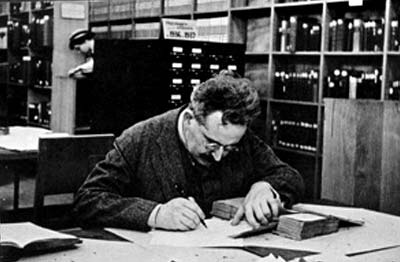
Benjamin at work in Paris’s Bibliothèque Nationale

Benjamin’s fate was similarly sealed. For a long while he’d been at work on his epic study of the Parisian arcades, research extending and developing his earlier set-pieces on Baudelaire and the flâneur, and Paris as “the capital of the nineteenth-century.” Paris’ “aura” had beguiled Benjamin ever since 1913, after a brief college trip. And as he busied himself there years later, scribbling away under the “painted sky of summer” in the Bibliothèque Nationale, the darkness of the Nazis steadily began to dim his reading light. Benjamin’s friends, especially Theodor Adorno and Gershom Scholem, pleaded for him to leave town, fast, before it was too late. He eventually got out in September 1940, fleeing south. With a U.S. entry visa in pocket, Benjamin made it down to the Pyrenees, to a Spanish border crossing. But after a catalogue of misfortunes and excruciatingly bad timing he was left stranded, his heart giving out, the frontier closed. He couldn’t go on, and O.D.’d on morphine on the evening of the 25th.

These deaths were truly tragic. Such relatively young men, so much left to do, their big brains destroyed by totalitarianism. Poignancy jars more than 60 years on, because we could almost imagine what might have been. We could perhaps visualize a happy ending, a lovely scene, in which Babel and Benjamin actually made it to daylight, are alive and safe, now old men in New York, enriching the city’s Jewish liberal culture.

New York had been on Benjamin’s mind on October 4th, 1938. He’d written Adorno, from Bertolt Brecht’s Danish retreat in Svendborg, of how he’d been studying the details of Manhattan’s streets on a map stuck to Stefan’s bedroom wall. “I walk up and down,” Benjamin told his comrade in New York, “the long street on the Hudson where your house is.” As for Babel, he was tormented by the idea of remaking himself as an émigré. He resisted the temptation in the 1930s, convinced that a writer “mutilates himself and his work by leaving his native country.” And yet, might he have always held out? Might Babel have fled as the rot set in the ’40s and ’50s? His first wife and daughter had already settled in Paris; his mother and sister in Brussels. Might Babel himself have emigrated, first to Europe, later on to the United States, maybe to New York?

image

Babel at work

In the 1920s, Benjamin was aware of Babel’s Red Cavalry stories. Nobody knows whether they ever met, despite Benjamin’s brief Moscow sojourn in early 1927 and Babel frequenting Berlin later that same year. But if they had met—in old age, in New York—what would they have talked about? They had a lot in common as younger men. Yet now, as worn thinkers, as short bespectacled men, with large paunches and hunched shoulders, one with a shock of disheveled white hair and mustache, the other bald and grinning, each walking unsteadily with a stick, what might be on their minds? Childhood? Passion for French literature? The task of the writer? Outsiderness? Politics and revolution? As a fall sun casts long shadows, two dream-like figures are seen shuffling through the leaves. It’s a crisp, cold afternoon in Central Park, with bright blue-sky overhead. Over the distant din of traffic, we can see their breath and hear the faint whisper of their voices.

“Remembrance is mysterious work, Herr Babel. Remembrance of one’s past; autobiography has a lot to do with time, with sequence, with what makes up the continuous flow of life. What I’m talking about is something different. What I’m talking about is space, about moments and discontinuities. In Berlin, I remember only moments and discontinuities, only spaces: montages, glimpses, motifs. As a child, a child of wealthy bourgeois parents, I needed and sought guides. I needed nursemaids, guides to the city’s wider expanses. You see I had a terrible sense of direction. I still do. I cannot fully orientate myself in New York, even after all these years. Instead of walking east, I go west. I can never tell what is uptown from what is downtown. I can’t make head nor tail of street numbers.

“Yes, Herr Babel, I remember street images, walking with my mother in Berlin, in our ‘theater of purchases.’ I always kept half a step behind her. My habit was intolerable to her. I walked with her in dreamy recalcitrance. On her I blame my inability in practical life. I was pampered, inept, solitary—couldn’t make a cup of coffee, still can’t. My ‘primal acquaintances’ were with streets and neighborhoods; with old Berlin houses. For a while I played with the idea of setting out my bios graphically on a map, no ordinary map. On it would be decisive benches in the Tiergarten, routes to different schools, cold grave stones, prestigious cafes long-gone but not forgotten, tennis courts where empty apartments blocks stand today, halls emblazoned with gold and stucco that the terrors of dancing classes made almost the equal of gymnasiums.

“That was my lived Berlin, my gateways to the city. So many entrances to this maze, so many staircases, scary staircases, with bad odors and bodies pressing so closely to mine, and classrooms nearby. On this map, too, would be all our houses. Like all wealthy families, we moved a lot—indeed every year. And there would also be Peacock Island. I remember Peacock Island as one of the first great disappointments of my life. There I didn’t find in the grass the peacock feathers I craved. I saw plenty of peacocks strutting up and down, but they couldn’t console me! I wanted peacock earth.”

“I, too, knew peacocks, Walter. But my great disappointment was doves. Once, I must have been about nine, I saw a peacock, with its shining tail, sat on a perch, like the sun in a damp autumn sky, moving its small impassive head this way and that. This was at the hunter’s market, and it was there that I bought a pair of cherry-colored doves from Ivan Nikodinych. I dreamed about doves with all the power of my soul; and then, one afternoon in 1905, after I’d finally bought them, Makarenko the cripple, smashed the doves on my temple.

“No one in the world, Walter, feels new things more intensely than children. My father promised to give me money to buy doves if I’d gain entry into the preparatory school in Nikolayev. The town is now a district of Odessa. Out of forty boys, only two Jews could enter. I had an aptitude for learning so I eventually got in. Being small of stature and puny, I was bookish and nervous and suffered headaches. Too much study. I was a dreamer. Just like you, my friend.

“Walking along the street did not seem to me an idle occupation. As I walked, I had good dreams, and everything, everything was native and familiar. Isn’t this what you mean by ‘primal acquaintance,’ Walter? I knew the signboards, the stones of the houses, the windows of the shops. To this day I remember the atmosphere; I feel it, and love it. I still feel the scent of my mother, the scent of her kindness, her words and smile. I love it because in it I grew, was happy and sad and dreamy, passionately and uniquely dreamy.

“Many Sabbath afternoons I spent with my grandmother. I dragged my books, my music stand and my dreaded violin. ‘Study Isaac,’ my grandmother always insisted, ‘study and you will attain everything—wealth and fame. You must know everything,’ she used to say. But one thing I couldn’t get, nor would ever know, was the violin. Even Zagursky couldn’t help me. The sounds crawled out of my violin like iron fillings! During practice I placed Turgenev or Dumas on the music stand, devouring page after page. Sometimes I’d skip practice altogether, elope down to Prakticheskaya Harbor. There my liberation began. The heavy waves by the sea wall distanced me further and further from our house. The wisdom of my grandfathers sat in my head: we are born for the pleasure of work, fighting, and love; we are born for that and nothing else! I needed to run outside to fresh air, to freedom. But I had no strength to raise my drooping head.”

“Oh yes, when I think of freedom and a drooping head, Babel, I think only of Paris. It spoke to the wanderer like a twig snapping under his feet in a forest. Paris taught me the art of straying, fulfilling my dreams, losing myself, answering uneasy expectations, surpassing graphic fantasies. It disclosed itself to me in the footsteps of a hermetic tradition. I can’t think of the Metro opening its hundreds of shafts all over the city without recalling my endless flâneries. Signboards and street names, passers-by, roofs, kiosks and bars, walls and quays, railings and squares, arcades— all immerse the solitary walker in the world of things, in the depths of a sleep in which the dream image wants to show the people their true faces. What kind of regimen cities keep over our imagination!”

“How true, Walter, my friend. It was in St. Petersburg, in the winter of 1916, on a forged passport, without a copeck, that I said to myself: better to go hungry, to go to prison, to be a tramp, than to sit at an office desk 10 hours a day. There is no particular daring in this vow, but I have not broken it and never will. I waited and waited for an exit visa in Kiev. But before I knew it the Nevsky Prospect flowed in the distance like the Milky Way.

“I remember a frozen yellow, foul-smelling street where I first found shelter. Soon I began to eke out a meager living doing translations, from French literature. I remember Maupassant, and the ravishing dark beauty with pink eyes, Raisa Mikhaylovna. ‘Maupassant is the only passion of my life,’ she once told me as we gulped Muscatel ’83. Alas, in her translations nothing remained of Maupassant’s phrasing—his free, flowing style with its long breathing of passion. I told her about style. No iron, I said, can enter the human heart as chillingly as a full stop placed at the right time. I left at eleven before her husband returned. I was sober and could have walked the chalk-line, but it was pleasanter to stagger, so I swayed from side to side, singing in a language I had just invented.

“After each of my stories, I feel several years older, Walter. Don’t talk to me about creative work à la Mozart, about the blissful time spent over a manuscript, about the free flow of imagination. When I’m writing the shortest story, I still have to work at it as if I were required to dig up Mount Everest all by myself with a pick and shovel. My language becomes clear and strong not when I can no longer add a sentence, but only when I can no longer take away from it.”

“For me, Babel, good prose has three steps: a musical stage when it is composed, an architectonic one when it is built, and a textile one when it is woven. But the more circumspectly you delay writing down an idea, the more maturely developed it will be on surrendering itself. Speech conquers thought, but writing commands it. On the other hand, I never stop writing because I have run out of ideas. I never let a thought pass incognito. I keep my notebook as strictly as the authorities keep their register of aliens!”

“When I write down the first version of a story, it’s a conglomeration of bits joined together by the dreariest connecting links. A clumsy prattle. Absolutely horrible! Slowly, Walter, I throw out the useless words. It’s this sort of pruning, my friend, which brings out the independent force of language and style. The struggle doesn’t need many words. But those words must be good words. As to trite, vulgar, commonplace, contrived clichés—we are very tired of them.”

“Ah, Herr Babel, you remind me of our old journal, Angelus Novus, named after Paul Klee’s painting, and our hopes. Ah, those hopes! Hopes I still have. And the words! Our struggle, our words, our style, sought to articulate the experience of free thinking and criticism, unpredictable and unconscious thinking; thinking and words that held greater promise for the future and are capable of much greater development. We, too, avoided vulgar, commonplace, contrived clichés. Golden fruits in silver bowls we never expected.”

“The style of our period must be characterized by courage and restraint, by fire, passion, strength and joy. And merriment, dear Walter! We must have a new style. In the old days, you know, we were given everything. The Party, the government, they gave us everything, depriving us only of one privilege—that of writing badly! This is a very important privilege for the writer. It was taken away from us and we took full advantage of it. We must renounce that old privilege.”

“Somehow it is right that a writer stands alone. He must be a malcontent, not a leader. Not a pioneer, but a spoilsport, Babel. If we wish to gain a clear picture of the writer in the isolation of his trade, what we see is rag-picker at daybreak, picking up rags of speech and verbal scraps with his stick, and tossing them, grumbling and growling, a little drunk, into his cart. I was a rag-picker at the dawn of the day of revolution.”

“I recall my rag-picker’s cart, and the revolution, and me riding with the Cossacks to Witków, so long ago now. It’s painful to think. The whole business deprived me of my tea! On my cart, I grieved for the future of the revolution. I was a city boy, short and bespectacled, intellectual, a war correspondent, riding on horseback for the first time. They called me ‘four-eyes,’ hated me because I wanted to live ‘without enemies.’ The Cossacks reviled the intelligentsia; you’ve read Gogol’s Taras Bulba haven’t you? They wanted to massacre professors and writers and Jews. I was an outsider. Shrieks, whips cracking, shouts of ‘dirty Yid.’ ‘Ah, so you’re a milksop are you,’ they’d say, ‘with glasses on your nose.’ They killed men with glasses.”

“’Tis true that the work of the melancholic is the total immersion of the eternal voyager. Long ago no one wanted me—Walter Benjamin—in the academy. They didn’t get my Trauerspiel, couldn’t figure it out for the life of them. And the publishers didn’t want any of my own stuff. So many promises! For a pittance, I translated Proust and Balzac, and Baudelaire. The money wasn’t worth the time I had to spend on them. But how can I be bitter? I thought of getting involved with Marxist politics, joining the Party, going to Moscow. We might have met then, eh? I wanted to study Hebrew. I could attain a view of the totality of my horizon only in these two experiences.”

“Oh, those Rules of the Russian Communist Party! If you only knew, Walter. The whole Party wore aprons that are smeared with blood and shit. With confused poet’s brains, I tried to digest the class struggle—and the pages of the Song of Songs and revolver cartridges.”

“You sound just like old Brecht, Babel. ‘Crude thoughts,’ he’d say, ‘should be part and parcel of dialectical thinking, because they are nothing but the referral of theory to practice. A thought must be crude to come into its own in action.’ Gershom never liked my involvement with Brecht. Nor did Teddie. But my agreement with Brecht was one of most important and most strategic points in my entire position. Both you and Brecht, Babel, have a lot of the poet and the gangster in you!”

“Aha, our Odessan gangsters wore masks and carried revolvers. They had the soul of murderers. They were one of us. They came from us. They were our blood, our flesh. Half of Odessa worked in their shops. Gangsters rolled about the floor and choked with laughter, full-throated laughter: ‘shut your ugly mug,’ they’d roar.”

“Indeed, but how can dialectical materialism spin that vulgar materialism into such fine thread that even strange birds such as you and I, Babel, are caught in it? I don’t know. But I think sometimes that the ‘four gray women’ of Faust II are weavers who also get the coarsest flax to be fine spun. I see in myself not a representative of dialectical materialism as dogma, but a scholar to whom the stance of the materialist seems scientifically and humanly more productive. Though I haven’t been able to do research and think in any sense other than a theological one: in accord with the Talmudic teaching about the 49 levels of meaning in every passage of the Torah.”

“In our socialism, the possessed of devils, the liars, the moonstruck, and destitute sages sat next to each other. Oh, Walter, dense sadness of memories! Who would tell Gedali today where is the revolution and where is the counter-revolution? Yes, I cry to the revolution. Yes, I cry to it, but it hides its face from Gedali, and from me. It sends ahead of it naught but shooting. The sun does not enter eyes that are closed. But shall we rip open those closed eyes? Gedali says the revolution is about pleasure. It is the good deed of good men and women—an unrealizable revolution? I, too, want the International—a Fifth International—of good men and women. I want each soul to be taken and registered, and given first-grade rations. Woe to us, Walter, where is the joy-giving revolution?”

“Gedali is our angel of history. His face is turned toward the past. Where we perceive a chain of events, he sees one single catastrophe that keeps piling wreckage upon wreckage and hurls it in front of his feet. Gedali, our angel, would like to stay, awaken the dead, and make whole what has been smashed. But a storm is blowing from Paradise; it has got caught in his wings with such violence that our angel can no longer close them. This storm irresistibly propels him into the future to which his back is turned, while the pile of debris before him grows skyward. This storm, Isaac, is what we call progress.”

“Let’s die for progress, my old German friend. Let’s die for a pickled cucumber and the revolution…”

Two old men reach the park-gate. They can be seen embracing, out on Central Park West, slapping each other on the back, ready to depart their separate ways. They both walk off, slowly, in opposite directions, along the shady side of the street. Soon they disappear in the shadow of the El Dorado whose tan façade seems to quiver in the frosty air.

What remains are their remains: books, short stories, essays, snippets and jottings, radio broadcasts, letters, diaries, reviews, fragments. They themselves are gone forever, their lives closed. But their oeuvre is open, bursting with energy and passion. Babel loved life, reveled in telling stories, marveled at commonplace everydayness. His picaresque tales brim with detail and drama, and are alive with the minor characters that make up major history. He dug adventure and played hard. Benjamin likewise loved life, but with a dark, melancholic undertow. He adored Paris, paced its streets, lapped up its café society, chronicled it close up yet always as an outsider. He loved kids and toys, haunted library stacks, yearned for literary recognition, but never got it in his lifetime. Seventy years on, with glasses on their noses and autumn in their hearts, Benjamin and Babel continue to inspire free-spirited, independent intellectuals everywhere.

*Note: The body of this essay presents a fictitious dialogue between Walter Benjamin and Isaac Babel. I’ve used almost exclusively their own words. Only on rare occasions have I paraphrased, tweaking their language slightly, for rhetorical purposes. Inspiration for the piece comes from Benjamin himself, who, remember, wanted to produce a work consisting entirely of quotations.

Posted in All, Previously Published | Leave a comment

James Joyce’s Lifewand

A version of this article was previously published in December 2013 at the antipode foundation

By Andy Merrifield

“He lifts the lifewand and the dumb speak” – James Joyce

One of the great humanist visions of James Joyce’s Finnegans Wake is the sigla HCE, coined after its fifty-something anti-hero, Dublin innkeeper Humphrey Chimpden Earwicker. Joyce homes in on a Saturday evening, on a single night’s sleep, after a whole day’s drinking, during a thunderstorm when Earwicker tosses over the previous day’s events and the whole of his life hitherto. His is the “patternmind,” Joyce says, the dream of a man dreaming a dream of the world. HCE are the “normative letters” of what Joyce calls “Here Comes Everybody,” a “manyfeast munificent,” an archetypal image of our collective, desiring unconscious. Yet this dreamer is “more mob than man,”“an imposing everybody he always indeed looked constantly the same as and equal to himself and magnificently well worthy of any and all such universalization.”

The puns and portmanteaus of Finnegans Wake, its roguish drolleries and comic lampoons, its decentered way of seeing reality, always seem closer to the truth of the world for me. Finnegans Wake always intrigues me more than Ulysses, which is a more grounded book, the tale of a specific city (Dublin) on a specific day, with specific dramatis persona—the Blooms and the Dedaluses—who all appear as themselves and only as themselves, in wide-awake daytime. Finnegans Wake supplies no “objective” frame of reference, and offers only subjective distortions and contortions, liquefactions and refractions, things nearer to the diffusive and expansive “patternmind” of capitalist reality.

image

Finnegans Wake draft

Not that Finnegans Wake doesn’t have structuring. If Ulysses adopts Homeric punctuation, Finnegans Wake’s four-part ring cycle takes Vico to heart, Giambattista Vico, the eighteenth-century humanist author of New Science. Joyce borrowed Vico’s “poetic wisdom,” the belief that humans alone create the world, create one another into the facts of society. The other Vico idea, flagging out Finnegans Wake’s basic building block, is that civilizations pass through cycles, distinctive phases.

In the deep past, deities conditioned our life, watched over us, dissed us, held the key to our collective destiny. Later came a heroic phase, with faith not so much in gods as in heroic myths, myths about Caesar and Napoleon, about indomitable master-builders like Stalin, like Baron Haussmann, like Le Corbusier, like Robert Moses, etc. Finnegans Wake is full of jests about master-builders, full of allusions to Ibsen’s Master-Builder (Ibsen was the adolescent Joyce’s own cult hero). Ibsen’s Master-Builder reveals the frailty of the builder’s ego, his fear of falling, his mania to uphold supernatural powers, including sexual powers.

Vico was never a believer in progress; he didn’t conceive each cycle as advancement, as improvement in the human lot. Like Spengler, Vico’s line is cultural pessimism, the inevitability of decline: each reoccurring cycle doesn’t so much shine light as darken the sky; a foreboding beckons, a moral breakdown. History twists back on itself: each positive corso slips back into a barbaric ricorso, into a ruse of reason, into the terror of technocracy.

One time, not so long ago, we had god-like managers who acted as good social democrats, during the good old days of the public sector when administrative deities seemed to care about real people and gave the poor a break. We might label this divine phase the managerialist cycle, which seemed to crumble in the mid-1970s. Then we heard a thunderclap that foretold of a new period, a heroic cycle of mythical entrepreneurs, the 1980s, when public managers gave way to private moguls, to new myths about fearless people who innovate in our economy, to people who speculate and cogitate on the power of money, on its spectacular prowess.

Yet just when it seemed this heroic phase was set in stone, was holy writ, we began to witness it crack and crumble; we began to recognize that mythic entrepreneurial heroes of the stock market and private sector were only human after all, all-too-human, terribly human. Soon another cycle opened up, and another thunderclap was heard throughout our land; a cycle we’re living through right now, one in which “collisions with men” mean “collusions with money” and humans prey off one another, the epoch of the 1%, the parasitic era.

Parasites now chomp away at the common-wealth the world over. They eat away inside the social body, stripping peoples’ assets, foreclosing homes, dispossessing value rather than contributing anything towards its creation. Social wealth is consumed through conspicuously wasteful enterprises, administered by parasitic elites, our very own neo-aristocracy, who squander generative capacity by thriving exclusively from unproductive activities: they roll dice on the stock market, profit from unequal exchanges, guzzle at the public trough, filch rents from property and housing, gouge fees from ordinary people—mysterious, made-up fees, fees for utilities, for using ATMs, for borrowing money, for online transactions.

Vico’s pessimism seemingly wins out; the promise of our progressive all-too-human phase after gods and heroes isn’t so progressive after all. It’s one great big depressing lie thrown back in our faces. Those in control of society and the economy, and politics, summon up the dark forces of persuasion and fear, of fundamentalism and free-marketeerism, of theology and austerity, to command the bodies and souls of us all.

And yet, and yet… just when all seems lost, Joyce veers from Vico. When thunder strikes, it terrifies us; a screaming comes across the sky. We scurry for cover. Sometimes it terrifies us so much we seek the support and comfort of other people. Somehow the cycles of Finnegans Wake take us onwards, forwards towards progression not regression. Earwicker’s night sweats are shrugged off by morning; his inner demons have been overcome, his soul resurrected, refreshed and brought back to ordinary life, in broad daylight. After the tumult and turbidity of Saturday night, comes the peace of Sunday morning.

And so, for Joyce, the promise of this human phase is the promise of Here Comes Everybody, an enlarged democratic vista; a vaster, more inclusive form of humanity; an affirmation and exaltation, an act of integration—not disintegration. Here Comes Everybody is an opening up to the future not a narrowing of the present; if Braudel rightly saw financialization as a “sign of autumn,” as a cycle of decline and decay, then spring will always come around again for Joyce, replenishing those fallen leaves in a “commodious vicus of recirculation.” Finnegans Wake is a tragicomedy with a happy undertow, a chaosmos with a democratic ordering, a basking in a “panaroma of all flores of speech.”

Before us and inside us is a truly cosmopolitan world culture, our Here Comes Everybody. Here Comes Everybody is what global citizenship ought to be about—hence the “normative letters,” HCE—a citizenship that’s territorial yet one in which territoriality is narrower and broader than both “city” and “nationality”; a citizen of the block, of the neighborhood, becomes a citizen of the world, a universal citizen rooted in place, encountering fellow citizens across the corridor and at the other end of the planet, sharing world music together, reading books in every language, watching world cinema, entering Twitter streams and communing on Facebook. For good reason did Joyce offer of a variant on his Here Comes Everybody thesis: Here Comes Everybuddy, a wink to Facebook users everywhere.

World literature has morphed into world culture, and this world culture is now an arena in which a more advanced cosmopolitan citizenship emerges—might emerge—a Here Comes Everybody forever present at its own birth pangs. Or almost everybody, a 99% of everybody. In this citizenship perception replaces passport and horizon is almost as important as habitat; a perception and horizon simultaneously in place and in space, off-line somewhere local, and online somewhere planetary, somewhere virtual. It is a space, in other words, in which Everybody meets Everybuddy, staving off Everybully (as Joyce cautions), a passionate embrace between bodies and buddies.

It’s a dream space in which there’s reconciliation between Earwicker and Ann—a.k.a. Anna Livia Plurabelle (ALP), the “bringer of plurabilities,” the wife and mother of Earwicker’s twins, Jerry (Shem) and Kevin (Shaun), and daughter Isobel (Izzy). ALP’s presence flows through Finnegans Wake like Dublin’s Liffey River opening up the sea, like Paris’s Seine creating Being, washing away the grime of life. Both the Liffey and the Seine gush through Anna like a river of blood, like healing waters, like the ebb of death and the flow of renewed life. The “Sein annews,” Joyce says: it’s the sinew and core of his and HCE-ALP’s very Being, their “Sein.” (Sein is the German verb “to be.”) Meanwhile, the Seine “anews,” is eternally reoccurring and constantly renewing, forever bridging the past and the future, like in Anna Livia’s beautiful closing elegy, expressing cleansing waters and the healing powers of reunification, of a rising up to a new level:

“Soft morning, city! … No wind no word. Only a leaf, just a leaf and then leaves. The woods are fond always. As were we their babes in. And robins in crews so. It is for me goolden wending. Unless? Away! Rise up, man of the hooths, you have slept so long! Or is it only so mesleems? On your pondered palm. Reclined from cape to pede. With pipe on bowl. Terce for a fiddler, sixt for makmerriers, none for a Cole. Rise up now and aruse!” 

What does this HCE-ALP alliance rise up towards? Collisions of men and women don’t, Joyce implies, necessarily have to be “collusions with money,” nor even collusions with oppression and sexism. They can also express complex collideorscapes, that magnificently suggestive concept from Finnegans Wake: “what would that fargazer seem to seemself to seem seeming of, dimm it all? Answer: A collideorscape!”

Joyce’s fargazing saw one great big kaleidoscope, a collision of people, people encountering other people, a coincidence of opposites, the coexistence of unity within disunity, a human kaleidoscope in which each separate image, each separate mix, changes with each respective shake. Human patterns and colorations depend upon how things come together, how coincidences take hold, how they congeal to form other realities, other ways of seeing and acting. Something new here is disclosed. Perhaps above all else, the collideorscape is a “collision” or “escape,” a collision and an escape, a dialectics of liberation, a thesis and antithesis creating new synthesis. Joyce hatches his Great Escape here, his Great Escape from language, and our Great Escape from the dominant order.

Indeed, the Joycean collideorscape amounts to nothing less than the contingent creation of a new political movement, one struggling to impose its singularity as a mass democratic movement, one building democracy through the scattered shards of social movements the world over. Therein each scattered shard bonds and reinforces the other, forms a new patternmind of an offensive front and rearguard defense. Efficacy will likely be predicated on how protagonists organize themselves internally yet coordinate themselves externally, reach out to one another to create a broader, more inclusive constellation of dissent, coexisting horizontally and democratically, overground and underground. The ensuing collideorscape refracts fresh light on things, creates a new political aura, a different shape and sound to social reality. This is what Here Comes Everybody has to be about, can be about. An intersection. The lifewand in which the dumb speak.

Posted in All blogs, Previously Published | Tagged , , , | Leave a comment

Urban Questions: Personal and Political Interrogations

In 1977, when Manuel Castells’ classic book, The Urban Question, was first put into English, I’d been a year out of high school, in Liverpool. It was five years after its original French publication, four years since an OPEC oil embargo had sent advanced economies into giddy noise dives, and a year on from the Sex Pistols’ debut hit, Anarchy in the UK. These were heady times, the 1970s, full of crises and chaos, a post-1968 era of psychological alienation and economic annihilation, of Punk Rock and Disco, of Blue Mondays and Saturday Night Fever. The decade was also a great testing ground for a book bearing the subtitle, A Marxist Approach. Indeed, the same year as The Urban Question: A Marxist Approach became available to Anglophone audiences, the Sex Pistols were screaming, “THERE’S NO FUTURE, NO FUTURE FOR YOU AND ME!”

I didn’t know The Urban Question back then, nor much about Marxism; I was eighteen, hardly read anything, and remember most of all the candlelit doom of Callaghan’s “Winter of Discontent.” Power cuts, strikes and piled up rubbish seemed the social order of the day. And the Sex Pistols’ mantra of NO FUTURE seemed bang on for my own personal manifesto of the day. I became, largely without knowing it, something of a fuck-you anarchist, not really knowing what to do, apart from destroy—usually myself: “what’s the point?” Johnny Rotten had asked. I didn’t see any point. The decade was dramatized by sense of lost innocence. I watched my adolescence dissipate into damp Liverpool air, into a monotone gray upon gray.

It was only in the early 1980s that I first learned to read and write to survive. By then, Margaret Thatcher was Prime Minister and I’d discovered something never encouraged at school: I loved to write, loved to write about things I’d read, about things I’d done, people I’d met. Before long, I’d gained access to the local Polytechnic as a “mature student,” as a second-chance scholar, as a scholar-with-attitude. That as the Thatcherite project was in full flight dismantling welfare statism; multiple levels of local and national government felt Thatcher’s “free market” heat, got abolished, abused, and recalibrated to suit the whims of an ascendant private sector.

This posed some pretty tough intellectual and political questions for my friends and I at Liverpool Polytechnic, as we passed our time wondering how to intellectually fill the post-punk void. We hated the bourgeois state with serious venom. We wanted to smash it, rid ourselves of its oppressive sway. So when Thatcher started to do just that, we were left wondering where to turn? Did we want that nanny state back? Life had been boring and programmed with it, but maybe things were going to be much worse without it?

In retrospect, 1984 seems a watershed, the significant year of contamination: Ronald Reagan had begun his second term and the Iron Lady had survived the Brighton Bombing; the IRA’s attempt to finish Thatcher off had the perverse effect of only setting her more solidly on her way, propelling her full-kilter into dismantling the post-war social contract between capital and labor, taking on (and taking out) organized labor and organized opposition in the process; Arthur Scargill and the miners, as well as Militant in Liverpool, took it full on the chin.

imageIt was then that I discovered Castells’ The Urban Question. The major thing that immediately struck me, I remember, was its cover: Paul Klee’s Blue Night. Only recently—very recently in fact, this past January at a London Tate Modern Klee retrospect—did I eventually see for myself Klee’s enigmatic canvas, from 1937, one of his last, an unusually expansive (50X76cm) work in an oeuvre characterized by intricacy and smallness. For a long while Blue Night was one of my favorite paintings. I’d always wondered whose choice it had been to have it adorn a book about Marxism and the city? Castells’ own? I still don’t know. The other thing that intrigued me about The Urban Question was its heavy Althusserian Marxism. I’d borrowed Louis Althusser’s For Marx from the Poly library, trying to figure out what was going on. Little made sense initially. Only a lot later did I recognize how Castells mobilized in original and idiosyncratic ways twin pillars of Althusserian formalism: ideology and reproduction.

Unlike Althusser, this was Althusserian formalism applied to the real world, to the conflictual urban condition of the 1970s, to the fraught decade when capitalism attempted to shrug off the specter of post-war breakdown, the decade when I attempted to shrug off my own crisis, a coming of age in an age not worth coming of age in. Moreover, although this urban system was declining, was in evident trouble everywhere, collapsing entirely it wasn’t. Castells wanted to know why. “Any child knows,” Althusser had said in his famous essay “Ideology and Ideological State Apparatuses,” “that a social formation which did not reproduce the conditions of production at the same time as it produced would not last a year.” The citation, a paraphrase of Marx, in a letter to Dr. Kugelmann (July 11, 1868), summed up the whole point of Volume Two of Capital: without reproduction there could be no production; without the realization of surplus-value, no fresh surplus value could ever get produced; production is predicated on extended and expanded reproduction. And yet, given inevitable ruptures in the “normal” functioning of capitalist production, how come capitalism survived then, still survives?

Althusser actually passed over all the stuff about reproduction of capitalist relations of production from Volume Two of Capital, passed over those political-economic “reproduction schemas” that Marx conceptualizes, and beds his vision down in the ideological reproduction of labor-power, in his own particular notion of ideology: “an imaginary representation of an individual’s real conditions of existence.” Consequently, in The Urban Question, Castells attacked urban studies precisely because of its ideological content. Erstwhile research on “the city,” he’d said, had formulated “imaginary representations,” framing the city in terms of “urban culture,” in narrow sociological and anthropological terms. Such approaches focus on “dimensions of the city,” on “densities,” on “size,” on the idea that the city exhibits a particular specificity, its own of organization and transformation; a logic which, Castells said, pays scant attention to broader dynamics of capitalist political-economic and social relations, particularly to their reproduction.

So in The Urban Question Castells said the urban isn’t really a unit of production at all; production operates at a bigger scale, at least on a regional scale and increasingly international stage. Production isn’t the right analytical entry point into the urban question. Rather, it is, à la Althusser, reproduction that counts most, the reproduction of the urban system and its links to the overall survival of capitalism. The urban, Castells insisted, typically awkwardly, is “a specific articulation of the instances of the social structure within a spatial unit of the reproduction of labor-power.”

From the mid-1970s onwards, around the time the Sex Pistols announced “NO FUTURE,” Castells began to define and refine his notion of the urban as the spatial unit of social reproduction by coining the concept “collective consumption.” Collective consumption is implicit in the reproduction of “unproductive” collective goods and services outside of the wage-relation, outside of variable capital, items like public housing and infrastructure, schools and hospitals and collectively consumed services. “The essential problems regarded as urban are,” Castells said, “in fact bound up with the processes of ‘collective consumption’… That is to say, means of consumption objectively socialized, which, for specific historical reasons, are essentially dependent for their production, distribution and administration on the intervention of the state.”

And yet, what arose over the decade was an awkward predicament for progressive people, and for Marxist theoreticians: items of collective consumption so vital for reproduction of the relations of production, so vital for freeing up “bottlenecks” in the system, so vital for providing necessary (yet unprofitable) goods and services, so indispensable for propping up demand in the economy—were now being cast aside. How could this be? What once appeared essential ingredients for capitalism’s continued reproduction—for its long term survival—now turned out to be only contingent after all; the state began desisting from coughing up money for them; and soon, as the 1980s kicked in, would actively and ideologically wage war against them.

The Left has never really come to terms with the shock waves this earthquake engendered; the seismic tremor that registered big digits on the neoliberal Richter Scale. The 1980s bid adieu to social democratic reformism, to an age when the public sector was the solution and the private sector the problem. The former now needed negating, pundits and ideologues maintained, required replacement by its antithesis; now the private sector was the solution and a shot and bloated public sector the problem. Managerial urbanization—when state bureaucrats dished out items of collective consumption through some principle of redistributive justice or vague notion of equality—had given way to an urbanization in which the market was the panacea. Writ large was the beginning of the privatization of everything.

Thatcher’s assault on welfare provision and blatant class warfare created a generation of lazy entrepreneurs in Britain, capitalists who had no need to innovate or even become entrepreneurial because business was handed to them on a Tory silver platter. And those remaining urban managers no longer concerned themselves with redistributive justice; most wouldn’t even know what the phrase meant. Instead, their working day began to be passed applying cost-benefit analysis to calculate efficiency models, devising new business paradigms for delivering social services at minimum cost; services inevitably got contracted-out to low-ball bidders, and whole government departments were dissolved or replaced by new units of non-accountable “post-political” middle-managers, whose machinations are about as publicly transparent as mud. The Urban Question was rapidly becoming an old urban question.

Maybe what was most entrepreneurial about the 1980s was the innovative way in which the private sector reclaimed the public sector, used the public sector to prime the private pump, to subsidize the reproduction of capital rather than the reproduction of people. Any opposition was systematically and entrepreneurially seen off, done in, both materially and ideologically. In 1986, Thatcher abolished a whole realm of regional government—the Metropolitan County Councils—at the same time as she bypassed municipal authorities (frequently Left and/or Labour-run) with a new species of urban growth machine: so-called quangos, alleged public-private partnerships, bodies like Urban Development Corporations (UDCs), which spearheaded London Docklands, as well as redevelopment of Liverpool’s deindustrialised waterfront. By this time, I’d gone up to Oxford to do a PhD with the famous Marxist geographer David Harvey, who suggested I summarily went back down to Liverpool, back to its ruins and ruination, back to talk to Militant, back to look the negative in the face and tarry with it.

I’ve been tarrying with negativity ever since, trying to convert it into something positive. Yet several decades on, after a lot of reading, a lot of talking and listening, after a lot of political hope and a fair bit of disillusionment, after a lot of wandering around the world, I finally got down to writing my own version of Urban Question, entitled, somewhat unoriginally, The New Urban Question. It’s a short, polemical book, a hopeful book that nonetheless tries to cover a lot of ground. It goes back to the source in order to move through and beyond the times, our times right now, when any “Marxist approach” to the urban question demands hard answers; not least because now the dialectic of the urban as a site of capital accumulation and social struggle has changed.

As the Thatcherite 1980s gave way to the Blairite late-’90s, and as it stands today, extended reproduction of capital is achieved through financialisation and dispossession, through dispossession and reconfiguration of urban space. The urban is no longer an arena where value is created so much as extracted, gouged out of the common coffers, appropriated as monopoly rents and merchants’ profits, as shareholder dividends and interest payments; the urban, nowadays, is itself exchange value. We’re essentially moving from Castells’ 1970s era, when the urban found its definition as a spatial unit of collective consumption, to our era when the urban gets defined by new forms of predatory dispossession, by what I call, in The New Urban Question, “the parasitic mode of urbanization.”

Now, insofar as capitalist risk management goes, insofar as addressing glitches within the overall reproduction of capital in the economy, the state is a first line of defense, a veritable executive committee for managing the common affairs of a bourgeoisie and aristocratic super-elite, stepping in at the first signs of crisis—baling out the bankrupted corporations, the too-big-to-fail financial institutions. One way it gets away with it is through “austerity governance,” the latest form of ruling class manufactured consent, something fitting neatly with the material needs of those in state and economic power—the two are largely inseparable. Austerity enables parasitic predilections to flourish by opening up hitherto closed market niches; it lets primitive accumulation continue apace, condoning the flogging off of public sector assets, the free giveaways of land and public infrastructure, the privatizations, etc., all done in the name of cost control, of supposedly trimming bloated public budgets. What were once untouchable, non-negotiable collective use-values are now fair game for re-commodification, for snapping up cheaply only to resell at colossally dearer prices.

The net result, thirty years since my initial encounter with The Urban Question, is that collective consumption items have morphed into individualized consumption items. By that I mean as the state has divested from its apparent systemic requirement to subsidize and fund public goods, as it has divested from its role of ensuring extended social reproduction, erstwhile public goods have become accessible to people only via the market, hence at a price. Thus people themselves willy-nilly pick up the tab of the price of social reproduction; we’ve taken care of our own lot, in other words, often achieved it through borrowing money, self-reproducing as the private sector cashes in, quite literally at our expense. Returning, then, to the Castellian conundrum of how is it possible that the state can back away from funding collective consumption whilst ensuring the capitalist system continues to survive, we can answer it quite bluntly: via a debt economy.

According to a Bank of England report (November 2013), household debt in Britain has soared to record levels. Individuals now owe a total of £1.43 trillion. Families, we hear, are borrowing if only to deal with higher costs of living, using credit finance to pay household bills. The bulk of the debt is in mortgages, needless to say, which are steadily on the up, reflective of inflated house prices. The debt economy flourishes, both in public and privately, because it is at once profitable on supply and demand sides. On the one hand, cities experience budget cuts, workers get laid off, services cut, libraries and sports centers close, education funding is slashed; public facilities are sold off to private, for-profit interests, for-profit vultures who valorise knockdown price public infrastructure. Municipalities need to borrow money in order to raise money. Public services are then run and maintained by private interests, by capitalistic vultures, invariably declining in quality afterwards. On the other hand, people are compelled to pay more, more on council tax, more on education, more on healthcare, more on services that are now driven by accountancy exigencies rather peoples’ real needs. It’s no coincidence, then, that all those major items of collective consumption that Castells identified in the 1970s—education, housing, and health—are now items featuring on the ever-growing list of household debt burden. People are falling prey to predatory loan sharks to fund basic human needs.

Little wonder, too, that now there’s an emergent debt resistors’ movement gathering steam. Citizens on both sides of the Atlantic are striking out at the “Creditocracy” (Andrew Ross’s term) in our midst. They’re participating in a debtors’ movement, like “Rolling Jubilee” (rollingjubilee.org and jubileedebt.org.uk). In the US, Occupy Wall Street’s roving “Strike Debt” group hasn’t just waged war on the debt collector (college tuition debt alone in the US stands at $1 trillion); it has likewise baled out the people, raising $600,000 to buy back a cool $15 millions’ worth of household debt, at a bargain price on the secondary debt market, a lot emerging from sub-prime mortgage foreclosures. Rolling Jubilee has thereby liberated debt at the same time as highlighted the grand larceny and absurdity of our burgeoning debt economy.

Meantime, as governments insist on belt-tightening austerity policies, they turn a blind eye on tax dodging companies and super-rich individuals, who carve themselves up and re-register their head offices in tax havens like the Cayman Islands, Monaco or Luxembourg. Already, in response, a groundswell of opposition has developed. Grassroots organizations like “UK Uncut” have adopted rambunctious and brilliantly innovative direct action “occupations,” creating scandals around tax-avoiding parasites like the elite London department store Fortnum & Mason and Vodafone (who had a handy 0% income tax rate for 2012). UK Uncut have likewise launched concerted campaigns against HSBC, Royal Bank of Scotland, Barclay’s and other Dodge City banks and financial institutions. Google and Amazon, too, lurk in the invisible wings, tax dodging and double-dutching all the way to the bank, awaiting popular ambush.

In this sense, tax reform and stamping down on bigwig tax avoidance might not be so reformist: it could even be revolutionary, kick-starting militant activism, a renewed urban politics based around the practices and conditions of indebted everyday life. Here, maybe the greatest reform and strongest prophylactic against parasitic urban invasion and dispossession is democracy, a strengthening of participatory democracy in the face of too much representative democracy, especially when representation is made by public servants intent on defending private gain. Public representatives simply shouldn’t have any legitimacy if they habitually let tax dodgers off the hook: We cannot accept their office.

Active citizens need to engineer some planned shrinkage of the financial sector, waging war on monetary blood sucking much as ruling classes waged war on public services during the 1970s and 1980s. In 1976, then-New York City Housing Commissioner Roger Starr said the city, any city, needed to separate out neighborhoods that were “productive” and “unproductive” on the tax base. His plan was to eliminate the unproductive ones, closing down the fire stations, police and sanitation services. Poor areas like the South Bronx suffered immeasurably. Ironically, the idea retains a good deal of purchase. Shrinking services that are unproductive drags on our tax base might boil down to financial services; and unproductive neighborhoods, drags our tax base, like London’s Mayfair, home of hedge funds and private equity companies, discreet behind iron-railed Victorian mews, spotlessly painted white, might be the first to be reclaimed.

Analytically and ideologically, the whole question of “managers,” especially of middle management, remains vital for pinpointing administrative culpability; or, if you will, is politically vital for breaking the “weakest link” in parasitic capitalism, To that degree, struggling for democracy means loosening the diktat these anonymous, unaccountable, behind-closed-doors middle managers have over our culture, those in the private and public sectors, those bankers and functionaries, technocrats and creditocrats who orchestrate the repossession of society. Breaking this weakest link implies struggling not only against the massively complex and alienating divisions of labor we have today, but also against the even more massively alienating bureaucratic compartmentalisations that rule over us, those precisely orchestrated by middle-managers and accountants who mediate between us and the 1%. To frame it that way is to suggest that middle managers remain central to a new urban question, to a new democratic problematic in which politicians and their administrators (or is that the other way around?) no longer even pretend to want to change anything significant.

Posted in All, All blogs | Tagged , , , , | 1 Comment

The Shadow Citizenry

Previously Published in June 2015 at Open Democracy

by Andy Merrifield

It’s exciting to see one of Henri Lefebvre’s last essays, “Quand la ville se perd dans une metamorphose planétaire” (1989), finally make it into English, in a recent edition of the Environment and Planning D: Society and Space journal, entering Anglophone discussion and debate for the first time.[*] One could doubtless quibble with the idea of se perdre becoming “dissolving”—instead of the more prosaic, less dramatic “to get lost,” “to go astray,” or “to lose its way”; but the vital thing is that Lefebvre’s sense and sensibility remains intact throughout “Dissolving City, Planetary Metamorphosis,” and for that Neil Brenner and his crew should be commended.

Like a lot the old guy wrote—hey, almost everything—this essay raises as many questions as it supplies answers. It’s fascinating to see how his vision of the right to the city had matured during the period 1967-1989, from its initial airing on the eve of Parisian student eruptions to the eventual tumbling of the Berlin Wall, from exorcizing demons at the Pentagon to tanks rumbling into Tiananmen Square. Lefebvre’s essay is prescient (and downbeat) about how upsizing cities produce downsizing work, how “planetary urbanization” unleashes more perils than possibilities, and how that time-served ideal of city dwellers becoming solid citizens seems irrevocably severed.

There are plenty of angles, plenty of viewpoints, from which to tackle this brief yet dense essay. But here I want only to deal with one aspect of it: its final line: “The right to the city implies nothing less than a revolutionary conception of citizenship.” In what follows, I want to riff on this line, give my own take on what it might mean today, on what it ought to mean today, twenty-five years down the line. Lefebvre is adamant about the need “to reformulate the framework for citizenship,” given the unsettling nature of capitalist urbanization, that capital constantly circulates, that money values settle everywhere, that people get inexorably displaced, extricated from familiar territories, deported to unfamiliar banlieues.

But just what kind of right is “revolutionary citizenship”? Is such citizenship a right at all? Clearly, it’s a citizenship beyond any notion of passport: it isn’t about “official” documents; it isn’t any legal right, bestowed upon us by institutions of the bourgeois nation-state. In this light, maybe we need to reformulate the whole framework of rights, come clean about the rights question, reformulate it alongside the very notion of the city itself. Working this through might then help us derive a fresh notion of what Lefebvre’s revolutionary watchword—the right to the city—might really still mean, might actually inspire us to create today.

* * *

Let me begin with a hypothesis, one I’d like to think Henri might agree with: revolutionary citizenship is not a right: it has to be taken, recreated anew, struggled for—not rubber-stamped. For revolutionaries, for people concerned with real social change, with changing societies, with inventing new urban life, we might say the rights question got buried in 1848, destroyed by bourgeois gravediggers. The above hypothesis compels us to consider that we no longer have rights, shouldn’t expect any, should wise up to the fact that nobody in power or authority is ever going to acknowledge our rights, grant us those rights we thought were ours, thought would become enshrined in our culture, especially after the 1789 French Revolution. But they didn’t get enshrined.

In 1791, we had Thomas Paine’s The Rights of Man and of the Citizen kindle our hopes of such popular enfranchisement. And then, after overthrowing the French Monarchy, Robespierre, in 1792, tried to uphold these ideals, tried to endorse them at the National Convention, the first revolutionary assembly of “popular will,” run by left-leaning bourgeois Jacobins. Robespierre took positions of great virtue and astonishing courage concerning human rights. He was against martial law, against the death penalty, against slavery in the colonies; he was for universal suffrage, for the right to petition, for freedom of the press, for civic rights of actors and Jews. But the 9th Thermidor backlash in July 27, 1794, the right-swinging counter-revolution against Jacobin liberal democracy, trampled over hopes of any Bill of Rights, hopes that capital and labor might establish a just social contract, that an emergent industrial working class, together with artisans and peasants, might one day find societal harmony with a progressive bourgeoisie.

Between 1794 and 1848, working class people in Europe retained these hopes. The workers’ movement of 1830 tried again to consummate these hopes; it failed. In 1848, between February and June, a new generation of workers, still demanding their rights, took to the streets en masse, across all Europe as well as in France; again they failed, again they found their rights bloodied in the streets. This fraught era of 1830-1848 tried to reset the balance between bourgeoisie and worker. It made a last-ditch effort to salvage the rights issue, to fulfill the latent promise of The Rights of Man and of the 1789 revolution. The “June Days” of 1848 were the last popular reaction to Thermidor reaction. In a way, insurgents back then still played a bourgeois game, still somehow believed in the rules to this bourgeois game. And yet, again, the movement failed: the promise of bourgeois citizenship was drowned in the icy waters of conservative recidivism. The awful truth: the promise of liberal-bourgeois rights had been a big lie all along. Now everybody knew it, everybody who had to know it. “The revolutionary storm of 1848,” Engels wrote in 1890, in an added footnote to the Communist Manifesto, “swept away this whole shabby tendency.” It had “cured its protagonists,” Engels said, “of the desire to dabble further” in speculative beliefs of “eternal truths.”

Maybe it’s no coincidence that 1848 was the year when the Communist Manifesto appeared. With stirring, thunderous prose, Marx declared the holy profane; no matter what we thought, no matter what we were demanding, there were no longer sacred ideals, no longer “rights” to shelter behind, to invoke to protect ourselves; there was nobody to whom “we,” the people, could appeal, especially when brutalized, especially when that brutality was actually lawful, actually an intrinsic feature of (capitalist) society’s everyday functioning. Hitherto sentimental notions, hitherto time-honored beliefs, hitherto respected occupations—all of them, Marx said, had been “stripped of their haloes.” “In one word, for exploitation, veiled by religious and political illusions,” the bourgeoisie “has substituted naked, shameless, direct, brutal exploitation.” “All that is solid melts into air,” Marx wrote, famously, “all that is holy is profaned, and man is at last compelled to face with sober senses, his real conditions of life, and his relations with his kind.” Could it be, then, that “sober senses” means having no illusions about rights, that they’ve melted into air, that we should now face up, unflinchingly, to our real conditions of neoliberal social life?

* * *

When he’d waded in in 1967, appealing to the “right to the city,” Lefebvre at once inspired and muddled the debate. He’d inspired and confused the issue on both counts, at the level of rights, on the one hand, and of the city, on the other. He’d confused things because at the same time as he demanded rights to the city he was denouncing the city. He’d said that the right to the city was a “cry and demand” for urban life, for the “right to centrality,” for the right to participate as active subjects in urban history, not be moved on or pushed aside as passive objects. But he’d also said that the city was a “pseudo-concept,” that a newly emergent “urban society” was predicated on “the ruins of the city.” The city was opening up, the oyster bursting out of its shell—as geographer Jean Gottmann put it in the early 1960s in Megalopolis. Monocentrality now gave way to polycentrality, to amorphous urban forms, to expansive and invasive urban forms, ones unexplainable via old paradigms; it was hard to know anymore which “centrality” Lefebvre was talking about. The city now devoured the countryside, the countryside ruralized the city; the traditional city and traditional countryside melted into air, congealed into something qualitatively different, into something quantitatively unnerving. Lefebvre said a new paradigm was required, a new way of conceptualizing “urban society,” a new way of conceptualizing the right to this new urban society, a new citizenship for this urban society, an urban citizenship, a revolutionary urban citizenship.

Revolutionary citizens are citizens without rights, disenfranchised urban citizens the world over. We somehow know one another, identify with each other, wherever we go. We speak in differing tongues yet have things in common, usually sharing a common enemy. We have collective hopes and mutual affinities, a similar “structure of feeling,” a feeling of being on the receiving end of somebody else’s doing, frequently somebody rich and powerful’s doing. As revolutionary citizens we carry shadow passports. Our shadow passports express a citizenship waiting in the wings, a solidarity haunting the mainstream, floating through frontiers, across designated checkpoints, sometimes even straying between academic disciplines. For holders of shadow passports, homeland securities and border control agencies know nothing about our true identity; official maps rarely tell us where to go: they’re useless in helping us re-orientate ourselves, in helping us find ourselves, in helping us discover one another.

The idea of a shadow passport is a major motif of Andrei Bely’s revolutionary masterpiece, Petersburg, written in the early 1910s. It tells the story of the run up to the aborted Russian revolution of 1905, a little more than a decade prior to the Bolsheviks’ eventual triumph. Bely’s text is symbolic as well as slapstick, hilariously comical as well as intensely poetical. All the while an atmosphere of hysteria prevails—political hysteria. Everyone knew the times were a-changing, that politics and intrigue wafted in the air, that “momentous events were rumbling,” that something was about to give, soon. But what? Bely never quite tells; he never gives readers a straight answer. His story is one in which “everyone feared something, hoped or something, poured into the streets, gathered in crowds, and again dispersed…” (This feature isn’t unlike ours today.)

imageBely’s is a twilight drama of political intrigue, a portrayal of a phantom world in which the invisible stalks the visible. Masked red dominoes and would-be parricide bombers—Russian radical history is full of inter-generational strife, of sons forever dueling fathers—dart in and out of the shadows; revolutionaries jostle with reactionaries, nihilists with government nobodies; Unknown Ones are transformed into Elusive Ones, double agents into secret agents, secret police into agents-provocateurs. Bely adds a “fourth dimension” to things, makes the make-believe all-too-real. Apollon Apollonvich, the reactionary right-wing senator, warns of those “mangy little fellows” scheming behind the scenes. (Apollon’s wayward anarchist son, Nikolai, is one of these mangy figures; he’s plotting behind the scenes to blow dad up, with a bomb in a sardine can.) Shady characters like these, Apollon Apollonvich says, are “essential figures at this time of transition,” figures who, apart from anything else, must be kept out the dancehalls, because “if these apparently innocent dances were permitted, dances of a different sort might be continued in the streets.” Mangy little dancing figures are in the vanguard of the incipient revolutionary struggle; they’re the mainstay of the shadow citizenry. But who are these little mangy fellows today?

Maybe it’s not hard to conceive the shadow passport citizenry comprising a disenfranchised constituency who now haunt the global banlieue. A lot reside in the core yet live out the periphery, feel the periphery inside them, identify with the periphery. They’re the superfluous ones, the ninja generation, the jobless and incomeless and assetless, the Indignados on the streets of Spain, Occupiers denouncing unearned plenty, Greeks who feel the brunt of the Troika, of the fiscal probity of European Central Bankers, of the EU technocrats and bureaucrats, of middle-managers and accountancy governors.

Of course, there are quite a few Greeks, those cheering for the Golden Dawn, who cling onto their “official” passports for dear life, who invoke ultra-nationalist purity and neo-Nazi necessity; but shadow passport holders embrace a very different citizenship, a very different internationalism. They’ve more in common with dispossessed Arab and African youth in French suburbs, with Palestinians lobbing rocks at Israeli tanks, with Detroiters beholden to “Emergency Managers,” with Brazilians protesting public transport hikes, with looters in Tottenham, with anybody and everybody who’ve had their homes repossessed, who’ve defaulted on their loans, who are indebted, whose pensions are kaput, whose immediate future is kaput. The shadow passport citizenry is a territorial reserve army of foot soldiers, a relative surplus population of ordinary people, who want in but are forced out; they’re often defiant yet somehow disunited, disgruntled and raging in a global civil war of austerity and high frequency piracy.

* * *

We’ve seen this shadow citizenry step of the shadows in recent times, enter into the public light of day, into the public squares and streets. They’ve expressed themselves a shadow citizens of the world, gathering in crowds, yet always, somehow, dispersing again. In my book The Politics of the Encounter (2013), I tried to figure out, inadequately, how these crowds of people come together, what makes them tick, what makes them fall apart, what kind of spaces they need, what kind of spaces they create. Where are participants now? I suggested that the notion of encounter is crucial for any shadow citizenry, crucial for helping it affirm its collective identity, crucial for helping it affirm its collective vitality, its collective coming together, its collective staying together. What’s encountered are elements expressing affinity and complementarity, a readiness to collide and interlock, to take hold like water becoming ice, like mayonnaise emulsifying, like milk cuddling, like people bonding and blending politically on the street.

“Every encounter is aleatory,” says Louis Althusser, in a beautiful, mysterious essay, “The Underground Current of the Materialism of the Encounter,” drafted in the late 1970s and only known in 1990s. (It makes a great pairing with Bely’s revolutionary undercurrent, Petersburg.) The world of radical history, Althusser says, gels at certain felicitous moments; ordinary rain becomes supernatural rain, rain that encounters sunshine, that takes hold radiantly; shadowy figures become iridescent as they journey over the rainbow. “This is what strikes everyone so forcefully during great commencements, during turns of history,” says Althusser, “when the dice are thrown back on the table unexpectedly; the cards are dealt out again without warning, elements are unloosened in the fit of madness that frees them up for new, surprising ways of taking-hold.”

For Althusser, everything falls, atoms fall in parallel with one another; the rain of life pitter-patters down, falls unconnectedly, like Lucretius’s “the dance of atoms” in The Nature of Things (circa 50 B.C.). Its falls until something intervenes, until something contingent breaks the parallelism, an “infinitesimal swerve,” a “clinamen.” Suddenly, there’s an agglomeration of raindrops, and a chain reaction is unleashed; the birth of something new, a new interconnection, a new reality. “It’s clear,” says Althusser (using his own emphases), “that the encounter creates nothing of the reality of the world… without the swerve and encounter, [it] would be nothing but agglomerated abstract elements, lacking all consistency and existence. So much so that we can say that the atoms’ very existence is due to nothing but the swerve and the encounter prior to which they led only a phantom existence.”

Thus the encounter bestows “reality” to the politically disaffected, to any shadow citizenry yearning to overcome its phantom existence, yearning to really change the order of things, to really rip apart society, ensuring nothing’s ever going to go back to what it was, that a “punctuating encounter” occurs. 1989 was such a punctuating encounter; the early phase of the French Revolution, up until 1794, was likewise a punctuating encounter. Things fundamentally changed, change was fundamental. There’s a rift, a rending of the fabric, of the social fabric, of the political fabric, of the economic fabric—and likely of the urban fabric. The day after the swerve, after the encounter, things are never ever going to return to what they once were.

How can a shadow citizenry encounter and bond with one another? How to withstand all the shock waves, all the reactionary assaults conservative forces will likely muster up? How can connections stay intact, not crack under fire? What might promote and reinforce assembly, help punctuating encounters stick? It’s impossible to know in advance—that was Althusser’s aleatory point. Still, what could help are arenas that promote bonding, that enable collective assembly. For the ancients Greeks, it was the agora, the great public space where Athenian citizens met and debated politics, debated democracy. Maybe what’s needed now, as our democracy is put up for tender, contacted-out and outsourced, is some kind of new citizens’ agora—a shadow citizens’ agora—someplace where a shaky public might constitute and conceptualize itself as a solid citizenry, as a Lefebvrian revolutionary citizenry.

* * *

Like the agora of old, the new shadow citizens’ agora would be where tragedian drama gets performed, where the shadow citizens’ catharsis is enacted. We need forums where shadow citizens’ can engage in epic theatre and drama, where we can debate and argue, analyse and admonish our democratic lack. Yet the shadow citizens’ agora must be something more than the hijacked public spaces we have nowadays, those pops and branded plazas that have somehow branded us. We can do better. We need to invent another “public” realm, one not defined by the state, nor even by tenure, but by citizens affirming their “general will,” someplace where, in the short term at least, we can bring all our hopes and fears to the surface, and work them through together.

Remember how Plato wanted to ban effusive, emotional outbursts from his republic, from his city of guardians, from his aristocratic oligarchy. All that arouses “parts of the soul,” he said, that “destroy the reasoning part.” Deep feeling “implants an evil constitution in the soul of each individual” and, as such, “corrupts even the good.” Maybe Plato was right, though, to insist on a bit of temperance and self-control? Maybe the shadow citizens’ agora could benefit from some cool-headedness, if only to offset any visceral lashing out, the emotive denouncing of everything, stuff that appeals to the immediate senses, that simplistically reacts on the senses—fascism prospers from the like, as does right-drifting European popularism.

Temperate discussion and analysis, thoughtful political criticism, diligent organizing and tactics, is presumably what Marx meant about us facing, “with sober senses,” our real conditions of life. We need new clubs and societies, meeting halls and debating chambers, cafés and bars, social clubs and youth centers, street corners and university classrooms, anyplace where “General Assemblies” might be forged and where people can congregate non-commercially, encounter other people actively. Because, let’s face it, there’s a dearth of spaces where people can engage with one another on human scale, where we can communicate and converse face-to-face; it’s hard to do it someplace that isn’t about shopping or gaping, that isn’t about having some digital screen shoved in your face. It’s hard to turn the sound down, to stop the music, to ignore the ads, and talk.

Shadow citizens’ agora need to ensure that hitherto silenced peoples have a voice, get a word in edgeways, get heard, and sometimes even get challenged. But to speak out in public, as a public searching for democratic consensus, there’s an need for a free press, for an alternative free press, for a press that’s open and publicly accessible, online as well as in print; a press that reports on news items people ought to hear about, not the celebrity gossip and right-wing propaganda that mainstream media booms out every hour, not the fear and loathing peddled by News International and Fox, not reactionary tabloid sound bite. Real news, news from other sources, news of real truths that usually don’t get a look in, that don’t get an earful, that aren’t allowed to be heard—they need to be channelled and broadcasted.

Meanwhile, speaking out and listening require forums in which shadow citizens can sometimes come together en masse. Democracy must allow people to assemble, to do so peaceably and without arms; although, of course, if this “right” is denied, if the principles of free assembly are opposed, then the sub-clause is that citizens ought to be able to assemble through any means necessary, peaceable or otherwise. It’s in the agora that they create where shadow citizens will have the power to act, to act after being heard, to act after having listened to others. It’s in the agora where we can assert ourselves as citizens of a participatory democracy—a participatory democracy inserting itself into a defective representative democracy.

From this outside, from the participatory twilight zone, shadow citizens might wrestle with the inside, with the fluorescent light of representative authority. We might even adopt Pierre Bourdieu’s vocab and say left-handed shadow peoples can attack right-handed state peoples. Bourdieu spoke of a rift between the left and right hands of the state. It’s a drama, he says, played out between, on the one hand, the left hand, a dwindling bunch of experienced politicians answerable to their constituents and who still try to uphold democracy; and, on the other right hand, a “state nobility” of elite technocrats and cabinet plutocrats, finance ministers and public-private bankers who no longer even pretend to want to change anything significant.

The rift marks an ever-widening cleavage between left-leaning rank-and-file representatives who still just about care about the public, and right-leaning senior civil servants who care only about the private, about budgets and bank balances. On the left side, we have a shadow citizenry of publicly-employed progressive councilors, social workers, community organizers, primary and secondary school teachers, health and housing officers, local government officials and progressive magistrates, care assistants and crèche workers; on the right side, we have a nobility of largely unaccountable agents propping up the upper-echelons of the Ministry of Finance and its regime of Accountancy Governance.

The pressure from the outside, from the shadowy undercurrent, might thereby give the left hand insiders the courage to step out of the closet, to take back democracy from technocracy, to break with the “historical inevitability” professed by the doyens of neoliberalism: there plainly is an alternative. Resistance from the outside, from the shadows, might equally hook up this inside to the outside; “official” representatives in government, in the council chambers, must be kept on with their toes by shouts in the street from mangy little figures, by a social movement exerting its pressure from without, in the public square, in the alternative media, across clandestine airwaves, in the shadow citizens’ agora, forcing the right side of the state to respond to the left side.

In a strange, dialectical sense, what we shadow citizens have before us—what we have enveloping us—is a sort of shadow ruling class. These guys run the visible administrative apparatus, call the shots, yet do so out of sight, do so unaccountably, in secret. Shadow citizens need to shine our own investigative light on dubious private sector management and mismanagement, on financial wheeling and dealing. We need some shadow citizens’ global registry of financial assets, together with a list of which accountants are cooking their books. We need greater democratic knowledge of who owns what, as well as who tots up the figures for those who own what. Something along these lines appears to be getting explored in suggestive ways with the “Citizens’ Audit,” an international network of local groups pressuring for an opening up of the state’s books, scrutinizing the shenanigans of shadowy accountants and the partisan administrators therein. It’s a program warranting consolidation so that we shadow citizens—not professional accountants already on the payroll of those they’re meant to be auditing—might initiate widespread monitoring and regulating of the public coffers.

Struggling for democracy means loosening the diktat those anonymous, unaccountable, behind-closed-doors administrators have over our culture, those in the private and public sectors, the bankers and accountants, the technocrats and creditocrats, the rentiers and realtors who orchestrate the financial repossession of our society. Here we’re perhaps ways away from the notion of the “right to the city”; or maybe we’re closer to it? Maybe, in the end, or at the point of a new beginning, we’re closer to what Lefebvre might have meant, closer to his more expansive and inclusive late take about reimagining a new social contract? Closer to what a revolutionary urban citizenship might now mean, might still imply? It’s a struggle, above all else, against finance capital, and against the administration of finance capital, a struggle that sometimes seems as much Kafkaesque as Marxist, an enigma of revolt, a struggle for our rights when all rights are denied, when we’ve no right left even to ask for our rights. So why ask? A Bill of Rights remains the ends not the means for enforcing a democratic citizenship. It’s the light at the end of the tunnel, the sunlight beyond the realm of shadows—beyond le royaume des ombres, Lefebvre called it. As we walk toward this light, force ourselves to look at it, I hope shadow citizens can stand the glare. I hope our eyes won’t ache.

[*]Henri Lefebvre, “Dissolving City, Planetary Metamorphosis” (translated by Laurent Corroyer, Marianne Potvin, and Neil Brenner), Environment and Planning D: Society and Space, 2014, Volume 32, pp203-205

Posted in Previously Published | 1 Comment

Future Shock

Previously published in March 2015 at antipode foundation.org

by Andy Merrifield

Speculating on the future, especially on the political future—and especially especially on a Left political future—is something you get slammed for these days; “they” tell you you’re writing fiction, particularly if your future threatens the status quo. On the other hand, if your future can be absorbed within the status quo, or else puts a different spin on that status quo, your future is realistic, permissible not dismissible: technocratic futures are okay, as are big futuristic master plans that involve lots of high-tech urban design stuff—lots of corporate high-tech urban design stuff—ones endorsed by some billionaire and administered by a patented scientific corporation. The reasons behind this are of course intellectual and political, particularly when ideology and politics underwrites commercial economics. Contemporary academia and a lot of scholarly social science have pretty much given up thinking about radical futures.[1]

It’s sad how low the bar is set, how unambitious and unimaginative the academy is with its knowledge production, keeping its thought within the narrow confines of academic specialization and arcane professional journals. Social science has retreated inwards, or has become servile, a mere handmaiden of power. Crucial therein is the dominance of the positivist-empiricist tradition, something perhaps obvious in our age of “experts,” in our era some describe as “post-political.” Positivism has always hidden behind the shield of quantification and “objectivity,” always tried to rid itself of politics. Now positivism/empiricism is a convenient methodological foil for technocrats trying to find consensus without conflict, gaining grants without upsetting anyone. Their opinions are neutral and expert, right? Their objective knowledge isn’t value-laden. Yours, if it’s critical and theoretically partisan, is warped, ideological; worse, fantasy.

All this got me thinking recently about the late Edward Said, about his BBC Radio 4 Reith Lectures from the early 1990s, on the role of amateur and professional intellectuals in knowledge production, about how one speaks truth to power, while the other speaks the truth of power. I won’t easily forget Said discoursing across the airwaves, inspiring intellectuals—and budding intellectuals (as I was then)—to reflect upon our craft and political engagement.[2] Hearing him was a big learning curve for me; not because I was learning something new; more because I was learning how to frame what I already knew, and what I might learn in the future. I’d actually seen Said in person, at Oxford, in its Sheldonian Theatre, a little while before he gave those Reith radio lectures. A packed house saw him present a dress rehearsal of his radio performances.

I was a graduate student in those days, writing up a PhD with David Harvey on “The Dialectics of Urban Space,” tussling with my own inner dialectic: a working class kid from Liverpool immersed in a world of Oxford professionals, upper class professionals, who talked a lot different from the way I talked—still talk a lot different from the way I talk. In that epoch, I considered myself very much a dedicated amateur—a dedicated amateur urbanist. Moreover, after tuning into Said at the Sheldonian, after hearing him on the radio, imbibing what he said, I was damn sure I would remain so. (I like to think I’ve been true to myself ever since.) I knew and still know that I could never give myself over to the professional world, sell myself over, capitulate, especially to what even back then was becoming a professionalized academic world, a world of grant-seekers and citation scores, of career promotions and tenure torments.

In accepted wisdom, we tend to think of amateurs as people who dabble, who don’t do things for a living, but who do something as a hobby, at weekends, in their spare time. We see amateurs as less accomplished than professionals. But professionalism, said Said, can constitute a form of compliant behavior, of making yourself marketable and presentable to the powers that be. None of which denies the need for competence, for being conscientious about what you do, and for having the right skills to do it. Not anyone can do heart surgery or pilot a plane, teach high school or cure animals. It involves training and learning. So it’s not the skills question that concerned Said; it’s more the professional practice, how you employ those skills, to whom you sell them, how you apply your knowledge, in whose interests you’re acting. Pros aren’t usually controversial; they’re on the payroll, they’re there to provide a service. Professionalism means having an expertise to hide behind, an often narrow expertise, an esoteric language that sets you apart, that gains entry into a professional bodies, one strictly off-limits to rank amateurs.

Amateurs, by contrast, aren’t moved by profit or pay; they usually care more about ideas and values not tied down to any profession; their vision is often more expansive, more eclectic, not hampered by the conservatism of narrow expertise, preoccupied with defending one’s intellectual turf. To be an amateur is to express the ancient French word: love of, a person who engages on an unpaid basis, a non-specialist, a layperson. Nothing pejorative intended. Amateurs sometimes care for ideas that question professional authority because they express concerns professions don’t consider, don’t see, don’t care about. Thus an amateur might likely be somebody who rocks the boat, who stirs up trouble, because he or she isn’t on anybody’s payroll—never will be on the payroll because of the critical things they say. In this sense, an intellectual ought to be an amateur, Said insisted, a thinking and concerned member of a society who raises questions at the very heart of even the most professionalized activity. Still, the issue for amateurs today is how to deal with the flagrant professionalism in our midst—in urban studies, in urban life, everywhere?

Professionals and wannabe professionals are everywhere in urban studies, everywhere in the exclusive running (and ruining) of cities, everywhere in the control of urban economies, in mayors’ imagination, everywhere in think tanks and institutions who study cities (especially in right-leaning, lavishly-funded ones), everywhere mass media have a say about cities, everywhere in the thinking (and non-thinking) about cities, everyplace where the grant money flows, the payroll beckons, the spotlight shines. We know, too, how university academics and their bosses desperately want a piece of this professional action, of this lover’s embrace with corporatism, of the professional branding of your center, of your “Urban Age” programme. Only professionals get a look in, get promoted to Chairs of this and that, hence every academic—well, almost every academic—wants to be a pro, a pro with brio.

The annals of professionals knowing best are bloodstained in urban history. We’ve had all sorts of ideas imposed on peoples’ lives from above, all kinds of paradigms that go from professional boardrooms to somebody’s drafty living room, if they’re lucky enough to have a living room. In the 1960s, for instance, Roger Starr published Urban Choices: The City and Its Critics (Penguin, 1967), a series of influential essays that framed urban issues very much from the professional’s standpoint. The book is revealing for the scorn heaped on “well-intentioned amateurs” [sic], as Starr responds to “the hundred critics” who dared question professional urbanists—city officials, planners and architects, private developers, realtors and of course Roger Starr himself. His roster of interferers reads like a Who’s Who of popular urbanists: Jane Jacobs, Saul Alinsky, Lewis Mumford, Ada Louise Huxtable, William H. Whyte, Herbert Gans.

Interestingly, Starr himself was on the real estate payroll. At the time, he was “Executive Director” of New York Citizens’ Housing and Planning Council, a mist-enveloped ideological veil for his reactionary activities. Loaded New York real estate interests bankrolled this bogus and misleading organization, which still exists (and still has little to do with real citizens). Meanwhile, Starr was given a loud megaphone to voice his dubious ideas: he was “Urban Affairs” commentator at The New York Times. Starr was in serious disagreement with Jane Jacobs, perhaps our greatest amateur urbanist, someone who famously stood up to that most formidable pro, Robert Moses. Starr can’t quite address Jacobs on equal terms; she is framed as a desperate housewife: “The critics of the American City,” says Starr, “have been talking to it as a nagging wife addresses her drinking husband—in sublime confidence that the victim suffers from a simple disease, requiring only a simple remedy. If only, says the wife, you could stay away from that first highball when you leave the office… If only, Jacobs tells the city [her husband], you didn’t hang out with those nasty city planners, and left yourself alone… You ought to take up a nice constructive hobby, like gardening, without artificial fertilizers.”

The same (male) hubris was directed at another rank amateur of Jacobs’ generation, Rachel Carson, arch-defender of the countryside, whose plight was similarly under assault from postwar corporate forces at large, intent on business. Carson’s Silent Spring (1962, Penguin) became the companion to Jacobs’ The Death and Life of Great American Cities (1961, Random House), published within a year of one another. Just as professional planners tried to discredit housewife Jacobs, so too did professional scientists (bankrolled by the chemical industry) try to discredit housewife Carson. Professional pesticides were killing our cities and our countryside.

The plot thickened in the 1970s: Roger Starr became New York City’s Housing Commissioner and in 1976 masterminded a national program following directly from his earlier representations of urban reality: Planned Shrinkage. Planned Shrinkage became the received professional wisdom of Federal government’s urban policy: the purposeful running down of blighted neighborhoods, of those seen as no longer economically “viable,” as too costly and too much of a Federal burden to save. “Shrinkage” was a cover for elimination, for the deliberately masterminded destruction of “bad” communities across America. Bad because pros said so, apparently proved so.

To bolster Planned Shrinkage, Roger Starr peddled Rand Institute data, manipulated and doctored data as it happened, the pure pseudo-science of the right-wing think tank’s political leanings, unsurprising given it was part of the Rand Corporation’s empire. Rand used statistical systems analysis far too complicated for the average amateur citizen to understand; alas, it was often far too complicated for the Rand Institute to comprehend as well, so they decided to cut corners, make assumptions that came from no other proven source than Rand scientists’ own heads.

The whole professional “logic” of Starr & Rand’s Planned Shrinkage was scientifically baseless and purely politically motivated, a ruling class war against costly public services; it signalled the beginnings of the hatchet job that neocons Reagan and Thatcher would soon wage, soon make their own. Indeed, in 1980s’ Britain, the Tories leapt on the bandwagon, recycling Planned Shrinkage in Liverpool after the 1981 Toxteth riots. Thatcher’s Chancellor Geoffrey Howe—now Lord Howe—thought Liverpool a lost cause. He even schemed spending cuts under so-called “Managed Decline.” The Howe revelation only became public in 2011, under the thirty-year ruling, which allows general access to National Archive files and Cabinet minutes. At the time, Howe was opposed to Secretary of State for Environment Michael Heseltine’s proposal for a regeneration fund to rebuild Liverpool’s ruins and riot-hit communities, believing it a waste of government money. “I cannot help feeling,” Howe said, “that the option of Managed Decline is one which we should not forget altogether. We must not expend all our limited resources trying to make water flow uphill.”

Fast forward to today: consider the historical lineage between Planned Shrinkage and frenzied pursuit for “austerity.” Planned Shrinkage and austerity have two common characteristics. First, is an overriding goal to rundown and/or plunder the public sector, to make “unproductive” public services productive for vested unproductive interests—you know, for financial parasites on the make. Second, both policies justify their programs through made up “evidence.” For austerity, just as for Planned Shrinkage, economists are the redoubtable voice of authority. Recently, the Harvard economic duo of Carmen Reinhart and Kenneth Rogoff published “Growth in a Time of Debt” in the American Economic Review, saying economic slump is the right time to slash public spending.

Nations with a public debt burden of more than 90% of their Gross Domestic Product (GDP), Reinhart and Rogoff say, will experience withered growth and economic stagnation. To prevent this, debt must be purged—public debt they mean. When crisis hits and hurts, rather than recommend state spending to support needy people, Reinhart and Rogoff invoke data to authorize further public sector downsizing. Alas, this data has been picked apart, shown to be spurious by a conscientious young graduate student, showing how the entire basis of Reinhart and Rogoff’s article, as well as a lot of austerity’s received wisdom, is utterly without foundation.[3] But, like Nassau W. Senior’s “last hour” from the nineteenth-century (satirized by Marx in Capital), who cares if it’s spurious and unfounded: the 90% claim has been music to the ears to ruling class professionals, to austerity honchos, to figures like Paul Ryan, the former Chairman of the U.S. House Budget Committee, and to Olli Rehn, a top economic official at the European Commission. These guys believe anything, seize upon anything, only to justify their own biases and policies, only to favor creditors and bondholders over everybody else.

For good reason was the French Marxist Henri Lefebvre suspicious of professionals sticking their mugs into concerns of the city. Let’s not forget how Lefebvre constructed a whole social theory from the standpoint of amateurs, from the standpoint of their everyday lives. To be sure, pros have everyday lives as well, and live in this same lived realm as all of us. But they function differently, play roles that affect ordinary people’s everyday life in ways that are often detached from their own privileged everyday life. Lefebvre tries to understand this in The Production of Space (Blackwell, 1991), with his “spatial triad,” which locates how different visions of reality coexist and conflict. He insists we all somehow “make” space, yet all of us can’t make that space in the same way, or on the same terms, especially on the terms of those who have wealth and power and authority.

With the notion of “representations of space,” Lefebvre underscores how assorted professionals and powerful people envision their world, envision the world we’re forced to live in. They have the power and wealth to make their own abstract conceptions into real-life representations, concrete and ideological manifestations; they make space subject to their own signs and codifications, to their own grandiose plans and world-historical paradigms. These representations of space may be “abstract,” conceived in professional business imaginations, in corporate boardrooms and at high-level consultations, but “abstract” is misleading: there’s nothing abstract here, nothing abstract in the sense of something purely conceptual, existing only in the mind. Their abstract is deeply, troublingly real; it really is embodied in a space like the world market, embodied in glass and steel, in concrete, in social relations and institutions, in security zones, in assorted trade agreements, in the kind of vision of the world that gets schemed at places like Davos each year, at the World Economic Forum.

Abstract space has very real social existence, just as interest rates and share prices on the stock market do; it finds a real objective expression in specific buildings and housing markets, in activities and modes of market intercourse over and through space, especially through urban space. This is why it’s so difficult for ordinary amateurs to work in the other direction: to abstract from everyday life and develop futuristic conceptions, politically shifting from the concrete to the abstract, and then back again to the concrete. Power begins on an abstract plane and foists its conception down on us, in the concrete; it makes its abstractions concrete. Since we amateurs don’t have that means or money, we must start concrete and try to scale upwards and outwards, try to realize our abstract renderings, our utopian and futuristic yearnings. In the process we frequently fail: we encounter barriers en route, political and economic obstacles that prevent this project getting generalized, like a socialist city trying to develop a socialist nation, or a socialist movement trying to create a socialist international.

Lefebvre himself tried to work through this dilemma theoretically, affirming something called transduction, an awkward term yet an important one. Transduction isn’t fact-filled empiricism, isn’t about induction; it’s a theoretical hypothesis, something more even than deduction. It supposes an incessant toing and froing between concepts and empirical experimentation, between what’s here now and what might be here soon, what might be here in the future. I tried to think that way in The New Urban Question (Pluto, 2014), constructing a “theoretical object”—or “virtual object.” It’s a method (and style) that plays havoc with standard social sciences. You ironize about the past, play around with the present and future; you excavate the past—conjure up the spirit of Rousseau and Robespierre, of the French Revolution, of 1848 revolts, of the Paris Commune, etc.—only to exhume the future. Are we talking normatively or literally, theoretically or metaphorically? All four.

Indeed, you run roughshod over what’s real and normative, what’s concrete and abstract, what’s deductive and inductive so that everything gets blurred into a very strange mode of thought. And you don’t get grants for it. Above all else, you leapfrog the empirical, the empirical as testable, as an operational research program, displacing it into the realm of the political. For the urban is itself a political object, a very special virtual political object; so is the “right to the city.” Urban rights are ones that need inventing, need inventing offensively; they aren’t established safeguards already there, ones you can invoke defensively, a Bill of Rights to which you can appeal in times of danger. Rights aren’t passive: they become your right by working through danger, by orchestrating effective political action. You make rights your right.

Hence the reason why so many people misunderstand what’s meant by right to the city, where the future necessarily stalks the present; horizons open up for the virtual to be glimpsed, for rights to actualize themselves through politics. Virtual theory, as such, isn’t a theory that explains reality, nor even “corresponds” with reality; it’s more a theory that is correct because it enables politics to be correct. It nurtures the correct politics, a robust and possible Left politics: theory here opens up space for a radical politics that hitherto wasn’t there, that as yet has no space. It opens up the vastest and most thrilling futuristic space of all, the noblest of all cloud-cuckoo lands: the continent of hope.

Notes

[1] For some exceptions from Geography see, among others, Mark Purcell’s The Down-Deep Delight of Democracy (Wiley-Blackwell, 2013), J. K. Gibson-Graham’s A Postcapitalist Politics (University of Minnesota Press, 2006), and David Harvey’s Spaces of Hope (Edinburgh University Press, 2000).

[2] Said’s lectures were later written up and published in an invaluable little book called Representations of the Intellectual (Vintage, 1994).

[3] See Robert Pollin and Michael Ash’s “Debt and growth: A response to Reinhart and Rogoff”, The New York Times, 29 April 2013.

Posted in Previously Published | Leave a comment

Encountering Paratheatrical Space

Previously published in October 2013 by AntipodeFoundation.org

Enter a strange room, any room you’ve never entered before. It feels empty somehow, no matter how big or small this room is, no matter how many people fill it. It’s maybe full of people: and yet still you feel lost in this room, in a space that seems dead and inert, despite its evident life. You feel there’s something missing, an absence, that there’s distance between people, between people and this space. By contrast, you instinctively know when a space feels alive, feels full, when the distance between people in space is overcome, bridged—socially as well as spatially. You sense instead a presence, a vitality, a fullness of something, a oneness between you and others in space. But a fullness of what?

As a geographer, as somebody interested in the sociality and politics of space, in relationships between space and being, this has always struck me as intriguing, both theoretically and politically. What fills a space? What makes it dead? What makes it feel alive, throb? Why is it that a packed shopping mall feels dead compared to the intimacy of a semi-deserted back street? What makes space a palpitating place, as Lefebvre (1991) might have said? What makes a space hot? Is it something to do with the relationships between people? Or is it something to do with the way people coexist with one another within the specific space they create themselves? The precise mix of factors is a complex phenomenological and existential affair for practitioners of any spatial discipline.[1] Part of the difficulty here is that the theme doesn’t easily lend itself to straightforward analytical explanation because what happens is as much corporeal and sensual as it is rational and conceptual.

I remember one afternoon when I lived in London going to the Barbican Theatre to see a cheap matinee performance of Shakespeare’s satirical rendering of doomed Trojan love, Troilus and Cressida. The play had had rave reviews and was performed by an impressive cast. I remember sitting there in a comfortable seat, near the front of a large auditorium almost bereft of audience (only a handful of spectators were present). What was so curious was how bored, how totally cut off from the stage and cast I felt, from all the action (and there was plenty of stomping about and heartache and dramatic explosions). Was it a scale thing? Was the emptiness inside me or due to a lack of people, a lack of audience? Was the deadness and heaviness I felt upon exiting because of an over-large space absent of life? Or was it something to do with the competence of the performers?

I actually went back to see Troilus and Cressida several weeks later, purposely on a Saturday night; there wasn’t an empty seat in the house. Yet I came away feeling the exact same thing, exact same awful sense of separation, of inertia despite the fluid comings and goings on stage; I felt a social and spatial distance within me, even while there was intense human proximity all around me. Instead of leaving in a thrilled state because of the passion and rage and love I’d just witnessed, instead of thinking about my own relationships with people and about my own life (as the best plays make you think), I was again overcome with a deadness, with a depression that had nothing to do with the quality of the cast nor with the execution of the play. It has something to do with living and performing in space, with the spatiality of absence and presence, with the construction of an environment rather than an invironment.

From time to time this sense of spatial absence hits any performer in public, any teacher and lecturer (perhaps the cast of Troilus and Cressida felt it at the Barbican?): there are moments we all recognize, moments when you enter a lecture hall somewhere, a classroom or a teaching space of some kind, full or empty of students/audience; and yet despite the numbers (or lack of them) everything feels lifeless and passive; you’re immediately struck by a distance which may persist during your lecture, even while you’re doing well, doing a good job of talking. Somehow, somewhere, communication in space is breaking down. Often changing the room configuration helps, shifting around the arrangement of chairs (if they’re movable), altering the spatial relationship between speaker and audience, between subject and objects, perhaps moving closer to the faces in the crowd, embracing them somehow, sitting amongst them, entering them, doing away with speaker podiums and desks to cower behind. All that may de facto collapse barriers of separation. Discrete little changes in the social geography of the room can palpably change the phenomenological sensation of what lives and what’s dead in space, of what’s inspiring and what crushes the spirit.

In this essay, I want to explore more closely absence and presence in and of space; I want to examine the relationships we have with the spaces we inhabit, the spaces that give us life—and which might give us life—and those that leave us lost, overwhelmed, and deadened. I want to explore this problematic via theatre, specifically via so-called Poor Theatre and paratheatre, as developed by Polish director Jerzy Grotowski (1933-1999). I want to tease out the theoretical and practical reality of Grotowski’s paratheatre, its practical practicality, if you will, showing how it can be made to matter in real social and spatial life. These ideas resonate within political life, too, and can help radical geographers “occupy” the links between social space and political space, between stage and street, between an individual desire for creative spontaneity and the collective necessity for disciplined action.

***

image

Jerzy Grotowski in Gdansk

Grotowski is a mythical and mystical character in drama circles, a director/producer who has operated like a bearded Zen master for several generations of experimental theatre artists throughout the world, a guru elevated to the same stature as Konstantin Stanislavsky and Bertolt Brecht (cf. Brockett and Findlay 1973; Croyden 1974; Braun 1995).[2] From the late 1950s onwards, Grotowski’s controversial theories, and the provocative plays he put on with his Polish Laboratory Theatre, stunned everybody; and his concept of “Poor Theatre” continues to prevail as the guiding principle for “environmental theatre.”

When released in that heady year of 1968, Grotowski’s book Towards a Poor Theatre immediately assumed Biblical authority for avant-garde theatrical practitioners, for actors as well as directors, for stage designers as well as radical playwrights. All his life Grotowski never ceased asking one fundamental question: “What is theatre?” Over the years, with beautiful simplicity and restless curiosity, he chiseled down and honed his answer, insisting there are really only two essential elements: the actor and the audience. “Everything else”, he reckons, “is supplementary” (Grotowski 1968: 19). At first blush, this concept might seem almost a-spatial, a total disregard for context, for space itself, for the staging of any drama, a sort of spatial repression in which every extraneous physical property has been stripped off, and only bare and stark human life prevail. In a sense, this is true, but, as we’ll see in a moment, there’s another way we can interpret this thesis.

“Rich Theatre”, Grotowski says (1968: 19), “depends on artistic kleptomania, drawing from other disciplines, constructing hybrid-spectacles, conglomerates without backbone or integrity”. In Rich Theatre, the sort usually performed at London’s Barbican, one is dazzled by grandiose sets and décor, by star actors, by high-tech lighting, by flashing colors and ornate costumes and heavy make up, by lightening quick changes of scenery, all of which is image-driven, says Grotowski, all of which frequently fosters audience passivity rather than empathy. Worse, this is theatre masquerading as cinema, or theatre’s sad attempt to compete with cinema and television. Rich Theatre, according to Grotowski, expresses theatre’s identity crisis, its retreat in the light of the dominance of movies and TV; it’s theatre’s desperate lunge to escape the impasse.

It’s clear that no matter how much theatre expands, how much it exploits its mechanical resources, it will always remain technologically inferior to film and television. So why bother competing? Why not draw on other low-tech resources? “If the theatre cannot be richer than cinema”, Grotowski says (1968: 41), “then let it be poor. If it cannot be as lavish as television, let it be ascetic. If it cannot be a technical attraction, let it renounce all outward technique”. Hence, let it be Poor Theatre, a theatre that does without lights, music, scenery; a theatre that could even do without theatre. Powerfully, and perhaps correctly, Grotowski believes “there is only one element of which film and television cannot rob the theatre: the closeness of the living organism. It is therefore necessary to abolish the distance between actor and audience by eliminating the stage, removing all frontiers. Let the most drastic scenes happen face to face with the spectators so that they are within arm’s reach of the actor, can feel his/her breathing and smell the perspiration” (Grotowski 1968: 41).

Henceforth, an infinite variation of performance-audience relationships is possible, a new “staging space” can be designed for each production, dynamically dependent not only on the actors, but on the audience as well, a new space designed for actors and spectators, wherein old classics and new plays can be performed in radically innovative ways; an integrated performance space can emerge in which the psychic distance (and resistance) between actor and audience is eliminated, or at least partly transcended. Now, actors can effectively play amongst spectators, directly contacting, touching the audience, almost giving the latter a supporting role.

From now on space itself assumes dramatic proportions, dramatic credibility, because the efficacy of this relationship between actors and the audience hinges utterly on an “architecture of action” (Grotowski 1968: 20): structures can be built amongst spectators, new spatial configurations can draw each party together, forcing audiences to react as they willy-nilly interact. In his staging of the 1904 Polish classic Akropolis, Grotowski radically modified the existing script and context, placing it within an atmosphere of a Nazi concentration camp: actors act amongst the audience while ignoring the audience, looking straight through them. Spectators are unnerved, quite literally feel the sense of stifling pressure, the claustrophobic congestion, the limitation of space; a discomforting proximity to torture and death is almost smelled; audience passivity turns into its culpability.

The elimination of the stage-auditorium dichotomy isn’t, however, the most important thing in Poor Theatre. “The essential concern”, Grotowski says (1968: 20), “is finding the proper spectator-actor relationship for each type of performance and embodying that decision in physical arrangements”. Otherwise put, the essential thing is humanly constructing a space (“a physical arrangement”) in which sensual and experiential communication can be most effectively transmitted. Physicality morphs into sociality; what is conceived only functions insofar as it infiltrates the lived, as it straddles the subject-object divide: a little recipe for fostering social life itself.

Not unsurprisingly, Grotowski’s productions were rarely preformed for a mass audiences of theatergoers: they invariably limited themselves to up to 100 or so spectators each time, conducted in small theatre spaces in which plays get distilled into one fever-pitched hour. Incredible demands were placed on actors and audiences alike. Actors underwent fiercely disciplined training; rehearsals lasted for months and months on end, sometimes years, and actors learned how to use their bodies in strange and demanding ways, contorting them, not only occupying a space but frequently becoming space, becoming the props and the stage; voices were adapted to create disturbing sounds or else were used as music in the face of an elimination of music. Audiences, too, like the actors, were compelled to overcome themselves, to transcend their limitations, to enter into an emotional and metaphysical dialogue with the actors. The Grotowski method is a kind of confession: one unveils oneself, discovers oneself, humanly; actors and audience as one, who mutually enter into a state of “warm openness” (Grotowski 1968: 47).

* * *
Theatre is all around us, is an act of life. Subjects and objects, performers and audiences are writ large in everyday life and, frequently, we to and fro between both roles. Being mutually aware of how we are simultaneously participants and spectators in our collective destiny has obvious political ramifications. Guy Debord (1970) said that the more we contemplate life the less with live it; the more we stay passive objects in our culture and society, the less we can actively participate in the production of our own life. Then, things will be done to us rather than by us, and our own ability to realize ourselves, to self-affirm ourselves, will be significantly stunted and stultified. Other people, people who reign over us, those who perform for us, without little dialogue, will draft the script of our life.
While he may have exaggerated the relative subordination of the spectator and over-estimated the quest for “non-separated” action (cf. Rancière 2009), Debord, like Grotowski, is at least forcing us to react (if not act) to pain, torture and injustice, to grief and death, to hypocrisy. Both men are somehow opposed to playing roles for other people and to all forms of accepted social custom. If, as each perhaps privately acknowledged, the distance between spectator and actor can never be entirely done away with, maybe the promise of the theatre is that it can provide the spatial relations for “a meeting”, for a critical dialogue, for an encounter and confrontation.

After all, it’s somehow in between, in the relationships between actors and spectators that a collective political program might be developed, gets waged. Radical politics will only ever find its place in the entr’acte, between the acts, within the space of the meanwhile, within the dialectical mediation of subjects and objects, within the all-too-real and the imagined unreal. So, too, will Left politics always be “poor”: we, as participants, can only ever be reliant on the performative possibilities of our bodies and minds.

The relationship between performers and spectators also bespeaks much about the links between Lefebvre’s conceived and lived space, between the active creation of your own space and passive consumption of the space you find yourself in. One of the best reenactments of Grotowskian Poor Theatre, vividly probing the links between thinking and creating—between creating and living in dream space, and realizing it—is André Gregory’s now-legendary production of Alice in Wonderland (1970). Disciple and close friend of Grotowski, Gregory’s labor of love “Manhattan Project” brought a little of Polish Laboratory Theatre verve to New York’s shoestring avant-garde theatrical scene. Reworking Lewis Carroll’s classic kids’ story as distinctively adult post-’68 agitprop, actors and audience alike took a giddy psychic trip down the proverbial rabbit hole.

Taking two years to rehearse, compressing the action into a scintillating 75 minutes, here the stage became a dense dream space in which explosive guffaws were matched only by a sinister atmosphere of fear; those present plunged deep down into unconscious horrors.[3] If the madness was exaggerated, if the Mad Hatter really was mad, then it was only to stress the reality of our scarily mad world. A cast of six invited you into Alice’s underground. And like Alice, you had to make a decision whether to stay down in a fantasy world or to come back up again into the everyday “real” world, and live henceforth with new knowledge; the dialogue between actors and audience in Alice represented a quest to gain and live with that new knowledge.

Originally performed in a small, bleak converted chapel in Lower Manhattan, only rudimentary props were used. Actors themselves mobilized their own bodies to create a rabbit hole; audiences had to enter via a makeshift rabbit hole; Alice’s sudden size changes weren’t done through fancy special effects but through skillful body manipulation; umbrellas became trees; people croquet balls; actors descending underground literally did fall; legs became rungs on ladders; tables a house; arms a hookah puffed on by a caterpillar who’s really an actor playing a bit role as a mushroom. “Our production concept might be said to be this”, says Gregory (1972: 44): “How could a group of children limited to a padded cell create an entire world…To play the way children play where the imagination and things lying around the house are used to create a concrete world…The essential thing is to use the script as a trampoline for the imagination. While we staged Alice in a ‘invironment’ rather than on stage when we were in New York, we have also played in a Berlin Riding Rink, an abandoned Italian 17th century dungeon, and an onion and garlic packing factory in Persia. In these places the natural invironment, pure ’n’ simple, became wonderful wonderland”.

* * *
After 1970, Grotowski walked away from the theatre, dropped out, left it behind, entered into a new phase he himself called “post-theatre”—or “paratheatre”. He’d pushed the physical and existential limits of theatre so much that now he crossed the border, strayed over a theoretical threshold, going beyond theatre only in order to enrich theatre. He’d walked away from theatre as a performance, theatre where aesthetic values were paramount, to a collective ritual and spiritual project in which the expression of ethical and moral human values were its aim.[4] He’d pushed and prodded and tried to collapse the actor-spectator breech to such a degree that now each congealed into a new theatrical subject, a participant in life, a so-called “brother” and “sister”, a secular expression of Grotowski’s monastic order, a “natural” paratheatrical performer and participant in a non-verbal group exercise of intercultural communion and communication.

Given Grotowski’s existential predilections, his obsessions with removing barriers and obstacles, with removing separations and masks, disguises and defenses, between actors and between actors and audiences, it’s perhaps not so surprising that the final act of elimination was to eliminate the theatre itself: “We noted”, he says (cited in Mennen 1975: 60), “that when we eliminate certain blocks and obstacles what remains is what is most elementary and most simple—what exists between human beings when they have a certain confidence between each other and when they look for an understanding that goes beyond the understanding of words…Precisely at that point one does not perform anymore”.

Grotowski coined the idea of “meetings” – I’d like to say “encounters” – which happen when actors and spectators come together, get to know one another, get to know themselves through each other; they learn how to “disarm” themselves step-by-step, how to free themselves “from a fear that divided human beings, how to find the simplest and most elementary relationships” (Grotowski cited in Mennen 1975: 60). What Grotowski’s paratheatrics seems to let us glimpse is the process of solidarity formation. What was once a personal confrontation of an actor, with him or herself, with an audience, now gets transformed into social confrontation: actors and spectators participate as one in a collective performance in which no one is performing and the accepted script of performer, the accepted custom of performing in the dominant culture, gets subverted. The playhouse is nothing other than social life.

In this way, paratheatre becomes a sort of radical radicalization of an already radical Poor Theatre, a theatre that could potentially convert any stage into a street, any street into a special dramatic stage; any form of street demo or sit-in or occupation could be taken as a form of paratheatre, a shifting scene of groups of performers and spectators coming together as one great big (or small) confrontational whole, defining their space, producing their space, searching to eliminate barriers between themselves, rejecting the conventional restrictions of knowing one’s place, of passively spectating in somebody else’s life, conditioned by somebody else’s script.

Throughout the 1970s, a retreat thirty miles outside the Polish town of Wroclaw became the new staging for Grotowski’s “Laboratorium” paratheatrical projects. Some of the most noted people from the world of experimental theatre—Peter Brook, Joe Chaikin, Eugenio Barba, Luca Ronconi, Jean-Louis Barrault and André Gregory—undertook pilgrimages to Grotowski’s Laboratorium. Nearly every evening came a key element in paratheatrics, the fabled “Beehive”, always announced in advance, always open to all-comers, always led by the participants themselves.

In Louis Malle’s 1981 film My Dinner with André, André Gregory gives a compelling summation of his own experiences participating in a Grotowskian Beehive. Gregory himself, like Grotowski, had dropped out of the theatre in the mid-1970s, likewise disillusioned with where the art form was headed; he spent several years traveling the world in search of life’s meaning, in search of some spiritual reawakening. “I had nothing left to teach”, he confessed to friend Wally in My Dinner with André. “I had nothing left to say. I didn’t know anything. I couldn’t teach anything. Exercises meant nothing to me anymore. Working on scenes from plays seemed ridiculous. I didn’t know what to do” (Shawn and Gregory 1981: 22).[5]

And yet, at Grotowski’s invitation, Gregory did go to Poland; and he did participate first-hand in a paratheatrical workshop, in a collective improvisation of elementary (and elemental) experiences labeled a Beehive. Instead of playing a role, a character in, say, a Chekhov set-piece, instead of acting on impulse on behalf of your character, now you become the character, Gregory says, now “you have no imaginary situation to hide behind, and you have no other person to hide behind” (Shawn and Gregory 1981: 25). And the theme or the plot is made up of who “we” all are together; the question then becomes how to bring to action this theme—how to find the theme through action, how action is created by impulse, by somebody having an impulse. “In a way”, says Gregory (Shawn and Gregory 1981: 26), “it’s going right back to childhood, where simply a group of children enter a room or are brought into a room, without toys, and they begin to play. Grown-ups were learning how to play again”.

Imagine a hundred strangers encountering each other in a room late at night, many of whom don’t speak the same language, can’t communicate through words. A group starts to sing, perhaps singing a beautiful song, and after a while others pick up the rhythm, learn the lyrics, sit in candlelight around a fire, sing together. Suddenly, somebody does something that detonates the scene (in Gregory’s Beehive he flung a teddy bear to Grotowski!), and soon there’s wild dancing, and drums boom and a magic flute is played; people form two huge circles and join hands and sway in different directions; a collective ritual ensues, punctuated by repetitions, by rhythms, comprising what Gregory describes as a “great human kaleidoscope” (Shawn and Gregory 1981: 31), an evening made up of “shiftings of the kaleidoscope”.

The whole Beehive would last for four or five hours, eventually winding down in the early hours of the morning, at daybreak. What was happening here, Gregory thinks, was something to do with living, something about trying to find the truthful impulse, “not to do what you should or ought to do or what is expected of you, but trying to find what it is that you really want to do or need to do or have to do” (Shawn and Gregory 1981: 34). “I think I experienced for the first time”, he says (Shawn and Gregory 1981: 38), “what it means to be truly alive”. What was amazing about these workshops, Gregory concludes, “was how quickly people seemed to fall into enthusiasm, celebration, joy, wonder, abandon, wildness, tenderness. And could we stand to live like that? I mean, maybe we’re just simply afraid of living? (Shawn and Gregory 1981: 110).

One entire space, accordingly, becomes a performing space. And yet, nobody is merely watching or performing for somebody else: everybody is creating an event, an invironment, by transforming the relationship between people, by communicating in space, by transforming space, by engaging in a scenic dialogue with a space. In an invironment the “performance” itself engineers and creates the spatial relations, as well as the behavior of every participant; that, in turn, leads to more fluid situations in which the performance itself is somehow controlled by the shifting spatial configuration, by what we might label the total space participants have themselves created. A “total space” literally breathes, breathes through the activity that the space contains, that it prompts and promotes, that it sanctions.

Total spaces are the kind of spaces that literally erupt as a street paratheatrical drama, as dramatic street theatre, like in October 1967 beside the Pentagon, like in May 1968 in Paris, like in December 1999 in Seattle, and, of course, like in September 2011 in Zuccotti Park. The efficacy of all paratheatrical street drama will necessarily depend on the performative activity of creating a “total space”, a space in which actors and spectators encounter each other as one: sheer relationships, group rituals, collective rhythms and repetitions will define elemental connections in space, connections between crowds of people and their individual bodies. Separations are overcome, and, for a moment, for an instant, some kind of radical situation is glimpsed.

Occupy represents one of the greatest paratheatrical political moments of recent years. All of this isn’t just mass protest against global inequality and financial injustice, against a decadent neoliberal political machine trying to dominate the world; it’s equally an extraordinary act of collective solidarity during an acute crisis of capitalism, a time when people encounter each other as citizens, as individuals participating, performing unselfconsciously, giving themselves wholesale to group practice, creating an absolute (and ephemeral) democracy in Lower Manhattan, in Madrid, in Athens, in Istanbul, in Cairo, in London – and in many places more, even as we speak – creating their very own Beehives in front of Wall Street, in front of assorted government buildings, in prominent public squares, attempting to exorcize these spaces of their private demons, cracking open the nut at the core of our political and economic authority and authoritarianism.

All this activism, meanwhile, in its varied forms and diverse participants, affirms the Grotowskian need to abolish social and psychic distance, to eliminate the stage in theatre and in life, to remove all frontiers in its pursuit for an “architecture of action”. Grotowski tried to develop what activists and geographers should now try to develop in their spatial politics: the closeness of the living organism, the magical ingredient that makes social space tick, that gives spaces vitality, that ensures emotional connectivity not simply physical proximity. As such, Grotowski’s Poor Theatre reveals its own specifically geographical counterpart: Poor Space. A Poor Space isn’t to be confused with an impoverished space, just as Poor Theatre isn’t a deprived theatre but a theatre of ascetic riches.

Poor Space isn’t image driven, doesn’t create barriers between participants and audiences, doesn’t encourage Debordian spectators; it doesn’t simply lie dormant, isn’t a passive backdrop, inert scenery, adornment equipped with air-conditioning and technological gismos like in rich, mall space, like in rich theatre space, like at the Barbican. Instead, Poor Space tries to create the conditions whereby everybody, in some shape or form, participates in the environment they inhabit, performs without being on stage, without being self-conscious of their performance. In Poor Space, makers and watchers participate as one in the artless art of real life.

In Poor Space, form and order are given to spontaneous activity, to new improvisations, precisely because of spatial insideness, precisely because Poor Space stimulates “disciplined” spontaneity, a spontaneity that guards itself against degenerative chaos. This apparently paradoxical principle of “spontaneous ordering” applies to group political space, to “occupied” space. Paratheatrics pushes to the limit the idea of participation and performance in its development of collective ritual, in its great human kaleidoscope in which joy and celebration, wonderment and wildness, tenderness and abandon find structuring, somehow get defined.

In occupied paratheatrical space, Poor Space pushes itself onwards towards a Total Space: participants congeal not only as one singular force dialoging with their environment, but as a force that creates its own space. The model says a lot about theatrical street demos, about large group mobilizations and occupations requiring considerable organization and discipline, as well as active (and reactive) spontaneous energy. Any paratheatrical space—as a total space—would galvanize these twin forces of discipline and spontaneity in its group passion, in its intricate ordering, in its human bonding and solidarity.

Grotowski said theatre’s social function is to permit an individual ripening, a social evolution, a collective uplifting that enables us to emerge from darkness into a blaze of light. Why shouldn’t radical politics be anything else than letting light blaze on darkness? And why not try to ensure that our spaces blaze with natural light, too? Radical geographers have a special role to play here, as both actors and stage designers, as savvy playwrights who know all about spatial relations and spatial forms, about the difference space makes in any human performance. We also know that streets and public spaces open to theatrical performance can enrich human geography beyond wealth.

Endnotes
[1] The space of being and becoming, of course, greatly interested Sartre (1943) in his existential quest for freedom. Inspired by Husserlian phenomenology, Sartre formulated the notion of “situation”: you’re never entirely free in any situation, Sartre says, but you can always change the situation, make conscious choices in it, imagine other situations, change the situation and change yourself at the same time. The idea of situations likewise struck a chord with Guy Debord in his Situationist muckraking years when he sought to hijack certain urban situations, to detonate them, to modify them, to push the limits of their internal logic to create situations, often highly theatrical situations, with new internal logics. “The new Beauty will be THE SITUATION,” Debord (2008: 119) said in 1954, “that is to say, provisional and lived.”
[2] Grotowski’s mystique arises from his style and appearance. One time he was fat and wore black business suits and a black tie; trademark black sunglasses only added to his air of detachment. Then he suddenly became very thin, rapidly losing over 80lbs, doing away with the sunglasses and sporting a wispy beard and long hair. Donned in an open-necked shirt and denim jacket, he looked, as Richard Schechner (1999: 8) once said, “like a cross between a hippie and a martial arts master”.
[3] Some of the anarchy and slapstick of this ephemeral theatrical moment is captured for posterity by Richard Avedon’s photographs, assembled in the delightful Alice in Wonderland: The Forming of a Company and the Making of a Play (see Arbus 1973). In it, Director Gregory talks frankly about Grotowski’s influence.
[4] Grotowski also felt people were now performing so well in their own lives that performance in the theatre was pretty much superfluous, even obscene.
[5] My Dinner with André has since become a cult classic with its interplay over dinner of two old theatre acquaintances, Wallace Shawn and André Gregory, each playing themselves, each embodying personal and philosophical disparities in their approach to life as well as to theatre. The film is a touching virtuosic colloquy, perhaps the most profound culinary dialogue since Plato’s Symposium.

References
Arbus D (1973) Alice in Wonderland: The Forming of a Company and the Making of a Play. New York: E.P. Dutton & Co
Braun E (1995) The Director and the Stage: From Naturalism to Grotowski. London: Methuen
Brockett O and Findlay R (1973) Century of Innovation: A History of European and American Theatre and Drama Since the Late 19th Century. New York: Allyn & Bacon
Croyden M (1974) Lunatics, Lovers and Poets: The Contemporary Experimental Theatre. New York: Delta
Debord G (1970 [1967]) The Society of the Spectacle. Detroit: Black and Red Books
Debord G (2008 [1954]) Réponses de L’Internationale lettriste à deux enquêtes du groupe surréaliste belge. In J-L Rançon (ed) Guy Debord: Œuvres. Paris: Quarto Gallimard
Gregory A (1972) Alice in Wonderland. New York: Dramatists Play Service
Grotowski J (1968) Towards a Poor Theatre. New York: Clarion Books
Lefebvre H (1991 [1974]) The Production of Space. Oxford: Blackwell
Mennen R (1975) Jerzy Grotowski’s paratheatrical projects. The Drama Review 19(4):58-69
Rancière J (2009) Le spectateur émancipé. Paris: Éditions La fabrique
Sartre J-P (1943) L’être et le néant. Paris: Gallimard
Schechner R (1999) Jerzy Grotowski, 1933-1999. The Drama Review 43(2):5-8
Shawn W and Gregory A (1981) My Dinner with André. New York: Grove Press

Posted in Previously Published | Leave a comment