
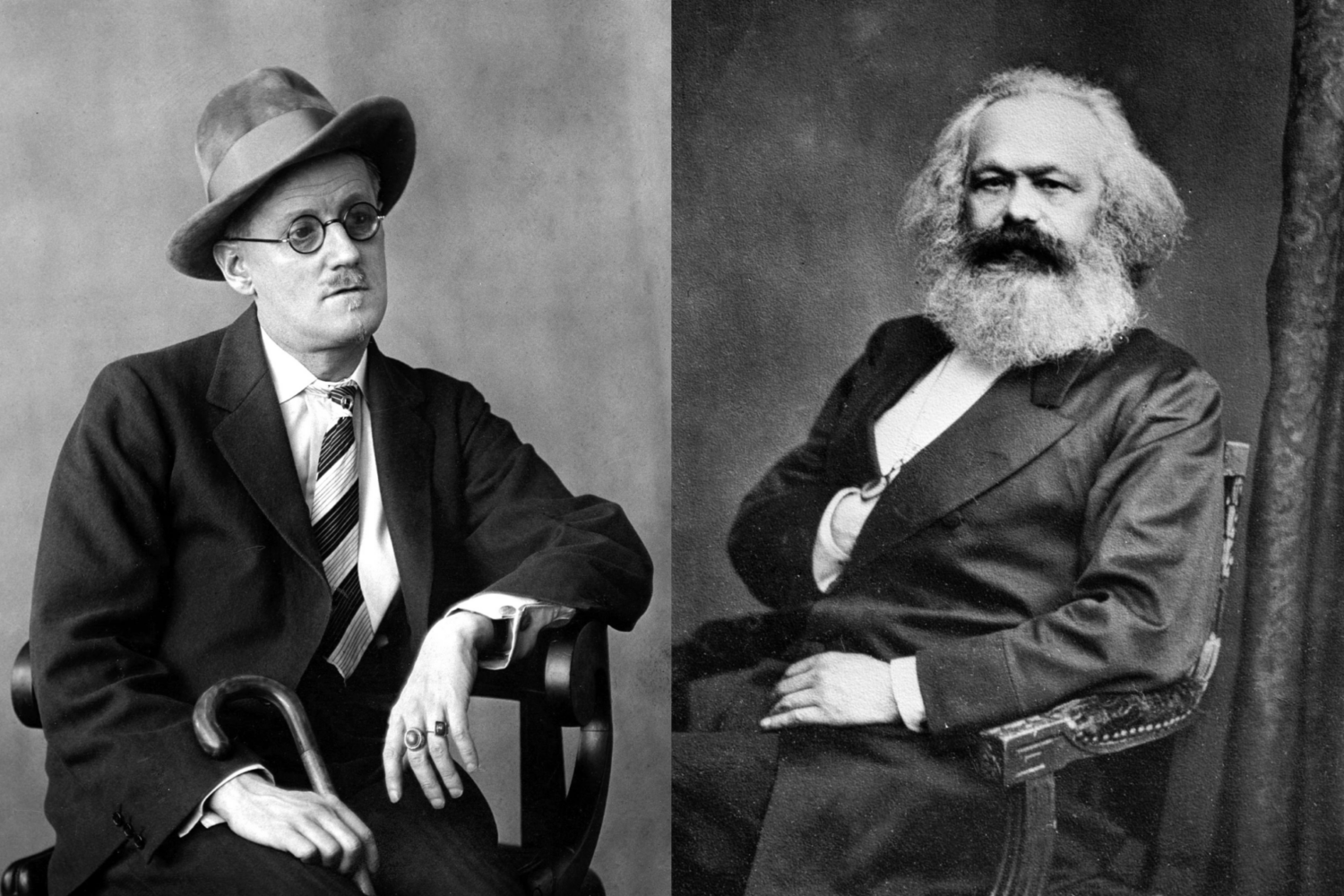
For a long while, I’ve had a peculiar fantasy of bringing volume two of Marx’s Capital into dialogue with James Joyce’s Finnegans Wake. I’ve always thought both books existed in a strange parallel universe, where capital courses alongside the Joycean riverrun, the river Liffey, and each share some profound correspondence, an unexpected gravitational pull, like that between quantum mechanics and fluid dynamics.
“In a constantly rotating orbit,” says Marx in a sequel to volume one of Capital he’d subtitled “The Process of Capitalist Circulation,” “every point is simultaneously a starting point and a point of return.” “Thus we have seen,” Marx continues, “that not only does every particular circuit (implicitly) presuppose the others, but also that the repetition of the circuit in one form includes the motions which have taken place in other forms of the circuit. Thus the entire distinction presents itself as merely one of form, a merely subjective distinction that exists only for the observer.”
Thus “the book really has no beginning, or end. It ends in the middle of a sentence and begins in the middle of the same sentence.” So wrote Joyce to Harriet Shaw Weaver, describing the seamless flow between the closing and opening lines of his great masterpiece: “A way a lone a last a loved a long the…riverrun, past Eve and Adam’s, from swerve of shore to bend of bay, brings us by a commodious vicus of recirculation back to Howth Castle and Environs.”
Anybody who’s ever leafed through Finnegans Wake will quickly recognize that we’re not dealing here with a standard novel, just as anybody leafing through Marx’s Capital will know we’re not dealing with standard economics. In Capital volume two, there’s constant intertwining of appearance and disappearance of various forms of capital; in Finnegans Wake, protagonists come and go in assorted guises, too, in various transfigurations, ranging from mythological characters to entire geographical structures—like trees, rivers, and mountains. Marx said he didn’t like classical political economy and Joyce admitted he never liked conventional “storytelling,” of writing books that had a linear narrative; and in the Wake there’s no real tale to follow. He said his book “has significance completely above reality; transcending humans, things, senses, and entering the realm of complete abstraction.”
The two principal characters, Anna Livia Plurabelle and husband Humphrey Chimpden Earwicker, “are at the same time the city and its founder, the river and mountain; there isn’t even a chronological ordering of the action,” Joyce says. “It is simultaneous action, represented by the novel’s circular construction.” Anna Livia becomes a representation of the River Liffey (its Latin name is Amnis Livia), as well as of all the rivers that appear in Finnegans Wake (the first chapter contains allusions to over three hundred of them).
If anything, the Liffey assumes a lead role in the book, just as Dublin shines as the mainstay in Ulysses. The river continuously flows in Finnegans Wake, from its initial passages until the poignant dénouement, streaming from its source twenty-miles southwest of Dublin, meandering for fifty miles, northwest, then west, then northwest again, eventually turning eastward through the city and out into Dublin Bay, disappearing into the open sea along with Anna Livia, who’d been quietly pondering her own life as her namesake river, and as a mother and life-giver.
“As a whole, then,” Marx says, “capital is simultaneously present, and spatially coexistent, in its various phases. But each part is constantly passing from one phase or functional form into another, and thus functions in all of them in turn. The forms are therefore fluid forms, and their simultaneity is mediated by their succession. Each form both follows and precedes the others, so that the return of one part of the capital to one form is determined by the return of another part to another form. Each part continuously describes its own course, but it is always another part of capital that finds itself in this form, and these particular circuits simply constitute simultaneously and successive moments of the overall process.”
Part of the difficulty of reading Finnegans Wake and volume two of Capital is precisely that their world is moving, flowing; the realities in question, in both texts, are processual. Unlike either Ulysses or Capital volume one, which have fixed coordinates, real-life characters concretely embedded in a place and time, in Dublin or inside a historically given working day, now we’re no longer on solid ground. It’s like reading on a raft that’s getting swept along by a rapid current.
When the musicologist John Cage, another Wake enthusiast, put Joyce’s great “Irish Circus” to music, composing his Roaratorio in 1979, a strangely lulling cacophony of Irish pub ballads, chattering and clanging from Dublin’s everyday life, overlaid with Joyce’s own garbled words, one of its most vivid and enduring sounds was streaming and gurgling water. And in the late 1940s, when the surrealist painter André Masson drew mocks for a potential cover of Finnegans Wake, he, too, gave us this streaming and gurgling water, visually represented.
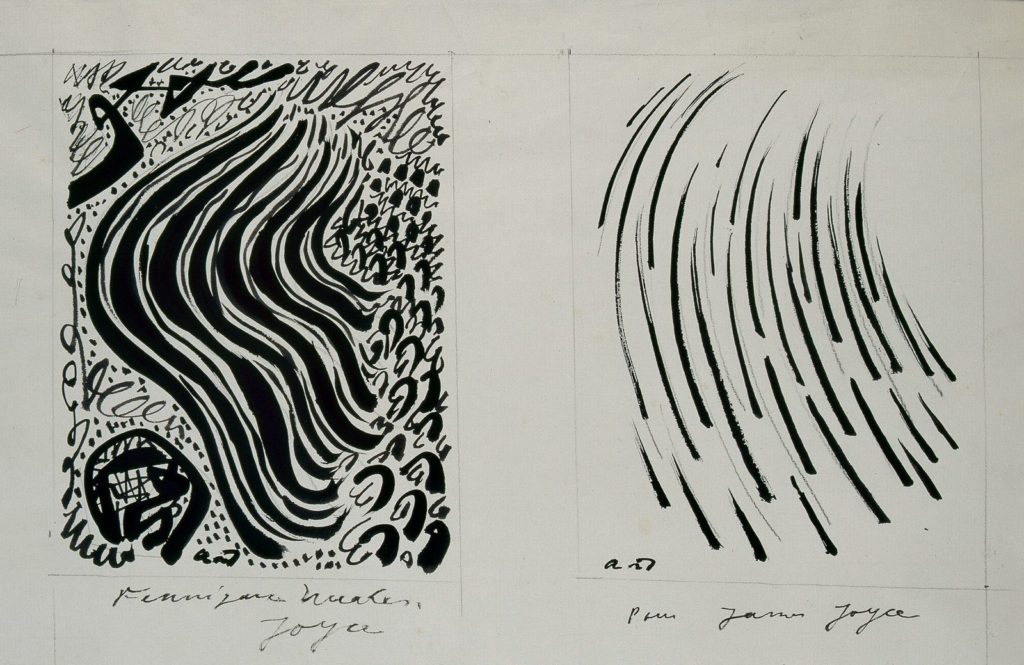
André Masson, “Drawings for the Cover of Finnegans Wake” (Irish Museum of Modern Art)
Central to both Finnegans Wake and Capital volume two is the idea of disequilibrium, of jarring punctuation, of breakdown. For Joyce, disequilibrium and breakdown get emphasized by fearsome thunderclaps—ten of them punctuate Finnegans Wake, clattering 100 letters-long “thunderwords”: “bababadalgharaghtakamminarronnkonnbronntonner-ronntuonnthunntrovarrhounawnskawntooohoordenenthurnuk!” Joyce’s language even sounds like a rending, like a noise that rattles the earth, that terrifies.
In a sense, Marx was also a prophet of thunderclaps; they punctuate his cyclical vision of reality, its growth and crisis, its continuity and discontinuity, the corsos and ricorsos of successive movements of money, productive, and commodity capital—“the three figures of the circuit,” Marx calls them. It’s a basic chain, a relentlessly enlarging spiral, spreading throughout the globe. And Marx, like Joyce, deploys his own sigla: M-C…P…C’-M’, with M-C representing the conversion of a sum of money into a sum of commodities, P is production, and C’-M’ the transformation of the commodity-capital from its commodity-form into an augmented money-form.
It’s a process that continuously turns over, must continuously grow, whirl and whirr faster and faster, yet it’s out of control of even the most powerful capitalists, rupturing inevitably, prone to economic crisis, and maybe, just maybe, to working-class revolt. As such, thunderclaps haunt the capitalist soundscape. They’ve done so in the past and they’ll continue in the future, clattering loud and wide. As Marx conceives it, the reproduction and accumulation of capital, and the metamorphoses of the various cycles, encompass a unity and contradiction of opposites—expressed in the commodity-form itself, in the contradictory unity of use-value and exchange-value, and in the exchange between commodities and money.
To frame the seismic faultline of disequilibrium, Marx mobilizes in volume two his famous “reproduction schemas,” with their two departments. Department 1, he says, is the production of means of production for capitalists, actual machinery and technology, hardware products that capitalist firms sell to other capitalists who then use them as means of production in their own business of production. Department 2 is the production of consumption goods for workers and luxury goods for capitalists, the same ones who control production in Department 1. Without investment in Department 1, there’ll be no production of goods in Department 2; without workers in Department 1, there’ll be no purchasing power in the form of wages for the consumer goods in Department 2, which workers produce themselves.
For balanced growth, a proportionality between each department would be required that’s impossible to imagine in a world of competitive capitalism, where businesses jockey each other and try to leapfrog their sectoral rivals. Invariably, the laws of motion of bourgeois society have an innate tendency to overproduce, to overreach in its development of productive capacity (in the production of means of production and consumer goods). Production in Department 2 often occurs beyond the limits of workers’ purchasing power, sparking a glut of consumer goods; a problem of realization ensues that, in turn, effects continued investment in Department 1. By analytically breaking down the various phases of production and circulation in the total social capital, Marx highlighted that stable development under capitalism is but a rare exception, never the general rule.
Marx’s friend, confidant and benefactor, Frederick Engels, who edited volume two of Capital posthumously for Marx, after the latter’s death in 1883, feared for the book. “The second volume will provoke great disappointment,” he wrote in a letter to a Russian populist, “because it is purely scientific and doesn’t contain much for agitation.” Yet Engels didn’t want to understate its intellectual importance, nor its significance for the workers’ movement. “The developments it contains,” Engels reckoned, “are indeed of such superior order that the vulgar reader will not take the trouble to fathom them and to follow them out.”
Engels could’ve been talking about the reviews of Finnegans Wake, after its appearance in 1939, a book perplexing even Joyce loyalists (like Ezra Pound), disappointing many, dismissed as incomprehensible and unreadable, as sheer madness, as a leg-puller. Vladimir Nabokov, a great admirer of Ulysses, didn’t care for the Wake, denouncing it as “nothing but a formless and dull mass of phony folklore.” Critics didn’t get turned on by either book, passing them over, preferring Ulysses or reading only volume one of Capital (then skipping to volume three afterward). On the other hand, more patient sticklers have remarked that hanging in there with both texts is rewarding; hardy readers will finish up somehow enlightened and enriched.
How so? Mainly because the parallel universes of the Joyce’s riverrun and Marx’s circulation of capital converge in analog progression: both texts take us forward, dialectically, toward some higher state of Being, each metamorphosing into something potentially vaster and more open, something full of human possibility. Marx tells us that the circulation of capital literally makes the world go around. It implicates us all in its spiraling contradictions, forces us to commodify ourselves, to be both workers and consumers. The deep analysis he offers us here, of the reproduction of the capitalist economy and bourgeois society in its totality, is something we may ignore, may not wish to read, but its laws of motion, he insists, will never ignore us.
The toing and froing of money, productive, and commodity capital, oscillating in and out of the spheres of circulation and production, appearing and disappearing, motioning back and forth, outward and onward, everywhere annihilating space by time, is a reality that forges everybody as class subjects. Marx goes to pains to show that the plight of the worker isn’t solely something that happens on the job, in production, at the workplace: the realization of value and surplus value takes place closer to home, even in the home, in everyday life. It has to: it requires us as consumers, as buyers of the merchandise we’ve made, as living contradictions of market relations, selling ourselves as we must inexorably purchase what’s on sale. Marx’s point is that knowing this, knowing thyself and the system that conditions thyself, that sometimes destroys thyself, might prompt us to do something about it, to wake up, as Joyce said, to rise up—aruse.
Here, too, Joyce and Marx find common ground, jointly emphasizing that the fall—the foundational, reoccurring motif of the Wake—represents the universal human condition; that history is driven by its worst foot forward, that the tragic is the mechanism driving world-historical human experience. Out of every fall, though, out of every crisis, every earthshattering punctuation, Joyce and Marx agree, there’ll be a rise, a waking up, a resurrection. The fall thus becomes at once destructive and transformative. “Phall if you but will, rise you must.”
All of which bodes the question: what might the notion of “wake” really mean? The obvious response is one Joyce mobilizes himself: the actual “wake” of Tim Finnegan, recounted in the Irish ballad of the eponymous “hod” carrier, a bricklayer who, drunk one morning up a ladder, falls and is thought dead. At his wake, somebody splashes whisky—the “water of life” in Gaelic—on Tim’s head, only to have him suddenly leap up, bawling, “D’ye think I’m dead?”
The ballad’s theme of death and resurrection appealed to Joyce’s scatological imagination, which, like Marx’s, remained darkly optimistic. Forever fascinated by the potencies of fermentation, Joyce has Earwicker transfigure and resurrect into Tim Finnegan. Meanwhile, without that apostrophe in Finnegans Wake, there’s another sense to who might be waking. A clue comes from Joyce’s own allegiances, drawn to outsiders and the downtrodden, to déclassé middle-class and working-class people; they populate his creative universe and command his political sympathies. Those Finnegans are the little people of the world, the unsung heroes of his Wake, insignificant people, a nameless working-class, who, as the ballad goes, “to rise in the world carry a hod.”
Earwicker himself might have been a small businessman, a petty-bourgeois, yet in reality he was a lowly pub-keep steadily slipping into the ranks of the proletarianized working-class—or, like his shadow-self Tim Finnegan, slipping down the ladder, joining the ranks of hod-carriers the world over. “Slave wager and foeman…now one and the same person, their fight upheld to right for a wee while being baffled and tottered.” To that degree, Joyce’s class vision in Finnegans Wake pretty much tallies with Marx’s idea of proletarianization, of the progressive immiseration of the petty bourgeois and a downwardly mobile middle-class.
To say this is to suggest that Finnegans Wake can be read as a Bildungsroman of an aspiring working-class everywhere, of ordinary people who graft hard, hoping to become upwardly mobile, that their graft might eventually pay off, especially for their children. This upwardly mobile dream is no longer a reality for many people. The intelligent, non-alienated ones know it for the sad and deceitful myth it is, as ideology peddled by the ruling class. When hopes of respectable mobility are dashed, when the inevitably of the fall under bourgeois society becomes apparent, we might see those little Finnegans wake, wake up collectively, cooperate to awaken as a class-conscious working-class.
Which is why Anna Livia, like so many women the world over, initiates the rally cry of socialists, mimicking the refrain from The International: “Arise ye workers from your slumber!” “Rise up, man of hooths,” she urges her husband near the end of Finnegans Wake, “you have slept so long…rise up now and aruse!” “Come! Step out of your shell!” says Anna. “Array! Surrection!” “How glad you’ll be I waked you. How well you’ll feel! For ever after.”
Joyce, like Marx, believed in the world, thought of it in terms of progress. Those seventeen years he spent cagily calling Finnegans Wake “work in progress” also affirmed human progress, that the world itself could be a work in progress, an act of labor in the Marxist sense, remade through human action. (He thought this as the world around him was falling apart in war.) Earwicker seems to have gotten somnolently radicalized, making Finnegans Wake a more revolutionary book than Ulysses (liberal by comparison), and this not only in its conception: Joyce’s own political evolution seems to have radicalized as Earwicker slept.
Time is vital for capital–turnover time, circulation time, surplus labor time, etc. But it also mulches hope for people. And it did for Joyce and Marx. What we have before us now is similarly a work in progress, a life in progress, albeit a desperately flawed one as most of us know. Just before his death in 1941, Joyce often used to say to his friends, time will tell: “WAIT TILL FINNEGAN WAKES.” He liked to repeat it. He was always hopeful about his books and about life. So was Marx, about his own books and life. And so might we be, hopeful, waiting, patiently, doggedly, for those Finnegans one day to wake up.


