The Shadow Citizenry

Previously Published in June 2015 at Open Democracy

by Andy Merrifield

It’s exciting to see one of Henri Lefebvre’s last essays, “Quand la ville se perd dans une metamorphose planétaire” (1989), finally make it into English, in a recent edition of the Environment and Planning D: Society and Space journal, entering Anglophone discussion and debate for the first time.[*] One could doubtless quibble with the idea of se perdre becoming “dissolving”—instead of the more prosaic, less dramatic “to get lost,” “to go astray,” or “to lose its way”; but the vital thing is that Lefebvre’s sense and sensibility remains intact throughout “Dissolving City, Planetary Metamorphosis,” and for that Neil Brenner and his crew should be commended.

Like a lot the old guy wrote—hey, almost everything—this essay raises as many questions as it supplies answers. It’s fascinating to see how his vision of the right to the city had matured during the period 1967-1989, from its initial airing on the eve of Parisian student eruptions to the eventual tumbling of the Berlin Wall, from exorcizing demons at the Pentagon to tanks rumbling into Tiananmen Square. Lefebvre’s essay is prescient (and downbeat) about how upsizing cities produce downsizing work, how “planetary urbanization” unleashes more perils than possibilities, and how that time-served ideal of city dwellers becoming solid citizens seems irrevocably severed.

There are plenty of angles, plenty of viewpoints, from which to tackle this brief yet dense essay. But here I want only to deal with one aspect of it: its final line: “The right to the city implies nothing less than a revolutionary conception of citizenship.” In what follows, I want to riff on this line, give my own take on what it might mean today, on what it ought to mean today, twenty-five years down the line. Lefebvre is adamant about the need “to reformulate the framework for citizenship,” given the unsettling nature of capitalist urbanization, that capital constantly circulates, that money values settle everywhere, that people get inexorably displaced, extricated from familiar territories, deported to unfamiliar banlieues.

But just what kind of right is “revolutionary citizenship”? Is such citizenship a right at all? Clearly, it’s a citizenship beyond any notion of passport: it isn’t about “official” documents; it isn’t any legal right, bestowed upon us by institutions of the bourgeois nation-state. In this light, maybe we need to reformulate the whole framework of rights, come clean about the rights question, reformulate it alongside the very notion of the city itself. Working this through might then help us derive a fresh notion of what Lefebvre’s revolutionary watchword—the right to the city—might really still mean, might actually inspire us to create today.

* * *

Let me begin with a hypothesis, one I’d like to think Henri might agree with: revolutionary citizenship is not a right: it has to be taken, recreated anew, struggled for—not rubber-stamped. For revolutionaries, for people concerned with real social change, with changing societies, with inventing new urban life, we might say the rights question got buried in 1848, destroyed by bourgeois gravediggers. The above hypothesis compels us to consider that we no longer have rights, shouldn’t expect any, should wise up to the fact that nobody in power or authority is ever going to acknowledge our rights, grant us those rights we thought were ours, thought would become enshrined in our culture, especially after the 1789 French Revolution. But they didn’t get enshrined.

In 1791, we had Thomas Paine’s The Rights of Man and of the Citizen kindle our hopes of such popular enfranchisement. And then, after overthrowing the French Monarchy, Robespierre, in 1792, tried to uphold these ideals, tried to endorse them at the National Convention, the first revolutionary assembly of “popular will,” run by left-leaning bourgeois Jacobins. Robespierre took positions of great virtue and astonishing courage concerning human rights. He was against martial law, against the death penalty, against slavery in the colonies; he was for universal suffrage, for the right to petition, for freedom of the press, for civic rights of actors and Jews. But the 9th Thermidor backlash in July 27, 1794, the right-swinging counter-revolution against Jacobin liberal democracy, trampled over hopes of any Bill of Rights, hopes that capital and labor might establish a just social contract, that an emergent industrial working class, together with artisans and peasants, might one day find societal harmony with a progressive bourgeoisie.

Between 1794 and 1848, working class people in Europe retained these hopes. The workers’ movement of 1830 tried again to consummate these hopes; it failed. In 1848, between February and June, a new generation of workers, still demanding their rights, took to the streets en masse, across all Europe as well as in France; again they failed, again they found their rights bloodied in the streets. This fraught era of 1830-1848 tried to reset the balance between bourgeoisie and worker. It made a last-ditch effort to salvage the rights issue, to fulfill the latent promise of The Rights of Man and of the 1789 revolution. The “June Days” of 1848 were the last popular reaction to Thermidor reaction. In a way, insurgents back then still played a bourgeois game, still somehow believed in the rules to this bourgeois game. And yet, again, the movement failed: the promise of bourgeois citizenship was drowned in the icy waters of conservative recidivism. The awful truth: the promise of liberal-bourgeois rights had been a big lie all along. Now everybody knew it, everybody who had to know it. “The revolutionary storm of 1848,” Engels wrote in 1890, in an added footnote to the Communist Manifesto, “swept away this whole shabby tendency.” It had “cured its protagonists,” Engels said, “of the desire to dabble further” in speculative beliefs of “eternal truths.”

Maybe it’s no coincidence that 1848 was the year when the Communist Manifesto appeared. With stirring, thunderous prose, Marx declared the holy profane; no matter what we thought, no matter what we were demanding, there were no longer sacred ideals, no longer “rights” to shelter behind, to invoke to protect ourselves; there was nobody to whom “we,” the people, could appeal, especially when brutalized, especially when that brutality was actually lawful, actually an intrinsic feature of (capitalist) society’s everyday functioning. Hitherto sentimental notions, hitherto time-honored beliefs, hitherto respected occupations—all of them, Marx said, had been “stripped of their haloes.” “In one word, for exploitation, veiled by religious and political illusions,” the bourgeoisie “has substituted naked, shameless, direct, brutal exploitation.” “All that is solid melts into air,” Marx wrote, famously, “all that is holy is profaned, and man is at last compelled to face with sober senses, his real conditions of life, and his relations with his kind.” Could it be, then, that “sober senses” means having no illusions about rights, that they’ve melted into air, that we should now face up, unflinchingly, to our real conditions of neoliberal social life?

* * *

When he’d waded in in 1967, appealing to the “right to the city,” Lefebvre at once inspired and muddled the debate. He’d inspired and confused the issue on both counts, at the level of rights, on the one hand, and of the city, on the other. He’d confused things because at the same time as he demanded rights to the city he was denouncing the city. He’d said that the right to the city was a “cry and demand” for urban life, for the “right to centrality,” for the right to participate as active subjects in urban history, not be moved on or pushed aside as passive objects. But he’d also said that the city was a “pseudo-concept,” that a newly emergent “urban society” was predicated on “the ruins of the city.” The city was opening up, the oyster bursting out of its shell—as geographer Jean Gottmann put it in the early 1960s in Megalopolis. Monocentrality now gave way to polycentrality, to amorphous urban forms, to expansive and invasive urban forms, ones unexplainable via old paradigms; it was hard to know anymore which “centrality” Lefebvre was talking about. The city now devoured the countryside, the countryside ruralized the city; the traditional city and traditional countryside melted into air, congealed into something qualitatively different, into something quantitatively unnerving. Lefebvre said a new paradigm was required, a new way of conceptualizing “urban society,” a new way of conceptualizing the right to this new urban society, a new citizenship for this urban society, an urban citizenship, a revolutionary urban citizenship.

Revolutionary citizens are citizens without rights, disenfranchised urban citizens the world over. We somehow know one another, identify with each other, wherever we go. We speak in differing tongues yet have things in common, usually sharing a common enemy. We have collective hopes and mutual affinities, a similar “structure of feeling,” a feeling of being on the receiving end of somebody else’s doing, frequently somebody rich and powerful’s doing. As revolutionary citizens we carry shadow passports. Our shadow passports express a citizenship waiting in the wings, a solidarity haunting the mainstream, floating through frontiers, across designated checkpoints, sometimes even straying between academic disciplines. For holders of shadow passports, homeland securities and border control agencies know nothing about our true identity; official maps rarely tell us where to go: they’re useless in helping us re-orientate ourselves, in helping us find ourselves, in helping us discover one another.

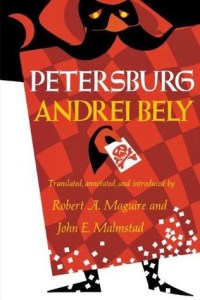
The idea of a shadow passport is a major motif of Andrei Bely’s revolutionary masterpiece, Petersburg, written in the early 1910s. It tells the story of the run up to the aborted Russian revolution of 1905, a little more than a decade prior to the Bolsheviks’ eventual triumph. Bely’s text is symbolic as well as slapstick, hilariously comical as well as intensely poetical. All the while an atmosphere of hysteria prevails—political hysteria. Everyone knew the times were a-changing, that politics and intrigue wafted in the air, that “momentous events were rumbling,” that something was about to give, soon. But what? Bely never quite tells; he never gives readers a straight answer. His story is one in which “everyone feared something, hoped or something, poured into the streets, gathered in crowds, and again dispersed…” (This feature isn’t unlike ours today.)

imageBely’s is a twilight drama of political intrigue, a portrayal of a phantom world in which the invisible stalks the visible. Masked red dominoes and would-be parricide bombers—Russian radical history is full of inter-generational strife, of sons forever dueling fathers—dart in and out of the shadows; revolutionaries jostle with reactionaries, nihilists with government nobodies; Unknown Ones are transformed into Elusive Ones, double agents into secret agents, secret police into agents-provocateurs. Bely adds a “fourth dimension” to things, makes the make-believe all-too-real. Apollon Apollonvich, the reactionary right-wing senator, warns of those “mangy little fellows” scheming behind the scenes. (Apollon’s wayward anarchist son, Nikolai, is one of these mangy figures; he’s plotting behind the scenes to blow dad up, with a bomb in a sardine can.) Shady characters like these, Apollon Apollonvich says, are “essential figures at this time of transition,” figures who, apart from anything else, must be kept out the dancehalls, because “if these apparently innocent dances were permitted, dances of a different sort might be continued in the streets.” Mangy little dancing figures are in the vanguard of the incipient revolutionary struggle; they’re the mainstay of the shadow citizenry. But who are these little mangy fellows today?

Maybe it’s not hard to conceive the shadow passport citizenry comprising a disenfranchised constituency who now haunt the global banlieue. A lot reside in the core yet live out the periphery, feel the periphery inside them, identify with the periphery. They’re the superfluous ones, the ninja generation, the jobless and incomeless and assetless, the Indignados on the streets of Spain, Occupiers denouncing unearned plenty, Greeks who feel the brunt of the Troika, of the fiscal probity of European Central Bankers, of the EU technocrats and bureaucrats, of middle-managers and accountancy governors.

Of course, there are quite a few Greeks, those cheering for the Golden Dawn, who cling onto their “official” passports for dear life, who invoke ultra-nationalist purity and neo-Nazi necessity; but shadow passport holders embrace a very different citizenship, a very different internationalism. They’ve more in common with dispossessed Arab and African youth in French suburbs, with Palestinians lobbing rocks at Israeli tanks, with Detroiters beholden to “Emergency Managers,” with Brazilians protesting public transport hikes, with looters in Tottenham, with anybody and everybody who’ve had their homes repossessed, who’ve defaulted on their loans, who are indebted, whose pensions are kaput, whose immediate future is kaput. The shadow passport citizenry is a territorial reserve army of foot soldiers, a relative surplus population of ordinary people, who want in but are forced out; they’re often defiant yet somehow disunited, disgruntled and raging in a global civil war of austerity and high frequency piracy.

* * *

We’ve seen this shadow citizenry step of the shadows in recent times, enter into the public light of day, into the public squares and streets. They’ve expressed themselves a shadow citizens of the world, gathering in crowds, yet always, somehow, dispersing again. In my book The Politics of the Encounter (2013), I tried to figure out, inadequately, how these crowds of people come together, what makes them tick, what makes them fall apart, what kind of spaces they need, what kind of spaces they create. Where are participants now? I suggested that the notion of encounter is crucial for any shadow citizenry, crucial for helping it affirm its collective identity, crucial for helping it affirm its collective vitality, its collective coming together, its collective staying together. What’s encountered are elements expressing affinity and complementarity, a readiness to collide and interlock, to take hold like water becoming ice, like mayonnaise emulsifying, like milk cuddling, like people bonding and blending politically on the street.

“Every encounter is aleatory,” says Louis Althusser, in a beautiful, mysterious essay, “The Underground Current of the Materialism of the Encounter,” drafted in the late 1970s and only known in 1990s. (It makes a great pairing with Bely’s revolutionary undercurrent, Petersburg.) The world of radical history, Althusser says, gels at certain felicitous moments; ordinary rain becomes supernatural rain, rain that encounters sunshine, that takes hold radiantly; shadowy figures become iridescent as they journey over the rainbow. “This is what strikes everyone so forcefully during great commencements, during turns of history,” says Althusser, “when the dice are thrown back on the table unexpectedly; the cards are dealt out again without warning, elements are unloosened in the fit of madness that frees them up for new, surprising ways of taking-hold.”

For Althusser, everything falls, atoms fall in parallel with one another; the rain of life pitter-patters down, falls unconnectedly, like Lucretius’s “the dance of atoms” in The Nature of Things (circa 50 B.C.). Its falls until something intervenes, until something contingent breaks the parallelism, an “infinitesimal swerve,” a “clinamen.” Suddenly, there’s an agglomeration of raindrops, and a chain reaction is unleashed; the birth of something new, a new interconnection, a new reality. “It’s clear,” says Althusser (using his own emphases), “that the encounter creates nothing of the reality of the world… without the swerve and encounter, [it] would be nothing but agglomerated abstract elements, lacking all consistency and existence. So much so that we can say that the atoms’ very existence is due to nothing but the swerve and the encounter prior to which they led only a phantom existence.”

Thus the encounter bestows “reality” to the politically disaffected, to any shadow citizenry yearning to overcome its phantom existence, yearning to really change the order of things, to really rip apart society, ensuring nothing’s ever going to go back to what it was, that a “punctuating encounter” occurs. 1989 was such a punctuating encounter; the early phase of the French Revolution, up until 1794, was likewise a punctuating encounter. Things fundamentally changed, change was fundamental. There’s a rift, a rending of the fabric, of the social fabric, of the political fabric, of the economic fabric—and likely of the urban fabric. The day after the swerve, after the encounter, things are never ever going to return to what they once were.

How can a shadow citizenry encounter and bond with one another? How to withstand all the shock waves, all the reactionary assaults conservative forces will likely muster up? How can connections stay intact, not crack under fire? What might promote and reinforce assembly, help punctuating encounters stick? It’s impossible to know in advance—that was Althusser’s aleatory point. Still, what could help are arenas that promote bonding, that enable collective assembly. For the ancients Greeks, it was the agora, the great public space where Athenian citizens met and debated politics, debated democracy. Maybe what’s needed now, as our democracy is put up for tender, contacted-out and outsourced, is some kind of new citizens’ agora—a shadow citizens’ agora—someplace where a shaky public might constitute and conceptualize itself as a solid citizenry, as a Lefebvrian revolutionary citizenry.

* * *

Like the agora of old, the new shadow citizens’ agora would be where tragedian drama gets performed, where the shadow citizens’ catharsis is enacted. We need forums where shadow citizens’ can engage in epic theatre and drama, where we can debate and argue, analyse and admonish our democratic lack. Yet the shadow citizens’ agora must be something more than the hijacked public spaces we have nowadays, those pops and branded plazas that have somehow branded us. We can do better. We need to invent another “public” realm, one not defined by the state, nor even by tenure, but by citizens affirming their “general will,” someplace where, in the short term at least, we can bring all our hopes and fears to the surface, and work them through together.

Remember how Plato wanted to ban effusive, emotional outbursts from his republic, from his city of guardians, from his aristocratic oligarchy. All that arouses “parts of the soul,” he said, that “destroy the reasoning part.” Deep feeling “implants an evil constitution in the soul of each individual” and, as such, “corrupts even the good.” Maybe Plato was right, though, to insist on a bit of temperance and self-control? Maybe the shadow citizens’ agora could benefit from some cool-headedness, if only to offset any visceral lashing out, the emotive denouncing of everything, stuff that appeals to the immediate senses, that simplistically reacts on the senses—fascism prospers from the like, as does right-drifting European popularism.

Temperate discussion and analysis, thoughtful political criticism, diligent organizing and tactics, is presumably what Marx meant about us facing, “with sober senses,” our real conditions of life. We need new clubs and societies, meeting halls and debating chambers, cafés and bars, social clubs and youth centers, street corners and university classrooms, anyplace where “General Assemblies” might be forged and where people can congregate non-commercially, encounter other people actively. Because, let’s face it, there’s a dearth of spaces where people can engage with one another on human scale, where we can communicate and converse face-to-face; it’s hard to do it someplace that isn’t about shopping or gaping, that isn’t about having some digital screen shoved in your face. It’s hard to turn the sound down, to stop the music, to ignore the ads, and talk.

Shadow citizens’ agora need to ensure that hitherto silenced peoples have a voice, get a word in edgeways, get heard, and sometimes even get challenged. But to speak out in public, as a public searching for democratic consensus, there’s an need for a free press, for an alternative free press, for a press that’s open and publicly accessible, online as well as in print; a press that reports on news items people ought to hear about, not the celebrity gossip and right-wing propaganda that mainstream media booms out every hour, not the fear and loathing peddled by News International and Fox, not reactionary tabloid sound bite. Real news, news from other sources, news of real truths that usually don’t get a look in, that don’t get an earful, that aren’t allowed to be heard—they need to be channelled and broadcasted.

Meanwhile, speaking out and listening require forums in which shadow citizens can sometimes come together en masse. Democracy must allow people to assemble, to do so peaceably and without arms; although, of course, if this “right” is denied, if the principles of free assembly are opposed, then the sub-clause is that citizens ought to be able to assemble through any means necessary, peaceable or otherwise. It’s in the agora that they create where shadow citizens will have the power to act, to act after being heard, to act after having listened to others. It’s in the agora where we can assert ourselves as citizens of a participatory democracy—a participatory democracy inserting itself into a defective representative democracy.

From this outside, from the participatory twilight zone, shadow citizens might wrestle with the inside, with the fluorescent light of representative authority. We might even adopt Pierre Bourdieu’s vocab and say left-handed shadow peoples can attack right-handed state peoples. Bourdieu spoke of a rift between the left and right hands of the state. It’s a drama, he says, played out between, on the one hand, the left hand, a dwindling bunch of experienced politicians answerable to their constituents and who still try to uphold democracy; and, on the other right hand, a “state nobility” of elite technocrats and cabinet plutocrats, finance ministers and public-private bankers who no longer even pretend to want to change anything significant.
The rift marks an ever-widening cleavage between left-leaning rank-and-file representatives who still just about care about the public, and right-leaning senior civil servants who care only about the private, about budgets and bank balances. On the left side, we have a shadow citizenry of publicly-employed progressive councilors, social workers, community organizers, primary and secondary school teachers, health and housing officers, local government officials and progressive magistrates, care assistants and crèche workers; on the right side, we have a nobility of largely unaccountable agents propping up the upper-echelons of the Ministry of Finance and its regime of Accountancy Governance.

The pressure from the outside, from the shadowy undercurrent, might thereby give the left hand insiders the courage to step out of the closet, to take back democracy from technocracy, to break with the “historical inevitability” professed by the doyens of neoliberalism: there plainly is an alternative. Resistance from the outside, from the shadows, might equally hook up this inside to the outside; “official” representatives in government, in the council chambers, must be kept on with their toes by shouts in the street from mangy little figures, by a social movement exerting its pressure from without, in the public square, in the alternative media, across clandestine airwaves, in the shadow citizens’ agora, forcing the right side of the state to respond to the left side.

In a strange, dialectical sense, what we shadow citizens have before us—what we have enveloping us—is a sort of shadow ruling class. These guys run the visible administrative apparatus, call the shots, yet do so out of sight, do so unaccountably, in secret. Shadow citizens need to shine our own investigative light on dubious private sector management and mismanagement, on financial wheeling and dealing. We need some shadow citizens’ global registry of financial assets, together with a list of which accountants are cooking their books. We need greater democratic knowledge of who owns what, as well as who tots up the figures for those who own what. Something along these lines appears to be getting explored in suggestive ways with the “Citizens’ Audit,” an international network of local groups pressuring for an opening up of the state’s books, scrutinizing the shenanigans of shadowy accountants and the partisan administrators therein. It’s a program warranting consolidation so that we shadow citizens—not professional accountants already on the payroll of those they’re meant to be auditing—might initiate widespread monitoring and regulating of the public coffers.

Struggling for democracy means loosening the diktat those anonymous, unaccountable, behind-closed-doors administrators have over our culture, those in the private and public sectors, the bankers and accountants, the technocrats and creditocrats, the rentiers and realtors who orchestrate the financial repossession of our society. Here we’re perhaps ways away from the notion of the “right to the city”; or maybe we’re closer to it? Maybe, in the end, or at the point of a new beginning, we’re closer to what Lefebvre might have meant, closer to his more expansive and inclusive late take about reimagining a new social contract? Closer to what a revolutionary urban citizenship might now mean, might still imply? It’s a struggle, above all else, against finance capital, and against the administration of finance capital, a struggle that sometimes seems as much Kafkaesque as Marxist, an enigma of revolt, a struggle for our rights when all rights are denied, when we’ve no right left even to ask for our rights. So why ask? A Bill of Rights remains the ends not the means for enforcing a democratic citizenship. It’s the light at the end of the tunnel, the sunlight beyond the realm of shadows—beyond le royaume des ombres, Lefebvre called it. As we walk toward this light, force ourselves to look at it, I hope shadow citizens can stand the glare. I hope our eyes won’t ache.

[*]Henri Lefebvre, “Dissolving City, Planetary Metamorphosis” (translated by Laurent Corroyer, Marianne Potvin, and Neil Brenner), Environment and Planning D: Society and Space, 2014, Volume 32, pp203-205

Posted in Previously Published | 1 Comment

Future Shock

Previously published in March 2015 at antipode foundation.org

by Andy Merrifield

Speculating on the future, especially on the political future—and especially especially on a Left political future—is something you get slammed for these days; “they” tell you you’re writing fiction, particularly if your future threatens the status quo. On the other hand, if your future can be absorbed within the status quo, or else puts a different spin on that status quo, your future is realistic, permissible not dismissible: technocratic futures are okay, as are big futuristic master plans that involve lots of high-tech urban design stuff—lots of corporate high-tech urban design stuff—ones endorsed by some billionaire and administered by a patented scientific corporation. The reasons behind this are of course intellectual and political, particularly when ideology and politics underwrites commercial economics. Contemporary academia and a lot of scholarly social science have pretty much given up thinking about radical futures.[1]

It’s sad how low the bar is set, how unambitious and unimaginative the academy is with its knowledge production, keeping its thought within the narrow confines of academic specialization and arcane professional journals. Social science has retreated inwards, or has become servile, a mere handmaiden of power. Crucial therein is the dominance of the positivist-empiricist tradition, something perhaps obvious in our age of “experts,” in our era some describe as “post-political.” Positivism has always hidden behind the shield of quantification and “objectivity,” always tried to rid itself of politics. Now positivism/empiricism is a convenient methodological foil for technocrats trying to find consensus without conflict, gaining grants without upsetting anyone. Their opinions are neutral and expert, right? Their objective knowledge isn’t value-laden. Yours, if it’s critical and theoretically partisan, is warped, ideological; worse, fantasy.

All this got me thinking recently about the late Edward Said, about his BBC Radio 4 Reith Lectures from the early 1990s, on the role of amateur and professional intellectuals in knowledge production, about how one speaks truth to power, while the other speaks the truth of power. I won’t easily forget Said discoursing across the airwaves, inspiring intellectuals—and budding intellectuals (as I was then)—to reflect upon our craft and political engagement.[2] Hearing him was a big learning curve for me; not because I was learning something new; more because I was learning how to frame what I already knew, and what I might learn in the future. I’d actually seen Said in person, at Oxford, in its Sheldonian Theatre, a little while before he gave those Reith radio lectures. A packed house saw him present a dress rehearsal of his radio performances.

I was a graduate student in those days, writing up a PhD with David Harvey on “The Dialectics of Urban Space,” tussling with my own inner dialectic: a working class kid from Liverpool immersed in a world of Oxford professionals, upper class professionals, who talked a lot different from the way I talked—still talk a lot different from the way I talk. In that epoch, I considered myself very much a dedicated amateur—a dedicated amateur urbanist. Moreover, after tuning into Said at the Sheldonian, after hearing him on the radio, imbibing what he said, I was damn sure I would remain so. (I like to think I’ve been true to myself ever since.) I knew and still know that I could never give myself over to the professional world, sell myself over, capitulate, especially to what even back then was becoming a professionalized academic world, a world of grant-seekers and citation scores, of career promotions and tenure torments.

In accepted wisdom, we tend to think of amateurs as people who dabble, who don’t do things for a living, but who do something as a hobby, at weekends, in their spare time. We see amateurs as less accomplished than professionals. But professionalism, said Said, can constitute a form of compliant behavior, of making yourself marketable and presentable to the powers that be. None of which denies the need for competence, for being conscientious about what you do, and for having the right skills to do it. Not anyone can do heart surgery or pilot a plane, teach high school or cure animals. It involves training and learning. So it’s not the skills question that concerned Said; it’s more the professional practice, how you employ those skills, to whom you sell them, how you apply your knowledge, in whose interests you’re acting. Pros aren’t usually controversial; they’re on the payroll, they’re there to provide a service. Professionalism means having an expertise to hide behind, an often narrow expertise, an esoteric language that sets you apart, that gains entry into a professional bodies, one strictly off-limits to rank amateurs.

Amateurs, by contrast, aren’t moved by profit or pay; they usually care more about ideas and values not tied down to any profession; their vision is often more expansive, more eclectic, not hampered by the conservatism of narrow expertise, preoccupied with defending one’s intellectual turf. To be an amateur is to express the ancient French word: love of, a person who engages on an unpaid basis, a non-specialist, a layperson. Nothing pejorative intended. Amateurs sometimes care for ideas that question professional authority because they express concerns professions don’t consider, don’t see, don’t care about. Thus an amateur might likely be somebody who rocks the boat, who stirs up trouble, because he or she isn’t on anybody’s payroll—never will be on the payroll because of the critical things they say. In this sense, an intellectual ought to be an amateur, Said insisted, a thinking and concerned member of a society who raises questions at the very heart of even the most professionalized activity. Still, the issue for amateurs today is how to deal with the flagrant professionalism in our midst—in urban studies, in urban life, everywhere?

Professionals and wannabe professionals are everywhere in urban studies, everywhere in the exclusive running (and ruining) of cities, everywhere in the control of urban economies, in mayors’ imagination, everywhere in think tanks and institutions who study cities (especially in right-leaning, lavishly-funded ones), everywhere mass media have a say about cities, everywhere in the thinking (and non-thinking) about cities, everyplace where the grant money flows, the payroll beckons, the spotlight shines. We know, too, how university academics and their bosses desperately want a piece of this professional action, of this lover’s embrace with corporatism, of the professional branding of your center, of your “Urban Age” programme. Only professionals get a look in, get promoted to Chairs of this and that, hence every academic—well, almost every academic—wants to be a pro, a pro with brio.

The annals of professionals knowing best are bloodstained in urban history. We’ve had all sorts of ideas imposed on peoples’ lives from above, all kinds of paradigms that go from professional boardrooms to somebody’s drafty living room, if they’re lucky enough to have a living room. In the 1960s, for instance, Roger Starr published Urban Choices: The City and Its Critics (Penguin, 1967), a series of influential essays that framed urban issues very much from the professional’s standpoint. The book is revealing for the scorn heaped on “well-intentioned amateurs” [sic], as Starr responds to “the hundred critics” who dared question professional urbanists—city officials, planners and architects, private developers, realtors and of course Roger Starr himself. His roster of interferers reads like a Who’s Who of popular urbanists: Jane Jacobs, Saul Alinsky, Lewis Mumford, Ada Louise Huxtable, William H. Whyte, Herbert Gans.

Interestingly, Starr himself was on the real estate payroll. At the time, he was “Executive Director” of New York Citizens’ Housing and Planning Council, a mist-enveloped ideological veil for his reactionary activities. Loaded New York real estate interests bankrolled this bogus and misleading organization, which still exists (and still has little to do with real citizens). Meanwhile, Starr was given a loud megaphone to voice his dubious ideas: he was “Urban Affairs” commentator at The New York Times. Starr was in serious disagreement with Jane Jacobs, perhaps our greatest amateur urbanist, someone who famously stood up to that most formidable pro, Robert Moses. Starr can’t quite address Jacobs on equal terms; she is framed as a desperate housewife: “The critics of the American City,” says Starr, “have been talking to it as a nagging wife addresses her drinking husband—in sublime confidence that the victim suffers from a simple disease, requiring only a simple remedy. If only, says the wife, you could stay away from that first highball when you leave the office… If only, Jacobs tells the city [her husband], you didn’t hang out with those nasty city planners, and left yourself alone… You ought to take up a nice constructive hobby, like gardening, without artificial fertilizers.”

The same (male) hubris was directed at another rank amateur of Jacobs’ generation, Rachel Carson, arch-defender of the countryside, whose plight was similarly under assault from postwar corporate forces at large, intent on business. Carson’s Silent Spring (1962, Penguin) became the companion to Jacobs’ The Death and Life of Great American Cities (1961, Random House), published within a year of one another. Just as professional planners tried to discredit housewife Jacobs, so too did professional scientists (bankrolled by the chemical industry) try to discredit housewife Carson. Professional pesticides were killing our cities and our countryside.

The plot thickened in the 1970s: Roger Starr became New York City’s Housing Commissioner and in 1976 masterminded a national program following directly from his earlier representations of urban reality: Planned Shrinkage. Planned Shrinkage became the received professional wisdom of Federal government’s urban policy: the purposeful running down of blighted neighborhoods, of those seen as no longer economically “viable,” as too costly and too much of a Federal burden to save. “Shrinkage” was a cover for elimination, for the deliberately masterminded destruction of “bad” communities across America. Bad because pros said so, apparently proved so.

To bolster Planned Shrinkage, Roger Starr peddled Rand Institute data, manipulated and doctored data as it happened, the pure pseudo-science of the right-wing think tank’s political leanings, unsurprising given it was part of the Rand Corporation’s empire. Rand used statistical systems analysis far too complicated for the average amateur citizen to understand; alas, it was often far too complicated for the Rand Institute to comprehend as well, so they decided to cut corners, make assumptions that came from no other proven source than Rand scientists’ own heads.

The whole professional “logic” of Starr & Rand’s Planned Shrinkage was scientifically baseless and purely politically motivated, a ruling class war against costly public services; it signalled the beginnings of the hatchet job that neocons Reagan and Thatcher would soon wage, soon make their own. Indeed, in 1980s’ Britain, the Tories leapt on the bandwagon, recycling Planned Shrinkage in Liverpool after the 1981 Toxteth riots. Thatcher’s Chancellor Geoffrey Howe—now Lord Howe—thought Liverpool a lost cause. He even schemed spending cuts under so-called “Managed Decline.” The Howe revelation only became public in 2011, under the thirty-year ruling, which allows general access to National Archive files and Cabinet minutes. At the time, Howe was opposed to Secretary of State for Environment Michael Heseltine’s proposal for a regeneration fund to rebuild Liverpool’s ruins and riot-hit communities, believing it a waste of government money. “I cannot help feeling,” Howe said, “that the option of Managed Decline is one which we should not forget altogether. We must not expend all our limited resources trying to make water flow uphill.”

Fast forward to today: consider the historical lineage between Planned Shrinkage and frenzied pursuit for “austerity.” Planned Shrinkage and austerity have two common characteristics. First, is an overriding goal to rundown and/or plunder the public sector, to make “unproductive” public services productive for vested unproductive interests—you know, for financial parasites on the make. Second, both policies justify their programs through made up “evidence.” For austerity, just as for Planned Shrinkage, economists are the redoubtable voice of authority. Recently, the Harvard economic duo of Carmen Reinhart and Kenneth Rogoff published “Growth in a Time of Debt” in the American Economic Review, saying economic slump is the right time to slash public spending.

Nations with a public debt burden of more than 90% of their Gross Domestic Product (GDP), Reinhart and Rogoff say, will experience withered growth and economic stagnation. To prevent this, debt must be purged—public debt they mean. When crisis hits and hurts, rather than recommend state spending to support needy people, Reinhart and Rogoff invoke data to authorize further public sector downsizing. Alas, this data has been picked apart, shown to be spurious by a conscientious young graduate student, showing how the entire basis of Reinhart and Rogoff’s article, as well as a lot of austerity’s received wisdom, is utterly without foundation.[3] But, like Nassau W. Senior’s “last hour” from the nineteenth-century (satirized by Marx in Capital), who cares if it’s spurious and unfounded: the 90% claim has been music to the ears to ruling class professionals, to austerity honchos, to figures like Paul Ryan, the former Chairman of the U.S. House Budget Committee, and to Olli Rehn, a top economic official at the European Commission. These guys believe anything, seize upon anything, only to justify their own biases and policies, only to favor creditors and bondholders over everybody else.

For good reason was the French Marxist Henri Lefebvre suspicious of professionals sticking their mugs into concerns of the city. Let’s not forget how Lefebvre constructed a whole social theory from the standpoint of amateurs, from the standpoint of their everyday lives. To be sure, pros have everyday lives as well, and live in this same lived realm as all of us. But they function differently, play roles that affect ordinary people’s everyday life in ways that are often detached from their own privileged everyday life. Lefebvre tries to understand this in The Production of Space (Blackwell, 1991), with his “spatial triad,” which locates how different visions of reality coexist and conflict. He insists we all somehow “make” space, yet all of us can’t make that space in the same way, or on the same terms, especially on the terms of those who have wealth and power and authority.

With the notion of “representations of space,” Lefebvre underscores how assorted professionals and powerful people envision their world, envision the world we’re forced to live in. They have the power and wealth to make their own abstract conceptions into real-life representations, concrete and ideological manifestations; they make space subject to their own signs and codifications, to their own grandiose plans and world-historical paradigms. These representations of space may be “abstract,” conceived in professional business imaginations, in corporate boardrooms and at high-level consultations, but “abstract” is misleading: there’s nothing abstract here, nothing abstract in the sense of something purely conceptual, existing only in the mind. Their abstract is deeply, troublingly real; it really is embodied in a space like the world market, embodied in glass and steel, in concrete, in social relations and institutions, in security zones, in assorted trade agreements, in the kind of vision of the world that gets schemed at places like Davos each year, at the World Economic Forum.

Abstract space has very real social existence, just as interest rates and share prices on the stock market do; it finds a real objective expression in specific buildings and housing markets, in activities and modes of market intercourse over and through space, especially through urban space. This is why it’s so difficult for ordinary amateurs to work in the other direction: to abstract from everyday life and develop futuristic conceptions, politically shifting from the concrete to the abstract, and then back again to the concrete. Power begins on an abstract plane and foists its conception down on us, in the concrete; it makes its abstractions concrete. Since we amateurs don’t have that means or money, we must start concrete and try to scale upwards and outwards, try to realize our abstract renderings, our utopian and futuristic yearnings. In the process we frequently fail: we encounter barriers en route, political and economic obstacles that prevent this project getting generalized, like a socialist city trying to develop a socialist nation, or a socialist movement trying to create a socialist international.

Lefebvre himself tried to work through this dilemma theoretically, affirming something called transduction, an awkward term yet an important one. Transduction isn’t fact-filled empiricism, isn’t about induction; it’s a theoretical hypothesis, something more even than deduction. It supposes an incessant toing and froing between concepts and empirical experimentation, between what’s here now and what might be here soon, what might be here in the future. I tried to think that way in The New Urban Question (Pluto, 2014), constructing a “theoretical object”—or “virtual object.” It’s a method (and style) that plays havoc with standard social sciences. You ironize about the past, play around with the present and future; you excavate the past—conjure up the spirit of Rousseau and Robespierre, of the French Revolution, of 1848 revolts, of the Paris Commune, etc.—only to exhume the future. Are we talking normatively or literally, theoretically or metaphorically? All four.

Indeed, you run roughshod over what’s real and normative, what’s concrete and abstract, what’s deductive and inductive so that everything gets blurred into a very strange mode of thought. And you don’t get grants for it. Above all else, you leapfrog the empirical, the empirical as testable, as an operational research program, displacing it into the realm of the political. For the urban is itself a political object, a very special virtual political object; so is the “right to the city.” Urban rights are ones that need inventing, need inventing offensively; they aren’t established safeguards already there, ones you can invoke defensively, a Bill of Rights to which you can appeal in times of danger. Rights aren’t passive: they become your right by working through danger, by orchestrating effective political action. You make rights your right.

Hence the reason why so many people misunderstand what’s meant by right to the city, where the future necessarily stalks the present; horizons open up for the virtual to be glimpsed, for rights to actualize themselves through politics. Virtual theory, as such, isn’t a theory that explains reality, nor even “corresponds” with reality; it’s more a theory that is correct because it enables politics to be correct. It nurtures the correct politics, a robust and possible Left politics: theory here opens up space for a radical politics that hitherto wasn’t there, that as yet has no space. It opens up the vastest and most thrilling futuristic space of all, the noblest of all cloud-cuckoo lands: the continent of hope.

Notes

[1] For some exceptions from Geography see, among others, Mark Purcell’s The Down-Deep Delight of Democracy (Wiley-Blackwell, 2013), J. K. Gibson-Graham’s A Postcapitalist Politics (University of Minnesota Press, 2006), and David Harvey’s Spaces of Hope (Edinburgh University Press, 2000).

[2] Said’s lectures were later written up and published in an invaluable little book called Representations of the Intellectual (Vintage, 1994).

[3] See Robert Pollin and Michael Ash’s “Debt and growth: A response to Reinhart and Rogoff”, The New York Times, 29 April 2013.

Posted in Previously Published | Leave a comment

Encountering Paratheatrical Space

Previously published in October 2013 by AntipodeFoundation.org

Enter a strange room, any room you’ve never entered before. It feels empty somehow, no matter how big or small this room is, no matter how many people fill it. It’s maybe full of people: and yet still you feel lost in this room, in a space that seems dead and inert, despite its evident life. You feel there’s something missing, an absence, that there’s distance between people, between people and this space. By contrast, you instinctively know when a space feels alive, feels full, when the distance between people in space is overcome, bridged—socially as well as spatially. You sense instead a presence, a vitality, a fullness of something, a oneness between you and others in space. But a fullness of what?

As a geographer, as somebody interested in the sociality and politics of space, in relationships between space and being, this has always struck me as intriguing, both theoretically and politically. What fills a space? What makes it dead? What makes it feel alive, throb? Why is it that a packed shopping mall feels dead compared to the intimacy of a semi-deserted back street? What makes space a palpitating place, as Lefebvre (1991) might have said? What makes a space hot? Is it something to do with the relationships between people? Or is it something to do with the way people coexist with one another within the specific space they create themselves? The precise mix of factors is a complex phenomenological and existential affair for practitioners of any spatial discipline.[1] Part of the difficulty here is that the theme doesn’t easily lend itself to straightforward analytical explanation because what happens is as much corporeal and sensual as it is rational and conceptual.

I remember one afternoon when I lived in London going to the Barbican Theatre to see a cheap matinee performance of Shakespeare’s satirical rendering of doomed Trojan love, Troilus and Cressida. The play had had rave reviews and was performed by an impressive cast. I remember sitting there in a comfortable seat, near the front of a large auditorium almost bereft of audience (only a handful of spectators were present). What was so curious was how bored, how totally cut off from the stage and cast I felt, from all the action (and there was plenty of stomping about and heartache and dramatic explosions). Was it a scale thing? Was the emptiness inside me or due to a lack of people, a lack of audience? Was the deadness and heaviness I felt upon exiting because of an over-large space absent of life? Or was it something to do with the competence of the performers?

I actually went back to see Troilus and Cressida several weeks later, purposely on a Saturday night; there wasn’t an empty seat in the house. Yet I came away feeling the exact same thing, exact same awful sense of separation, of inertia despite the fluid comings and goings on stage; I felt a social and spatial distance within me, even while there was intense human proximity all around me. Instead of leaving in a thrilled state because of the passion and rage and love I’d just witnessed, instead of thinking about my own relationships with people and about my own life (as the best plays make you think), I was again overcome with a deadness, with a depression that had nothing to do with the quality of the cast nor with the execution of the play. It has something to do with living and performing in space, with the spatiality of absence and presence, with the construction of an environment rather than an invironment.

From time to time this sense of spatial absence hits any performer in public, any teacher and lecturer (perhaps the cast of Troilus and Cressida felt it at the Barbican?): there are moments we all recognize, moments when you enter a lecture hall somewhere, a classroom or a teaching space of some kind, full or empty of students/audience; and yet despite the numbers (or lack of them) everything feels lifeless and passive; you’re immediately struck by a distance which may persist during your lecture, even while you’re doing well, doing a good job of talking. Somehow, somewhere, communication in space is breaking down. Often changing the room configuration helps, shifting around the arrangement of chairs (if they’re movable), altering the spatial relationship between speaker and audience, between subject and objects, perhaps moving closer to the faces in the crowd, embracing them somehow, sitting amongst them, entering them, doing away with speaker podiums and desks to cower behind. All that may de facto collapse barriers of separation. Discrete little changes in the social geography of the room can palpably change the phenomenological sensation of what lives and what’s dead in space, of what’s inspiring and what crushes the spirit.

In this essay, I want to explore more closely absence and presence in and of space; I want to examine the relationships we have with the spaces we inhabit, the spaces that give us life—and which might give us life—and those that leave us lost, overwhelmed, and deadened. I want to explore this problematic via theatre, specifically via so-called Poor Theatre and paratheatre, as developed by Polish director Jerzy Grotowski (1933-1999). I want to tease out the theoretical and practical reality of Grotowski’s paratheatre, its practical practicality, if you will, showing how it can be made to matter in real social and spatial life. These ideas resonate within political life, too, and can help radical geographers “occupy” the links between social space and political space, between stage and street, between an individual desire for creative spontaneity and the collective necessity for disciplined action.

***

image

Jerzy Grotowski in Gdansk

Grotowski is a mythical and mystical character in drama circles, a director/producer who has operated like a bearded Zen master for several generations of experimental theatre artists throughout the world, a guru elevated to the same stature as Konstantin Stanislavsky and Bertolt Brecht (cf. Brockett and Findlay 1973; Croyden 1974; Braun 1995).[2] From the late 1950s onwards, Grotowski’s controversial theories, and the provocative plays he put on with his Polish Laboratory Theatre, stunned everybody; and his concept of “Poor Theatre” continues to prevail as the guiding principle for “environmental theatre.”

When released in that heady year of 1968, Grotowski’s book Towards a Poor Theatre immediately assumed Biblical authority for avant-garde theatrical practitioners, for actors as well as directors, for stage designers as well as radical playwrights. All his life Grotowski never ceased asking one fundamental question: “What is theatre?” Over the years, with beautiful simplicity and restless curiosity, he chiseled down and honed his answer, insisting there are really only two essential elements: the actor and the audience. “Everything else”, he reckons, “is supplementary” (Grotowski 1968: 19). At first blush, this concept might seem almost a-spatial, a total disregard for context, for space itself, for the staging of any drama, a sort of spatial repression in which every extraneous physical property has been stripped off, and only bare and stark human life prevail. In a sense, this is true, but, as we’ll see in a moment, there’s another way we can interpret this thesis.

“Rich Theatre”, Grotowski says (1968: 19), “depends on artistic kleptomania, drawing from other disciplines, constructing hybrid-spectacles, conglomerates without backbone or integrity”. In Rich Theatre, the sort usually performed at London’s Barbican, one is dazzled by grandiose sets and décor, by star actors, by high-tech lighting, by flashing colors and ornate costumes and heavy make up, by lightening quick changes of scenery, all of which is image-driven, says Grotowski, all of which frequently fosters audience passivity rather than empathy. Worse, this is theatre masquerading as cinema, or theatre’s sad attempt to compete with cinema and television. Rich Theatre, according to Grotowski, expresses theatre’s identity crisis, its retreat in the light of the dominance of movies and TV; it’s theatre’s desperate lunge to escape the impasse.

It’s clear that no matter how much theatre expands, how much it exploits its mechanical resources, it will always remain technologically inferior to film and television. So why bother competing? Why not draw on other low-tech resources? “If the theatre cannot be richer than cinema”, Grotowski says (1968: 41), “then let it be poor. If it cannot be as lavish as television, let it be ascetic. If it cannot be a technical attraction, let it renounce all outward technique”. Hence, let it be Poor Theatre, a theatre that does without lights, music, scenery; a theatre that could even do without theatre. Powerfully, and perhaps correctly, Grotowski believes “there is only one element of which film and television cannot rob the theatre: the closeness of the living organism. It is therefore necessary to abolish the distance between actor and audience by eliminating the stage, removing all frontiers. Let the most drastic scenes happen face to face with the spectators so that they are within arm’s reach of the actor, can feel his/her breathing and smell the perspiration” (Grotowski 1968: 41).

Henceforth, an infinite variation of performance-audience relationships is possible, a new “staging space” can be designed for each production, dynamically dependent not only on the actors, but on the audience as well, a new space designed for actors and spectators, wherein old classics and new plays can be performed in radically innovative ways; an integrated performance space can emerge in which the psychic distance (and resistance) between actor and audience is eliminated, or at least partly transcended. Now, actors can effectively play amongst spectators, directly contacting, touching the audience, almost giving the latter a supporting role.

From now on space itself assumes dramatic proportions, dramatic credibility, because the efficacy of this relationship between actors and the audience hinges utterly on an “architecture of action” (Grotowski 1968: 20): structures can be built amongst spectators, new spatial configurations can draw each party together, forcing audiences to react as they willy-nilly interact. In his staging of the 1904 Polish classic Akropolis, Grotowski radically modified the existing script and context, placing it within an atmosphere of a Nazi concentration camp: actors act amongst the audience while ignoring the audience, looking straight through them. Spectators are unnerved, quite literally feel the sense of stifling pressure, the claustrophobic congestion, the limitation of space; a discomforting proximity to torture and death is almost smelled; audience passivity turns into its culpability.

The elimination of the stage-auditorium dichotomy isn’t, however, the most important thing in Poor Theatre. “The essential concern”, Grotowski says (1968: 20), “is finding the proper spectator-actor relationship for each type of performance and embodying that decision in physical arrangements”. Otherwise put, the essential thing is humanly constructing a space (“a physical arrangement”) in which sensual and experiential communication can be most effectively transmitted. Physicality morphs into sociality; what is conceived only functions insofar as it infiltrates the lived, as it straddles the subject-object divide: a little recipe for fostering social life itself.

Not unsurprisingly, Grotowski’s productions were rarely preformed for a mass audiences of theatergoers: they invariably limited themselves to up to 100 or so spectators each time, conducted in small theatre spaces in which plays get distilled into one fever-pitched hour. Incredible demands were placed on actors and audiences alike. Actors underwent fiercely disciplined training; rehearsals lasted for months and months on end, sometimes years, and actors learned how to use their bodies in strange and demanding ways, contorting them, not only occupying a space but frequently becoming space, becoming the props and the stage; voices were adapted to create disturbing sounds or else were used as music in the face of an elimination of music. Audiences, too, like the actors, were compelled to overcome themselves, to transcend their limitations, to enter into an emotional and metaphysical dialogue with the actors. The Grotowski method is a kind of confession: one unveils oneself, discovers oneself, humanly; actors and audience as one, who mutually enter into a state of “warm openness” (Grotowski 1968: 47).

* * *
Theatre is all around us, is an act of life. Subjects and objects, performers and audiences are writ large in everyday life and, frequently, we to and fro between both roles. Being mutually aware of how we are simultaneously participants and spectators in our collective destiny has obvious political ramifications. Guy Debord (1970) said that the more we contemplate life the less with live it; the more we stay passive objects in our culture and society, the less we can actively participate in the production of our own life. Then, things will be done to us rather than by us, and our own ability to realize ourselves, to self-affirm ourselves, will be significantly stunted and stultified. Other people, people who reign over us, those who perform for us, without little dialogue, will draft the script of our life.
While he may have exaggerated the relative subordination of the spectator and over-estimated the quest for “non-separated” action (cf. Rancière 2009), Debord, like Grotowski, is at least forcing us to react (if not act) to pain, torture and injustice, to grief and death, to hypocrisy. Both men are somehow opposed to playing roles for other people and to all forms of accepted social custom. If, as each perhaps privately acknowledged, the distance between spectator and actor can never be entirely done away with, maybe the promise of the theatre is that it can provide the spatial relations for “a meeting”, for a critical dialogue, for an encounter and confrontation.

After all, it’s somehow in between, in the relationships between actors and spectators that a collective political program might be developed, gets waged. Radical politics will only ever find its place in the entr’acte, between the acts, within the space of the meanwhile, within the dialectical mediation of subjects and objects, within the all-too-real and the imagined unreal. So, too, will Left politics always be “poor”: we, as participants, can only ever be reliant on the performative possibilities of our bodies and minds.

The relationship between performers and spectators also bespeaks much about the links between Lefebvre’s conceived and lived space, between the active creation of your own space and passive consumption of the space you find yourself in. One of the best reenactments of Grotowskian Poor Theatre, vividly probing the links between thinking and creating—between creating and living in dream space, and realizing it—is André Gregory’s now-legendary production of Alice in Wonderland (1970). Disciple and close friend of Grotowski, Gregory’s labor of love “Manhattan Project” brought a little of Polish Laboratory Theatre verve to New York’s shoestring avant-garde theatrical scene. Reworking Lewis Carroll’s classic kids’ story as distinctively adult post-’68 agitprop, actors and audience alike took a giddy psychic trip down the proverbial rabbit hole.

Taking two years to rehearse, compressing the action into a scintillating 75 minutes, here the stage became a dense dream space in which explosive guffaws were matched only by a sinister atmosphere of fear; those present plunged deep down into unconscious horrors.[3] If the madness was exaggerated, if the Mad Hatter really was mad, then it was only to stress the reality of our scarily mad world. A cast of six invited you into Alice’s underground. And like Alice, you had to make a decision whether to stay down in a fantasy world or to come back up again into the everyday “real” world, and live henceforth with new knowledge; the dialogue between actors and audience in Alice represented a quest to gain and live with that new knowledge.

Originally performed in a small, bleak converted chapel in Lower Manhattan, only rudimentary props were used. Actors themselves mobilized their own bodies to create a rabbit hole; audiences had to enter via a makeshift rabbit hole; Alice’s sudden size changes weren’t done through fancy special effects but through skillful body manipulation; umbrellas became trees; people croquet balls; actors descending underground literally did fall; legs became rungs on ladders; tables a house; arms a hookah puffed on by a caterpillar who’s really an actor playing a bit role as a mushroom. “Our production concept might be said to be this”, says Gregory (1972: 44): “How could a group of children limited to a padded cell create an entire world…To play the way children play where the imagination and things lying around the house are used to create a concrete world…The essential thing is to use the script as a trampoline for the imagination. While we staged Alice in a ‘invironment’ rather than on stage when we were in New York, we have also played in a Berlin Riding Rink, an abandoned Italian 17th century dungeon, and an onion and garlic packing factory in Persia. In these places the natural invironment, pure ’n’ simple, became wonderful wonderland”.

* * *
After 1970, Grotowski walked away from the theatre, dropped out, left it behind, entered into a new phase he himself called “post-theatre”—or “paratheatre”. He’d pushed the physical and existential limits of theatre so much that now he crossed the border, strayed over a theoretical threshold, going beyond theatre only in order to enrich theatre. He’d walked away from theatre as a performance, theatre where aesthetic values were paramount, to a collective ritual and spiritual project in which the expression of ethical and moral human values were its aim.[4] He’d pushed and prodded and tried to collapse the actor-spectator breech to such a degree that now each congealed into a new theatrical subject, a participant in life, a so-called “brother” and “sister”, a secular expression of Grotowski’s monastic order, a “natural” paratheatrical performer and participant in a non-verbal group exercise of intercultural communion and communication.

Given Grotowski’s existential predilections, his obsessions with removing barriers and obstacles, with removing separations and masks, disguises and defenses, between actors and between actors and audiences, it’s perhaps not so surprising that the final act of elimination was to eliminate the theatre itself: “We noted”, he says (cited in Mennen 1975: 60), “that when we eliminate certain blocks and obstacles what remains is what is most elementary and most simple—what exists between human beings when they have a certain confidence between each other and when they look for an understanding that goes beyond the understanding of words…Precisely at that point one does not perform anymore”.

Grotowski coined the idea of “meetings” – I’d like to say “encounters” – which happen when actors and spectators come together, get to know one another, get to know themselves through each other; they learn how to “disarm” themselves step-by-step, how to free themselves “from a fear that divided human beings, how to find the simplest and most elementary relationships” (Grotowski cited in Mennen 1975: 60). What Grotowski’s paratheatrics seems to let us glimpse is the process of solidarity formation. What was once a personal confrontation of an actor, with him or herself, with an audience, now gets transformed into social confrontation: actors and spectators participate as one in a collective performance in which no one is performing and the accepted script of performer, the accepted custom of performing in the dominant culture, gets subverted. The playhouse is nothing other than social life.

In this way, paratheatre becomes a sort of radical radicalization of an already radical Poor Theatre, a theatre that could potentially convert any stage into a street, any street into a special dramatic stage; any form of street demo or sit-in or occupation could be taken as a form of paratheatre, a shifting scene of groups of performers and spectators coming together as one great big (or small) confrontational whole, defining their space, producing their space, searching to eliminate barriers between themselves, rejecting the conventional restrictions of knowing one’s place, of passively spectating in somebody else’s life, conditioned by somebody else’s script.

Throughout the 1970s, a retreat thirty miles outside the Polish town of Wroclaw became the new staging for Grotowski’s “Laboratorium” paratheatrical projects. Some of the most noted people from the world of experimental theatre—Peter Brook, Joe Chaikin, Eugenio Barba, Luca Ronconi, Jean-Louis Barrault and André Gregory—undertook pilgrimages to Grotowski’s Laboratorium. Nearly every evening came a key element in paratheatrics, the fabled “Beehive”, always announced in advance, always open to all-comers, always led by the participants themselves.

In Louis Malle’s 1981 film My Dinner with André, André Gregory gives a compelling summation of his own experiences participating in a Grotowskian Beehive. Gregory himself, like Grotowski, had dropped out of the theatre in the mid-1970s, likewise disillusioned with where the art form was headed; he spent several years traveling the world in search of life’s meaning, in search of some spiritual reawakening. “I had nothing left to teach”, he confessed to friend Wally in My Dinner with André. “I had nothing left to say. I didn’t know anything. I couldn’t teach anything. Exercises meant nothing to me anymore. Working on scenes from plays seemed ridiculous. I didn’t know what to do” (Shawn and Gregory 1981: 22).[5]

And yet, at Grotowski’s invitation, Gregory did go to Poland; and he did participate first-hand in a paratheatrical workshop, in a collective improvisation of elementary (and elemental) experiences labeled a Beehive. Instead of playing a role, a character in, say, a Chekhov set-piece, instead of acting on impulse on behalf of your character, now you become the character, Gregory says, now “you have no imaginary situation to hide behind, and you have no other person to hide behind” (Shawn and Gregory 1981: 25). And the theme or the plot is made up of who “we” all are together; the question then becomes how to bring to action this theme—how to find the theme through action, how action is created by impulse, by somebody having an impulse. “In a way”, says Gregory (Shawn and Gregory 1981: 26), “it’s going right back to childhood, where simply a group of children enter a room or are brought into a room, without toys, and they begin to play. Grown-ups were learning how to play again”.

Imagine a hundred strangers encountering each other in a room late at night, many of whom don’t speak the same language, can’t communicate through words. A group starts to sing, perhaps singing a beautiful song, and after a while others pick up the rhythm, learn the lyrics, sit in candlelight around a fire, sing together. Suddenly, somebody does something that detonates the scene (in Gregory’s Beehive he flung a teddy bear to Grotowski!), and soon there’s wild dancing, and drums boom and a magic flute is played; people form two huge circles and join hands and sway in different directions; a collective ritual ensues, punctuated by repetitions, by rhythms, comprising what Gregory describes as a “great human kaleidoscope” (Shawn and Gregory 1981: 31), an evening made up of “shiftings of the kaleidoscope”.

The whole Beehive would last for four or five hours, eventually winding down in the early hours of the morning, at daybreak. What was happening here, Gregory thinks, was something to do with living, something about trying to find the truthful impulse, “not to do what you should or ought to do or what is expected of you, but trying to find what it is that you really want to do or need to do or have to do” (Shawn and Gregory 1981: 34). “I think I experienced for the first time”, he says (Shawn and Gregory 1981: 38), “what it means to be truly alive”. What was amazing about these workshops, Gregory concludes, “was how quickly people seemed to fall into enthusiasm, celebration, joy, wonder, abandon, wildness, tenderness. And could we stand to live like that? I mean, maybe we’re just simply afraid of living? (Shawn and Gregory 1981: 110).

One entire space, accordingly, becomes a performing space. And yet, nobody is merely watching or performing for somebody else: everybody is creating an event, an invironment, by transforming the relationship between people, by communicating in space, by transforming space, by engaging in a scenic dialogue with a space. In an invironment the “performance” itself engineers and creates the spatial relations, as well as the behavior of every participant; that, in turn, leads to more fluid situations in which the performance itself is somehow controlled by the shifting spatial configuration, by what we might label the total space participants have themselves created. A “total space” literally breathes, breathes through the activity that the space contains, that it prompts and promotes, that it sanctions.

Total spaces are the kind of spaces that literally erupt as a street paratheatrical drama, as dramatic street theatre, like in October 1967 beside the Pentagon, like in May 1968 in Paris, like in December 1999 in Seattle, and, of course, like in September 2011 in Zuccotti Park. The efficacy of all paratheatrical street drama will necessarily depend on the performative activity of creating a “total space”, a space in which actors and spectators encounter each other as one: sheer relationships, group rituals, collective rhythms and repetitions will define elemental connections in space, connections between crowds of people and their individual bodies. Separations are overcome, and, for a moment, for an instant, some kind of radical situation is glimpsed.

Occupy represents one of the greatest paratheatrical political moments of recent years. All of this isn’t just mass protest against global inequality and financial injustice, against a decadent neoliberal political machine trying to dominate the world; it’s equally an extraordinary act of collective solidarity during an acute crisis of capitalism, a time when people encounter each other as citizens, as individuals participating, performing unselfconsciously, giving themselves wholesale to group practice, creating an absolute (and ephemeral) democracy in Lower Manhattan, in Madrid, in Athens, in Istanbul, in Cairo, in London – and in many places more, even as we speak – creating their very own Beehives in front of Wall Street, in front of assorted government buildings, in prominent public squares, attempting to exorcize these spaces of their private demons, cracking open the nut at the core of our political and economic authority and authoritarianism.

All this activism, meanwhile, in its varied forms and diverse participants, affirms the Grotowskian need to abolish social and psychic distance, to eliminate the stage in theatre and in life, to remove all frontiers in its pursuit for an “architecture of action”. Grotowski tried to develop what activists and geographers should now try to develop in their spatial politics: the closeness of the living organism, the magical ingredient that makes social space tick, that gives spaces vitality, that ensures emotional connectivity not simply physical proximity. As such, Grotowski’s Poor Theatre reveals its own specifically geographical counterpart: Poor Space. A Poor Space isn’t to be confused with an impoverished space, just as Poor Theatre isn’t a deprived theatre but a theatre of ascetic riches.

Poor Space isn’t image driven, doesn’t create barriers between participants and audiences, doesn’t encourage Debordian spectators; it doesn’t simply lie dormant, isn’t a passive backdrop, inert scenery, adornment equipped with air-conditioning and technological gismos like in rich, mall space, like in rich theatre space, like at the Barbican. Instead, Poor Space tries to create the conditions whereby everybody, in some shape or form, participates in the environment they inhabit, performs without being on stage, without being self-conscious of their performance. In Poor Space, makers and watchers participate as one in the artless art of real life.

In Poor Space, form and order are given to spontaneous activity, to new improvisations, precisely because of spatial insideness, precisely because Poor Space stimulates “disciplined” spontaneity, a spontaneity that guards itself against degenerative chaos. This apparently paradoxical principle of “spontaneous ordering” applies to group political space, to “occupied” space. Paratheatrics pushes to the limit the idea of participation and performance in its development of collective ritual, in its great human kaleidoscope in which joy and celebration, wonderment and wildness, tenderness and abandon find structuring, somehow get defined.

In occupied paratheatrical space, Poor Space pushes itself onwards towards a Total Space: participants congeal not only as one singular force dialoging with their environment, but as a force that creates its own space. The model says a lot about theatrical street demos, about large group mobilizations and occupations requiring considerable organization and discipline, as well as active (and reactive) spontaneous energy. Any paratheatrical space—as a total space—would galvanize these twin forces of discipline and spontaneity in its group passion, in its intricate ordering, in its human bonding and solidarity.

Grotowski said theatre’s social function is to permit an individual ripening, a social evolution, a collective uplifting that enables us to emerge from darkness into a blaze of light. Why shouldn’t radical politics be anything else than letting light blaze on darkness? And why not try to ensure that our spaces blaze with natural light, too? Radical geographers have a special role to play here, as both actors and stage designers, as savvy playwrights who know all about spatial relations and spatial forms, about the difference space makes in any human performance. We also know that streets and public spaces open to theatrical performance can enrich human geography beyond wealth.

Endnotes
[1] The space of being and becoming, of course, greatly interested Sartre (1943) in his existential quest for freedom. Inspired by Husserlian phenomenology, Sartre formulated the notion of “situation”: you’re never entirely free in any situation, Sartre says, but you can always change the situation, make conscious choices in it, imagine other situations, change the situation and change yourself at the same time. The idea of situations likewise struck a chord with Guy Debord in his Situationist muckraking years when he sought to hijack certain urban situations, to detonate them, to modify them, to push the limits of their internal logic to create situations, often highly theatrical situations, with new internal logics. “The new Beauty will be THE SITUATION,” Debord (2008: 119) said in 1954, “that is to say, provisional and lived.”
[2] Grotowski’s mystique arises from his style and appearance. One time he was fat and wore black business suits and a black tie; trademark black sunglasses only added to his air of detachment. Then he suddenly became very thin, rapidly losing over 80lbs, doing away with the sunglasses and sporting a wispy beard and long hair. Donned in an open-necked shirt and denim jacket, he looked, as Richard Schechner (1999: 8) once said, “like a cross between a hippie and a martial arts master”.
[3] Some of the anarchy and slapstick of this ephemeral theatrical moment is captured for posterity by Richard Avedon’s photographs, assembled in the delightful Alice in Wonderland: The Forming of a Company and the Making of a Play (see Arbus 1973). In it, Director Gregory talks frankly about Grotowski’s influence.
[4] Grotowski also felt people were now performing so well in their own lives that performance in the theatre was pretty much superfluous, even obscene.
[5] My Dinner with André has since become a cult classic with its interplay over dinner of two old theatre acquaintances, Wallace Shawn and André Gregory, each playing themselves, each embodying personal and philosophical disparities in their approach to life as well as to theatre. The film is a touching virtuosic colloquy, perhaps the most profound culinary dialogue since Plato’s Symposium.

References
Arbus D (1973) Alice in Wonderland: The Forming of a Company and the Making of a Play. New York: E.P. Dutton & Co
Braun E (1995) The Director and the Stage: From Naturalism to Grotowski. London: Methuen
Brockett O and Findlay R (1973) Century of Innovation: A History of European and American Theatre and Drama Since the Late 19th Century. New York: Allyn & Bacon
Croyden M (1974) Lunatics, Lovers and Poets: The Contemporary Experimental Theatre. New York: Delta
Debord G (1970 [1967]) The Society of the Spectacle. Detroit: Black and Red Books
Debord G (2008 [1954]) Réponses de L’Internationale lettriste à deux enquêtes du groupe surréaliste belge. In J-L Rançon (ed) Guy Debord: Œuvres. Paris: Quarto Gallimard
Gregory A (1972) Alice in Wonderland. New York: Dramatists Play Service
Grotowski J (1968) Towards a Poor Theatre. New York: Clarion Books
Lefebvre H (1991 [1974]) The Production of Space. Oxford: Blackwell
Mennen R (1975) Jerzy Grotowski’s paratheatrical projects. The Drama Review 19(4):58-69
Rancière J (2009) Le spectateur émancipé. Paris: Éditions La fabrique
Sartre J-P (1943) L’être et le néant. Paris: Gallimard
Schechner R (1999) Jerzy Grotowski, 1933-1999. The Drama Review 43(2):5-8
Shawn W and Gregory A (1981) My Dinner with André. New York: Grove Press

Posted in Previously Published | Leave a comment