
Every once in a while I like to delve into Henri Lefebvre’s La Somme et le Reste, the French philosopher’s two volumed autobiography from 1959. At nearly 800 pages, there’s always something juicy to chew on. It’s one of the most original, and idiosyncratic, works of philosophy ever written, Lefebvre greatest book as a Marxist. There, he lets everything rip, loosens every shackle, serves up his lyrical and romantic confession, his “inventory” of the delights of a life in philosophy as well as the pitfalls befalling a philosopher in life. Personal reminiscences jostle with stinging rebuttals; historical and political analyses combine with literary set pieces. There are disquisitions on young Marx’s humanism, on Hegel, Nietzsche, and Schelling, on alienation and the “total man”; portraits of friends and pillories of enemies; sometimes we get portraits of enemies and pillories of friends. There are even poems hinting of Baudelaire and Rimbaud.
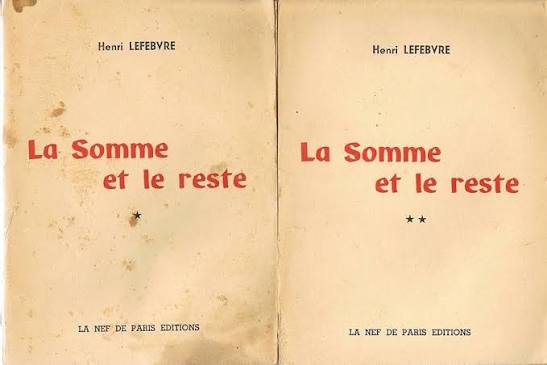
Writing La Somme et le Reste was clearly therapeutic for Lefebvre, his Proustian moment, reclaiming lost time and space, going backwards as a means to move forwards, to embrace an uncertain future. Interestingly, Lefebvre devotes a lovely section to Marcel Proust, writing fondly and admiringly about the novelist, about how it wouldn’t do Marxists any harm to read him more attentively; they, we, might learn a few tricks about how to engage with people and about how to understand a particular class of people.
I’d been reading a lot of Proust myself lately, wondering how to frame my own appreciation and enjoyment of him, musing on whether there could be any Proust for radicals. So I was keen to reread what Lefebvre had to say about an artist rarely associated with the Marxist tradition. (Walter Benjamin’s essay “The Image of Proust” and Michael Sprinker’s History and Ideology in Proust are among those rare exceptions.) Lefebvre is a fan of Proust, appreciates Charles Swann, Proust’s anti-hero, who, before marrying Odette, lived on the Quai d’Orléans, a seedier location near Notre-Dame, contrasting starkly to the prim and proper Right Bank of Proust’s other characters. Marcel, Proust’s alter-ego narrator, has his great-aunt exclaim that Swann’s quartier is “infamant d’habiter!”—disgraceful to live in!
Swann is maybe Proust’s most ambiguous character, a man of the world and, like Lefebvre himself, an inveterate dandy, a true aesthete out of place in the aristocratic pecking order; Jewish and ailing, he’s a tragic figure later ostracized because of his pro-Dreyfus leanings. Lefebvre never takes Proust as a snob—Swann, in fact, scorned snobbery. Nor did Proust hold the same views about life and reality as his aristocratic peers. By the time we reach the end of À la Recherche du Temps Perdu, Marcel knew two things: that he could become a writer and that all those aristocrats were really a bunch of shallow philistines, mediocrities at best, conceited good-for-nothings.
Is Proust a bourgeois writer? asks Lefebvre. “Of course,” he says, “but from where do you find a better and more authentic satire of the bourgeoisie? What caricatured canvas of the ‘class enemy’ is worthy as that of the Verdurin’s salon? What aggressive critique of bourgeois decadence attains the acuity of the analysis of Swann’s passion, this great love that commences by jealousy, which is to say, by a sentiment of ownership? We need only wish that one day socialist realism reaches an art as subtle as Proust’s and can arrive at a singularly powerful vision and Romanesque construction.”
Proust defended his Bohemian literary heroes like Baudelaire from bourgeois denigration, holding le poète maudit in the highest esteem. Proust knew Les fleurs du mal by heart, singled Baudelaire out as “the greatest poet of the nineteenth-century,” as the direct descendant, really the initiator, of “involuntary memory,” those sensory triggers that resurrect past moments of pleasure. Proust’s Baudelaire, though, isn’t the poet of doom and gloom but the courageous creative romantic, who “knows the art of evoking happy minutes,” “where life flows and stirs without cease.”
Lefebvre shares this affection for Baudelaire, whom he sees as a genuine original, a chip off the old literary block, the greatest poet of everyday life. Baudelaire’s poetry becomes especially sublime, says Lefebvre, when he gives up his quest for sublimity, when “the marvelous”—as the surrealists would have it—takes on an intensity of its own. Then, Lefebvre writes, with his own emphasis, Baudelaire “abandons the metaphysical and moral plane to immerse himself in the everyday, which from that moment on he will deprecate, corrode and attack, but on its own level as if from within.”
Lefebvre suggests there’s nothing in surrealists’ manifestos that hadn’t already appeared in Baudelaire. Baudelaire’s poetry, Lefebvre says, while condemning everyday life extracts the passion and beauty embedded in everyday life—its drama and delight, its loneliness and grandeur, the conflicting sensations of the horror and the ecstasy of life, which take on “a revolutionary meaning provided it is understood and situated by knowledge, by social criticism of people and ideas.” And, of course, to do so, critical thought must itself descend into everyday life.
This is pretty much how Lefebvre reads Proust, bedding down his oeuvre in the concept of time–not of clock time, of objective “standard” time, but of subjective lived time, the cyclical time of memory and recollection, of repetition. Lefebvre says that time in Proust has nothing in common with Henri Bergson’s notion of time. “The Romanesque or romantic time of Proust,” Lefebvre reckons, “doesn’t reduce itself to any philosophically conceived time, neither to Bergson’s nor Heidegger’s.” Lefebvre thinks Proustian time is a more musical, “intense and vigorous… more polyvalent.” Proust’s great novel manages to reverse aging, says Lefebvre, assuages its breakdown, and recaptures youth from the past; not in real time, but in memory and art, in the imagination and creation.
***
When Proust passed away in 1922, Lefebvre was a twenty-something philosopher spontaneously cohering around the development of humanist Marxism with other, similarly aged fellow-traveler philosophers; some, like Lefebvre, were disillusioned students at the Sorbonne; all were engaging with their rival Surrealists, headed by André Breton; all were reacting to Comintern Third International Marxism, especially to its dogmatism and reduction of Marx’s thought to economism.
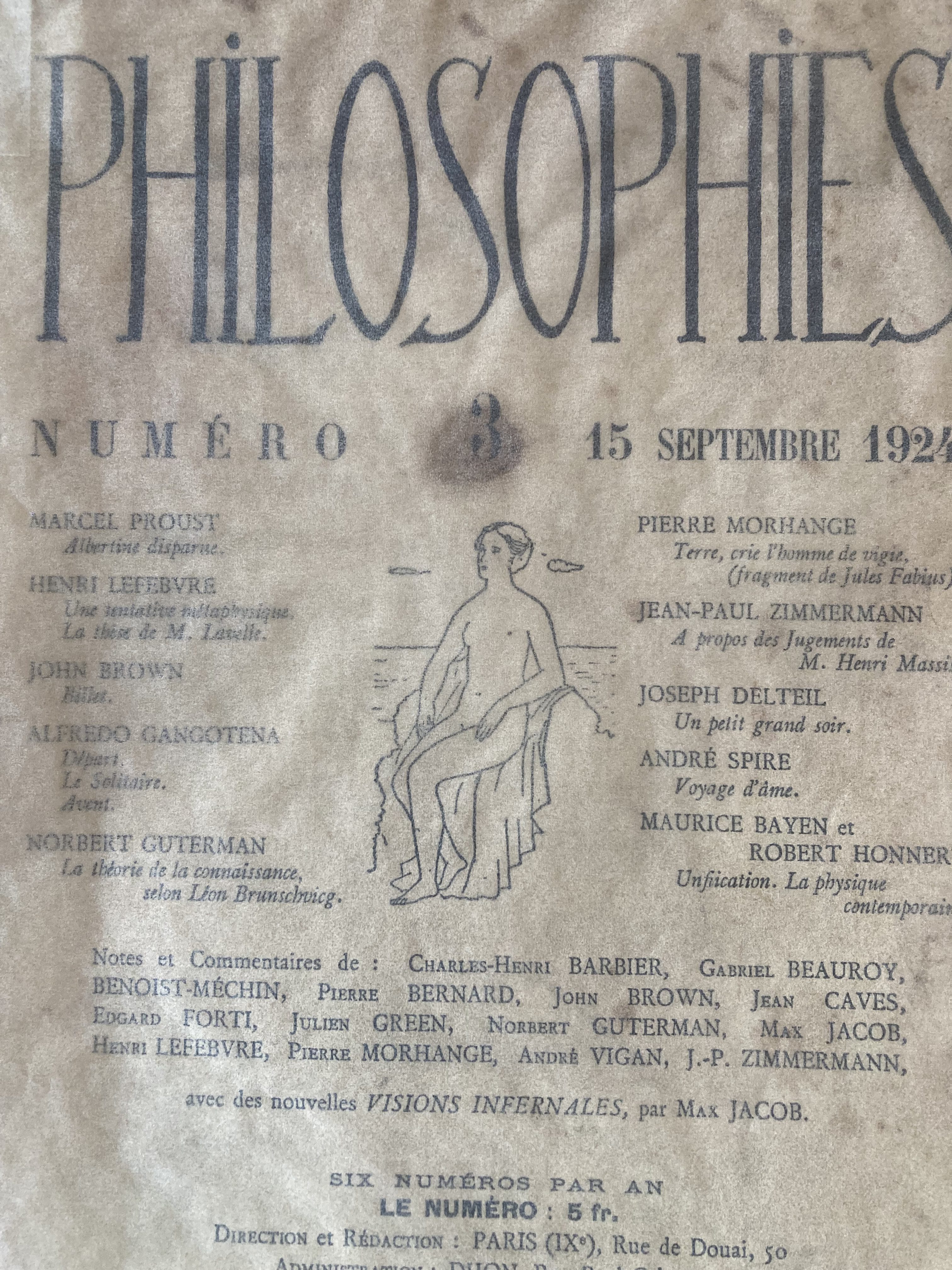
In 1924, this young group established their own journal, Philosophies, edited by Georges Politzer—with Lefebvre, Norbert Guterman, Georges Friedmann, and Pierre Morhange sitting on its editorial board. Lefebvre would soon join the French Communist Party (PCF), yet the journal itself was avowedly non-affiliated, radically open, discussing politics as well as new literature and art, featuring book reviews together with pithy commentaries on the state of knowledge and the world.
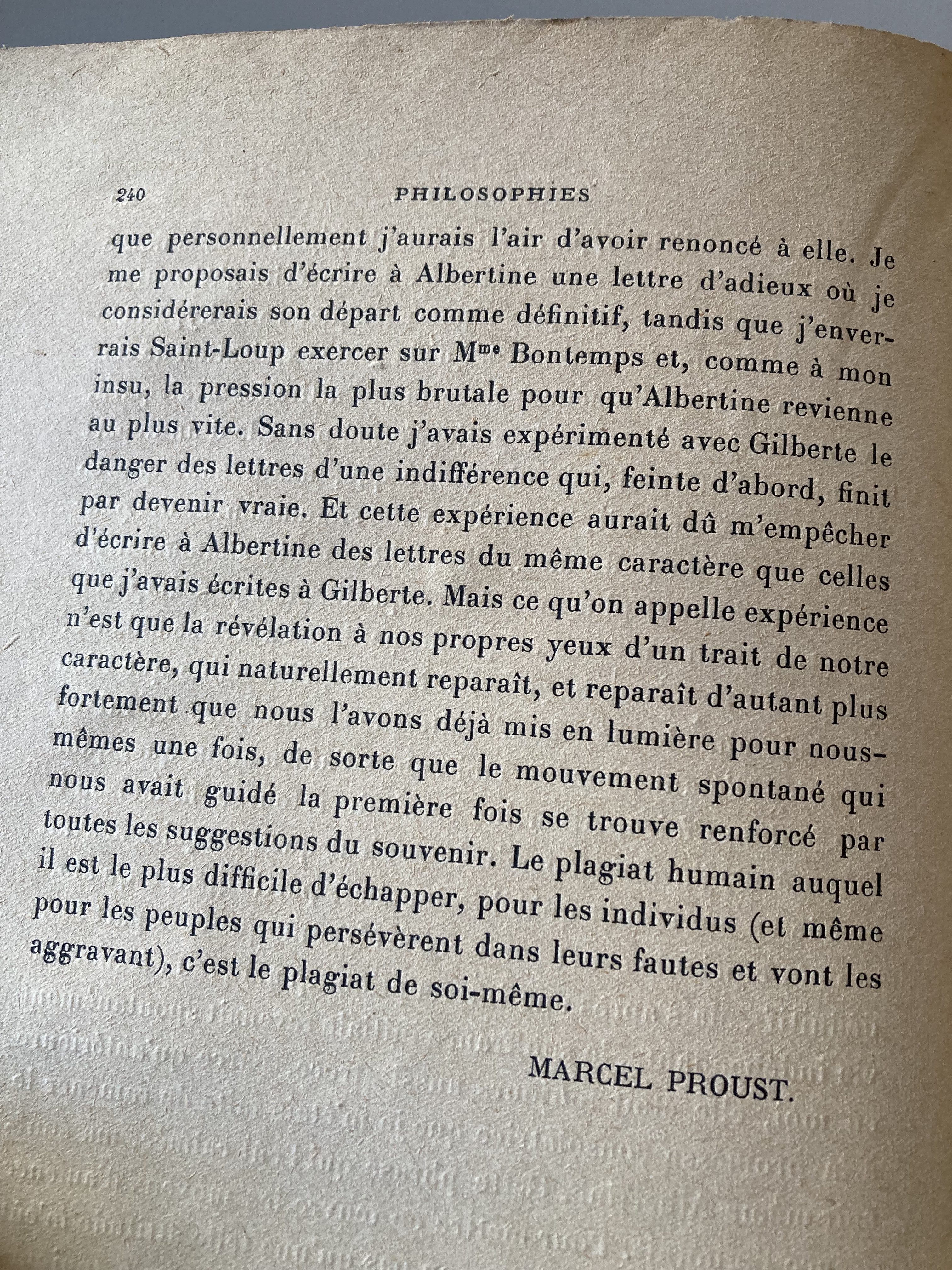
In issue number 3, dated September 15, 1924, Philosophies published, as its main event, a “fragment” from Proust, a posthumous extract from Albertine Disparue, a real coup for the editors. “I decided to write Albertine a letter,” wrote Proust in his extract,
in which I would regard her departure as final… exerting the most brutal pressure to make Albertine return as soon as possible. No doubt I had had experience with Gilberte of the danger of letters expressing an indifference which, feigned at first, ends by becoming genuine. And this experience ought to have restrained me from writing to Albertine letters of the same sort as those that I had written to Gilberte. But what we call experience is merely the revelation to our own eyes of a trait in our character which naturally reappears and reappears all the time more markedly because we have already brought it into prominence once of our own accord, so that the spontaneous impulse which guided us in the first occasion finds itself reinforced by all the suggestions of memory. The human plagiarism, which is most difficult to avoid, for individuals (and even for nations which persevere in their faults and continue to aggravate them) is the plagiarism of oneself. (C.K. Scott-Moncrieff’s translation.)
Lefebvre admits “it wasn’t only the works of Proust that enthused us: it was also the man himself, with his painful aspects, morbid and lamentable, with his conquest of his self over an illness that was partly feigned and self-perpetuated. We even went searching for him… a Proustian pilgrimage to Illiers (Combray), Pierre Morhange and me… The attacks ever since on Proust by ‘realist’ writers have exasperated me, on par with a few other stupid camps.”
Time in Proust bears an uncanny resemblance with the theory of time the philosophers’ group espoused at the time—notably with what Lefebvre would label “a theory of moments.” Conceived around 1925, this sought, among other things, to disrupt Bergson’s linear time, his durée, or duration. Creation, Bergson thought, is like the flow of an arrow on a teleological trajectory. “The line [of the arrow] may be divided into as many parts as we wish,” he wrote, “of any length that we wish, and it will always be the same line.” Life itself, Bergson insisted, unfolds in a similar temporality, and, according to him, we comprehend ourselves in this unbroken, absolute time: “we perceive existence when we place ourselves in duration in order to go from that duration to moments, instead of starting from moments in order to bind them again and to construct duration.”
Lefebvre despised Bergson. “If, during this period [1924-25], he writes in La Somme et le Reste, “there was a thinker for whom we (the young philosophers’ group) professed without hesitation the most utter contempt, it was Bergson. This feeble and formless thinker, his pseudo-concepts without definition, his theory of fluidity and continuity, his exaltation of pure internality, made us physically sick.”
“The duration,” Lefebvre says, “far from defining itself solely as linear and punctuated by discontinuities, reorientates itself like a curl of smoke or a spiral, a current in a whirlpool, or a backwash.” The moment is what Lefebvre on numerous occasions calls “the modality of presence.” Here, just as alienation reflects an absence, a dead moment empty of content, the Lefebvrian moment, like Proust’s moment of involuntary memory, signifies a presence, a fullness, something alive.
Lefebvre saw in Proust a novelist attempting to go against the grain of time’s arrow of progress, of the historicism held by some Marxists like Georg Lukács, where history can be reduced to an inevitable, almost deterministic, unbroken sequence of time, culminating in a definitive outcome. In response, Lefebvre constructed a framework of historical duration from the standpoint of the moment—from, in other words, the exact opposite pole to Bergson’s.
Writing in November 1913, Proust likewise distanced himself from Bergson (who was actually the husband of one of Proust’s cousins): “my book would perhaps be like an attempt at a sequence of ‘Novels of the unconscious’; I would not be at all ashamed to say ‘Bergsonian novels’ if I believed that, for it happens in every age that literature attempts to attach itself—post hoc, of course—to the prevailing philosophy. But that would not be accurate, for my work is dominated by the distinction between involuntary and voluntary memory, a distinction which not only does not appear in M. Bergson’s philosophy but is even contradicted by it.”
Proust is the nemesis of linear time. His time shifts and spirals, loops back and forth; past and present commingle in a complex feedback, even if the passage of real time escapes nobody. One of the problems about real time, however, is the destructive force of Habit—uppercase, as Proust sometimes uses it. Habit is the sort of thing Marx might have called a fetishism, something preventing us from directly encountering the world, throwing a veil over reality. Proust understands how habit comforts us through routine while at the same time dulls our perception of reality, turning everything into background noise. Art contrasts with habit—or should contrast with it. Art’s task is to undo habit, and, in Proust’s case, to unleash involuntary memory, which soothes the existential anguish of time passing, of life running away with itself.
In La Somme et le Reste, Lefebvre recognizes “the revolutionary aspect of non-linear time.” “It appeared to me,” he says, “a lot more essential: radical discontinuities blurred into a theory that placed involution, or its dissolution, on the same plane as revolution. Ultimately, I conspired that the theory of moments, considered as a unique philosophy and ontology, might eliminate the idea of human historicity.”
Lefebvrian moments are relatively autonomous instances of social reality, intense fragments of life that shatter routinized, alienated life. Each moment–be it of joy or love, of poetry or play, of justice or revolution, embodies within itself the “total realization of the possible,” and just for a moment “raises itself to the status of an absolute.” The separation between constraint and desire thereby withers away. Moments are located in everyday life, yet somehow expose the shortcomings of everyday life, and thus offer a critique of everyday life.
As such, Lefebvrian moment mimics the Proustian moment, confirming why the philosopher was so smitten by the novelist’s romantic universe. After all, moments for both men imply a certain notion of liberty and passion. “For the old-fashioned romantic, says Lefebvre, “the fall of a leaf is a moment as significant as the fall of the state for a revolutionary”—or, we might say, as the taste of a madeleine dipped in lime blossom tea, or the metallic sound of a spoon clinking against a plate, or a stumble on uneven paving in the courtyard of the Guermantes’ mansion. These are all keys, defining scenes in Proust, epiphany moments when dormant sensory detail get unlocked. The past is never truly lost: its momentary presence is preserved somewhere in our subconscious. “Relatively durable,” Lefebvre says, “the moment stands out from the continuum of transitories within the amorphous realm of the psyche.”
In a beautiful passage from La Somme et le Reste, worth citing at length, Lefebvre elaborates on Proustian time and its radical import:
Proust’s time doesn’t reduce itself neither to fluidity nor to the juxtaposition of states with overly determined contours, nor to irreversibility, nor to reversibility. Original presence doesn’t disappear entirely, except with death or with completion of the work which coincides with death. In one sense irreversible, time is in another sense reversible. It finds itself again, up to a certain point. The artist possesses this grace—or this favor—because they deserve it and earn it at the price of constant effort. Proust’s work constructs itself, laboriously ascending the course of time instead of following it or surrendering to it. It regains youth, childhood, recaptures primordial—inalterable yet ever-altered—impressions bestowed upon the newborn human being by the successive birth of emotions and sentiments: contact with a mother, with flowers, with water and the sky, with the landscape and the earth, with people and the world. In terms that were not employed with the same abundance thirty years ago as they are today, this work powerfully structured, organizes itself—much like musical time—in an internal and vigorous manner.
***
The other thing about the 1920s we glean from La Somme et le Reste is how Surrealism was never far from Lefebvre’s purview; nor was it very distant from Proust’s. Over the years, Lefebvre made no bones about his ambivalence towards surrealism, calling movement, not entirely complimentary, “a revolutionary micro-society.” Yet it was always somehow there in his imaginative drive, and in his generation’s formative phase.
Lefebvre admired and detested Breton, seemingly in equal measure, remembering his first encounter with the man himself: October 1925, a crucial year for Lefebvre, in Breton’s Paris apartment-atelier at 42 rue Fontaine. Lefebvre, impressionable, five-years Breton’s junior, noticed on the surrealist’s desk a giant brick of a tome—Hegel’s Science of Logic. “You haven’t read this?” enquired Breton, condescendingly. “Read it first and then come back to see me.”
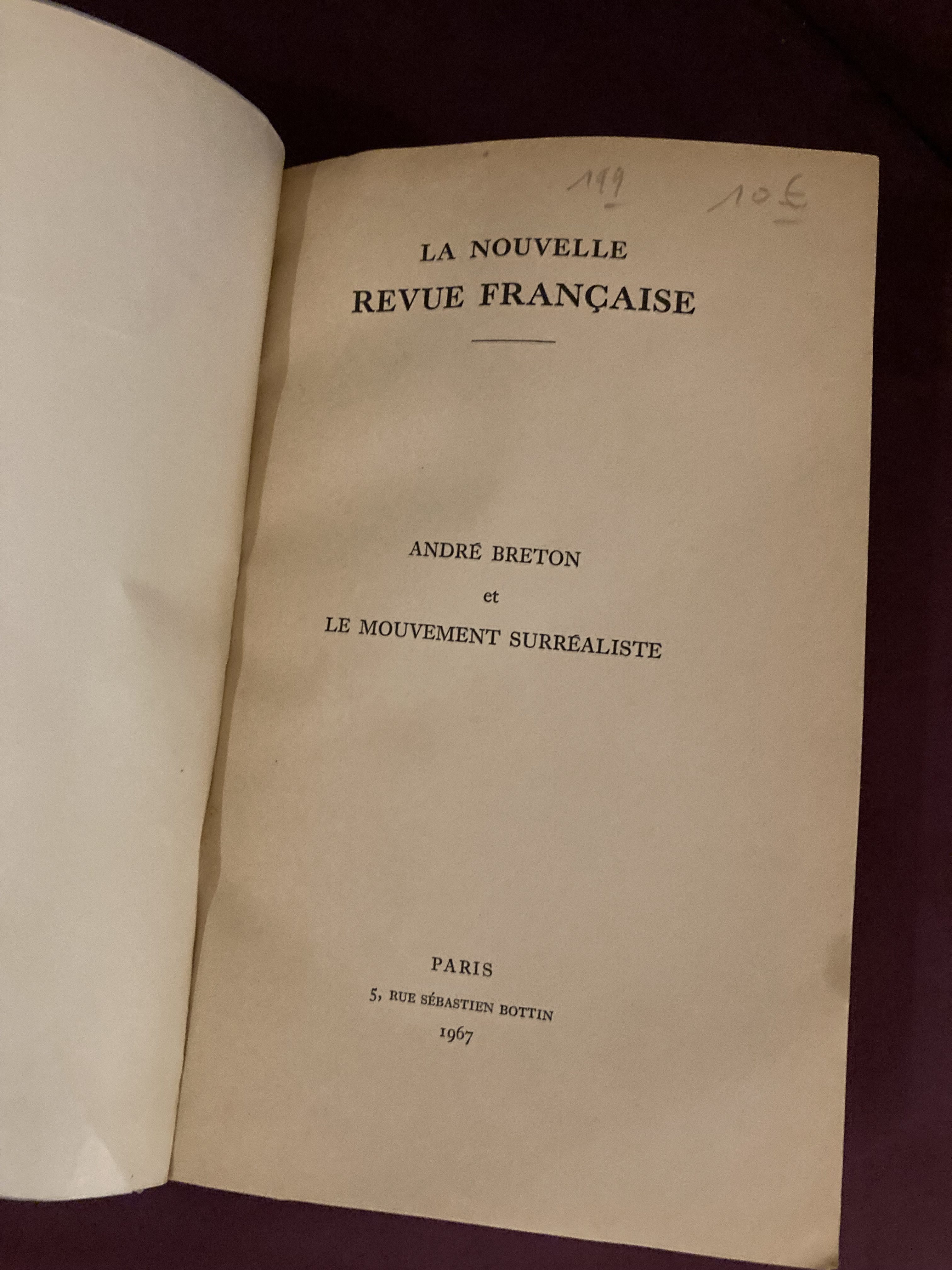
After Breton’s death in 1966, Lefebvre contributed a brilliant essay in homage to Breton, entitled simply “1925,” published on April 1, 1967 in La Nouvelle Revue Française. It was a bitingly honest reflection on that watershed year for Lefebvre, which marked the end of one epoch and the beginning of another, an adieu to youthful idealism. 1925 witnessed a narrowing of the horizon and Lefebvre’s inauguration into life’s hard facts. The twenty-four-year-old was entering the world like Joyce’s young artist Stephen Dedalus: to seek his misfortune.
The break between surrealists and philosophers’ group was definitive. Both agreed on the notion of refusal, on a rejection of interwar bourgeois society, yet disagreed on the perspectives of this refusal. “Our intuition or intention left a place for poetry,” Lefebvre writes, “to research and to chance discoveries [trouvailles], to adventures towards the possible, but the surrealists gave a premature conclusion and solution to this problematic of ‘the possible’.”
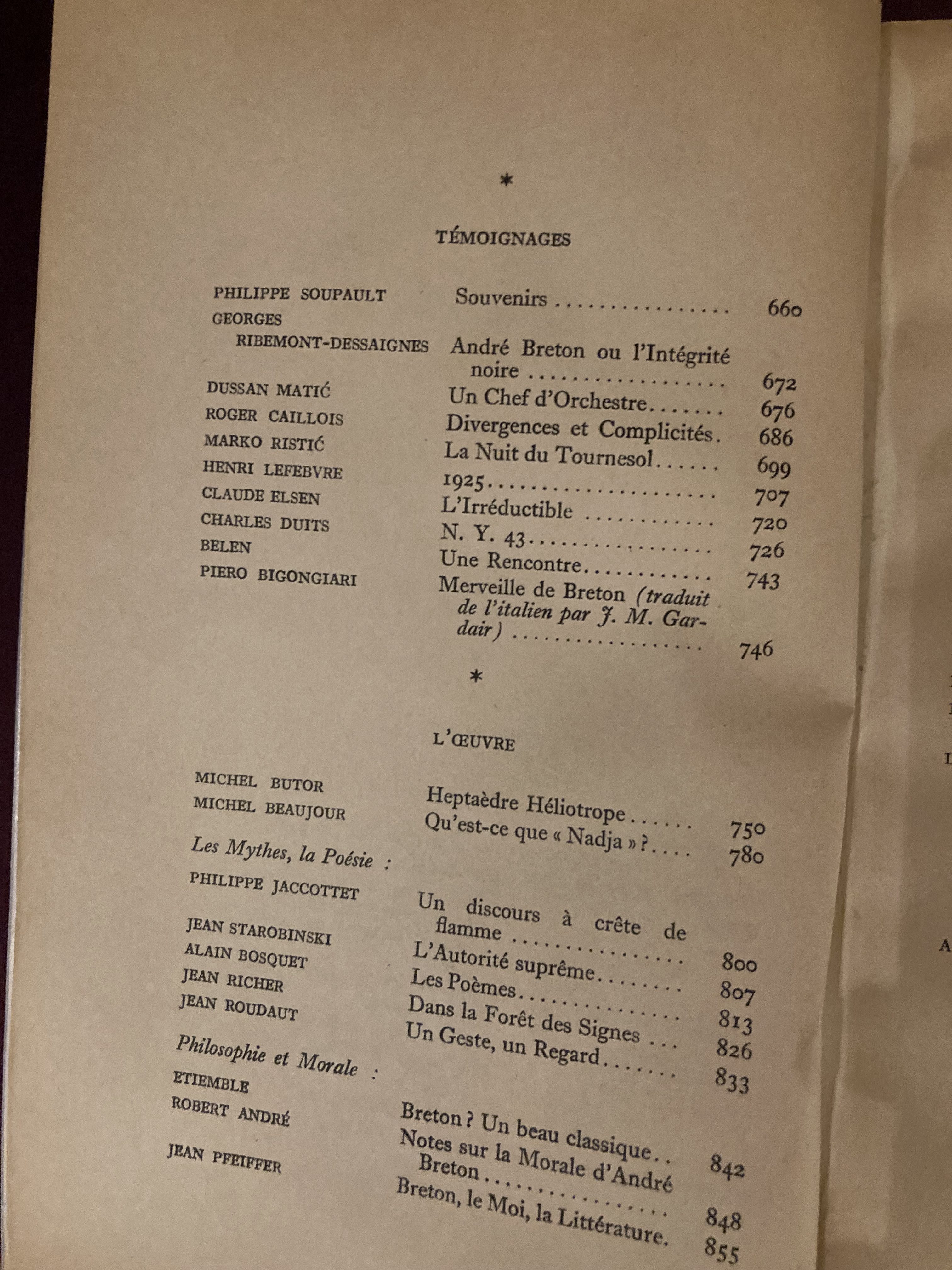
“I could have become a surrealist,” Lefebvre maintained, “if it hadn’t been for André Breton’s insufferable personality,” for his “megalomania.” “So,” Lefebvre confesses, “I’ve never been a ‘surrealist’ and am not one now. But I come from the era and the exigencies that led to the eruption of surrealism… Surrealism exaggerated (an untenable) romanticism and expressed contempt for the platitude and prose of the world, hatred of both flat unhappiness and flat pleasure.” Lefebvre concurred, equally agreeing with their “implicit hypothesis that only the most extreme and excessive images make it possible to grasp in its contradictory depth the real in both man and the world.”
A few years prior to Lefebvre encountering Breton, when the budding surrealist was cash poor and needed a job, Breton had his own very personal encounter with the reclusive novelist. In April 1920, Gaston Gallimard recruited the young poet to work at La Nouvelle Revue Française, earning 400 francs per month (around $28), dealing with the journal’s subscriptions and correspondence with authors, but also, more notably, acting as a proofreader for none other than Proust himself. It’s the only instance of Breton having the paid work he so despised; wage-labor, he’d say eight-years on in Nadja, wasn’t where life’s meaning was at.
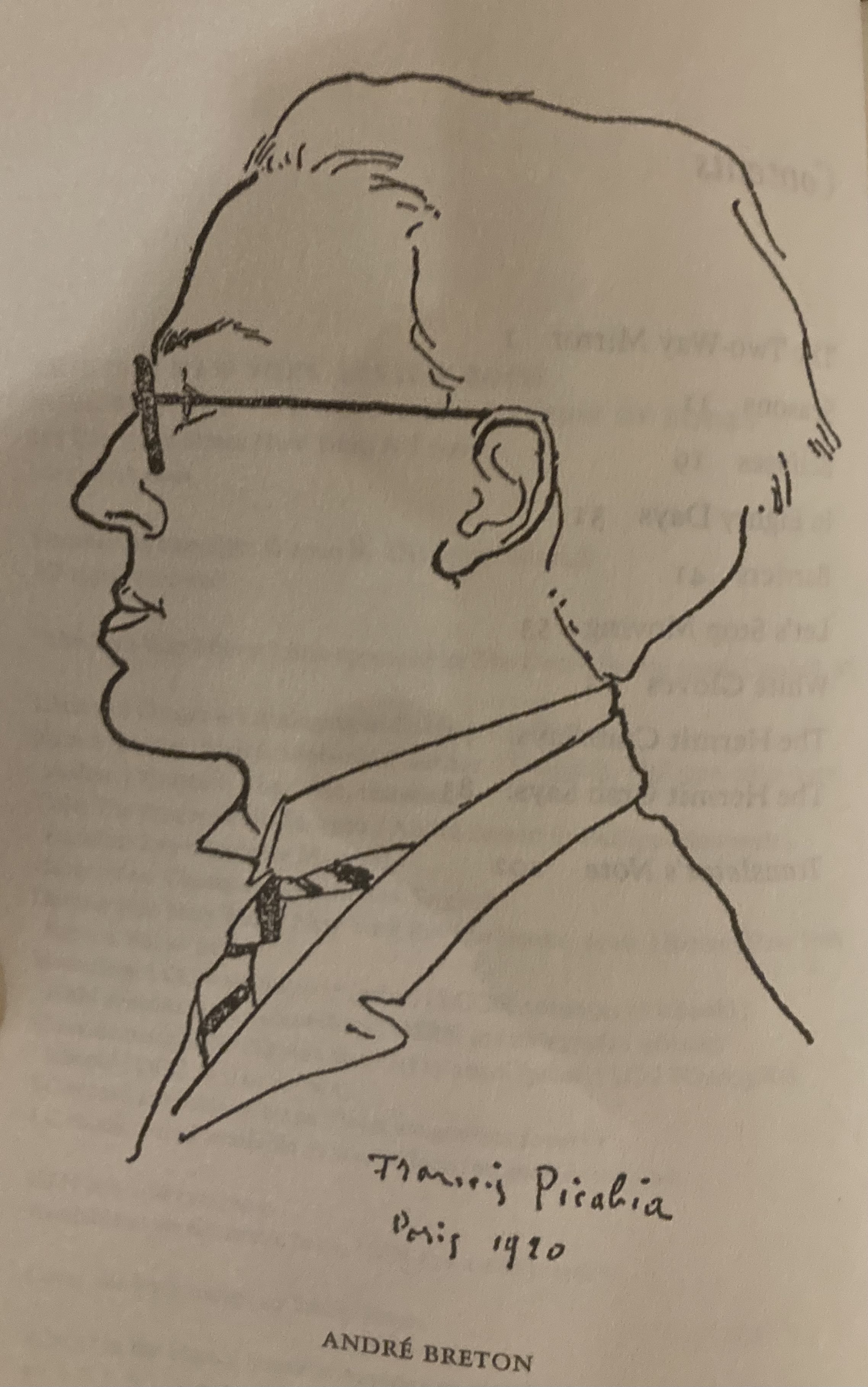
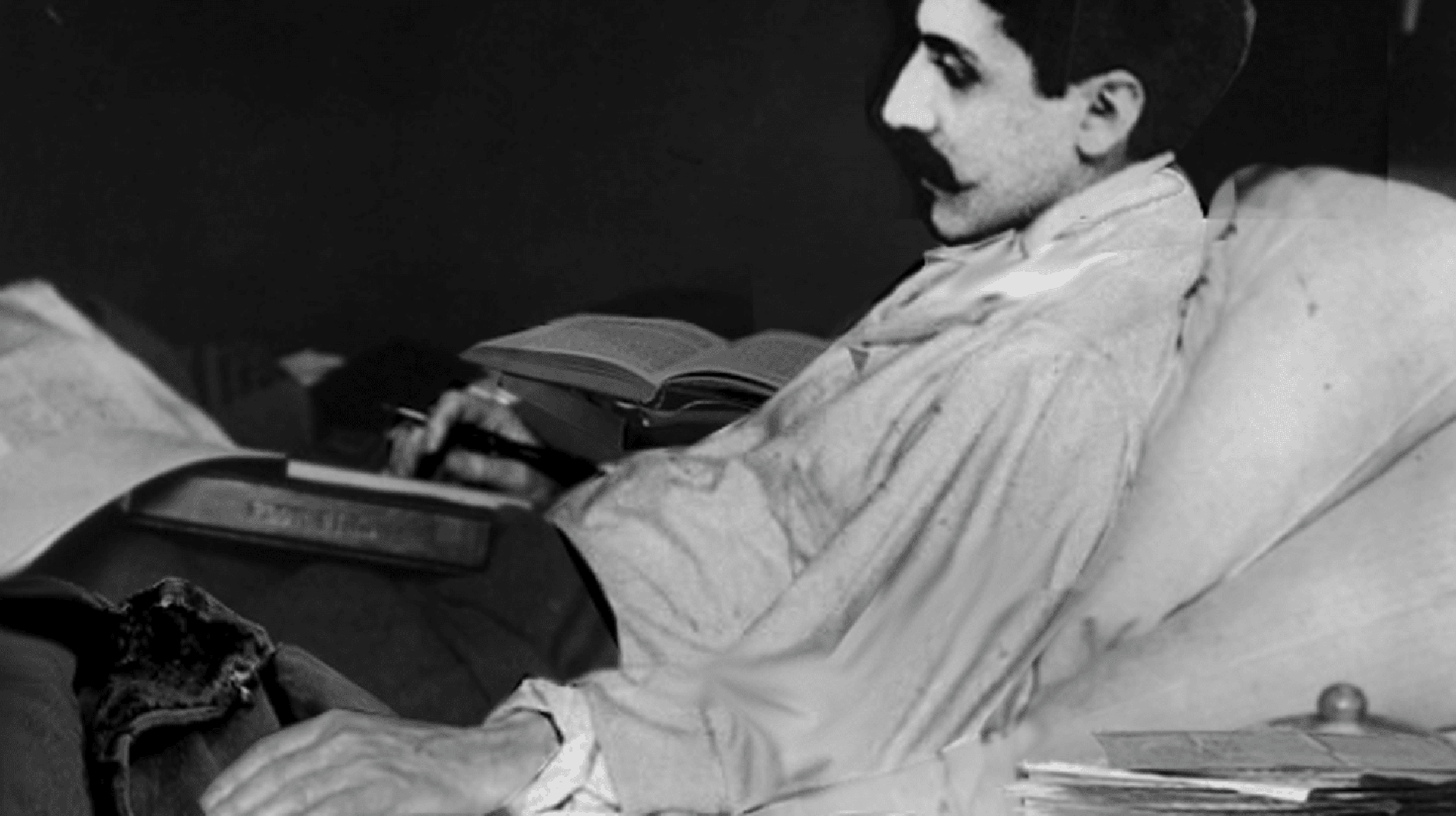
Proust only ever worked at night, exclusively at home, so Breton was obliged to start work at 44 rue Hamelin at 11pm. On his debut visit, Breton had already eaten supper. Yet when he arrived, Proust insisted on a sumptuous dinner, a delivery from the Ritz hotel! Proust ate none of it himself, surviving exclusively throughout the evening off strong café au lait. (So fueled with caffeine, reputedly consuming around seventeen cups of coffee each day, Proust hardly ever slept.) Breton politely consumed the meal, knowing next time to desist from eating.
Breton’s aesthetic tastes never really tallied with Proust’s, weren’t his cup of tea; but he warmed to the man himself, and remembers Proust as “extremely charming and unfailingly friendly,” a gracious host, appreciative of the young man who spent entire evenings, until dawn, reading aloud in his resonant voice the galleys of Le Côté de Guermantes. He’d always hold a fond memory of spending time with Proust. “With the incessant additions and revisions,” Breton said, and with those famous paperolles glued to the side of manuscript, entering Proust’s work felt like entering “a vast literary labyrinth.” In later interviews, Breton softened his opinions about Proust’s writings, saying that he held an “intense admiration” for his “poetic treasures.”
Proust himself had been enthusiastic about Breton’s and Philippe Soupault’s Magnetic Fields (1920), the duo’s initiation into the poetics of “automatic writing,” where physical and mental impulses are understood as a forcefield of perpetual vibration, and where everything interferes and communicates “wirelessly.” Soupault, whose mother knew Proust, had written a long letter to the novelist, enclosing a copy of Les Champs Magnétiques. Soupault remembers seeing Proust when he and his mother vacationed at the Grand Hotel in Cabourg, a well-known Proust haunt and proxy town for Balbec; and late one evening, in Paris, not long after sending Proust his and Breton’s book, Proust’s chauffeur rang Soupault’s apartment bell, asking him to come down and talk to Monsieur Proust in the back of his taxi; “muffled up,” Soupault recalls, “his eyes glowing like an owl’s.”
Proust apologized for disturbing him in the dead of night and for not getting back to him sooner, thanking Soupault for the gift of their “audacious” and “major” work. Likely Proust appreciated their idea because his own rapid-fire, convoluted prose, written as he said au galop, at a galop, is itself a sort of impulsive automatism, where involuntary memory is freeze-framed on the page. It took one to know one: Proust may have been the real pioneer of automatic writing. Was he the first surrealist? Or was Breton the first Proustian? Céleste Albaret, Proust’s devoted housekeeper, the thinly disguised model for “Françoise,” said in her memoir Monsieur Proust that she’d never seen anyone write as quickly as Proust, at such lightening speed, always semi-recumbent, in bed, bundled up again the cold, using his knees as a makeshift desk, displaying astonishing writing stamina despite ailing health.
Breton didn’t last long at Gallimard nor as Proust’s aide; a poor proofreader, his heart was never really in it. The first galleys of Le Côté de Guermantes, the third volume of À la Recherche du Temps Perdu, were riddled with more than 200 errata, later spotted by Proust yet seemingly missed by Breton. I say “seemingly” here because, as Franc Schuerewegen, a French literature scholar at the University of Antwerp, would have it, Breton purposelessly made a hash of proofreading Proust: for in Proust he’d recognized a masterpiece of automatic writing that he and Soupault thought they’d developed in Les Champs Magnétiques.
Schuerewegen reckons Breton tried to sabotage Proust’s manuscript, not only missing details but deliberately misplacing names, like that of “Bergotte,” Proust’s famed writer (based on Anatole France) and hero of young Marcel, replacing it with “Bergson,” after Henri, the famed philosopher, knowing full well he was pulling a fast one. Proust had promised Soupault an extract of le Côté de Guermantes for his and Breton’s surrealist revue Littérature, yet was late in handing it over, delayed, he said in a letter to Soupault (September 21, 1920), not because he didn’t want to, more that he had so much work to finish off on his volume, correcting all its faults: “your friend Monsieur Breton bears half of the blame,” Proust wrote. (The promised extract never materialized in Littérature.)
Breton was jealous of Proust, says Schuerewegen, “and in a manner a little infantile, like a child who breaks the toy of another infant to spite him,” he ensured “that the beautiful text he had before him wasn’t passed on to the public as it was, but rather reached them in a mutilated, distorted, and truncated version. Proust uncovered the scheme and managed to put a stop to it just in time.”
***
In le Côté de Guermantes, the narrator Marcel, hitherto interiorized in his closeted inner life, enters into a wider outside world, mingling with “worldly people,” les mondains, the alluring universe of socialites; only soon to distance himself from their social hierarchy, from their banal and vulgar antics, condescending to those with a genuine sense of taste, justice, and beauty. The glamor of those fancy soirées seen from the outside rapidly became trivial and shallow when encountered on the inside. Proust’s “worldly” aristocrats were full of pettiness, coldness, and inbred stupidity.
For years, an adolescent Marcel had been infatuated with the aloof Duchess of Guermantes, often waiting in street on the lookout for her walking alone, repeating to himself how, “The street belongs to everyone.” Marcel, Proust writes, “marveled at the thought that in the crowded street, often drenched with rain and made precious like the streets of some Italian towns, the Duchesse de Guermantes did indeed mingle the moments of her own secret life with the public world, on view to everybody, a mysterious presence jostled by everybody, with the splendid wantonness of the greatest works of art.”
And yet, after a while, growing up and seeing the duchesse operate at close quarters, Marcel muses, “[t]he atmosphere surrounding Madame de Guermantes, after existing for years in my mind only as the reflection of a magic-lantern slide and of a stained-glass window, began to lose its colors when quite different dreams impregnated it with the bubbling water of fast-flowing streams… the fairy wastes away when we come into contact with the actual person to whom her name corresponds, for the name then begins to reflect that person who contains nothing of the fairy.” Even Proust’s savage take downs are full of lyrical charm!
Céleste Albaret says that Proust’s politics were more radical than a lot of people might have imagined. “He admired the feeling and intelligence of another friend of his youth,” Albaret says, “Léon Blum, one of the luminaries of the Socialist Party.” Proust likewise held in high regard the other socialist leader, Jean Jaurès, assassinated in 1914 because of his passionate pacifism. “He was a great man,” Proust told Albaret, “and a brave one. The only one who could have saved us from this stupid war.” Albaret confirms how Proust was “shattered by his murder.”
The Dreyfus Affair (1894), when the Jewish army captain Alfred Dreyfus was falsely accused and convicted of treason, “had also been very important to Proust,” adds Albaret. “You might have expected him to be timid, to be anxious to keep out of such conflicts, but he told me how he threw himself into the struggle and went to all the court hearings. He extolled Emile Zola and all those who defended Dreyfus for their courage… It was clear,” says Albaret, “that, as always, what had disgusted him the most was what he had seen at once—the deceit and injustice of the trial and the sentence. It was terrible.”
After Proust’s death, the Soviet’s decided that Proust could teach revolutionaries a thing or two about culture, and not just about bourgeois culture in the west. In 1936, the Russian edition of International Literature told its readers that they “are bringing out translations of Hemingway and Proust not merely in order to demonstrate ‘bourgeois decay’. Every genuine work of art,” they said, “and such are the productions of Hemingway and Proust, enriches the reader’s knowledge of life and heightens their aesthetic sensibility and their emotional culture—in a word, it figures in the broad sense, as a factor of educational value”
“This morning I was rereading something in Saint-Simon,” Proust’s Swann says in a conversation with Marcel’s grandfather and two aunts (his grandmother’s sisters), “that would have amused you. It’s in the volume about his mission to Spain; it’s not one of the best, hardly more than a journal, but at least it’s a marvelously well written one, which already makes it rather fundamentally different from the deadly boring journals we think we have to read every morning and evening! ‘I don’t agree, there are days when reading the papers seems to me very pleasant indeed,’ my aunt Flora interrupted… ‘When they talk about things or people that interest us!’ said my aunt Céline, going one better. ‘I don’t deny it’, answered Swann with surprise. ‘What I fault the newspapers for is that day after day they draw attention to insignificant things whereas only three or four times in our lives do we read a book in which there is something really essential.”


