
Something thrilling arrived in the mail a little while ago—in the snail mail, I mean, the real post: a complete set of the 1920s French revue Philosophies, purchased from a Roman antiquarian bookseller at considerable cost (don’t ask how much!), all six issues (actually only five physical specimens because numbers 5 and 6 were combined into a double header). The revue ran between March 1924 and March 1925, a whole year, on whose editorial board sat Henri Lefebvre, writing, as a twenty-three- and twenty-four-year-old, some of his most prominent journeyman essays there, wide-ranging polemics and critical reviews from a young philosopher learning his craft. On show, we might say, was “Early Lefebvre,” an Henri Lefebvre in gestation, an Henri Lefebvre before he became Henri Lefebvre.
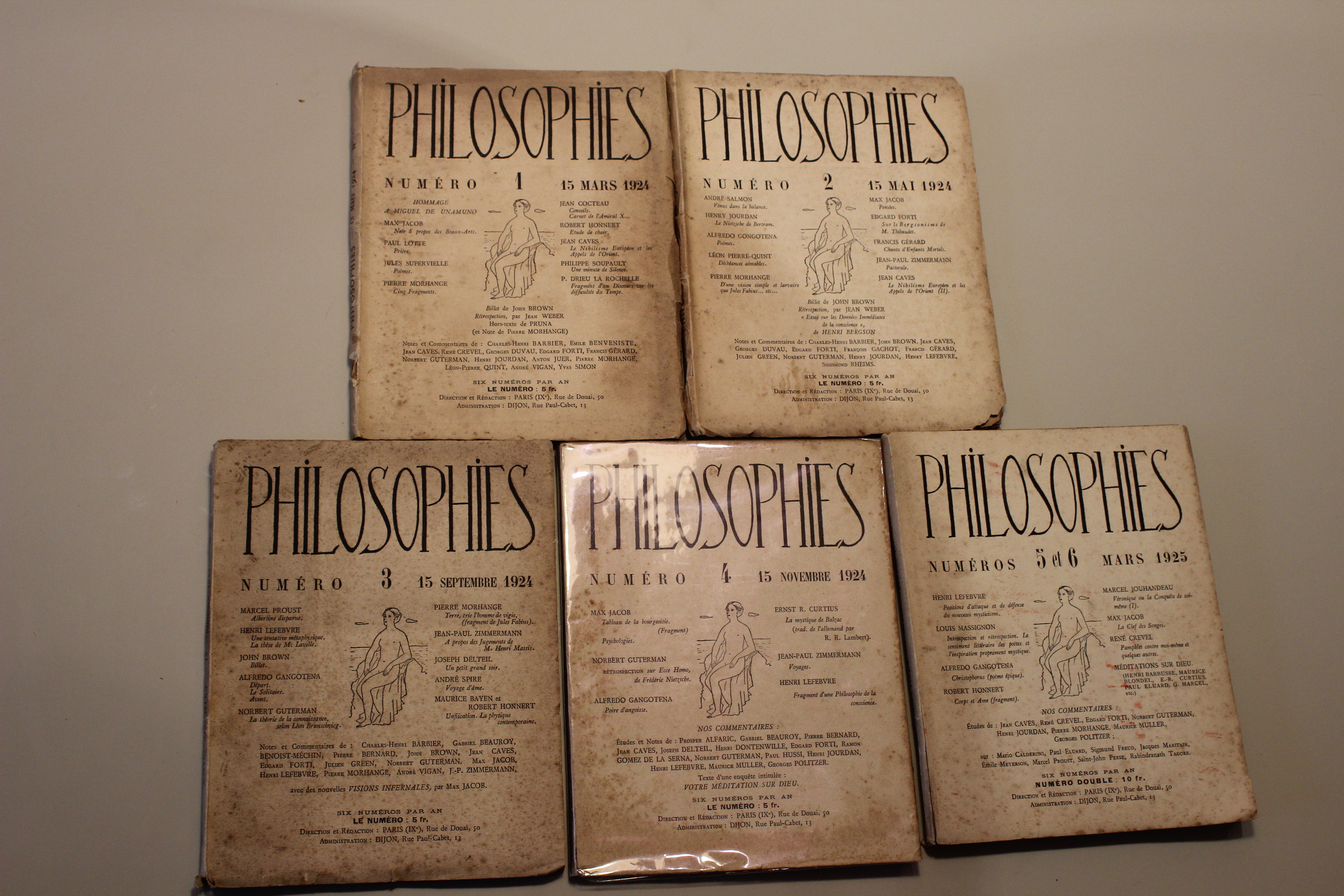
What a treasure trove to behold! Not only to read the assorted articles, but also to leaf through the yellowing, frayed yet still intact pages, to feel the quality of a magazine whose copies are amazingly well preserved given their age: over one-hundred-years old! Philosophies promoted itself as “the organ of the New Literary Movement,” a review that sought “to realize CONTEMPORARY HUMANISM” (uppercase); a new movement “dedicated to POETRY, ANALYSIS, and the rebirth of PHILOSOPHY” (again uppercase usage). The scope and breadth of the ideas and contributions was unprecedented at the time in its reach, containing pieces from the likes of Max Jacob, Henri Barbusse, Jean Cocteau, Pierre Drieu La Rochelle, Philippe Soupault, and Julien Green, extracts from the works of Marcel Proust and Friedrich Nietzsche (Ecco Homo), short critical commentaries and book reviews (of Proust, Freud, Eluard, Tzara, Cocteau, Joyce, Bergson, and Brunschvicg), as well as fragments of works in progress and scattered poems in both prose and verse. (In a letter on April 27, 1924, to Lady Rothermere, T.S. Eliot said that he considered Philosophies one of the most intelligent journals in France.)
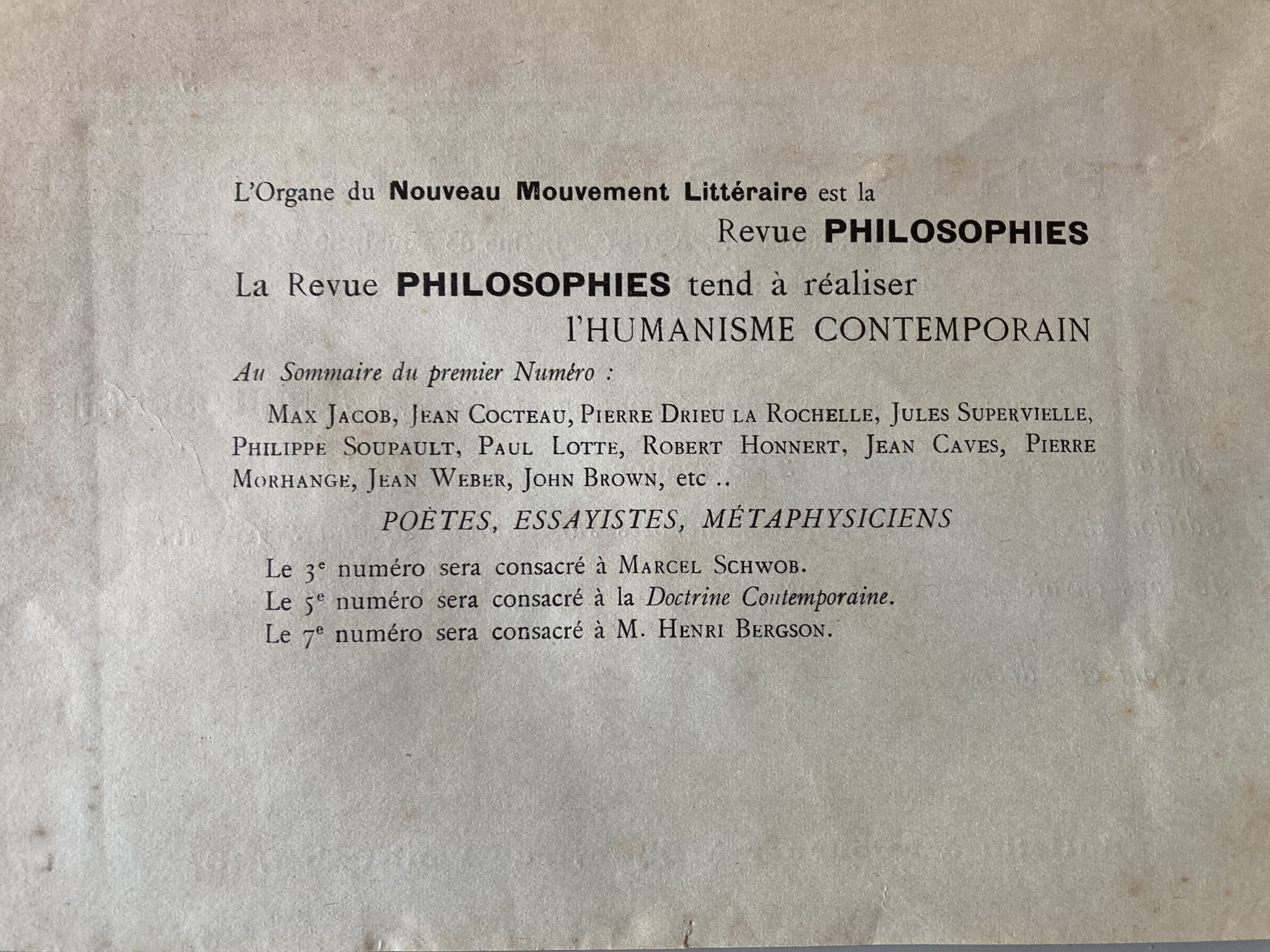
The literary flavoring of Philosophies is striking, even at first glance, but equally is its lofty philosophical ambition, its attempt to conjoin (and reconcile) the philosophical with the poetic, the ethical with the aesthetical, developing and affirming its dialectical relationship, doing so politically. Lefebvre admitted decades later that “the articles published in our revue Philosophies were sometimes close to the philosophical tendency of phenomenology… and a little of everything: of existentialism, of psychoanalysis, of ontology. We inhabited a ‘lair of premonitions’, ‘the laundry room’, editor-in-chief Pierre Morhange called it.” (Morhange penned his own pieces frequently under the pseudonym “John Brown.”) When Lefebvre wrote in La Somme et le Reste that he “loved too much the bubbling and the ferment of concepts that burst out new and fresh,” he could’ve easily been describing the agenda of Philosophies, so intense and exciting were its outburst of ideas.
With its non-aligned radicalism (Cocteau and Drieu la Rochelle were, after all, on the Right), it was perhaps inevitable that the revue’s effervescence, like a Lefebvrian moment, would quickly peter out, its fizz being relatively short-lived. Maybe Philosophies was too radically open for its own good. Lefebvre hinted as much: “I wanted its orientation more defined,” he said, “whereas Morhange wanted to make it more general and universal, welcoming a bit of everyone, including people like Jean Cocteau, Albert Cohen and Drieu La Rochelle. As for me, I was against this eclecticism. For example, I was furious when we met Cocteau. I couldn’t help but feel a sort of juvenile disdain for the man. Perhaps wrongly, but that’s how it was.” (André Breton, incidentally, shared this disdain, hating Cocteau even more vehemently than Lefebvre.)
It was Lefebvre’s contributions that interested me the most; they were the real motive for my purchasing Philosophies. Above all, I was especially keen to see his oft-cited review of Tristan Tzara’s Seven Dada Manifestos. But there were other nice surprises in store. One was glimpsing Lefebvre writing again about Marcel Proust, defending Proust from an attack by Ramon Fernandez that had appeared in the Nouvelle Revue Française (April 1, 1924). Debate here surrounded the philosophical problematic of what Proust called “Les Intermittences du Coeur”—“The Intermittences of the Heart”—a famous section in Sodom and Gomorrah, originally intended as the title for the whole of this fourth volume of À La Recherche du Temps Perdu.
In it, Proust illustrates how an involuntary memory-jolt can suddenly bring back the vivid presence of a departed loved one, which, in this case, is Marcel’s grandmother, her leaning over him, undressing him as a young boy upon their arrival at Balbec. Proust, says Lefebvre, shatters the oblivion of daily life and reveals the painful contradiction between the chronology of real events and the chronology of sensory emotions, “that anachronism,” as Proust puts it, “that so often prevents the calendar of facts from corresponding to that of our feelings.” Someone dear to us dies and we’re upset, pretty devastated. But our real grief and grieving only occurs some time thereafter, later on, often triggered quite by chance, by some involuntary incident. Proust’s oeuvre, Lefebvre thinks, is a brilliant work of art predicated on lived experience yet somehow an artform that takes us beyond lived experience.
Still, it isn’t, Lefebvre says, anything Fernandez suggests, isn’t any kind of metaphysics that can be critiqued as such. À la Recherche du Temps Perdu, “vibrates with an incomparable force distinct and superior to the life of its motifs and of the beings that it contains.” The dialectic between intelligence and Being lies at the core of Lefebvre’s beef with Fernandez. “In Proust,” Lefebvre says, “intelligence is as much what moves and motivates as what immobilizes and judges. It is thus something quite different from what Monsieur Fernandez claims it to be. A sensory and affective impression is what draws us towards things and what anchors and defines them for us… Indeed, this only makes us better appreciate the beauty of the sacrifice Proust made for his art—choosing, in his maturity, not to seek a higher form of life, but rather to more fully grasp the nature of abandonment and fragmentation.”
One thing fascinating throughout Philosophies is the total absence of Hegel and Marx, who are nowhere on the revue’s agenda. It’s amazing to read a Lefebvre silent about Marx, not having yet discovered the mighty thinker, not yet a self-avowed Marxist. The young men who founded Philosophies all came of age in the chaos and collapse of Europe during the Great War, all witnessing value systems crumble, all sensing a crushing destruction still looming around them, still haunting the continental landscape. The revue itself was conceived to invent new values, and to revalue old ones, growing as a venture out of the alienation and disgust for the bourgeois capitalist order. And yet nowhere is Lefebvre and his coeditors able to define this alienation and disgust with any conceptual clarity.
This is evident in Lefebvre’s review of Tzara’s Seven Dada Manifestos; an odd piece, really; its tonality is more satirical and ironic than I’d imagined, perhaps even more critical. Lefebvre spends a lot of time situating Dada in its philosophical context—in the context of Schopenhauer, Bergson and Nietzsche. Lefebvre is a fan, up to a point. Dada was necessary, he says, significant in its negativity, but it leaves us wondering what might come next, what might be positive, what is reconstructive after all the destruction.
Tzara was the disgruntled son reacting to his father’s generation, to the warmongers and soft liberals. He’s the long lost heir of Bazarov, the brilliant “nihilist” from Turgenev’s Fathers and Sons, who had no palate for past romanticism and wanted to sweep everything away. “Art, poetry…everything?” “‘Everything’, repeated Bazarov with unutterable calm… ‘At the present time the most useful thing is negation—so we deny. The first thing is to clear the ground’.”
Compared to Dada, says Lefebvre, Surrealism offers only a phony transcendence. It considers itself daring, but pales in the face of the whirlwind force of Dada. “Dada doesn’t seek to provide us with a cosmic soul (which, in its broadest sense, could be understood as the problem of Surrealism). It ceases its destruction precisely at the point where it would become a construction. Dada refutes everything, refutes logic, intelligence, believes it is creating when it destroys—or, rather, it deliberately conflates the two concepts.”
“Dada negates everything,” Lefebvre continues, “including itself. It proclaims in vain the sovereignty of the moment, the primacy of the ‘globule of the second’…
To be consistent, the Dadaist must deny the flash the very instant they’ve glimpsed it. Dada’s negative is defined categorically as a negation whereas it should elude any definition. It therefore rejects with consummate ease. Moreover, Dada refutes itself; it speaks, stutters, arranges words; it conjures up images that are sometimes amusing; it succeeds—what a pleasure for us to discover that Dada succeeds at something! At that moment, when it blissfully reveals itself, Dada is no longer Dada. It has demolished the world. But the broken pieces are sound; nothing is as funny as seeing Dada deploy these pieces. It believes it is inventing, but it is only reassembling the puzzle using the debris… Dada smashes the crockery with great clatter; yet it gathers up the little shards from which one can still make out insipid flowers and hideous gilding. Poor Dada… The candid pretensions of its manifestos will doubtless provoke a smile; and yet despite its naiveties, Dada is the representative spirit that says ‘no’, the embodiment of a feigned madness carried out to its ultimate conclusion. Through Dada, we can evaluate the bold ventures of certain innovators.
Over half a century afterwards, in a series of interviews assembled in Le Temps des Méprises [The Time of Mistakes], Lefebvre commented that each time he’d see his friend Tristan Tzara (who died in 1963), the latter would ask: “‘Well, have you collected up the pieces yet?’ ‘No’, I’d always say, ‘because I want to smash them up more!’” Lefebvre forever pledged his allegiance to Dada and Tzara over Breton and Surrealism. “If I had to define my relationship with the avant-garde,” he said, “I’d attach myself to Dada… From its first manifesto in 1918, Dada condemned the West’s logocentrism and eurocentrism with a deliberately infantile formula: Dada was the first and final stammer. When Tristan Tzara, young and fiery, proclaimed that Europe—its thought and politics and all it had once been—was nothing but boom-boom-boom, this went very far. It was a puerile term that stunningly evoked the drums of infancy, of grand military bands, of politicians’ rhetoric, of exploding bombs.” In the end, Dada was “like a hypodermic jab in the nerve center of modernity,” and the exquisite pain of its needle point was, like a vicious, final bee sting, a prelude to its own demise.
There’s another radical spirit prowling the pages of Philosophies, a quieter one: Max Jacob, cubist-surrealist poet, mystic, and gay bohemian who seemed the very incarnation of what bohemianism was all about. Poor denizen of Montmartre, shacked up in a dingy hovel along rue Ravignan, near the famous Bateau-Lavoir, where his friend Picasso lived and worked, Jacob was of an older generation, twenty-five years Lefebvre’s senior, on close terms with Gertrude Stein, Coco Chanel, Jean Cocteau, and Amedeo Modigliani (who painted several portraits of the poet). In 1915, Jacob had a spiritual epiphany, witnessing an apparition of Christ shimmering on the wall of his Montmartre room, a vision that would profoundly shape the future trajectory of his life—prompting Jacob, a Jew, to convert to Catholicism and live out an ascetic life, semi-reclusive, devoting himself to prayer, painting, and poetry.
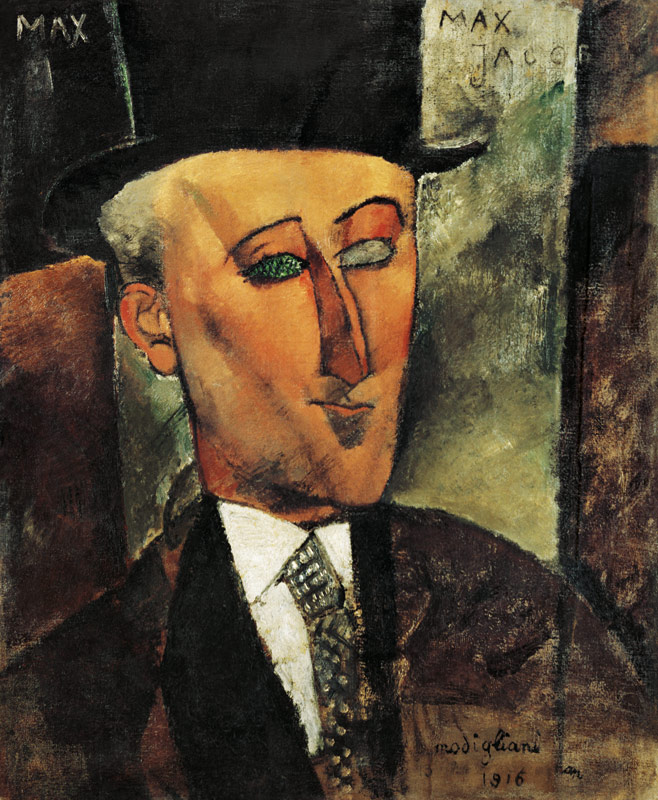
Yet Jacob was tormented soul, full of contradictions, and could also be a ridiculous exhibitionist and flamboyant extrovert, a gifted raconteur known for his sharp wit and sharp mind, for his frequent tomfoolery and legendary buffoonery, all packaged in his biting disdain of bourgeois respectability. Lefebvre was strangely attached to Jacob, loved him after a fashion, warts and all, and drew him into the circle of Philosophies. Lefebvre thought Jacob’s attitude and poetic voice no less revolutionary than the surrealists’–in his proclamation of an anti-aestheticism, in his rejection of art for art’s sake, in his favoring of an art of raw emotion and spiritual revolt, an adventure of the body and mind that culminated as a total oeuvre, i.e. as a work of art that is one’s own life.
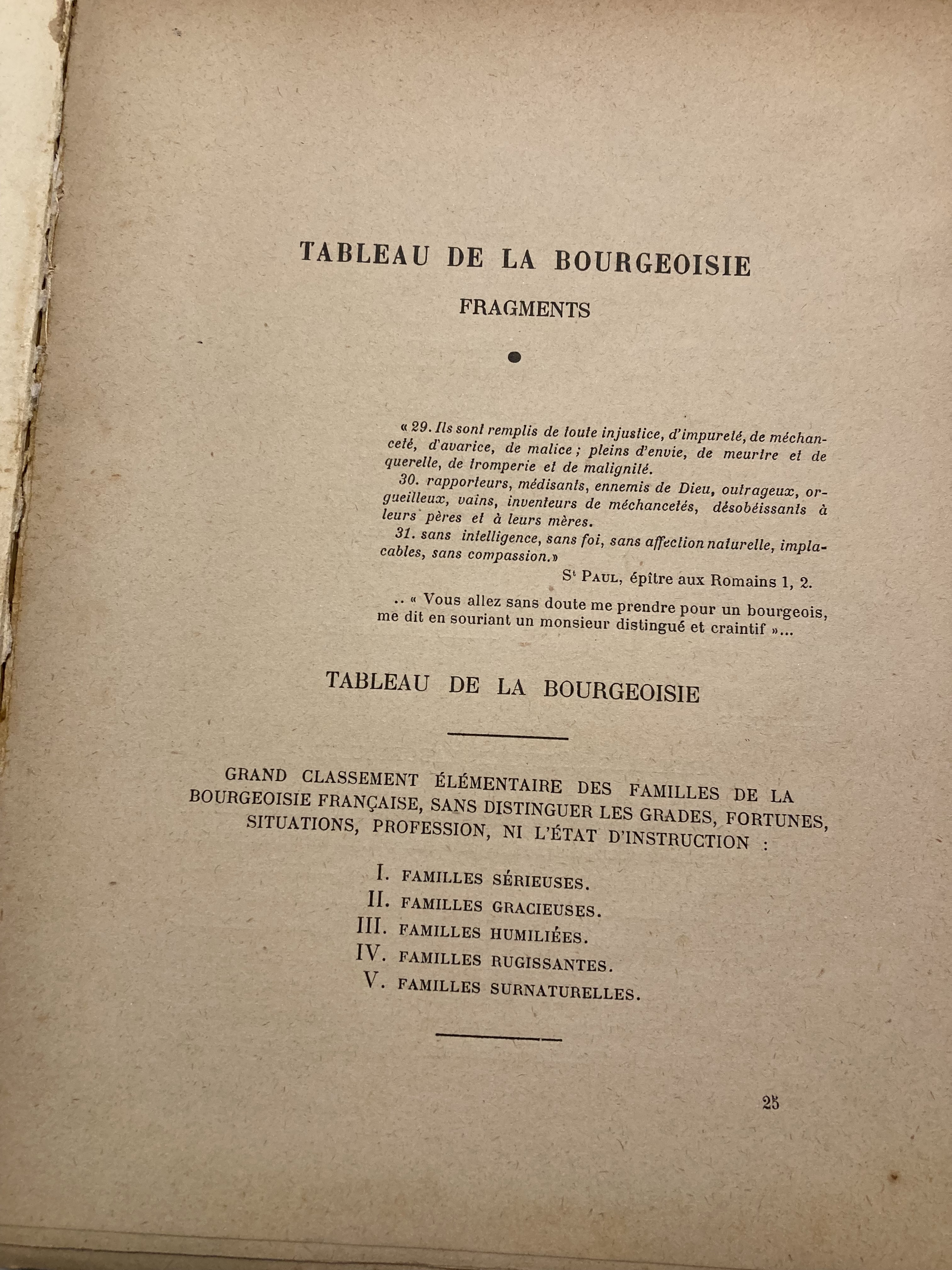
Philosophies regularly featured Jacob’s works, his poetry and prose, including “Note à propos des Beaux Arts,” and “his very satirical” (Lefebvre’s words) Tableau de la Bourgeoisie, a sardonic nomenclature and typology of French bourgeois families, approached from the inside, undertaken as a botanist might classify plants, only Jacob portrays a human botany: “Serious Families,” “Gracious Families,” Humiliated Families,” “Turbulent Families,” and “Supernatural Families”—“You will no doubt take me for a bourgeois,” says Jacob’s epigraph, perhaps talking about himself, “a distinguished and timid-looking man said to me with a smile.”
Lefebvre first encountered Jacob at the nadir of his poverty and misery, living in a squalid Parisian hotel room on rue Nollet. “I lived then in the 17th arrondissement, rue des Apennins, not far away.” In the 1930s, Lefebvre kept in contact with Jacob, after the latter had withdrawn to Saint-Benoît-sur-Loire, a hundred miles south of Paris, lodging in the shadow of the Benedictine Abbey of Fleury, leading there a monastic life himself. Lefebvre was employed in those days as a philosophy teacher at a high school in Montargis, thirty miles away (40 minutes by car). Instructing lycéens in the philosophical classics by day, Lefebvre burned the midnight oil by night, setting about translating into French texts by Hegel and Marx (the earliest translated fragments, in fact, of The Economic and Philosophical Manuscripts), while drafting his first important Marxist text, Le matérialisme dialectique, which appeared on the cusp of war in 1939. Meanwhile, in May 1935, a thirty-three-year-old Lefebvre was elected to Montargis’ city council on an “anti-fascist unity” ticket.
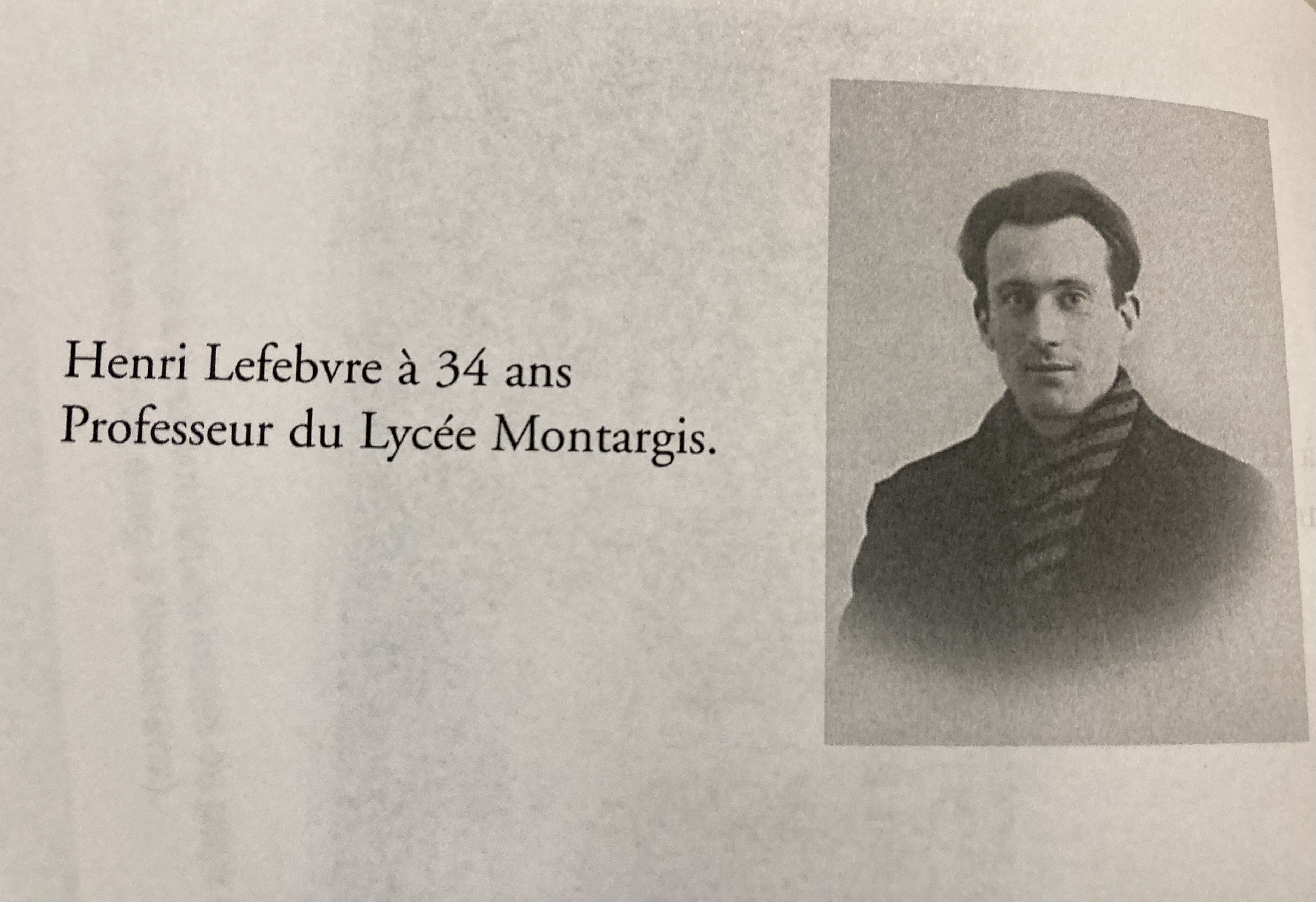
Lefebvre never quite established the same relationship with Jacob after Lefebvre joined the French Communist Party in 1928. “Max had a horror of ‘Reds’, as he called them.” “He was persuaded that the communists would exterminate him,” that they were possessed by the devil. “What fear he had of that! Like he feared and hated Aragon! When one thinks of Max’s end in Drancy, what a sad irony.” Because of his Jewish origins, Jacob was arrested at Saint-Benoît by the Gestapo on February 24, 1944, taken initially to a prison in nearby Orléans, before being transferred to Drancy Internment Camp in northeast Paris. Two weeks on, before his scheduled deportation to Auschwitz, he died of pneumonia in the camp’s infirmary. “I suffered for years,” Lefebvre maintained, “from the animosity Max showed me towards the end of his life.”
Jacob’s biographer, Rosanna Warren, interviewed Lefebvre in the mid-1980s when researching her sensitive and comprehensive Max Jacob: A Life in Art and Letters, an impressive tome thirty years in the making. The encounter is amusing and worth recounting. “Lefebvre received me in his apartment near what was then a fairly new Centre Pompidou,” Warren wrote in her preface. “He lived in a shrine, not to the Virgin Mary, but to the intellect: the tall windows shed light into a high, airy room lined with bookshelves. As a young man, Lefebvre had known Jacob around Saint-Benoît in association with the journal Philosophies, which Lefebvre helped edit. The aged professor resembled a hawk: he sat tensely upright in his chair; he was thin and energetic, with white hair tossed back from his high, pale, angular forehead; he had a sharp nose and crystalline blue eyes. I must have seemed unusually innocent that day, a young mother trying to look respectable in a prim white suit and pink blouse. Lefebvre leaned toward me and said, ‘You are a strange person to be writing about Max Jacob’. ‘Why?’ I asked. He leaned closer and rasped, ‘Max Jacob was perverted’.”
Later in her text, Warren describes other comic antics when Lefebvre and some of his Montargis pals (like Marcel and Marguerite Béalu) called on Jacob and took him on jaunts in Lefebvre’s car. “Lefebvre,” says Warren, “remembered these excursions as madly entertaining but also, at times, as perverse. Jacob became manic in the company of smart young men, regaling them with stories and outrageous theories. On one occasion, he made them stop the car so he could urinate in a field. Somehow, in the operation, Jacob’s ring slipped off his finger. Always poor, he considered his rings as his savings account, and he made a tremendous fuss about finding the ring, insisting that his friends grope around on the damp grass until someone finally retrieved the errant gem.” The Béalus equally recalled high jinks, of Jacob with Lefebvre, arguing into the early hours of the morning about the relative merits of Hegel.
***
Lefebvre’s early writings in Philosophies wrestle with themes that somehow anticipate the arrival of Hegel and Marx in French intellectual and political life; it’s as if their coming was being willed, already getting billed, avant la lettre. Lefebvre’s longest essay appeared in the farewell issue of Philosophies: “Positions d’attaque et de défense du nouveau mysticisme”—“Positions of Attack and Defense of the New Mysticism,” a precocious piece, almost preempting Feuerbach’s critique of religion. Lefebvre was calling for a new practice, not simply a human practice, but also something constructive and active, reconciling the human subject with its object, with the surrounding environment outside of the self. Hegel had yet to land in France; ditto the young Marx. But Lefebvre was problematizing the world in a way that was invoking their spirit, helping him and his young Philosophies group understand the human condition in the shifting sands of the interwar years.
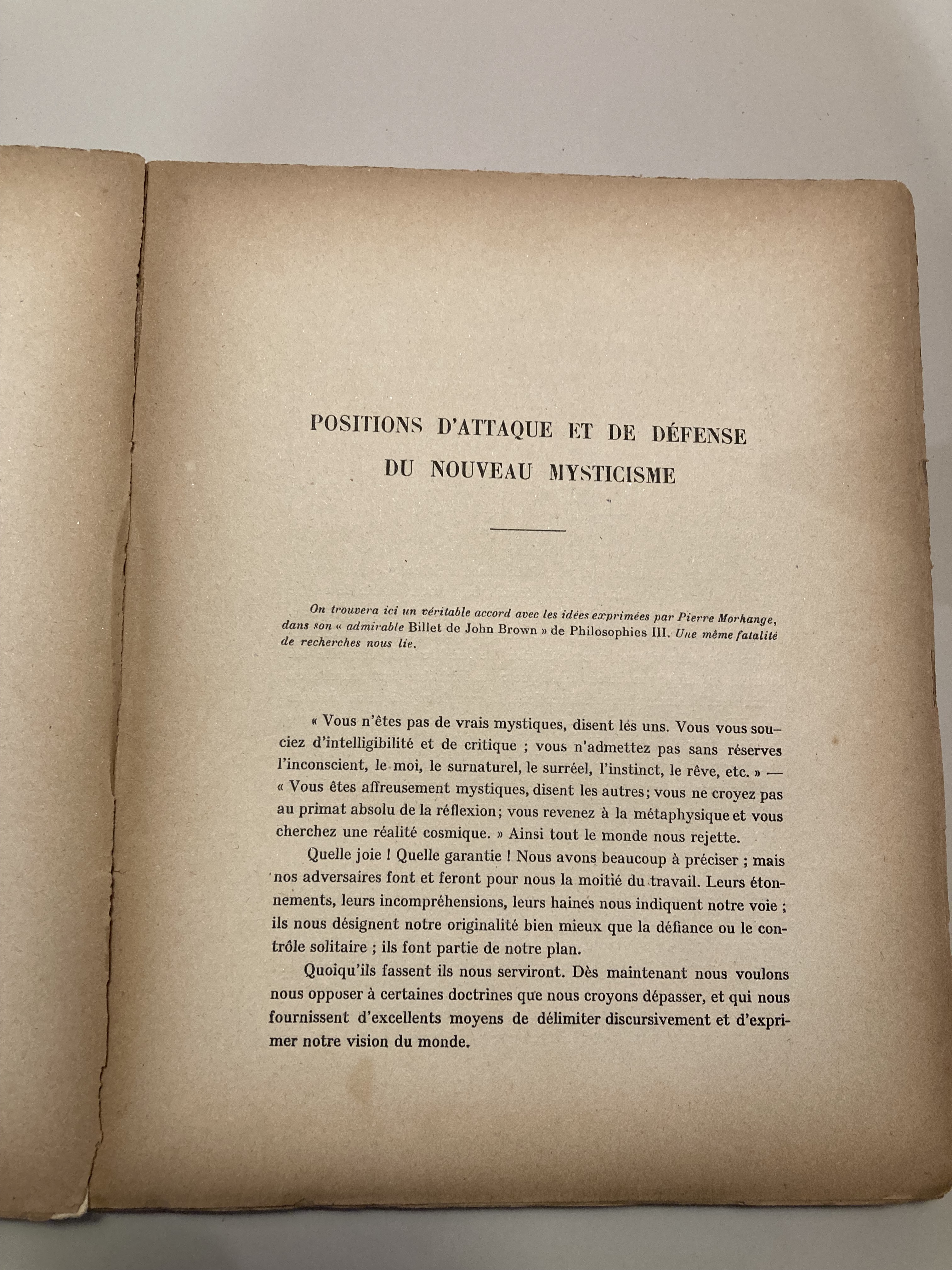
Lefebvre’s critique of the “new mysticism” takes aim at the assorted forms of mysticism in vogue during the 1920s. The first, he says, is the mysticism of the “true mystics,” those who adhere to a superior essence and want to surrender the human will to it, forsake the self for this higher abstract power. It’s the sort of thinking, Lefebvre says, that contains its own “intimate contradiction,” “an irreducible duality between the human and the absolute, between the exaltation of the self and the abolition of the self.”
True mystics, though, have been challenged by an idealist critique, on the face of it an anti-mysticism, yet one that only serves as an apologia for another sort of mysticism.“Idealism, we know, has fine and legitimate designs. But this doctrine is our enemy,” says Lefebvre. “It no more knows how to escape itself, how to perceive boldly and organize the true masses objectively… There is something analog in the operation of the idealist: withdrawal, which doesn’t consist of turning inward and closing one’s eyes but rather of fleeing the concrete entirely, of distancing oneself from things, and replacing them with more agreeable substitutes.”
Curiously, says Lefebvre, there’s a third type of mysticism masquerading as the antidote to the others, at first blush more palatable because it emphasizes what Lefebvre calls “Total Action.” There’s focus here on “concrete existence,” yet it’s only a new kind of metaphysics, a “spiritual action” peddled by the usual suspects, by the three bugbears of Lefebvre’s early career, the three “Bs”: Bergson, Blondel, and Brunschvicg. Bergson, we know about, discussing him last time; Maurice Blondel, who taught Lefebvre at the Sorbonne, mouthed of action, Lefebvre says, but it had little relationship to real action. “I don’t only mean political action,” Lefebvre qualifies, “but social practice. Blondel transcribed action in a metaphysical language, and the hard contours of practice lose themselves in the heavens.”
Likewise Brunschvicg, who spoke of “nothing living, nothing actual, only an even more fervent and wide-ranging spiritualism than Blondel’s.” “We separated ourselves from this idealism,” Lefebvre says in Philosophies. “The lecture hall of the Sorbonne,” La Somme et le Reste recalls, “where Brunschvicg taught, offered young philosophers an oasis of calm erudition and intellectual serenity that I couldn’t prevent myself from finding—spontaneously—cozy and stagnant. All around the Sorbonne, in many different directions, was immense fermentation.”
“Everything was collapsing,” Lefebvre says, “all was about to recommence. The young avant-garde discovered Cantor, Einstein, Freud, Hegel, Marx, Lenin. And Novalis, Hoffman. And Valéry and Proust. Pell-mell. The Russian Revolution had made a tabula rasa of past history and reconstructed society from top to bottom. Einstein cancelled out the old science of nature and reconstructed it on a new basis. Freud cancelled out the old psychology and reconstructed it on the basis of new ideas. Dadaism had made a tabula rasa of the past and reconstructed language on the basis of the stammer.” Notwithstanding, “in the teaching of Brunschvicg, nothing responded to the questions that young men after the war, in the collapse of values and despairing of all received ideas, had posed.”
“Positions d’attaque et de défense du nouveau mysticisme” was published in March 1925, that watershed year for Lefebvre, “the crucial date,” he insisted. “I would want to emphasize that, because it is passed over rather lightly in the history books. My memories of it are very precise. A room was hired in the rue Jacques-Callot, near the École des Beaux Arts, for a meeting between the Surrealists and the Philosophies group, and various other avant-garde groups like Clarté. The modern revolution was created at that point. We imagined a different economic system, a different social base, and a different state superstructure. What we had was a revolutionary plan in place of the vague aspirations of the ’14-’18 war and the immediate post-war period.”
That same fateful year, one night in October, seven months after the cessation of Philosophies, Lefebvre also went to visit André Breton at his studio near the Place Pigalle, on whose table sat Hegel’s Science of Logic. “Breton gave me a brilliant exposé of the Hegelian doctrine of Surrealism and of the relationship between the real and the surreal, which was a dialectical one.” Thereon after Lefebvre began to devour Hegel, who led him to Marx. Indeed, if Breton had found in Hegel the bridge spanning the unconscious world of Freud—the world of dreams and the id—with the awake real world of consciousness, Lefebvre instead found Marx; the world of consciousness then transformed itself into conscious activity, into wide-awake social practice, the activity that Lefebvre had been craving for so long.
At first, Lefebvre read Marx as a critique of religion. Back then, he knew only the early Marx, the Marx of the 1844 manuscripts, the left-wing Hegelian. Back then, too, he dragged Hegel ever closer towards Marx, and Marx towards Hegel, staking out a rich Hegelian Marxism, seeing Hegel as crucial for understanding Marx as the latter’s direct dialectical precursor. In the years ahead, as Lefebvre passed from his twenties into his thirties, he would give concrete historical context to abstract Hegelian categories, grounding them in the politics of an emergent fascist order.
It’s hard not to underscore Lefebvre’s astonishing productivity in the 1930s, during his Montargis tenure. The books were rattled off with startling rapidity, reflecting the urgency of the moment. In fast succession appeared Karl Marx: Morceaux Choisis (1934) (edited with Norbert Guterman), La Conscience Mystifée (1936) (written with Norbert Guterman), Le Nationalisme contre les Nations (1937), Hitler au Pouvoir (1938), Hegel: Morceaux Choisis (1938) (edited with Norbert Guterman), Nietzsche (1939), and Le Matérialisme Dialectique (1939), which became a mini bestseller in France, one of several Lefebvre books to make it onto Hitler’s list of banned reading.
As the Nazis were about to stomp across Europe, an unknown twentysomething Karl Marx was getting unveiled to popular audiences who seemed all ears for a study that placed alienation at the forefront of its critique of bourgeois society. “Built upon Hegel and the 1844 Manuscripts,” Lefebvre reflected in La Somme et le Reste, “and intended to restore a genuine philosophical dimension to Marxism, this book was bound to be poorly received: above all in the political circumstances of the time.” Not just on the Right, Lefebvre meant, with Hitler’s ascendency; but also on the Marxist Left, “with its unconditional attachment to the USSR, and to Stalin, and to all his ideas that became gospel for the international Marxist and communist movement.”


