Watching the Detectives

There’s awe-inspiring immensity down there. I’m looking out over Mexico City, from thirty-six floors up in the sky, a recumbent giant right before me, shimmering in glorious February sunshine. It’s a miracle I’m here, shacked up in this lux hotel for a few days. Behind triple-glazed glass, I can’t hear a thing; but what a sight to behold, to conjure with. Down below I can see the great green expanse of Chapultepec, sliced apart by Paseo de la Reforma and criss-crossed by the enormous multi-tiered expressway—Circuito Interior—over in the distance, gridlocked with traffic. It looks like the traffic passes beneath a rollercoaster, even passes into this rollercoaster, looping the loop. The city all around seems only to end at the horizon, at the foothills of faraway mountains beyond; at times Mexico City even seems to stretch beyond that horizon, beyond anything as-yet recognisable, as if it’s already staking out some new planetary urban turf. The view is so gripping I hardly want to abandon my perch. Yet I have to get out, into the sunlight, out from behind my glass insulation, plunge into the frantic beast outside.

Immediately outside the door is actually mellow, the leafy upscale tranquility of Polanco’s quietly busy streets. The air is balmy, life-affirming. I’m wandering passageways named after Ancient philosophers and famous writers; one is called Alejandro Dumas, which leads me into Parque Lincoln, a verdant little oasis with its scrubbed white clock tower, pond and peacocks, an aviary and a statue of Abraham, the park’s namesake icon. I stroll along empty paths, cross over the road. Even the traffic is polite around here. I smell a bookstore somewhere. I think of Walter Benjamin, that intrepid urbanist and bookwormer, and understand what he meant when he was unpacking his library: each book on the shelf, he said, was like a little memento of a time spent wandering the city streets, a tiny brick with which he could reconstruct past urban environments and perhaps even imagine new ones to come. “How many cities have revealed themselves to me in the marches I undertook in the pursuit of books!”

Then I find it. Or it finds me: Cafebreria El Péndulo, a city-wide chain, a bookstore-cum-café, though like so many in Latin American it has an inner atrium of immense beauty and taste. Light floods into it, and the sense of space, of openness and solace, is palpable. Exotic vegetation invades the stacks; or maybe books invade exotic vegetation, leafs become leaves. I’m searching for the book I need. Everywhere titles are delicately encased in cellophane. I’m not sure if I can look in. There’s plenty of people sitting in armchairs, drinking Latte; yet nobody reads a book.

Suddenly, I see one I have to have. I prise open its protection, rip it apart. It’s free now, liberated, readable—some 600 pages. Daubed across its cover in black uppercase is: THE SAVAGE DETECTIVES. I think I’ve found my Mexico City field manual; I think I’ve found the field manual for the rest of my days on earth. I’m lost in Mexico but feel I am on the way to finding myself. I settle back into an armchair at El Péndulo, and before long realise that I’m in a bookstore, and a neighbourhood, where no real poet ever bought books: they stole books from these places, pilfered from them.

Roberto Bolaño, the book’s author, died in 2003 at fifty, taken away by liver disease in Blanes, on Spain’s Costa Brava, a bit north of Barcelona, where he’d lived with wife and two kids during his forties. A Santiago native who grew up in Mexico City, Bolaño studied law but dropped out, yearned to be a writer, a poet, and helped establish a combustible group of wayward poets—the Ultrarealists. In the 1970s, they heckled and hassled and threw ripe tomatoes at literary conventionality, doing so as they lusted for literature in life. The Savage Detectives depicts, with a faint fictional patina, his years of youthful torment and turmoil, of catastrophes past and those you can be sure will come.

For 139 pages I listen to a young punk kid, a seventeen-year-old ado called Juan Garcia Madero telling us in his journal about teenage angst, about scribbling a few good refrains and trying to get laid. Each day he reveals his heart. He writes his Mexican Fleurs du mal, documenting his inauguration into a literary world that smoulders under a volcano. He seems more successful at fucking than writing, and manages to get off with two lonesome barmaids who take a shining to this bright young lad. He’s an orphan lodging with his aunt and uncle yet knows all about verse, about classical meter, about pentapodies and threnodies, about rispetti and strambotti. He hangs out at poetry workshops, getting bored, but afterwards, after hours, his real poetic initiation begins, in the city’s grungy bars and cafés, like the crummy Café Quito along Calle Bucareli—which in real life is the Café La Habana with its little rehabbed tables and retro beige and white chequered tile flooring. It’s here where he joins a group of disaffected poets called the Visceral Realists, and befriends The Savage Detectives’ two principal characters, visceral poets whose verse seems better practiced in life than penned on any page: Ulises Lima and Arturo Belano, poor, elusive underground men who we know are later destined to vanish into the Sonora desert.

Lima and Belano aren’t much older than Juan yet are already men of the world haunted by grown-up demons. They talk about Compte de Lautréamont as if he’s still their best pal. They’re on the trail of another phantom, Visceral Realism’s mythical poet Godmother, Cesárea Tinajero, who, back in the 1920s, had herself disappeared into the lost sands of the Sonora. Lima walks everywhere, never takes the bus or Metro, walks towards the unknown. Every book in the world for him is out there waiting to be read. Lima reads in his sleep, even reads in the shower. Belano, meanwhile, carries frayed and folded photocopies of Raymond Queneau’s verse in his back pocket, paper so scrumpled that it looks more like Origami, “a startled paper flower with its petals splayed towards the four points of the compass.” Visceral Realists want to negate all hitherto existing Latin American poetry, clear away what Lautréamont called “the poetic whimpers of the century”; they’re stuck between Octavio Paz and Pablo Neruda, the rock and the hard place.

Nighttime now. I’ve wended my way back to my aerial den. I’m reading on my bed, propped up by a pillow, staring out the window at the twinkling galaxy of lights, the liquid movement of red and yellow flows, oscillating and interlocking into some still-undiscovered chaotic constellation. I’m looking at Mexico City while reading about Mexico City. I’m here, physically present, in the real Mexico City, in this great seething, sprawling metropolis; yet I’m inside Bolaño’s great seething, sprawling metropolis, too, inside a book where places and words congeal into a singular literary reality: a life in literature becomes a literature of life.

After a while, I start to think about one of the characters in The Savage Detectives who’s about my age, Quim Font, a tormented adult, father of precocious and promiscuous daughters, Maria and Angelica, talented poets, dancers and painters; Maria beds Juan one night at dad’s house, a little fortress property in La Condesa, which turns in on itself with an inner courtyard and two houses. The daughters have their own separate quarters. Quim was once a successful architect but we quickly get wind of his downward drift; his psychological disposition is what we might describe as troubled. He’s moody and melancholic, frequently babbling bizarrely. At the end of the first part of Bolaño’s book, Quim lends Ulises and Arturo his old Impala sports car, so they can make a fast getaway with Juan and Lupe, a young prostitute whose psychotic pimp, Alberto, is threatening to kill. They take leave on New Year’s Eve 1975, with Quim losing his mind as well as his car.

It’s hardly surprising that when we next hear from him, after the narrative of The Savage Detectives splinters into dozens of polyphonic testimonies, a 400-page musing on what actually happened to Ulises and Arturo on the road, circa 1975-1996, Quim is now certified—a resident inmate of El Repose Mental Health Clinic. Yet institutionalisation seems to be doing Quim good. He’s calmed down a lot, although maybe it’s the medication. Anyhow, now he declaims with lucidity about books he’s read over the years, read when bored and when calm, but also when happy and sad, when thirsty for knowledge, even when desperate.

The latter are books that Ulises and Arturo want to write, Quim says. Their big mistake! You can’t live your whole life in desperation, Quim thinks. He’s learned that lesson the hard way, being desperate for so long himself. The passage from adolescence to adulthood is one from desperation to serenity, a regenerative process, he says, learning how to embrace Proust and Thomas Mann’s The Magic Mountain. When I hear this I’m not sure whether it’s the grown-up Quim talking or the grown-up Bolaño. Ultimately, Quim—or Bolaño—believes that a literature of desperation is “a literature of resentment,” “full of sharp instruments and lynched messiahs”; it “doesn’t pierce the heart the way a calm page, a carefully thought-out page, a technically perfect page does.” Quim warned everybody. He lost his mind doing so, was driven mad. “Seek oneself,” he says, “lose oneself in strange lands. But with a guiding line.”

I’ve got to get a grip on things myself. I need to write this last quotation of Quim’s down somewhere, pin it near my work station. Some days I feel as troubled by the world as Quim, looking over the edge, trying not to fall down. Maturity isn’t about rediscovering lost youth in middle-age; it’s transforming youthful impulses, propelling them into the here and now, using them to help stake out what lies ahead, giving these youthful impulses a richer, more mature meaning. I’m glad I’m a grown-up fifty-something, with a daughter; I wouldn’t want to go back. I want to be a Visceral Realist as well as a Magical Marxist, a radical poet of pandemonium, but who, as Guy Debord once said, “speaks as coolly as possible about things that have aroused so much passion.” I need that guiding line, that invisible thread.

The next morning, bright and early, I head off on foot for Quim’s old neighbourhood, La Condesa, my favourite part of Mexico City, hiking across Chapultepec, past the National Anthropology Museum and the Zoologico, traversing some scary traffic arteries, passing over the Circuito Interior on a rusty footbridge, into the backstreets of hip and arty Condesa, with its pavement cafés and trendy boutiques. Things here are chic but with just enough Bohemian grunge to give the area an edge, to ward off cleansed bourgeoisdom. As ever, there are some stunning bookstores, like the hyper-modern space at Cultural Bella Época, an Art Deco jewel of a building, with a cinema, cultural centre and obligatory ace coffee shop. It’s said to be Latin America’s biggest bookstore, with 35,000 titles, and a 2,000 square-metre glass ceiling that looks as if it’s been transplanted from Amazonia. At ground floor level you can relax on big leather sofas amid the vegetation, and read under a flood of radiant white light.

After an early lunch, taken on a sidewalk terrace at Milo’s Bar & Grill, a stone’s throw from Parque Espana, watching the weekday late-morning world gently go by, listening to a chorus of chirping birds, I go off in search of another bookstore, this time for Anglophones, “Under the Volcano,” a literary haven on Calle Celaya. At first I can’t find it, walk by it. It’s discreet. From the outside it looks like somebody’s house, colonial-style, with striking blue-arched iron-grilling over its windows. You enter through an ornate archway entrance and pass into a darkened, somewhat dingy hall, with exotic looking Gauginesque artwork on the wall. A staircase leads you up to the bookstore itself, really one small room, lined wall-to-ceiling with used books.

The stock is rich and ample, well-organised and up-to-date—good condition American editions. Somebody knows what they’re doing. A young American guy mans the till, standing in for the store’s owner who’s out of town on a trip. Bolaño’s The Savage Detectives is third on its bestseller list, behind Nabokov’s Lolita and Zadie Smith’s White Teeth, though ahead of Malcolm Lowry’s Under the Volcano—eponymous inspiration for the bookstore—and Thomas Pynchon’s Gravity’s Rainbow. “Under the Volcano” professes to be “an embassy for the soul of the English-speaking world—its literature in Mexico…a web-free, Kindle-less island of analog time in a digital sea; a community centre for Commonwealth and American expatriates in the most exciting, vibrant and accessible city on earth.”

I don’t beg to differ. I browse the Bolaño section and tell the young American I’m currently reading The Savage Detectives. He tells me to check out Bolaño’s poetry; Bolaño always saw himself as a poet, a better poet than novelist: his poetry made him blush less, he himself said. The American treasures his bilingual collection of Bolaño’s verse, keeps it at home and wouldn’t put in up for sale any day. Look at The Romantic Dogs, he recommends. “I’m here with the romantic dogs/ and here I’m going to stay.” Bolaño wrote poetry in “the land of idiots,” scribbled outpourings in the “silent wing of the Unknown University.” Accreditation here is a life-journey spent under the stars, not a certificate you gain at graduation.

I remember The Savage Detectives’ epigraph, from Malcolm Lowry: “Do you want Mexico to be saved? Do you want Christ to be our king?” “No…” I tell the American that Lowry originally hailed from Liverpool, like me—well, actually he came from New Brighton, across the River Mersey from Liverpool itself, close by, although unlike me Lowry was a rich kid, the son of a wealthy cotton merchant. I used to go to New Brighton for my summer vacation as a kid in the 1960s, take the ferry across the Mersey. Lowry, like Bolaño, like Ulises and Arturo, was searching for something his whole life, glimpsed it, even grasped it, yet was never able to deal with what he’d found. He destroyed himself. He was happier living in his art than living in his life. Like Quim, somewhere en route he lost his guiding line. He stepped over the edge, plunged down the abyss he’d been staring down way too long.

Under the Volcano, published in 1947, takes place in 1938 on the Day of the Dead, in Cuernavaca, a small town south of Mexico City. The book immortalises the hard liquor mezcal, and the trembling hand of the “Consul,” the defrocked English civil servant Geoffrey Fermin, Lowry’s alcoholic alter-ego abandoned by his wife, a man who drank his mezcal down to the worm. He was one of Guy Debord’s literary heroes. “Nothing in the world was more terrible than an empty bottle!” the Consul says. “Unless it was an empty glass.” “How, unless you drink as I do,” he says, “can you hope to understand the beauty of an old woman from Tarasco who plays dominoes at seven o’clock in the morning?”

The atmosphere of tropical heat and sweaty bodies, of sapping humidity and overhead fans, of colonial castoffs and quirky barflies steers Lowry’s Under the Volcano towards Gabriel García Márquez; yet Lowry’s dramatic tension is more brutal and destructive, more menacing, wrenching him nearer to Faulkner. The volcanoes loom everywhere, and vultures, adding to the sense of impending doom: “The volcanoes seemed terrifying in the wild sunset…and vultures hovered there like burnt papers floating from a fire.” The Consul leans on a bar and stares into “his second glass of the colourless ether-smelling liquid. To drink or not to drink—But without mezcal, he imagined, he had forgotten eternity, forgotten the world’s voyage, that the earth was a ship, lashed by the Horn’s tail, doomed never to make their Valparaiso.”

Bolaño’s cast likewise search for their Valparaiso, for their own eternity, as they down another mezcal—“Los Suicidas,” they ominously call it—toasting the Consul’s memory silently in their dreams. “Christ,” says Fermin, shot at the end of Lowry’s masterpiece, thrown down a ravine with a dead dog, like Kafka’s Joseph K., “this is a dingy way to die.” The spirit of Nietzsche haunts, the Nietzsche of Gay Science, who spoke of “preparatory men,” of people of the future wanting “their own festivals and weekdays, their own periods of mourning” and whose “greatest enjoyment is living dangerously,” sailing into uncharted seas, building a city under Vesuvius, under a volcano.

Ulises and Arturo build their house under a volcano. They, too, go searching for their own weekdays and periods of mourning. They crop up all over the place, all over the world—Barcelona, Kigali, London, Madrid, Managua, Paris, Rome, San Diego, Tel Aviv—going their own separate geographical ways, wandering in the wilderness; yet, somehow, no matter where they go, Bolaño joins them together ontologically. They do every odd job under the sun, from washing dishes to camp site watchmen, having adventures galore, cropping up in Liberian civil wars and Nicaraguan revolutions, seemingly doing it all with no money nor with any fixed abode. We hear nothing about their writings; indeed, they seem to have given up the act of writing altogether. Their poetic blush is now living, alive, inscribed into practical everyday verse, viscerally real. As one testimony put it, theirs is “the riddle of the poet who’s lost and survives.” The truth is “I don’t remember anymore, but don’t worry, the poet doesn’t die, he loses everything, but he doesn’t die.”

Ulises shows up twenty-years later, still apparently youthful but he must be in his forties now, prowling Mexico City’s Parque Hundido, with its floral clock, a shadowy poet fugitive who has an affecting rendezvous, a pure make-believe rendezvous, with old man Octavio Paz, by then a Nobel Laureate. Paz is accompanied by his faithful housekeeper who recounts the secret event. Lima and Paz shake hands, sit down on a park bench. “How long did they talk? Not long. And yet from where I was sitting it was clear that it was a leisurely, calm, polite conversation.” They spoke of Cesárea Tinajero, whom Paz remembers by reputation. A little later we find out what really happened to Tinajero, because The Savage Detectives flips back in time, to New Year’s Day 1976; we’re on the road again, a day on from where we left off, all those pages ago, with Ulises and Arturo and Juan and Lupe blasting along in Quim’s Impala, hurtling through the Sonora desert.

Ulises has learned how to drive like Dean Moriarty and Juan returns as a Sal Paradise narrator. They bivouac in the fictional border town of Santa Teresa—centre of action for Bolaño’s final, incomplete novel, 2666—where they at last encounter Cesárea Tinajero. “She looked like a rock or an elephant,” Juan writes. “Her rear end was enormous and it moved to the rhythm set by her arms, two oak trunks.” She’s lived on her own for years in a modest adobe house in the middle of nowhere, a tragic woman who seems content; she radiates “immense humanity.” She hurls herself at Alberto, helps kill him, though takes a bullet in the chest doing so, losing her own life. They bury her afterwards and discover her valedictory poem, her only written poem. Did she ever need to write another?

Amazingly, it’s just a few rows of lines, lines not words. It’s wordless, made up of straight, wavy and jagged pen movements, zigzags resembling life’s elemental path, verses of ups and downs and powerful feelings. What does the straight line mean, they wonder? The horizon, maybe, calmness, still seas? And the wavy one? Hills on the horizon, movement, change? And the jagged? Shark’s teeth, mountains on the horizon, choppy seas tossed by a gale? The poem says it all. It’s also where The Savage Detectives trails off. We’re none the wiser about what happened to its stars, whether they lived beyond the 1990s? Is it true that poets never die? The closing sequence of Bolaño’s great book lingers, the dénouement to a novel of exquisite artistry that’s finished yet unfinished. We watch the detectives even while we’re kept guessing, even while we never quite know what they were investigating. “What’s the mystery?” somebody asks. “Then the boys looked at me and said: there is no mystery.”

The Savage Detectives filled my head for the remainder of my stay in Mexico City, spent looking at its golden Angel, at the crumbling pyramids near the Plaza de la Constitución, at Diego Rivera’s stunning mural on the stairwell and walls of the National Palace, depicting Mexico’s ancient and modern history. And I wander into more bookstores, dozens of them, along Calle Donceles, chaotic, dusty bookstores that don’t seem to have acquired much new stock since the mid-1970s. I venture further east, to the edge of Mexico City’s historic district, to the traditional market of Merced, a vast roofed labyrinth of narrow alleyways piled high each side with fruit and vegetables; with chillies and chillies and more chillies; with mountains of beans and onions; with garlic and herbs and cheeses; with giant cacti leaves—nopals—whose spines little old women sit around slicing off, skinning them. Then I wander outside, along Anillo de Circunvalación, where there’s a sidewalk bazaar—a super-kinetic tianguis in full motion and commotion, with “unofficial” street hawkers peddling their wares, their jeans and tee-shirts, their mobile phones and candy, their quesadillas and tostadas, poor people selling to poor people. Huddled discreetly in doorways, meanwhile, are scantily-clad young prostitutes, touting business in this renowned “tolerance” zone.

Mexico City literally brims with intense life everywhere; everybody hustles, usually quietly, frequently courageously. Life is a song and dance without much song and dance. I’m sorry I’ve got to leave, sorry I’ve got to put Bolaño down. But I know I’ll come back to him again and again even if I can’t come back to Mexico City again and again. He’ll be my perpetual upper in times of downer. Perhaps it’s just me, but those downers seem more frequent these days. It’s not a great moment for humanist poets, for visceral realists intent on art and literature. Of course, there’s never really ever been a good time for humanist poets; there aren’t too many job openings, never will be. Ulises and Arturo teach us that we should forget about whether there are job openings or not, forget about expectations of “success”—why should a society that rewards liars reward us anyway?—and get on with practicing our art while living our life, creating something that resists by the very nature of its own honest creation. In that sense, it’s true, poets never die, because their spirit will always live on; their art will prevail come what may. Bolaño creates a crazy world of restless romantic dogs, inspiring for younger guys out on the mooch, but likewise inspiring for older guys, too, for people like me, who still want to keep our noses close to the ground, spending our days digging for buried bones.

Posted in All | 2 Comments

Death and Life in Knausgaard

This essay first appeared in Review 31 on 24th January 2017

Storytellers, the late John Berger was wont to say, are ‘Death’s Secretaries’: they borrow their authority from the dead. Death hands storytellers the file, ‘full of sheets of uniformly black paper.’ ‘All the storyteller needs or has,’ Berger reckoned, ‘is the capacity to read what is written in black.’ The Norwegian writer Karl Ove Knausgaard is a Death’s Secretary after Berger’s own heart. His bestselling, 3,600-page ‘autobiographical’ blockbuster, My Struggle, which has been translated into 22 languages, is an epic story scrawled in black. The sixth and final volume – its thickest at over a thousand pages – is set to appear later in 2017, one of the most eagerly awaited literary events of the year.

Midway through the first book, A Death in the Family, Knausgaard says ‘writing is drawing the essence of what we know out of the shadows.’ The dark shadow looming large over My Struggle, and over Knausgaard’s life, is the death of Knausgaard’s father – a brooding, unpredictable and menacing alcoholic whose death tore son Karl Ove apart. He hated his father, was terrorised by him, psychologically and emotionally. And yet, when the grownup boy heard of his father’s eventual demise, he cried. Why did he cry? Who was this father? Who was the son? What had the son become now that he, too, was a father – a father writing about his father?

The search for answers became Knausgaard’s quest for self-clarification, his attempt to find wholeness again – or perhaps to find wholeness for the first time. It was a literary quest as much as anything else: how to find the right words to represent a life, prompted by a sudden insight into death. Writing wasn’t and still isn’t cathartic for Knausgaard; he insists on that. It is torture, a twisted medium that buys time, that somehow offsets death. My Struggle became Knausgaard’s personal struggle, his trial, perhaps even The Trial. Only here K. is Knausgaard himself, and The Trial in question is one in which Knausgaard – let’s henceforth call him K. – is both judge and jury. The case that follows is to prove his own innocence – or guilt. In My Struggle, K. accuses himself.

At first, he tried to fictionalise things. But that didn’t work. It only pushed events away from K., made it sound phoney, remote. For years it also prompted writer’s block. K. couldn’t advance with the standard novel in a standard manner, creating characters; he had to go elsewhere. The stakes were higher. K. had to bring things closer, inside himself. It’s not what happens there, he says, not what actions are played out there; it’s the there itself: ‘There, that is writing’s location and aim. But how to get there?’ So he starts writing in the first-person, compiling his own diary of a madman, wondering if what he was saying was any good. He kept going, was encouraged to keep going by his editor-friend Geir Gulliksen, despite the latter’s balking at the work-in-progress’s title, Min Kamp, like Mein Kampf.

The constant feeling of humiliation

Before long, K. started to reconstruct himself as he reconstructed past years. In order to move forward he went backward, in search of lost time, buried memory. Proust was the writer who’d made the greatest impression on K.; he’d shown K. so many possibilities. But K. makes it clear that his work doesn’t create beautiful art, like Proust’s, using beautiful words and luscious prose. My Struggle isn’t so much about creating beauty as finding meaning. K.’s words are ordinary and plain, nailed to the page with a fierce, sometimes searing honesty, with graphic intensity. This isn’t writing that grabs you by the collar: it’s literature that singes your backside. Still, we’re not talking about anything realist; K.’s work transgresses realism: it’s that which gives My Struggle its artistry, its Proustian flair.

In a way, Peter Handke, the Austrian novelist and playwright, about whom K. has written admiringly, is a better guide. Handke’s novella A Sorrow Beyond Dreams (1972) deals with the suicide of Handke’s mother and similarly addresses the problem of representation. Its ‘plot’ is likewise a struggle to express death in language. K. quotes Handke describing his method, which might equally be K.’s method:

‘I first took the facts as my starting point and looked for ways of formulating them. But I soon noticed that in looking for formulations I was moving away from the facts. I then adopted a new approach – starting not with the facts but with the already available formulations, the linguistic deposit of man’s social experience.’

For all that, My Struggle is K.’s Dream Beyond Sorrows; it’s not a book about despair. K. was glad his father was dead. Yet memory is a weird thing and isn’t ‘a reliable quantity in life … It is for the simple reason that memory doesn’t prioritise truth. It is never the demand for truth that determines whether memory recalls an action accurately or not. It is self-interest which does.’ For K., the sound of the crack of a sledgehammer enters his head, the memory of his ruddy-cheeked father banging away outside their house, pounding rock, breathing heavily. Rural Norway, 1976. An eight-year-old boy runs across the grass because he’d seen death in the sea, on the TV news, bounding over to tell dad. Don’t run across the grass, Dad scowls, sledgehammer in hand. ‘I stared at him. How could he know I had run?’ His back was turned. ‘And shut your gob,’ dad says to son. ‘You look like an idiot.’ ‘You’re a waste of space.’

Another time son returns to find the house ice-cold. ‘Can’t we put on the heating?’ son asks dad. ‘It’s freezing in here.’ ‘Fweezing?’ dad mimics, ‘We’re not putting on any heating, however fweezing it is.’ ‘I couldn’t roll my ‘r’s,’ son says in his text. ‘Never had been able to say “r”, it was one of the traumas of my late childhood. My father used to mimic me, sometimes to make me aware that I couldn’t pronounce it. But I just turned and went back upstairs. I did not want to give him the pleasure of seeing my moist eyes.’ What struck the teenage adolescent was ‘the constant feeling of humiliation.’

‘Nor did he go to any of the innumerable football matches I played in as I was growing up.’ ‘He was never one of the parents who drove to away games, never one of the parents who watched home games.’ On one rare occasion he did come, by default. ‘He drove me to the shale pitch in Kjevik, he was going on to Kristiansand, we had a practice match against some team from upcountry. We sat in the car, as silent as ever . . . Then I had a sudden inspiration and asked him if he wanted to see the match. No, he couldn’t, he had to go on, didn’t he. Well, I hadn’t expected him to say yes, I said.’

But later, ‘when the second half was nearing an end I spotted his car by the sideline, behind the piles of snow. Could vaguely make out his dark figure behind the windscreen.’ With only a few minutes left, son had a chance to score a final goal, receiving a perfectly weighted pass. To his left foot, his wrong foot. It skidded off. He’d fluffed his opportunity. ‘You didn’t put your chance away,’ comments dad later. It was the first thing he said to son. ‘I didn’t think you’d mess that up.’ ‘Oh well, I said. But we won anyway. What was the score? Two-one, I said, glancing at him, because I wanted him to ask who had scored the goals. Which, mercifully, he did. Did you score then? he asked. Yes, I said. Both of them.’

A chill wind

And then in 1998, the 30-year-old son hears dad is finally no more. Dad’s life had imploded; over the years that K. had grown estranged from him, a spiral of decline hit, worse than son ever imagined. Once upon time, dad was an upstanding local schoolteacher, a relatively normal lower-middle-class parent. Mum and dad were together. But their marriage failed. Mum moved to Bergen, son went to school in Kristiansand, lodged a while with grandma, dad’s mother. Dad moved to northern Norway, with a new partner, had a daughter; then they split, partner leaving dad who began drinking heavily. Dad lived alone, drank even more. Then he went to live with grandma, and kept on drinking, drinking with grandma. He had no job. He drank away everything. Bloated, he no longer ate. Then, one day, grandma finds him dead. ‘Dad is dead,’ writes son, with his own italics. ‘A chill wind blew through me.’

Some of K.’s most harrowing writing in My Struggle, the denouement of Book One, describes him and his elder brother, Yngve, sorting out dad’s funeral. They had to go to grandma’s to put dad’s affairs in order, little imagining the nightmare soon to befall them. ‘The smell inside the house was unbearable. . . What is that bloody stretch? . . . I turned and went into the living room.’

‘For as long as I could remember, it had been used on church holidays and special occasions. Now dad’s huge TV was in the middle of the floor and two of the large leather chairs had been dragged in front of it. A little table swimming with bottles, glasses, pouches of tobacco and overflowing ashtrays stood between them. In front of the three-piece suite by the wall lay some articles of clothing. I could see two pairs of trousers and a jacket, some underpants and socks. The smell was awful. There was excrement on the sofa, smeared and in lumps. I bent down over the clothes. They were also covered in excrement. The varnish of the floor had been eaten away, leaving large, irregular stains. By pee? I felt an urge to smash something. Lift the table and sling it at the window. Tear down the shelf. But I felt so weak I could barely walk.’

A week later, at the funeral parlour, K. sees his body.

‘And that there was no longer any difference between what once had been my father and the table he was lying on, or the floor on which the table stood, or the wall socket beneath the window, or the cable running to the table lamp beside him. For humans are merely one form among many, which the world produces over and over again, not only in everything that lives but also in everything that does not live, drawn in sand, stone and water. And death, which I have always regarded as the greatest dimension of life, dark, compelling, was no more than a pipe that springs a leak, a branch that cracks in the wind, a jacket that slips off a clothes hanger and falls to the floor.’

In delving deeper into dad, and deeper into himself, K.’s real struggle unfolds, a struggle that gives body and soul to My Struggle, to books that destroy linear time and conventional narrative flow, that shift between past and present, memory and intuition, observation and conjecture, fact and feeling. A boy-island struggles to become a man, a man in love, a man who dances in the dark, a man who struggles to become a husband who struggles to become a father who struggles to be a writer, a better writer, giving order to his disorder, bringing sunshine to the falling rain. My Struggle becomes a struggle with the inexorable fragility of being wholly human.

Ever so steadily the spectre of death is shrugged off. Death gives back a sense of urgency that we know belongs uniquely to life. If we can read the torrent of K.’s words, get beyond the tedium of some of the detail, we can glimpse a modern-day Bildungsroman, a coming of age portrait of the artist as an ordinary man. He quits school in 1987, goes off to be a supply teacher in a village on a northern island, planning to write his novel in the evenings, saving enough money to travel around Europe as a free spirit. But he’s accepted onto a creative writing course in Bergen, where, despite dreams of an itinerant life, he stays put for nine years, learning his craft, writing music criticism for a student rag, publishing his first novel, Out of This World (1998), which wins the Norwegian Critics’ Prize. He moves to Malmo, to Stockholm, has a kid, eventually marries another woman, has three more kids and ends up in rural Sweden, in a tiny village called Glemmingebro.

A literature of boredom

In K.’s hands, mundane everyday life gets represented as . . . well, mundane everyday life – and somehow it assumes an epic quality, like Brecht’s great play about his great hero Galileo: ‘GALILEO: (washing the upper part of his body, puffing, and good-humoured:) “Put the milk on the table”…’ Oftentimes it’s a literature of boredom we’re reading, or frustration, the woes of a writer without time to write – though having the time to tell us. K. lets us enter the familiar world, the world we all recognise and live out, and then, without us really seeing how, he wrenches us out of this familiarity, takes us elsewhere. Everyday objects, acts and images – making coffee, smoking a cigarette, staring out of the window, the light, the rain, people’s faces, changing nappies, kids’ parties, walking down the street – all the routine trivia and décor of daily life becomes, for K., an existential quest, a metaphysical drama. Little is portrayed directly as we inhabit it. Instead it becomes a world of shudder and dread, of nothingness and ecstasy:

‘While the muted winter light that had forced its way through the clouds seemed to draw all the colours and flat surfaces towards one another and minimise the differences between them with its greyness and fragility, this clear, direct sunlight emphasised them. Around me the town exploded with colour. Not the warm biological colours of the summer but the mineral colours of winter, cold and synthetic. Red brick, yellow brick, dark green bonnets, blue signs, an orange jacket, a purple scarf, grey-black tarmac, verdigris metal and shiny chrome. Sparkling windows, glowing walls and glinting gutters on one side of the building; black windows, dark walls, toned down almost invisible gutters on the other.’

At times when we hear K.’s internal monologue – some of his most compelling writing – we’re reminded of Sartre’s anti-hero Roquentin and the nausea he feels touching door knobs, glimpsing gnarled tree roots; the shock of recognition, the spinning of the head, when he, a fully conscious human being, encounters the inanimate coldness of things. K. feels this Sartrean nausea, as nothingness needing to be filled, as isolation and dislocation screaming out for meaning. K. gives our world meaning by writing about it, by having to write about it, by filling the void with words, making it whole, somehow intelligible and above all communicable. That’s why we read him; that’s why we find his books strangely hard to put down.

K. admitted recently that for a long time he’d thought literature lay elsewhere, in the centre not in the periphery, not in Norway, in Bergen, or rural Sweden. He said this in 2016, in his tender foreword to the 100th-anniversary edition of James Joyce’s A Portrait of the Artist as a Young Man. In the periphery, K. once believed, little happened; there, things were without significance, unworthy of being written about, inconsequential. ‘History belonged to others, literature belonged to others, truth belonged to others.’ But after reading Joyce, K. recognised ‘the true essence of literature is that the conquest of what belongs to the individual alone, what is special and characteristic, and to Joyce’s mind unique, is also what belongs, and is unique, to us. Literature is never the preserve of others, and it knows no centre – which is to say that its centre is any place at which it exists.’ Great literature can happen anywhere, anyplace we find ourselves, anyplace the human spirit is touched, anyplace authentic experience is expressed, shared.

A way through chaos and confusion

This expression can even be voiced from the tiny Swedish village K. now calls home; literature doesn’t have to play away from home. It’s a message conveyed in K.’s latest work in English, Home and Away: Writing the Beautiful Game (2016), at first blush a book about football, about the 2014 World Cup in Brazil, a series of letters K. exchanged with his Swedish writer-friend Fredrik Ekelund. Ekelund went to Brazil and sends K. tales of matches and soccer heroes, sunshine and beaches, primary colours and caipirinhas, crazy parties and bustling cafés, exuberant people and exotic outdoor life; Fredrik’s world is hot and high-spirited, extrovert. K.’s, meanwhile, is family-oriented, introvert: he falls asleep watching games on TV.

Yet Home and Away is much more than about footfall: it’s full of nuggets on life and death, on culture and class, on the task of the writer and the location of literature. In one letter (12 June 2014), K. explains to Fredrik his need for stability, for structure and repeatable patterns: ‘routines have been a way through the chaos and confusion, and this has worked well, we are fine, all of us.’ In another (25 June 2014), he tells his friend how he had to crash, exhausted, before France versus Ecuador was over.

‘Woken at half past six by Anne [his youngest] making disgruntled noises. I fed her, put her on the changing table and placed a mountain of clean clothes in the cupboards, emptied and filled the washing machine, changed the bedding and tidied the rooms…then I made lunch for the girls—fried fillet of chicken, pepper and a wok sauce with noodles, and then fruit, slices of bread, water, pear juice, yogurt and pancakes…and at half past nine I drove the girls to the theatre, stopped at the local shop and bought our lunch, then sat and worked on an essay for two hours, one page. . . Such is life here. Nothing spectacular, nothing memorable, a life filled with children, cooking, driving, football on TV and sleepy evenings, all set in countryside full to bursting with gentle beauty.’

When it comes to the crunch, K. writes (4 July 2014), ‘being a writer is about only one thing: sitting down behind a desk and looking at an empty page and knowing it has to be filled with something, from nothing. That is where the excitement is, the pleasure, but also the doubt, the uncertainty, the fear of failure. If you don’t want that, if you have had your fill and are better off without it, you are no longer a writer. Success has nothing to do with this.’

Fredrik, we hear, roots for Brazil, with their poetic ball-play. K.’s team is Argentina; Brazil isn’t for him. Argentina never does anything beautiful for the sake of beauty, he says; they’re always well-organised defensively and sometimes even a bit cynical, drawing on an opponent’s weaknesses rather than their own strengths. The first World Cup K. remembers was in Argentina – 1978, as a nine-year-old. ‘I was spellbound,’ he says. ‘Argentina, both the country and the team, represented an adventure for me. . . There’s a lot of romanticism in this, but it is a different kind from the romanticism I see in your letters. For you Brazil is lived, it is alive. Argentina for me? I have never been there, it is no more than a dream, a fantasy, anchored nowhere else but in the books I have read.’ You know, he tells Fredrik, he’d originally wanted My Struggle to be called Argentina. Not a treatise on megalomaniacal world-historical domination, conquering everything and everybody, but a stoic, unheroic struggle for self-knowledge, for inner meaning, for finding life in non-life, for unearthing a yes from a no, an Argentina from a Brazil.

This is perhaps one reason why, over the past year, during 12 months that brought us Brexit and Donald Trump, terrorist explosions and trucks ploughing into innocent people, I’ve found a strange pleasure and peace reading Knausgaard, absorbing his struggle into my own little struggle, reading him when I could barely face reading anything else, least of all a newspaper. His words leapfrog across national boundaries, transcend specific times and spaces and enter into you directly, almost by osmosis, as authentic human experience, above and beyond politics. Where Knausgaard begins his great masterpiece is what he leaves us with at the end of it all: a beating heart. Sooner or later it will stop; he knows it, we all know it. But in the meantime, its pounding action belongs to a precious life-form in which we are constantly surrounded by phenomena from the realm of death. Knausgaard brings death back to life. His is a literature not of release or avoidance but relief: a hushed Nordic scream that struggles to help us struggle on.

Posted in All | Leave a comment

FIFTY-YEARS ON: The Right to the City

2017 marks the Golden Jubilee of Henri Lefebvre’s Right to the City, his “cry and demand” for a more participatory and democratic city life. It’s a cause both to celebrate and commiserate. But celebration and commiseration have typically been part and parcel of the Left’s dialectic, a dialectic that cuts inside us as people as well as political subjects. For everyone concerned about the fate of our cities, before us now lies a massive expansion of urban life across the planet, an opening up of urban horizons and frontiers, matched by a closing of the political mind, a withering of the established political will.

Ours is an urban society, set to be evermore so during the decades to come; yet political leaders almost everywhere are putting up walls, cowering before provincial smallness rather than embracing cosmopolitan vastness. When Lefebvre long ago spoke of “planetary urbanisation,” he did so because he thought the scope and possibility for the right to the city might enlarge, that our narrative about cities might become bigger and more inclusive. The right to the city needed to flourish within this immensity, he said, had to understand it, keep its frame of reference and plane of immanence open.

Lefebvre announced the right to the city at the centenary of Marx’s Capital, doing so with a self-avowed “cavalier intention.” Urbanisation, for him, was and still is a “revolutionary” process in which assorted ruling classes played and continue to play the dominant role. It’s they who initiate the drive to totalise the productive forces, to colonise and commodify land, to valorise people and nature. Just as they’ve fracked deep into the earth and power-drilled monetised value from nature, ruling classes now frack into human nature as well, power-drilling value from different aspects of everyday life, from land and housing, from the entire public realm.

Lefebvre, though, never imagined that urbanisation would be everywhere, that bricks and mortar, freeways and highways would predominate every which way, that all green space would turn grey; neither was he saying that cities would quantitatively overwhelm the planet. (That’s why he would have been radically at odds with the empirics of UN-Habitat’s “Urban Age” thesis.) Rather, as his commemoration of Marx’s Capital implies, he was warning of the closing of the circle of a particular form of post-war capitalism, one that defines itself less through a model of industrial or agricultural production and more and more through an actual production of space.

This system produces planetary geography as a commodity, as a pure financial asset, using and abusing people and places as strategies to accumulate capital. The process embroils everybody, no matter where; even when it doesn’t embroil, when it abandons people and places, it embroils. Urban society today is tantamount to the progressive production of evermore frackable spatial units. In a way, I like to think Lefebvre was hoping his thesis would become untrue, that the circle can never be complete, that it has to stop, or else be diverted, even if there’s no going back, that urban society, like it or not, is here to stay.

Urban society is thus the battle ground for new forms of radical and progressive politics: it has to be. Lefebvre affirmed this not out of personal whim: capitalism affirmed it out of historical necessity, as our “objective” reality, as an arena in which we all must now engage, willy-nilly. His most explicit reference to planetary urbanisation came later in life, in a valedictory essay from 1989, “Quand la ville se perd dans une métamorphose planétaire,” published two years before his death.

His precise language here is worth pondering on for a moment. Menace stalks us, Lefebvre says; not so much of “planetary urbanisation” but of “the planetarisation of the urban” (“la planétarisation de l’urbain”). The ordering is telling. For the urban doesn’t so much spread as it becomes the vortex for sucking in everything the planet offers: its land and wealth, its capital and power, its culture and people—its dispensable labour-power. It’s this sucking in of people and goods, of capital and information that fuels the urban machine, that makes it so dynamic as well as so destabilising, because its energising and totalising force “expulses” (expels) people, “secretes” what Lefebvre calls a “residue.” This expulsion process makes urban space expand, lets it push itself out, has it further entangle rural space, and disentangle rural life.

Lefebvre says every big system leaves a residue that escapes it, that is chewed up and spat out by it. Every whole leaves a remainder. It’s an idea most forcefully articulated in Metaphilosophy, Lefebvre’s dense takedown of traditional philosophy, published a couple of years prior to The Right to the City. In Metaphilosophy, Lefebvre says that totalisations like global capitalism always exhibit leakiness, have internal contradictions that both structure and de-structure. Totalisation can never be total; it always secretes and expels a “residual element,” its Other. There’ll always be people who don’t fit into any whole, who don’t want to fit in, who aren’t allowed to fit in. They’re the stuff left over after all the metrics are totted up, after everything has seemingly been accounted for: le reste after la somme. They’re the philosophical anti-concepts, an affirmation of remainders, of marginal dregs, a growing planetary constituency.

Residues are people who feel the periphery inside them, who identify with the periphery, even if sometimes they’re located in the core. Residues exist in the world of work: precarious and downsized workers, informal and gig economy workers, petty service sector and agricultural workers—residues are workers without regularity, without salaries and security, without benefits and pensions; they’re workers without any real stake in the future of work.

Residues are refugees rejected and rebuked, profiled and patrolled no matter where they wander. They’re displacees, people forced off the land, thrown out of their housing (by impersonal property markets and violent eviction), whose homes have been repossessed, whose living space teeters on the geographical and economic edge. Residues come from the city as well as the countryside and congregate in a space that’s often somewhere in-between, neither traditional city nor traditional countryside. I call this somewhere in-between the global banlieue; I mean it literally and metaphorically, as a concrete and potential space, as a place of political encounter, one not yet fully glimpsed.

Resides are the NINJA (No Income, No Job, No Asset) generation; Greeks who feel the brunt of the Troika austerity initiatives; dispossessed Arab and African youth in French suburbs; Detroiters beholden to “Emergency Managers”; Palestinians lobbing rocks at Israeli tanks; Rojava Kurds in northern Syria; Indignados on the streets of Spain; “June Days” Brazilians protesting public transport hikes; occupiers in Istanbul’s Gezi Park; Umbrella kids in Hong Kong’s Occupy Central; Nuitards staked out around Paris’s Place de la République. The list goes on, and on.

The spirit of Metaphilosophy gets worked through The Right to the City. Planetary urbanisation is itself a metaphilosophical category, a will to totalise, a discontinuity within continuity, a difference in repetition, a breakdown of old industrial society, and its supersession—its overcoming—by a new spatial form: diffusive, unbound and apparently planetary in its reach, beyond any city-rural breach. Thus a profound existential problem is displaced onto the plane of urban society where it now transpires as a complex political dilemma, an attempt to forge a new humanitarianism out of the “bad side” of capitalist development. Capitalism’s cutting edge is a bleeding edge for ordinary people.

While planetary urbanisation has to be a theory trying to figure out totalisation under contemporary capitalism, it shouldn’t itself be a totalising theory. Instead, it’s a theory of residues within a vortex, an attempt to piece together a politics of residues, a politics of remainders in the whole. Lefebvre even suggests that the political ante here is to formulate a new “revolutionary conception of citizenship.” Indeed, he says this is really what he meant by “the right to the city” all along. And this is the working hypothesis he’s bequeathed us fifty-years down the line, left us to figure out practically. The right to the city is about residues reclaiming (or claiming for the first time) their rights to a collective urban life, to an urban society they’re actively making yet are hitherto disenfranchised from: “the right to the city implies nothing less than a revolutionary conception of citizenship.”

So many people have been pushed off-limits these days that it’s extended the limit of limits, created a more expansive social space for a new conception of citizenship, for a citizenship still to be invented. In this guise, citizenship lies inside and beyond a passport, inside and beyond any official documentation. It doesn’t express a legal right bestowed by any institution of the bourgeois nation-state. What we’re talking about is a citizenship without a flag, without a country, without borders. At this point I can only label it a “shadow citizenship,” something phantom-like.

Still, many residues in America’s deindustrialised heartlands aren’t interested in expansive conceptions of citizenship. Nobody has ever shown them any, of course, offered them any. Meantime, these residues seem content with more reactionary kinds of enfranchisement; and when somebody promises it them, they jump, they vote Right. Now, there’s a common theme uniting the whole world: People recognising their own disenfranchisement. It has reached desperate depths. But frustration matched with vulnerability has enabled assorted demagogues (religious as well as political) to step in. Some have voiced populist ragings against the machine, created scapegoats galore, any old or new straw target, anything to further their vested interests and political ambitions. And many residues, for want of an alternative, have believed them.

But parochial nest-building is doomed over the longer term, retrogressive in our age where human interconnectivity has broadened and deepened. To see the world through the lens of planetary urbanisation thus has certain distinct advantages. After all, it’s a viewpoint expressive of commonality rather than difference, a mutually shared planet in which people who look different, who talk different from one another, who don’t know one another, who may even hate one another, have more in common than they might think.

That shared experience is an ever-growing mutuality of disadvantage and despair, of suffering and perhaps hope. There’s affinity even if it’s rarely acknowledged. The right to the city has to help us identify how this affinity gets recognised, how it gets mediated, undermined, upended by forces upending the planet, forces that work together, that throw everybody into a scary mix. The right to the city has to help us create new forms of organisation, new institutions that leap across the nationalist divide. How to invent a new, more “hospitable” form of citizenship that nourishes people’s sense of identity without crushing other people’s identity? How can people—residues—express and become themselves through their connection to urban society?

Jacques Derrida once wondered whether it was possible to define a modern cosmopolitanism that bypassed the nation-state. His response is uncannily similar to Lefebvre’s. Yes, Derrida said, it was and still is possible: through relatively-autonomous cities, independent from any state, separate nodes allied to one another through “forms of solidarity to be invented.” We’re still trying to invent this solidarity; so far it has alluded the Left. But Derrida urges us to make “yet another effort.” He uses an intriguing phase to describe the nemesis of disenfranchisement and dispossession: “villes-refuges”—“cities of refuge” (or sanctuary cities)—crucibles for a new kind of unconditional citizenship.

This ideal actually prevailed in 5th-Century Greece, voiced by Pericles, Athens’ first citizen, in his famous “Funeral Oration,” recounted by Thucydides in Peloponnesian War. Pericles commemorated Athenian war dead and wanted its citizens to remember how their system of government had “a different attitude than its neighbours towards military security.” Theirs was based on openness not closure, discussion not denial. “Our city is open to the world,” Pericles proclaimed, and Athenians should have “a confidence of liberality.” “We have no periodical deportations,” he said. “The greatness of our city brings it about that all good things from all over the world flow into us.” Athens was a paragon of urban citizenship everywhere, “a city that’s the school of all Greece.”

Five centuries on, the Old Testament spoke of cities of refuge set aside as sanctuaries for people, spaces of asylum to protect innocents—and sometimes the guilty: “These towns will be cities of refuge,” The Book of Numbers said (35: 15-17), “for the sons of Israel as well as for the stranger and the settler amongst you.” The Hebraic tradition recognises the right to an urban immunity and hospitality that goes way beyond mere particularism, a simple search for unique refuge: it’s a divine hope for a form of urban sovereignty where people could become wholly human.

What Derrida has in mind are cities of sanctuary for writers who undergo persecution because of their art and political views; but he hints, too, that the concept might apply to all displacees and emigres, to all asylum seekers and refugees—writers or otherwise. Might we broaden this notion even more to include residues in general, safeguarding all the rootless and landless effected by everyday trauma, by the ordinary madness of our political-economic system? A place of asylum where people can become wholly human?

“A new sovereignty of cities,” says Derrida, “would open up a novel space for rights which inter-state national rights have failed to open up.” “We dream of another concept,” he says, “of another right, of a potential right of the city” (emphasis added). Derrida knows this is “an experimentation of a right and a democracy to come.” He knows, like Lefebvre, it’s wishful-thinking, utopian, especially since he gives us little sense of what a “ville-refuge” might look like, let alone how it might be achieved.

Yet the concept might be closer to home than he thought. A number of US cities—Los Angeles, New York, Chicago, Oakland, San Francisco, Boston, Philadelphia and Providence—all recently pledged not to cooperate with Donald Trump’s promise to deport millions of illegal immigrants. Across the US, “sanctuary cities” are gearing up to oppose federal government and its immigration agents. Liberal urban bastions reaffirm their intention to defy the Trump administration. At the risk of losing millions dollars in federal support, they’ll act as bulwarks against mass deportation. These cities have no power to bestow “official” rights to people; but they have the power to resist, putting a new twist on struggles against federal government: this time it’s liberal cities not conservative states who counter what they see as unjust federal intervention.

In response to a crisis of political legitimation, the “spectre” of urban solidarity looms; minorities in cities recognise that national and international rights are “out of joint.” In a way, we now need to read Derrida’s idea of “villes-refuges” in conjunction not only with Lefebvre’s right to the city, but also with the former’s earlier Spectres of Marx, where he spoke of a “New International”; “a profound transformation,” Derrida called it, “projected over the long term, of international law, of its concepts and field of intervention.” This New International is “a link,” Derrida said, an affinity, a suffering and hope, still discreet, almost secret, without status or title, contract or coordination, party or country, national community or common belonging to a class.

We’re not yet sure what this International really is; we can’t name it anything positive. But it’s there nonetheless, we know it’s there, hope it’s there, out on the horizon, if we can look that far. We know it’s more needed than ever before, needed everywhere. It’s a ghostly dream-thought of a new status for the city, a right to and of the city, a will to belong to a democratic urban webbing, a solidarity of confederated assemblies interrogating the essence of politics and the role of the nation-state: just what is a citizen of the urban, a citadin(e) of the twenty-first century? Progressives will have their work cut out in this challenging year ahead. Meantime, à la tienne, Henri!…

Posted in All | 9 Comments

Good to Know You! Tribute to John Berger

A tribute to John Berger, who passed away aged 90 on 2 January 2017. Posted originally on Verso Books blog, 3 January 2017.

John died yesterday. I’ll remember his voice, his laugh, his charm and generosity. His words. Stripped-down words, mystical and carefully chosen words, earthy words, fierce words. They’ll always grab us, make us think, feel and act, piss people off. To weep for John is to weep on the shoulder of life. Remember him, gazing up at Aesop, in front of Velázquez’s great canvas?

“He’s intimidating, he has a kind of arrogance. A pause for thought. No, he’s not arrogant. But he doesn’t suffer fools gladly. The presence of Aesop refers to nothing except what he has felt and seen. Refers to no possessions, to no institutions, to no authority or protection. If you weep on his shoulder, you’ll weep on the shoulder of his life. If you caress his body, it will recall the tenderness it knew in childhood.”

John didn’t suffer fools gladly, either.

Poetic humanism was John’s language, like Wordsworth. His was a finely-textured animal and mineral Marxism that journeyed over distances and across cultures, beyond disciplinary borders and through mental divisions of labour. John, who called himself a “jack of all trades,” said writing should be an act of joining things together, making sense of disparate things, and seeing that they’re not so disparate after all. He was driven to demystify productive and creative processes.

Death was forever part of John’s life. Storytellers, he said, are “Death’s Secretaries”; they borrow their authority from the dead. Death hands storytellers the file, “full of sheets of uniformly black paper.” “All the storyteller needs or has is the capacity to read what is written in black.” So now we, too, must read John in black. He’s handed us the file.

Decades of riding his Honda Blackbird 1100cc motorbike, along narrow mountain passes at breakneck speeds, must have taught John the thin line between living ecstasy and rapid death. A patch of black ice here, a mishap there, a careless motorist around the bend… it’s all over, you’re rolling down the valley of the damned. Or was it living amongst peasants that sensitised his awareness of death – the proximity of dying people, with moribund traditions, clinging grimly onto bare life? Death let John marvel at the wonders of the life-spirit, of daily life as epic drama and Greek tragedy. “It seems that I write mostly about the dead and death. If this is so, I can only add that it is done with a sense of urgency which belongs uniquely to life.”

“Everything’s a question of how you lean,” explains motorcyclist Jean Ferrero in To the Wedding. Ninon, Jean’s daughter, just diagnosed as HIV-positive, recounts this lesson as her father heads to her wedding in a village in Italy. A little parable on life that one: it’s all a matter of how you lean – how you deal with inertia, how you deal with the life’s gravity and grace.

John once took Spinoza for a spin on his Blackbird: “Coming for a ride, Bento?” “I wouldn’t make a direct comparison between a motorbike and a telescope for which you ground lenses,” he wrote in Bento’s Sketchbook, “yet they have certain features in common: both need to be well-aimed, both diminish distance, and both offer a tunnel of attention and the sensation of speed… In the tunnel of speed there is also a kind of silence, and when you get off the bike or remove your eye from the eyepiece, all the slow repetitive sounds of daily life return, and the silence recedes.”

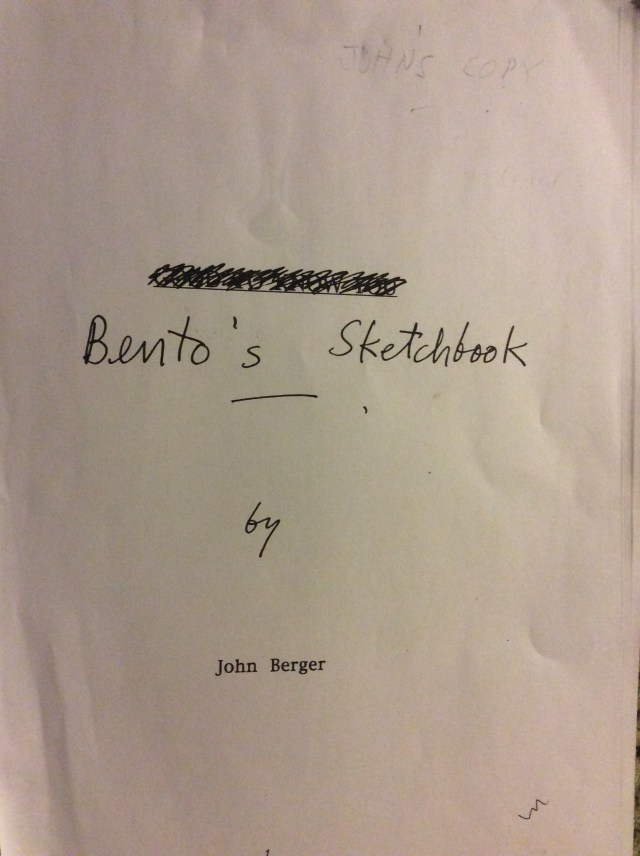
He was still at work on Bento’s Sketchbook, the book I’ll most cherish in his oeuvre, when I was writing my book on his life and work several years ago. At the time he lent me a wonderful handmade maquette of the text in progress, his only copy. Thus Bento’s Sketchbook for me became a fascinating insight into Berger’s Sketchbook, into John’s annotated prose, his crossings-out, his finger-smudged drawings, his doubts–even doubts about its title (he was originally going to call it Good to Know You—see photo below). If he was trying to access Spinoza’s workshop, as well as the mind behind those propositions and demonstrations, now I could enter John’s own workshop, be privy to the private gleam of his unpolished diamonds.

You pilot a motorbike with your eyes, Bento’s Sketchbook says. All things for John always came back to ways of seeing, his eternal recurrence. Ways of riding are really ways of seeing, and ways of drawing. “For many years I’ve been fascinated by a certain parallel between the act of piloting a bike and the act of drawing. The parallel fascinates me because it may reveal a secret. About what? About displacement and vision. Looking brings closer.”

Think of a motorbike’s trajectory as something similar to a drawn line. “You are riding a drawing,” John said; you traverse an immanent plane, travel over contours, across smooth space, folding, unfolding, and refolding as you go. Drawings and motorbikes unite around intuitive reason and express common notions. This seems to be what John tried to transmit in Bento’s Sketchbook, as he did in all his books: common notions.

John’s whole life represents a species of eternity; his art lies beyond duration, beyond space. A lightness of touch, resembling the “geometrical” deftness of Spinoza’s Ethics, lies everywhere in his work: the culmination of all those years of restless activity, of writing and thinking, of drawing and riding, of meeting and discussing. The finally-achieved “blessedness” and mortality of Spinoza’s “third level of knowledge,” knowledge that John spent ninety-years searching for.

A religiosity, this third kind of knowledge, was present in his being and his work in recent years. Not a religiosity of institutions, of churches and commissars, of higher powers; not a God above us, a transcendent creator who offers us freedom only after death in heaven. John’s God is monadal and metaphysical, like Spinoza’s, a single substance with infinite attributes, inside us, in nature, inside both us and nature, an immanent essence we can tap without meditation or mediators, something we can experiment with, struggle for, sketch out.

And so, too, is the Godhead in the Blackbird, in the Blackbird we can hear starting up in our heads, revving up one last time in our memory, ready for its journey back home, to its final foyer in Mieussy. So long, we might say, like the Woody Guthrie song, it’s been Good To Know You! Fly Blackbird, fly… fly into the light of the dark black night…

img_0129

Posted in All | 3 Comments

Planetary Urbanisation — The Whole and the Remainder

This essay offers another take on debates about planetary urbanisation—or “planétarisation de l’urbain,” as philosopher-urbanist Henri Lefebvre calls it. I will come back to why I think he calls it that later on. Before then, I want to start out with a little excursus into the countryside, into rural life, without which much of debate about capitalist urbanisation makes no sense. I want to grasp rural life, though, via the imaginative eye of John Berger’s triology Into Their Labours, debuting with Pig Earth, his otherworldly depiction of all-too-earthly French Alpine life. When Pig Earth appeared in 1979 the majority of the world’s population lived in the countryside and toiled as peasants. Not anymore. Now, almost forty-years on, the balance has tilted. Now, we’re told, the majority of people in the world live and labour in cities, in massively expanding megacities, the bulk of which are in the developing world, in Asia, Africa and Latin America.

Pig Earth is about peasants. One is Marcel who clings onto the land for dear life. He owns a shire-horse as strong as an ox, bearing a distinct resemblance to her master. One day Marcel’s son, Edouard, buys his father a twelve-year old tractor: “I got it cheap,” the son announces. Edouard and Marcel aren’t exactly on the same page. Edouard is a modern young man who doesn’t want to kill himself toiling the land, nor does he want to fritter away his life in any factory. So he chooses the life of a traveling salesman, selling soap and other domestic wares, on the road and in the open air. His son cheats people, Marcel thinks, he doesn’t practice a trade. And that tractor he’s bought is useless because Marcel can’t drive, doesn’t want to drive. Machines make monkey-work productive, Marcel says; and the wealth they create goes to those who own the machines.

“They make sure we know the machines exist,” Marcel says. “From then onwards working without one is harder.” Not having the machine makes the father look old-fashioned to the son, makes the husband look mean to his wife, makes one neighbour look poor to the next. After you’ve lived a while with not having the machines they offer you a loan to buy a tractor. What you earn from your milk each year is the price of a tractor. That’s why the peasant needs a loan. But with a tractor he needs all the parts, all the machinery, all the gadgets that come with it. So more loans are required for more machines and gadgets; soon the peasant falls deeper and deeper into debt. Eventually, he’s forced to sell out, get a job, if he’s lucky, in the local factory, providing the local factory hasn’t gone bust, or gone abroad. Selling out, it’s what those city slickers planned all along, Marcel thinks. “The world has left the earth behind it,” says Marcel to Edouard. “And what was on the earth?” demands the angry son. “Half the men here had to emigrate because there wasn’t enough to eat! Half the children died before they grew up! Why don’t you admit it!”

Marcel has a vat full apple dregs—marc—which he ferments each year to create gnôle, rocket fuel eau-de-vie. The dregs gives off warmth in the cold air of winter. Marcel shovels it into sacks and hauls it by horse and cart to the village distillery. Peasants drink gnôle, use it as antiseptic for themselves and for their animals, preserve fruit and herbs in it, cook in it, cook sausages that release dreams because they’re salty and spicy and saturated in alcohol. But the authorities tax gnôle, treat it almost like it’s illegal moonshine, bootleg liquor. From time to time, inspectors tour the villages on the lookout for surplus gnôle, gnôle beyond the statutory twenty liters, gnôle that needs to be taxed.

In the middle of a snowstorm, a strange car stops on the bridge. “The buggers have come back again!” Marcel and other villagers in the distillery call out. Then the two men get out, “wearing city overcoats, spotless green Wellington boots.” They greet the villagers yet nobody greet the inspectors back. “Marcel’s marc has yielded one hundred and sixty liters of eau-de-vie at fifty percent, which meant, the oldest inspector says, speaking as if he were explaining to children, “that he had to pay on eighty six liters the sum of two hundred and six thousand, four hundred francs.”

Later that afternoon, Marcel seeks vengeance, seeks justice as the countryside strikes back against the city, against paper money and its paper laws. He stops the inspectors’ car at gunpoint, leads them away to a distant hayloft stinking of gnôle and piss, and locks them up in the dark with a bunch of shaggy sheep. Meanwhile, he dumps their car over a ravine, and for a while lets them feel a rural cold, a rural suffering. Before he releases his prisoners, before the police come to handcuff Marcel, before they eventually sentence him to two years jail for rebellion against officers of the state, armed robbery and willful destruction of public property, one inspector begs the peasant to tell how much he’s asking for them. Marcel appears not to hear. “You must understand,” the eldest inspector says, “that we have more experience than you of the value of money.” Then Marcel thrusts his fist into the fleece of the nearest sheep, and spoke almost through the animal: “The value of money! The value of money!” he cries.

The sad thing, Marcel knows, is that the inspectors belong to another time, to another world, to linear rather than cyclical time, to urban time. It’s impossible to take revenge on them because they’ll never understand what Marcel is trying to avenge, the logic of his actions, his motives, his concept of justice. Nor will the judge or jury. Theirs is an abstract world, a world of abstract wealth, of abstract laws, of abstract money, of illusions in which everything appears to be a game, a game of role-playing, a game of fictitious assets and extractive practices…

In Berger’s sequel, Once in Europa, from 1989, the factory now dominates: a lot of local peasants finally cave into reality and get jobs there. The centerpiece story is about a woman called Odile, a smart Savoyarde farm kid who grows up into a smart everywoman. Her complexly interwoven soliloquy takes us through peasant generations, from childhood to womanhood, from motherhood to grandmotherhood, from land to factory, from factory to branch plant, from branch plant to city migrant. In the space of seventy pages, Berger has penned a sweeping peasant Bildungsroman.

Odile mediates between a bygone world of her father and mother’s generation and the new one to come, a new world that’s her world but which already seems bankrupt at birth. Her family’s romance is a Freudian Family Romance, full of bitter internal squabbles as much as tenderly love, squabbles between siblings, squabbles between fathers and sons, squabbles between mothers and daughters. Battles to overcome the private world are dramatised by perpetual struggles to overcome the public world: struggles to stay on the land, struggles to stop the factory encroaching, struggles to stop the factory closing, struggles to resist going to city, struggles to resist the city itself.

“The men who worked in the factory smelt of sweat,” Odile says, “some of them of wine or garlic, and all of them of something dusty and metallic.” The factory’s furnaces throb without cease, producing thirty thousand tons of ferromanganese every year, retching toxic blue smoke from its chimneys; men work night and day; the factory makes money, provides jobs for locals whose land no longer provides; it provides jobs for non-locals, too, who begin to arrive in droves; it tests out new alloys, makes experiments, and yet “it is inert, barren, derelict.” Men on the furnaces breathe air that contains four hundred thousand dust particles per liter, lethal amounts; chimneys spew out two hundred tons of fluorine a year; nearby forests are dying, cows and sheep are poisoned; and before long, the factory belongs to a multinational with factories in twenty-one different countries. “Papa had been right about the venom,” Odile laments.

Odile’s story takes us one-step nearer to Berger’s third book, Lilac and Flag, from 1990, an “old wives’ tale” of the urban underworld, a world tellingly above ground and which might await Odile’s own kids. Indeed, Odile herself could easily be the old wife in question and the two lovers, Lilac and Flag, the pet names of Sucus and Zsuzsa, her son and daughter-in-law. Sucus and Zsuzsa are trying to tread their slippery way through the spectral city of Troy, a paradigmatic megacity of expressways and concrete blocks, of money values and deceit, of immense freedom and brutal imprisonment.

Sucus lives with this mother and father on the fourteenth-floor of an anonymous high-rise on the city’s banlieue; papa Clement came from the village as a teenager and worked all his life opening oysters. One day Clement has a freak accident with a TV set, gets badly burned, and slips away in hospital. He’d always wondered whether his son could find a job. “There are no jobs,” Sucus tells papa on his deathbed, “except the ones we invent. No jobs. No jobs.” “Go back to the village, that’s what I’d like to do,” says Clement. “See the mountains for the last-time.” Half the men in the ward, he says, were remembering either their village or their mothers. Sucus’ generation doesn’t know the village, so could never go back; and yet, it can’t quite find itself in the alien city either. Sucus’ and Zsuzsa’s generation can go neither backwards nor forwards: it has nostalgia for neither the past nor the future. And they’re not prepared to take the same shit as their parents. Their expectations are different. Their prospects are almost non-existent.

From life experience, Zsuzsa and Sucus know that our cities are run by corrupt politicians and bent police, by shyster real estate corporations and financial institutions whose corruption is blatant and legal. They know the rules of the urban game are rigged against them. Their tragedy is a tragedy of arriving too late (or perhaps too early?): When their parents came there were still steady factory jobs to be had. But those industries have gone bust or cleared out to someplace cheaper, to somewhere even more exploitable and expendable. Berger knows better than anyone how millions of peasants and smallholders across the globe are each year thrown off their rural land by big agribusiness, by corporate export farming, by land grabbing; these people lose the means to feed themselves as well as the means to make a little money; so, as “seventh men,” they migrate to the city in search of work that’s increasingly disappearing, migrating to an alien habitat they can little afford or understand.[1] Meanwhile, as austerity drives continue to trim urban public budgets, glaring holes appear in welfare safety nets.

The sons and daughters of “seventh men” understand this habitat better, well enough to know that now there are no decent jobs left, only insecure, under-paid work and over-worked workers in its Lazarus informal layers: busboys and valets parkers, waiters and barmen, cleaners and security guards, builders and buskers, hawkers and hustlers. A push-pull effect has taken hold, a vicious dialectic of dispossession, sucking people into the city while spitting others out of the center, forcing poor urban old-timers and vulnerable newcomers to embrace each other out on the periphery, out on assorted zones of social marginalisation, out on the global banlieue. This is the bigger old wives’ tale that Lilac and Flag reveals.

What Berger has grasped here is part of the dynamic that Henri Lefebvre calls “urban society.” This is what the progressive production of our urban age looks like from the standpoint of rural life. Here is how “urban society” has its way, has its sway, how it subtly insinuates and brutally incorporates people and places into its global orbit. It does so slowly, over generations, through “evolutionary” modernisation processes; and it does so rapidly and forcibly, through theft and dispossession, through displacement and dislocation. Long-range entropy typically mixes with sudden and immediate catastrophe. This is how urban society takes hold, takes off, and keeps going, grows, expands, accumulates.

***
Lefebvre first announced the coming of urban society in 1970. It was a “revolutionary” process, he said, because the revolution in question is a drama in which assorted global ruling classes have played the lead role. It’s they who’ve initiated the will to totalise the productive forces, to colonise and commodify land everywhere, to valorise people and nature. Just as they’ve fracked deep into the earth and power-drilled monetised value from nature, ruling classes have begun fracking deeply into human nature as well, power-drilling value from different aspects of our everyday life, from dwelling space, from land and housing, from the whole public realm. It’s a process of creative destruction, of economic, political and ecological transformation; and it’s global and ongoing, bounded only by the upper limits of planet earth itself.

The opening line of La révolution urbaine sets the tone of things, uttering a bleak warning: “the complete urbanisation of society; today virtual, tomorrow real.” When Lefebvre said this I don’t think he was ever imagining that cities would be everywhere, that concrete and bricks, that freeways and highways would predominate every which way; he wasn’t suggesting the end of all green space and rural life. The latter would live on somehow, depleted and diminished; people would still work the land, likely as agricultural wage-labourers, likely for big agribusinesses who deal with mono-crops for export, to urban markets.

No, what Lefebvre was warning us about was the closing of the circle of a particular form of capitalism that defines itself less and less through a model of industrial or agricultural production and more through a process of spatial production, of producing planetary geography as a commodity, as a pure financial asset, using and abusing people and places as strategies to accumulate capital. Otherwise put: he was warning us that urban society could be best defined as the progressive production of evermore frackable spatial units. In a way, I like to think that Lefebvre was hoping his thesis became untrue, that the process had to stop, or at least had to be diverted, even if there’s no going back, that urban society, like it or not, is here to stay.[2]

Berger gives us an narrative of intimate human drama; Lefebvre tries to frame this drama as fraught political struggle, full of threats as well as existential possibilities. Urban society is the battle ground for new forms of radical and progressive politics; it has to be. He affirmed this not out of any personal whim: capitalism has affirmed it out of historical necessity, has made it our “objective” reality, the arena in which we all must now engage. “The urban problematic, urbanism as ideology and institution, urbanisation as a global tendency,” Lefebvre says, “are worldwide facts. The urban revolution is a planetary phenomenon.”

Imagery such as this has lately sparked lively debate in urban studies, homing in precisely on the notion of “planetary urbanisation.” [3] Lefebvre’s allusions to “planetary urbanisation” are scattered throughout La révolution urbaine. Its most explicit reference comes in his valedictory essay from 1989, the two-page “Quand la ville se perd dans une métamorphose planétaire,” published a few years before his death.[4] Lefebvre’s language here is worth pondering on for a moment. Menace stalks us, he says; not so much of “planetary urbanisation” but of “the planetarisation of the urban” (la planétarisation de l’urbain). The ordering of the phrase is telling.

The urban, Lefebvre seems to say, isn’t transitive but intransitive: the urban doesn’t so much spread per se as becomes the vortex for sucking in everything the planet offers: its land and wealth, its capital and power, its culture and people—its dispensible labour-power. It’s this sucking in of people and goods, of capital and information that fuels the urban machine, that makes it so dynamic as well as so menacing, because its energising and totalising force “expulses” (expels) people, “secretes” what Lefebvre calls its “residue.” This expulsion process makes urban space expand, lets it push itself out, has it further entangle rural space, and disentangle rural life.

Lefebvre says every big system leaves a residue that escapes it, that is chewed up and spat out by it, yet somehow, against it all, resists this system. Lefebvre, like Berger, knows how every whole leaves a remainder. (Remainders, after all, are the subject matter of the latter’s books.) It’s an idea most forcefully voiced by Lefebvre in Metaphilosophy, written half-a-decade before La révolution urbaine.[5] In Metaphilosophy, Lefebvre says that in any totalisation like global capitalism there’s always leakiness; there are always internal contradictions that structure and de-structure. Totalisation can never be total. Totalisation secretes and expels willy-nilly a “residual element,” its Other, its shadow. Displacement expulses replacement, dislocation expulses relocation, disenfranchisement expulses reenfranchisement. There are always people who don’t fit into any whole, who don’t want to fit in, who aren’t given the chance to fit in. They’re the stuff left over after all the sums are done, after everything has seemingly been accounted for: le reste after la somme. They are the philosophical anti-concepts, an affirmation of remainders, of marginal dregs, a growing constituency the world over.

Residues are remainders who live out the periphery, who feel the periphery inside them, who identify with the periphery, even if sometimes that periphery is in the core. Residues exist in the world of work: precarious and downsized workers, informal and gig economy freelance workers, petty service sector and agricultural workers—residues are workers without regularity, workers without salaries, workers without security, workers without mainstream trappings such as benefits and pensions; they’re workers without any real stake in the future of work. Residues are displacees, too, people forced off the land, people thrown out of their housing (by impersonal property markets and violent eviction), people whose homes have been repossessed, whose living space teeters on the geographical and economic edge. Residues come from the city as well as the countryside and congregate in a space that’s often somewhere in-between. I call this somewhere in-between the global banlieue; I mean it literally and metaphorically, as a potential space of real encounter, one not yet fully glimpsed.

True, a few residues have made themselves residual, voluntarily opting out, self-electing and self-selecting to live differently, communually, marginally, in new communities sprouting up in urban squats or in experimental eco-villages. But in general resides are the superfluous ones, the Sucuses and Zsuzsas of our world, the NINJA (No Income, No Job, No Asset) generation; some might be loosely politically conscious of themselves as residues: Greeks who feel the brunt of the Troika austerity initiatives, dispossessed Arab and African youth in French suburbs, Detroiters beholden to “Emergency Managers,” Palestinians lobbing rocks at Israeli tanks, Rojava Kurds in northern Syria, seventh men and women, refugees rejected and rebuked and whose homeland is little more than an “imagined community,” Indignados on the streets of Spain, “June Days” Brazilians protesting public transport hikes, occupiers in Istanbul’s Gezi Park, Umbrella kids in Hong Kong’s Occupy Central, Nuitards staked out around Paris’s Place de la République. The list goes on, and on.

To affirm residues is to affirm what romantic poet John Keats called “negative capability”: the capacity of human beings to transcend and overcome their contexts, to live with contradictions, to resist contradictions, to innovate and blast through contradictions, to blast through social confinement and confining contexts and structures. To reassemble residues is, Lefebvre says, to think revolutionary thought, “a revolutionary thought-act” (pensée-acte). Throwing in your lot with residues is “to inaugurate an act of poiesis,” to declare war, to step up to the plate, to bat against crushing totality, to challenge it to a duel, “to toss the glove in the face of established powers.” It’s “to rise up in grand defiance against systems and acquired forms, to seize from them new forms.”

***
The spirit of Metaphilosophy gets worked through La révolution urbaine. Urban society is itself a metaphilosophical category, a will to totalise, a discontinuity within continuity, a difference in repetition, a breakdown of old industrial society, with its traditional city and traditional countryside, and its supersession—its overcoming—by a new form: diffusive, unbound and apparently planetary in its reach, beyond any city-rural breach. The journey from Pig Earth and Once in Europa to Lilac and Flag takes us through and onto the other side of this breach. Thus a profound existential problem is displaced onto the plane of urban society where it now transpires as a complex political dilemma, as an attempt to forge a “new humanism” (and humanitarism) out of the “bad side” of capitalist development.

Point to bear in mind: while planetary urbanisation is a theory trying to figure out totalisation under neoliberal capitalism, it shouldn’t itself be a totalising theory. It’s a theory of residues within a vortex, an attempt to figure out the politics of residues, the politics of remainders in the whole. Lefebvre even suggests that in this urban vortex the political ante is to formulate “a revolutionary conception of citizenship.” He says this is really what he meant all along by “the right to the city.” It’s about residues reclaiming (or claiming for the first time) their rights to a collective urban life, to an urban society they’re actively making yet are hitherto disenfranchised from: “the right to the city implies nothing less than a revolutionary conception of citizenship.”[6] So many people have been pushed off-limits that it’s extended the limit of limits, created an even more expansive social space for a new conception of citizenship, for a citizenship to be invented.

This conception of citizenship will have nothing to do with a passport: citizenship here lies inside and beyond a passport, inside and beyond any official documentation. That’s why it’s revolutionary: it doesn’t express a legal right bestowed by any institution of the bourgeois nation-state. What we’re talking about here is a citizenship that’s not the badge of business or a bickering nationalism. It’s a shadow citizenship without a flag, a sovereignty constituted by a going back to the future, back in the sense that the building block for this citizenship is the light of the ancient ideal of a citadin, a person belonging to the city, a citizen belonging to la cité, having a right à la cité. Only nowadays la cité might be more attuned to the modern word “urban.”

Urban, like cité, suggests a political object that isn’t an object as such; it doesn’t mean a direct link to a territory whose borders are policed. You don’t need a passport to have rites of passage or rights of residence in this jurisdiction. Citizenship means something more than birthplace or naturalisation and isn’t constructed around strict delimitation, between thresholds and frontiers, between citizen and non-citizen. “Being a citizen used to mean remaining attached to a territory,” Lefebvre says. “Now, in the modern city, the city dweller is in perpetual movement, constantly circulating and settling, then extricating themselves from place entirely…in the large modern metropolis, social relations tend to be international, not only for migratory reasons but also, and above all, because of the multiplicity of communication technologies, not to mention the globalisation of knowledge. Given such trends, isn’t it necessary to reformulate the framework of citizenship? City dweller and citizen must be linked but never conflated.”

Here “urban” gets away from seeing cities as just physical entities. Instead, urban incorporates all manifestations of capitalist economic dominance over everyday life, including rural everyday life. Urban, on the other hand, satisfies a “hospitable” ideal of citizenship because it can nourish people’s sense of identity without crushing other people’s identity. People can express and become themselves, expand and enlarge themselves through their connection with urban society, with a polis, within an urban constellation, in an open and shareable form of identity. They’ll be citizens of cities without a state. The modern nation-state is a dubious place to feel at home in, to define oneself by: it’s a toxic concept, a dangerous ideal, full of narrowmindedness and arbitrary prejudice that expresses one person’s identity while denying somebody else’s.

International law is still dominated by the rules of a sovereign state, by intangible and flimsy rules problematic for upholding peoples’ rights. Is it possible to create a citizenship beyond the nation-state, somehow above and inside the nation-state? After three-decades of citizenship denial by Assad’s Syrian military regime, Kurdish self-determination now appeals to a citizenship that isn’t about forming a state so much as affirming an autonomous, decentralised region, a participatory democracy without walls: KURDE AZAD SINORA NASNAKE—“Free Kurds Don’t Recognise Borders.” Kurdish democracy now constitutes a form of “Democratic Confederalism,” the creation of free self-governing communities throughout the Rojava region, with village, town and city assemblies organising themselves into a series of communes, which sort out everyday adminstration and service delivery. It’s an admirable radical experiment gravitating around the area’s major urban areas—Aleppo, Kobane and Qamishli—a die-hard militancy achieved in a bloodied, war-torn Middle-East.

***
Twenty-years ago, Jacques Derrida mused philosophically along these lines, and wondered whether it was possible to define a modern identity, and a modern cosmopolitanism, that bypassed the nation-state. His response was uncannily similar to Lefebvre’s. Yes, Derrida said, it was and still is possible: through relatively-autonomous cities, independent from any state, separate nodes allied to one another through “forms of solidarity to be invented.” We’re still trying to invent this solidarity; it has so far alluded us. Yet Derrida urges us to make “yet another effort.” He uses an intriguing phase to describe the pancea for urban dispossession: “villes-refuges”—“cities of refuge,” crucibles for a new kind of unconditional citizenship, for a new right to and of the city.

In the Old Testament, cities of refuge were set aside as sanctuaries for people who “killed accidentally” (cf. Numbers, 35: 9-32; Chronicles 6: 42 & 52; Joshua, 20: 1-9); “these towns will be cities of refuge,”Chronicles said, “for the sons of Israel as well as for the stranger and the settler amongst you.” What Derrida has in mind are cities of sanctuary for writers who undergo persecution because of their art and political views; but he hints, too, that the concept might apply to all displacees and emigrés, to all asylum seekers and refugees—writers or otherwise. Might we broaden this notion even more to include residues in general, safeguarding all the rootless and landless effected by everyday trauma, by the ordinary madness of our economic system?

“A new sovereignty of cities,” says Derrida, “would open up an original space for rights which inter-state national rights have failed to open up.” “We dream of another concept,” he says, “of another right, of a potential right of the city” (emphasis added). Derrida knows this is “an experimentation of a right and of a democracy to come.” He knows it’s wishful-thinking, utopian, especially since he gives us little sense of what a “ville-refuge” might look like, let alone how it might be achieved. Still, if we can build new towns, even whole new megacities, what’s stopping us from reconstituting a new ideal of urban belonging, from forging an international urban solidarity for which no state, party, trade union or formal institution seems willing to take responsibility?

In an odd sense, the “spectre” of a shadow citizenry looms, a blurry phantom of solidarity in times of crisis; its activism recognises that our national and international laws and rights are “out of joint.” Perhaps we need to read Derrida’s idea of “villes-refuge” in conjunction not only with Lefebvre and Berger but also with Derrida’s own earlier work, Spectres of Marx, where he spoke of a “New International”; “a profound transformation,” he called it, “projected over the long term, of international law, of its concepts, and its field of intervention.” This New International is “a link,” Derrida said, an affinity, a suffering and hope, a still discreet, almost secret link, but more and more visible, with more than a sign of it. It’s an untimely link, he says, without status, without title, without a name, barely public, without contract, without coordination, without party, without country, without national community, without co-citizenship, without common belonging to a class.

We’re not sure what this International really is yet; we can’t name it anything positive. But it’s there nonetheless, we know it’s there, out on the horizon, more needed than ever before, needed everywhere. It’s a ghostly dream-thought of a new status for the city, for cities belonging to a democratic urban webbing, for a solidarity of confederated assemblies interrogating the essence of politics and the role of the nation-state: what is a citizen of the urban, a citadin of the twenty-first century?


Endnotes

[1] A Seventh Man (Penguin, London, 1975) is Berger’s now-classic treatise of European migrant workers. What compels the migrant worker to leave his village and accept this humiliation? Berger wonders. Far from being on the margins of the modern urban experience, the migrant is, Berger says, central to it.

[2] The progressive production of evermore frackable units is a “tendency” rather than a steadfast law. It’s tempered by only one thing: by social reproduction, by the need to reproduce labour-power. If everywhere were fracked for value, if everywhere masses of people (workers) couldn’t afford dwelling space, then the urban system would presumably break down. Marx, in Capital Volume 3 (Chapter 46), warned of the “monstrous power wielded by landed property,” used against “labourers as a means of practically expelling them from the earth as a dwelling-place.” It’s clear that “practically expelling” people from the earth as a dwelling-place is the driving force in the production of residual space.

[3] See Neil Brenner and Christian Schmid, “Towards a new epistemology of the urban,” City 15(2/3) 2015:151-182 and Richard Walker, “Building a better theory of the urban: A response to ‘Towards a new epistemology of the urban’,” City 15(2/3) 2015:183-191

[4] Henri Lefebvre, “Quand la ville se perd dans une métamorphose planétaire,” Le monde dipolomatique, May, 1989, pp16-17. For an English translation, see Laurent Corroyer, Marianne Potvin and Neil Brenner, “Dissolving City, Planetary Metamorphosis,” Environment and Planning D: Society and Space 32(2) 2014:203-205

[5] Lefebvre’s fascinatingly suggestive text has recently been made available to Anglophones: see Henri Lefebvre, Metaphilosophy (Verso, London, 2016)

[6] This is the last line of Lefebvre’s “Quand la ville se perd dans une métamorphose planétaire,” his last essay.

[7] Jacques Derrida, Cosmopolites de tous les pays, encore un effort (Edition Galilée, Paris, 1997). The text marked a speech that Derrida wrote (though never gave in person) for a meeting of the International Parliament of Writers, Strasbourg, 6th November 1995. Derrida was Vice-President of a Parliament that included Wole Soyinka, Salman Rushdie, Pierre Bourdieu and Edouard Glissant.


Posted in All | Leave a comment

The Amateur of Life

One of my all-time favourite essays on “amateur reason” is by the French poet Charles Baudelaire: The Painter of Modern Life, published in 1863. Funnily enough, this set piece of art criticism has been celebrated for many things, especially as a paean to modernity—remember Baudelaire’s famous modern dictum: “the transitory, the fugitive, the contingent”? But it has never been fêted for what I think it is: the best evocation of intellectual amateurism and critique of professional expertism. The amateurism in question is that of a singular man, Baudelaire says, an archetype we might say, a man who seeks no approval from anybody. He’s the nemesis of what constitutes self-promotional “success” today, of mediatised showboating. In fact, he wants to go about incognito, doesn’t even want Baudelaire to call him by name. So Baudelaire suppresses his name, uses instead M.G.—after Monsieur Guys, Constantin Guys, the painter of modern life.

No mere painter, Guys, no mere artist or professional specialist whose “conversations are limited to the narrowest of circles,” Guys was something more: “a man of the world,” Baudelaire says, a “world-minded” person, a person of the “whole world.” Guys hates to be called “specialist,” even hates the label “artist.” He hates to be tied down to an expertise like a serf tied to the soil, like an accountant tied to accounts. Guys wants to know everything, understand everything, appreciate all that happens on planet earth, its mysteries and miseries, its delights and charms, embroil himself in everything, depict it with paint on canvas, with pencil and charcoal on paper, with watercolours. How can somebody so open be an expert, a hired hand? Impossible. He’s passionate about passion. Baudelaire searches for the right epithet, calls Guys something thrilling: “a spiritual citizen of the universe.”

All of this is lightyears removed from today’s reality, from our cult of expertism, which is more akin to the blasé attitude Guys hates: the attitude of knowing everything, of having seen and done everything. Indeed, so much of what goes on in public life nowadays is a blasé privatised affair, the exclusive domain of policy wonks and business executives, of professional “experts.” Everything that was directly lived has moved away into a representation, into a representation done for and by experts, done from above and foisted down from above, onto a public, onto ordinary amateurs. Amateurs might want to have a say, might even be “experts” in their own right—in gardening, in amateur dramatics, in car mechanics, in painting—but what they say, and what they do, is taken as mere amusement, as something unimportant. Professional experts, by contrast, are people who apply themselves to specialisms in an important way. That’s how they’re commonly held. They’re there to be listened to, nodded at, taken seriously.

Experts know everything. To guard this expert status they must know everything. “Expert” becomes a pretext to say what you like in a certain context; it’s an opt-out clause, a denial of open-mindedness, of being inquisitive, of stretching your horizon. Experts affirm what they think they know matter-of-factly, never straying outside their comfort zones, where they’d be insecure, a non-expert, like the rest of us. So they play safe; expert circles shrink, vistas narrow, intellectual curiosity diminishes. Experts can’t drop their professional guard; an esoteric language sets them apart, gains entry into exclusive expert bodies, onto expert panels, ones strictly off-limits to rank amateurs, unless they’re the audience.

A staggering array of experts bodies now dominate the implementation of social needs and the adjudication of public utility. Expert managers and specialist middle-managers step up to the plate to bat at all levels of government; ditto economic policy; ditto health systems; ditto educational policy; ditto the business of science, its Research & Development, its scientific patents and intellectual property rights. Unaccountable agents head up the upper-echelons the Ministry of Finance and its regime of Accountancy Governance; elite technocrats and cabinet plutocrats, expert economists and accountants, consultants and advisors, think-tank experts offer not-so-laissez-faire encouragement to self-regulating market intensity; it’s these professional experts who try to maintain the functioning credibility and sustained viability of this fictitious commodity system, a reality of lies wherein economic crises are terribly truthful.

Experts are a self-perpetuating cabal who tell us what we must learn, what we must read, what needs to be sold, what aspect of public culture must to be written off, is without economic value, is “inefficient.” Experts tell us how we must present ourselves in public, how we must present ourselves to ourselves, how we must do our job, how we must talk and write. Experts tell us about our personalities and about our hopes and desires, about how we must live, and die. They tell us how to invest our money, if we have any, how much tax we should pay, and what our legal rights are. Experts even tell politicians how they should govern. It’s not that some experts are necessarily wrong; it’s more the mantle of power experts now assume, the worshiping of expertism, the degree to which the expert seems to rule supreme, are a law unto themselves, beyond ordinary, non-expert accountability. Experts are both a new church and a new mafia, seducing and extorting at one and the same time.

***
And then we have Baudelaire. Thank heavens for Baudelaire! Baudelaire tries to keep intact a romantic wisdom that seems ever more vital, more vitally needed than ever. The key section in The Painter of Modern Life is “The Artist, Man of the World, Man of Crowds, and Infant,” a subtle shift in dialectical logic, an amateur’s logic, though no less rigorous for it. To be sure, the movement from artist as specialist to man of the world, and then from man of the crowd to infant loosens the the grip any expert could hope to secure. It took one amateur to recognise his other, his semblable: Baudelaire is the painter of the painter of modern life, an artist who wrote art criticism for fun, about artists like Guys who often painted and scribbled for fun, for their own amusement, for pleasure. (The pleasure wasn’t always about content. Guys sketched modern death as well as modern life: for several years, on-the-spot, he drew battle scenes from the Crimean War, with fields strewn with human debris.)

Baudelaire didn’t consider art criticism or poetry as any kind of job, as any real métier, even if he sometimes got paid to do it, got tossed a few sous for his labours. He’d have done it for nothing anyway, and frequently did do it for nothing. But he was serious about his writing nonetheless, deadly serious. And although he seemed to write in solitary confinement, what he wrote was invariably destined for a wider, popular public. His Paris Spleen poems, like The Painter of Modern Life itself, weren’t written in learned literary reviews but featured as Op-Eds in Le Figaro. They were feuilletons of a roving reporter, episodes of modern vagabondage seen through the lens of a modern vagabond poet. Nothing could compare today. They were provocations rather pacifications, partial and political rather than paltry and platitudinal. The journalist-poet Baudelaire was equally serious as both a challenger and champion of “minor” artists like Constantin Guys, or of “major” ones like Eugène Delacroix, or Edgar Allan Poe, with whom Baudelaire fraternally bonded.

But Baudelaire never saw himself as a professional critic, as a professional anything for that matter. This wasn’t so much self-depreciation as self-affirmation, a furtive sidestep to unaccommodated and unco-opted amateurism, to free-floating outsiderness. Baudelaire had a distinct advantage here: he was never a university prof, was never crippled by wooden language, by academic tiffs, by career pretensions. He wasn’t hemmed in by methodological straightjackets, by the need to defend such-and-such a paradigm of thought. That’s perhaps what separates the specialist from the person of the world, the artist of the whole world who engages with the whole world. Willy-nilly they’ll have impact. Willy-nilly their point of departure is curiosity; Guys had it by the bundles; so did Baudelaire.

For the spiritual citizen of the universe, curiosity is a “fatal, irresistible passion.” Guys may have painted dandies and flâneurs but he certainly wasn’t one himself. The dandy and flâneur aspire to cold detachment, to indifferent restraint, rather like the today’s expert, who’s paid to behave “objectivity,” consulted for their passionless pragmatism, the antithesis of impassioned curiosity. The expert’s nonchalance is the nonchalance of numbers, of metrics, of hiding behind PowerPoint, of coolly voicing “facts” not opinions. Experts are demonstrative with data and deliverables; they are, like Baudelaire’s dandy, blasé “as a matter of policy.”

Spiritual citizens of the universe, though, are perpetually in convalescence (a strange term, I know, a term Baudelaire borrows from Poe), and here convalescence means taking stock after illness, maybe after a professional illness, after a near death experience that shakes you to your existential core. It’s the shock of recognition, a born-again realisation of who you really are. Convalescence is like “a return to childhood,” Baudelaire says, simultaneously a regression and eventual progression, seeing everything again as an infant sees everything, as you once saw everything: that is, with novelty, with newness and freshness, with curiosity, with a perception that’s “acute and magical.”

Imagination flows. Cynicism lifts. New delights glimpsed. New odours breathed. Faculties revived. Genius, says Baudelaire, in a lovely passage, is “childhood recaptured at will, childhood equipped with an adult’s physical means to express itself, with the analytical mind that enables it to bring order into the sum of material involuntarily amassed.” What else is this but the restlessness of non-specialism, the pure delight of wanting to know, of not already knowing, of wanting to know something new: “To this deep and joyful curiosity,” says Baudelaire, “one needs to attribute the fixed gaze and animal ecstasy of children before the new, whatever it may be: faces and landscapes, lights and glimmerings, colours.” But to engage in the world with passion, with the animal ecstasy of the child, you need to get out into the world. Thus, the major methodological motif of the person of the world: épouser la foule, to marry or merge with the crowd, to feel the elemental passions of ordinary life as it is really lived—for better or for worse.

This puts methodological amateurism into practice, very different from professional posturing, when expert protagonists rarely venture out of the office or conference room, and just as infrequently stoop low into the depths of humanity, to see it from the bottom upwards, from the inside. Theirs is a methodological superiority; the very nature of being “expert” already sets you apart, puts you above it all, more knowledgeable than what’s down below, outside. It’s a gaze looking down, not immersion in. Experts parachute into distant lands for a few days; World Bankers “advise” about infrastructure or whatnot, young “expert” consultants at McKinsey’s, with its “global research and information professionals,” collect and collate data, do it online, from afar, throwing themselves into projects with which they have little experience or feel for, notwithstanding Ivy League credentials. (That’s one reason why you get expensive botched jobs. It’s a recurrent theme within professionalism: incompetence.)

A couple of times Baudelaire even adopts the word “amateur.” Alas, it’s bowdlerised in all English translations I’ve seen. So Anglophones lose Baudelaire’s play of meaning, never hear him say “amateur.” Indeed, sometimes he does mean “lover of”; other times what he means really is “amateur,” somebody who does things for the love of doing those things, who does it without pay, with great competence, because of a deep emotional attachment, because of passion and curiosity. Unlike professionals, they’re not alienated from their subject matter. In the original Le peintre de la vie moderne, listen to Baudelaire: “l’amateur de la vie fait du monde sa famille.” THE AMATEUR OF LIFE MAKES THE WORLD [THEIR] FAMILY. It’s a beautiful evocation, worth spelling out in uppercase. But it’s an evocation that gets a bad rap in the “official” translations: “The lover of life makes the world his family,” which strikes as something different. Especially if we compare the next sentence, where Baudelaire says: “l’amoureux de la vie universelle entre dans la foule comme dans un immense réservoir d’électricité.” “The lover of universal life moves into the crowd like they’re entering an immense reservoir of electricity.” That’s how we might put it in English. But we’re lost in translation: the lover of universal life and the amateur of life elide into one great love. Maybe that’s fair enough; but Baudelaire is quite clear: he says both “amateur” and “amoureux” and here we might assume he wants to make a distinction, that there are two different types of lovers and doers, hence two different words: the amateur of life and the lover of universal life.

***
Doubtless there are plenty of experts who love life, too. Doubtless a few want to break out of their narrow expert confines, be really multidisciplinary, really exploratory, maybe even critical, maybe even childlike again about their learning. I’m not sure. Maybe there are others who’d like to stop their expert performing, pull the curtain down, because they know it’s all a silly game of show, an act. One problem is that experts operate within a professional context, within a whole professionalised apparatus that pumps out its own professional ideology, which grips people, interpellates people, “hails” experts and laypeople alike, slots them into occupational roles, into boxes and moulds. And it’s hard to break out of these moulds.

Oddly enough, it’s perhaps hardest of all for experts to break out. They’ve constructed an iron-cage around themselves, a prison-house in which they’re at once warders and inmates. A lot has to do with the “reputation economy,” with the ever-expanding industry of branding and blanding personal identity. Could we ever imagine Baudelaire or Constantin Guys giving a flying fuck about reputation? As if what they wrote or drew was ever dictated by the endless anxiety of worrying about how they appeared before professional audiences, about how they should forget disagreement, fall into line with the pleasing conformity of groupthink. It’s unimaginable. That’s why we might label Baudelaire and Guys “sincere,” that they were sincere about themselves and about what they did—they were authentic, we might also say. Fear of losing professional face in the reputation economy is a dead-ringer for insincerity, and, God forbid, for being struck off the exclusive “Directory of Experts.”

Most university academics now appear on their institution’s “Directory of Experts.” Here we have a searchable, alphabetic database of the “Research Expertise” of every faculty member, there as a resource for intrepid journalists who have an afternoon to write a story. Who to call to get the appropriate scoop about such-and-such a field? Who can offer the suitably condensed juicy soundbite? It’s all there for media offing, a simple list of words of wisdom journalists can use and abuse. If we hit a letter (either name or expert field), we can get a scholar’s intellectual profile, distilled into a half-dozen expertise keywords, a peculiar and particular branding that all universities have, that every “Centre of Excellence” peddles, which means every university. How to judge the most excellent amidst all this excellence? Which expert out of an endless roster of experts? Who is the most expert expert? Maybe there’s even a “Baudelaire” keyword, an expert on being an amateur in life? Maybe then we can get the relevant lowdown on poetry and wine, on melancholia and moroseness. I wonder which media might be interested?

Within these expert Yellow Pages, moving in and out of categories, if ever the whim strikes you, is a tricky affair. It’s like Agent Mulder or Scully from the X-Files: you’re typecasted and you can’t do anything else; no matter what, you’re gonna always be Agent Scully and Mulder. Disciplinary border controls and intellectual gatekeepers won’t give security clearance, won’t let you enter into unknown intellectual territories, into other thought-spaces where you’ve no reputation, no expertise—unless you bribe them with your big grant money. It’s a lost cause. Baudelaire’s wasn’t the only vie maudite, the only accursed life. Meanwhile, amateurs have their work cut out, too. To seek amateurism, says Baudelaire, is “damnation already done.” Amateurism will be your joy, for sure, but also your eternal curse, your perpetual challenge. It’ll be your mutiny in search of personal authenticity, your quest to tell the truth about yourself in a world that rewards you for telling lies, for playing its game, its Great Game. When you’ve persuaded yourself that bad faith is really good faith, and that you get a big payoff from society’s bad faith, you’re well on the way to living with your inauthentic self. It takes great acts of courage or folly to do otherwise, sometimes self-destructive acts of courage, like Baudelaire’s.

And here there’ll be a politics, always they’ll be a politics. The politics of amateurism is about dismantling our giant professional machine, stripping it of its legitimacy, of its functioning credibility. This dismantling has to be done from the inside as well as from the outside, from inside and outside of professional “expert” camps. It’s a drama involving double agents and great refusers, who’ll call out to others, to those who know how to strategise and disrupt; to those whose value systems are intact. Professional experts will have amateur alter-egos and shadow selves, Edward Snowden-like whistleblowers yearning to break free, warning of the totalitarian expert nightmare we’re all somehow entangled in. Double agents and great refusers will know how resistance today isn’t so much about what you do as who you are, ontological as opposed to epistemological, something that cuts right inside you, into your passionate beliefs, into your convalescence, into your democratic hopes and anti-professional desires. Resistance, in other words, needs to be wholesale, a total way of Being. Walter Benjamin reckoned Baudelaire was “an agent of the secret discontent of his class within its own rule.” Maybe we can see Baudelaire as an agent of secret discontent within our own professional class system, a secret amateur trying to shrug off “expertise.” He’s inviting us on a voyage yet condemning us forever to be an accomplice in a haunting and heartfelt ideal.

Posted in All | Leave a comment

Towards a Metaphilosophy of the Urban

This essay was first published in Antipode Foundation on 4th December 2015

I suspect I’m not the only one thrilled by the prospect of seeing Henri Lefebvre’s great philosophical tract, Métaphilosophie, from half-a-century ago, finally make it into English. Thanks to the dedicated steady work of Stuart Elden, rapidly becoming Lefebvre’s Anglophone ambassador (I’m tempted to say an English Rémi Hess, but that wouldn’t be kind), and David Fernbach’s considerable translation skills, Metaphilosophy is due out next spring with Verso. This might well be the philosophical event of 2016. The translation has a wonderful postface essay by Marxist scholar Georges Labica, a former philo prof at Nanterre. Labica says Métaphilosophie is a very important book, as important for us today as it was important for Lefebvre himself back then. Indeed, it’s perhaps Lefebvre’s most important work, says Labica, a milestone text, the most satisfactorily executed and the best organised of all his books, demarcating what he once did from what he would soon do, punctuating his own past from an emergent future. Here, we have Lefebvre ploughing the land and planting seeds for what would eventually bloom into books on space and urbanism, and a third volume of Critique of Everyday Life (in 1981), which, remember, is subtitled “Towards a Metaphilosophy of Everyday Life.”

Labica also thinks Métaphilosophie is one of Lefebvre’s most ambitious undertakings, his towering engagement with Hegel and Marx, with Nietzsche and Heidegger, with poetics and polemics, with himself and the world he knew, the world he wanted to change. Feuerbach also has a cameo in Métaphilosophie, the man famously taken to task by Marx, the man from whom Marx took much; Lefebvre similarly wants to transform the world along with abstract, contemplative philosophy; he knows that’s the point. But Métaphilosophie is equally an accomplished book of interpretation, written by a sexagenarian philosopher-poet at the top of his game, an ancient Greek who’s also a heterodox Marxist, a Fourierian utopian who’s a Heraclitian nomad, forever flowing, never wanting to step into the same philosophical waters twice. Thus, into the Anglosphere enters Metaphilosophy, “a philosophical text,” Stuart Elden says in his contextualising intro, “that seeks to leave Philosophy behind”; it’s a study, says Elden, “of productive tensions.”

***
Lefebvre was always slippery about what he meant by “metaphilosophy.” And he’s as slippery as ever in Metaphilosophy itself; rarely do we get a straight answer, rarely does he want to systematise himself, explain his thought in a way that cuts it up, that boxes it off. He seems to suggest metaphilosophy is philosophising beyond pure philosophy, a sort of free play with big concepts, with thoughts above and beyond academic philosophy, beyond the institution of philosophy, a philosophy without borders and limits, a holistic approach to social, existential and political questions, a philosophy that realises itself through political practice. He knew full well the tag would confuse, would likely perplex any interlocutor, befuddle even the initiated.

Take an instance from 1974. Dialoguing on “Evolution or Revolution” in Amsterdam’s Lutheran church with eminent political philosopher Leszek Kolakowski, Lefebvre gleefully proclaimed himself something else than mere philosopher. “No,” he said, “I consider myself a metaphilosopher, that is to say, I don’t build a system. I aim to take from philosophy those ideas which are capable of arousing a critical consciousness, ideas that are destined for a higher and at the same time more profound consciousness of the world in which we live.” “Mr. Kolakowski,” mediator Fons Elders wonders, “do you agree with this idea of metaphilosophy?” “First of all,” says Kolakowski, “I don’t understand what it means exactly… this metaphilosophy?” Defending himself, Lefebvre responds: “I’d like to return to the idea of metaphilosophy. First, Marx has said that the revolution, the way he thinks it, conceives it, and projects it, is not a philosophy, but the realisation of philosophy. In the course of its history, philosophy creates a certain idea of the human being, and the revolution realises this idea, but not without modifying and transforming it. Metaphilosophy is the idea that philosophy leads towards an idea or a projection of a human being, which revolution realises.”

Overcoming philosophy—dépassement de la philosophie—is, accordingly, a key item in the construction of metaphilosophy. Philosophers deal in abstract thought, in rarefied concepts, often without social content; and, as people, they tend not to be too connected with an everyday public. Meanwhile, everyday people aren’t terribly smitten by philosophy, nor by philosophising. Life is just too practical, too pragmatic; big ideas seem too remote from this reality. Thus the twain rarely meets, this schism between the abstract and the concrete, between ambitious thought and courageous action, which, Lefebvre thinks, is a big problem for both constituencies, for enlightened philosophers as well as alienated people—or is that the other way around? Philosophy needs to bed itself down in everyday life, needs a creative, poetic and active impulse, really an amalgam of all three, bringing theory and practice into unity, into a transformative and creative mutation, into a productive confrontation. “It behooves metaphilosophical thought,” Lefebvre says, “to imagine and to propose new forms, or rather a new style that can construct itself practically, and realise the philosophical project by metamorphosing the everyday.”

Those three impulses transpire and conspire in Métaphilosophie as praxis, poiesis and mimesis. Praxis comes from Marx, of course, and is Marxist in orientation, emphasising relations of production, relations between people, social relations, social activity, concrete practice in the sense that Marx identifies in his Theses on Feuerbach: “Feuerbach, not satisfied with abstract thinking, wants sensuous contemplation; but he does not conceive sensuousness as practical, human-sensuous activity” (5th thesis); “All social life is essentially practical. All mysteries which lead theory to mysticism find their rational solution in human practice and in the comprehension of this practice” (8th thesis).

Poiesis, for its part, is a sort of praxis as well, stemming from the Greek root “to make.” But not produce in the technical sense; more to create from ideas something beautiful, to create an oeuvre, a work of art, poetry or theatre, even a city, the spontaneous creation of social participants, of citizens united. It can also mean to fashion the self in a creative, poetic act; in Introduction to Metaphysics, Martin Heidegger saw poiesis as the original site of the disclosure of Being. “All creation isn’t poiesis,” Lefebvre tells us, “but all poiesis is creation.” This poetic blush has us glimpse Nietzsche and Heidegger, brings poetry to bear on technology, spontaneity on rationality, freedom on necessity, Becoming on Being. The link between praxis and poiesis, says Lefebvre, is a the link “between repetition and creation, between discourse and speech.”

The contradiction gets mediated, he says, by mimesis, something more than just “imitation.” We get a hint of this again from the ancient Greeks, especially from “imitative poets” like Homer, whose likes Plato wanted to banish from the city. Imitation is a form of representation; for Plato, it’s the notion that imitative poets represent people behaving immoderately. Imitation is a “copy of the truth,” Plato says, how things appear; not good: a misrepresentation of human virtue. Lefebvre flirts with this idea, but sides with Homer rather than Plato. Mimesis doesn’t directly coincide with imitation, he says, but instead can be a creative message bearer, too, a “perception and intuition.” It situates formalism, is about difference as well as repetition, a kind of habitus that enables social reproduction to unfold, to unfold as before; but it’s also something that breaks out of repetition, out of simple reproduction, permitting something else to take hold, to take form. Mimesis, in short, is inherent in both poiesis and praxis; it’s about—using the language of Critique of Everyday Life (volume 3)—“continuity and discontinuity.”

***
In Métaphilosophie, Lefebvre roots for a totality without totalisation. He knows that in any totalisation like global capitalism there’s always leakiness, always ruptures, always internal contradictions that both structure and de-structure. Totalisation can never be total. When mimesis, poiesis and praxis encounter one another, weird and wonderful things emerge from the mix. Totalisation secretes willy-nilly a “residual element,” its Other, its shadow. Every totalising system, explains Lefebvre, “leaves a residue, which escapes it, which resists it.” There are always people who don’t fit into any whole, old Henri included. They’re the stuff left over after all the sums have been done, after everything has seemingly been accounted for; le reste after la somme. They’re philosophical anti-concepts, an affirmation of remainders, of marginal dregs, of the power of the ragged and irreducible.

Early in Métaphilosophie, Lefebvre tells what he means by irréductible. Totalising systems tend to “expulse” a residue, he says, which is essential in its irreducibility, in its implacability, in its refusal to sit down and comply. Philosophy “expulses” the everyday and the ludic; technocracy expulses desire and imagination; bureaucracy expulses individual deviancy and subversion; reason and rationality expulse irrationality and spontaneity. To affirm residue, says Lefebvre, is to affirm a romanticism, a revolutionary romanticism, concocted from “certain essential themes of Marxism: negativity, contestation, radical critique.” To talk about a residue is thus to talk about what another romantic, John Keats, called “negative capability”: the capacity of human beings to transcend and overcome their contexts, to live with contradictions, to resist contradictions, to innovate and blast through contradictions, to blast through social confinement, through confining totalising contexts and structures.

Actually, Lefebvre’s “method of residues” doesn’t so much draw upon as “parody” another nineteenth-century Brit, “the well known and little employed scientific method left by the empiricist philosopher John Stuart Mill.” In A System of Logic (1843), Mill said “the residue of the phenomenon is the effect of the remaining antecedents.” But “our method,” Lefebvre counters, “contains several articles: to detect residues—to wager on them—to demonstrate how they’re a precious essence, to reunite them, to organise their revolt and totalise them.” Each residue is an irreducible yearning to be pulled together. To reassemble residues is, for Lefebvre, to think revolutionary thought, “a revolutionary thought-act” [pensée-acte]. Waxing lyrical and political in the important climatic sections to Métaphilosophie, Lefebvre reckons that throwing in your lot with residues is “to inaugurate an act of poiesis,” is to declare war, to step up to the plate, to bat against mimesis, against crushing totality, to challenge it to a duel, “to toss the glove in the face of established powers.” It’s “to rise up, in grand defiance, against systems and acquired forms, and to seize from them other forms.”

***
Five years on from Métaphilosophie, Lefebvre wrote his best text on the city, La révolution urbaine. Yet even here—especially here—it seems the spirit of metaphilosophy is still getting worked through, that the notion of an ontological overcoming remains vital. Only now, what’s being overcome is the city itself, a breaking of the chains of mimetic repetition; a not so romantic revolution, an urban revolution. Ambivalence is legion; the dialectic highly charged. Because just as metaphilosophy is built upon the ruins of traditional philosophy, so, too, is urban society built upon the ruins of the traditional city. “Metaphilosophy,” he says in La révolution urbaine, “freed itself from philosophy like urban society emerges from the exploding city.”

Urban society, then, is itself a metaphilosophical category, a discontinuity within a continuity, a difference in repetition, a breakdown of old industrial society, with its traditional city, and its supersession—its overcoming—by a novelly new urban form: diffusive, unbound and planetary in its reach, beyond the breach. Thus the profoundly anti-philosophical problem of metaphilosophy is displaced onto the profoundly practical plane of urban society, where it transpires as a complex theoretical and political dilemma. Otherwise put: the urban is the arena where praxis, poiesis and mimesis are brought to metaphilosophical judgment.

The metaphilosophical ambition Lefebvre sets himself in The Urban Revolution is nothing less than an attempt to forge a “new humanism” out of the “bad side” of capitalist development. For the revolution in question is a drama in which the ruling classes have played the lead role. It’s they who’ve initiated the will to totalise the productive forces, to colonise and commodify land everywhere, to valorise people and nature, to frack value from human nature. Just as they’ve fracked deep into the earth and power-drilled monetised value from nature, ruling classes have begun fracking deeply into human nature as well, power-drilling value from different aspects of our everyday life, from the public realm, from all sorts of mysterious fees and charges slapped onto things, from land and real estate. The urban process is really the progressive production of evermore frackable spatial units. It’s a process of creative destruction, of economic, political and ecological transformation; and it’s global and ongoing, bounded only by the upper limits of planet earth itself. “The urban problematic, urbanism as ideology and institution, urbanisation as a global tendency,” Lefebvre says in La révolution urbaine, “are worldwide facts. The urban revolution is a planetary phenomenon.”

Imagery such as this has sparked lively debate in urban studies, homing in on the notion of “planetary urbanisation.” Philosophers, as yet, haven’t come onboard. Metaphilosophers and metageographers appear to be taking note. Still, confusion abounds. But if we read closely what Lefebvre seems to be saying about both planetary urbanisation and metaphilosophy, we can glean productive insights from the combination, even guiding political thoughts, ideas that can transcend blind fields and help residues see the light.

Lefebvre’s allusions to “planetary urbanisation” are scattered throughout La révolution urbaine. Its most explicit reference, maybe, comes in his valedictory essay from 1989, the two-page “Quand la ville se perd dans une métamorphose planétaire,” published a couple of years before his death. His language there is worth pondering on for a moment. Menace stalks us, Lefebvre says; not so much the menace of “planetary urbanisation” as “the planetarisation of the urban” [la planétarisation de l’urbain]. The ordering of the phrase is telling. The urban doesn’t so much spread per se as it becomes a vortex for sucking in everything the planet offers: its capital, its wealth, its culture, and its people. It’s this sucking in of people and goods and capital that makes urban life so dynamic, and so menacing, because this is a totalising force that also “expulses” people, that secretes its residue. And it’s this expulsion process that makes urban space expand, that lets it push itself out. It’s an internal energy that creates outer propulsion, an exponential external expansion. The will to totalise literally expulses a residue whose ranks are swelling as we speak.

Residues are the subject matter of any metaphilosophy of the urban, of any planetarisation of the urban. Point to remember: while metaphilosophy is trying to figure out the totalisation of the urban under capitalism, it should not itself be a totalising theory. It’s a theory of residues within a vortex. Lefebvre even goes as far as to say that within this urban vortex a new humanism bases itself on “revolutionary citizenship.” He implies that this is what he really meant by “the right to the city” all along, that it’s about residues reclaiming their rights to the city they’ve been expelled from, a revolutionary citizenship that has nothing to do with a passport: citizenship here lies inside and beyond a passport, inside and beyond any official documentation. It doesn’t express a legal right bestowed by an institution of the bourgeois nation-state.

The method of residues is the reality of residues, the reality of all those expulsees, all those banished from the trappings of neoliberal urban reality. The residues are the disenfranchised constituency haunting the global banlieue. I like to call this residue a shadow citizenry: the remainders and irreducibles who live out the periphery, who feel the periphery inside them, who identify with the periphery, even if sometimes this periphery is located in the core. They’re the superfluous ones, the NINJA (No Income, No Job, No Asset) generation, the M15 Indignados on the streets of Spain, occupiers denouncing unearned plenty and growing wealth inequality, Greeks who feel the brunt of the Troika, dispossessed Arab and African youth in French suburbs, Palestinians lobbing rocks at Israeli tanks, Kobane Kurds, Detroiters beholden to “Emergency Managers,” “June Days” Brazilians protesting public transport hikes, looters in London and Stockholm, occupiers in Gezi Park and kids in Hong Kong’s Occupy Central, undocumented migrants, refugees rejected and rebuked, profiled and patrolled, no matter where they wander. Residues are anybody and everybody who has had their homes repossessed, who has defaulted on their loans, who’re debt encumbered, whose pensions are kaput, whose immediate future is kaput.

Residues exist in the realm where social exclusion meets spatial marginality. They’re a minority that’s increasingly a majority, a new majority: if anything, residues are the new norm, the new planetary default position. So many people have been pushed off-limits that it’s extended the limit of limits, created an even larger social space for the concept of citizenship, for a revolutionary citizenship denied, or else one yet to be invented. The task of a metaphilosophy of the urban is quite simply—or quite complicatedly—to help reassemble and unite this disparate mass of planetary residue; it’s not to cosy up to institutional power, to placate the rich while pleading for the poor. Neither is “planetary urbanisation” about creating abstract, systematised theory, since all that seems alien to Lefebvre’s tastes and contrary to his opinions. He was, after all, the arch-anti-systematiser, a man of the margins, of the periphery. Metaphilosophy of the urban isn’t to formalise theory, isn’t to produce “nice” urban theory so far removed, so disembodied from critical reality, that everybody is happy with its formulation, especially the donors and funders. Wasn’t this precisely Lefebvre’s beef with philosophy: that it had become an institutional discourse associated with a university and a state?

Today, the institutionalisation that menaces planetary urbanisation mimics the institutionalisation that Lefebvre said menaced structuralism in the 1960s: the reign of structuralism, he said, chimed nicely with the state’s structuration of urban reality. Structuralism’s preoccupation with “system” and “systematisation,” he said, “dehydrates the lived” and ended up as an ideological apologia for the bureaucracy it sought to critique. Now, though, the discourse of planetary urbanisation is menaced by another form of institutionalisation: its big-scale reach, its will to systematise, to formalise holistically, attracts its big-scale namesakes; not so much states as planetary institutions—the UN-Habitats, the LSEs, the Harvards of this world, the off-shore university franchises, the big grant-givers and big data-drivers, the smart city initiatives and creative classes, the urban futures labs and urban age programmes, etc., etc.—the list goes on and on, inevitably following the money and flourishing the career. The hashtag is mimetic rather than poetic; rarely do residues get a look in, except as audiences.

Therein, too, professional urbanists confer, the new Lefebvrian cybernathropes. These guys (and gals) have so many university Chairs around the world that they’re now caricatures of the old Woody Allen gag (from Annie Hall): soon they’ll be able to assemble complete dining sets. Indeed, they have plenty of chairs and dining sets already, enough to furnish a large amphitheatre, for one of their TED talks. Professional urbanists lurch towards technocracy not metaphilosophy: They’re antithetical to all metaphilosophy stands for, to all Lefebvre stood for, all he desired, all we should desire. “Metaphilosophy does away with this servitude,” he insisted, half-a-century ago. The sentence somehow jars in our times. It expresses my biggest fear with the coming of Metaphilosophy: that we’ve lost the will to overcome it.


Posted in All | Tagged , , , , , , , , , , , , , , , , , , , | Leave a comment

From the Underground to The Circle, and Back Again

Since my late teens, I’ve had a penchant for Russian literature. It started with Dostoevsky. It may have been because we were both clerks—Dostoevsky’s “underground man,” that is, he’d been a clerk, too, a petty clerk in the Russian civil service. That could have been our initial bonding, the basis of our strange friendship. I’ll always remember what Dostoevsky said at the start of his novella, Notes from Underground: “It goes without saying that both these Notes and their author are fictitious. Nevertheless, people like the author of these notes may, and indeed must, exist in our society, when we take into account the circumstances under which that society has been formed.” We hit it off immediately, despite our epochal differences, despite our age gap (he was forty), our different tongues. Like him I was rude and enjoyed being rude. It was all I could do, of course, for not taking bribes, for not wanting in. I was serving my time, paying my penance, as a wages clerk at the dock board in Liverpool; it was around 1978, not long before the power cuts. An OPEC oil embargo had sent advanced economies into giddy noise dives, and the Sex Pistols had had a debut hit, “Anarchy in the UK.” These were heady times, full of crises and chaos, of psychological alienation and economic annihilation, of Punk Rock and Disco, of Blue Mondays and Saturday Night Fever.

During the candlelit doom of Callaghan’s “Winter of Discontent” (1978/9), blackouts, strikes and piled up rubbish seemed the social order of the day. The decade was dramatised by a sense of lost innocence. I watched my adolescence dissipate into damp Liverpool air, into a monotone grey upon grey. I was adrift, often between jobs, between tiresome, pointless office jobs that in Liverpool most people thought I was lucky to have. I was a self-avowed underground man; Dostoevsky populated my imagination. Before long, I could recite passages of Notes From Underground by heart. In around one hundred pages, our anti-hero, our “PARADOXICALIST—as Dostoevsky called him—uttered an unnerving yet strangely uplifting refrain. This paradoxalist was woven from a weird cloth. He teems with opposite elements. He calls himself an insect and a mouse and takes pleasure from his own suffering. He seems stark raving mad. Or maybe he’s completely normal… maybe it’s the world that’s stark raving mad, that drives people over the edge, into action.

The underground man reads a lot, maybe even thinks too much too often, has a “hysterical craving for contrast and contradiction.” Sometimes he wants, needs, to plunge headlong into society, to feel its thrills and dangers, its delights and disorder. Phoney order bores him, disgusts him. He has to get out. Out of his self and out into the world. One night he passes a tavern and glimpses a ballroom brawl. There, a six-foot-plus army officer, brandishing billiard cues, is dispatching assailants out of the window. In enters the underground man, yearning to be thrown from the window himself. But “without a word of explanation,” he’s placed aside. The officer passes by “as though he hadn’t noticed me.” “I could forgive blows,” the underground man says, “but I absolutely cannot forgive him for having moved me, for having completely failed to notice me.”

How to get even, how to make the officer take notice of him? How to make the world take notice of him? A duel? A literary quarrel? A missive in the mail? The underground man spots his enemy strolling along the Nevsky Prospect, St. Petersburg’s main boulevard, rarely moving aside for anybody and trampling right through people. This bully just strolls right though everybody, like they’re empty space. Ordinary people move aside, “wriggle like eels” and make way for him, for professional authority figures like him, for those in power, for those with power. What if you don’t move aside? What if you stand your ground? The idea takes hold.

At first, the underground man balks. In one attempt, and at the last second, he loses his nerve and steps aside. Another time, ready to go for it, he stumbles and sprawls across the sidewalk, falling at the officer’s feet. Afterwards, he’s feverish for days. Then one afternoon, unexpectedly, he sees his antagonist again, out on the Nevsky. This time, closing his eyes, he doesn’t budge an inch, not one inch! “He did not even look round and pretended not to notice me,” the underground man beams. “But he was only pretending, I am convinced of that. I am convinced of that to this day! Of course, I got the worst of it—he was stronger, but that wasn’t the point. The point was that I had attained my goal, had kept my dignity. I’d placed myself publicly on an equal social footing.” And so, “perhaps I am more alive than you are,” the underground man taunts. “Take a closer look at it! We don’t even know where life lives now, or what it is, or what it’s called…”

***
There’s something going on here inside the underground man’s head that Dostoevsky calls “intensely developed individuality.” It’s a “positive disease,” he says, a “hyperconsciousness,” a “feeling that one has reached the last barrier.” Realising back then that it couldn’t have been otherwise, that it couldn’t have been any different, was the reason why I wanted it to be otherwise, wanted it to be different, just for the hell of it, just for spite. It had to change, it could change… bah, what did it matter if it changed or not… I vacillated, was grimly determined, was determined to be grim. Like a lot of people in this era, I’d reached the final barrier; my hopeless situation meant it was never hopeless, that it could be changed… I had no idea then how it could change, what would happen next, where I could go, what I could do…

Meanwhile, I watched Dostoevsky up the ante with his underground paradoxicalist. Hyperconsciousness, apparently, emerges through “the intricacies of sensuality.” Underground people revel in it; they can never be organ stops or piano keys, coolly reasoning beings. We feel. We act stupidly sometimes, impulsively, often irrationally. We could never live in any Crystal Palace, never abandon our own free will. “Let me ask you now,” Dostoevsky says: “what can one expect from this person if they’re endowed with such strange qualities?” They wouldn’t be in love with any Crystal Palace, with any “pure” rationality, with any “two times two equals four.” Now, “two times two equals four is a fine thing,” says Dostoevsky, but after two times two equals four “there’s nothing left to do, or even to learn.” It’s a done deal: “everything will be computed and designed with such exactitude that no more actions or adventures will be possible in the world.” And yet, just when Dostoevsky fears most this hyper-professionalised world of logic and logarithms, he jolts: “I wouldn’t be surprised in the slightest if, suddenly, for no particular reason, in the midst of the universal future rational wellbeing, somebody were to appear and, putting their hands on their hips, would say to us all: ‘how about it, why don’t we knock this rational wellbeing into smithereens with one swift kick, with the sole purpose of sending all these logarithms to the devil!’”

The target of Dostoevsky’s vitriol—the “Crystal Palace”—is Nikolai Chernyshevsky’s radical utopia, descriptions of which form the most radiant passages of the latter’s novel What Is To Be Done?, appearing in 1863, two years before Dostoevsky’s Notes from Underground. Key scene is protagonist Vera Pavlovna’s fourth dream phase, imagining human perfectibility, an ideal symbolised by a “building, an enormous building, such as are now in but a few capitals… or no, there is not a single one like that now! It stands amid fields and meadows, gardens and woods… There is nothing like it now; no, but there is one that points towards it—the palace which stands on Sydenham Hill. Glass and steel, steel and glass, and that is all. No, that is not all, that is only the shell of the building… But there, inside, there is a real house, an enormous house. It is covered by this crystal and steel building as by a sheath. . . Life is healthy and quiet here. It preserves freshness.”

Chernyshevsky had visited Joseph Paxton’s famous pinnacle of Hyde Park’s 1851 Great International Exhibition, after it had moved to Sydenham Hill. Dostoevsky, too, had been there, in 1862, and wrote about it in Winter Notes on Summer Impressions, his European travelogue from 1863. He’d gasped for breadth at Paxton’s Crystal Palace, at the sight of this incarnation of ultimate truth, but recoiled in horror at the thought of living in a society modelled on it: “you feel that here something has been achieved, that here there is victory and triumph. No matter how independent you might be, for some reason you become terrified. ‘Hasn’t the ideal in fact been achieved here?’ you think. ‘Isn’t this the ultimate?… Isn’t it in fact necessary to accept this as the truth fulfilled and grow dumb once and for all?’’’

In the late 1950s, the novelist and satirist Alan Harrington explicitly drew on Dostoevsky in his quirky non-fiction account of Life in the Crystal Palace. One time friend of Beat writers Jack Kerouac and Allen Ginsberg, Harrington (1939-1997) was a chip off Dostoevsky’s own block, typically mixing black humour with poetic imagination, mockery (and self-mockery) with biting social critique. Life in the Crystal Palace centres around Harrington’s many years working in Public Relations for an unnamed giant US corporation (Standard Oil, in New Jersey), and “begins,” the book’s blurb says, “where The Organization Man [William H. Whyte’s classic] left off, vividly reporting the author’s experiences. It says to those who yearn for perfect security, ‘I’ve had it, and I gave it up.’ And it tells why.” Dostoevsky’s spirit haunts Harrington’s years at the Corporation, having a job for life, being a company man, wearing an ordinary grey suit, having security, a pension, a chance to live without anxiety, an entire lifetime as an employee, a protected man, amiable, decent, polite, cooperative, what could be better? And the Crystal Palace, the glimmering symbol of corporate professional life, seems nothing less than the headquarters of the Good Society, of the happy life.

Here all frustrations are banished. “Even in younger men,” Harrington says, “the hard muscle of ambition tends to go slack after awhile… gradually you become accustomed to the Utopian drift… when we moved to the suburbs, the company paid its employees moving expenses and helped them settle in their new homes.” “I began to feel,” says Harrington, “what I now recognise was a gradually deepening contentment. If you are on the watch for symptoms, here are a few: (1) You find that you are planning your life defensively, in terms of savings plans and pensions, rather than thinking speculatively. (2) You become much less impatient over inefficiency, shrug your shoulders and accept it as the way things are. (3) Your critical faculties become dull; you accept second-best; it seems unsporting to complain. (4) Nothing makes you nervous. (5) You find that you are content to talk to people without saying anything. (6) You mention something like ‘our Human Development Department’ to outsiders and learn with surprise that they think you made a joke.”

“I can’t even get sick anymore,” says Harrington. “This will sound ridiculous, but when the company obtained a supply of influenza shots, I found myself in the absurd position of refusing one. For some reason I wanted a chance to resist the flu in my own way. What is the moral of all this? I am not quite sure, but some time ago Dostoevsky put it in Notes from Underground: ‘In the Crystal Palace suffering is unthinkable. You believe, do you not, in a Crystal Palace which shall be forever unbreakable—in an edifice, that is to say, at which no one shall be able to put out his tongue, or in any other way to mock?… I should fight shy of such a building.”

***
Underground man Harrington could never accept the numbing security of the big corporation. At heart, he’s a dialectical personality, fighting shy of such an edifice, standing up to the monotony of cubicle life, wanting to stick his tongue out—just for the hell of it—to live a bit, out on the edge. Circa 2015, it’s a curious thing rereading Alan Harrington’s tale of bygone corporate America. It’s a curious thing, too, rereading Dostoevsky in mature adulthood, now that my underground days seem so long ago. The underground is still in me; yet even thinking nowadays that professional life is based on any kind of rationality seems absurd to the grown up me. The problem with two times two equals four is that most professionals accept its principle, but end up sticking their tongues out to it, too; sometimes, when it suits them, two times two equals five is an very fine thing. Today’s austerity measures, we know, are based as much on nonscience (and nonsense) as any kind of rational science. So the underground person sticking tongues out, contesting structures of power, acting out on the Nevsky Prospect somewhere, is up against something much more than either Dostoevsky or Harrington could ever have imagined in their day. Hurrah for the underground! But it’s a different underground now, and underground people are different; so are our assailants, our antagonists. “I wonder what he’s doing now,” asks Dostoevsky, “that dear friend of mine? Who’s he trampling on now?”

If we want to see the real incarnation of Dostoevsky’s Crystal Palace in the Third Millennium professionalised world, we should look no further than Dave Eggers’ The Circle, his barely fictionalised parable of The Corporation, the omnipotent, multi-grained, decaffeinated dream conglomerate of Google, Microsoft, Facebook and Paypal, set in a dazzling Californian campus, “wild with Pacific colour.” The Harrington utopia of a job for life has suddenly transformed itself into a dystopic job to the Death, death in paradise, where once flabby contentment now gives way to lean jittery anxiety; life in work means having no life, living in permanent fear of being dispensable, performing worse than your counterparts, your peers. Nothing is hidden anymore; all is transparent, trackable, observable, quantifiable; nobody doesn’t participate. As somebody reminds protagonist Mae Holland, the young woman who’s recruited wholesale into the Circle’s professionalised ideal, “don’t you see that it’s all connected? You play your part. You have to part-icipate.” At the Circle, your PARTICIPATION RANK is common knowledge; everybody knows it. “We see this workplace as a community,” another colleague reminds Mae, “and every person who works here is part of that community.”

If the performance stacks up, everything is yours. But the performance never lets up, has to get better, faster, more efficient; nothing short of a perfection is permitted, a perfection in which there’s everything left to do. The Circle gets under your skin; you become it; you sleep it, eat it, procreate it. This isn’t so much a suburban Leave it to Beaver as The Day of the Locusts; but the locusts are now inside you, inside your head, eating away, and we have to fight mightily not to let them in. Yet Mae is smitten and bitten, and sounds a lot like Chernyshevsky’s Vera Pavlovna but in wide awake time: “a few thousand Circlers began to gather in the twilight, and standing among them, Mae knew that she never wanted to work—never wanted to be—anywhere else. Her hometown, and the rest of California, the rest of America, seemed like some chaotic mess in the developing world. Outside the walls of the Circle, all was noise and struggle, failure and filth. But here, all had been perfected. The best people had made the best systems and the best systems had reaped funds, unlimited funds, that made possible this, the best place to work. And it was natural that it was so, Mae thought, who else but utopians could make utopia?”

Eggers even has an underground man, a guy called Mercer, Mae’s ex-boyfriend, a loser because he doesn’t want in, knows it’s a scam: He’s there to pull tongues at the Crystal Palace. Mae once loved him but now hates his guts. He’s her past, the mess outside, antiquarian bullshit; he spends his time making chandeliers out of dead animal parts. “Here’s the thing,” Mercer tells Mae in one fraught scene, “and it’s painful to say this to you. But you’re not very interesting anymore. You sit at a desk twelve hours a day and you have nothing to show for it except for some numbers that won’t exist or be remembered in a week. You’re leaving no evidence that you lived. There’s no proof.
‘Fuck you, Mercer.’” Mae rejoins.
“And worse,” he says, “you’re not doing anything interesting anymore. You’re not seeing anything, saying anything. The weird paradox is that you think you’re at the centre of things, and that makes your opinions more valuable, but you yourself are becoming less vibrant. I bet you haven’t done anything offscreen for months. Have you?
‘You’re such a fucker, Mercer.’”

But fucker Mercer’s big problem is his problem of wanting out. Somehow, he’s worse being off-line than on, worse unplugging himself, and fleeing, than standing his ground and engaging. It’s like standing under a tree during a lightening strike. He writes Mae one last note: “By the time you read this, I’ll be off the grid, and I expect that others will join me. In fact, I know others will join me. We’ll be living underground, and in the desert, in the woods. We’ll be like refugees, or hermits, some unfortunate but necessary combination of the two. Because this is what we are. I expect this is some second great schism, where two humanities will live, apart but parallel. There will be those who live under the surveillance dome you’re helping to create, and those who live, or try to live, apart from it. I’m scared to death for us all.” He’s right to be scared: fleeing in his pickup truck, drones hunt him down; SeeChange cameras track him. In fierce determination to get out, to escape beyond their gaze, Mercer ploughs his vehicle through a crash barrier and careens down a gorge below, dead, very dead indeed. Everything is on film, recorded, remarked upon: “Mae, you were trying to help a very disturbed, antisocial young man. You and the other participants were reaching out, trying to bring him into embrace of humanity, and he rejected that.”

***
There’s actually another underground man in Eggers’ life in the Crystal Palace. In a lot of ways, this character is more politically satisfying than Mercer, more our real dialectical personality. He’s an amateur masquerading as a pro, an insider who’s also an outsider. Wearing “an enormous hoodie,” he even looks like a contemporary underground man, an occupier or black bloc revolter. This underground man is none other than the Circle’s boy-wonder visionary, Tyler Gospodinov, the company’s first “Wise-Man,” whom everybody knows as “Ty.” Mae knows him as Kalden, Ty’s amateur alter-ego, his shadow self, a kind of Edward Snowden whistleblower who warns of the closing of the Circle, of the totalitarian nightmare he’d help create. He’s not running away from anything: he’s hacking it, trying to disassemble it, from the inside. But he needs help; he reaches out to Mae, seeing her as ambivalent, as still a potential subverter, as a twisted dialectician. Yet as things move, she’s too far gone; she’s straight. The other Wise-Men, says Kalden, have “professionalised our idealism, monetarised our utopia.” They “saw the connection between our work and politics,” he says, “and between politics and control. Public-private leads to private-private, and soon you have the Circle running most or even all government services, with incredible private sector efficiency and an insatiable appetite.”

Kalden knows more than Mercer. He’s an outsider-insider, a maggot in the apple, trying to eat his way out from the core. He’s not so much a Great Refuser as a Double Agent, calling out to others, to fellow underground men and women, those who aren’t unplugged and off-line but are tuned in, masters and mistresses of both worlds, knowing the limitations of each. But they know what’s what, know how to strategise, how to disrupt. Their value systems are intact; authentic, we might say. All know how resistance these days isn’t so much about what you do as who you are: it’s an ontological reality more than epistemological, something that cuts right inside you, into your beliefs, into your democratic hopes, into your anti-corporate desires. Resistance, in other words, needs to be wholesale, a total way of Being. The enigma of revolt is to make revolt enigmatic, from the inside as well as the outside, don’t make it obvious, nor even direct. If only our professional antagonists could be nailed in the street, bumping them out of the way! “There used to be an option of opting out,” Kalden says at the end of The Circle. “But now that’s over… The Circle needs to be dismantled.”

Posted in All | Leave a comment

The Madhouse and the Whole Thing There: A Note on Amateurs and Professionals

I’m still tinkering around with this theme of “amateurs” and “professionals.” I’m writing a longer piece, which I’ve filed under my “Work in Progress” rubric, but I wanted to share a little extract here of where my head is currently at. These days, pros dominate not only urban studies but every aspect of economic and political life. Professional ideology is normalised into the very being of working life and career ambitions. Lots of educated people are “hailed” into professionalism much the same way Althusser said ideology “recruits” individuals as class subjects. “Hey, you there!” says Althusser. We’re hailed, interpellated. And somehow we know it’s us who’s being called. “Yep, I’m here.” This hailing interpellates concrete individuals as professional class subjects, enabling people to willingly and gladly swallow the corporate line, to speak the business speak, to lean in, to internalise the mantras, to participate readily as a team player in the organisation, in “our” organisation. We become believing professional subjects, breathing the company, even at weekends.

Maybe it’s just me but whenever I hear business types speak their banalities, or even academics talk about research assessments and finance, about grant money and committees for this and that, I feel the same sense of outsiderness and stupefaction as Dostoevsky’s Underground Man. I love the scene when he goes to a reunion of his old school pals. They’re all “successes,” of course, yet only capable of thinking about promotion. He’s struck by “the pettiness of their thoughts, the stupidity of their pursuits, their games, their conversations.” “They talked about excise duty,” he says, “about business in the Senate, about salaries and promotions, about His Excellency, and the best means to please him, and so on, and so on.” It all sounds somehow familiar.

One vital counter to all this is CONFRONTATION, of amateurs being subversive, of not swallowing professional soundbite, of shrugging off professional ambition, of refusing professional recruitment. “Hey, you there!” “NO, NOT ME!” Amateurs need courage; we need to fiercely guard our independence and resist professional domestication, immunise ourselves against professional lures, against incorporation into the corporation, academic or otherwise.

Remember one of Edward Said’s amateur heroes—or amateur anti-heroes—Bazarov, from Turgenev’s Fathers and Children (1862). Bazarov sets the tone, dictates a standard; he might be our conscience. Bazarov has a hard time with the mealy-mouthed elders of his day, with the liberals and reactionaries who tell you to respect the law and obey the current order of things. Bazarov embraces progressiveness, scoffs at mediocrity, assails clichés. He’d doubtless scowl at the professional spin you hear these days. Bazarov regards everything with scepticism. And he doesn’t take fools gladly. He’s at two with the world he’s compelled to live in. Bazarov doesn’t kowtow to any authority, doesn’t acknowledge any superior. He’s an unrelenting questioner, a devastatingly confrontational intellect, a dedicated amateur, a dialectical spirit. Either society has to go or he goes.

In Chapter Ten of Fathers and Sons, we glimpse Bazarov in action, tackling head on Pavel Petrovich, the “funny old” liberal uncle of Bazarov’s friend Arkady.

“At present,” says Bazarov, “the most useful thing is negation.”

“Everything?” wonders Pavel Petrovich.

“Everything.”

“How can that be? Not only art, poetry—but also—terrible to say—”

“‘Everything,’ repeated Bazarov with indescribable composure.”

In fact, Bazarov is a lot like his alter ego a century on, Guy Debord, the Situationist muckraker, another dialectical spirit, who practiced as well as preached détournement, the pillorying and hijacking of all things, the negation of all “professional” things—of bourgeois art and literature, of bourgeois politics and urbanism, of bourgeois spaces and ideas. “All my life,” Debord said at the beginning of Panegyric, his slim autobiography, “I’ve seen only troubled times, extreme divisions in society, and immense destruction; I have taken part in these troubles.” Debord was a prophet of storms: he lived through a lot of them, conjuring up a few more in his own imagination. “I went slowly but inevitably,” he says, “toward a life of adventure, with my eyes open. I couldn’t even think of studying for one of the learned professions that lead to holding down a job, for all of them seemed completely alien to my tastes or contrary to my opinions.”

But Debord the destroyer was also Debord the creator of the greatest dialectical prose poem crafted by an amateur: The Society of the Spectacle, from 1967. One of its best lines is its opener, perhaps one of the best political lines ever written: “All that was directly lived has moved away into a representation.” The Society of the Spectacle’s 221 strange, elegant theses, aphoristic in style and peppered with irony, give us stirring crescendos of literary power, compelling evocations of a professional “spectacular” world in which division spells unity, appearance essence, and falsity truth. In this topsy-turvy world everything and everybody partakes in a perverse paradox, a paradox denied. What the young Marx said in 1844 still holds: “I am ugly, but I can buy for myself the most beautiful women. Therefore I am not ugly… I, in my character as an individual am lame, but money furnishes me with twenty-four feet. Therefore I am not lame. I am bad, dishonest, unscrupulous, stupid; but money is honored, and therefore so is its possessor… money is the real mind of all things and how can its possessor be stupid?”

Debord wanted to resist the reality of this professional non-reality, this world in which ugliness signified beauty, dishonesty honesty, stupidity intelligence. He wanted to subject it to his own dialectical inversion, to his own spirit of negation. We’d do well to take heed. Scathing of the “professional underlings of the spectacle,” as he called them, Debord wrote a follow up to his original masterpiece, twenty-one years later: Comments on the Society of Spectacle. He felt beholden to write again about our times, about times even more dire than before, because, he said, it seemed nobody else would. What he’d spotted was a spectacular coup d’état, a society gone madly professionalised, earmarked by several distinctive features: incessant technological renewal; integration of state and economy; generalised secrecy; unanswerable lies; and an eternal present.

Techno-gizmos proliferate at unprecedented speeds; commodities outdate themselves almost each week; nobody can step down the same supermarket aisle twice. The commodity is beyond criticism; useless junk nobody really needs assumes a vital life force that everybody apparently wants. The state and economy have congealed into an undistinguishable unity, managed by professional spin doctors, spin-doctored by professional managers. Everyone is at the mercy of the professional expert or specialist, and the most useful expert and specialist is he or she who can best lie. Without any real forum for dissent, public opinion has been silenced. Masked behind game shows, reality television and CNN, news of what is genuinely important, of what is really changing, is seldom seen or heard. Professional ineptitude compels not laughter but universal respect, as if that offers some kind of guarantee.

At times, you get the sense Debord follows Stephen Dedalus from Joyce’s The Portrait of Artist as a Young Man, even if he does it as an older man, expressing himself in some mode of life and art as freely as he can, and as wholly as he can, using for his defense his only arms: “SILENCE, EXILE, CUNNING.” Debord said he’d cherished the pleasures of exile as others had suffered the pains of submission. Is this impulse expressive of the amateur plight today? Maybe all amateurs are likely to be in some kind of metaphysical exile, out of place, displaced, living life, as James Joyce says, this time in Finnegans Wake, “in the broadest way immarginable.” Yet I wonder, too, if amateurs nowadays can’t afford the luxury of staying silent, that they should air their dialectical contradictions, express them as loudly as they can, in public, battle for them, exteriorize them, alongside other amateurs.

To be sure, as Debord himself knew: “in an unified world there is no exile.” There is no real exile for the amateur, no geographical safe haven to flee to, no without the spectacle—only a refusal to perform within it, or to perform in a different subversive way; to be restless and questioning, sceptical and adversarial, caring for ideas that are ambiguous and contradictory, ironic and even comic. Dialectical amateurs will revel in expansiveness, in conflict and contradiction, just as pros will doubtless demand consensus and reconciliation. The pro’s media machine wants simple soundbite and clarity; the dialectical amateur affirms complexity and paradox—thoughts and ideas that can’t be distilled into trite banalities.

Maybe William Empson’s work on poetic ambiguity (Seven Types of Ambiguity) works itself through the amateur personality as a psychological and social ambiguity, as an ambiguity that animates amateur art as well as politics, that mobilizes metaphor (I); that turns opposites into new ideas (II); that puns—think of the wonderful chaosmos of James Joyce, a world in which everybuddy lived alove with everybiddy else, preventing everybully taking over (III); that uses surprising words to reveal internal conflict (IV); that expresses “fortunate confusions” as random, unexpected words prompt fresh, unexpected thoughts and deeds (V); that fills in ambiguities left through professional emptiness, through lack of content, through stupid contentless banality (VI); and that, finally, recognizes the power of certain oppositions, that they’ll never be entirely resolved, and so be it (VII).

Most ambiguities, says Empson, are beautiful: they hold things together in dynamic tension; they don’t imply uncertainty but convey honesty; they don’t lack clarity but express tension, essential contradictions that form a necessary totality, tensions that must be conveyed and addressed, sometimes sustained. Such provides a richer meaning to words and actions, and to politics. The amateur personality will be a complex residue, a minority, a normative type, someone who ought to be, who we now need more than ever, a real intellectual, a real critic as artist, a creative destroyer, an ordinary amateur citizen with magical powers, with negative capabilities.

En route, we’ll see how amateur personalities will likely be fragile characters, too, minor characters who’ll need other minor amateur characters for support, other fragile dialectical personalities. Our inner contradictions must be expressed as collective enunciations, as an active dialectical solidarity. Together, we can create something positive, fuse all our negative energies and conjoin into something amateurishly affirmative, living beyond the negative. The maths is simple: the multiplication of negative integers stacks up into a positive whole number. Such is the creative ambiguity, the affirmation of our own amateur minority-hood, and no less inspiring for that. On the contrary, always on the contrary: we have just cause to celebrate our becoming-amateur, our collective and dialectical joyfulness in the madhouse and the whole thing there. [1]

Note

[1]  I’m paraphrasing Empson’s poem, from 1949, “Let it Go.”

Posted in All blogs | Tagged , , , , , , , , , | 1 Comment

Vernacular Values: Remembering Ivan Illich

By Andy Merrifield

I’ve been revisiting the great maverick radical Ivan Illich, who died in 2002, aged 76. Illich was an Austrian who had no real homeland, a Jew who became a Catholic, a Priest who denounced the Vatican, a global intellectual who toured continents on foot. He lived a rich life as an ascetic, studying crystallography in Florence, medieval history in Salzburg, and theology and philosophy in Rome. He spoke at least half a dozen languages though reputedly worked in ten. With a vast polemical oeuvre, Illich laid into Western institutions, into medicine and schooling, into law and labour, into transportation and energy policy; he was a Marxist who castigated Marxism, a socialist against welfarism. In the early 1950s, he was a parish pastor in Manhattan’s Washington Heights, then one of New York’s poorest neighbourhoods; populated by fresh-off-the-boat Puerto Ricans, it wasn’t so much a job of preaching as outreach practice, a learning rather than teaching experience. Illich later went against the immigration flow, moving to Puerto Rico himself, becoming vice-rector of its Catholic University in Ponce. He didn’t last long, though, getting kicked out for outspokenness on Papal abortion policy, together with its silences on the Bomb.

In 1961, Illich went to Mexico and founded his infamously brilliant Centro Intercultural de Documentación (CIDOC), a language and research centre, really a free university in an old hacienda at Cuernavaca, the Aztec’s former summer residence, a half-hour’s drive south of Mexico City. Illich taught and dialogued there with everybody and anybody: with do-good missionaries and hippie misfits, with drop-outs and emissaries, with Peace Corp volunteers and Kennedy envoys; soon enough he’d have them all denouncing US imperialism and capitalist industrial development, questioning technocracy and actually-existing democracy, Western cultural values and Third World military dictatorship. CIDOC’s radicalism and independent thinkery attracted streams of converts, nourished all the while by Illich’s boundless energy, by his spirit of conviviality and charisma—tall and thin, cosmopolitan and elegant, he enjoyed nothing more than a glass of wine and serious conversation. (André Gorz, for one, came to pay homage and took much from the man about post-work and political ecology.[1])

image

Ivan Illich in Mexico

image

Andre Gorz and Dorine in Vosnon, France

Illich had it in for professional institutions of every kind, for what he called “disabling professions”; this is what interests me most in his work, this is what I’ve been trying to revisit, trying to recalibrate and reload, in our own professionalised times. I’ve been trying to affirm the nemesis of professionalism: amateurs. Illich said professionals incapacitate ordinary peoples’ ability to fend for themselves, to invent things, to lead innovative lives beyond the thrall of corporations and institutions. Yet Illich’s war against professionalism isn’t so much a celebration of self-survival (letting free market ideology rip) as genuine self-empowerment, a weaning people off their market-dependence. We’ve lost our ability to develop “convivial tools,” he says, been deprived of our use-value capacities, of values systems outside the production and consumption of commodities. We’ve gotten accustomed to living in a supermarket.

***

Illich’s thinking about professionalisation was partly inspired by Karl Polanyi’s magisterial analysis on the “political and economic origins of our time,” The Great Transformation (1944). Since the Stone Age, Polanyi says, markets followed society, developed organically as social relations developed organically, from barter and truck systems, to simple economies in which money was a means of exchange, a mere token of equivalent worth. Markets were always “embedded” (a key Polanyi word) in social relations, always located somewhere within the very fabric of society, whose institutional and political structure “regulated” what markets could and couldn’t do. Regulation and markets thus grew up together, came of age together. So “the emergence of the idea of self-regulation,” says Polanyi, “was a complete reversal of this trend of development … the change from regulated to self-regulated markets at the end of the 18th century represented a complete transformation in the structure of society.”

We’re still coming to terms with this complete transformation, a transformation that, towards the end of the 20th century, has made the “disembedded” economy seem perfectly natural, perfectly normal, something transhistorical, something that always was, right? It’s also a perfectly functioning economy, as economic pundits now like to insist. Entering the 1990s, this disembedded market system bore a new tagline, one that persists: “neoliberalism.” Polanyi’s logic is impeccable: a “market economy can exist only in a market society.”

Inherent vices nonetheless embed themselves in this disembedded economy. Land, labour and money become vital parts of our economic system, of our speculative hunger games. But, says Polanyi, land, labour and money “are obviously not commodities” (his emphasis). “Land is only another name for nature, which is not produced by man,” he says; “labour is only another name for human activity which goes with life itself”; “actual money … is merely a token of purchasing power which, as a rule, is not produced at all, but comes into being through the mechanism of banking or state finance.” Thus “the commodity description of labour, land and money is entirely fictitious,” a commodity fiction, the fiction of commodities.

Still, we live in fictitious times (as filmmaker Michael Moore was wont to say): land, labour and money as commodities provide us with the vital organising principle of our whole society. So fiction remains the truth, and fictitious truth needs defending, needs perpetuating; the postulate must be forcibly yet legitimately kept in place. But kept in place how, and by whom? By, we might say, a whole professional administration, by a whole professional cadre, by a whole professional apparatus that both props up and prospers from these fictitious times. Professionalism is the new regulation of deregulation, the new management of mismanagement, an induced and imputed incapacitation.

And so a vast array of professional and specialist bodies, Illich says in Disabling Professions (Marion Boyars Publishers, 1977), “now dominate the creation, adjudication and implementation of needs.” “They are more deeply entrenched than a Byzantine bureaucracy,” he says, “more international than a world church, more stable than any labour union, endowed with wider competencies than any shaman, and equipped with a tighter hold over those they claim as victims than any mafia.” Expert managers and specialist middle-managers step up to the plate to bat at all levels of government; ditto health systems; ditto educational policy; ditto the business of science, its R&D, its scientific patents and intellectual property rights.

Unaccountable agents head up the upper-echelons the Ministry of Finance and its regime of Accountancy Governance; elite technocrats and cabinet plutocrats, economists and accountants, consultants and advisors, think-tanks and for-profit public agencies now offer not-so-laissez-faire encouragement to self-regulating market intensity; it is these actors who try to maintain the functioning credibility and sustained viability of this fictitious commodity system, a reality of lies wherein economic crises are terribly truthful. Here the rule of experts might constitute a government for the people; but it ain’t ever going to constitute a government of the people. That’s why, insists Illich, our democratic prospects hinge on our ability to disable these disabling professions.

Illich’s hope against hope is for a “post-professional ethos” in which people recognise the professional emperor’s new clothes, that we’ve all been had, are still being had, that those guys are starkers and we should know it. Professionals need to be challenged by people power, by mass amateurism asserting its popular will, a will that also needs to be a collective political force. Out of this post-professional vision we might create new tools of conviviality, another kind of human sociability, a collective commons beyond monetary speculation, beyond professional mismanagement. And we might do it now. What might get affirmed aren’t only “use-values” but “vernacular values,” embedded economic activities, a new social imaginary.

Vernacular values are intuitive knowledges and practical know-how that structure everyday culture; they pivot not so much—as Gramsci says—on common sense as on “good sense”. They’re reasonable intuitions and intuitive reason: words, habits and understandings that inform real social life—the real social life of a non-expert population. Illich reminds us that “vernacular” stems from the Latin vernaculam, meaning “homebred” or “homegrown,” something “homemade.” (We’re not far from the notion of amateur here.) Vernacular is a mode of life and language below the radar of exchange-value; vernacular language is language acquired without a paid teacher; loose, unruly language, heard as opposed to written down. (“Eartalk,” Joyce called it in Finnegans Wake, a language for the “earsighted.”) To assert vernacular values is, accordingly, to assert democratic values, to assert its means through popular participation.

***

Illich harks a paean to citizenly action, to a shadow citizenry trying to outflank a shadow ruling class, even trying to outflank “Shadow Work,” as he calls it, recognising how much of what we see as “informal” and “unproductive” labour (revolving around reproduction) could underwrite a more radicalised ideal of subsistence; a “style of life,” Illich says, in which people have reduced their market dependence. They’ve done so “by protecting—by political means—a social infrastructure in which tools are used primarily to generate use-values that are unmeasured and unmeasurable by professional need-makers.” Excessive wealth and prolonged formal employment form part and parcel of the same problem; they must be overcome, negated. We work longer and longer merely to pay off our debts, to afford more and more commodities we’re told we need, can’t live without. Such is “impoverished wealth,” Illich says, a wealth too rare to be shared and too destructive of the liberty of those who have none; a double whammy of poverty on each flank.

One of Illich’s most militant battle cries is something he called the right to useful unemployment. It was a counterfactual plea, going against the flow of a Left in the 1970s who was still championing full employment. André Gorz, for one, was convinced by this plea, becoming its ablest and most vocal disciple. In the 1980s, bidding “farewell to the working class,” he said it was “no longer a question of winning power as a worker, but of winning the power no longer to function as a worker.” It’s not that the working class is an entirely dead species, says Gorz, reiterating Illich’s ideas; it’s more that it has been displaced, acquiring “a more radical form in a new social arena.”

What Gorz calls a “non-class” has an “added advantage over Marx’s working class”, because, he says, it’s “immediately conscious of itself”: “This non-class encompasses all those who have been expelled from production by the abolition of work, or whose capacities are under-employed as a result of industrialisation … It includes all the supernumeraries of present-day social production, who are potentially or actually unemployed, whether permanently or temporarily, partially or completely. It results from the decomposition of the old society based upon the dignity, value, social utility and desirability of work.”

Illich chips in to add how professionals peddle the privileges and status of the job: they adjudicate its worthiness and rank, while forever tut-tutting those without work. Unemployment “means sad idleness, rather than the freedom to do things that are useful for oneself or for one’s neighbour”. “What counts,” Illich says, “isn’t the effort to please or the pleasure that flows from that effort but the coupling of the labour force with capital. What counts isn’t the achievement of satisfaction that flows from action but the status of the social relationship that commands production—that is, the job, situation, post, or appointment.”

Effort isn’t productive unless it’s done at the behest of some boss; economists can’t deal with a usefulness of people outside of the corporation, outside of stock value, of shareholder dividend, of cost-benefit. Work is only ever productive when its process is controlled, when it is planned and monitored by professional agents, by managers and the managers of managers. Can we ever imagine unemployment as useful, as the basis for autonomous activity, as meaningful social or even political activity?

The utopian element is unashamed. It’s a wish-image of the future that rarely gets a look in anymore. Can we envisage a world in which time isn’t squandered as mindless working time? Work for most people usually means time spent doing something that has absolutely no meaning for the doer: an alienated activity, with an alienated product (if there is a product), controlled by an alienating organisation, all conspiring to shape an alienated self. Many 20- and 30-somethings are now learning how to reevaluate their “career” choices, as well as the whole notion of career itself, because they’re smart enough to know that they might not have anything deemed “a career” anymore. In fact, there’s a whole generation of college educated 20-somethings who know they’ll never work a “proper” salaried job. Neither are they turned on by temping or interning. They know they can never count on a pension or any “right to work.”

Perhaps, during crises, we can hatch alternative programmes for survival, other methods through which we can not so much “earn a living” as live a living. Perhaps we can self-downsize, as Illich suggests, and address the paradox of work that goes back at least to Max Weber: work is revered in our culture, yet at the same time workers are becoming superfluous; you hate your job, your boss, hate the servility of what you do, and how you do it, the pettiness of the tasks involved, yet want to keep your job at all costs. You see no other way of defining yourself other than through work, other than what you do for a living. Perhaps there’s a point at which we can all be pushed over the edge, voluntarily take the jump ourselves, only to discover other aspects of ourselves, other ways to fill in the hole, to make a little money, to maintain our dignity and pride, and to survive off what Gorz calls a “frugal abundance.”

Perhaps it’s time to get politicised around non-work and undercut the professionalisation of work and life. In opting out, or at least contesting from within, perhaps we can create a bit of havoc, refuse to work as we’re told, and turn confrontation into a more positive device, a will to struggle for another kind of work, where use-value outbids exchange-value, where amateurs prevail over professionals. If, in times of austerity, capitalists can do without workers, then it’s high time workers (and ex-workers) realise that we can do without capitalists, without their professional hacks, and their professional institutions, that we can devise work without them, a work for ourselves. Illich throws down the gauntlet here, challenges us to conceive another de-professionalised, vernacular non-working future. He certainly gets you thinking, has had me thinking, and rethinking, more than a decade after I’ve had any kind of job.

Note

[1] Gorz and Illich bonded personally as well as politically: born in the same region of the world, in the same era, without neither identity nor nationality, they hailed from nowhere and everywhere. Gorz first met Illich in Paris in 1973, after being impressed by Illich’s manuscript, “Retooling Society” (appearing in print as Tools for Conviviality [Marion Boyars Publishers, 1973]). Gorz and his love supreme, Dorine, the longstanding English wife he immortalised in Letter to D., went to Cuernavaca the following year. The visit coincided with the publication of Illich’s book, Medical Nemesis (Marion Boyars Publishers, 1974), and with Dorine herself being diagnosed as having arachnoiditis, an incurable degenerative disease. As Gorz wrote in Letter to D., “we had no inkling that the critique of techno-medicine was soon to coincide with our personal concerns”. They revisited Illich a second time in 1976, coinciding with a trip to California to see Herbert Marcuse. In September 2007, the 84-year-old Gorz and terminally ill Dorine ended their days together in a joint-suicide pact.

Posted in All blogs | Tagged , , , , , , , , , | 1 Comment